check engine TOYOTA RAV4 1996 Service Workshop Manual
[x] Cancel search | Manufacturer: TOYOTA, Model Year: 1996, Model line: RAV4, Model: TOYOTA RAV4 1996Pages: 1632, PDF Size: 41.64 MB
Page 492 of 1632
Courtesy of TOYOTA MOTOR SALES, U.S.A., INC.
ENGINE COOLANT TEMPERATURE (ECT) SWITCH
Avalon, Camry 3.0L, Camry Solara 3.0L, & Sienna
1. Drain engine coolant. Remove ECT switches. See ECT SWITCH LOCATION table. Place ECT switch
thermal sensor into a water bath.
2. Using an ohmmeter, check that there is no continuity between ECT switch terminals when coolant
temperature is above 208°F (98°C) on No. 1 ECT switch or below 181°F (83°C) on No. 2 ECT switch. If
there is continuity, replace switch.
3. Cool water and check that there is continuity between the switch terminals when coolant temperature is
below 190°F (88°C) or above 199°F (93°C), on Avalon, or above 201°F (94°C), on Camry with 3.0L,
Camry Solara with 3.0L and Sienna. If there is no continuity, replace switch.
4. Reinstall switches. Fill with engine coolant.
Camry 2.2L, Camry Solara 2.2L, Celica (1999), Corolla, ECHO & RAV4
1. Drain engine coolant. Remove ECT switch. See ECT SWITCH LOCATION table. Place ECT switch
thermal sensor into a water bath.
2. Using an ohmmeter, check that there is no continuity between ECT switch terminals when coolant
temperature is above 199°F (93°C). If continuity exists, replace ECT switch.
3. Cool water and check that there is continuity when coolant temperature is below 181°F (83°C). If there is
no continuity, replace ECT switch.
4. Reinstall switches. Fill with engine coolant.
ENGINE COOLANT TEMPERATURE (ECT) SENSOR
MR2 & 2000 Celica
1. Drain engine coolant. On 2000 Celica, remove No. 2 cylinder head cover. On all models, remove ECT
sensor. See ECT SENSOR LOCATIONS
. Place ECT sensor and thermometer into a water bath.
ECT SENSOR LOCATIONS
2. Measure resistance between terminal Nos. 1 and 2. See Fig. 17
. If resistance is not as specified, replace
ECT sensor.
ApplicationSensor Location
Celica (2000)Driver's Side, Rear Of Radiator
MR2Passenger's Side, Rear Of Radiator
1999 Toyota RAV4
1999-2000 ENGINE COOLING Electric Cooling Fans
Microsoft
Sunday, November 22, 2009 10:21:41 AMPage 22 © 2005 Mitchell Repair Information Company, LLC.
Page 530 of 1632
M/T models, depress and release clutch pedal. On all models, if CRUISE control indicator light comes on when
switch is in OFF position and goes off when switch is in ON position, circuit for that switch being activated is
okay. Go to next step. If CRUISE control indicator does not function as indicated, see SYMPTOM
DIAGNOSIS and perform appropriate test(s).
Vehicle Speed Sensor
1. Raise vehicle and support vehicle with drive wheels off ground. Start engine and slowly depress
accelerator pedal until vehicle speed is 25 MPH or more. Turn cruise ON-OFF switch to ON position. If
CRUISE control indicator light flashes on and off every .25 second, go to next step. If CRUISE control
indicator light does not flash on and off every .25 second, see SYMPTOM DIAGNOSIS
and perform
appropriate test(s).
2. Slow vehicle speed to 25 MPH or less. If CRUISE control indicator light comes on and stays on, vehicle
speed sensor circuit is okay. Go to next step. If CRUISE control indicator light does not come on, see
SYMPTOM DIAGNOSIS
and perform appropriate test(s).
3. Cruise control function test is now complete. No problems are indicated at this time. If cruise control
system still does not function properly and no trouble codes are present, see SYMPTOM DIAGNOSIS
and perform appropriate test(s). Problem may also be intermittent.
SYMPTOM DIAGNOSIS
Symptom diagnosis should only be performed if no Diagnostic Trouble Codes (DTCs) are present. If symptom
is unknown, perform CRUISE CONTROL FUNCTION TEST
to identify problem area. Identify symptom
and perform appropriate test. Perform tests in order listed.
SET Not Occurring Or CANCEL Occurring (No DTCs Present)
Check the following components and/or circuits:
Perform CRUISE CONTROL SWITCH CIRCUIT test under SYSTEM TESTS.
Perform DTC 21: VEHICLE SPEED SENSOR CIRCUIT test under DIAGNOSTIC TESTS.
Perform STOPLIGHT SWITCH CIRCUIT test under SYSTEM TESTS.
Perform PARK/NEUTRAL POSITION SWITCH CIRCUIT test under SYSTEM TESTS.
Perform CLUTCH SWITCH CIRCUIT test under SYSTEM TESTS.
Perform DTC 11 OR DTC 15: ACTUATOR MOTOR CIRCUIT test under DIAGNOSTIC TESTS.
Check actuator control cable adjustment. See ADJUSTMENTS .
Replace cruise control ECU with a known-good ECU and retest. If symptom is no longer present, replace
ECU.
SET Not Occurring Or CANCEL Occurring (DTC Is Not Output)
Check the following components and/or circuits:
Perform CRUISE CONTROL ECU POWER SOURCE CIRCUIT test under SYSTEM TESTS.
Replace cruise control ECU with a known-good ECU and retest. If symptom is no longer present, replace
1999 Toyota RAV4
1999 ACCESSORIES & EQUIPMENT Cruise Control Systems - RAV4
Microsoft
Sunday, November 22, 2009 10:52:01 AMPage 6 © 2005 Mitchell Repair Information Company, LLC.
Page 535 of 1632
1. Check stoplight operation. If stoplight operation is okay, go to next step. If stoplights DO NOT operate
correctly, check and repair stoplight system as necessary. See WIRING DIAGRAMS
.
2. Perform CANCEL SWITCHES test under CRUISE CONTROL FUNCTION TEST
under TROUBLE
SHOOTING. If stoplight input signal is not as specified, go to next step. If stoplight input signal is as
specified, no problem is indicated at this time. Fault may be intermittent. If sent here from SYMPTOM
DIAGNOSIS, perform next test listed.
3. Remove cruise control ECU with connector attached. See Fig. 1
. Turn ignition switch to ON position.
Backprobing cruise control ECU connector, measure voltage between ground and cruise control ECU
connector terminal No. 2 (Green/White wire). With brake pedal depressed, battery voltage should exist.
With brake pedal released, voltage should be less than one volt. If voltage is not as specified, go to next
step. If voltage is as specified, no problem is indicated at this time. Fault may be intermittent. If sent here
from SYMPTOM DIAGNOSIS, perform next test listed.
4. Check for open circuit in wiring harness and connectors between cruise control ECU and stoplight switch.
Repair as necessary and retest system. If wiring harness and connectors are okay, replace cruise control
ECU and retest system.
IDLE SIGNAL CIRCUIT
1. Remove cruise control ECU with connector attached. Disconnect Engine Control Module (ECM) 16-pin
connector. ECM is located behind bottom center of instrument panel, in front of console. Turn ignition
switch to ON position. Backprobing connector, measure voltage between ground and cruise control ECU
connector terminal No. 13 (Blue wire).
2. With throttle valve fully open, battery voltage should exist. With throttle valve fully closed, voltage
should be less than 2 volts. If voltage is not as specified, go to next step. If voltage is as specified, no
problem is indicated at this time. Fault may be intermittent. If sent here from SYMPTOM DIAGNOSIS,
perform next test listed.
3. Check wiring harness and connectors between ECM and TP sensor. Repair as necessary and retest
system. If wiring harness and connectors are okay, go to next step.
4. Disconnect TP sensor 3-pin Black connector. Measure resistance between TP sensor connector terminals
No. 2 (Brown wire) and No. 3 (Blue/Red wire). Resistance should be 2000-10,200 ohms with throttle
valve fully opened, and 200-6300 ohms with throttle valve fully closed. If resistance is as specified, go to
next step. If resistance is not as specified, replace TP sensor and retest system.
5. Check wiring harness and connectors between cruise control ECU and TP sensor, and between TP sensor
and ground. Repair as necessary and retest system. If wiring harness and connectors are okay, replace
cruise control ECU and retest system.
ELECTRONICALLY CONTROLLED TRANSMISSION (ECT) CIRCUIT
1. Start engine and bring to operating temperature. Drive vehicle and ensure overdrive operation is turned on
and off when overdrive ON-OFF switch is operated. If overdrive switch is okay, go to next step. If
overdrive switch is not okay, see appropriate ELECTRONIC CONTROLS article in AUTOMATIC NOTE: Ensure Throttle Position (TP) sensor circuit is operating as designed, and no
fault codes are present for TP sensor circuit. See appropriate ON-VEHICLE
ADJUSTMENTS article in ENGINE PERFORMANCE.
1999 Toyota RAV4
1999 ACCESSORIES & EQUIPMENT Cruise Control Systems - RAV4
Microsoft
Sunday, November 22, 2009 10:52:01 AMPage 11 © 2005 Mitchell Repair Information Company, LLC.
Page 536 of 1632
TRANSMISSIONS article.
2. Turn ignition switch to OFF position. Remove cruise control ECU and disconnect connector. See Fig. 1
.
Turn ignition switch to ON position. Using voltmeter positive lead, backprobe cruise control ECU
harness connector terminal No. 14 (Yellow/Black wire) with negative lead to ground. If battery voltage is
present, go to next step. If battery voltage is not present, go to step 5 .
3. Turn ignition switch to OFF position. Reconnect cruise control ECU connector. Using voltmeter positive
lead, backprobe cruise control ECU connector terminal No. 6 (Pink wire) with negative lead to ground.
Bring engine to operating temperature and test drive vehicle with overdrive switch moved from ON to
OFF position. With overdrive in OFF position, voltage should be less than .5 volt. With overdrive in ON
position, battery voltage should be present. If voltage is not as specified, go to next step. If voltage is as
specified, no problem is indicated at this time. Fault may be intermittent. If sent here from SYMPTOM
DIAGNOSIS, perform next test listed.
4. Check wiring harness and connectors between cruise control ECU terminal No. 6 (Pink wire) and
electronically controlled transmission solenoid. Repair as necessary. If wiring harness and connectors are
okay, replace cruise control ECU and retest system.
5. Check wiring harness and connectors between cruise control ECU connector terminal No. 14
(Yellow/Black wire) and Engine Control Module (ECM) 22-pin connector terminal No. 20
(Yellow/Black wire). Repair as necessary. If wiring harness and connectors are okay, replace cruise
control ECU and retest system.
PARK/NEUTRAL POSITION SWITCH CIRCUIT
1. Ensure starting system is operating normally. Check for starting system problems and repair as necessary.
See STARTERS article in STARTING & CHARGING SYSTEMS. If starting system is okay, go to next
step.
2. Perform park/neutral position switch test. See CANCEL SWITCHES test in CRUISE CONTROL
FUNCTION TEST under TROUBLE SHOOTING. If park/neutral position switch input signal is not as
specified, go to next step. If park/neutral position switch input signal is as specified, no problem is
indicated at this time. Fault may be intermittent. If sent here from SYMPTOM DIAGNOSIS, perform
next test listed.
3. Remove cruise control ECU with connector attached. See Fig. 1
. Turn ignition switch to ON position.
Backprobing connector, measure voltage between ground and terminal No. 3 (Blue/Black wire) at cruise
control ECU connector. With shift lever in Drive, battery voltage should be present. With shift lever in
any other position, voltage should be less than one volt. If voltage is not as specified, go to next step. If
voltage is as specified, no problem is indicated at this time. Fault may be intermittent. If sent here from
SYMPTOM DIAGNOSIS, perform next test listed.
4. Check wiring harness and connectors between cruise control ECU and park/neutral position switch.
Repair as necessary. If wiring harness and connectors are okay, replace cruise control ECU and retest
system.
CLUTCH SWITCH CIRCUIT
1. Ensure starting system is operating normally. Check for starting system problems and repair as necessary.
If starting system is okay, go to next step.
2. Perform clutch switch position test. See CANCEL SWITCHES test in CRUISE CONTROL
1999 Toyota RAV4
1999 ACCESSORIES & EQUIPMENT Cruise Control Systems - RAV4
Microsoft
Sunday, November 22, 2009 10:52:01 AMPage 12 © 2005 Mitchell Repair Information Company, LLC.
Page 537 of 1632
FUNCTION TEST under TROUBLE SHOOTING. If clutch switch input signal is not as specified, go to
next step. If clutch switch input signal is as specified, no problem is indicated at this time. Fault may be
intermittent. If sent here from SYMPTOM DIAGNOSIS, perform next test listed.
3. Remove cruise control ECU with connector attached. See Fig. 1
. Turn ignition switch to ON position.
Using voltmeter positive lead, backprobe cruise control ECU connector terminal No. 3 (Blue/Black wire)
with negative lead to ground. With clutch pedal depressed, battery voltage should exist. With clutch pedal
released, voltage should be less than one volt. If voltage is not as specified, go to next step. If voltage is
as specified, no problem is indicated at this time. Fault may be intermittent. If sent here from SYMPTOM
DIAGNOSIS, perform next test listed.
4. Check wiring harness and connectors between cruise control ECU and TURN & GAUGE fuses in
instrument panel junction block. Repair as necessary. If wiring harness and connectors are okay, replace
cruise control ECU and retest system.
CRUISE CONTROL ECU POWER SOURCE CIRCUIT
1. Locate ECU-IG (10-amp) fuse in instrument panel junction block. See Fig. 1
. Remove ECU-IG fuse and
ensure fuse continuity. If fuse is okay, go to next step. If fuse is not okay, check for short between cruise
control ECU connector terminal No. 9 (Black/Yellow wire) and ECU-IG fuse.
2. Remove cruise control ECU with connector attached. See Fig. 1
. Turn ignition switch to ON position.
Using voltmeter, backprobe between cruise control ECU connector terminals No. 9 (Black/Yellow wire)
and No. 16 (White/Black wire). If battery voltage is not present, go to next step. If battery voltage is
present, no problem is indicated at this time. Fault may be intermittent. If sent here from SYMPTOM
DIAGNOSIS, perform next test listed.
3. Turn ignition switch to OFF position. Backprobing connector, measure resistance between ground and
terminal No. 16 (White/Black wire) at cruise control ECU connector. If resistance is less than one ohm,
check wiring harness or connector between cruise control ECU connector and battery. Repair as
necessary and retest system. If resistance is one ohm or more, repair wiring harness or connector between
cruise control ECU connector terminal No. 16 (White/Black wire) and ground. Retest system.
CRUISE CONTROL INDICATOR LIGHT CIRCUIT
1. Turn ignition switch to ON position. Backprobing connector, measure voltage between ground and
terminal No. 4 (Green/Red wire) at cruise control ECU connector. With cruise control switch in OFF
position, battery voltage should be present. With cruise control switch in ON position, voltage should be
less than 1.2 volts.
2. If voltage is as specified, no problem is indicated at this time. Fault may be intermittent. If sent here from
SYMPTOM DIAGNOSIS, perform next test listed. If voltage is not as specified, check instrument
cluster. See appropriate INSTRUMENT PANELS article. Repair as necessary. If instrument cluster is
okay, replace cruise control ECU and retest system.
DIAGNOSTIC CIRCUIT
1. Locate Data Link Connector (DLC) No. 1 in right side of engine compartment, near shock tower.
Connect voltmeter positive lead to terminal Tc and negative lead to terminal E1. See Fig. 2
. Turn
ignition switch to ON position. If battery voltage is not present, go to next step. If battery voltage is
present, no problem is indicated at this time. Fault ma
y be intermittent. If sent here from SYMPTOM
1999 Toyota RAV4
1999 ACCESSORIES & EQUIPMENT Cruise Control Systems - RAV4
Microsoft
Sunday, November 22, 2009 10:52:01 AMPage 13 © 2005 Mitchell Repair Information Company, LLC.
Page 540 of 1632
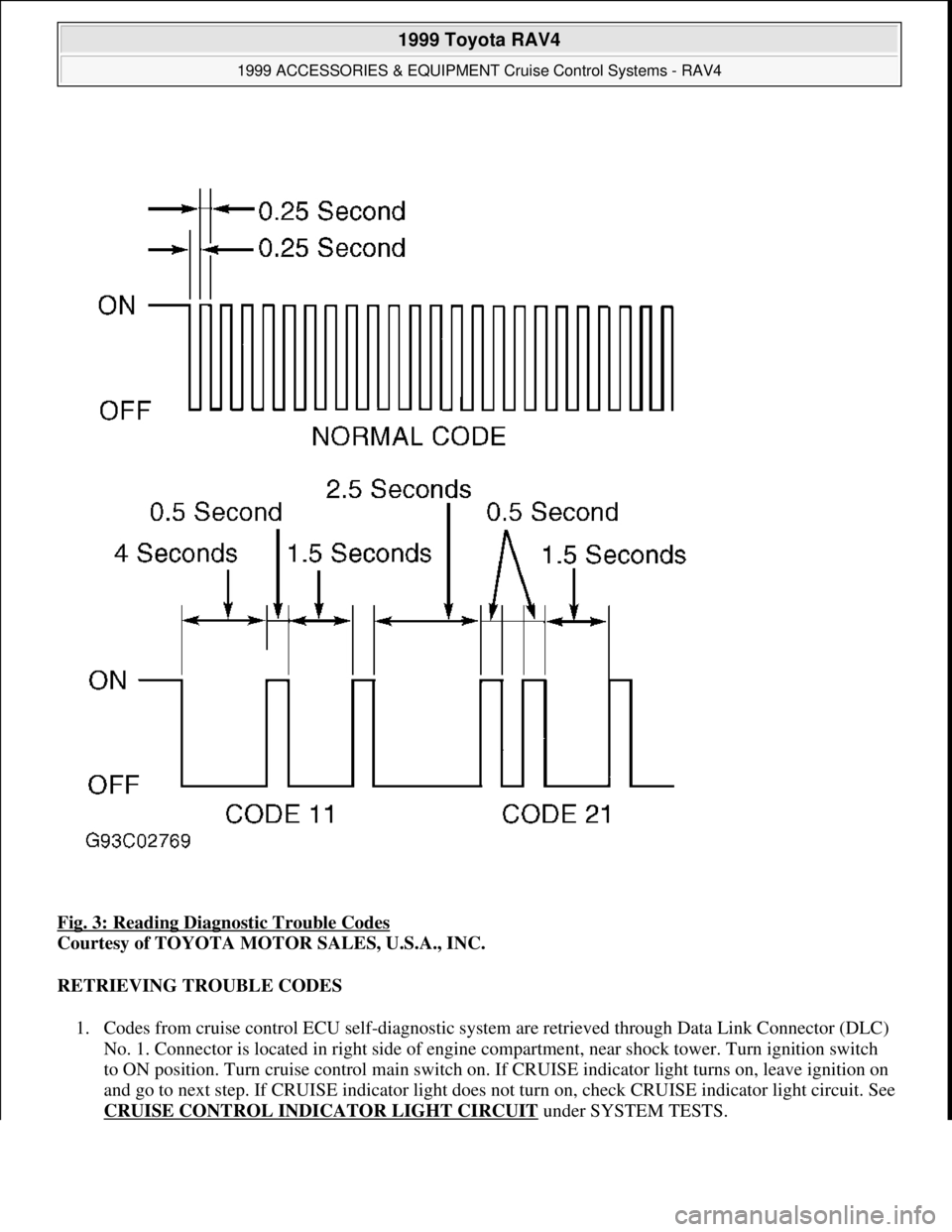
Fig. 3: Reading Diagnostic Trouble Codes
Courtesy of TOYOTA MOTOR SALES, U.S.A., INC.
RETRIEVING TROUBLE CODES
1. Codes from cruise control ECU self-diagnostic system are retrieved through Data Link Connector (DLC)
No. 1. Connector is located in right side of engine compartment, near shock tower. Turn ignition switch
to ON position. Turn cruise control main switch on. If CRUISE indicator light turns on, leave ignition on
and go to next step. If CRUISE indicator light does not turn on, check CRUISE indicator light circuit. See
CRUISE CONTROL INDICATOR LIGHT CIRCUIT
under SYSTEM TESTS.
1999 Toyota RAV4
1999 ACCESSORIES & EQUIPMENT Cruise Control Systems - RAV4
Microsoft
Sunday, November 22, 2009 10:52:01 AMPage 16 © 2005 Mitchell Repair Information Company, LLC.
Page 668 of 1632
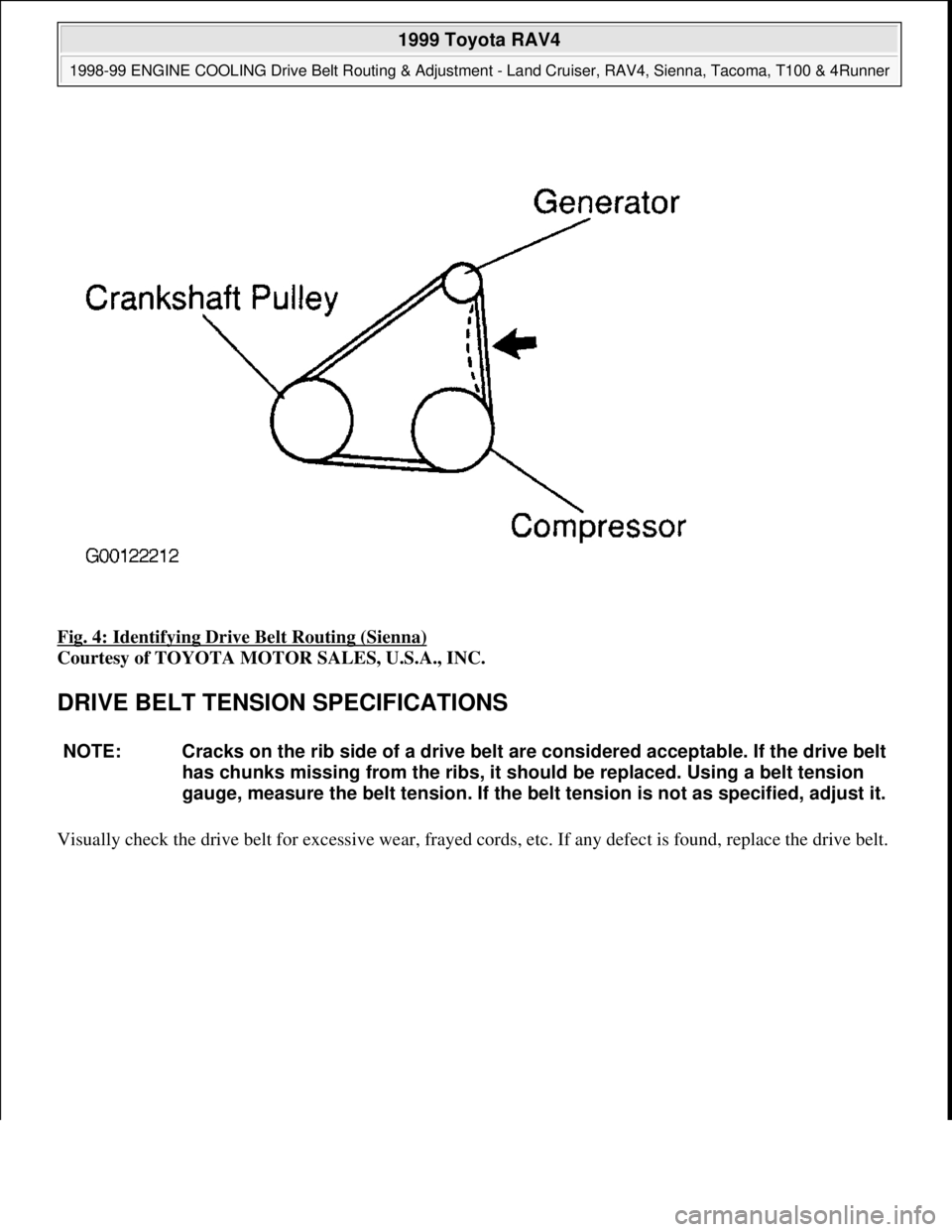
Fig. 4: Identifying Drive Belt Routing (Sienna)
Courtesy of TOYOTA MOTOR SALES, U.S.A., INC.
DRIVE BELT TENSION SPECIFICATIONS
Visually check the drive belt for excessive wear, frayed cords, etc. If any defect is found, replace the drive belt.
NOTE: Cracks on the rib side of a drive belt are considered acceptable. If the drive belt
has chunks missing from the ribs, it should be replaced. Using a belt tension
gauge, measure the belt tension. If the belt tension is not as specified, adjust it.
1999 Toyota RAV4
1998-99 ENGINE COOLING Drive Belt Routing & Adjustment - Land Cruiser, RAV4, Sienna, Tacoma, T100 & 4Runner
Microsoft
Sunday, November 22, 2009 10:20:43 AMPage 4 © 2005 Mitchell Repair Information Company, LLC.
Page 669 of 1632
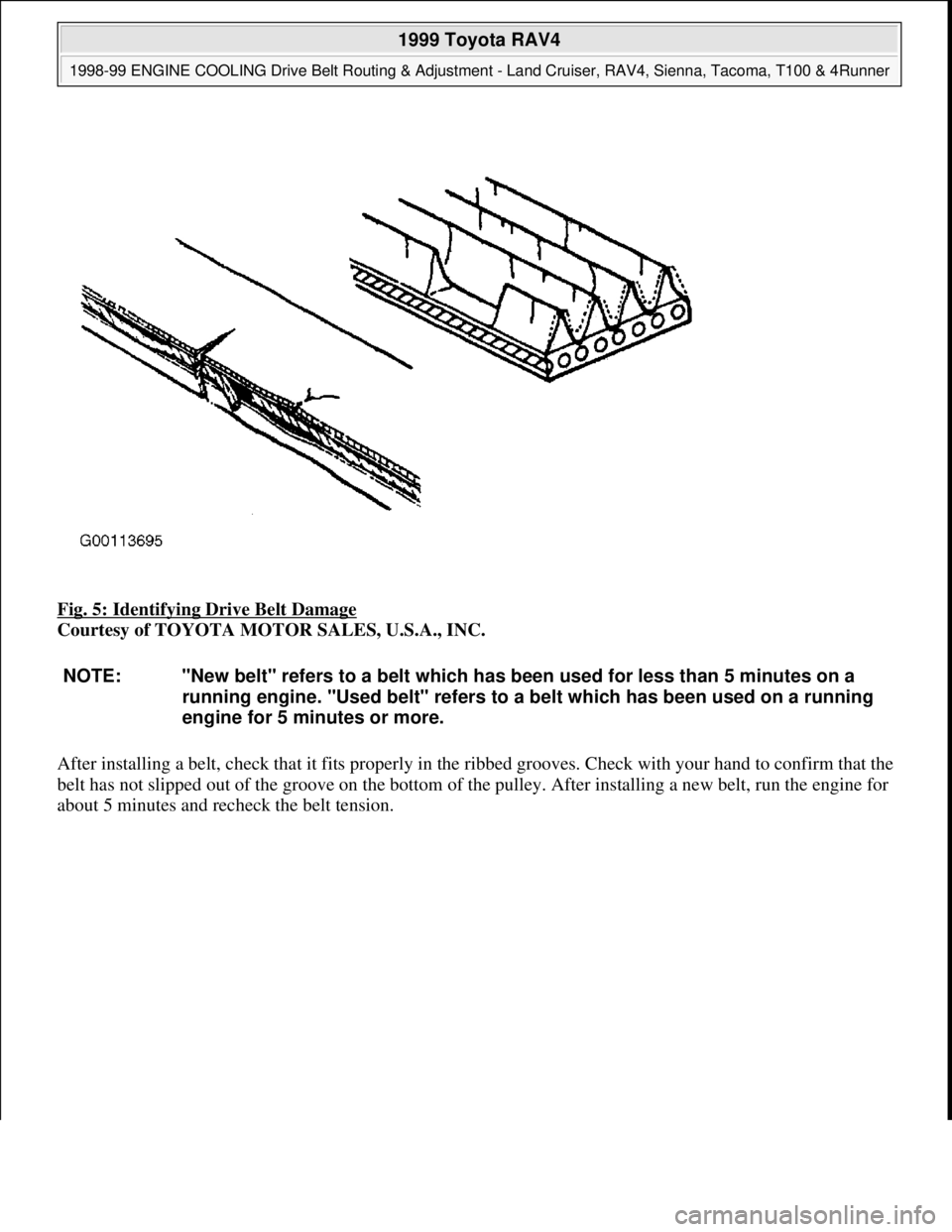
Fig. 5: Identifying Drive Belt Damage
Courtesy of TOYOTA MOTOR SALES, U.S.A., INC.
After installing a belt, check that it fits properly in the ribbed grooves. Check with your hand to confirm that the
belt has not slipped out of the groove on the bottom of the pulley. After installing a new belt, run the engine for
about 5 minutes and recheck the belt tension.
NOTE: "New belt" refers to a belt which has been used for less than 5 minutes on a
running engine. "Used belt" refers to a belt which has been used on a running
engine for 5 minutes or more.
1999 Toyota RAV4
1998-99 ENGINE COOLING Drive Belt Routing & Adjustment - Land Cruiser, RAV4, Sienna, Tacoma, T100 & 4Runner
Microsoft
Sunday, November 22, 2009 10:20:43 AMPage 5 © 2005 Mitchell Repair Information Company, LLC.
Page 670 of 1632
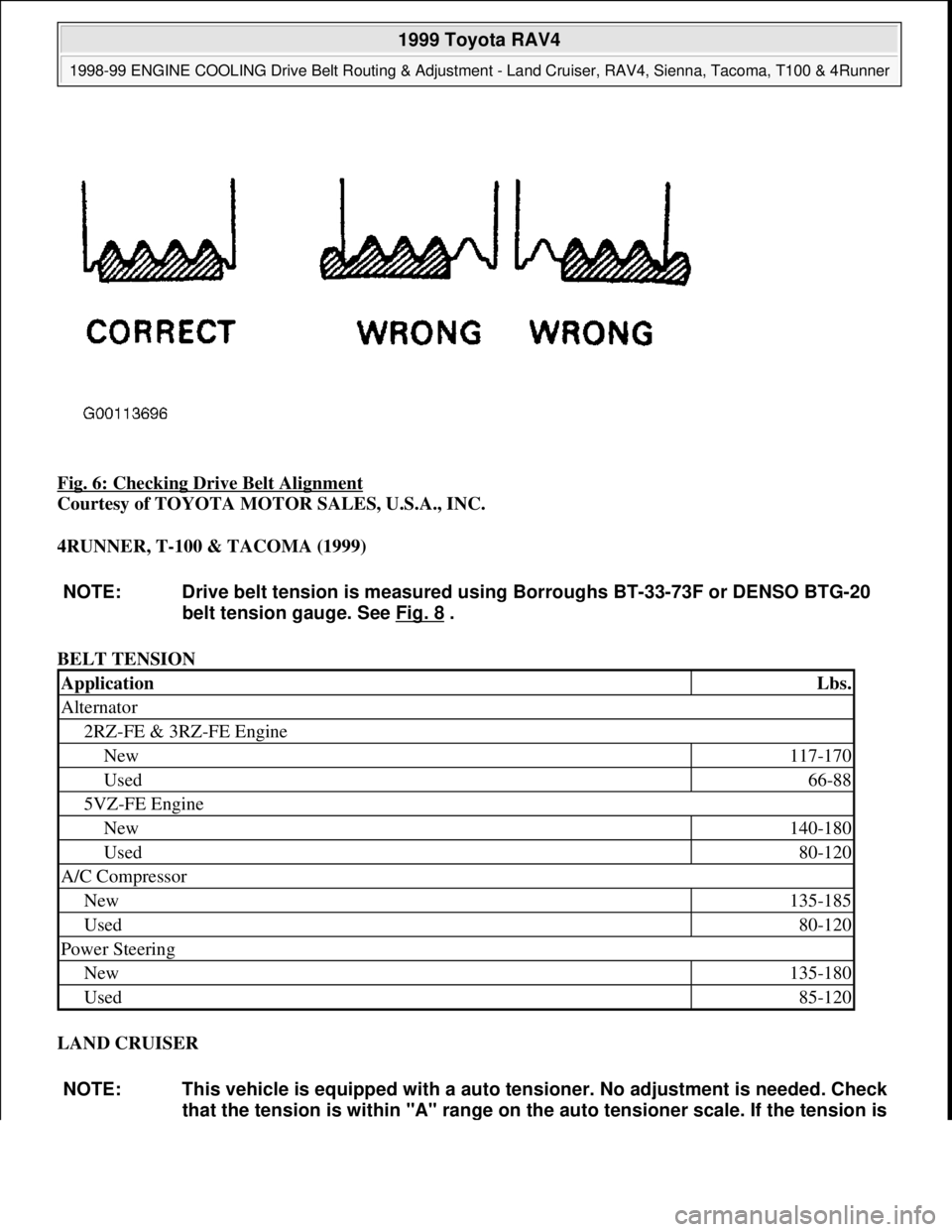
Fig. 6: Checking Drive Belt Alignment
Courtesy of TOYOTA MOTOR SALES, U.S.A., INC.
4RUNNER, T-100 & TACOMA (1999)
BELT TENSION
LAND CRUISER
NOTE: Drive belt tension is measured using Borroughs BT-33-73F or DENSO BTG-20
belt tension gauge. See Fig. 8
.
ApplicationLbs.
Alternator
2RZ-FE & 3RZ-FE Engine
New117-170
Used66-88
5VZ-FE Engine
New140-180
Used80-120
A/C Compressor
New135-185
Used80-120
Power Steering
New135-180
Used85-120
NOTE: This vehicle is equipped with a auto tensioner. No adjustment is needed. Check
that the tension is within "A" range on the auto tensioner scale. If the tension is
1999 Toyota RAV4
1998-99 ENGINE COOLING Drive Belt Routing & Adjustment - Land Cruiser, RAV4, Sienna, Tacoma, T100 & 4Runner
Microsoft
Sunday, November 22, 2009 10:20:43 AMPage 6 © 2005 Mitchell Repair Information Company, LLC.
Page 685 of 1632
VALVE CLEARANCE ADJUSTMENT
1. Disconnect power steering fluid reservoir, PCV hoses, cable brackets and control cables for access to
valve cover. Disconnect spark plug wires from spark plugs.
2. Disconnect engine wiring harness protector at rear of timing belt cover for access to valve cover. When
disconnecting engine wiring harness protector, remove bolt on intake manifold side of engine first, and
then bolt on exhaust manifold side of engine.
3. Remove nuts, grommets, valve cover and gasket. Note location of grommets for reassembly reference, as
grommets must be installed in original location.
4. Rotate crankshaft clockwise, as viewed from timing belt end of engine, so cylinder No. 1 is at TDC on
compression stroke, and timing mark on crankshaft pulley aligns with "0" mark on timing belt cover.
Cylinder No. 1 is front cylinder at timing belt end of engine.
5. Ensure valve lifters are loose on cylinder No. 1 and tight on cylinder No. 4. If conditions are not as
described, rotate crankshaft clockwise one complete revolution (360 degrees).
6. With cylinder No. 1 at TDC on compression stroke, check valve clearance on specified valves. Perform
STEP 1 in illustration. See Fig. 2
. Using feeler gauge, measure and record valve clearance between valve
lifter and camshaft. NOTE: Adjust valve clearance with engine cold.
1999 Toyota RAV4
1999-2000 ENGINES 2.0L 4-Cylinder
Microsoft
Sunday, November 22, 2009 10:22:26 AMPage 2 © 2005 Mitchell Repair Information Company, LLC.