4WD TOYOTA RAV4 1996 Service Repair Manual
[x] Cancel search | Manufacturer: TOYOTA, Model Year: 1996, Model line: RAV4, Model: TOYOTA RAV4 1996Pages: 1632, PDF Size: 41.64 MB
Page 1 of 1632
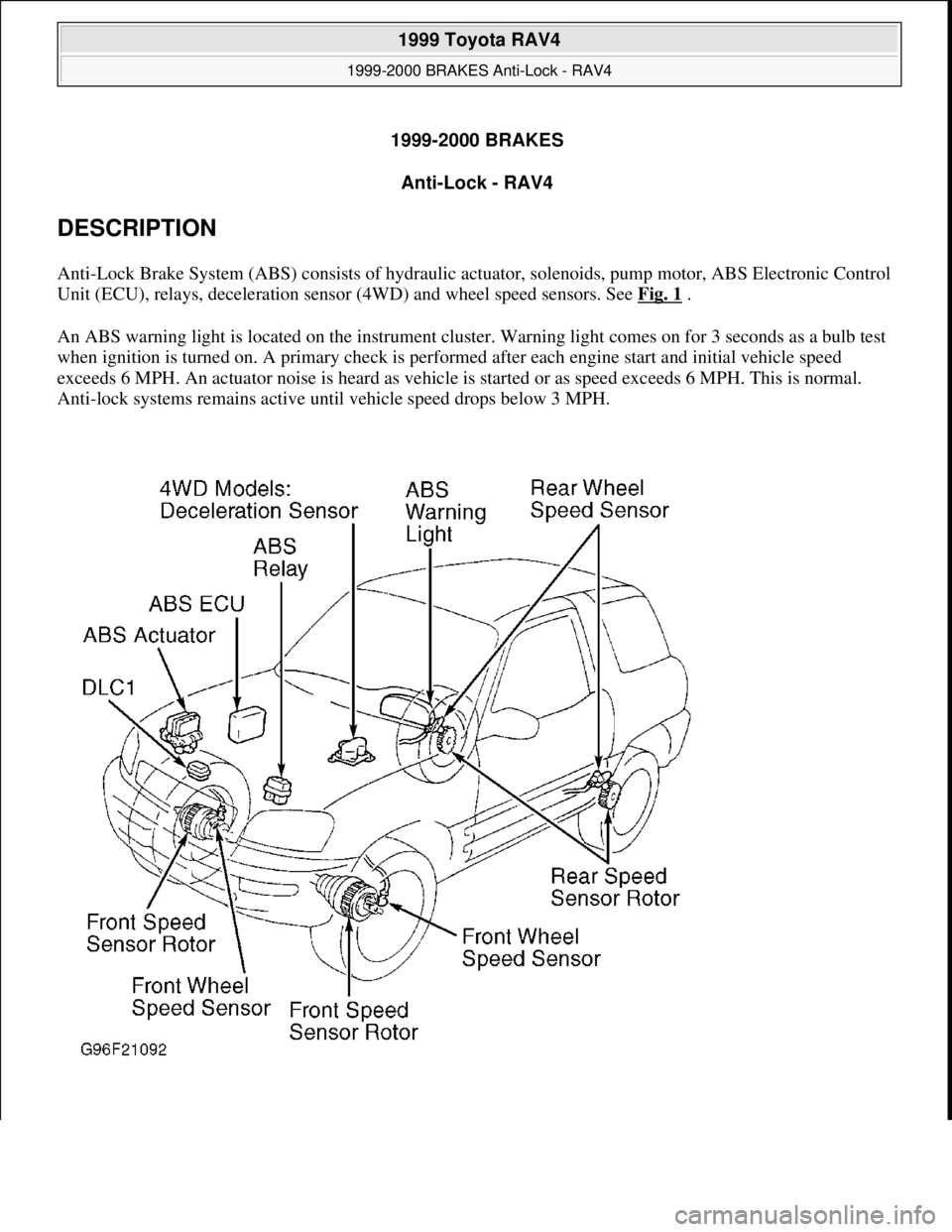
1999-2000 BRAKES
Anti-Lock - RAV4
DESCRIPTION
Anti-Lock Brake System (ABS) consists of hydraulic actuator, solenoids, pump motor, ABS Electronic Control
Unit (ECU), relays, deceleration sensor (4WD) and wheel speed sensors. See Fig. 1
.
An ABS warning light is located on the instrument cluster. Warning light comes on for 3 seconds as a bulb test
when ignition is turned on. A primary check is performed after each engine start and initial vehicle speed
exceeds 6 MPH. An actuator noise is heard as vehicle is started or as speed exceeds 6 MPH. This is normal.
Anti-lock systems remains active until vehicle speed drops below 3 MPH.
1999 Toyota RAV4
1999-2000 BRAKES Anti-Lock - RAV4
1999 Toyota RAV4
1999-2000 BRAKES Anti-Lock - RAV4
Microsoft
Sunday, November 22, 2009 10:06:17 AMPage 1 © 2005 Mitchell Repair Information Company, LLC.
Microsoft
Sunday, November 22, 2009 10:06:21 AMPage 1 © 2005 Mitchell Repair Information Company, LLC.
Page 4 of 1632
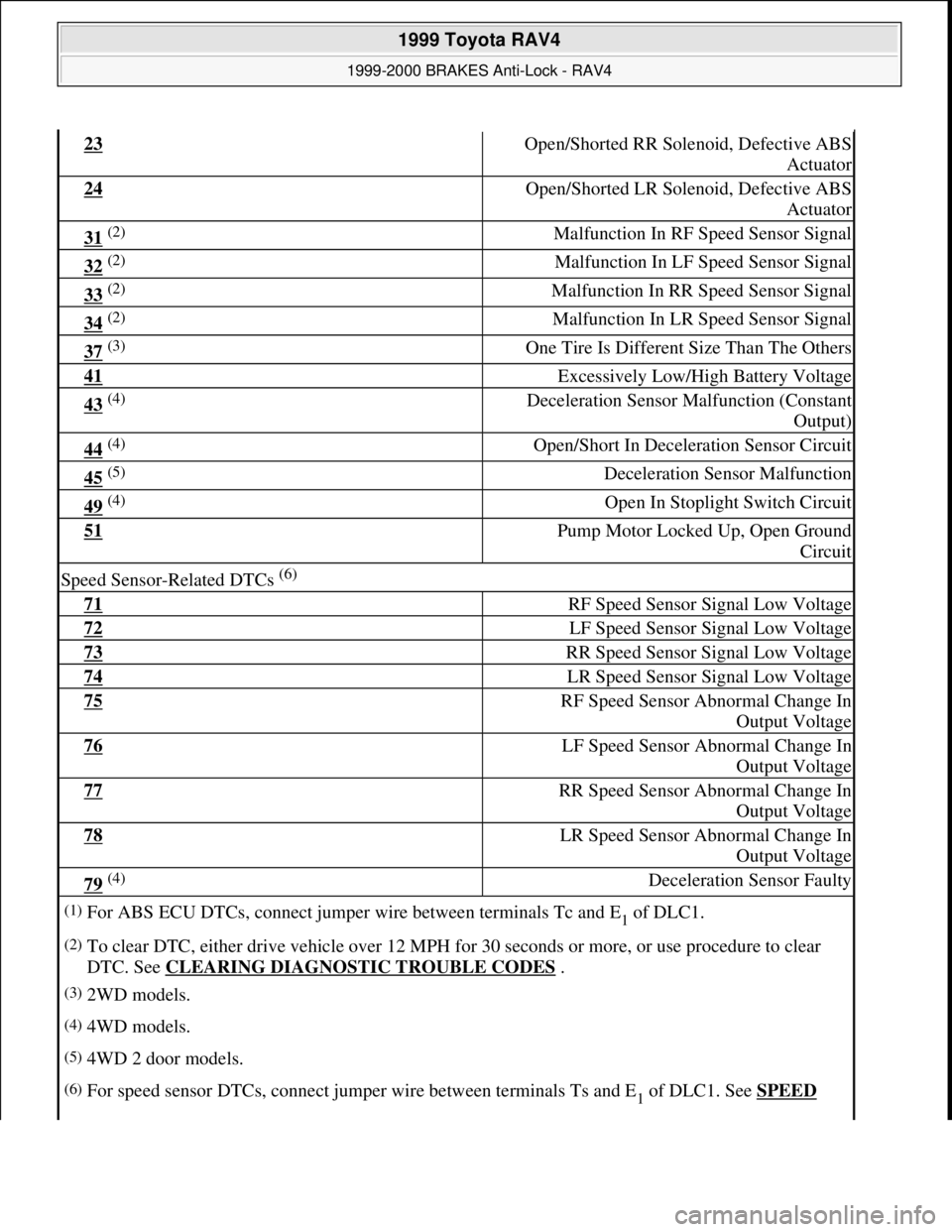
23 Open/Shorted RR Solenoid, Defective ABS
Actuator
24 Open/Shorted LR Solenoid, Defective ABS
Actuator
31 (2) Malfunction In RF Speed Sensor Signal
32 (2) Malfunction In LF Speed Sensor Signal
33 (2) Malfunction In RR Speed Sensor Signal
34 (2) Malfunction In LR Speed Sensor Signal
37 (3) One Tire Is Different Size Than The Others
41 Excessively Low/High Battery Voltage
43 (4) Deceleration Sensor Malfunction (Constant
Output)
44 (4) Open/Short In Deceleration Sensor Circuit
45 (5) Deceleration Sensor Malfunction
49 (4) Open In Stoplight Switch Circuit
51 Pump Motor Locked Up, Open Ground
Circuit
Speed Sensor-Related DTCs (6)
71 RF Speed Sensor Signal Low Voltage
72 LF Speed Sensor Signal Low Voltage
73 RR Speed Sensor Signal Low Voltage
74 LR Speed Sensor Signal Low Voltage
75 RF Speed Sensor Abnormal Change In
Output Voltage
76 LF Speed Sensor Abnormal Change In
Output Voltage
77 RR Speed Sensor Abnormal Change In
Output Voltage
78 LR Speed Sensor Abnormal Change In
Output Voltage
79 (4) Deceleration Sensor Faulty
(1)For ABS ECU DTCs, connect jumper wire between terminals Tc and E1 of DLC1.
(2)To clear DTC, either drive vehicle over 12 MPH for 30 seconds or more, or use procedure to clear
DTC. See CLEARING DIAGNOSTIC TROUBLE CODES
.
(3)2WD models.
(4)4WD models.
(5)4WD 2 door models.
(6)For speed sensor DTCs, connect jumper wire between terminals Ts and E1 of DLC1. See SPEED
1999 Toyota RAV4
1999-2000 BRAKES Anti-Lock - RAV4
Microsoft
Sunday, November 22, 2009 10:06:17 AMPage 4 © 2005 Mitchell Repair Information Company, LLC.
Page 17 of 1632
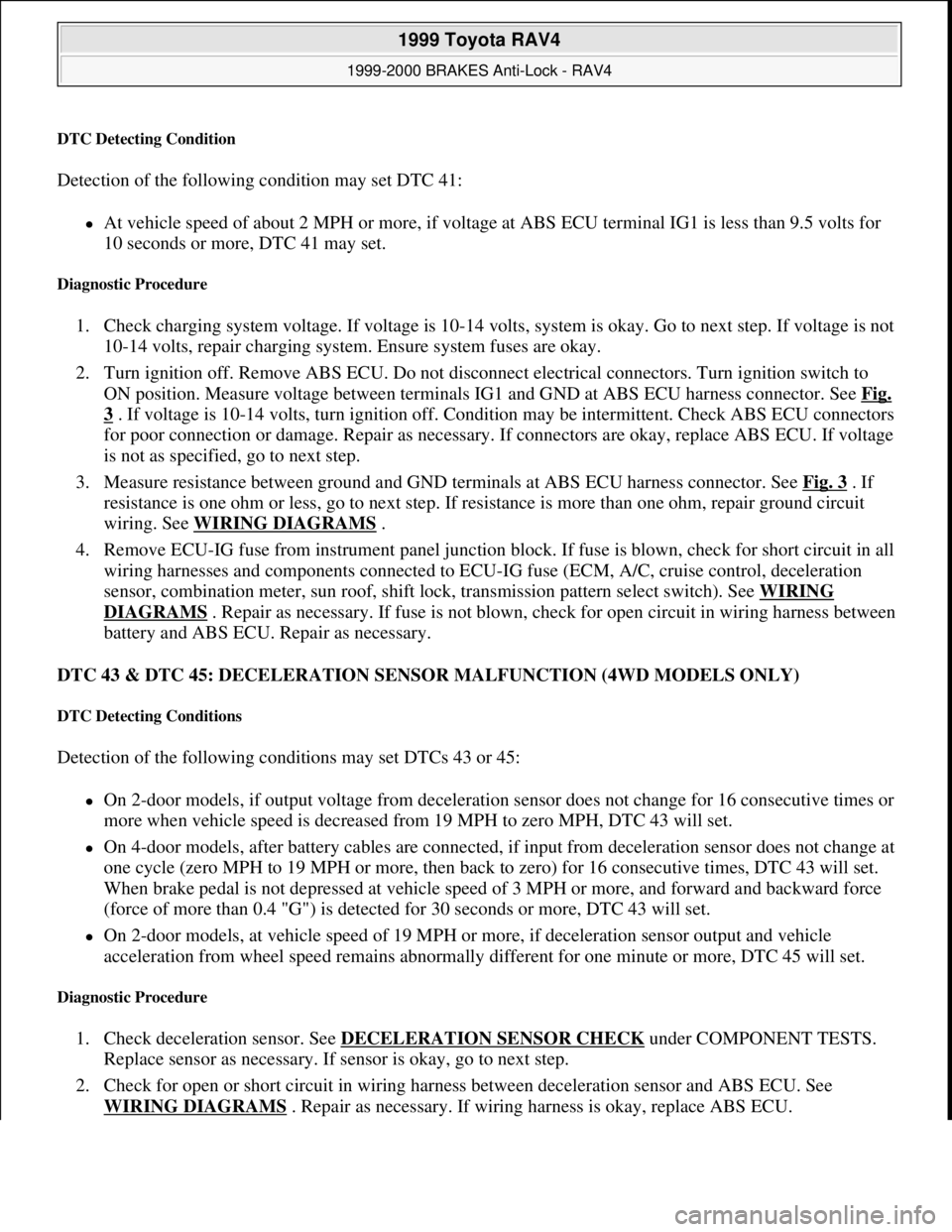
DTC Detecting Condition
Detection of the following condition may set DTC 41:
At vehicle speed of about 2 MPH or more, if voltage at ABS ECU terminal IG1 is less than 9.5 volts for
10 seconds or more, DTC 41 may set.
Diagnostic Procedure
1. Check charging system voltage. If voltage is 10-14 volts, system is okay. Go to next step. If voltage is not
10-14 volts, repair charging system. Ensure system fuses are okay.
2. Turn ignition off. Remove ABS ECU. Do not disconnect electrical connectors. Turn ignition switch to
ON position. Measure voltage between terminals IG1 and GND at ABS ECU harness connector. See Fig.
3 . If voltage is 10-14 volts, turn ignition off. Condition may be intermittent. Check ABS ECU connectors
for poor connection or damage. Repair as necessary. If connectors are okay, replace ABS ECU. If voltage
is not as specified, go to next step.
3. Measure resistance between ground and GND terminals at ABS ECU harness connector. See Fig. 3
. If
resistance is one ohm or less, go to next step. If resistance is more than one ohm, repair ground circuit
wiring. See WIRING DIAGRAMS
.
4. Remove ECU-IG fuse from instrument panel junction block. If fuse is blown, check for short circuit in all
wiring harnesses and components connected to ECU-IG fuse (ECM, A/C, cruise control, deceleration
sensor, combination meter, sun roof, shift lock, transmission pattern select switch). See WIRING
DIAGRAMS . Repair as necessary. If fuse is not blown, check for open circuit in wiring harness between
battery and ABS ECU. Repair as necessary.
DTC 43 & DTC 45: DECELERATION SENSOR MALFUNCTION (4WD MODELS ONLY)
DTC Detecting Conditions
Detection of the following conditions may set DTCs 43 or 45:
On 2-door models, if output voltage from deceleration sensor does not change for 16 consecutive times or
more when vehicle speed is decreased from 19 MPH to zero MPH, DTC 43 will set.
On 4-door models, after battery cables are connected, if input from deceleration sensor does not change at
one cycle (zero MPH to 19 MPH or more, then back to zero) for 16 consecutive times, DTC 43 will set.
When brake pedal is not depressed at vehicle speed of 3 MPH or more, and forward and backward force
(force of more than 0.4 "G") is detected for 30 seconds or more, DTC 43 will set.
On 2-door models, at vehicle speed of 19 MPH or more, if deceleration sensor output and vehicle
acceleration from wheel speed remains abnormally different for one minute or more, DTC 45 will set.
Diagnostic Procedure
1. Check deceleration sensor. See DECELERATION SENSOR CHECK under COMPONENT TESTS.
Replace sensor as necessary. If sensor is okay, go to next step.
2. Check for open or short circuit in wiring harness between deceleration sensor and ABS ECU. See
WIRING DIAGRAMS
. Repair as necessary. If wiring harness is okay, replace ABS ECU.
1999 Toyota RAV4
1999-2000 BRAKES Anti-Lock - RAV4
Microsoft
Sunday, November 22, 2009 10:06:17 AMPage 17 © 2005 Mitchell Repair Information Company, LLC.
Page 18 of 1632
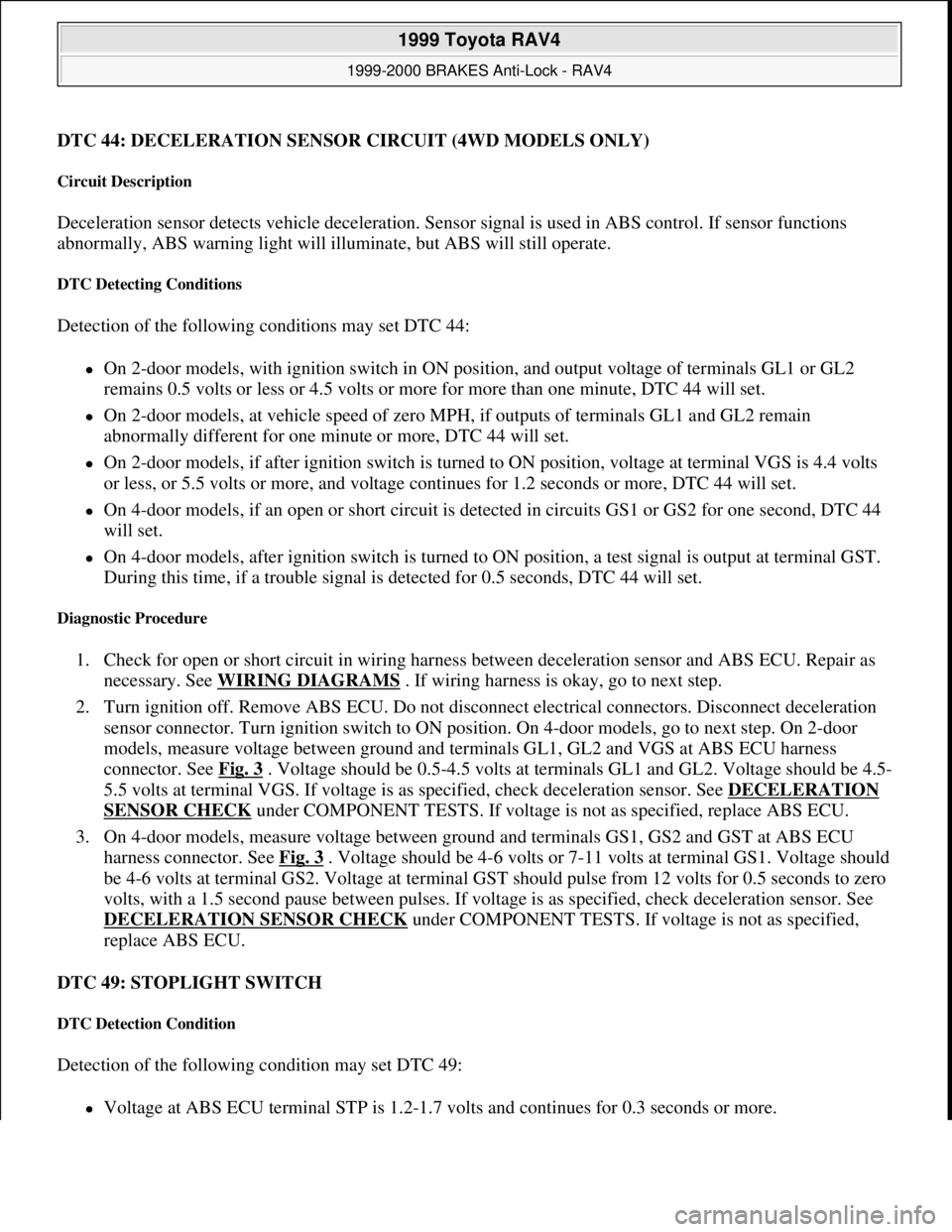
DTC 44: DECELERATION SENSOR CIRCUIT (4WD MODELS ONLY)
Circuit Description
Deceleration sensor detects vehicle deceleration. Sensor signal is used in ABS control. If sensor functions
abnormally, ABS warning light will illuminate, but ABS will still operate.
DTC Detecting Conditions
Detection of the following conditions may set DTC 44:
On 2-door models, with ignition switch in ON position, and output voltage of terminals GL1 or GL2
remains 0.5 volts or less or 4.5 volts or more for more than one minute, DTC 44 will set.
On 2-door models, at vehicle speed of zero MPH, if outputs of terminals GL1 and GL2 remain
abnormally different for one minute or more, DTC 44 will set.
On 2-door models, if after ignition switch is turned to ON position, voltage at terminal VGS is 4.4 volts
or less, or 5.5 volts or more, and voltage continues for 1.2 seconds or more, DTC 44 will set.
On 4-door models, if an open or short circuit is detected in circuits GS1 or GS2 for one second, DTC 44
will set.
On 4-door models, after ignition switch is turned to ON position, a test signal is output at terminal GST.
During this time, if a trouble signal is detected for 0.5 seconds, DTC 44 will set.
Diagnostic Procedure
1. Check for open or short circuit in wiring harness between deceleration sensor and ABS ECU. Repair as
necessary. See WIRING DIAGRAMS
. If wiring harness is okay, go to next step.
2. Turn ignition off. Remove ABS ECU. Do not disconnect electrical connectors. Disconnect deceleration
sensor connector. Turn ignition switch to ON position. On 4-door models, go to next step. On 2-door
models, measure voltage between ground and terminals GL1, GL2 and VGS at ABS ECU harness
connector. See Fig. 3
. Voltage should be 0.5-4.5 volts at terminals GL1 and GL2. Voltage should be 4.5-
5.5 volts at terminal VGS. If voltage is as specified, check deceleration sensor. See DECELERATION
SENSOR CHECK under COMPONENT TESTS. If voltage is not as specified, replace ABS ECU.
3. On 4-door models, measure voltage between ground and terminals GS1, GS2 and GST at ABS ECU
harness connector. See Fig. 3
. Voltage should be 4-6 volts or 7-11 volts at terminal GS1. Voltage should
be 4-6 volts at terminal GS2. Voltage at terminal GST should pulse from 12 volts for 0.5 seconds to zero
volts, with a 1.5 second pause between pulses. If voltage is as specified, check deceleration sensor. See
DECELERATION SENSOR CHECK
under COMPONENT TESTS. If voltage is not as specified,
replace ABS ECU.
DTC 49: STOPLIGHT SWITCH
DTC Detection Condition
Detection of the following condition may set DTC 49:
Voltage at ABS ECU terminal STP is 1.2-1.7 volts and continues for 0.3 seconds or more.
1999 Toyota RAV4
1999-2000 BRAKES Anti-Lock - RAV4
Microsoft
Sunday, November 22, 2009 10:06:17 AMPage 18 © 2005 Mitchell Repair Information Company, LLC.
Page 131 of 1632
for transmission removal.
3. Remove starter. On 4WD models, remove front drive shaft bracket. This is the bracket that the front drive
shaft center bearing assembly was bolted on.
4. On 2WD models, remove lower stiffener plate located between side of cylinder block and front of
transmission. On 4WD models, remove transmission-to-cylinder block through-bolt located near bottom
of transmission.
5. On all models, remove upper stiffener plate located just above the starter opening. Upper stiffener plate
fits between cylinder block and front of transmission. Remove torque converter bolts.
6. Remove transmission oil cooler pipes and brackets as necessary. Remove exhaust pipe support bracket
located between transmission and exhaust pipe. Support transmission with transmission jack.
7. Remove bolts/nuts from rear transmission mount. Remove transmission-to-cylinder block bolts. Lower
transmission from vehicle.
Installation
1. Before installing transmission, use dial indicator to check drive plate runout. Drive plate runout should be
checked right next to the starter ring gear on the drive plate. Replace drive plate if runout
exceeds .0079" (.200 mm).
2. Install torque converter on transmission. To ensure torque converter is fully seated, torque converter
depth should be checked. Using straightedge and caliper, measure torque converter depth from torque
converter bolt lug on torque converter to the surface on transmission. See Fig. 1
.
3. Torque converter depth should be more than 1.250" (31.75 mm). If torque converter depth is less than
specified, check for improperly seated torque converter.
4. To install, reverse removal procedure. Tighten all bolts/nuts to specification. See TORQUE
SPECIFICATIONS When installing torque converter bolts, apply Loctite to torque converter bolt
threads before installing. Adjust all cables and fill with ATF. See appropriate TRANSMISSION
SERVICING article.
Removal (RAV4 2WD)
1. Disconnect negative battery cable. Disconnect throttle valve cable from throttle body. Remove coolant
reservoir tank. Remover air cleaner assembly. Remove ground cable.
2. Remove starter. Remove the 3 upper transaxle-to-cylinder block bolts located at top of transaxle. Raise
and support vehicle. Remove lower engine covers.
3. Support engine with hoist. Steering gear assembly must be supported in place during transaxle removal.
Secure steering gear assembly to the engine hoist using an attaching strap placed at each end of steering
gear assembly.
4. Remove transaxle-to-mount bolts/nuts from top of transaxle at driver's side end of transaxle.
5. Remove front wheels. Drain transaxle fluid. Remove axle shafts from transaxle. See FWD AXLE
SHAFTS article in DRIVE AXLES.
6. Remove front exhaust pipe located between exhaust manifold and rear exhaust pipe. Support transaxle
with transmission jack. Disconnect shift cable, necessary electrical connectors and oil cooler hoses at
transaxle.
7. Remove shift cable brackets from suspension crossmember. Suspension crossmember is located below
1998 Toyota Avalon XLS
TRANSMISSION SERVICING - A/T 1997-98 TRANSMISSION SERVICING Toyota - Transmission Removal &
Installation
Helpmelearn
November-03-08 10:30:28 AMPage 19 © 2005 Mitchell Repair Information Company, LLC.
Page 133 of 1632
Installation
1. Before installing transaxle, use dial indicator to check drive plate runout. Drive plate runout should be
checked right next to the starter ring gear on the drive plate. Replace drive plate if runout
exceeds .0079" (.200 mm).
2. Install torque converter on transaxle. To ensure torque converter is fully seated, torque converter depth
should be checked. Using straightedge and caliper, measure torque converter depth from torque converter
bolt lug on torque converter to the surface on transaxle. See Fig. 1
.
3. Torque converter depth should be more than .502" (12.75 mm). If torque converter depth is less than
specified, check for improperly seated torque converter.
4. To install, reverse removal procedure. Tighten all bolts/nuts to specification. See TORQUE
SPECIFICATIONS When installing torque converter bolts, apply Loctite to torque converter bolt
threads before installing. Ensure the Gray torque converter bolt is installed first before installing the
remaining torque converter bolts.
5. When installing suspension crossmember and engine mount crossmember, ensure all bolts and nuts are
installed before tightening to specification. See Fig. 8
.
6. Use NEW gaskets and NEW nuts when installing front exhaust pipe. Adjust all cables and fill with ATF.
See appropriate TRANSMISSION SERVICING article.
Removal (RAV4 4WD)
1. Manufacturer recommends removing engine and transaxle as an assembly and then remove transaxle
from engine. See 2.0L 4-CYLINDER article in ENGINES for engine removal.
2. With engine and transaxle removed, remove starter. Remove bolts and stiffener plate. Stiffener plate fits
between side of cylinder block and front of transaxle.
3. Remove torque converter cover from front of transaxle. Remove torque converter bolts. Remove bolts
and center stiffener plate. Center stiffener plate fits between top of transaxle and cylinder block.
4. Remove the 2 transfer case-to-cylinder block bolts. Remove transaxle-to-cylinder block bolts. Separate
transaxle from engine.
Installation
1. Before installing transaxle, use dial indicator to check drive plate runout. Drive plate runout should be
checked right next to the starter ring gear on the drive plate. Replace drive plate if runout
exceeds .0079" (.200 mm).
2. Install torque converter on transaxle. To ensure torque converter is fully seated, torque converter depth
should be checked. Using straightedge and caliper, measure torque converter depth from torque converter
bolt lug on torque converter to the surface on transaxle. See Fig. 1
.
3. Torque converter depth should be more than .539" (13.70 mm). If torque converter depth is less than
specified, check for improperly seated torque converter.
4. To install, reverse removal procedure. Tighten all bolts/nuts to specification. See TORQUE
SPECIFICATIONS When installing torque converter bolts, apply Loctite to torque converter bolt
threads before installing. Ensure the Dark Green torque converter bolt is installed first before installing
the remainin
g torque converter bolts.
1998 Toyota Avalon XLS
TRANSMISSION SERVICING - A/T 1997-98 TRANSMISSION SERVICING Toyota - Transmission Removal &
Installation
Helpmelearn
November-03-08 10:30:29 AMPage 21 © 2005 Mitchell Repair Information Company, LLC.
Page 137 of 1632
exceeds .0079" (.200 mm).
2. Install torque converter on transmission. To ensure torque converter is fully seated, torque converter
depth should be checked. Using straightedge and caliper, measure torque converter depth from torque
converter bolt lug on torque converter to the surface on transmission. See Fig. 1
.
3. Torque converter depth should be more than .707" (17.95 mm). If torque converter depth is less than
specified, check for improperly seated torque converter.
4. To install, reverse removal procedure. Tighten all bolts/nuts to specification. See TORQUE
SPECIFICATIONS When installing torque converter bolts, apply Loctite to torque converter bolt
threads before installing. Ensure the Green torque converter bolt is installed first before installing the
remaining torque converter bolts.
5. Once engine and transmission are installed, adjust all cables and fill with ATF. See appropriate
TRANSMISSION SERVICING article.
Removal (Tacoma 4WD)
1. Disconnect negative battery cable. Remove transmission oil dipstick. Disconnect throttle valve cable from
throttle body.
2. Raise and support vehicle. Remove lower engine cover. Remove fan shroud from radiator. Remove rear
console box, located between the seats. Remove screws from front console, located near transfer case and
transmission shift levers.
3. Remove front console with transfer case shift lever knob. Disconnect electrical connectors for removal of
transmission shift lever assembly. Disconnect shift linkage at transmission shift lever assembly. Remove
transmission shift lever assembly.
4. Remove snap ring and transfer case shift lever from transfer case. Remove transmission oil dipstick tube
and "O" ring. Place reference marks on drive shaft flanges for reassembly reference. Remove drive shafts.
5. Remove exhaust pipes as necessary for access to transmission and transfer case. Disconnect speedometer
cable and necessary electrical connectors for transmission and transfer case removal. Remove
transmission oil cooler pipes and brackets as necessary.
6. Remove starter and stabilizer bar. Remove torque converter cover from front of transmission. Remove
torque converter bolts. Front differential assembly rear mount must be removed for transmission removal.
Rear mount is located on front differential assembly, just behind the drive shaft flange.
7. Support front differential assembly with jack. Remove front differential assembly rear mount-to-
crossmember nut. Slightly raise front differential assembly. Remove the 2 front differential assembly rear
mount bolts.
8. Support transmission with transmission jack. Remove transmission mount-to-transmission crossmember
bolts. Remove transmission crossmember, located below transmission and transfer case. Remove
transmission-to-cylinder block bolts. Lower transmission with transfer case from vehicle.
Installation
1. Before installing transmission, use dial indicator to check drive plate runout. Drive plate runout should be
checked right next to the starter ring gear on the drive plate. Replace drive plate if runout
exceeds .0079" (.200 mm).
2. Install torque converter on transmission. To ensure torque converter is full
y seated, torque converter
1998 Toyota Avalon XLS
TRANSMISSION SERVICING - A/T 1997-98 TRANSMISSION SERVICING Toyota - Transmission Removal &
Installation
Helpmelearn
November-03-08 10:30:29 AMPage 25 © 2005 Mitchell Repair Information Company, LLC.
Page 141 of 1632
2. With engine and transmission removed, remove starter if not previously removed. Remove torque
converter cover from front of transmission. Remove torque converter bolts. Remove transmission-to-
cylinder block bolts. Separate transmission from engine.
Installation
1. Before installing transaxle, use dial indicator to check drive plate runout. Drive plate runout should be
checked right next to the starter ring gear on the drive plate. Replace drive plate if runout
exceeds .0079" (.200 mm).
2. Install torque converter on transmission. To ensure torque converter is fully seated, torque converter
depth should be checked. Using straightedge and caliper, measure torque converter depth from torque
converter bolt lug on torque converter to the surface on transmission. See Fig. 1
.
3. Torque converter depth should be more than 1.250" (31.75 mm) for 2.7L 4-cylinder or .707" (17.95 mm)
for 3.4L V6. If torque converter depth is less than specified, check for improperly seated torque converter.
4. To install, reverse removal procedure. Tighten all bolts/nuts to specification. See TORQUE
SPECIFICATIONS . When installing torque converter bolts, apply Loctite to torque converter bolt
threads before installing.
5. Once engine and transmission are installed, adjust all cables and fill with ATF. See appropriate
TRANSMISSION SERVICING article.
Removal (T100 4WD)
1. Disconnect negative battery cable. Remove knob from transfer case shift lever. Remove screws and boot
from transfer case shift lever. Remove snap ring and transfer case shift lever from transfer case.
2. Disconnect throttle valve cable from throttle body. Raise and support vehicle. Remove lower engine
cover. Remove transmission oil dipstick, dipstick tube and "O" ring.
3. Place reference marks on drive shaft flanges for reassembly reference. Remove drive shafts. Remove
front exhaust pipe located between exhaust manifold and catalytic converter.
4. Disconnect speedometer cable and necessary electrical connectors for transmission and transfer case
removal. Disconnect shift linkage at side of transmission. Remove shift linkage cross shaft located
between frame and shift lever on transmission.
5. Remove starter. Remove transmission oil cooler pipes and brackets as necessary. Remove stiffener plates
located on each side of cylinder block. Stiffener plate fits between side of cylinder block and front of
transmission.
6. Remove stabilizer bar. Support transmission with floor jack. Remove bolts and dynamic damper
transmission crossmember. Dynamic damper is located on driver's side of transmission crossmember,
next to transmission mount bolts and is fastened to bottom of transmission crossmember using 2 bolts.
7. Remove transmission mount-to-transmission crossmember bolts. Remove transmission crossmember
located below transmission and transfer case.
8. Remove torque converter cover from front of transmission. Remove torque converter bolts. Remove
transmission-to-cylinder block bolts. Lower transmission with transfer case from vehicle.
Installation
1998 Toyota Avalon XLS
TRANSMISSION SERVICING - A/T 1997-98 TRANSMISSION SERVICING Toyota - Transmission Removal &
Installation
Helpmelearn
November-03-08 10:30:29 AMPage 29 © 2005 Mitchell Repair Information Company, LLC.
Page 143 of 1632
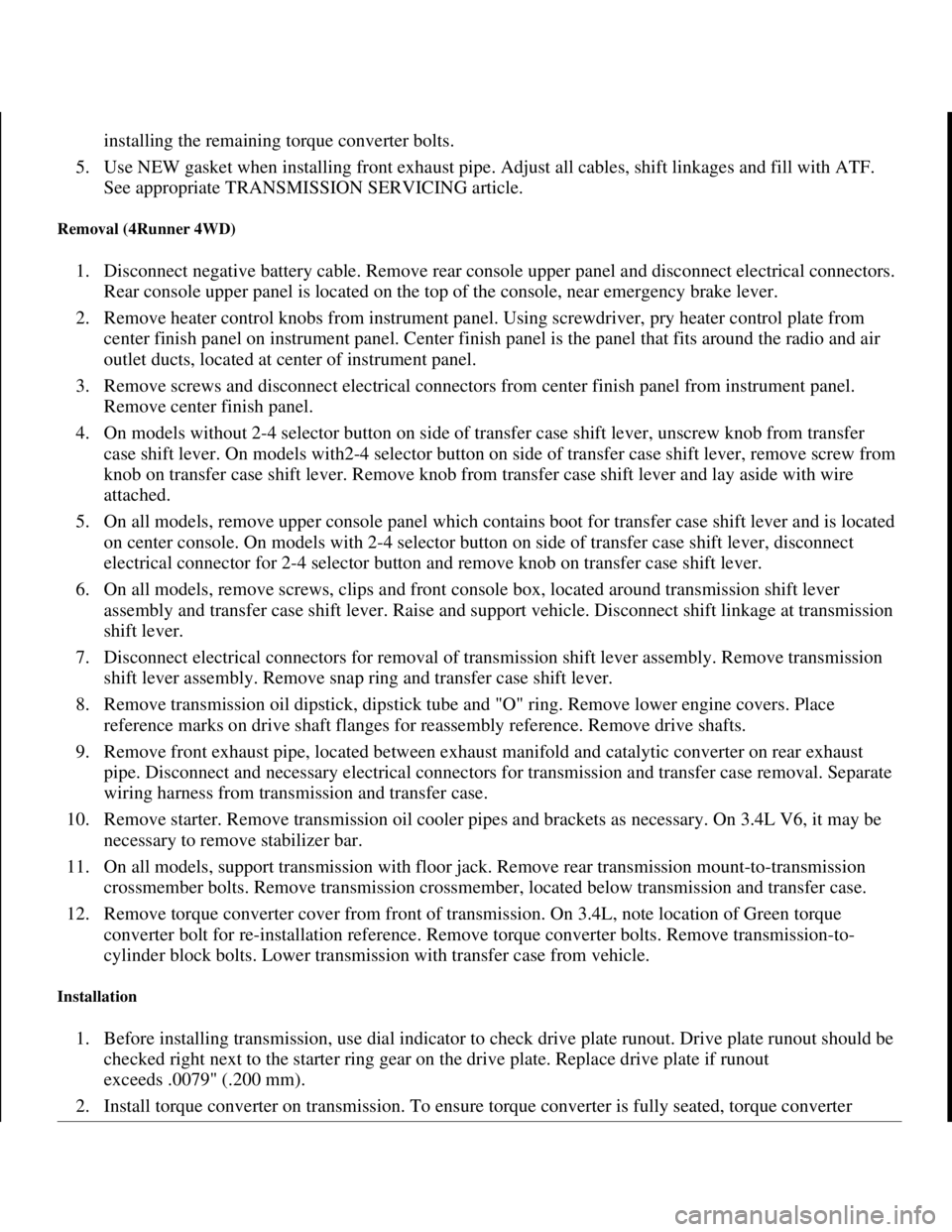
installing the remaining torque converter bolts.
5. Use NEW gasket when installing front exhaust pipe. Adjust all cables, shift linkages and fill with ATF.
See appropriate TRANSMISSION SERVICING article.
Removal (4Runner 4WD)
1. Disconnect negative battery cable. Remove rear console upper panel and disconnect electrical connectors.
Rear console upper panel is located on the top of the console, near emergency brake lever.
2. Remove heater control knobs from instrument panel. Using screwdriver, pry heater control plate from
center finish panel on instrument panel. Center finish panel is the panel that fits around the radio and air
outlet ducts, located at center of instrument panel.
3. Remove screws and disconnect electrical connectors from center finish panel from instrument panel.
Remove center finish panel.
4. On models without 2-4 selector button on side of transfer case shift lever, unscrew knob from transfer
case shift lever. On models with2-4 selector button on side of transfer case shift lever, remove screw from
knob on transfer case shift lever. Remove knob from transfer case shift lever and lay aside with wire
attached.
5. On all models, remove upper console panel which contains boot for transfer case shift lever and is located
on center console. On models with 2-4 selector button on side of transfer case shift lever, disconnect
electrical connector for 2-4 selector button and remove knob on transfer case shift lever.
6. On all models, remove screws, clips and front console box, located around transmission shift lever
assembly and transfer case shift lever. Raise and support vehicle. Disconnect shift linkage at transmission
shift lever.
7. Disconnect electrical connectors for removal of transmission shift lever assembly. Remove transmission
shift lever assembly. Remove snap ring and transfer case shift lever.
8. Remove transmission oil dipstick, dipstick tube and "O" ring. Remove lower engine covers. Place
reference marks on drive shaft flanges for reassembly reference. Remove drive shafts.
9. Remove front exhaust pipe, located between exhaust manifold and catalytic converter on rear exhaust
pipe. Disconnect and necessary electrical connectors for transmission and transfer case removal. Separate
wiring harness from transmission and transfer case.
10. Remove starter. Remove transmission oil cooler pipes and brackets as necessary. On 3.4L V6, it may be
necessary to remove stabilizer bar.
11. On all models, support transmission with floor jack. Remove rear transmission mount-to-transmission
crossmember bolts. Remove transmission crossmember, located below transmission and transfer case.
12. Remove torque converter cover from front of transmission. On 3.4L, note location of Green torque
converter bolt for re-installation reference. Remove torque converter bolts. Remove transmission-to-
cylinder block bolts. Lower transmission with transfer case from vehicle.
Installation
1. Before installing transmission, use dial indicator to check drive plate runout. Drive plate runout should be
checked right next to the starter ring gear on the drive plate. Replace drive plate if runout
exceeds .0079" (.200 mm).
2. Install torque converter on transmission. To ensure torque converter is fully seated, torque converter
1998 Toyota Avalon XLS
TRANSMISSION SERVICING - A/T 1997-98 TRANSMISSION SERVICING Toyota - Transmission Removal &
Installation
Helpmelearn
November-03-08 10:30:29 AMPage 31 © 2005 Mitchell Repair Information Company, LLC.
Page 149 of 1632
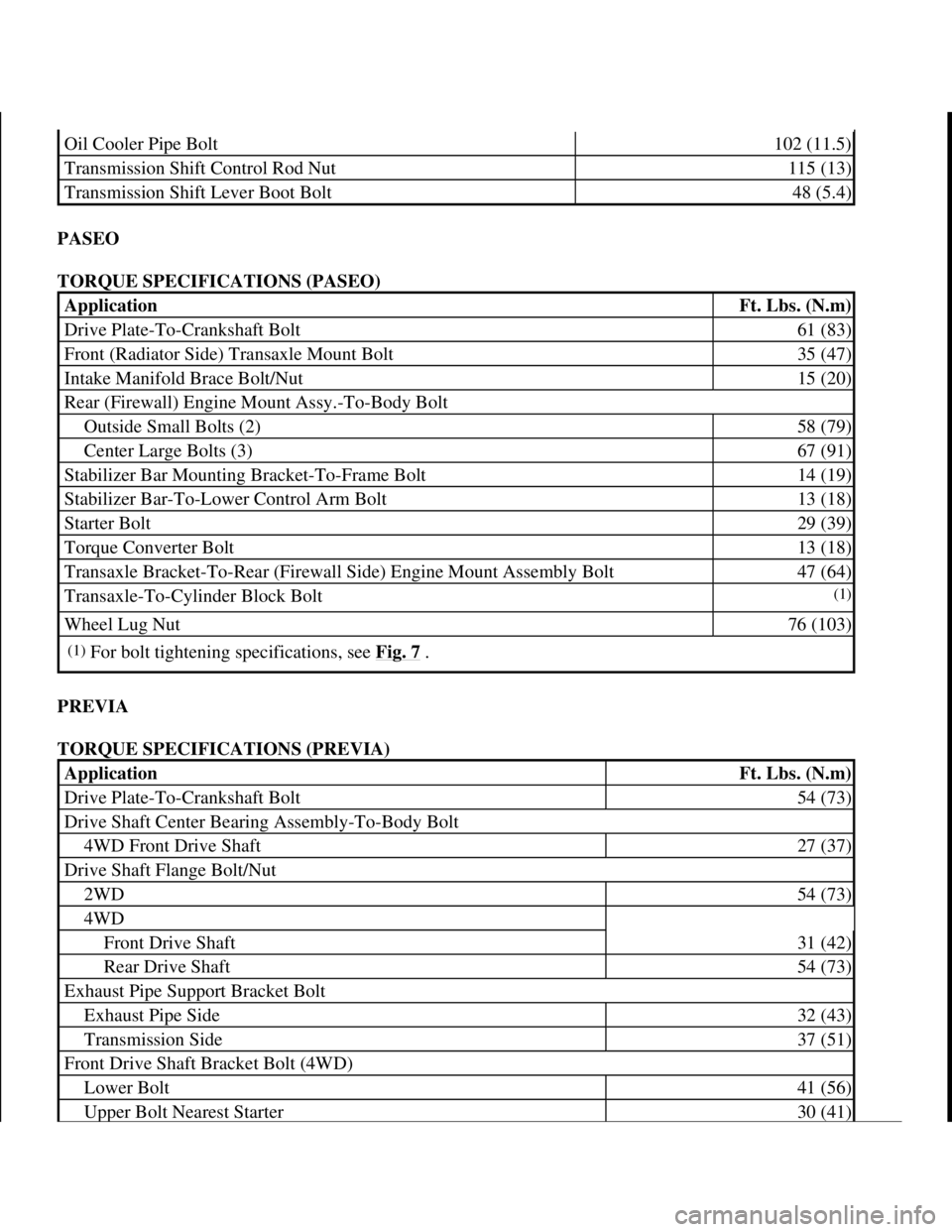
PASEO
TORQUE SPECIFICATIONS (PASEO)
PREVIA
TORQUE SPECIFICATIONS (PREVIA)
Oil Cooler Pipe Bolt102 (11.5)
Transmission Shift Control Rod Nut115 (13)
Transmission Shift Lever Boot Bolt48 (5.4)
ApplicationFt. Lbs. (N.m)
Drive Plate-To-Crankshaft Bolt61 (83)
Front (Radiator Side) Transaxle Mount Bolt35 (47)
Intake Manifold Brace Bolt/Nut15 (20)
Rear (Firewall) Engine Mount Assy.-To-Body Bolt
Outside Small Bolts (2)58 (79)
Center Large Bolts (3)67 (91)
Stabilizer Bar Mounting Bracket-To-Frame Bolt14 (19)
Stabilizer Bar-To-Lower Control Arm Bolt13 (18)
Starter Bolt29 (39)
Torque Converter Bolt13 (18)
Transaxle Bracket-To-Rear (Firewall Side) Engine Mount Assembly Bolt47 (64)
Transaxle-To-Cylinder Block Bolt(1)
Wheel Lug Nut76 (103)
(1)For bolt tightening specifications, see Fig. 7 .
ApplicationFt. Lbs. (N.m)
Drive Plate-To-Crankshaft Bolt54 (73)
Drive Shaft Center Bearing Assembly-To-Body Bolt
4WD Front Drive Shaft27 (37)
Drive Shaft Flange Bolt/Nut
2WD54 (73)
4WD
Front Drive Shaft31 (42)
Rear Drive Shaft54 (73)
Exhaust Pipe Support Bracket Bolt
Exhaust Pipe Side32 (43)
Transmission Side37 (51)
Front Drive Shaft Bracket Bolt (4WD)
Lower Bolt41 (56)
Upper Bolt Nearest Starter30 (41)
1998 Toyota Avalon XLS
TRANSMISSION SERVICING - A/T 1997-98 TRANSMISSION SERVICING Toyota - Transmission Removal &
Installation
Helpmelearn
November-03-08 10:30:29 AMPage 37 © 2005 Mitchell Repair Information Company, LLC.