Control arm TOYOTA RAV4 2006 Service Owner's Guide
[x] Cancel search | Manufacturer: TOYOTA, Model Year: 2006, Model line: RAV4, Model: TOYOTA RAV4 2006Pages: 2000, PDF Size: 45.84 MB
Page 1457 of 2000
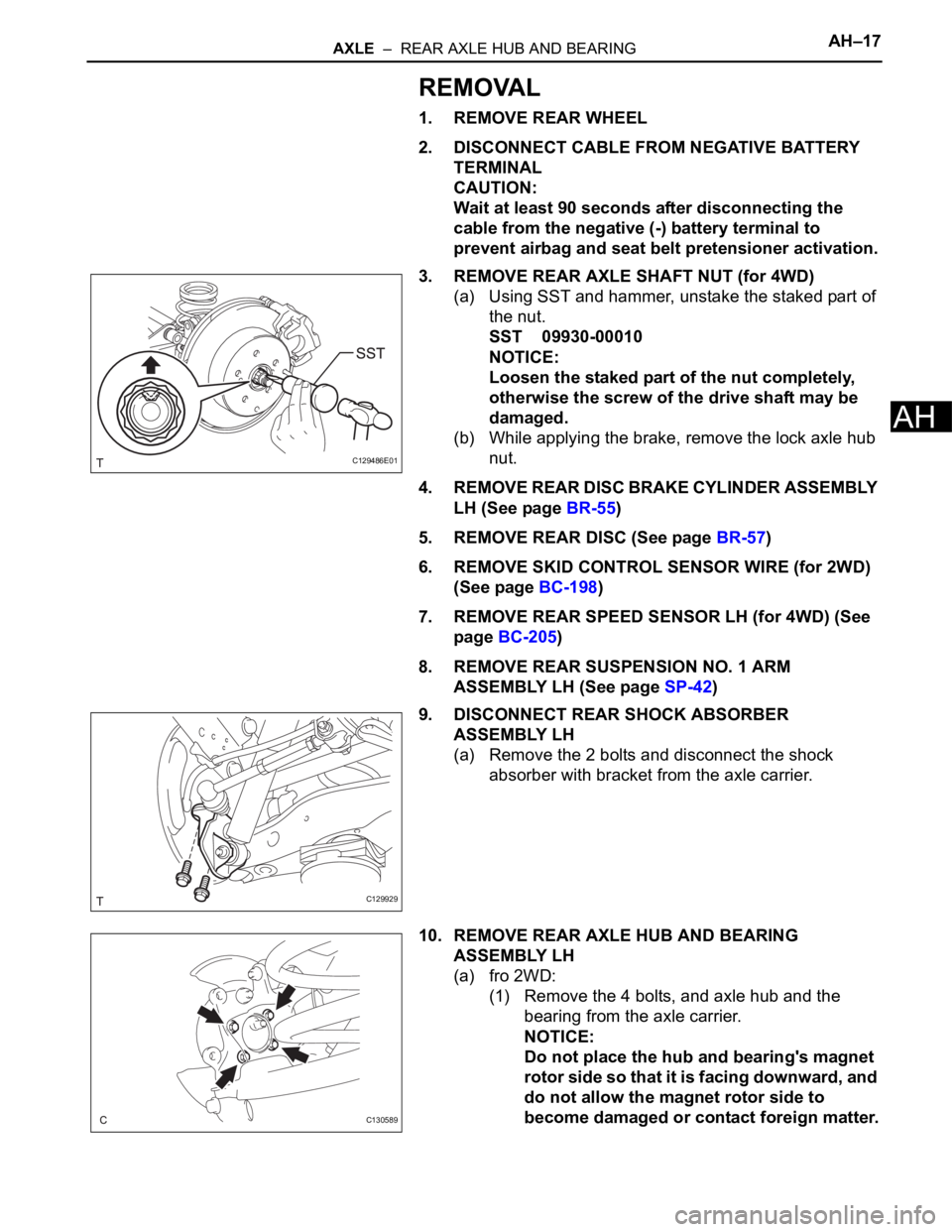
AXLE – REAR AXLE HUB AND BEARINGAH–17
AH
REMOVAL
1. REMOVE REAR WHEEL
2. DISCONNECT CABLE FROM NEGATIVE BATTERY
TERMINAL
CAUTION:
Wait at least 90 seconds after disconnecting the
cable from the negative (-) battery terminal to
prevent airbag and seat belt pretensioner activation.
3. REMOVE REAR AXLE SHAFT NUT (for 4WD)
(a) Using SST and hammer, unstake the staked part of
the nut.
SST 09930-00010
NOTICE:
Loosen the staked part of the nut completely,
otherwise the screw of the drive shaft may be
damaged.
(b) While applying the brake, remove the lock axle hub
nut.
4. REMOVE REAR DISC BRAKE CYLINDER ASSEMBLY
LH (See page BR-55)
5. REMOVE REAR DISC (See page BR-57)
6. REMOVE SKID CONTROL SENSOR WIRE (for 2WD)
(See page BC-198)
7. REMOVE REAR SPEED SENSOR LH (for 4WD) (See
page BC-205)
8. REMOVE REAR SUSPENSION NO. 1 ARM
ASSEMBLY LH (See page SP-42)
9. DISCONNECT REAR SHOCK ABSORBER
ASSEMBLY LH
(a) Remove the 2 bolts and disconnect the shock
absorber with bracket from the axle carrier.
10. REMOVE REAR AXLE HUB AND BEARING
ASSEMBLY LH
(a) fro 2WD:
(1) Remove the 4 bolts, and axle hub and the
bearing from the axle carrier.
NOTICE:
Do not place the hub and bearing's magnet
rotor side so that it is facing downward, and
do not allow the magnet rotor side to
become damaged or contact foreign matter.
C129486E01
C129929
C130589
Page 1458 of 2000
AH–18AXLE – REAR AXLE HUB AND BEARING
AH
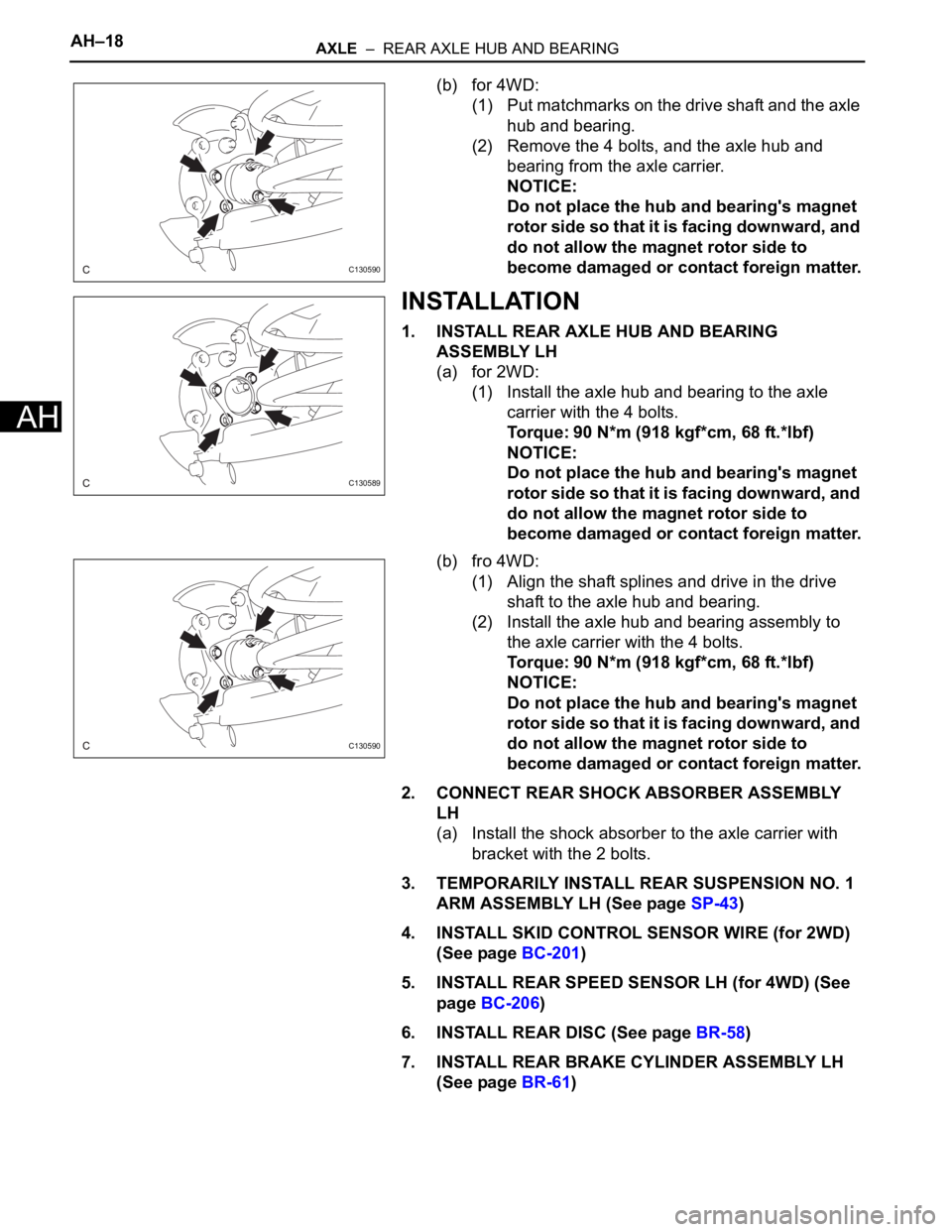
(b) for 4WD:
(1) Put matchmarks on the drive shaft and the axle
hub and bearing.
(2) Remove the 4 bolts, and the axle hub and
bearing from the axle carrier.
NOTICE:
Do not place the hub and bearing's magnet
rotor side so that it is facing downward, and
do not allow the magnet rotor side to
become damaged or contact foreign matter.
INSTALLATION
1. INSTALL REAR AXLE HUB AND BEARING
ASSEMBLY LH
(a) for 2WD:
(1) Install the axle hub and bearing to the axle
carrier with the 4 bolts.
Torque: 90 N*m (918 kgf*cm, 68 ft.*lbf)
NOTICE:
Do not place the hub and bearing's magnet
rotor side so that it is facing downward, and
do not allow the magnet rotor side to
become damaged or contact foreign matter.
(b) fro 4WD:
(1) Align the shaft splines and drive in the drive
shaft to the axle hub and bearing.
(2) Install the axle hub and bearing assembly to
the axle carrier with the 4 bolts.
Torque: 90 N*m (918 kgf*cm, 68 ft.*lbf)
NOTICE:
Do not place the hub and bearing's magnet
rotor side so that it is facing downward, and
do not allow the magnet rotor side to
become damaged or contact foreign matter.
2. CONNECT REAR SHOCK ABSORBER ASSEMBLY
LH
(a) Install the shock absorber to the axle carrier with
bracket with the 2 bolts.
3. TEMPORARILY INSTALL REAR SUSPENSION NO. 1
ARM ASSEMBLY LH (See page SP-43)
4. INSTALL SKID CONTROL SENSOR WIRE (for 2WD)
(See page BC-201)
5. INSTALL REAR SPEED SENSOR LH (for 4WD) (See
page BC-206)
6. INSTALL REAR DISC (See page BR-58)
7. INSTALL REAR BRAKE CYLINDER ASSEMBLY LH
(See page BR-61)
C130590
C130589
C130590
Page 1470 of 2000
SP–34SUSPENSION – REAR COIL SPRING
SP
INSTALLATION
HINT:
• Use the same procedures for the RH side and LH side.
• The procedures listed below are for the LH side.
1. INSTALL REAR COIL SPRING INSULATOR LOWER
LH
(a) Install the insulator lower to the suspension No. 2
arm.
2. REMOVE REAR COIL SPRING LH
(a) Install the coil spring to the suspension No. 2 arm.
3. INSTALL REAR COIL SPRING INSULATOR UPPER
LH
(a) Align the stopper part of the insulator upper with the
coil spring tip, and install the insulator upper.
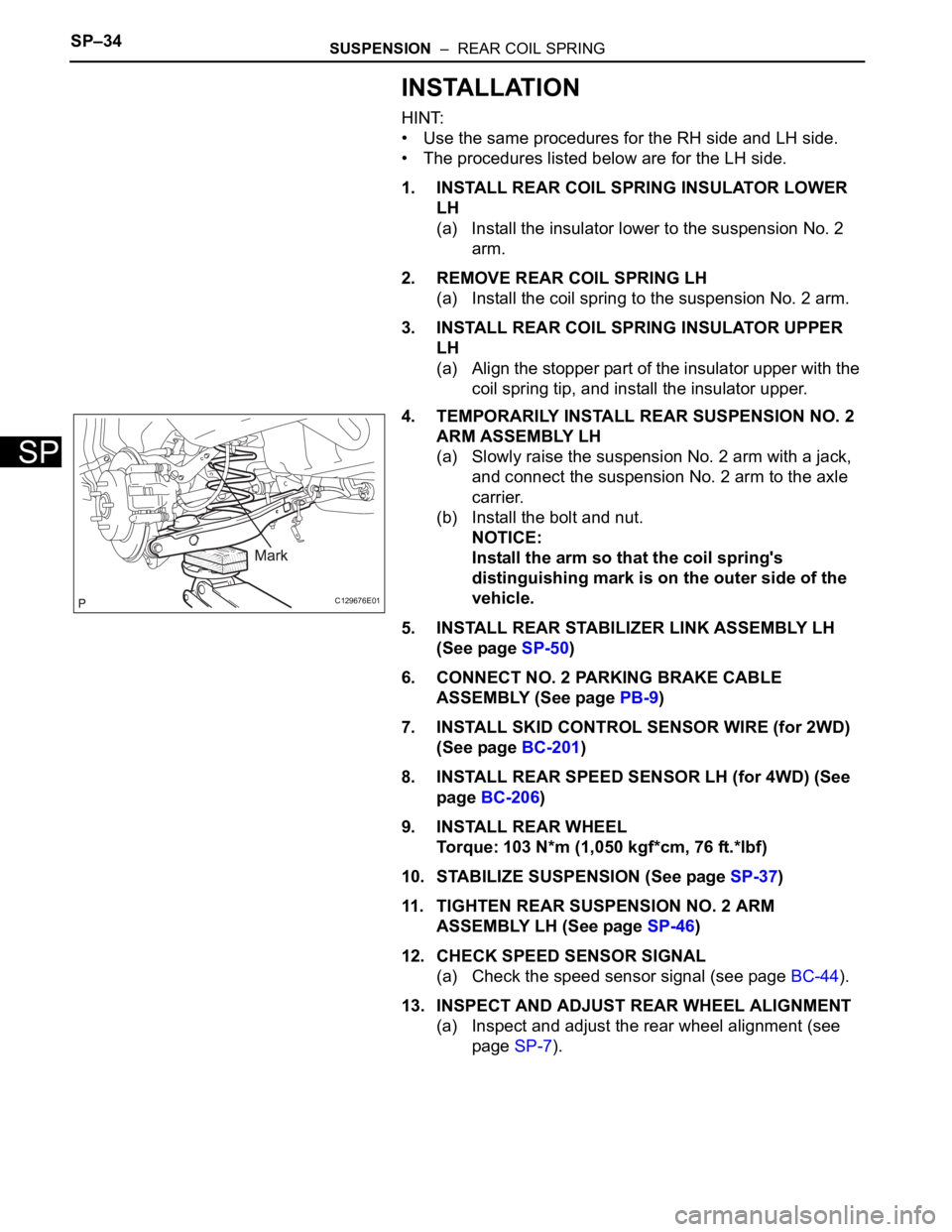
4. TEMPORARILY INSTALL REAR SUSPENSION NO. 2
ARM ASSEMBLY LH
(a) Slowly raise the suspension No. 2 arm with a jack,
and connect the suspension No. 2 arm to the axle
carrier.
(b) Install the bolt and nut.
NOTICE:
Install the arm so that the coil spring's
distinguishing mark is on the outer side of the
vehicle.
5. INSTALL REAR STABILIZER LINK ASSEMBLY LH
(See page SP-50)
6. CONNECT NO. 2 PARKING BRAKE CABLE
ASSEMBLY (See page PB-9)
7. INSTALL SKID CONTROL SENSOR WIRE (for 2WD)
(See page BC-201)
8. INSTALL REAR SPEED SENSOR LH (for 4WD) (See
page BC-206)
9. INSTALL REAR WHEEL
Torque: 103 N*m (1,050 kgf*cm, 76 ft.*lbf)
10. STABILIZE SUSPENSION (See page SP-37)
11. TIGHTEN REAR SUSPENSION NO. 2 ARM
ASSEMBLY LH (See page SP-46)
12. CHECK SPEED SENSOR SIGNAL
(a) Check the speed sensor signal (see page BC-44).
13. INSPECT AND ADJUST REAR WHEEL ALIGNMENT
(a) Inspect and adjust the rear wheel alignment (see
page SP-7).
C129676E01
Page 1471 of 2000
SUSPENSION – REAR UPPER CONTROL ARMSP–41
SP
INSTALLATION
HINT:
• Use the same procedures for the RH side and LH side.
• The procedures listed below are for the LH side.
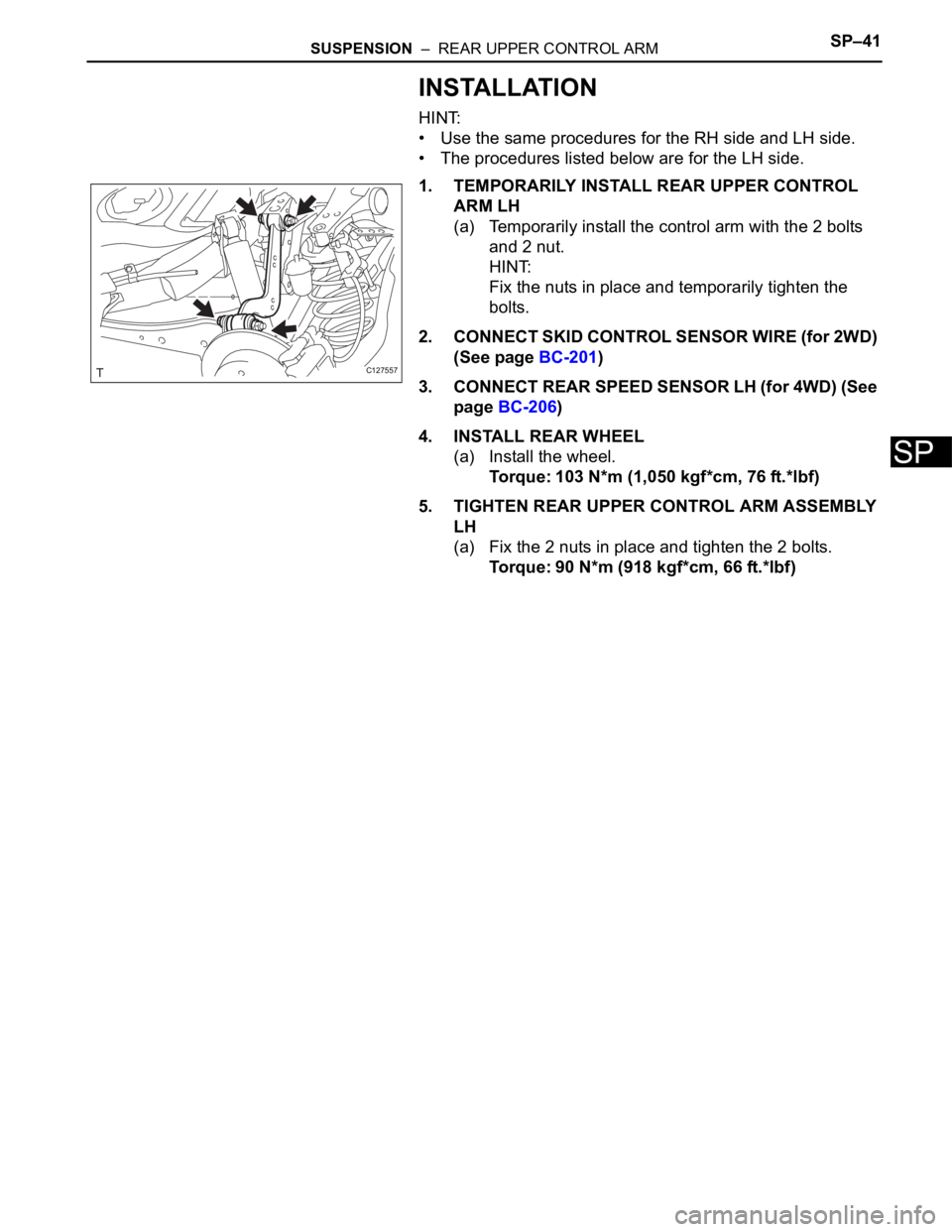
1. TEMPORARILY INSTALL REAR UPPER CONTROL
ARM LH
(a) Temporarily install the control arm with the 2 bolts
and 2 nut.
HINT:
Fix the nuts in place and temporarily tighten the
bolts.
2. CONNECT SKID CONTROL SENSOR WIRE (for 2WD)
(See page BC-201)
3. CONNECT REAR SPEED SENSOR LH (for 4WD) (See
page BC-206)
4. INSTALL REAR WHEEL
(a) Install the wheel.
Torque: 103 N*m (1,050 kgf*cm, 76 ft.*lbf)
5. TIGHTEN REAR UPPER CONTROL ARM ASSEMBLY
LH
(a) Fix the 2 nuts in place and tighten the 2 bolts.
Torque: 90 N*m (918 kgf*cm, 66 ft.*lbf)
C127557
Page 1473 of 2000
SUSPENSION – REAR NO. 2 SUSPENSION ARMSP–47
SP
INSTALLATION
HINT:
• Use the same procedures for the RH side and LH side.
• The procedures listed below are for the LH side.
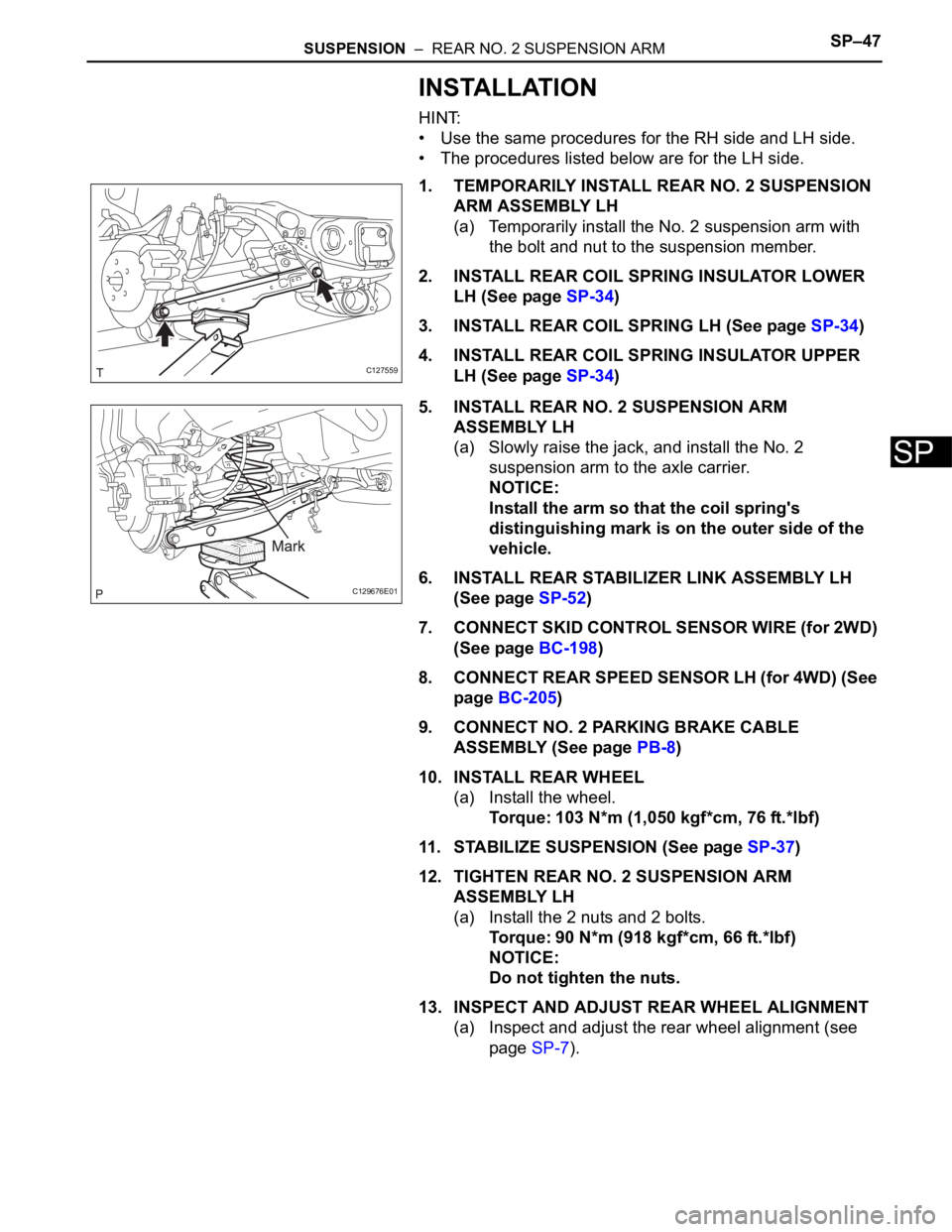
1. TEMPORARILY INSTALL REAR NO. 2 SUSPENSION
ARM ASSEMBLY LH
(a) Temporarily install the No. 2 suspension arm with
the bolt and nut to the suspension member.
2. INSTALL REAR COIL SPRING INSULATOR LOWER
LH (See page SP-34)
3. INSTALL REAR COIL SPRING LH (See page SP-34)
4. INSTALL REAR COIL SPRING INSULATOR UPPER
LH (See page SP-34)
5. INSTALL REAR NO. 2 SUSPENSION ARM
ASSEMBLY LH
(a) Slowly raise the jack, and install the No. 2
suspension arm to the axle carrier.
NOTICE:
Install the arm so that the coil spring's
distinguishing mark is on the outer side of the
vehicle.
6. INSTALL REAR STABILIZER LINK ASSEMBLY LH
(See page SP-52)
7. CONNECT SKID CONTROL SENSOR WIRE (for 2WD)
(See page BC-198)
8. CONNECT REAR SPEED SENSOR LH (for 4WD) (See
page BC-205)
9. CONNECT NO. 2 PARKING BRAKE CABLE
ASSEMBLY (See page PB-8)
10. INSTALL REAR WHEEL
(a) Install the wheel.
Torque: 103 N*m (1,050 kgf*cm, 76 ft.*lbf)
11. STABILIZE SUSPENSION (See page SP-37)
12. TIGHTEN REAR NO. 2 SUSPENSION ARM
ASSEMBLY LH
(a) Install the 2 nuts and 2 bolts.
Torque: 90 N*m (918 kgf*cm, 66 ft.*lbf)
NOTICE:
Do not tighten the nuts.
13. INSPECT AND ADJUST REAR WHEEL ALIGNMENT
(a) Inspect and adjust the rear wheel alignment (see
page SP-7).
C127559
C129676E01
Page 1651 of 2000
AIR CONDITIONING – AIR CONDITIONING SYSTEM (for Automatic Air Conditioning Sys-
tem)AC–23
AC
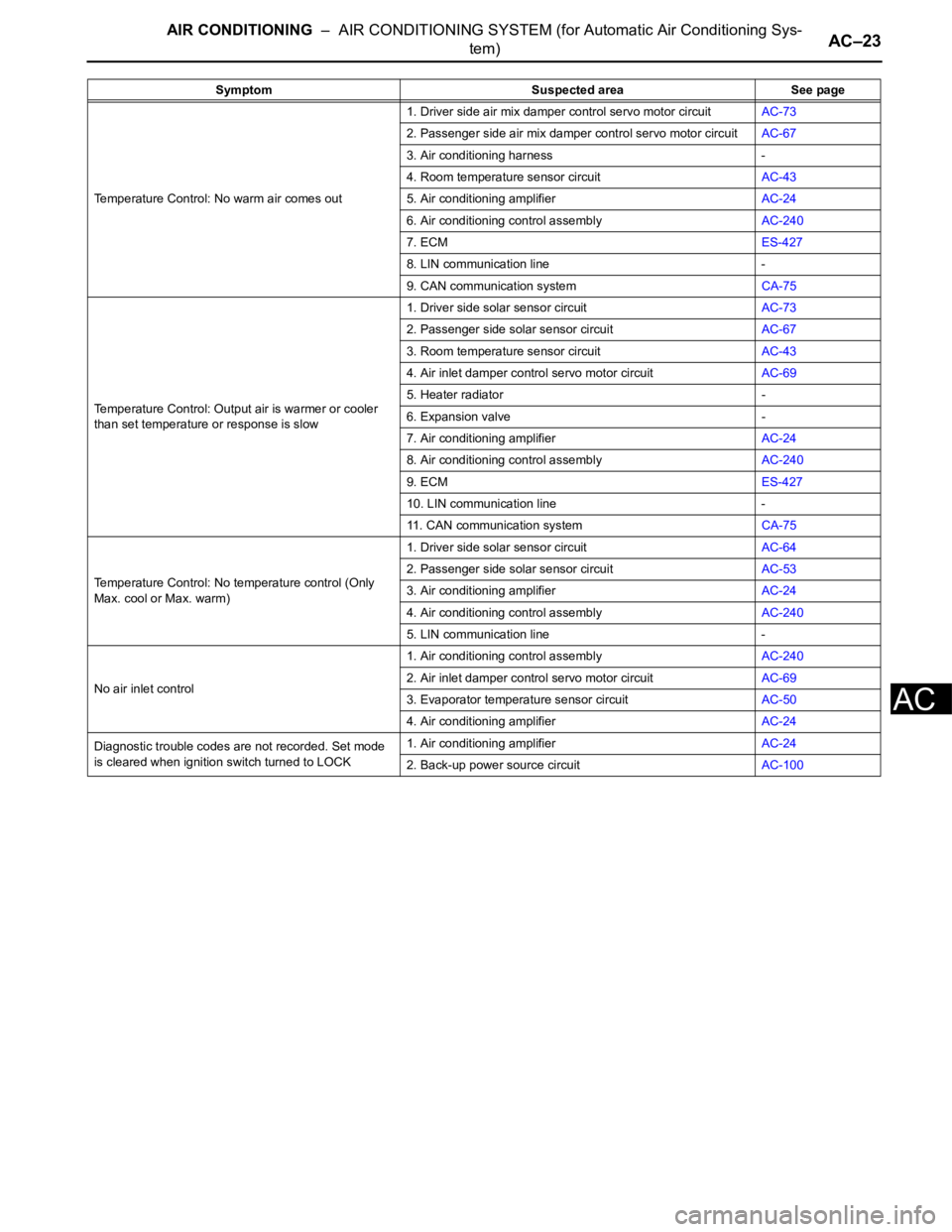
Temperature Control: No warm air comes out1. Driver side air mix damper control servo motor circuitAC-73
2. Passenger side air mix damper control servo motor circuitAC-67
3. Air conditioning harness -
4. Room temperature sensor circuitAC-43
5. Air conditioning amplifierAC-24
6. Air conditioning control assemblyAC-240
7. ECMES-427
8. LIN communication line -
9. CAN communication systemCA-75
Temperature Control: Output air is warmer or cooler
than set temperature or response is slow1. Driver side solar sensor circuitAC-73
2. Passenger side solar sensor circuitAC-67
3. Room temperature sensor circuitAC-43
4. Air inlet damper control servo motor circuitAC-69
5. Heater radiator -
6. Expansion valve -
7. Air conditioning amplifierAC-24
8. Air conditioning control assemblyAC-240
9. ECMES-427
10. LIN communication line -
11. CAN communication systemCA-75
Temperature Control: No temperature control (Only
Max. cool or Max. warm)1. Driver side solar sensor circuitAC-64
2. Passenger side solar sensor circuitAC-53
3. Air conditioning amplifierAC-24
4. Air conditioning control assemblyAC-240
5. LIN communication line -
No air inlet control1. Air conditioning control assemblyAC-240
2. Air inlet damper control servo motor circuitAC-69
3. Evaporator temperature sensor circuitAC-50
4. Air conditioning amplifierAC-24
Diagnostic trouble codes are not recorded. Set mode
is cleared when ignition switch turned to LOCK1. Air conditioning amplifierAC-24
2. Back-up power source circuitAC-100 Symptom Suspected area See page
Page 1653 of 2000
AIR CONDITIONING – AIR CONDITIONING SYSTEM (for Automatic Air Conditioning Sys-
tem)AC–25
AC
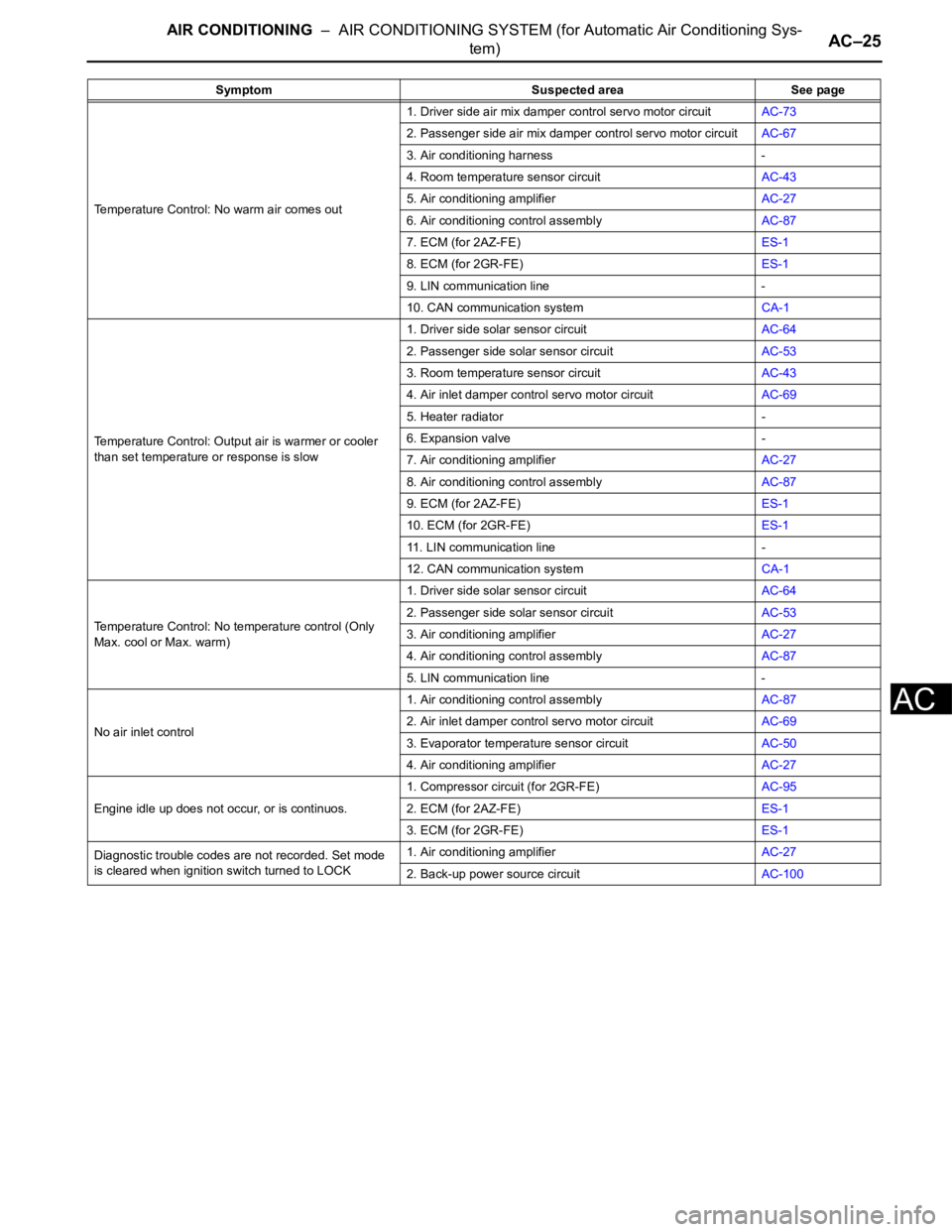
Temperature Control: No warm air comes out1. Driver side air mix damper control servo motor circuitAC-73
2. Passenger side air mix damper control servo motor circuitAC-67
3. Air conditioning harness -
4. Room temperature sensor circuitAC-43
5. Air conditioning amplifierAC-27
6. Air conditioning control assemblyAC-87
7. ECM (for 2AZ-FE)ES-1
8. ECM (for 2GR-FE)ES-1
9. LIN communication line -
10. CAN communication systemCA-1
Temperature Control: Output air is warmer or cooler
than set temperature or response is slow1. Driver side solar sensor circuitAC-64
2. Passenger side solar sensor circuitAC-53
3. Room temperature sensor circuitAC-43
4. Air inlet damper control servo motor circuitAC-69
5. Heater radiator -
6. Expansion valve -
7. Air conditioning amplifierAC-27
8. Air conditioning control assemblyAC-87
9. ECM (for 2AZ-FE)ES-1
10. ECM (for 2GR-FE)ES-1
11. LIN communication line -
12. CAN communication systemCA-1
Temperature Control: No temperature control (Only
Max. cool or Max. warm)1. Driver side solar sensor circuitAC-64
2. Passenger side solar sensor circuitAC-53
3. Air conditioning amplifierAC-27
4. Air conditioning control assemblyAC-87
5. LIN communication line -
No air inlet control1. Air conditioning control assemblyAC-87
2. Air inlet damper control servo motor circuitAC-69
3. Evaporator temperature sensor circuitAC-50
4. Air conditioning amplifierAC-27
Engine idle up does not occur, or is continuos.1. Compressor circuit (for 2GR-FE)AC-95
2. ECM (for 2AZ-FE)ES-1
3. ECM (for 2GR-FE)ES-1
Diagnostic trouble codes are not recorded. Set mode
is cleared when ignition switch turned to LOCK1. Air conditioning amplifierAC-27
2. Back-up power source circuitAC-100 Symptom Suspected area See page
Page 1935 of 2000

2AZ-FE ENGINE CONTROL SYSTEM – SFI SYSTEMES–47
ES
DATA LIST / ACTIVE TEST
1. DATA LIST
HINT:
By reading the DATA LIST displayed on an intelligent
tester, values can be checked, including those of the
switches, sensors, and actuators, without removing any
parts. Reading the DATA LIST as the first step of
troubleshooting is one method of shortening diagnostic
time.
NOTICE:
In the table below, the values listed under Normal
Condition are for reference only. Do not depend
solely on these values when determining whether or
not a part is faulty.
(a) Warm up the engine.
(b) Turn the ignition switch OFF.
(c) Connect the intelligent tester to the DLC3.
(d) Turn the ignition switch ON.
(e) Turn the tester ON.
(f) Select the following menu items: DIAGNOSIS /
ENHANCED OBD II / DATA LIST.
(g) Check the values by referring to the table below.
ECM:
Intelligent Tester Display Measurement: Range (Display) Normal Condition*1 Diagnostic Note
INJECTORInjection period of No. 1 cylinder:
Min.: 0 ms, Max.: 32.64 ms1.0 to 3.0 ms: Idling -
IGN ADVANCE Ignition timing advance for No. 1
cylinder:
Min.: -64 deg, Max.: 63.5 degBTDC 0 to 14 deg: Idling -
CALC LOADCalculated load by ECM:
Min.: 0 %, Max.: 100 %• 10 to 30 %: Idling
• 10 to 30 %: Running without
load at 2,500 rpmLoad value
VEHICLE LOADVehicle load:
Min.: 0 %, Max.: 25,700 %Actual vehicle loadLoad percentage in terms of
maximum intake air flow amount
MAFAir flow rate from Mass Air Flow
(MAF) meter:
Min.: 0 g/sec., Max.: 655.35 g/sec.1 to 3 g/sec.: Idling
2 to 6 g/sec.: Running without
load at 2,500 rpmIf value approximately 0.0 g/sec.:
• MAF meter power source
circuit open
• VG circuit open or short
If value 160.0 g/sec. or more:
• E2G circuit open
ENGINE SPDEngine speed:
Min.: 0 rpm, Max.: 16,383.75 rpm650 to 750 rpm: Idling -
VEHICLE SPDVehicle speed:
Min.: 0 km/h, Max.: 255 km/hActual vehicle speed Speed indicated on speedometer
COOLANT TEMPEngine coolant temperature:
Min.: -40
C, Max.: 140C80 to 100C (176 to 212F):
After warming up• If -40
C (-40F): sensor circuit
open
• If 140
C (284F) or more:
sensor circuit shorted
INTAKE AIRIntake air temperature:
Min.: -40
C, Max.: 140CEquivalent to ambient air
temperature• If -40
C (-40F): sensor circuit
open
• If 140
C (284F) or more:
sensor circuit shorted
AIR-FUEL RATIORatio compared to stoichiometric
level:
Min.: 0, Max.: 1.9990.8 to 1.2: Idling• Less than 1 (0 to 0.999) =
Lean
• Stoichiometric air-fuel ratio = 1
• Greater than 1 (1.001 to
1.999) = Rich
Page 1938 of 2000

ES–502AZ-FE ENGINE CONTROL SYSTEM – SFI SYSTEM
ES
THROTL OPN DUTYThrottle actuator opening duty
ratio:
Min.: 0 %, Max.: 100 %0 to 40 %: During idling• When accelerator pedal
depressed, duty ratio
increased
• Read value with ignition switch
ON (Do not start engine)
THROTL CLS DUTYThrottle actuator closed duty ratio:
Min.: 0 %, Max.: 100 %0 to 40 %: During idling• When accelerator pedal
released quickly, duty ratio
increased
• Read value with ignition switch
ON (Do not start engine)
THRTL MOT (OPN)Throttle actuator duty ratio (open):
Min.: 0 %, Max.: 100 %0 to 40 %: During idling ETCS service data
THRTL MOT (CLS)Throttle actuator duty ratio
(closed):
Min.: 0 %, Max.: 100 %0 to 40 %: During idling ETCS service data
O2S B1 S2Heated oxygen sensor output
voltage for sensor 2:
Min.: 0 V Max.: 1.275 V0.1 to 0.9 V: Driving at 70 km/h
(44 mph)Performing INJ VOL or A/F
CONTROL function of ACTIVE
TEST enables technician to check
output voltage of sensor
AFS B1 S1A/F sensor output voltage for
sensor 1:
Min.: 0 V Max.: 7.999 V2.8 to 3.8 V: IdlingPerforming INJ VOL or A/F
CONTROL function of ACTIVE
TEST enables technician to check
output voltage of sensor
TOTAL FT #1Total fuel trim value for fuel
system:
Min.: -0.5, Max.: 0.496-0.2 to 0.2 -
SHORT FT #1Short-term fuel trim:
Min.: -100 %, Max.: 99.2 %-20 to 20 %Short-term fuel compensation
used to maintain air-fuel ratio at
stoichiometric air-fuel ratio
LONG FT #1Long-term fuel trim:
Min.: -100 %, Max.: 99.2 %-20 to 20 %Overall fuel compensation carried
out in long-term to compensate
continual deviation of short-term
fuel trim from central value
FUEL SYS #1Fuel system status:
OL or CL or OL DRIVE or OL
FAULT or CL FAULTCL: Idling after warming up• OL (Open Loop): Has not yet
satisfied conditions to go
closed loop
• CL (Closed Loop): Using A/F
sensor as feedback for fuel
control
• OL DRIVE: Open loop due to
driving conditions (fuel
enrichment)
• OL FAULT: Open loop due to
detected system fault
• CL FAULT: Closed loop but A/
F sensor, which used for fuel
control malfunctioning
O2FT B1 S2Short-term fuel trim associated
with sensor 2:
Min.: -100 %, Max.: 99.2 %--
AF FT B1 S1Short-term fuel trim associated
with sensor 1:
Min.: 0, Max.: 1.999• Value less than 1 (0.000 to
0.999) =Lean
• Stoichiometric air-fuel
ratio=1
• Value greater than 1 (1.001
to 1.999) = Rich-
AFS B1 S1A/F sensor current:
Min.: -128 mA, Max.: 127.99 mA--
CAT TEMP B1S1Estimated catalyst temperature
(sensor 1):
Min.: -40
C, Max.: 6,513.5C-- Intelligent Tester Display Measurement: Range (Display) Normal Condition*1 Diagnostic Note
Page 1941 of 2000

2AZ-FE ENGINE CONTROL SYSTEM – SFI SYSTEMES–53
ES
SPD TESTCheck mode result for vehicle
speed sensor:
COMPL or INCMPL--
MISFIRE TESTCheck mode result for misfire
monitor:
COMPL or INCMPL--
OXS1 TESTCheck mode result for HO2
sensor:
COMPL or INCMPL--
A/F SSR TEST B1Check mode result for air-fuel
ratio sensor:
COMPL or INCMPL--
MIL MIL status:
ON or OFFON: MIL ON -
MIL ON RUN DISTMIL ON run distance:
Min.: 0 km, Max.: 65,535 kmDistance after DTC detected -
MIL ON RUN TIMERunning time from MIL ON:
Min.: 0 minutes,
Max.: 65,535 minutesEquivalent to running time after
MIL ON-
ENG RUN TIMEEngine run time:
Min.: 0 seconds,
Max.: 65,535 secondsTime after engine start -
TIME DTC CLEARTime after DTC cleared:
Min.: 0 minutes,
Max.: 65,535 minutesEquivalent to time after DTCs
erased-
DIST DTC CLEARDistance after DTC cleared:
Min.: 0 km, Max.: 65,535 kmEquivalent to drive distance
after DTCs erased-
WU CYC DTC CLEARWarm-up cycle after DTC cleared:
Min.: 0, Max.: 255-Number of warm-up cycles after
DTC cleared
OBD CERT OBD requirement OBD2 -
#CARB CODES Emission related DTCs - Number of emission related DTCs
COMP MONComprehensive component
monitor:
N O T AV L o r AVA I L--
FUEL MONFuel system monitor:
N O T AV L o r AVA I L--
MISFIRE MONMisfire monitor:
N O T AV L o r AVA I L--
O2S (A/FS) HTRO2S (A/FS ) heater monitor:
N O T AV L o r AVA I L--
O2S (A/FS) HTRO2S (A/FS ) heater monitor:
COMPL or INCMPL--
O2S (A/FS) MONO2S (A/FS ) monitor:
N O T AV L o r AVA I L--
O2S (A/FS) MONO2S (A/FS ) monitor:
COMPL or INCMPL--
EVAP MONEVAP monitor:
N O T AV L o r AVA I L--
EVAP MONEVAP monitor:
COMPL or INCMPL--
CAT MONCatalyst monitor:
N O T AV L o r AVA I L--
CAT MONCatalyst monitor:
COMPL or INCMPL--
CCM ENAComprehensive component
monitor:
UNABLE or ENABLE-- Intelligent Tester Display Measurement: Range (Display) Normal Condition*1 Diagnostic Note