Control arm TOYOTA RAV4 2006 Service User Guide
[x] Cancel search | Manufacturer: TOYOTA, Model Year: 2006, Model line: RAV4, Model: TOYOTA RAV4 2006Pages: 2000, PDF Size: 45.84 MB
Page 490 of 2000
ES–362AZ-FE ENGINE CONTROL SYSTEM – SFI SYSTEM
ES
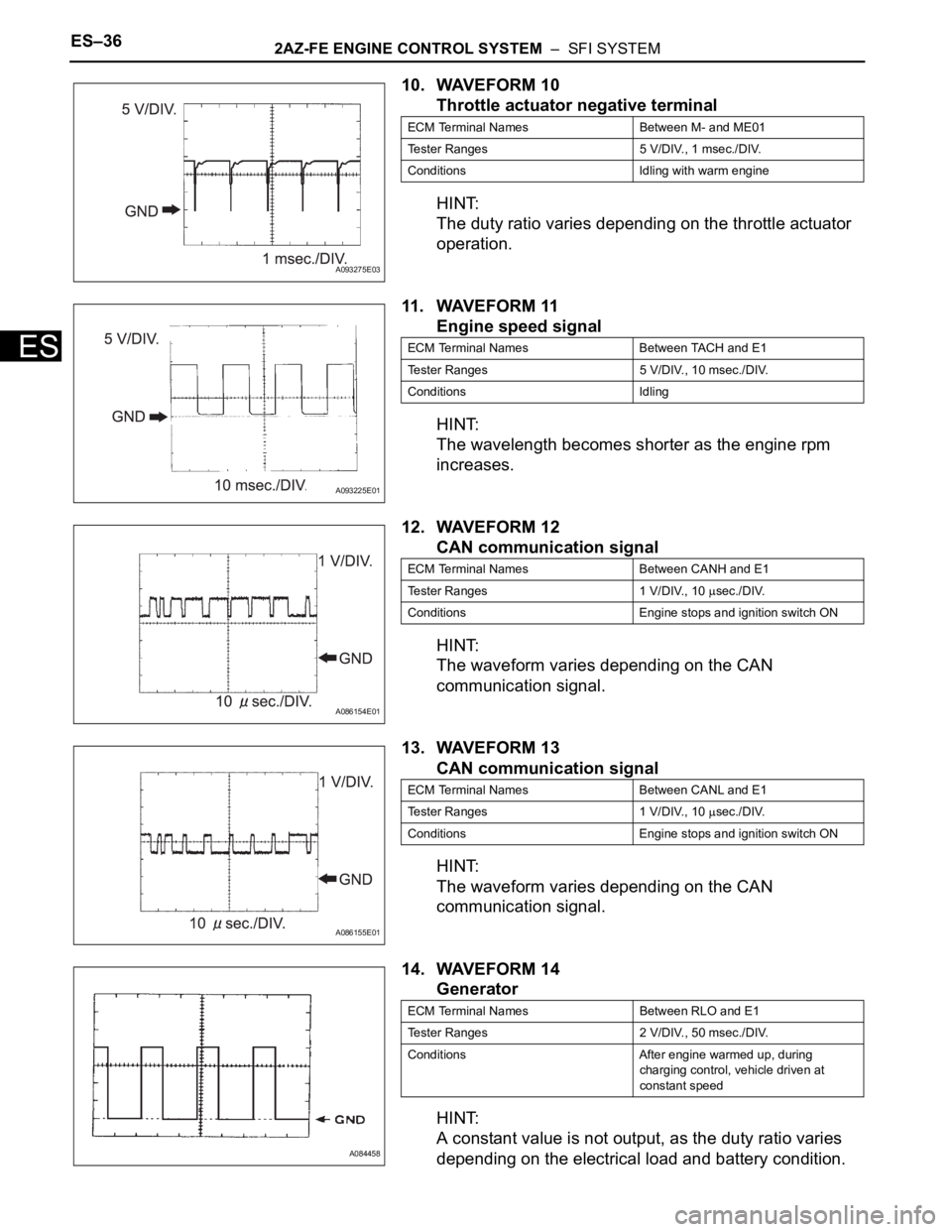
10. WAVEFORM 10
Throttle actuator negative terminal
HINT:
The duty ratio varies depending on the throttle actuator
operation.
11 . WAVE F OR M 11
Engine speed signal
HINT:
The wavelength becomes shorter as the engine rpm
increases.
12. WAVEFORM 12
CAN communication signal
HINT:
The waveform varies depending on the CAN
communication signal.
13. WAVEFORM 13
CAN communication signal
HINT:
The waveform varies depending on the CAN
communication signal.
14. WAVEFORM 14
Generator
HINT:
A constant value is not output, as the duty ratio varies
depending on the electrical load and battery condition.
A093275E03
ECM Terminal Names Between M- and ME01
Tester Ranges 5 V/DIV., 1 msec./DIV.
Conditions Idling with warm engine
A093225E01
ECM Terminal Names Between TACH and E1
Tester Ranges 5 V/DIV., 10 msec./DIV.
Conditions Idling
A086154E01
ECM Terminal Names Between CANH and E1
Tester Ranges 1 V/DIV., 10
sec./DIV.
Conditions Engine stops and ignition switch ON
A086155E01
ECM Terminal Names Between CANL and E1
Tester Ranges 1 V/DIV., 10
sec./DIV.
Conditions Engine stops and ignition switch ON
A084458
ECM Terminal Names Between RLO and E1
Tester Ranges 2 V/DIV., 50 msec./DIV.
Conditions After engine warmed up, during
charging control, vehicle driven at
constant speed
Page 491 of 2000
2AZ-FE ENGINE CONTROL SYSTEM – SFI SYSTEMES–37
ES
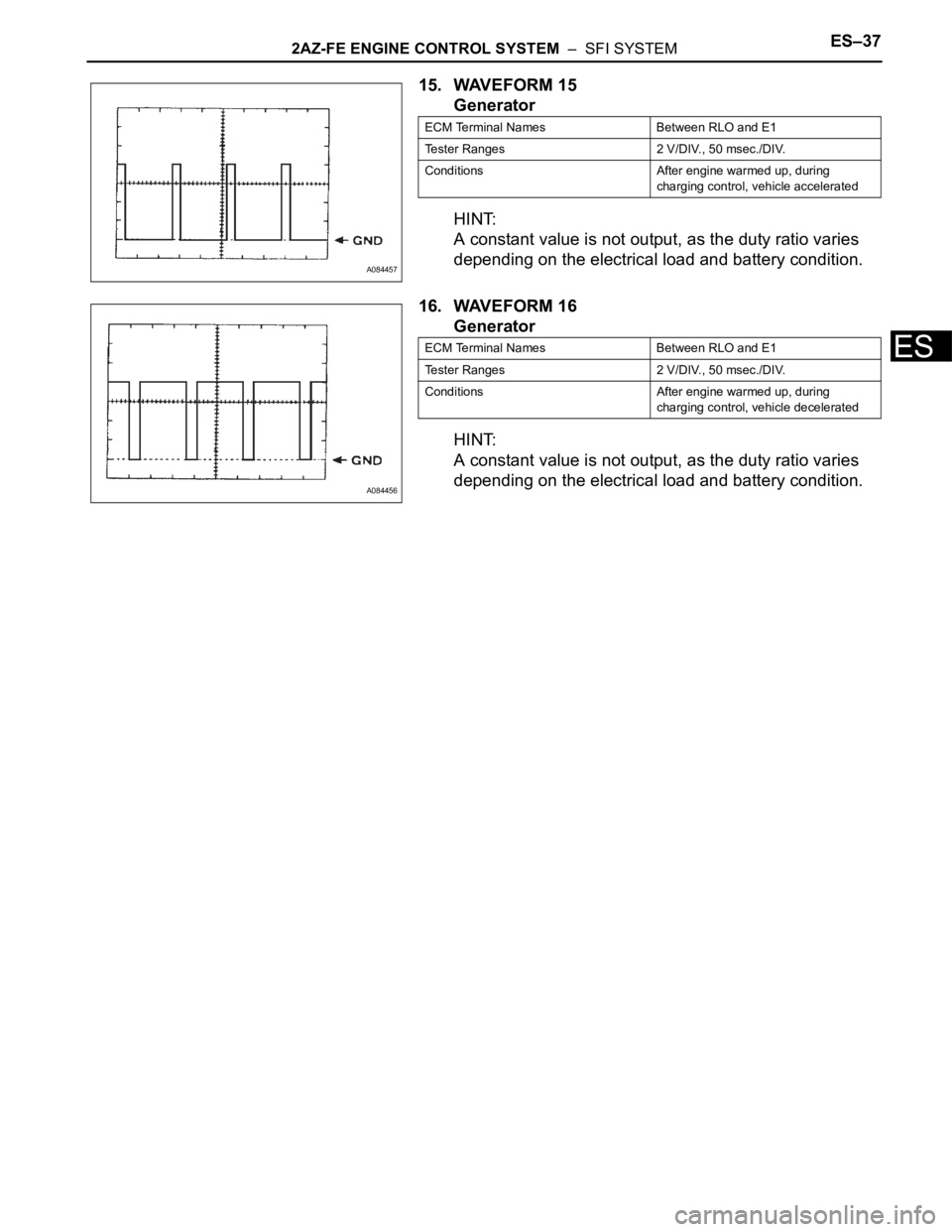
15. WAVEFORM 15
Generator
HINT:
A constant value is not output, as the duty ratio varies
depending on the electrical load and battery condition.
16. WAVEFORM 16
Generator
HINT:
A constant value is not output, as the duty ratio varies
depending on the electrical load and battery condition.
A084457
ECM Terminal Names Between RLO and E1
Tester Ranges 2 V/DIV., 50 msec./DIV.
Conditions After engine warmed up, during
charging control, vehicle accelerated
A084456
ECM Terminal Names Between RLO and E1
Tester Ranges 2 V/DIV., 50 msec./DIV.
Conditions After engine warmed up, during
charging control, vehicle decelerated
Page 493 of 2000
2AZ-FE ENGINE CONTROL SYSTEM – SFI SYSTEMES–39
ES
3. 2 TRIP DETECTION LOGIC
When a malfunction is first detected, the malfunction is
temporarily stored in the ECM memory (1st trip). If the
same malfunction is detected during the next
subsequent drive cycle, the MIL is illuminated (2nd trip).
4. FREEZE FRAME DATA
Freeze frame data records the engine conditions (fuel
system, calculated engine load, engine coolant
temperature, fuel trim, engine speed, vehicle speed,
etc.) when malfunctions are detected. When
troubleshooting, freeze frame data can help determine if
the vehicle was moving or stationary, if the engine was
warmed up or not, if the air-fuel ratio was lean or rich,
and other data from the time the malfunction occurred.
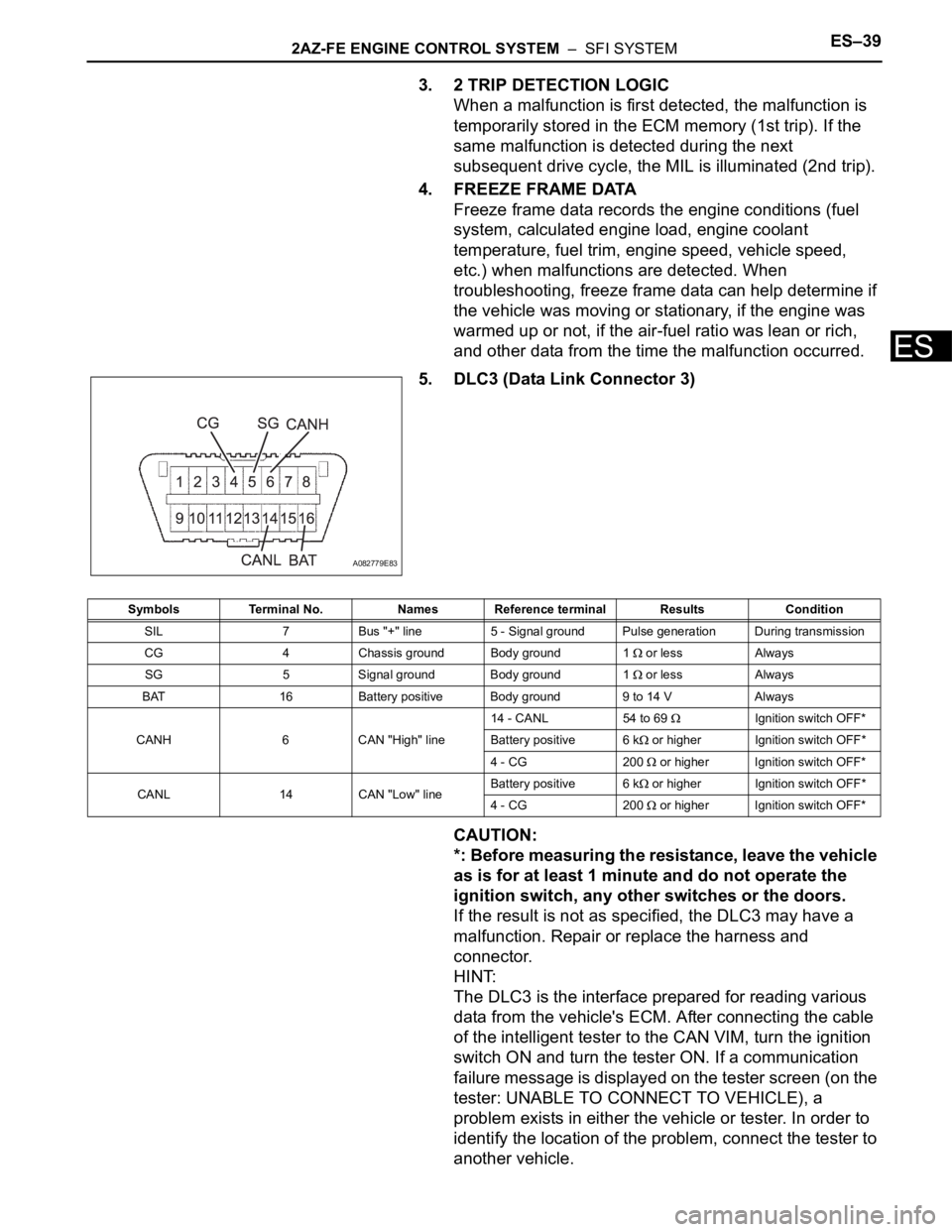
5. DLC3 (Data Link Connector 3)
CAUTION:
*: Before measuring the resistance, leave the vehicle
as is for at least 1 minute and do not operate the
ignition switch, any other switches or the doors.
If the result is not as specified, the DLC3 may have a
malfunction. Repair or replace the harness and
connector.
HINT:
The DLC3 is the interface prepared for reading various
data from the vehicle's ECM. After connecting the cable
of the intelligent tester to the CAN VIM, turn the ignition
switch ON and turn the tester ON. If a communication
failure message is displayed on the tester screen (on the
tester: UNABLE TO CONNECT TO VEHICLE), a
problem exists in either the vehicle or tester. In order to
identify the location of the problem, connect the tester to
another vehicle.
A082779E83
Symbols Terminal No. Names Reference terminal Results Condition
SIL 7 Bus "+" line 5 - Signal ground Pulse generation During transmission
CG 4 Chassis ground Body ground 1
or less Always
SG 5 Signal ground Body ground 1
or less Always
BAT 16 Battery positive Body ground 9 to 14 V Always
CANH 6 CAN "High" line14 - CANL 54 to 69
Ignition switch OFF*
Battery positive 6 k
or higher Ignition switch OFF*
4 - CG 200
or higher Ignition switch OFF*
CANL 14 CAN "Low" lineBattery positive 6 k
or higher Ignition switch OFF*
4 - CG 200
or higher Ignition switch OFF*
Page 496 of 2000
ES–422AZ-FE ENGINE CONTROL SYSTEM – SFI SYSTEM
ES
FREEZE FRAME DATA
1. DESCRIPTION
Freeze frame data records the engine conditions (fuel
system, calculated load, engine coolant temperature,
fuel trim, engine speed, vehicle speed, etc.) when a
malfunction is detected. When troubleshooting, it can
help determine if the vehicle was running or stopped, the
engine was warmed up or not, the air-fuel ratio was Lean
or Rich, and other data from the time the malfunction
occurred.
HINT:
If it is impossible to duplicate the problem even though a
DTC is detected, confirm the freeze frame data.
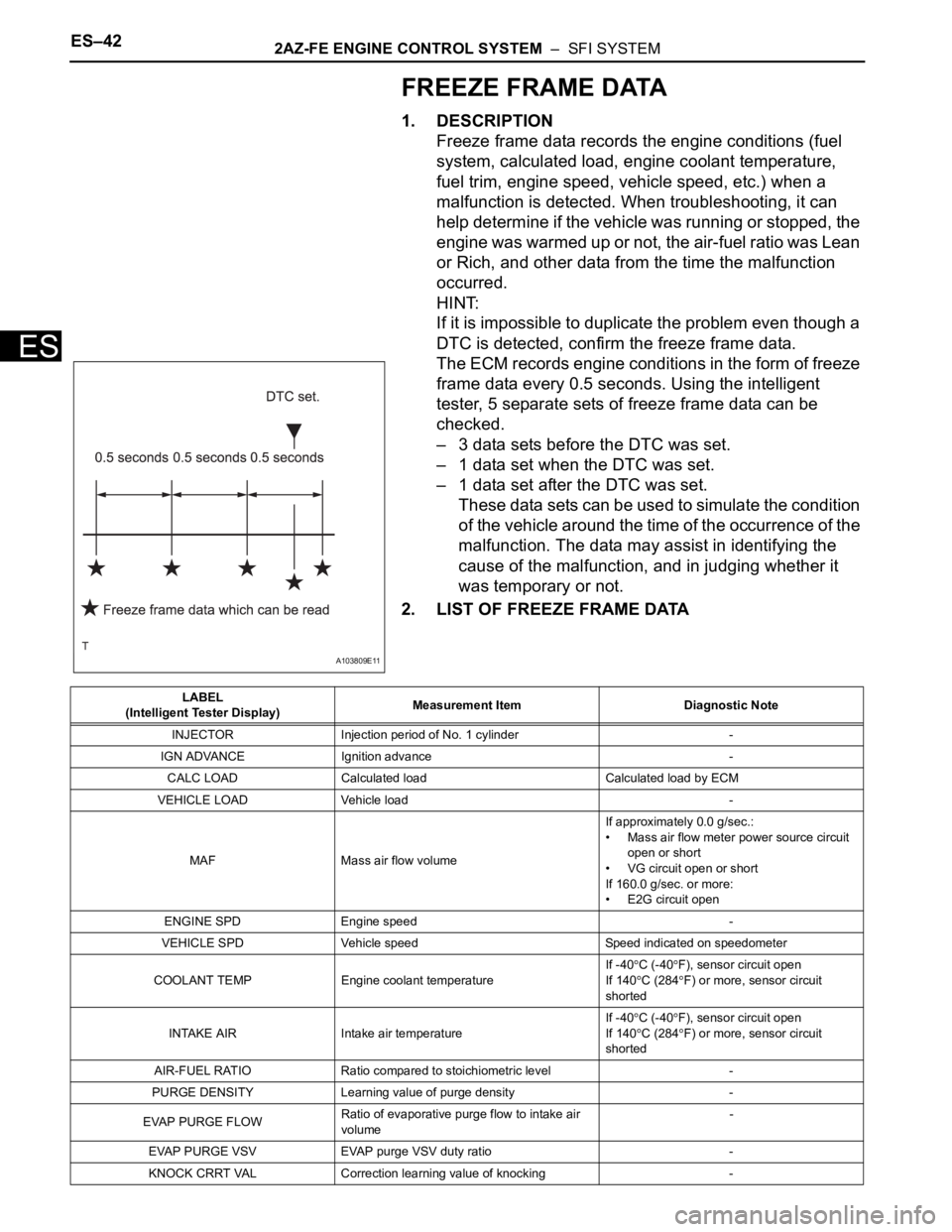
The ECM records engine conditions in the form of freeze
frame data every 0.5 seconds. Using the intelligent
tester, 5 separate sets of freeze frame data can be
checked.
– 3 data sets before the DTC was set.
– 1 data set when the DTC was set.
– 1 data set after the DTC was set.
These data sets can be used to simulate the condition
of the vehicle around the time of the occurrence of the
malfunction. The data may assist in identifying the
cause of the malfunction, and in judging whether it
was temporary or not.
2. LIST OF FREEZE FRAME DATA
A103809E11
LABEL
(Intelligent Tester Display)Measurement Item Diagnostic Note
INJECTOR Injection period of No. 1 cylinder -
IGN ADVANCE Ignition advance -
CALC LOAD Calculated load Calculated load by ECM
VEHICLE LOAD Vehicle load -
MAF Mass air flow volumeIf approximately 0.0 g/sec.:
• Mass air flow meter power source circuit
open or short
• VG circuit open or short
If 160.0 g/sec. or more:
• E2G circuit open
ENGINE SPD Engine speed -
VEHICLE SPD Vehicle speed Speed indicated on speedometer
COOLANT TEMP Engine coolant temperatureIf -40
C (-40F), sensor circuit open
If 140
C (284F) or more, sensor circuit
shorted
INTAKE AIR Intake air temperature If -40
C (-40F), sensor circuit open
If 140
C (284F) or more, sensor circuit
shorted
AIR-FUEL RATIO Ratio compared to stoichiometric level -
PURGE DENSITY Learning value of purge density -
EVAP PURGE FLOWRatio of evaporative purge flow to intake air
volume-
EVAP PURGE VSV EVAP purge VSV duty ratio -
KNOCK CRRT VAL Correction learning value of knocking -
Page 498 of 2000

ES–442AZ-FE ENGINE CONTROL SYSTEM – SFI SYSTEM
ES
VVT CTRL B1 VVT control status -
VA C U U M P U M PKey-off EVAP system leak detection pump
status(see page ES-333)
EVAP VENT VAL Key-off EVAP system vent valve status -
FAN MOTOR Electric fan motor -
TC/TE1 TC and CG (TE1) terminals of DLC3 -
ENG SPEED #1 Engine rpm during No. 1 cylinder fuel cutOutput only when FUEL CUT #1 is performed
using ACTIVE TEST
ENG SPEED #2 Engine rpm during No. 2 cylinder fuel cutOutput only when FUEL CUT #2 is performed
using ACTIVE TEST
ENG SPEED #3 Engine rpm during No. 3 cylinder fuel cutOutput only when FUEL CUT #3 is performed
using ACTIVE TEST
ENG SPEED #4 Engine rpm during No. 4 cylinder fuel cutOutput only when FUEL CUT #4 is performed
using ACTIVE TEST
ENG SPEED ALLAverage of engine rpm values during fuel cut
of No. 1 to No. 4 cylindersOutput only when ACTIVE TEST is performed
VVTL AIM ANGL#1 VVT aim angle -
VVT CHNG ANGL#1 VVT angle -
VVT OCV DUTY B1 VVT OCV operation duty -
FC IDL Fuel cut idleON: when throttle valve fully closed and
engine speed over 3,500 rpm
FC TAU Fuel cut during very light loadFuel cut being performed under very light load
to prevent engine combustion from becoming
incomplete
IGNITION Ignition counter -
CYL #1 Cylinder #1 misfire Only displayed during idling
CYL #2 Cylinder #2 misfire Only displayed during idling
CYL #3 Cylinder #3 misfire Only displayed during idling
CYL #4 Cylinder #4 misfire Only displayed during idling
CYL ALL All cylinders misfire Only displayed during idling
MISFIRE RPM Engine speed when misfire occurred -
MISFIRE LOAD Engine load when misfire occurred -
MISFIRE MARGIN Margin to detect engine misfire -
MIL ON RUN DIST Distance after DTC is detected -
ENG RUN TIME Accumulated engine running time -
TIME DTC CLEAR Cumulative time after DTC cleared -
DIST DTC CLEAR Accumulated distance from DTC cleared -
WU CYC DTC CLEAR Warm-up cycle after DTC cleared -LABEL
(Intelligent Tester Display)Measurement Item Diagnostic Note
Page 509 of 2000

SE–4SEAT – FRONT POWER SEAT CONTROL SYSTEM
SE
NOTICE:
• The inspection should be performed with the
seat installed in the vehicle.
• Perform the 4 steps below for the full range of
motion for each power seat function.
(1) Choose a power seat function. Operate the
power seat switch and move the seat as much
as possible in one direction. Keep the seat in
that position for approximately 60 seconds.
(2) Operate the power seat switch again and
continue to try to move the seat in the same
direction as in the previous step. Measure the
amount of time elapsed before current is
automatically cut (the sound of the motor has
stopped).
Standard:
4 to 90 seconds
(3) After current has been cut, release the power
seat switch and wait for approximately 60
seconds.
(4) Operate the same power seat switch and move
the seat in the opposite direction. Check that
the motor operates.
3. CHECK LUMBAR SUPPORT ADJUSTER ASSEMBLY
(a) Check the PTC operation inside the power seat
motor.
NOTICE:
The inspection should be performed with the
seat installed in the vehicle.
(1) Operate the lumbar support switch and move
the lumbar support to either the foremost or
rearmost position. Keep the seat in that
position for approximately 60 seconds.
(2) Operate the lumbar support switch again and
continue to try to move the lumbar support in
the same direction as in the previous step.
Measure the amount of time elapsed before
current is automatically cut (the sound of the
motor has stopped).
Standard:
4 to 90 seconds
(3) After current has been cut, release the lumbar
support switch and wait for approximately 60
seconds.
(4) Operate the lumbar support switch and move
the seat in the opposite direction. Check that
the motor operates.
Page 552 of 2000
ES–282GR-FE ENGINE CONTROL SYSTEM – SFI SYSTEM
ES
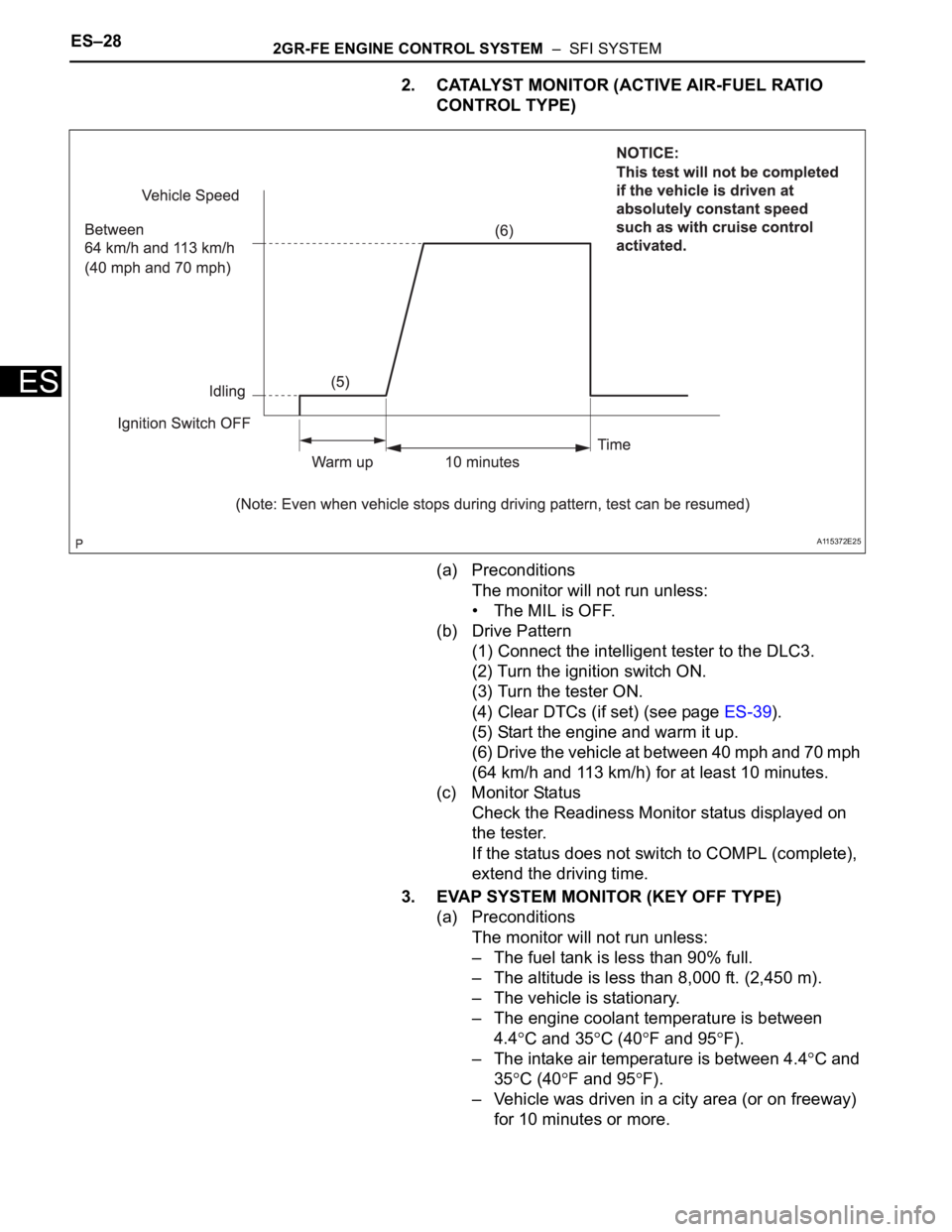
2. CATALYST MONITOR (ACTIVE AIR-FUEL RATIO
CONTROL TYPE)
(a) Preconditions
The monitor will not run unless:
• The MIL is OFF.
(b) Drive Pattern
(1) Connect the intelligent tester to the DLC3.
(2) Turn the ignition switch ON.
(3) Turn the tester ON.
(4) Clear DTCs (if set) (see page ES-39).
(5) Start the engine and warm it up.
(6) Drive the vehicle at between 40 mph and 70 mph
(64 km/h and 113 km/h) for at least 10 minutes.
(c) Monitor Status
Check the Readiness Monitor status displayed on
the tester.
If the status does not switch to COMPL (complete),
extend the driving time.
3. EVAP SYSTEM MONITOR (KEY OFF TYPE)
(a) Preconditions
The monitor will not run unless:
– The fuel tank is less than 90% full.
– The altitude is less than 8,000 ft. (2,450 m).
– The vehicle is stationary.
– The engine coolant temperature is between
4.4
C and 35C (40F and 95F).
– The intake air temperature is between 4.4
C and
35
C (40F and 95F).
– Vehicle was driven in a city area (or on freeway)
for 10 minutes or more.
A115372E25
Page 554 of 2000
ES–302GR-FE ENGINE CONTROL SYSTEM – SFI SYSTEM
ES
– Air-fuel ratio feedback control is performed.
(b) Drive Pattern for front A/F sensor and HO2 sensor
(1) Connect the intelligent tester to the DLC3.
(2) Turn the ignition switch ON.
(3) Turn the tester ON.
(4) Clear DTCs (see page ES-39).
(5) Start the engine, and warm it up until the ECT
reaches 75
C (167F) or higher.
(6) Drive the vehicle at between 60 km/h (38 mph)
and 120 km/h (75 mph) for at least 10 minutes.
(7) Change the transmission to 2nd gear.
(8) Accelerate the vehicle to 64 km/h (40 mph) or
more by depressing the accelerator pedal for at
least 10 seconds.
(9) Soon after performing step (8) above, release
the accelerator pedal for at least 4 seconds without
depressing the brake pedal in order to execute fuel-
cut control.
(10) Allow the vehicle to decelerate until the vehicle
speed declines to less than 10 km/h (6 mph).
(11) Repeat steps from (8) through (10) above at
least 3 times in one driving cycle.
(c) Monitor Status
(1) Check the Readiness Monitor status displayed
on the tester.
(2) If the status does not switch to COMPL
(complete), make sure that the preconditions
have been met, and then perform steps from (5)
through (11) in the Drive Pattern above.
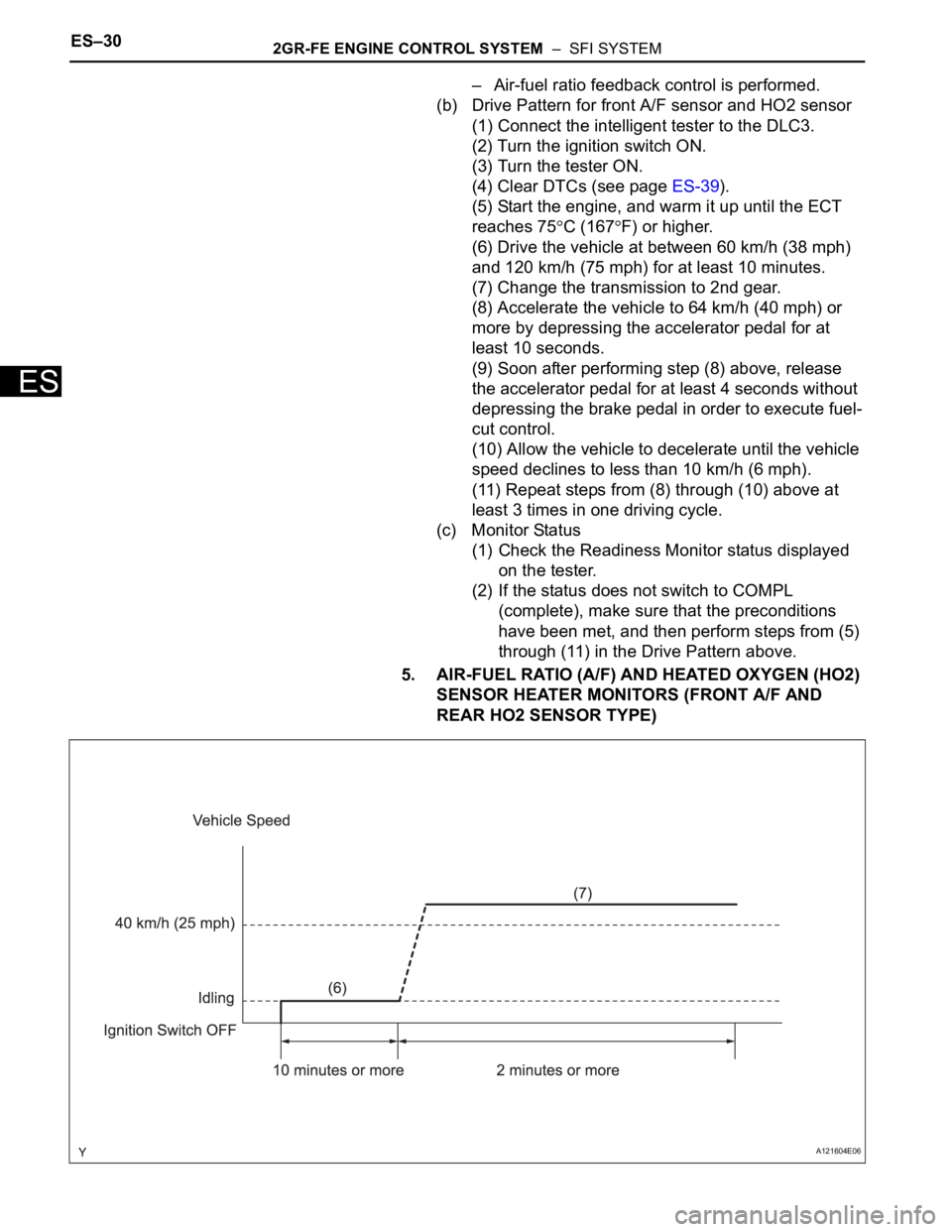
5. AIR-FUEL RATIO (A/F) AND HEATED OXYGEN (HO2)
SENSOR HEATER MONITORS (FRONT A/F AND
REAR HO2 SENSOR TYPE)
A121604E06
Page 556 of 2000
ES–322GR-FE ENGINE CONTROL SYSTEM – SFI SYSTEM
ES
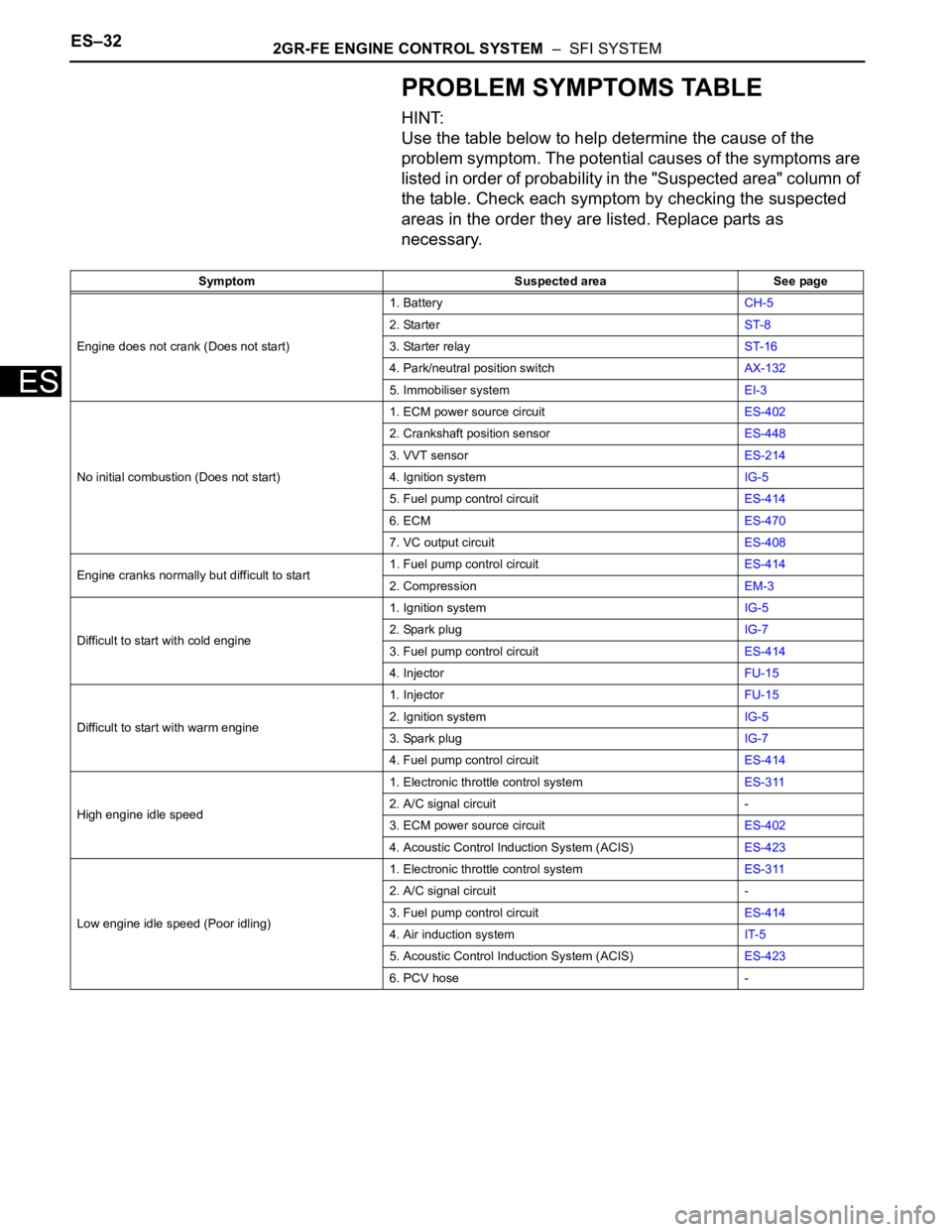
PROBLEM SYMPTOMS TABLE
HINT:
Use the table below to help determine the cause of the
problem symptom. The potential causes of the symptoms are
listed in order of probability in the "Suspected area" column of
the table. Check each symptom by checking the suspected
areas in the order they are listed. Replace parts as
necessary.
Symptom Suspected area See page
Engine does not crank (Does not start)1. BatteryCH-5
2. StarterST-8
3. Starter relayST-16
4. Park/neutral position switchAX-132
5. Immobiliser systemEI-3
No initial combustion (Does not start)1. ECM power source circuitES-402
2. Crankshaft position sensorES-448
3. VVT sensorES-214
4. Ignition systemIG-5
5. Fuel pump control circuitES-414
6. ECMES-470
7. VC output circuitES-408
Engine cranks normally but difficult to start1. Fuel pump control circuitES-414
2. CompressionEM-3
Difficult to start with cold engine1. Ignition systemIG-5
2. Spark plugIG-7
3. Fuel pump control circuitES-414
4. InjectorFU-15
Difficult to start with warm engine1. InjectorFU-15
2. Ignition systemIG-5
3. Spark plugIG-7
4. Fuel pump control circuitES-414
High engine idle speed1. Electronic throttle control systemES-311
2. A/C signal circuit -
3. ECM power source circuitES-402
4. Acoustic Control Induction System (ACIS)ES-423
Low engine idle speed (Poor idling)1. Electronic throttle control systemES-311
2. A/C signal circuit -
3. Fuel pump control circuitES-414
4. Air induction systemIT-5
5. Acoustic Control Induction System (ACIS)ES-423
6. PCV hose -
Page 559 of 2000

2GR-FE ENGINE CONTROL SYSTEM – SFI SYSTEMES–35
ES
THW (B30-79) - ETHW (B30-78) L - BR Engine coolant
temperature sensorIdling, Engine coolant temperature
80
C (176F)0.2 to 1.0 V
VCTA (B30-96) - ETA (B30-97) B - W Power source of throttle
position sensor (specific
voltage)Ignition switch ON 4.5 to 5.5 V
VTA1 (B30-98) - ETA (B30-97) Y - W Throttle position sensor
(for engine control)Ignition switch ON,
Throttle valve fully closed0.5 to 1.1 V
Ignition switch ON,
Throttle valve fully open3.3 to 4.9 V
VTA2 (B30-99) - ETA (B30-97) GR - W Throttle position sensor
(for sensor malfunction
detection)Ignition switch ON,
Throttle valve fully closed2.1 to 3.1 V
Ignition switch ON,
Throttle valve fully open4.6 to 5.0 V
VPA (A9-55) - EPA (A9-59) W - Y Accelerator pedal position
sensor (for engine control)Ignition switch ON,
Accelerator pedal released0.5 to 1.1 V
Ignition switch ON,
Accelerator pedal fully depressed2.6 to 4.5 V
VPA2 (A9-56) - EPA2 (A9-60) R - O Accelerator pedal position
sensor (for sensor
malfunctioning detection)Ignition switch ON,
Accelerator pedal released1.2 to 2.0 V
Ignition switch ON,
Accelerator pedal fully depressed3.4 to 5.0 V
VCPA (A9-57) - EPA (A9-59) B - Y Power source of
accelerator pedal position
sensor (for VPA)Ignition switch ON 4.5 to 5.5 V
VCP2 (A9-58) - EPA2 (A9-60) L - O Power source of
accelerator pedal position
sensor (for VPA2)Ignition switch ON 4.5 to 5.5 V
HA1A (B30-86) - E04 (B30-23)
HA2A (B30-109) - E04 (B30-23) G - BR
B - BRA/F sensor heater Idling Below 3.0 V
Ignition switch ON 9 to 14 V
A1A+ (B30-93) - E1 (B30-81) W -BR A/F sensor Ignition switch ON 3.3 V*
A1A- (B30-116) - E1 (B30-81) BR - BR A/F sensor Ignition switch ON3.0 V*
A2A+ (B30-120) - E1 (B30-81) L - BR A/F sensor Ignition switch ON 3.3 V*
A2A- (B30-119) - E1 (B30-81) Y - BR A/F sensor Ignition switch ON 3.0 V*
HT1B (B30-48) - E03 (B30-104)
HT2B (B30-47) - E03 (B30-104)LG - BR
Y - BRHeated oxygen sensor
heaterIdling Below 3.0 V
Ignition switch ON 9 to 14 V
OX1B (B30-88) - EX1B (B30-65)
OX2B (B30-87) - EX2B- (B30-64)W - GR
B - B-WHeated oxygen sensor Engine speed maintained at 2,500
rpm for 2 minutes after warming up
sensorPulse generation (see
waveform 2)
#10 (B30-45) - E01 (B30-22)
#20 (B30-85) - E01 (B30-22)
#30 (B30-44) - E01 (B30-22)
#40 (B30-84) - E01 (B30-22)
#50 (B30-43) - E01 (B30-22)
#60 (B30-83) - E01 (B30-22)Y - BR
W - BR
B - BR
BR - BR
L - BR
G - BRInjector Ignition switch ON 9 to 14 V
Idling Pulse generation (see
waveform 3)
KNK1 (B30-95) - EKNK (B30-94)
KNK2 (B30-118) - EKN2 (B30-
11 7 )R - G
B - WKnock sensor Engine speed maintained at 4,000
rpm after warming up enginePulse generation (see
waveform 4)
VCV1 (B30-115) - E1 (B30-81) G-R - BR Power source for VVT
sensor (specific voltage)Ignition switch ON 4.5 to 5.0 V
VCV2 (B30-113) - E1 (B30-81) V - BR Power source for VVT
sensor (specific voltage)Ignition switch ON 4.5 to 5.0 V
VCE1 (B30-114) - E1 (B30-81) GR - BR Power source for VVT
sensor specific voltage)Ignition switch ON 4.5 to 5.0 V
VCE2 (B30-112) - E1 (B30-81) Y - BR Power source for VVT
sensor (specific voltage)Ignition switch ON 4.5 to 5.0 V
VV1+ (B30-69) - VV1- (B30-92) P - L-B Variable valve timing
(VVT) sensor (Intake side
(bank 1))Idling Pulse generation
(see waveform 5) Symbol (Terminal No.) Wiring Color Terminal Description Condition Specified Condition