Control arm TOYOTA RAV4 2006 Service Owner's Manual
[x] Cancel search | Manufacturer: TOYOTA, Model Year: 2006, Model line: RAV4, Model: TOYOTA RAV4 2006Pages: 2000, PDF Size: 45.84 MB
Page 560 of 2000

ES–362GR-FE ENGINE CONTROL SYSTEM – SFI SYSTEM
ES
VV2+ (B30-67) - VV2- (B30-90) W - B Variable valve timing
(VVT) sensor (Intake side
(bank 2))Idling Pulse generation
(see waveform 5)
EV1+ (B30-68) - EV1- (B30-91) Y - G Variable valve timing
(VVT) sensor (Exhaust
side (bank 1))Idling Pulse generation
(see waveform 5)
EV2+ (B30-66) - EV2- (B30-89) R - L Variable valve timing
(VVT) sensor (Exhaust
side (bank 2))Idling Pulse generation
(see waveform 5)
NE+ (B30-110) - NE- (B30-111) G - R Crankshaft position sensor Idling Pulse generation (see
waveform 5)
IGT1 (B30-40) - E1 (B30-81)
IGT2 (B30-39) - E1 (B30-81)
IGT3 (B30-38) - E1 (B30-81)
IGT4 (B30-37) - E1 (B30-81)
IGT5 (B30-36) - E1 (B30-81)
IGT6 (B30-35) - E1 (B30-81)W - BR
G-R - BR
G - BR
LG - BR
P - BR
V - BRIgnition coil (ignition
signal)Idling Pulse generation (see
waveform 6)
IGF1 (B30-106) - E1 (B30-81) Y - BR Ignition coil (ignition
confirmation signal)Ignition switch ON 4.5 to 5.5 V
Idling Pulse generation (see
waveform 6)
PRG (B30-108) - E1 (B30-81) LG - BR Purge VSV Ignition switch ON 9 to 14 V
Idling Pulse generation (see
waveform 7)
SPD (A9-8) - E1 (B30-81) V - BR Speed signal from
combination meterDriving at 20 km/h (12 mph) Pulse generation (see
waveform 8)
STA (A9-48) - E1 (B30-81) LG - BR Starter signal Cranking 5.5 V or more
NSW (B30-62) - E1 (B30-81) G-R - BR Starter relay control Ignition switch ON Below 1.5 V
Cranking 6.0 V or more
STP (A9-36) - E1 (B30-81) L - BR Stop light switch Brake pedal depressed 7.5 to 14 V
Brake pedal released Below 1.5 V
ST1- (A9-35) - E1 (B30-81) GR - BR Stop light switch
(opposite to STP terminal)Ignition switch ON,
Brake pedal depressedBelow 1.5 V
Ignition switch ON,
Brake pedal released7.5 to 14 V
M+ (B30-19) - ME01 (B30-20) G - BR Throttle actuator Idling with warm engine Pulse generation (see
waveform 9)
M- (B30-18) - ME01 (B30-20) R - BR Throttle actuator Idling with warm engine Pulse generation (see
waveform 10)
FC (A9-7) - E1 (B30-81) W - BR Fuel pump control Ignition switch ON 9 to 14 V
Idling Below 1.5 V
FPR (B30-59) - E1 (B30-81) W - BR Fuel pump control Cranking 9 to 14 V
FPR (B30-59) - E1 (B30-81) W - BR Fuel pump control Idling 9 to 14 V
W (A9-24) - E1 (B30-81) R - BR MIL Ignition switch ON Below 1.5 V
Idling 9 to 14 V
TC (A9-27) - E1 (B30-81) G - BR Terminal TC of DLC3 Ignition switch ON 9 to 14 V
TACH (A9-15) - E1 (B30-81) GR - BR Engine speed Idling Pulse generation (see
waveform 11)
VPMP (A9-42) - E1 (B30-81) W - BR Vent valve (built into
canister pump module)Ignition switch ON 9 to 14 V
MPMP (A9-34) - E1 (B30-81) B - BR Leak detection pump (built
into canister pump
module)Leak detection pump OFF Below 3 V
Leak detection pump ON 9 to 14 V
VCPP (B30-75) - EPPM (B30-76) V - BR Power source for canister
pressure sensor (specific
voltage)Ignition switch ON 4.5 to 5.5 V Symbol (Terminal No.) Wiring Color Terminal Description Condition Specified Condition
Page 561 of 2000
2GR-FE ENGINE CONTROL SYSTEM – SFI SYSTEMES–37
ES
HINT:
*: The ECM terminal voltage is constant regardless
of the output voltage from the sensor.
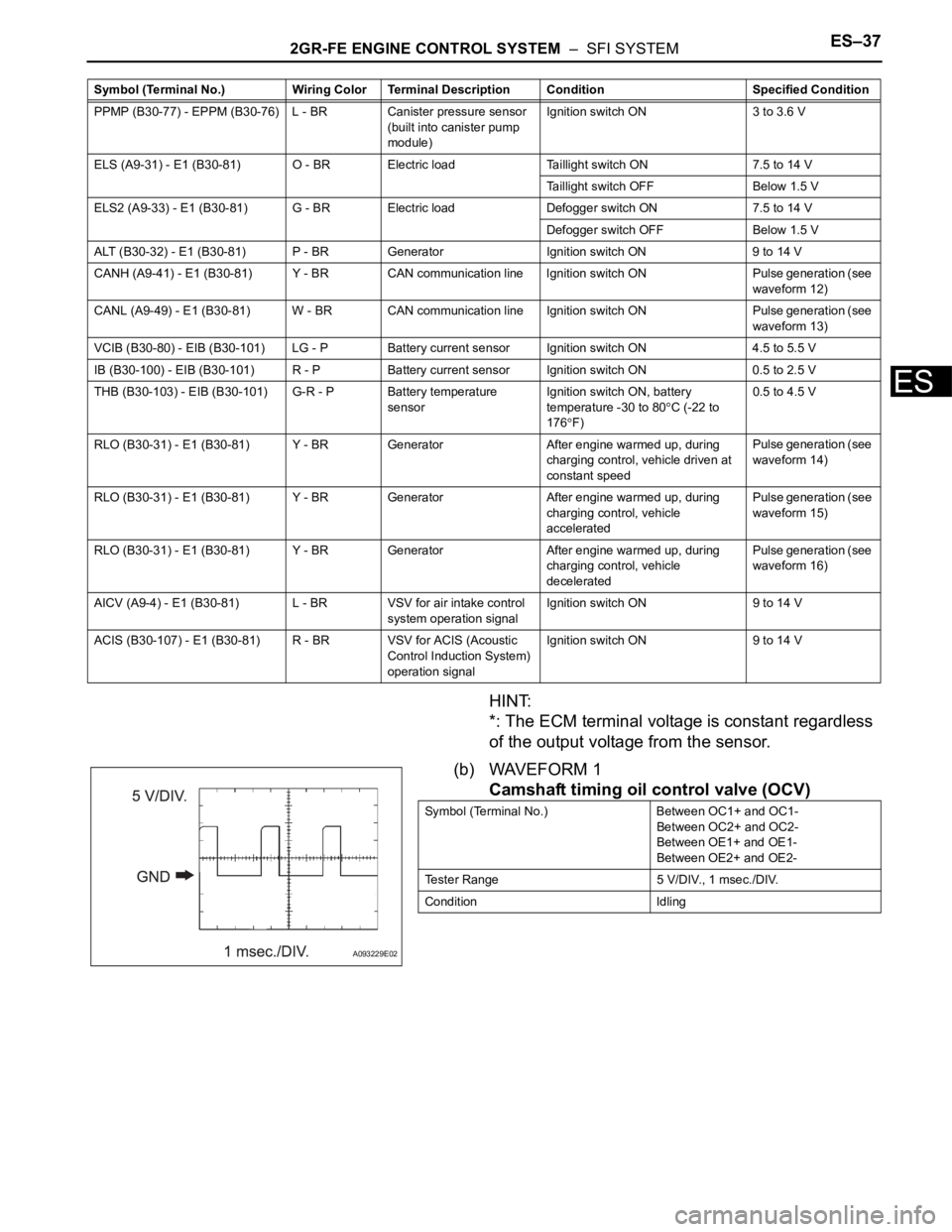
(b) WAVEFORM 1
Camshaft timing oil control valve (OCV)
PPMP (B30-77) - EPPM (B30-76) L - BR Canister pressure sensor
(built into canister pump
module)Ignition switch ON 3 to 3.6 V
ELS (A9-31) - E1 (B30-81) O - BR Electric load Taillight switch ON7.5 to 14 V
Taillight switch OFF Below 1.5 V
ELS2 (A9-33) - E1 (B30-81) G - BR Electric load Defogger switch ON7.5 to 14 V
Defogger switch OFF Below 1.5 V
ALT (B30-32) - E1 (B30-81) P - BR Generator Ignition switch ON 9 to 14 V
CANH (A9-41) - E1 (B30-81) Y - BR CAN communication line Ignition switch ON Pulse generation (see
waveform 12)
CANL (A9-49) - E1 (B30-81) W - BR CAN communication line Ignition switch ON Pulse generation (see
waveform 13)
VCIB (B30-80) - EIB (B30-101) LG - P Battery current sensor Ignition switch ON 4.5 to 5.5 V
IB (B30-100) - EIB (B30-101) R - P Battery current sensor Ignition switch ON 0.5 to 2.5 V
THB (B30-103) - EIB (B30-101) G-R - P Battery temperature
sensorIgnition switch ON, battery
temperature -30 to 80
C (-22 to
176
F)0.5 to 4.5 V
RLO (B30-31) - E1 (B30-81) Y - BR Generator After engine warmed up, during
charging control, vehicle driven at
constant speedPulse generation (see
waveform 14)
RLO (B30-31) - E1 (B30-81) Y - BR Generator After engine warmed up, during
charging control, vehicle
acceleratedPulse generation (see
waveform 15)
RLO (B30-31) - E1 (B30-81) Y - BR Generator After engine warmed up, during
charging control, vehicle
deceleratedPulse generation (see
waveform 16)
AICV (A9-4) - E1 (B30-81) L - BR VSV for air intake control
system operation signalIgnition switch ON 9 to 14 V
ACIS (B30-107) - E1 (B30-81) R - BR VSV for ACIS (Acoustic
Control Induction System)
operation signalIgnition switch ON 9 to 14 V Symbol (Terminal No.) Wiring Color Terminal Description Condition Specified Condition
A093229E02
Symbol (Terminal No.) Between OC1+ and OC1-
Between OC2+ and OC2-
Between OE1+ and OE1-
Between OE2+ and OE2-
Tester Range 5 V/DIV., 1 msec./DIV.
Condition Idling
Page 562 of 2000
ES–382GR-FE ENGINE CONTROL SYSTEM – SFI SYSTEM
ES
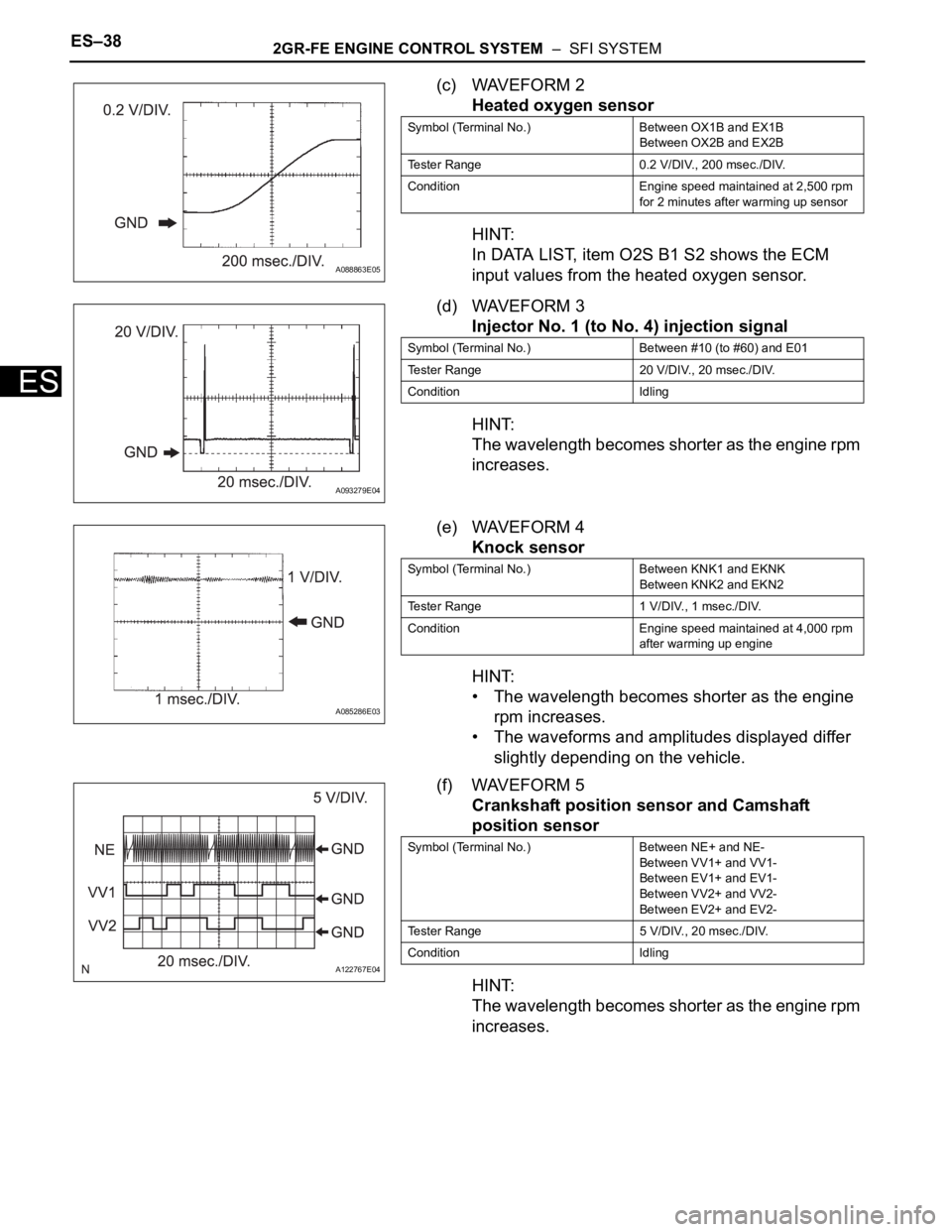
(c) WAVEFORM 2
Heated oxygen sensor
HINT:
In DATA LIST, item O2S B1 S2 shows the ECM
input values from the heated oxygen sensor.
(d) WAVEFORM 3
Injector No. 1 (to No. 4) injection signal
HINT:
The wavelength becomes shorter as the engine rpm
increases.
(e) WAVEFORM 4
Knock sensor
HINT:
• The wavelength becomes shorter as the engine
rpm increases.
• The waveforms and amplitudes displayed differ
slightly depending on the vehicle.
(f) WAVEFORM 5
Crankshaft position sensor and Camshaft
position sensor
HINT:
The wavelength becomes shorter as the engine rpm
increases.
A088863E05
Symbol (Terminal No.) Between OX1B and EX1B
Between OX2B and EX2B
Tester Range 0.2 V/DIV., 200 msec./DIV.
Condition Engine speed maintained at 2,500 rpm
for 2 minutes after warming up sensor
A093279E04
Symbol (Terminal No.) Between #10 (to #60) and E01
Tester Range 20 V/DIV., 20 msec./DIV.
Condition Idling
A085286E03
Symbol (Terminal No.) Between KNK1 and EKNK
Between KNK2 and EKN2
Tester Range 1 V/DIV., 1 msec./DIV.
Condition Engine speed maintained at 4,000 rpm
after warming up engine
A122767E04
Symbol (Terminal No.) Between NE+ and NE-
Between VV1+ and VV1-
Between EV1+ and EV1-
Between VV2+ and VV2-
Between EV2+ and EV2-
Tester Range 5 V/DIV., 20 msec./DIV.
Condition Idling
Page 563 of 2000
2GR-FE ENGINE CONTROL SYSTEM – SFI SYSTEMES–39
ES
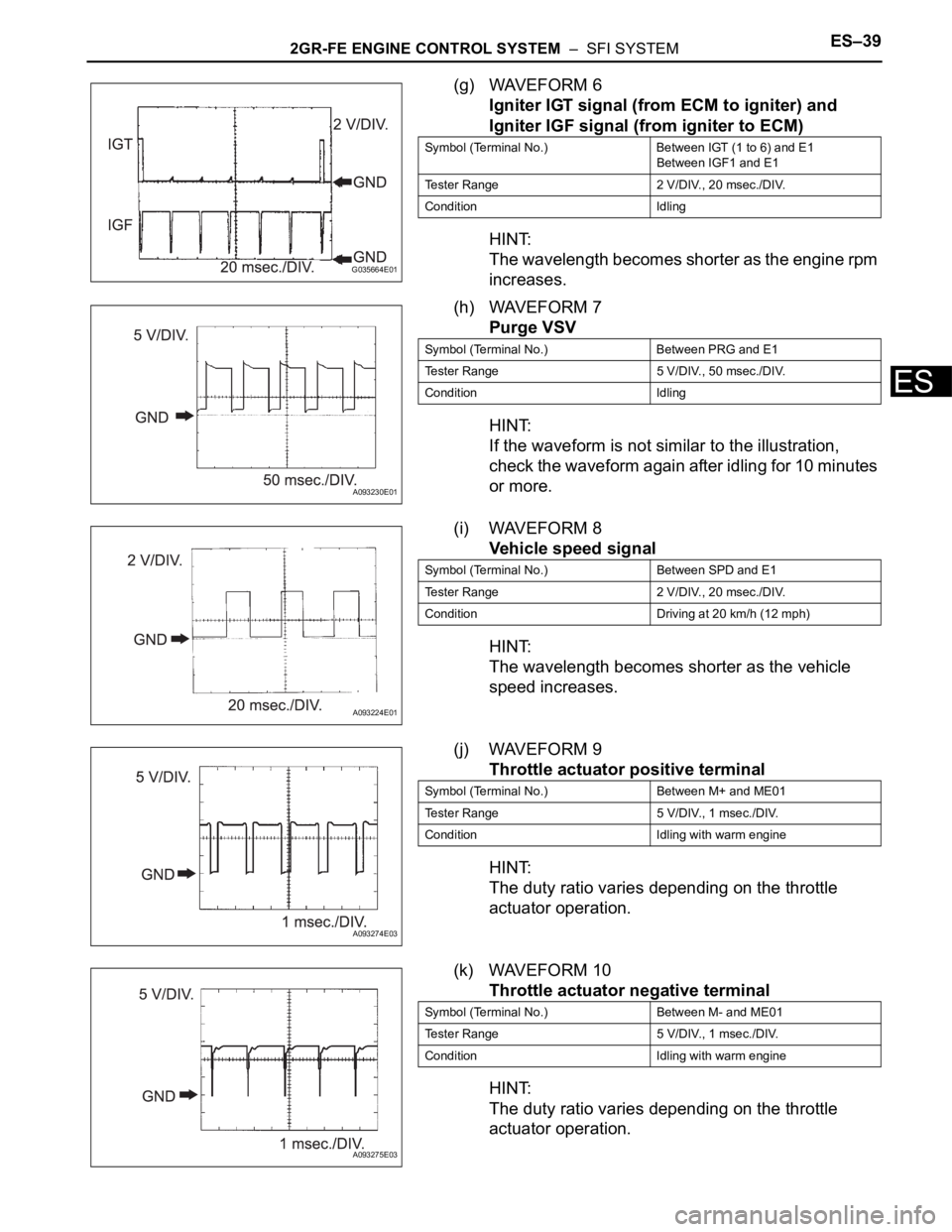
(g) WAVEFORM 6
Igniter IGT signal (from ECM to igniter) and
Igniter IGF signal (from igniter to ECM)
HINT:
The wavelength becomes shorter as the engine rpm
increases.
(h) WAVEFORM 7
Purge VSV
HINT:
If the waveform is not similar to the illustration,
check the waveform again after idling for 10 minutes
or more.
(i) WAVEFORM 8
Vehicle speed signal
HINT:
The wavelength becomes shorter as the vehicle
speed increases.
(j) WAVEFORM 9
Throttle actuator positive terminal
HINT:
The duty ratio varies depending on the throttle
actuator operation.
(k) WAVEFORM 10
Throttle actuator negative terminal
HINT:
The duty ratio varies depending on the throttle
actuator operation.
G035664E01
Symbol (Terminal No.) Between IGT (1 to 6) and E1
Between IGF1 and E1
Tester Range 2 V/DIV., 20 msec./DIV.
Condition Idling
A093230E01
Symbol (Terminal No.) Between PRG and E1
Tester Range 5 V/DIV., 50 msec./DIV.
Condition Idling
A093224E01
Symbol (Terminal No.) Between SPD and E1
Tester Range 2 V/DIV., 20 msec./DIV.
Condition Driving at 20 km/h (12 mph)
A093274E03
Symbol (Terminal No.) Between M+ and ME01
Tester Range 5 V/DIV., 1 msec./DIV.
Condition Idling with warm engine
A093275E03
Symbol (Terminal No.) Between M- and ME01
Tester Range 5 V/DIV., 1 msec./DIV.
Condition Idling with warm engine
Page 564 of 2000
ES–402GR-FE ENGINE CONTROL SYSTEM – SFI SYSTEM
ES
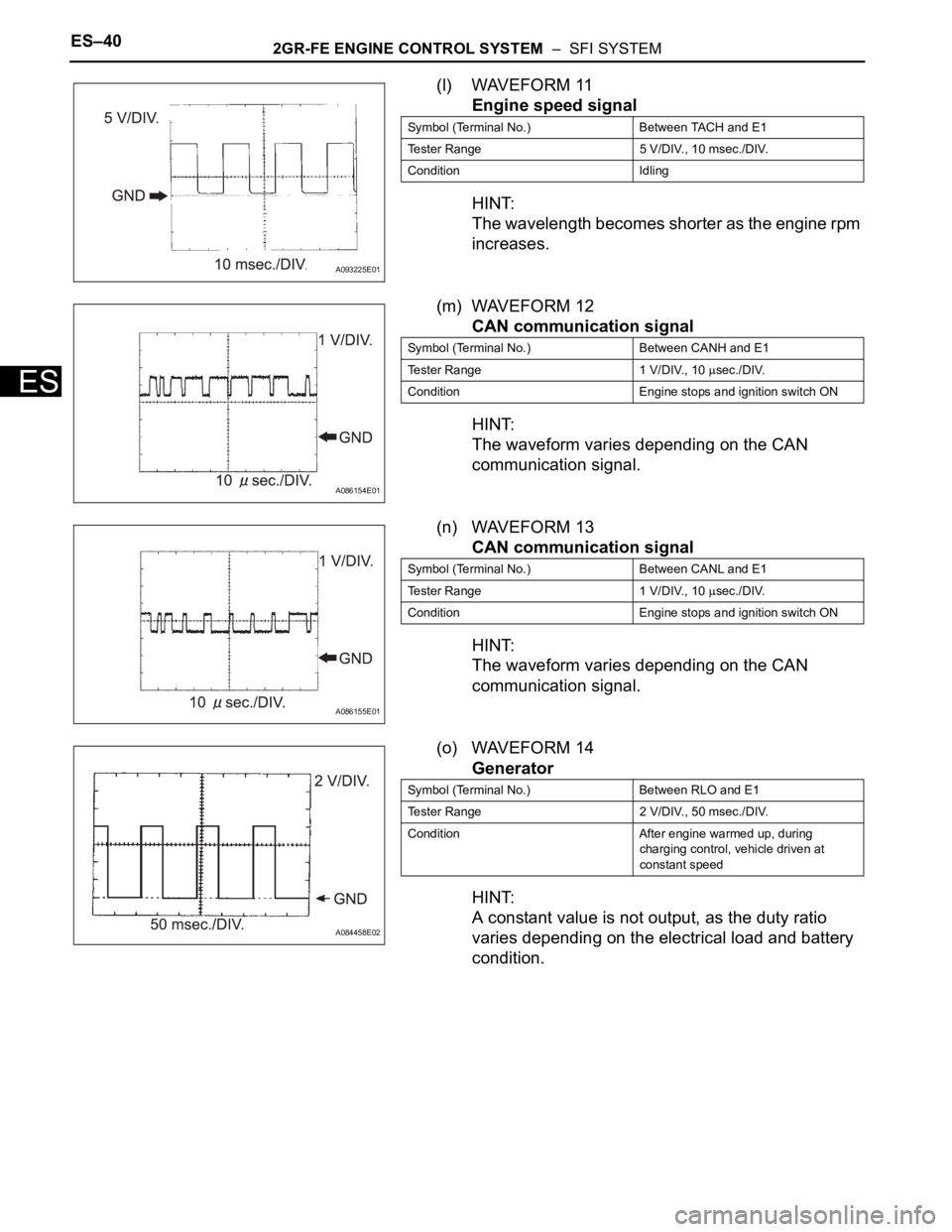
(l) WAVEFORM 11
Engine speed signal
HINT:
The wavelength becomes shorter as the engine rpm
increases.
(m) WAVEFORM 12
CAN communication signal
HINT:
The waveform varies depending on the CAN
communication signal.
(n) WAVEFORM 13
CAN communication signal
HINT:
The waveform varies depending on the CAN
communication signal.
(o) WAVEFORM 14
Generator
HINT:
A constant value is not output, as the duty ratio
varies depending on the electrical load and battery
condition.
A093225E01
Symbol (Terminal No.) Between TACH and E1
Tester Range 5 V/DIV., 10 msec./DIV.
Condition Idling
A086154E01
Symbol (Terminal No.) Between CANH and E1
Tester Range 1 V/DIV., 10
sec./DIV.
Condition Engine stops and ignition switch ON
A086155E01
Symbol (Terminal No.) Between CANL and E1
Tester Range 1 V/DIV., 10
sec./DIV.
Condition Engine stops and ignition switch ON
A084458E02
Symbol (Terminal No.) Between RLO and E1
Tester Range 2 V/DIV., 50 msec./DIV.
Condition After engine warmed up, during
charging control, vehicle driven at
constant speed
Page 565 of 2000
2GR-FE ENGINE CONTROL SYSTEM – SFI SYSTEMES–41
ES
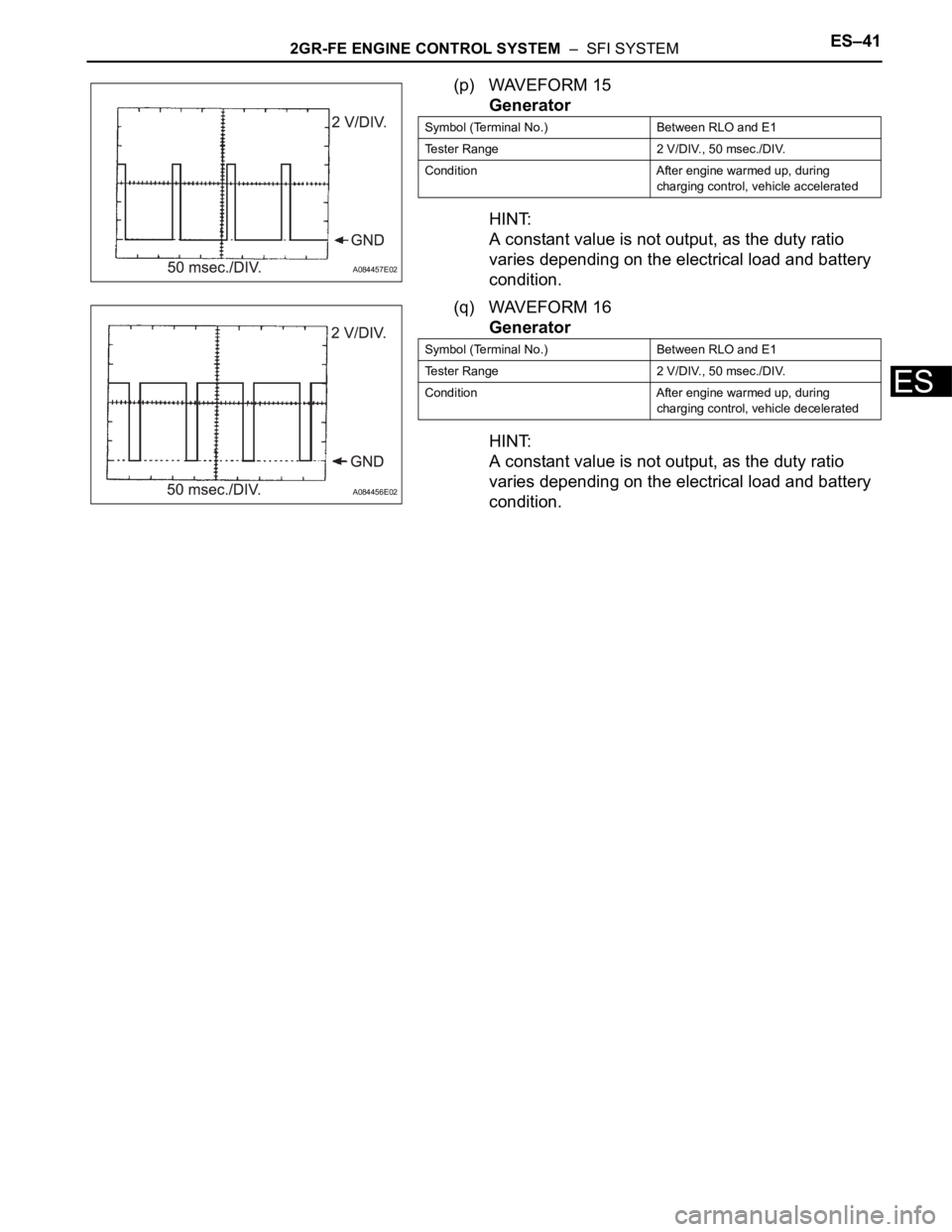
(p) WAVEFORM 15
Generator
HINT:
A constant value is not output, as the duty ratio
varies depending on the electrical load and battery
condition.
(q) WAVEFORM 16
Generator
HINT:
A constant value is not output, as the duty ratio
varies depending on the electrical load and battery
condition.
A084457E02
Symbol (Terminal No.) Between RLO and E1
Tester Range 2 V/DIV., 50 msec./DIV.
Condition After engine warmed up, during
charging control, vehicle accelerated
A084456E02
Symbol (Terminal No.) Between RLO and E1
Tester Range 2 V/DIV., 50 msec./DIV.
Condition After engine warmed up, during
charging control, vehicle decelerated
Page 567 of 2000
2GR-FE ENGINE CONTROL SYSTEM – SFI SYSTEMES–43
ES
3. 2 TRIP DETECTION LOGIC
When a malfunction is first detected, the malfunction is
temporarily stored in the ECM memory (1st trip). If the
same malfunction is detected during the next
subsequent drive cycle, the MIL is illuminated (2nd trip).
4. FREEZE FRAME DATA
Freeze frame data records the engine conditions (fuel
system, calculated engine load, engine coolant
temperature, fuel trim, engine speed, vehicle speed,
etc.) when malfunctions are detected. When
troubleshooting, freeze frame data can help determine if
the vehicle was moving or stationary, if the engine was
warmed up or not, if the air-fuel ratio was lean or rich,
and other data from the time the malfunction occurred.
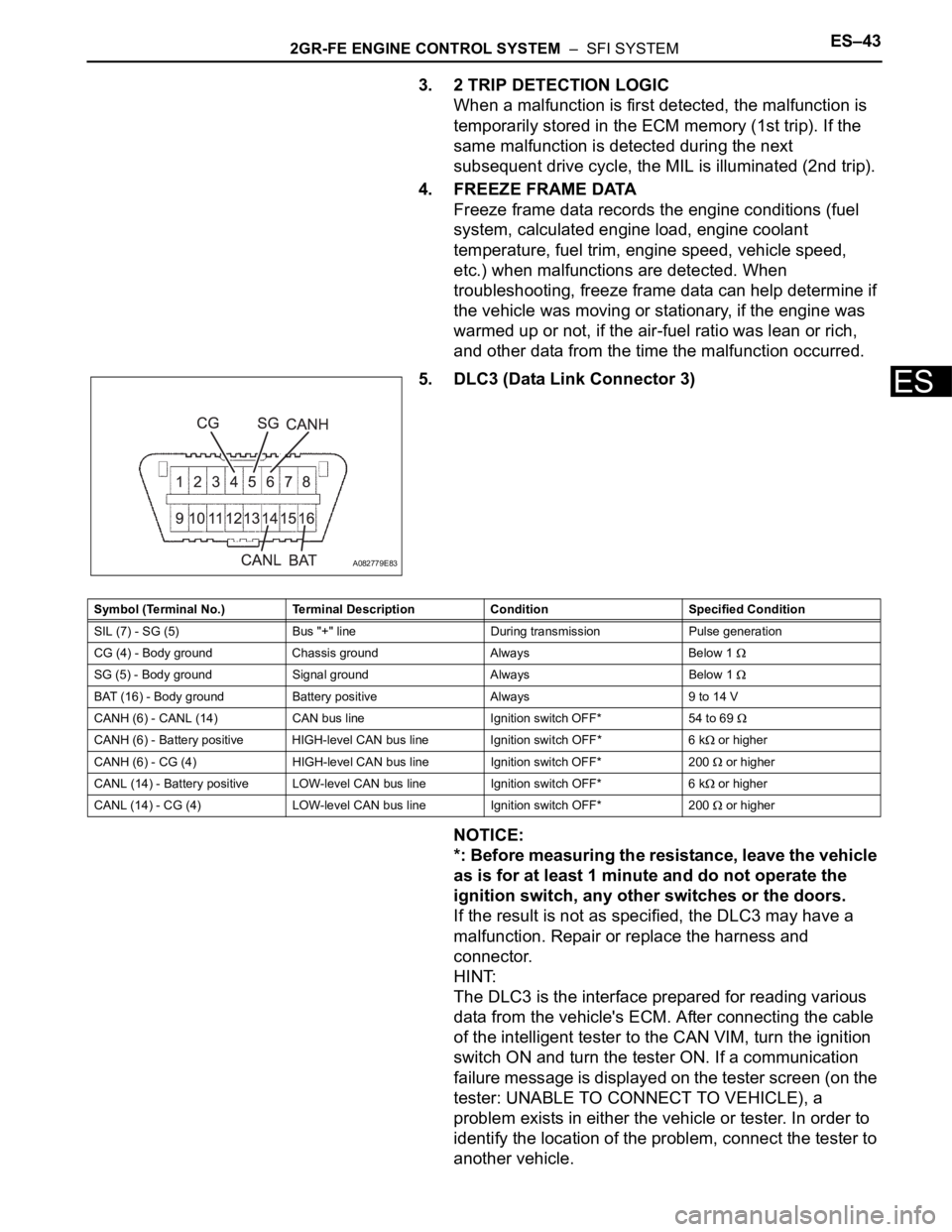
5. DLC3 (Data Link Connector 3)
NOTICE:
*: Before measuring the resistance, leave the vehicle
as is for at least 1 minute and do not operate the
ignition switch, any other switches or the doors.
If the result is not as specified, the DLC3 may have a
malfunction. Repair or replace the harness and
connector.
HINT:
The DLC3 is the interface prepared for reading various
data from the vehicle's ECM. After connecting the cable
of the intelligent tester to the CAN VIM, turn the ignition
switch ON and turn the tester ON. If a communication
failure message is displayed on the tester screen (on the
tester: UNABLE TO CONNECT TO VEHICLE), a
problem exists in either the vehicle or tester. In order to
identify the location of the problem, connect the tester to
another vehicle.
A082779E83
Symbol (Terminal No.) Terminal Description Condition Specified Condition
SIL (7) - SG (5) Bus "+" line During transmission Pulse generation
CG (4) - Body ground Chassis ground Always Below 1
SG (5) - Body ground Signal ground Always Below 1
BAT (16) - Body ground Battery positive Always 9 to 14 V
CANH (6) - CANL (14) CAN bus line Ignition switch OFF* 54 to 69
CANH (6) - Battery positive HIGH-level CAN bus line Ignition switch OFF* 6 k or higher
CANH (6) - CG (4) HIGH-level CAN bus line Ignition switch OFF* 200
or higher
CANL (14) - Battery positive LOW-level CAN bus line Ignition switch OFF* 6 k
or higher
CANL (14) - CG (4) LOW-level CAN bus line Ignition switch OFF* 200
or higher
Page 570 of 2000
ES–462GR-FE ENGINE CONTROL SYSTEM – SFI SYSTEM
ES
FREEZE FRAME DATA
1. DESCRIPTION
Freeze frame data records the engine conditions (fuel
system, calculated load, engine coolant temperature,
fuel trim, engine speed, vehicle speed, etc.) when a
malfunction is detected. When troubleshooting, it can
help determine if the vehicle was running or stopped, the
engine was warmed up or not, the air-fuel ratio was Lean
or Rich, and other data from the time the malfunction
occurred.
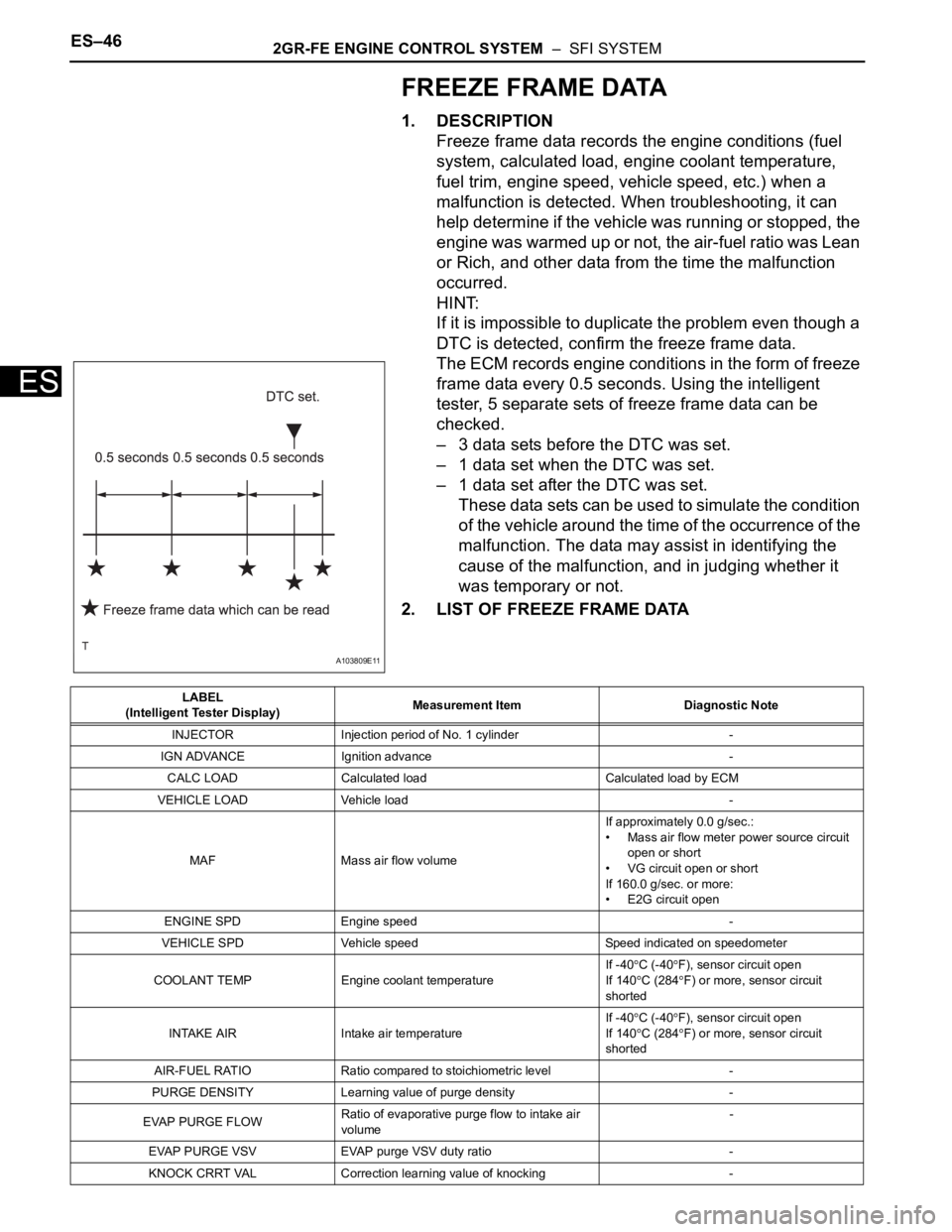
HINT:
If it is impossible to duplicate the problem even though a
DTC is detected, confirm the freeze frame data.
The ECM records engine conditions in the form of freeze
frame data every 0.5 seconds. Using the intelligent
tester, 5 separate sets of freeze frame data can be
checked.
– 3 data sets before the DTC was set.
– 1 data set when the DTC was set.
– 1 data set after the DTC was set.
These data sets can be used to simulate the condition
of the vehicle around the time of the occurrence of the
malfunction. The data may assist in identifying the
cause of the malfunction, and in judging whether it
was temporary or not.
2. LIST OF FREEZE FRAME DATA
A103809E11
LABEL
(Intelligent Tester Display)Measurement Item Diagnostic Note
INJECTOR Injection period of No. 1 cylinder -
IGN ADVANCE Ignition advance -
CALC LOAD Calculated load Calculated load by ECM
VEHICLE LOAD Vehicle load -
MAF Mass air flow volumeIf approximately 0.0 g/sec.:
• Mass air flow meter power source circuit
open or short
• VG circuit open or short
If 160.0 g/sec. or more:
• E2G circuit open
ENGINE SPD Engine speed -
VEHICLE SPD Vehicle speed Speed indicated on speedometer
COOLANT TEMP Engine coolant temperatureIf -40
C (-40F), sensor circuit open
If 140
C (284F) or more, sensor circuit
shorted
INTAKE AIR Intake air temperature If -40
C (-40F), sensor circuit open
If 140
C (284F) or more, sensor circuit
shorted
AIR-FUEL RATIO Ratio compared to stoichiometric level -
PURGE DENSITY Learning value of purge density -
EVAP PURGE FLOWRatio of evaporative purge flow to intake air
volume-
EVAP PURGE VSV EVAP purge VSV duty ratio -
KNOCK CRRT VAL Correction learning value of knocking -
Page 572 of 2000

ES–482GR-FE ENGINE CONTROL SYSTEM – SFI SYSTEM
ES
VVT CTRL B1
VVT CTRL B2VVT control status-
VA C U U M P U M PKey-off EVAP system leak detection pump
status(see page ES-369)
EVAP VENT VAL Key-off EVAP system vent valve status -
FAN MOTOR Electric fan motor -
AICV VSV VSV for Air Intake Control System (AICS) -
TC/TE1 TC and CG (TE1) terminals of DLC3 -
FC IDL Fuel cut idleON: when throttle valve fully closed and
engine speed over 3,500 rpm
FC TAU Fuel cut during very light loadFuel cut being performed under very light load
to prevent engine combustion from becoming
incomplete
IGNITION Ignition counter -
CYL #1 Cylinder #1 misfire Only displayed during idling
CYL #2 Cylinder #2 misfire Only displayed during idling
CYL #3 Cylinder #3 misfire Only displayed during idling
CYL #4 Cylinder #4 misfire Only displayed during idling
CYL #5 Cylinder #5 misfire Only displayed during idling
CYL #6 Cylinder #6 misfire Only displayed during idling
CYL ALL All cylinders misfire Only displayed during idling
MISFIRE RPM Engine speed when misfire occurred -
MISFIRE LOAD Engine load when misfire occurred -
MISFIRE MARGIN Margin to detect engine misfire -
ENG RUN TIME Accumulated engine running time -
TIME DTC CLEAR Cumulative time after DTC cleared -
DIST DTC CLEAR Accumulated distance from DTC cleared -
WU CYC DTC CLEAR Warm-up cycle after DTC cleared -LABEL
(Intelligent Tester Display)Measurement Item Diagnostic Note
Page 1337 of 2000
GF1A TRANSFER – ACTIVE TORQUE CONTROL 4WD SYSTEMTF–9
TF
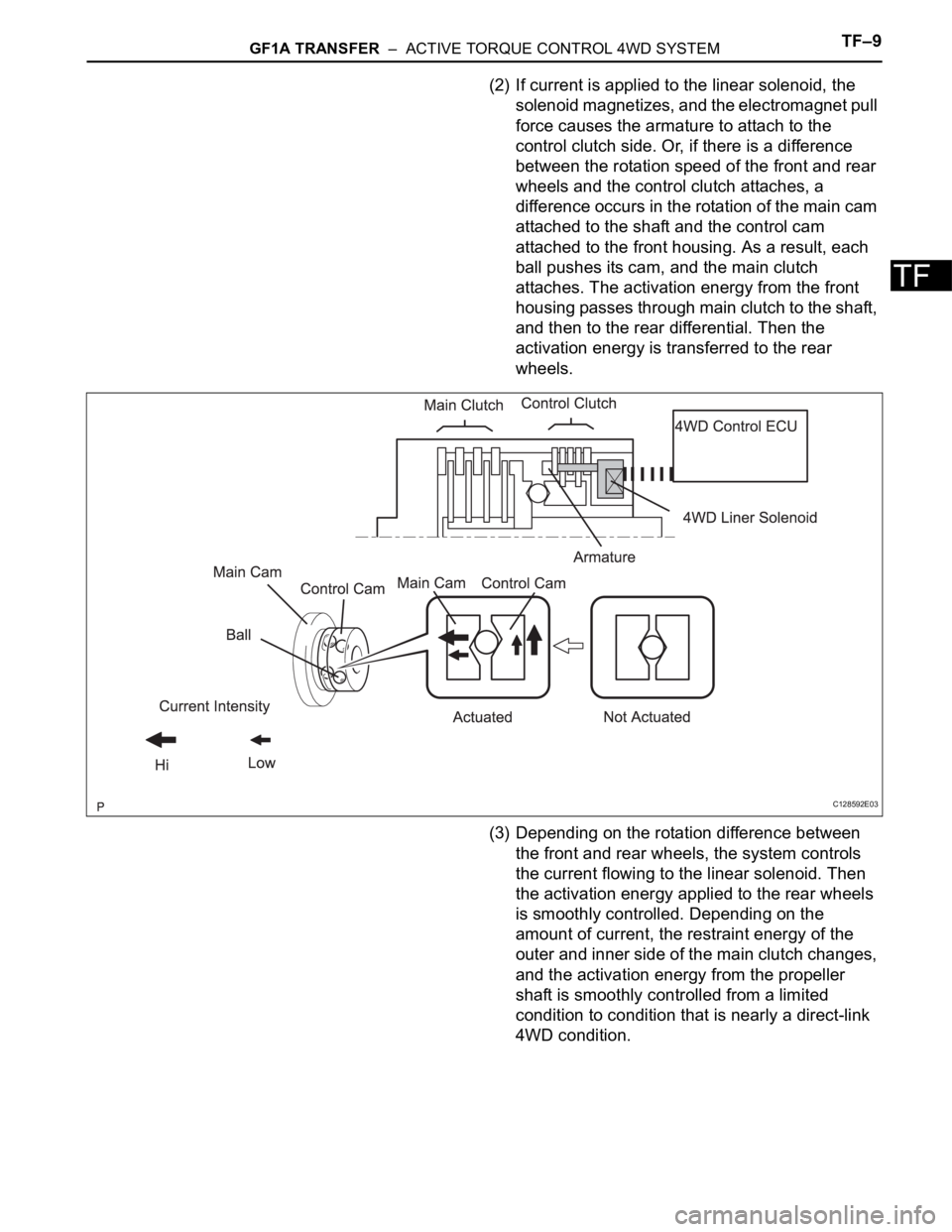
(2) If current is applied to the linear solenoid, the
solenoid magnetizes, and the electromagnet pull
force causes the armature to attach to the
control clutch side. Or, if there is a difference
between the rotation speed of the front and rear
wheels and the control clutch attaches, a
difference occurs in the rotation of the main cam
attached to the shaft and the control cam
attached to the front housing. As a result, each
ball pushes its cam, and the main clutch
attaches. The activation energy from the front
housing passes through main clutch to the shaft,
and then to the rear differential. Then the
activation energy is transferred to the rear
wheels.
(3) Depending on the rotation difference between
the front and rear wheels, the system controls
the current flowing to the linear solenoid. Then
the activation energy applied to the rear wheels
is smoothly controlled. Depending on the
amount of current, the restraint energy of the
outer and inner side of the main clutch changes,
and the activation energy from the propeller
shaft is smoothly controlled from a limited
condition to condition that is nearly a direct-link
4WD condition.
C128592E03