torque TOYOTA RAV4 2006 Service Repair Manual
[x] Cancel search | Manufacturer: TOYOTA, Model Year: 2006, Model line: RAV4, Model: TOYOTA RAV4 2006Pages: 2000, PDF Size: 45.84 MB
Page 1893 of 2000

WIPER AND WASHER – FRONT WIPER MOTOR AND LINKWW–13
WW
(c) Install the arm and blade with the nut. Make sure
that the arm and blade comes to the position shown
in the illustration.
Torque: 21 N*m (214 kgf*cm, 23 ft.*lbf)
HINT:
Hold down the arm hinge with your hand while
tightening the nut.
(d) Operate the front wipers while spraying water or
washer fluid on the windshield. Ensure that there is
no interference between the blades and pillar.
8. INSTALL FRONT WIPER ARM HEAD CAP
(a) Install the 2 caps.
9. CONNECT CABLE TO NEGATIVE BATTERY
TERMINAL
B133594E01
Page 1894 of 2000
WW–20WIPER AND WASHER – REAR WIPER MOTOR
WW
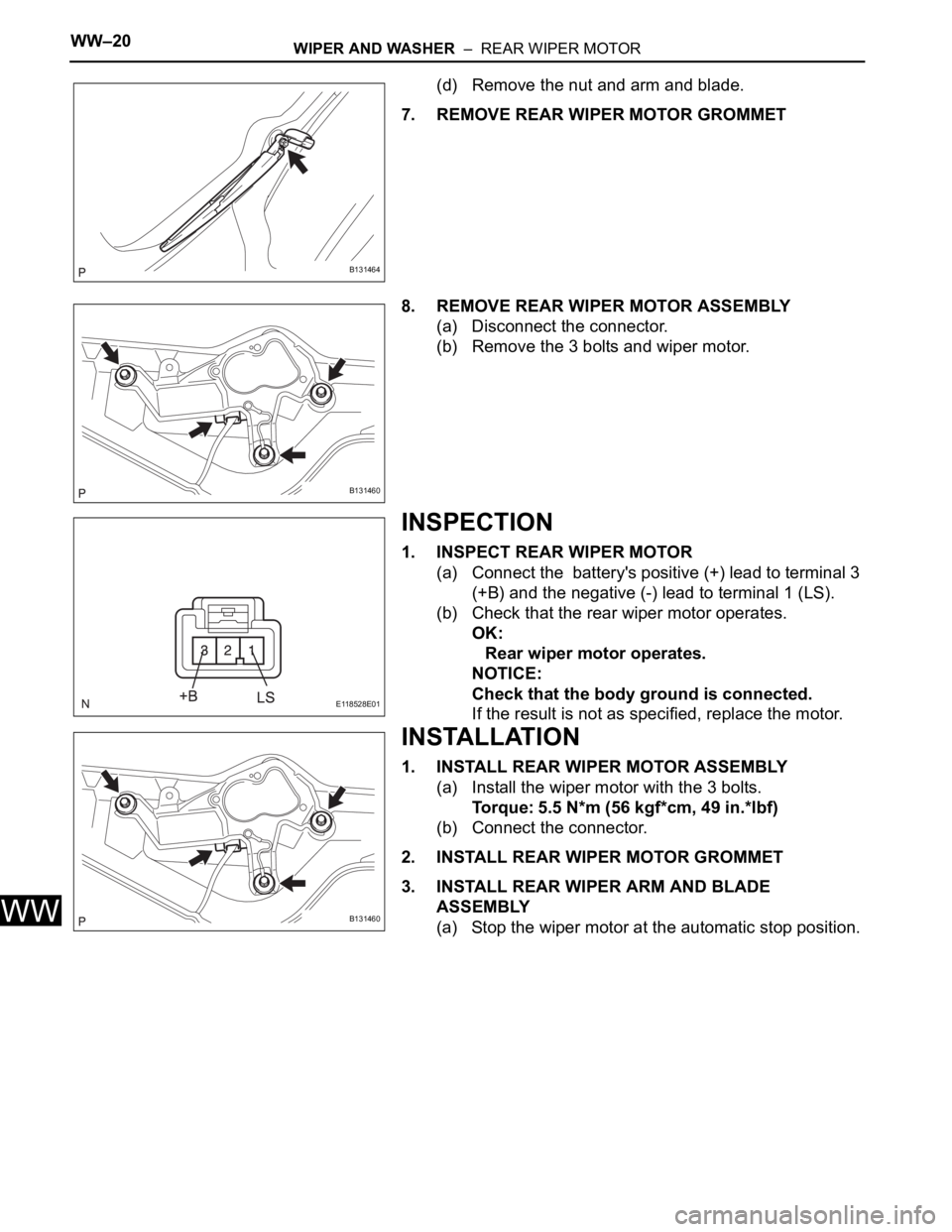
(d) Remove the nut and arm and blade.
7. REMOVE REAR WIPER MOTOR GROMMET
8. REMOVE REAR WIPER MOTOR ASSEMBLY
(a) Disconnect the connector.
(b) Remove the 3 bolts and wiper motor.
INSPECTION
1. INSPECT REAR WIPER MOTOR
(a) Connect the battery's positive (+) lead to terminal 3
(+B) and the negative (-) lead to terminal 1 (LS).
(b) Check that the rear wiper motor operates.
OK:
Rear wiper motor operates.
NOTICE:
Check that the body ground is connected.
If the result is not as specified, replace the motor.
INSTALLATION
1. INSTALL REAR WIPER MOTOR ASSEMBLY
(a) Install the wiper motor with the 3 bolts.
Torque: 5.5 N*m (56 kgf*cm, 49 in.*lbf)
(b) Connect the connector.
2. INSTALL REAR WIPER MOTOR GROMMET
3. INSTALL REAR WIPER ARM AND BLADE
ASSEMBLY
(a) Stop the wiper motor at the automatic stop position.
B131464
B131460
E118528E01
B131460
Page 1895 of 2000
WIPER AND WASHER – REAR WIPER MOTORWW–21
WW
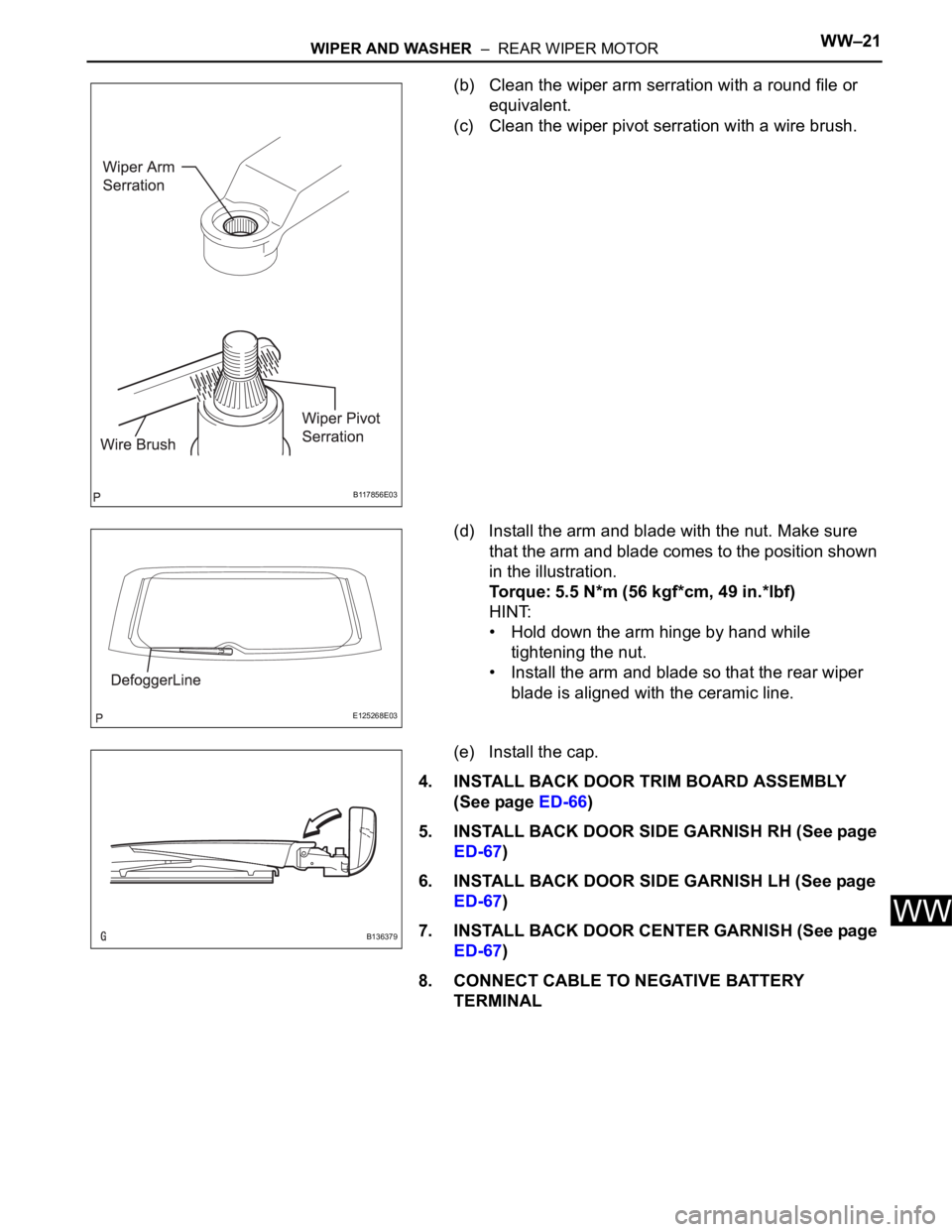
(b) Clean the wiper arm serration with a round file or
equivalent.
(c) Clean the wiper pivot serration with a wire brush.
(d) Install the arm and blade with the nut. Make sure
that the arm and blade comes to the position shown
in the illustration.
Torque: 5.5 N*m (56 kgf*cm, 49 in.*lbf)
HINT:
• Hold down the arm hinge by hand while
tightening the nut.
• Install the arm and blade so that the rear wiper
blade is aligned with the ceramic line.
(e) Install the cap.
4. INSTALL BACK DOOR TRIM BOARD ASSEMBLY
(See page ED-66)
5. INSTALL BACK DOOR SIDE GARNISH RH (See page
ED-67)
6. INSTALL BACK DOOR SIDE GARNISH LH (See page
ED-67)
7. INSTALL BACK DOOR CENTER GARNISH (See page
ED-67)
8. CONNECT CABLE TO NEGATIVE BATTERY
TERMINAL
B117856E03
E125268E03
B136379
Page 1957 of 2000
2AZ-FE ENGINE CONTROL SYSTEM – SFI SYSTEMES–69
ES
DESCRIPTION
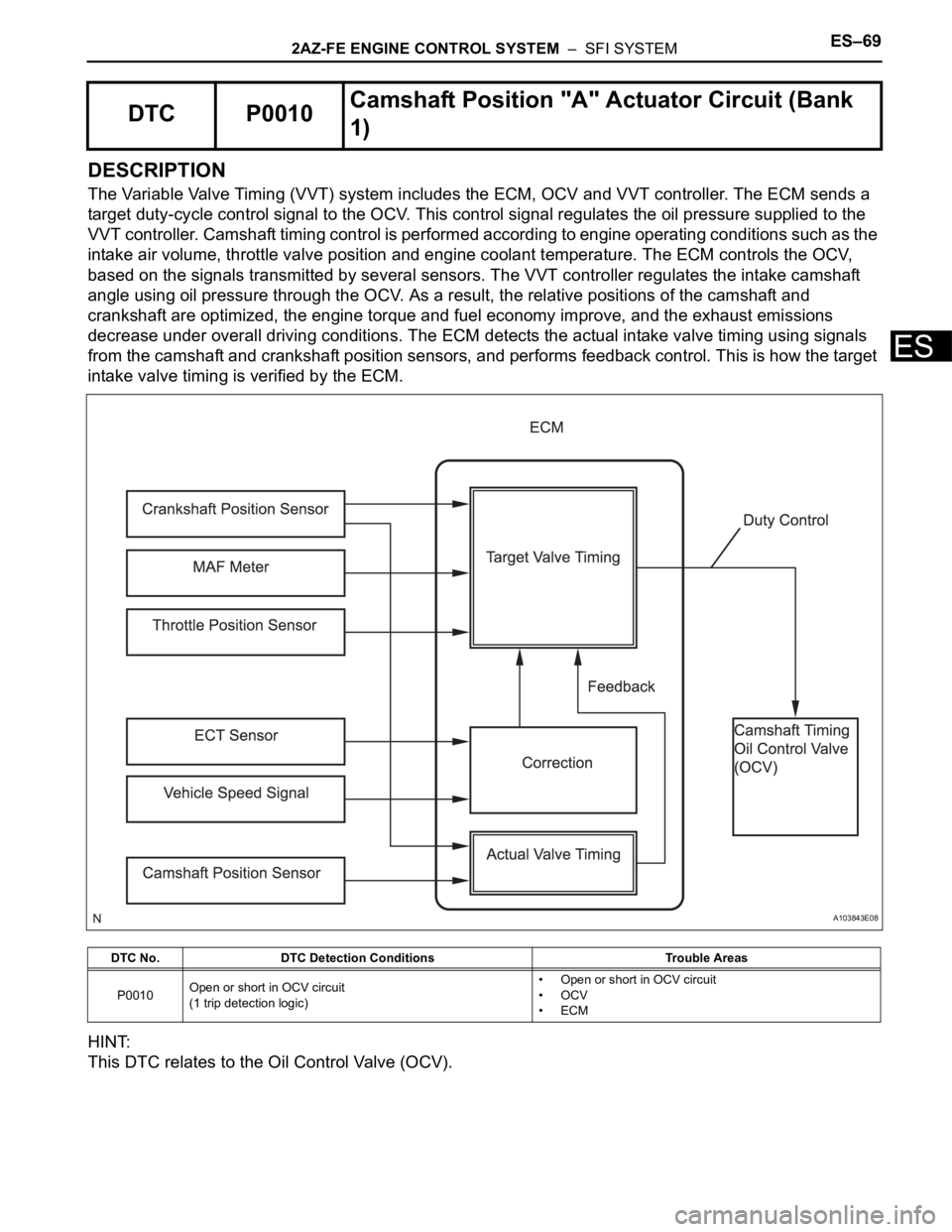
The Variable Valve Timing (VVT) system includes the ECM, OCV and VVT controller. The ECM sends a
target duty-cycle control signal to the OCV. This control signal regulates the oil pressure supplied to the
VVT controller. Camshaft timing control is performed according to engine operating conditions such as the
intake air volume, throttle valve position and engine coolant temperature. The ECM controls the OCV,
based on the signals transmitted by several sensors. The VVT controller regulates the intake camshaft
angle using oil pressure through the OCV. As a result, the relative positions of the camshaft and
crankshaft are optimized, the engine torque and fuel economy improve, and the exhaust emissions
decrease under overall driving conditions. The ECM detects the actual intake valve timing using signals
from the camshaft and crankshaft position sensors, and performs feedback control. This is how the target
intake valve timing is verified by the ECM.
HINT:
This DTC relates to the Oil Control Valve (OCV).
DTC P0010Camshaft Position "A" Actuator Circuit (Bank
1)
DTC No. DTC Detection Conditions Trouble Areas
P0010Open or short in OCV circuit
(1 trip detection logic)• Open or short in OCV circuit
•OCV
•ECM
A103843E08
Page 1961 of 2000
2AZ-FE ENGINE CONTROL SYSTEM – SFI SYSTEMES–73
ES
DESCRIPTION
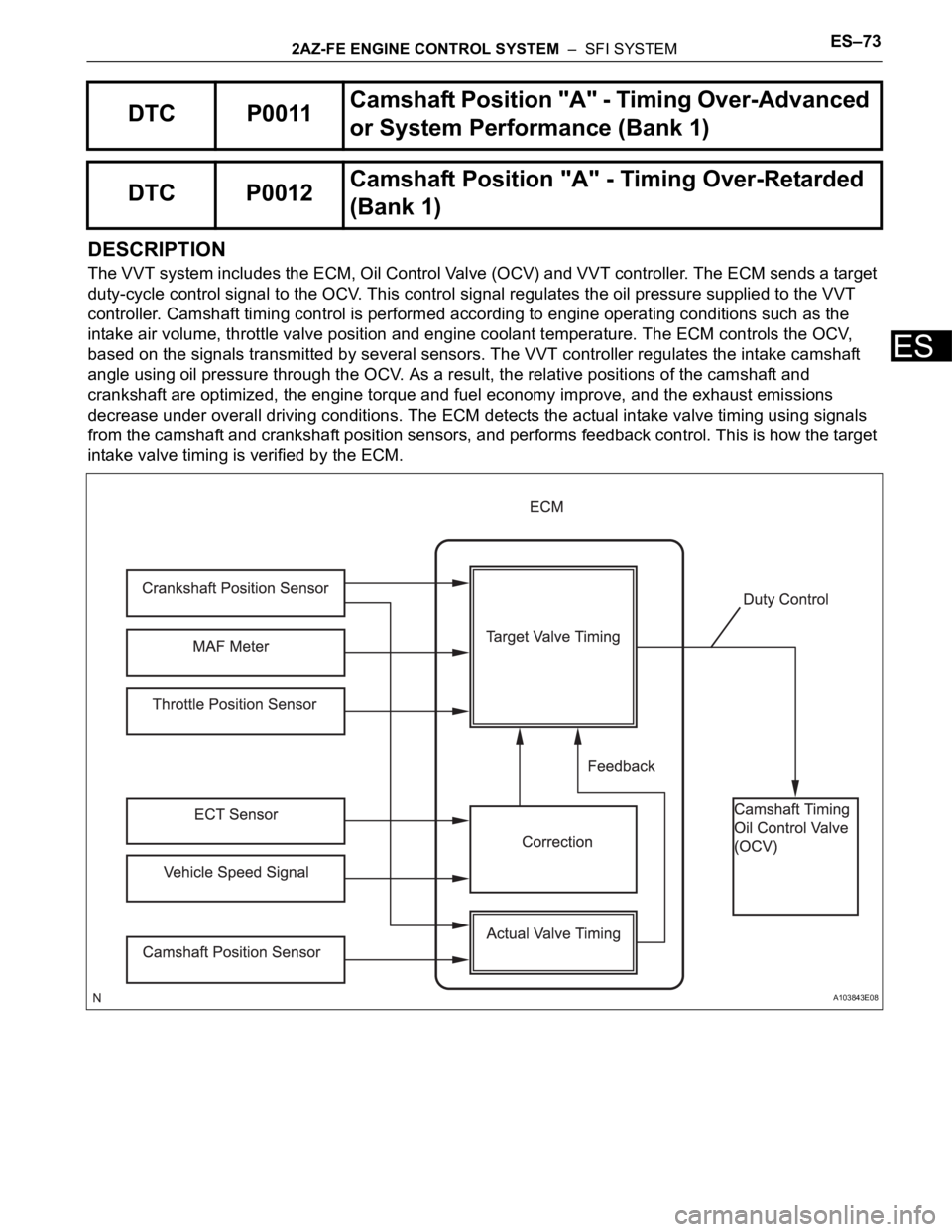
The VVT system includes the ECM, Oil Control Valve (OCV) and VVT controller. The ECM sends a target
duty-cycle control signal to the OCV. This control signal regulates the oil pressure supplied to the VVT
controller. Camshaft timing control is performed according to engine operating conditions such as the
intake air volume, throttle valve position and engine coolant temperature. The ECM controls the OCV,
based on the signals transmitted by several sensors. The VVT controller regulates the intake camshaft
angle using oil pressure through the OCV. As a result, the relative positions of the camshaft and
crankshaft are optimized, the engine torque and fuel economy improve, and the exhaust emissions
decrease under overall driving conditions. The ECM detects the actual intake valve timing using signals
from the camshaft and crankshaft position sensors, and performs feedback control. This is how the target
intake valve timing is verified by the ECM.
DTC P0011Camshaft Position "A" - Timing Over-Advanced
or System Performance (Bank 1)
DTC P0012Camshaft Position "A" - Timing Over-Retarded
(Bank 1)
A103843E08