Control arm TOYOTA RAV4 2006 Service Repair Manual
[x] Cancel search | Manufacturer: TOYOTA, Model Year: 2006, Model line: RAV4, Model: TOYOTA RAV4 2006Pages: 2000, PDF Size: 45.84 MB
Page 76 of 2000

ENGINE - 2GR-FE ENGINE
285EG18
Secondary
Timing
ChainExhaust Camshaft Intake CamshaftsExhaust Camshaft
Roller Rocker Arm
Va l v e S p r i n g
Retainer
Va l v e S p r i n g
Hydraulic
Lash Adjuster
Va l v e G u i d e
Bush Va l v e S p r i n g
Sheet
Va l v e
Secondary Timing
Chain Primary
Timing
Chain EG-80
VA LV E M E C H A N I S M
1. General
Each cylinder of this engine has 2 intake valves and 2 exhaust valves. Intake and exhaust efficiency is
increased due to the larger total port areas.
This engine uses roller rocker arms with built-in needle bearings. This reduces the friction that occurs
between the cams and the areas (roller rocker arms) that push the valves down, thus improving fuel
economy.
A hydraulic lash adjuster, which maintains a constant zero valve clearance through the use of oil pressure
and spring force, is used.
The intake camshafts are driven by the crankshaft via the primary timing chain. The exhaust camshafts
are driven by the intake camshaft of the respective bank via the secondary timing chain.
This engine uses a Dual VVT-i (Variable Valve Timing-intelligent) system which controls the intake and
exhaust camshafts to provide optimal valve timing according to driving conditions. With this adoption,
lower fuel consumption, higher engine performance, and fewer exhaust emissions have been achieved.
For details of Dual VVT-i control, see page EG-120.
Page 77 of 2000

ENGINE - 2GR-FE ENGINE
285EG19
VVT-i
ControllerNo. 2 Camshaft
(Exhaust)
Timing
Rotor
VVT-i ControllerNo. 1 Camshaft
(Intake)
No. 3 Camshaft
(Intake)
Timing
Rotor
VVT-i Controller
VVT-i ControllerNo. 4 Camshaft
(Exhaust)Indented R portion
of cam (Profile)
Cam with indented REG-81
2. Camshaft
The camshafts are made of cast iron alloy.
An oil passage is provided on the intake and exhaust camshafts in order to supply engine oil to the VVT-i
system.
A VVT-i controller has been installed on the front of the intake and exhaust camshafts to vary the timing
of the intake and exhaust valves.
Together with the use of the roller rocker arm, the cam profile has been designed with an indented R
(radius). This results in increased valve lift when the valve begins to open and finishes closing, helping
to achieve enhanced output performance.
Page 210 of 2000

INTRODUCTION – REPAIR INSTRUCTIONIN–27
IN
5. Lighting System
WIRLS BUZZ OPER ONFunction that makes wireless
buzzer sound for answer-back
when transmitter LOCK /
UNLOCK switch pressedON / OFF
OPEN DOOR WARN ONIf door is not completely closed
and transmitter LOCK switch is
pressed, this function sounds a
buzzer for 10 secondsON / OFF
WIRELESS OPER ONON / OFF of wireless door lock
functionON / OFF
ALARM FUNCTION ONOperates security alarm when
PANIC switch on transmitter
continuously pressed for 1
secondON / OFF
UNLOCK / 2 OPER ONFunction that unlocks driver side
door when unlock switch on
transmitter is pressed once, and
unlocks all doors when pressed
twice. If setting is OFF, pressing
unlock switch once makes all
doors unlock.ON / OFF
AUTO LOCK DELAY 30sThis function controls amount of
time from unlocking doors to
automatic re-locking function30s / 60s Display (Item) Default Contents Setting
Display (Item) Default Contents Setting
LIGHTING TIME
(Lighting Time)15 secondsChanges illumination duration
after door closure.
(It will quickly fade out in case of
turning ignition switch ON.)7.5/15/30 (seconds)
I/L ON /ACC OFF
(Room light illuminates when
ignition switch turned OFF)ONIlluminates light when ignition
switch turned to ACC.
(Room light illuminated when
interior light switch in DOOR
position)ON / OFF
I/L ON / UNLOCK
(Room light illuminates when
door key unlocked.)ONFunction to light up room light
when unlocking with door key
cylinder.
(Room light illuminated when
interior light switch in DOOR
position)ON / OFF
LIGHT CONTROL ONFunction to light up foot light
when ignition switch is ON and
shift position is not P.ON / OFF
Page 479 of 2000
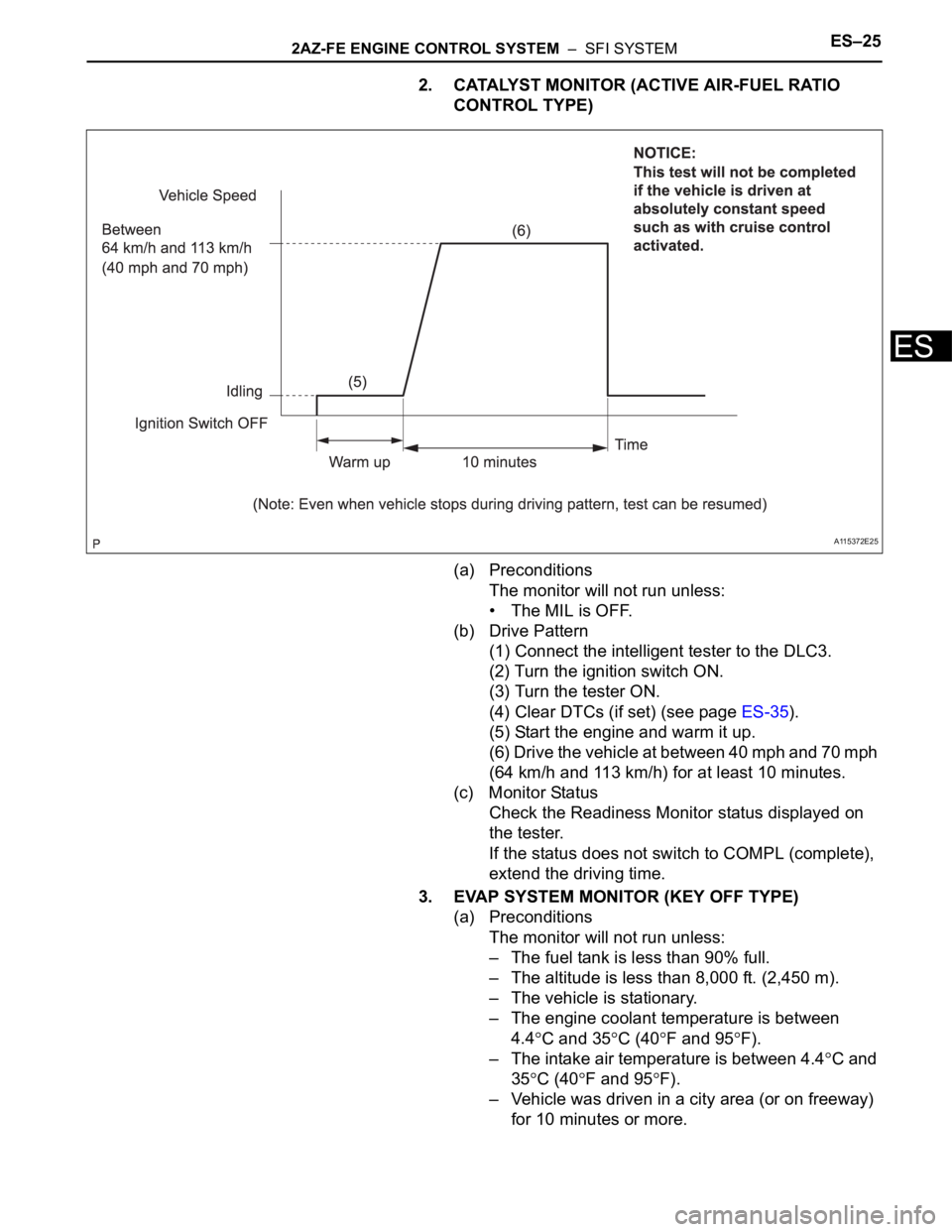
2AZ-FE ENGINE CONTROL SYSTEM – SFI SYSTEMES–25
ES
2. CATALYST MONITOR (ACTIVE AIR-FUEL RATIO
CONTROL TYPE)
(a) Preconditions
The monitor will not run unless:
• The MIL is OFF.
(b) Drive Pattern
(1) Connect the intelligent tester to the DLC3.
(2) Turn the ignition switch ON.
(3) Turn the tester ON.
(4) Clear DTCs (if set) (see page ES-35).
(5) Start the engine and warm it up.
(6) Drive the vehicle at between 40 mph and 70 mph
(64 km/h and 113 km/h) for at least 10 minutes.
(c) Monitor Status
Check the Readiness Monitor status displayed on
the tester.
If the status does not switch to COMPL (complete),
extend the driving time.
3. EVAP SYSTEM MONITOR (KEY OFF TYPE)
(a) Preconditions
The monitor will not run unless:
– The fuel tank is less than 90% full.
– The altitude is less than 8,000 ft. (2,450 m).
– The vehicle is stationary.
– The engine coolant temperature is between
4.4
C and 35C (40F and 95F).
– The intake air temperature is between 4.4
C and
35
C (40F and 95F).
– Vehicle was driven in a city area (or on freeway)
for 10 minutes or more.
A115372E25
Page 481 of 2000
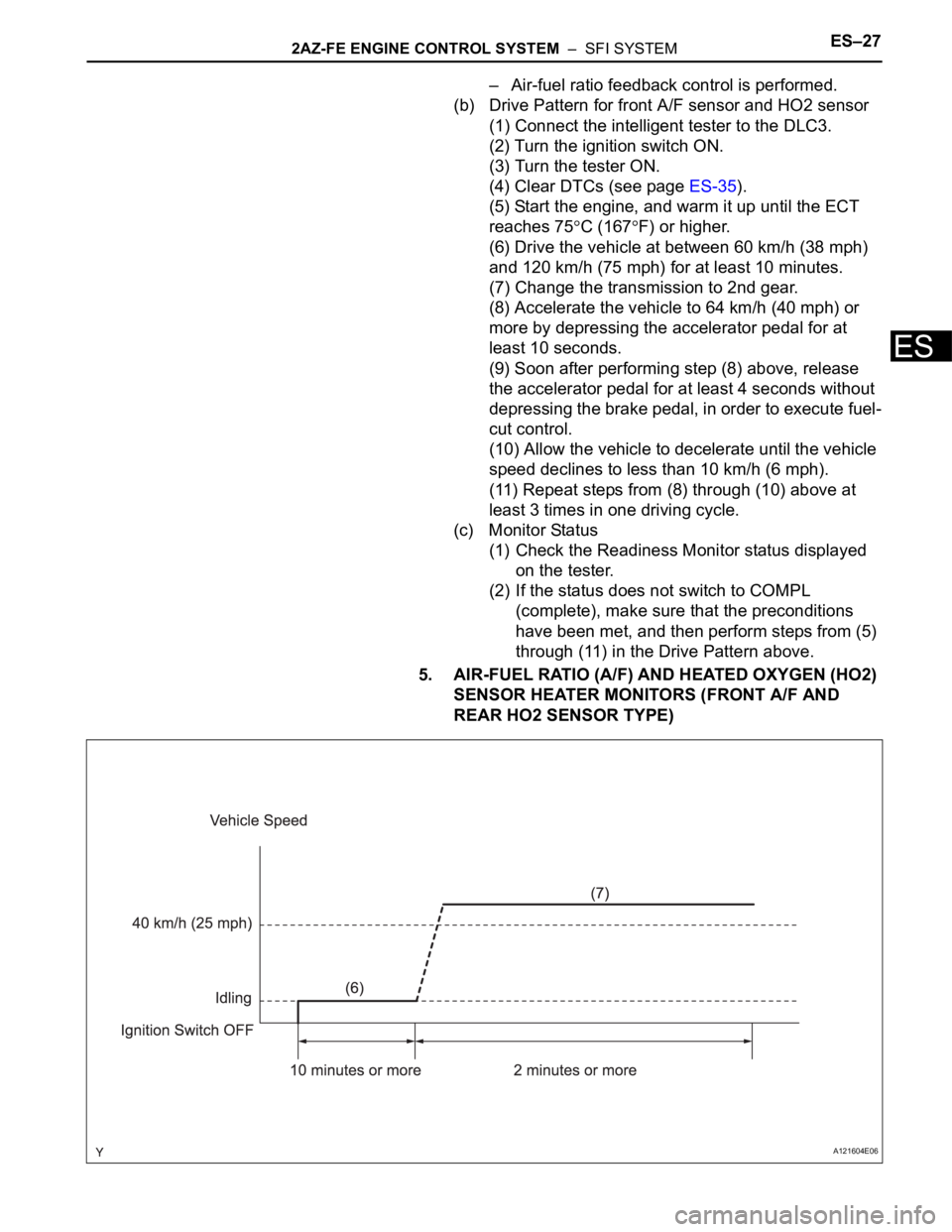
2AZ-FE ENGINE CONTROL SYSTEM – SFI SYSTEMES–27
ES
– Air-fuel ratio feedback control is performed.
(b) Drive Pattern for front A/F sensor and HO2 sensor
(1) Connect the intelligent tester to the DLC3.
(2) Turn the ignition switch ON.
(3) Turn the tester ON.
(4) Clear DTCs (see page ES-35).
(5) Start the engine, and warm it up until the ECT
reaches 75
C (167F) or higher.
(6) Drive the vehicle at between 60 km/h (38 mph)
and 120 km/h (75 mph) for at least 10 minutes.
(7) Change the transmission to 2nd gear.
(8) Accelerate the vehicle to 64 km/h (40 mph) or
more by depressing the accelerator pedal for at
least 10 seconds.
(9) Soon after performing step (8) above, release
the accelerator pedal for at least 4 seconds without
depressing the brake pedal, in order to execute fuel-
cut control.
(10) Allow the vehicle to decelerate until the vehicle
speed declines to less than 10 km/h (6 mph).
(11) Repeat steps from (8) through (10) above at
least 3 times in one driving cycle.
(c) Monitor Status
(1) Check the Readiness Monitor status displayed
on the tester.
(2) If the status does not switch to COMPL
(complete), make sure that the preconditions
have been met, and then perform steps from (5)
through (11) in the Drive Pattern above.
5. AIR-FUEL RATIO (A/F) AND HEATED OXYGEN (HO2)
SENSOR HEATER MONITORS (FRONT A/F AND
REAR HO2 SENSOR TYPE)
A121604E06
Page 483 of 2000
2AZ-FE ENGINE CONTROL SYSTEM – SFI SYSTEMES–29
ES
PROBLEM SYMPTOMS TABLE
HINT:
Use the table below to help determine the cause of the
problem symptom. The potential causes of the symptoms are
listed in order of probability in the "Suspected area" column of
the table. Check each symptom by checking the suspected
areas in the order they are listed. Replace parts as
necessary.
SFI system
Symptom Suspected area See page
Engine does not crank (Does not start)1. BatteryCH-4
2. StarterST-8
3. Starter relayST-16
4. Park/neutral position switchAX-108
5. Immobiliser systemEI-3
No initial combustion (Does not start)1. ECM power source circuitES-366
2. Crankshaft position sensorES-402
3. Camshaft position sensorES-399
4. Ignition systemIG-4
5. Fuel pump control circuitES-378
6. ECMES-26
7. VC output circuitES-373
Engine cranks normally but difficult to start1. Fuel pump control circuitES-378
2. CompressionEM-3
Difficult to start with cold engine1. Ignition systemIG-4
2. Spark plugIG-7
3. Fuel pump control circuitES-378
4. InjectorFU-11
Difficult to start with warm engine1. InjectorFU-11
2. Ignition systemIG-4
3. Spark plugIG-7
4. Fuel pump control circuitES-378
High engine idle speed1. Electronic throttle control systemES-265
2. A/C signal circuit -
3. ECM power source circuitES-366
Low engine idle speed (Poor idling)1. Electronic throttle control systemES-265
2. A/C signal circuit -
3. Fuel pump control circuitES-378
4. Air induction systemEC-7
5. PCV hoseEC-7
Rough idling1. CompressionEM-3
2. Spark plugIG-7
3. InjectorFU-11
4. Ignition systemIG-4
5. Fuel pump control circuitES-378
6. Electronic throttle control systemES-265
7. Air induction systemEC-7
8. PCV hoseEC-7
9. Mass air flow meterES-391
Page 486 of 2000

ES–322AZ-FE ENGINE CONTROL SYSTEM – SFI SYSTEM
ES
VPA (A9-55) - EPA (A9-59) W - YAccelerator pedal position
sensor (for engine control)Ignition switch ON,
Accelerator pedal released0.5 to 1.1 V
Ignition switch ON,
Accelerator pedal fully depressed2.6 to 4.5 V
VPA2 (A9-56) - EPA2 (A9-60) R - OAccelerator pedal position
sensor (for sensor
malfunctioning detection)Ignition switch ON,
Accelerator pedal released1.2 to 2.0 V
Ignition switch ON,
Accelerator pedal fully depressed3.4 to 5.0 V
VCPA (A9-57) - EPA (A9-59) B - YPower source of
accelerator pedal position
sensor (for VPA)Ignition switch ON 4.5 to 5.5 V
VCP2 (A9-58) - EPA2 (A9-60) L - OPower source of
accelerator pedal position
sensor (for VPA2)Ignition switch ON 4.5 to 5.5 V
HA1A (B30-109) - E04 (B30-46) L - W-B A/F sensor heaterIdling Below 3.0 V
Ignition switch ON 9 to 14 V
A1A+ (B30-112) - E1 (B30-104) B -BR A/F sensor Ignition switch ON 3.3 V*
A1A- (B30-113) - E1 (B30-104) R - BR A/F sensor Ignition switch ON3.0 V*
HT1B (B30-47) - E03 (B30-86) R - W-BHeated oxygen sensor
heaterIdling Below 3.0 V
Ignition switch ON 9 to 14 V
OX1B (B30-64) - EX1B (B30-87) B - BR Heated oxygen sensorEngine speed maintained at 2,500
rpm for 2 minutes after warming up
sensorPulse generation (see
waveform 2)
#10 (B30-108) - E01 (B30-45)
#20 (B30-107) - E01 (B30-45)
#30 (B30-106) - E01 (B30-45)
#40 (B30-105) - E01 (B30-45)L - W-B
G - W-B
B - W-B
W - W-BInjectorIgnition switch ON 9 to 14 V
IdlingPulse generation (see
waveform 3)
KNK1 (B30-110) - EKNK (B30-
111 )B - W Knock sensorEngine speed maintained at 4,000
after warming up enginePulse generation (see
waveform 4)
G2+ (B30-99) - G2- (B30-98) L - Y Camshaft position sensor IdlingPulse generation (see
waveform 5)
NE+ (B30-122) - NE- (B30-121) W - B Crankshaft position sensor IdlingPulse generation (see
waveform 5)
IGT1 (B30-85) - E1 (B30-104)
IGT2 (B30-84) - E1 (B30-104)
IGT3 (B30-83) - E1 (B30-104)
IGT4 (B30-82) - E1 (B30-104)R - BR
P - BR
G - BR
L - BRIgnition coil (ignition
signal)IdlingPulse generation (see
waveform 6)
IGF1 (B30-81) - E1 (B30-104) W - BRIgnition coil (ignition
confirmation signal)Ignition switch ON 4.5 to 5.5 V
IdlingPulse generation (see
waveform 6)
PRG (B30-49) - E1 (B30-104) G - BR Purge VSVIgnition switch ON 9 to 14 V
IdlingPulse generation (see
waveform 7)
SPD (A9-8) - E1 (B30-104) V - BRSpeed signal from
combination meterDriving at 20 km/h (12 mph)Pulse generation (see
waveform 8)
STA (A9-48) - E1 (B30-104) LG - BR Starter signal Cranking 5.5 V or
more
STAR (B30-52) - E1 (B30-104) W - BR Starter relay controlIgnition switch ON Below 1.5 V
Cranking 6.0 V or more
STP (A9-36) - E1 (B30-104) L - BR Stop light switchBrake pedal depressed 7.5 to 14 V
Brake pedal released Below 1.5 V
ST1- (A9-35) - E1 (B30-104) GR - BRStop light switch
(opposite to STP terminal)Ignition switch ON,
Brake pedal depressedBelow 1.5 V
Ignition switch ON,
Brake pedal released7.5 to 14 V
M+ (B30-42) - ME01 (B30-43) B - W-B Throttle actuator Idling with warm enginePulse generation (see
waveform 9) Symbols (Terminal No.) Wiring Colors Terminal Descriptions ConditionsSpecified
Conditions
Page 487 of 2000

2AZ-FE ENGINE CONTROL SYSTEM – SFI SYSTEMES–33
ES
HINT:
*: The ECM terminal voltage is constant regardless of the
output voltage from the sensor.
M- (B30-41) - ME01 (B30-43) W - W-B Throttle actuator Idling with warm enginePulse generation (see
waveform 10)
FC (A9-7) - E1 (B30-104) W - BR Fuel pump controlIgnition switch ON 9 to 14 V
Idling Below 1.5 V
W (A9-24) - E1 (B30-104) R - BR MILIgnition switch ON Below 1.5 V
Idling 9 to 14 V
TC (A9-27) - E1 (B30-104) G - BR Terminal TC of DLC3 Ignition switch ON 9 to 14 V
TACH (A9-15) - E1 (B30-104) GR - BR Engine speed IdlingPulse generation (see
waveform 11)
VPMP (A9-42) - E1 (B30-104) W - BRVent valve (built into
canister pump module)Ignition switch ON 9 to 14 V
MPMP (A9-34) - E1 (B30-104) B - BRLeak detection pump (built
into canister pump
module)Leak detection pump OFF Below 3 V
Leak detection pump ON 9 to 14 V
VCPP (B30-70) - EPPM (B30-94) Y - BRPower source for canister
pressure sensor (specific
voltage)Ignition switch ON 4.5 to 5.5 V
PPMP (B30-71) - EPPM (B30-94) V - BRCanister pressure sensor
(built into canister pump
module)Ignition switch ON 3 to 3.6 V
ELS1 (A9-31) - E1 (B30-104) O - BR Electric loadTaillight switch ON 7.5 to 14 V
Taillight switch OFF Below 1.5 V
ELS3 (A9-33) - E1 (B30-104) G - BR Electric loadDefogger switch ON 7.5 to 14 V
Defogger switch OFF Below 1.5 V
FANL (A9-21) - E1 (B30-104) R - BR Fan No. 1 relayIgnition switch ON 9 to 14 V
Idling with A/C ON, or high engine
coolant temperatureBelow 1.5 V
FANH (A9-22) - E1 (B30-104) W - BR Fan No. 2 relayIdling with high engine coolant
temperatureBelow 1.5 V
ALT (B30-50) - E1 (B30-104) B - BR Generator Ignition switch ON 9 to 14 V
CANH (A9-41) - E1 (B30-104) Y - BR CAN communication line Ignition switch ONPulse generation (see
waveform 12)
CANL (A9-49) - E1 (B30-104) W - BR CAN communication line Ignition switch ONPulse generation (see
waveform 13)
VCIB (B30-69) - EIB (B30-92) R - BR Battery current sensor Ignition switch ON 4.5 to 5.5 V
IB (B30-68) - EIB (B30-92) B - BR Battery current sensor Ignition switch ON 0.5 to 2.5 V
THB (B30-120) - EIB (B30-92) LG - BRBattery temperature
sensorIgnition switch ON, Battery
temperature -30 to 80
C (-22 to
176
F)0.5 to 4.5 V
RLO (B30-51) - E1 (B30-104) GR - BR GeneratorAfter engine warmed up, during
charging control, vehicle driven at
constant speedPulse generation (see
waveform 14)
RLO (B30-51) - E1 (B30-104) GR - BR GeneratorAfter engine warmed up, during
charging control, vehicle
acceleratedPulse generation (see
waveform 15)
RLO (B30-51) - E1 (B30-104) GR - BR GeneratorAfter engine warmed up, during
charging control, vehicle
deceleratedPulse generation (see
waveform 16) Symbols (Terminal No.) Wiring Colors Terminal Descriptions ConditionsSpecified
Conditions
Page 488 of 2000
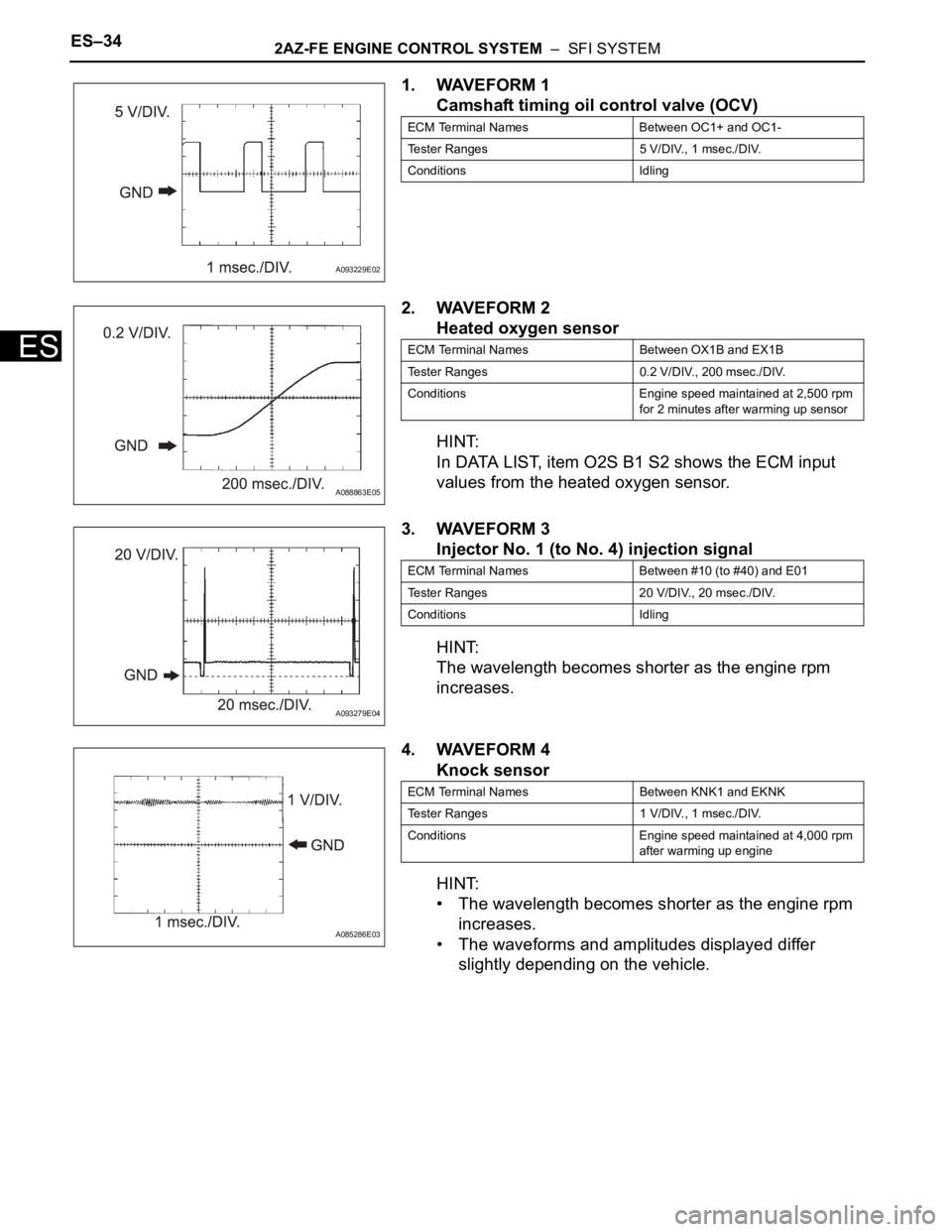
ES–342AZ-FE ENGINE CONTROL SYSTEM – SFI SYSTEM
ES
1. WAVEFORM 1
Camshaft timing oil control valve (OCV)
2. WAVEFORM 2
Heated oxygen sensor
HINT:
In DATA LIST, item O2S B1 S2 shows the ECM input
values from the heated oxygen sensor.
3. WAVEFORM 3
Injector No. 1 (to No. 4) injection signal
HINT:
The wavelength becomes shorter as the engine rpm
increases.
4. WAVEFORM 4
Knock sensor
HINT:
• The wavelength becomes shorter as the engine rpm
increases.
• The waveforms and amplitudes displayed differ
slightly depending on the vehicle.
A093229E02
ECM Terminal Names Between OC1+ and OC1-
Tester Ranges 5 V/DIV., 1 msec./DIV.
Conditions Idling
A088863E05
ECM Terminal Names Between OX1B and EX1B
Tester Ranges 0.2 V/DIV., 200 msec./DIV.
Conditions Engine speed maintained at 2,500 rpm
for 2 minutes after warming up sensor
A093279E04
ECM Terminal Names Between #10 (to #40) and E01
Tester Ranges 20 V/DIV., 20 msec./DIV.
Conditions Idling
A085286E03
ECM Terminal Names Between KNK1 and EKNK
Tester Ranges 1 V/DIV., 1 msec./DIV.
Conditions Engine speed maintained at 4,000 rpm
after warming up engine
Page 489 of 2000
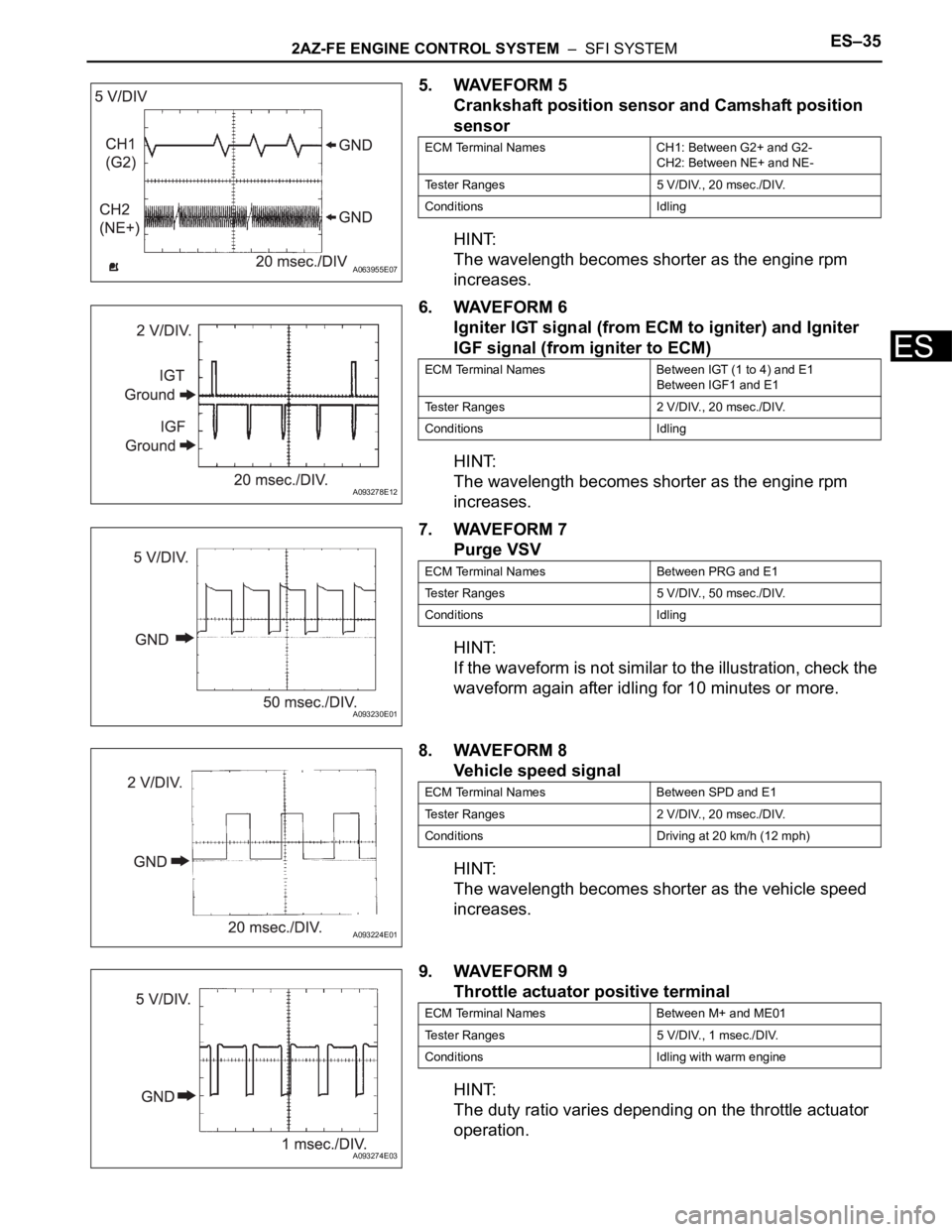
2AZ-FE ENGINE CONTROL SYSTEM – SFI SYSTEMES–35
ES
5. WAVEFORM 5
Crankshaft position sensor and Camshaft position
sensor
HINT:
The wavelength becomes shorter as the engine rpm
increases.
6. WAVEFORM 6
Igniter IGT signal (from ECM to igniter) and Igniter
IGF signal (from igniter to ECM)
HINT:
The wavelength becomes shorter as the engine rpm
increases.
7. WAVEFORM 7
Purge VSV
HINT:
If the waveform is not similar to the illustration, check the
waveform again after idling for 10 minutes or more.
8. WAVEFORM 8
Vehicle speed signal
HINT:
The wavelength becomes shorter as the vehicle speed
increases.
9. WAVEFORM 9
Throttle actuator positive terminal
HINT:
The duty ratio varies depending on the throttle actuator
operation.
A063955E07
ECM Terminal Names CH1: Between G2+ and G2-
CH2: Between NE+ and NE-
Tester Ranges 5 V/DIV., 20 msec./DIV.
Conditions Idling
A093278E12
ECM Terminal Names Between IGT (1 to 4) and E1
Between IGF1 and E1
Tester Ranges 2 V/DIV., 20 msec./DIV.
Conditions Idling
A093230E01
ECM Terminal Names Between PRG and E1
Tester Ranges 5 V/DIV., 50 msec./DIV.
Conditions Idling
A093224E01
ECM Terminal Names Between SPD and E1
Tester Ranges 2 V/DIV., 20 msec./DIV.
Conditions Driving at 20 km/h (12 mph)
A093274E03
ECM Terminal Names Between M+ and ME01
Tester Ranges 5 V/DIV., 1 msec./DIV.
Conditions Idling with warm engine