wheel TOYOTA RAV4 2006 Service Repair Manual
[x] Cancel search | Manufacturer: TOYOTA, Model Year: 2006, Model line: RAV4, Model: TOYOTA RAV4 2006Pages: 2000, PDF Size: 45.84 MB
Page 42 of 2000

ENGINE - 2AZ-FE ENGINE
005EG13Y
: With Control
: Without Control
Vehicle’s
Longitudinal G
Throttle Valve
Opening Angle
Accelerator Pedal
Depressed Angle
0
0
0
Time
EG-45
2) Normal Throttle Control (Non-linear Control)
It controls the throttle to an optimal throttle valve opening that is appropriate for the driving condition
such as the amount of the accelerator pedal effort and the engine speed in order to realize excellent throttle
control and comfort in all operating ranges.
Control Examples During Acceleration and Deceleration
3) Idle Air Control
The ECM controls the throttle valve in order to constantly maintain an ideal idle speed.
4) TRAC Throttle Control
As part of the TRAC system, the throttle valve is closed by a demand signal from the skid control ECU
if an excessive amount of slippage is created at a driving wheel, thus facilitating the vehicle in providing
excellent stability and driving force.
5) VSC Coordination Control
In order to bring the effectiveness of the VSC system control into full play, the throttle valve opening
angle is controlled by effecting a coordination control with the skid control ECU.
6) Cruise Control
An ECM with an integrated cruise control ECU directly actuates the throttle valve for operation of the
cruise control.
Page 115 of 2000

ENGINE - 2GR-FE ENGINE
005EG13Y
: With Control
: Without Control
Ve h i c l e ’ s
Longitudinal G
Throttle Valve
Opening Angle
Accelerator Pedal
Depressed Angle
0
0
0
Time
EG-119
2) Normal Throttle Control (Non-linear Control)
The ECM controls the throttle to an optimal throttle valve angle that is appropriate for the driving
condition such as the amount of the accelerator pedal effort and the engine speed in order to realize
excellent throttle control and comfort in all operating ranges.
Control Examples during Acceleration and Deceleration
3) Idle Air Control
The ECM controls the throttle valve in order to constantly maintain an ideal idle speed.
4) TRAC Throttle Control
As part of the TRAC system, the throttle valve is closed by a demand signal from the skid control ECU
if an excessive amount of slippage is created at a driving wheel, thus facilitates the vehicle in ensuring
excellent vehicle stability and driving force.
5) VSC Coordination Control
In order to bring the effectiveness of the VSC system control into full play, the throttle valve angle is
controlled by effecting a coordination control with the skid control ECU.
6) Cruise Control
An ECM with an integrated cruise control ECU directly actuates the throttle valve for operation of the
cruise control.
Fail-safe of Accelerator Pedal Position Sensor
For details, see page 46 in 2AZ-FE engine section.
Fail-safe of Throttle Position Sensor
For details, see page 47 in 2AZ-FE engine section.
Page 133 of 2000

CHASSIS - 4WD SYSTEM CH-66
4WD SYSTEM
DESCRIPTION
The 4WD system of the ’06 RAV4 uses an active torque control 4WD system.
It is a compact, lightweight, and high performance 4WD system that optimally controls the torque
distribution to the front and rear wheels through the electric control coupling in the rear differential.
ACTIVE TORQUE CONTROL 4WD SYSTEM
1. General
Based on information provided by various sensors, the 4WD ECU controls the amperage that is applied
to the electric control coupling, in order to transmit drive torque to the rear wheels when needed, and in
the amount needed. The following describes the features of the active torque control 4WD system.
Traction performance
Realizes stable start-off and acceleration performance
Driving stability performanceRealizes stable cornering performance
Fuel economyRealizes better fuel economy by transmitting drive torque to the rear
wheels when needed, in the amount needed.
A four-wheel drive lock switch has been provided. This enables the driver to select between the AUTO
and LOCK modes by operating the switch. The system optimally controls the torque distribution to the
front and rear wheels in the respective modes.
Mode
Four-wheel Drive
Lock Switch and
Indicator Light
Outline
AUTOOFF
Optimally distributes drive torque to the front and rear wheels.
Ensures optimal start-off performance during a start-off, based on
information provided by various sensors.
Suppresses the tight corner braking phenomenon* during low-speed
cornering.
Reduces the amount of torque distribution to the rear wheels and
improves fuel economy when the system judges that the vehicle is
traveling steadily.
Disengages the 4WD during braking deceleration.
LOCKON
Distributes the maximum torque limit to the rear wheels.
Distributes the maximum torque limit to the rear wheels during
start-off.
Distributes optimal torque during low-speed cornering.
Disengages the 4WD during braking deceleration.
Disengages the LOCK mode and transfers to the AUTO mode when
the vehicle speed exceeds 40 km / h (25 mph).
*: Tight corner braking phenomenon: a condition in which the brakes are applied due to a rotational difference
between the front and rear wheels, such as during low-speed cornering in the 4WD mode.
The 4WD ECU effects cooperative control with the skid control ECU, in order to control the drive torque
distribution to the front and rear wheels in accordance with information received from the skid control
ECU. These controls ensure a smooth acceleration and driving stability.
Page 134 of 2000

CHASSIS - 4WD SYSTEM
01MCH09Y
Electric Control Coupling
4WD ECU
Four-wheel Drive
Lock Switch
4WD LOCK
Indicator Light
4WD Warning
LightECM
Skid Control ECU
Main Body ECU
Ya w R a t e &
Deceleration Sensor
Steering Angle
SensorThrottle Position Sensor
Crankshaft Position Sensor
Park / Neutral Position
Switch
Speed Sensors
Stop Light Switch
Ambient Temperature
Sensor
Parking Brake Switch
CANH,
CANLCH-67
2. System Diagram
Page 135 of 2000

CHASSIS - 4WD SYSTEM
01NCH36Y
Skid Control ECU
Electric Control Coupling
ECM Ambient Temperature
Sensor
Main Body ECUSteering Angle
Sensor
Four-wheel Drive
Lock Switch
4WD ECU
Parking Brake
Switch Stop Light Switch
Yaw Rate & Deceleration
Sensor DLC3 CH-68
3. Layout of Main Components
Page 136 of 2000

CHASSIS - 4WD SYSTEMCH-69
4. Function of Main Components
ComponentFunction
Combination
4WD LOCK
Indicator LightIlluminates to inform the driver of the 4WD LOCK mode control.Combination
Meter4WD
Warning LightIlluminates to warn the driver of a malfunction in the 4WD system.
Speed Sensor (4)Detects the wheel speed of each 4 wheel.
Steering Angle SensorDetects the direction and angle of the steering wheel.
Yaw Rate & Deceleration SensorDetects the vehicle’s longitudinal and lateral acceleration.
Crankshaft Position SensorDetects the engine speed and outputs it to the ECM.
Accelerator Pedal Position SensorDetects the accelerator pedal position and outputs it to the ECM.
Throttle Position SensorDetects the throttle valve position and outputs it to the ECM.
Park / Neutral Position SwitchDetects the neutral position of the transaxle and outputs it to the
ECM.
Stop Light SwitchDetects the brake pedal depressing signal.
Parking Brake SwitchDetects when the parking brake lever is pulled up.
Four-wheel Drive Lock SwitchSwitches between the AUTO and LOCK modes.
4WD ECU
Controls the amperage that is applied to the electromagnetic
solenoid of the electric control coupling based on the signals
provided by the sensors in order to optimally distribute drive torque
in accordance with driving conditions.
ECMOutputs signals such as the shift position signal, throttle position
signal, and crankshaft position signal to the 4WD ECU.
Skid Control ECUOutputs signals such as the vehicle speed signal and deceleration
signal to the 4WD ECU.
Electric Control CouplingDistributes drive torque in accordance with the amperage applied
by the 4WD ECU.
Page 137 of 2000

CHASSIS - 4WD SYSTEM
01NCH38Y
Torque Distribution
to Rear WheelsTorque Distribution
to Rear Wheels
Straightline Driving Low-Speed Cornering
01NCH39Y
Torque Distribution
to Rear WheelsTorque Distribution
to Rear Wheels
Steady Driving Straightline Acceleration
NOTICE
In the LOCK mode after the four-wheel drive lock switch is pressed, the system starts control upon
judging that the vehicle is operating in a stable manner. During this judgment, the 4WD LOCK
indicator light blinks.
CH-70
5. System Operation
Auto Mode
1) Starting Off
The system ensures start-off performance by optimally distributing the entire drive torque, which is
transmitted by the engine, to the front and rear wheels.
To prevent the tight corner braking phenomenon from occurring during low-speed cornering, the
system reduces the amount of torque distribution to the rear wheels.
2) Normal Driving
During normal driving, when the system judges that the vehicle is traveling steadily, it reduces the
amount of torque distribution to the rear wheels. This allows the vehicle to operate in conditions
similar to front-wheel-drive, which improves fuel economy.
To ensure excellent acceleration performance during straightline acceleration and excellent driving
stability during cornering, the system controls the amount of torque distribution to the rear wheels.
Lock Mode
When the vehicle is in a situation that poses difficulty for it to pull itself out, such as sand, the driver can
switch to LOCK mode by operating the four-wheel drive lock switch. Thus, this mode effects optimal
control in accordance with the driving conditions and transmits as much drive torque as possible to the rear
wheels, in a mode that is similar to the locked 4WD mode.
Page 138 of 2000

CHASSIS - 4WD SYSTEM
Service Tip
When the 4WD ECU judges that the vehicle has become stable, it cancels the stopping of the 4WD
control and transfers to AUTO control. If the 4WD warning light blinks, take the following actions
without turning the engine OFF:
Drop the vehicle speed until the light goes out
Stop the vehicle and stay there until the light goes out
CH-71
6. Diagnosis
When the 4WD ECU detects a malfunction, the 4WD ECU makes a diagnosis and memorizes the failed
section. Furthermore, the 4WD warning light in the combination meter illuminates to inform the driver.
At the same time, the DTCs (Diagnosis Trouble Codes) are stored in memory. The DTCs can be read by
connecting a hand-held tester, or by connecting the SST (09843-18040) to the TC and CG terminals of
DLC3 and observing the blinks of the 4WD warning light.
For details of the DTCs that are stored in 4WD ECU memory, see the 2006 RAV4 Repair Manual (Pub. No.
RM01M1U).
7. Fail-safe
When there is a possibility of causing damage to the drive system due to a malfunction in the 4WD system
or rough driving, the system illuminates or blinks the 4WD warning light to inform the driver, stops the 4WD
controls, and enables the vehicle to operate in the front-wheel-drive mode.
Malfunction
4WD Warning Light
4WD System MalfunctionIlluminate
Rough driving in 4WDPre-warning for stopping 4WD controlSlow blinkingRough driving in 4WDStopping 4WD controlFast blinking
Page 167 of 2000
IN–22INTRODUCTION – REPAIR INSTRUCTION
IN
VEHICLE LIFT AND SUPPORT
LOCATIONS
1. NOTICE ABOUT VEHICLE CONDITION WHEN
JACKING UP VEHICLE
(a) The vehicle must be unloaded before jacking up /
lifting up the vehicle. Never jack up / lift up a heavily
loaded vehicle.
(b) When removing heavy parts such as the engine and
transmission, the center of gravity of the vehicle
may shift. To stabilize the vehicle, place a balance
weight in a location where it will not roll or shift, or
use a mission jack to hold the jacking support.
2. NOTICE FOR USING 4 POST LIFT
(a) Follow the safety procedures outlined in the lift
instruction manual.
(b) Use precautionary measures to prevent the free
wheel beam from damaging tires or wheels.
(c) Use wheel chocks to secure the vehicle.
3. NOTICE FOR USING JACK AND SAFETY STAND
(a) Work on a level surface. Use wheel chocks at all
times.
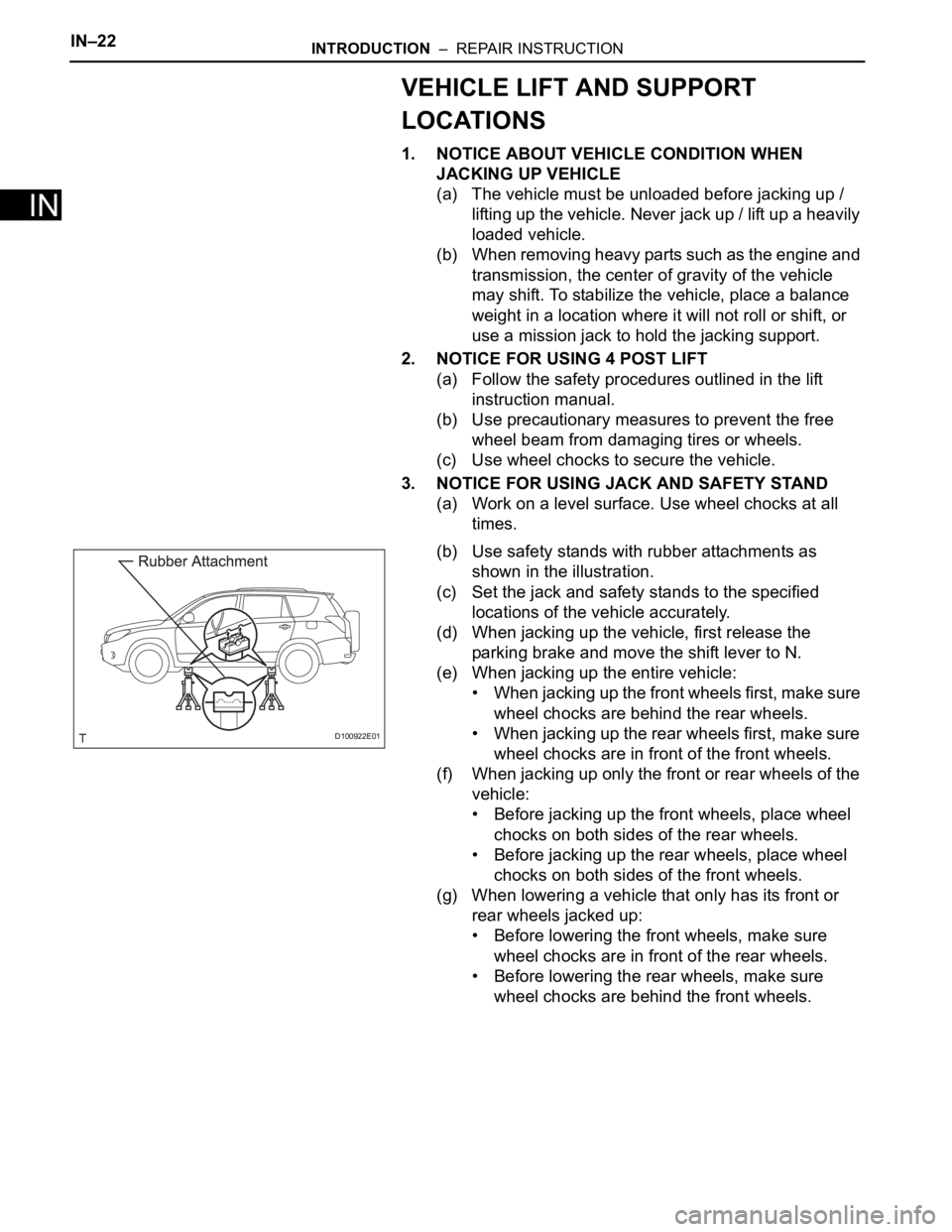
(b) Use safety stands with rubber attachments as
shown in the illustration.
(c) Set the jack and safety stands to the specified
locations of the vehicle accurately.
(d) When jacking up the vehicle, first release the
parking brake and move the shift lever to N.
(e) When jacking up the entire vehicle:
• When jacking up the front wheels first, make sure
wheel chocks are behind the rear wheels.
• When jacking up the rear wheels first, make sure
wheel chocks are in front of the front wheels.
(f) When jacking up only the front or rear wheels of the
vehicle:
• Before jacking up the front wheels, place wheel
chocks on both sides of the rear wheels.
• Before jacking up the rear wheels, place wheel
chocks on both sides of the front wheels.
(g) When lowering a vehicle that only has its front or
rear wheels jacked up:
• Before lowering the front wheels, make sure
wheel chocks are in front of the rear wheels.
• Before lowering the rear wheels, make sure
wheel chocks are behind the front wheels.
D100922E01
Page 179 of 2000

SERVICE SPECIFICATIONS – U151E AUTOMATIC TRANSMISSIONSS–47
SS
TORQUE SPECIFICATIONS
Automatic Transaxle Assembly
Part Tightened N*m kgf*cm ft*lbf
Park/neutral position switch Nut 6.9 70 61 in.*lbf
Bolt 5.4 55 48 in.*lbf
Control shaft lever x Control shaft 13 133 10
Shift control cable x Control shaft lever 15 153 11
Transaxle housing x Engine block Upper side bolt 64 653 47
Lower side bolt
A37 377 27
Lower side bolt
B46 470 34
Torque converter clutch x Drive plate 41 418 30
Flywheel housing under cover x Automatic transaxle 7.8 80 69 in.*lbf
Front engine mounting bracket x Transaxle 64 653 47
Rear engine mounting bracket x Transaxle 45 459 33
Engine mounting bracket LH x Transaxle 64 653 47
Oil filler tube x Transaxle
Oil filler tube x Front engine mounting bracket5.5 56 49 in.*lbf
Control cable bracket No. 1 x Transaxle 12 122 9
Control cable bracket No. 2 x Transaxle 12 122 9
Oil cooler inlet elbow x Transaxle 27 276 20
Oil cooler outlet elbow x Transaxle 27 276 20
Starter x Transaxle37 377 27
Starter wire x Starter9.8 100 88 in.*lbf
Speed sensor (NC) x Transaxle 11 112 8
Speed sensor (NT) x Transaxle 11 112 8
Drain plug x Oil pan47 479 35
Transmission wire x Transaxle 5.4 55 48 in.*lbf
ATF temperature sensor x Valve body 6.6 67 58 in.*lbf
Oil pan x Transaxle7.8 80 69 in.*lbf
Solenoid valve x Valve body SL2, DSL, S4 11 110 8
SL1, SL3 6.6 67 58 in.*lbf
Valve body x Transaxle11 11 2 8
Oil strainer x Valve body11 11 2 8
Floor shift assembly x Body12 122 9
Control cable clamp x Engine mounting insulator 12 122 9
Differential gear lube apply tube x Transaxle housing 9.8 100 87 in.*lbf
Front planetary gear lock nut 280 3,355 207
Brake apply tube clamp x Transaxle case 5.4 55 48 in.*lbf
Transaxle case No. 1 plug x Transaxle rear cover 7.4 75 65 in.*lbf
Transaxle rear cover x Transaxle case Bolt A 19 194 14
Other bolt 25 255 18
Parking lock pawl shaft x Transaxle case 9.8 100 87 in.*lbf
Oil pump assembly x Transaxle case 22 226 16
Transaxle housing x Transaxle case Bolt A 22 254 16
Bolt B 29 295 21
Bolt C 29 295 21
Bolt D 22 254 16
Automatic transmission case plug x Transaxle housing 7.4 75 65 in.*lbf
Automatic transmission case plug x Transaxle case 7.4 75 65 in.*lbf