warning light TOYOTA RAV4 PLUG-IN HYBRID 2021 Workshop Manual
[x] Cancel search | Manufacturer: TOYOTA, Model Year: 2021, Model line: RAV4 PLUG-IN HYBRID, Model: TOYOTA RAV4 PLUG-IN HYBRID 2021Pages: 666, PDF Size: 161.28 MB
Page 365 of 666
363
5
5-5. Using the driving support systems
Driving
WARNING
■Before using LTA system
●Do not rely sole ly upon the LTA
system. The LTA system does not automatically drive the vehicle or
reduce the amount of attention that
must be paid to the area in front of the vehicle. The driver must always
assume full responsibility for driving
safely by paying careful attention to
the surrounding conditions and operating the stee ring wheel to cor-
rect the path of t he vehicle. Also,
the driver must take adequate breaks when fatigued, such as from
driving for a long period of time.
●Failure to perform appropriate driv -
ing operations and pay careful
attention may lead to an accident, resulting in death or serious injury.
●When not u sing the LTA system, use the LTA switch to turn the sys -
tem off.
■Situations unsuitable for LTA
system
In the following situations, use the LTA switch to tu rn the system off.
Failure to do so may lead to an acci -
dent, resulting in death or serious injury.
●Vehicle is driven on a road surface which is slippery due to rainy
weather, fallen snow, freezing, etc.
●Vehicle is driven on a snow-cov -
ered road.
●White (yellow) lines are difficult to
see due to rain, snow, fog, dust,
etc.
●Vehicle is driven in a temporary
lane or restricted lane due to con - struction work.
●Vehicle is driven in a construction zone.
●A spare tire, tire chains, etc. are equipped.
●When the tires have been exces - sively worn, or when the tire infla -
tion pressure is low.
●When tires of a size other than
specified are installed.
●Vehicle is driven in traffic lanes
other than that highways and free -
ways.
●When your vehicle is towing a
trailer or during emergency towing
■Preventing LTA system malfunc -
tions and operations performed by mistake
●Do not modify the headlights or
place stickers, etc. on the surface of the lights.
●Do not modify the suspension etc. If the suspension etc. needs to be
replaced, contact any authorized
Toyota retailer or Toyota authorized repairer, or any reliable repairer.
●Do not install or place anything on the hood or grille. Also, do not
install a grille guar d (bull bars, kan-
garoo bar, etc.).
●If your windshield needs repairs,
contact any autho rized Toyota retailer or Toyota authorized
repairer, or any reliable repairer.
■Conditions in which functions
may not operate properly
In the following situ ations, the func- tions may not operate properly and
the vehicle may depart from its lane.
Drive safely by always paying careful
attention to your surroundings and operate the steering wheel to correct
the path of the vehicle without relying
solely on the functions.
Page 367 of 666
365
5
5-5. Using the driving support systems
Driving
■Lane departure alert function
When the system determines that
the vehicle might depart from its
lane or course*, a warning is dis -
played on the multi-information dis -
play, and either a warning buzzer
will sound or the steering wheel will
vibrate to alert the driver.
When the warning buzzer sounds or
the steering wheel vibrates, check the
area around your vehicle and carefully
WARNING
●The vehicle is driven in an area
without white (yellow) lines, such as
in front of a tollg ate or checkpoint, or at an intersection, etc.
●The white (yellow) lines are cracked, “Raised pavement
marker” or stones are present.
●The white (yellow) lines cannot be seen or are difficu lt to see due to
sand, etc.
●The vehicle is driven on a road sur -
face that is wet due to rain, pud -
dles, etc.
●The traffic lines are yellow (which
may be more difficult to recognize than lines that are white).
●The white (yellow) lines cross over a curb, etc.
●The vehicle is driven on a bright surface, such as concrete.
●If the edge of the road is not clear or straight.
●The vehicle is driven on a surface that is bright due t o reflected light,
etc.
●The vehicle is driven in an area
where the brightness changes sud -
denly, such as at the entrances and exits of tunnels, etc.
●Light from the hea dlights of an oncoming vehicle, the sun, etc.
enters the camera.
●The vehicle is driven on a slope.
●The vehicle is driven on a road which tilts left or right, or a winding
road.
●The vehicle is driven on an
unpaved or rough road.
●The traffic lane is excessively nar -
row or wide.
●The vehicle is ext remely tilted due to carrying heavy luggage or having
improper tire pressure.
●The distance to the preceding vehi -
cle is extremely short.
●The vehicle is moving up and down
a large amount due to road condi-
tions during drivi ng (poor roads or road seams).
●When driving in a t unnel or at night with the headlights off or when a
headlight is dim due to its lens
being dirty or it being misaligned.
●The vehicle is s truck by a cross-
wind.
●The vehicle is affected by wind from
a vehicle driven in a nearby lane.
●The vehicle has just changed lanes
or crossed an intersection.
●Tires which differ by structure, man -
ufacturer, brand or tread pattern are used.
●Snow tires, etc. are equipped.
●The vehicle is b eing driven at
extremely high speeds.
Functions included in LTA
system
Page 382 of 666
3805-5. Using the driving support systems
When a vehicle is de tected running ahead of you, the system automatically deceler-
ates your vehicle. When a great er reduction in vehicle speed is necessary, the sys-
tem applies the brakes (the stop lights will come on at this time). The system will
respond to changes in the speed of the vehicle ahead in order to maintain the vehi-
cle-to-vehicle distance set by the driver. Approach warning war ns you when the sys-
tem cannot decelerate sufficiently to prevent your vehicle from closing in on the
vehicle ahead.
When the vehicle ahead of you stops, your vehicle will also sto p (vehicle is stopped
by system control). After the veh icle ahead starts off, pressing the “+RES” switch or
depressing the accelerator pedal (start-off operation) will res ume follow-up cruising.
If the start-off operation is not performed, system control continues to keep your
vehicle stopped.
When the turn signal lever is operated and your vehicle moves t o an overtaking lane
while driving at 50 mph (80 km/h) or more, the vehicle will acc elerate to help to over-
take a passing vehicle.
The system’s identificat ion of what is an overtaking lane may be determined solely
based on the location of the ste ering wheel in the vehicle (left side driver position
versus right side driv er position.) If the vehicle is driven to a region where the over-
taking lane is on a different sid e from where the vehicle is normally driven, the vehi-
cle may accelerate when the turn signal lever is operated in th e opposite direction to
the overtaking lane (e.g., if th e driver normally operates the vehicle in a region
where the overtaking lane is to t he right but then drives to a region where the over-
taking lane is to the left, the vehicle may accelerate when the right turn signal is acti-
vated).
Example of acceleration
When there are no longer any preceding vehicles driving slower than the
set speed
The system accelerates until the set speed is reached. The system then returns to
constant speed cruising.
1 Press the cruise control main
switch to activate the cruise con -
trol.
Dynamic radar cruise control indicator
will come on and a message will be dis - played on the multi-information display.
Press the switch again to deactivate the
cruise control.
If the cruise control main switch is
pressed and held for 1.5 seconds or
more, the system tur ns on in constant
C
Setting the vehicle speed
(vehicle-to-vehicle distance
control mode)
Page 410 of 666
4085-5. Using the driving support systems
■Vehicles that can be detected
by the Blind Spot Monitor
The BSM function uses radar sen-
sors to detect the following vehicles
traveling in adjacent lanes and
advises the driver of the presence
of such vehicles via the indicators
WARNING
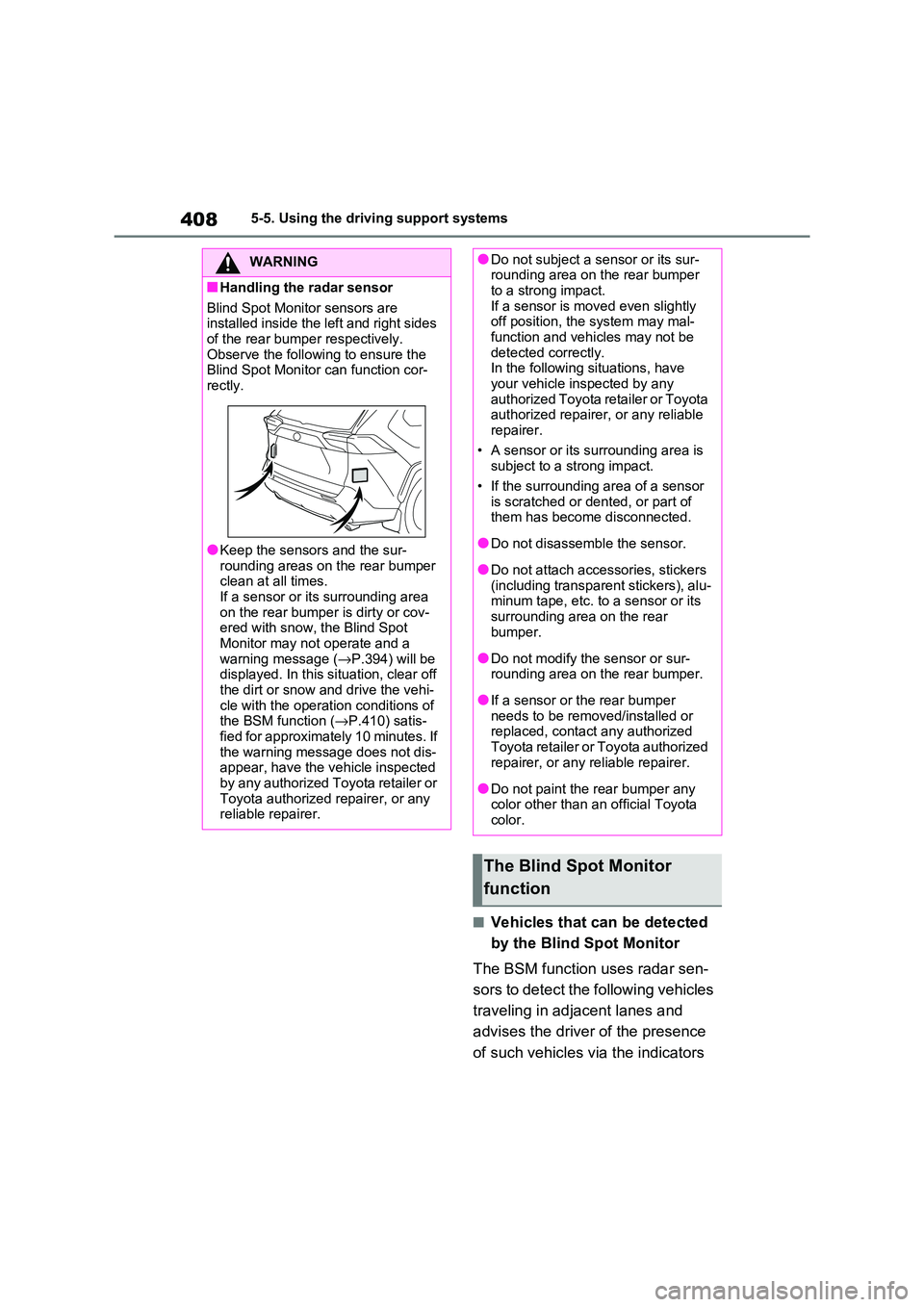
■Handling the radar sensor
Blind Spot Monitor sensors are
installed inside the left and right sides of the rear bumper respectively.
Observe the following to ensure the
Blind Spot Monitor can function cor - rectly.
●Keep the sensor s and the sur-
rounding areas on the rear bumper clean at all times.
If a sensor or its surrounding area
on the rear bumper is dirty or cov - ered with snow, the Blind Spot
Monitor may not operate and a
warning message ( →P.394) will be displayed. In this s ituation, clear off
the dirt or snow a nd drive the vehi-
cle with the operation conditions of the BSM function ( →P.410) satis-
fied for approximately 10 minutes. If
the warning message does not dis - appear, have the v ehicle inspected
by any authorized Toyota retailer or
Toyota authorized repairer, or any reliable repairer.
●Do not subject a sensor or its sur - rounding area on the rear bumper
to a strong impact.
If a sensor is moved even slightly off position, the system may mal-
function and vehicles may not be
detected correctly. In the following situations, have
your vehicle inspected by any
authorized Toyota retailer or Toyota authorized repairer, or any reliable
repairer.
• A sensor or its surrounding area is subject to a strong impact.
• If the surrounding area of a sensor
is scratched or dented, or part of them has become disconnected.
●Do not disassemble the sensor.
●Do not attach acce ssories, stickers
(including transparent stickers), alu - minum tape, etc. to a sensor or its
surrounding area on the rear
bumper.
●Do not modify the sensor or sur -
rounding area on the rear bumper.
●If a sensor or the rear bumper
needs to be removed/installed or replaced, contact any authorized
Toyota retailer or Toyota authorized
repairer, or any reliable repairer.
●Do not paint the rear bumper any
color other than an official Toyota color.
The Blind Spot Monitor
function
Page 418 of 666
4165-5. Using the driving support systems
■The system can be operated when
●The power switch is in ON.
●Toyota parking assist-sensor function is on.
●The vehicle speed is less than about 10 km/h (6 mph).
●The shift lever is in other than P.
■If “Clean Parking Assist Sensor” is
displayed on the multi-information display
A sensor may be covered with ice,
snow, dirt, etc. Rem ove the ice, snow, dirt, etc., from the sensor to return the
system to normal.
Also, due to ice forming on a sensor at low temperatures, a warning message
may be displayed or the sensor may not
be able to detect an object. Once the ice melts, the system will return to normal.
If a warning message is displayed even
if the sensor is cle an, there may be a sensor malfunction. Have the vehicle
inspected by any a uthorized Toyota
retailer or Toyota authorized repairer, or any reliable repairer.
WARNING
●The area directly under the bum -
pers is not detected.
Thin posts or objects lower than the sensor may not be detected when
approached, even if they have been
detected once.
■When to disable the function
In the following situations, disable the
function as it may operate even though there is no possibility of a colli -
sion.
●The vehicle is equipped with a com - mercial fender pole, wireless
antenna or fog lights.
●The front or rear bumper or a sen -
sor receives a strong impact.
●A non-genuine Toyota suspension
(lowered suspension, etc.) is
installed.
●Towing eyelets are installed.
●A backlit license plate is installed.
●When using an automatic car wash
■When using the Toyota parking
assist-sensor
In the following situations, the system
may not function correctly due to a
sensor malfunction, etc. Have the vehicle checked by any authorized
Toyota retailer or Toyota authorized
repairer, or any reliable repairer.
●The Toyota parki ng assist-sensor
operation display flashes or shows continuously, a nd a beep sounds
when no objects are detected.
●If the area around a sensor collides
with something, or is subjected to
strong impact.
●If the bumper or grille collides with
something.
●If the display flashes or is displayed continuously and a buzzer does not
sound, except when the mute func -
tion has been turned on.
■Notes when washing the vehicle
Do not apply intensiv e bursts of water or steam to the sensor area.
Doing so may result in the sensor
malfunctioning.
●When using a high pressure
washer to wash the vehicle, do not spray the sensors directly, as doing
so may cause a sensor to malfunc -
tion.
●When using steam to clean the
vehicle, do not direct steam too close to the sensors as doing so
may cause a sensor to malfunction.
Page 442 of 666

4405-5. Using the driving support systems
System), PCS will also be disabled
(only Pre-Collision warning is avail -
able). The PCS warning light will
come on and a message will be dis -
played on the multi-information dis -
play. ( →P.361)
■When the message is displayed on
the multi-information display show -
ing that TRC has been disabled
even if has not been pressed
TRC is temporary deactivated. If the information continues to show, contact
any authorized Toyota retailer or Toyota
authorized repairer, or any reliable repairer.
■Operating conditions of hill-start
assist control
When the following four conditions are met, the hill-start as sist control will oper-
ate:
●The shift lever is in a position other
than P or N (when starting off for-
ward/backward on an upward incline).
●The vehicle is stopped.
●The accelerator pedal is not
depressed.
●The parking brake is not engaged.
■Automatic system cancelation of
hill-start assist control
The hill-start assist control will turn off in any of the following situations:
●The shift lever is shifted to P or N.
●The accelerator pedal is depressed.
●The parking brak e is engaged.
●No more than 2 seconds have elapsed after the brake pedal is
released.
■Sounds and vibrations caused by
the ABS, brake assist, VSC, Trailer Sway Control, TRC and hill-start
assist control systems
●A sound may be heard from the
engine compartment when the brake
pedal is depressed repeatedly, when
the hybrid system i s started or just
after the vehicle beg ins to move. This sound does not indicate that a mal -
function has occurred in any of these
systems.
●Any of the followin g conditions may
occur when the a bove systems are operating. None of these indicates
that a malfunction has occurred.
• Vibrations may be felt through the vehicle body and steering.
• A motor sound may be heard also
after the vehicle comes to a stop.
■ECB operating sound
ECB operating sound may be heard in
the following cases, but it does not indi-
cate that a malfun ction has occurred.
●Operating sound heard from the
engine compartment when the brake pedal is operated.
●Motor sound of the brake system heard from the front part of the vehicle
when the driver’ door is opened.
●Operating sound heard from the
engine compartment when one or two
minutes passed after the stop of the hybrid system.
■Active Cornering Assist operation
sounds and vibrations
When the Active Cornering Assist is operated, operation sounds and vibra -
tions may be generat ed from the brake
system, but thi s is not a malfunction.
■EPS operation sound
When the steering wheel is operated, a
motor sound (whirring sound) may be
heard. This does not indicate a malfunc - tion.
■Automatic reacti vation of TRC,
Trailer Sway Control and VSC sys -
tems
After turning the TRC, Trailer Sway Control and VSC systems off, the sys -
tems will be automati cally re-enabled in
the following situations:
●When the power switch is turned off.
●If only the TRC syst em is turned off,
Page 445 of 666
443
5
5-5. Using the driving support systems
Driving
WARNING
●When driving over roads with pot -
holes or uneven surfaces
■TRC/VSC may not operate effec -
tively when
Directional control and power may not be achievable while driving on slip -
pery road surfaces , even if the
TRC/VSC system is operating.
Drive the vehicle carefully in condi - tions where stabilit y and power may
be lost.
■Active Cornering Assist does not
operate effectively when
●Do not overly rely on Active Corner - ing Assist. Active Cornering Assist
may not operate effectively when
accelerating down slopes or driving on slippery road surfaces.
●When Active Cornering Assist fre - quently operates, Active Cornering
Assist may temporarily stop operat -
ing to ensure prop er operation of the brakes, TRC and VSC.
■Hill-start assist control does not operate effectively when
●Do not overly rely on hill-start assist
control. Hill-start assist control may not operate effectively on steep
inclines and roads covered with ice.
●Unlike the parking brake, hill-start
assist control is not intended to hold
the vehicle stationary for an extended period of time. Do not
attempt to use hill-start assist con -
trol to hold the vehicle on an incline, as doing so may lead to an acci-
dent.
■When the TRC/ABS/VSC/Trailer
Sway Control is activated
The slip indicator light flashes. Always drive carefully. Reckless driving may
cause an accident. Exercise particular
care when the indicat or light flashes.
■When the TRC/VSC/Trailer Sway Control systems are turned off
Be especially careful and drive at a
speed appropriate t o the road condi- tions. As these ar e the systems to
help ensure vehicl e stability and driv-
ing force, do not turn the TRC/VSC/Trailer Sway Control sys -
tems off unle ss necessary.
Trailer Sway Control is part of the VSC system and will not operate if
VSC is turned off or experiences a
malfunction.
■Replacing tires
Make sure that all tires are of the specified size, brand, tread pattern
and total load capac ity. In addition,
make sure that the tires are inflated to the recommended tire inflation pres -
sure level.
The ABS, TRC and VSC/Trailer Sway Control systems will not function cor -
rectly if different ti res are installed on
the vehicle. Contact any authorized Toyota
retailer or Toyota a uthorized repairer,
or any reliable repairer for further information when replacing tires or
wheels.
■Handling of tires and the suspen -
sion
Using tires with any kind of problem or modifying the suspension will affect
the driving assist systems, and may
cause a system to malfunction.
■Trailer Sway Control precaution
The Trailer Sway C ontrol system is not able to reduce tr ailer sway in all
situations. Depending on many fac -
tors such as the conditions of the
vehicle, trailer, road surface and driv - ing environment, the Trailer Sway
Control system may not be effective.
Refer to your traile r owner’s manual for information on how to tow your
trailer properly.
Page 448 of 666
4465-6. Driving tips
Perform the following according to
the driving conditions:
Do not try to forcibly open a win-
dow or move a wiper that is fro -
zen. Pour warm water over the
frozen area to melt the ice. Wipe
away the water immediately to
prevent it from freezing.
To ensure proper operation of
the climate control system fan,
remove any sno w that has accu-
mulated on the air inlet vents in
front of the windshield.
Check for and remove any
excess ice or snow that may
have accumulated on the exte -
rior lights, vehicle’s roof, chassis,
around the tires or on the brakes.
Remove any snow or mud from
the bottom of your shoes before
getting in the vehicle.
Accelerate the veh icle slowly, keep
a safe distance between you and
the vehicle ahead, and drive at a
reduced speed suitable to road
conditions.
Park the vehicle and move the
s hif t le ve r to P w itho u t se tt ing th e
parking brake. The parking brake
may freeze up, preventing it from
being released. If the vehicle is
parked without setting the park -
ing brake, make sure to block the
wheels.
Failure to do so may be danger -
ous because it may cause the
vehicle to move unexpectedly,
possibly leading to an accident.
When the parking brake is in automatic
mode, release the parking brake after
shifting the shift lever to P. ( →P.326)
If the vehicle is left parked with
the brakes damp in cold tem -
peratures, there is a possibility of
the brakes freezing.
If the vehicle is parked without
setting the parking brake, con -
firm that the shift lever cannot be
moved out of P*.
*: The shift lever will be locked if it is
attempted to be shifted from P to any
other position with out depressing the
brake pedal. If the shift lever can be
shifted from P, t here may be a prob-
lem with the shift lock system. Have
the vehicle inspected by any autho -
rized Toyota retailer or Toyota autho -
rized repairer, or any reliable repairer
immediately.
Before driving the vehicle
When driving the vehicle
When parking the vehicle
WARNING
■When parking the vehicle
When parking the vehicle without
applying the parki ng brake, make
sure to chock the wheels. If you do
not chock the wheels, the vehicle may move unexpectedly, possibly result-
ing in an accident.
Page 464 of 666
4626-1. Using the air conditioning system and defogger
*: If equipped
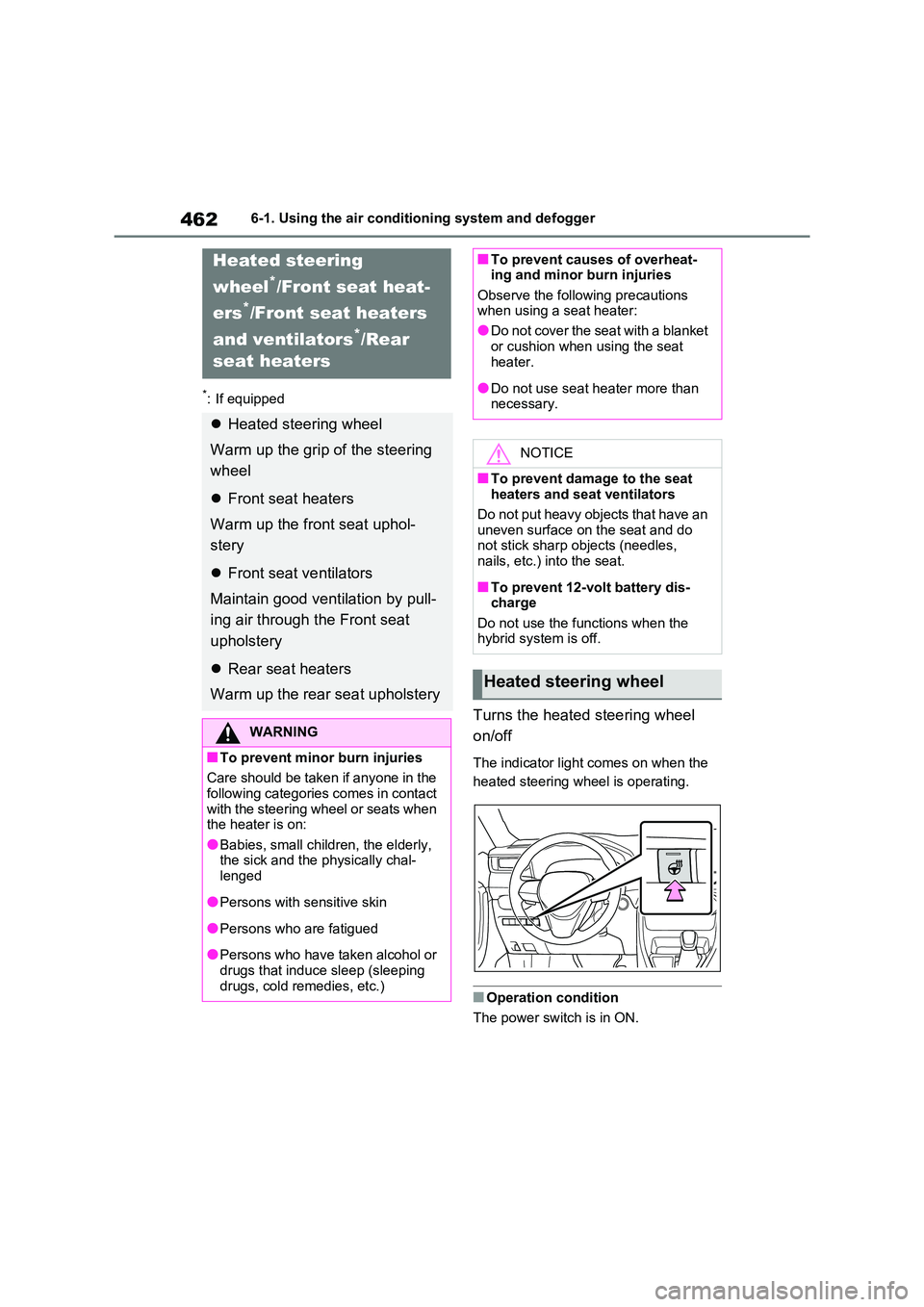
Turns the heated steering wheel
on/off
The indicator light comes on when the
heated steering wheel is operating.
■Operation condition
The power switch is in ON.
Heated steering
wheel*/Front seat heat-
ers*/Front seat heaters
and ventilators*/Rear
seat heaters
Heated steering wheel
Warm up the grip of the steering
wheel
Front seat heaters
Warm up the fr ont seat uphol-
stery
Front seat ventilators
Maintain good ventilation by pull -
ing air through the Front seat
upholstery
Rear seat heaters
Warm up the rear seat upholstery
WARNING
■To prevent minor burn injuries
Care should be taken if anyone in the
following categories comes in contact with the steering wheel or seats when
the heater is on:
●Babies, small children, the elderly, the sick and the p hysically chal-
lenged
●Persons with sensitive skin
●Persons who are fatigued
●Persons who have taken alcohol or
drugs that induce sleep (sleeping drugs, cold remedies, etc.)
■To prevent causes of overheat - ing and minor burn injuries
Observe the following precautions
when using a seat heater:
●Do not cover the seat with a blanket
or cushion when using the seat
heater.
●Do not use seat heater more than
necessary.
NOTICE
■To prevent damage to the seat heaters and seat ventilators
Do not put heavy objects that have an
uneven surface on the seat and do not stick sharp objects (needles,
nails, etc.) into the seat.
■To prevent 12-volt battery dis -
charge
Do not use the functions when the hybrid system is off.
Heated steering wheel
Page 471 of 666
469
6
6-3. Using the storage features
Interior features
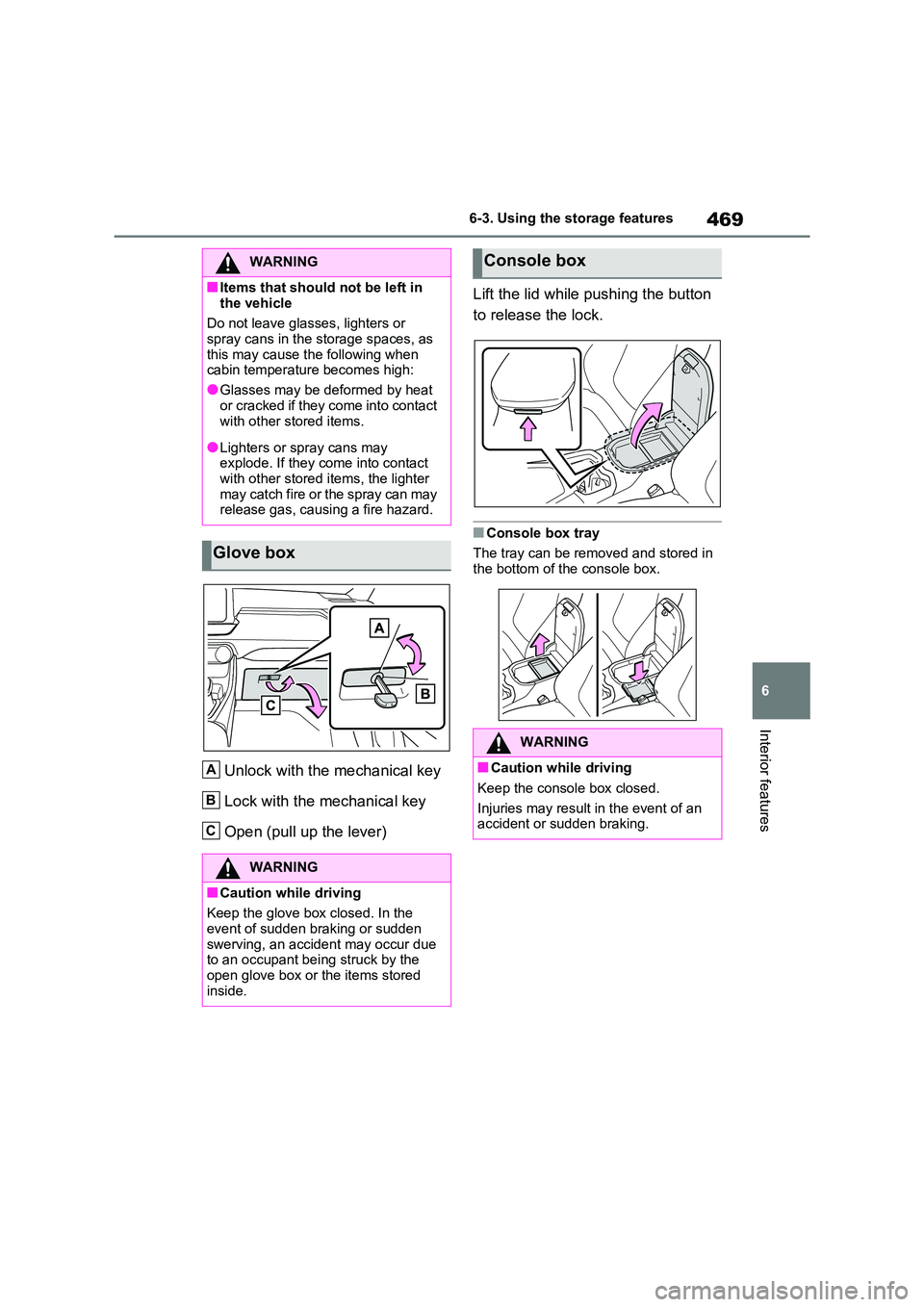
Unlock with the mechanical key
Lock with the mechanical key
Open (pull up the lever)
Lift the lid while pushing the button
to release the lock.
■Console box tray
The tray can be removed and stored in
the bottom of the console box.
WARNING
■Items that should not be left in
the vehicle
Do not leave glasses, lighters or spray cans in the storage spaces, as
this may cause the following when
cabin temperature becomes high:
●Glasses may be deformed by heat
or cracked if they come into contact
with other stored items.
●Lighters or spray cans may
explode. If they come into contact
with other stored items, the lighter may catch fire or the spray can may
release gas, causing a fire hazard.
Glove box
WARNING
■Caution while driving
Keep the glove box closed. In the
event of sudden braking or sudden swerving, an accident may occur due
to an occupant be ing struck by the
open glove box or t he items stored inside.
A
B
C
Console box
WARNING
■Caution while driving
Keep the console box closed.
Injuries may result in the event of an
accident or sudden braking.