weight TOYOTA RAV4 PLUG-IN HYBRID 2023 Owners Manual
[x] Cancel search | Manufacturer: TOYOTA, Model Year: 2023, Model line: RAV4 PLUG-IN HYBRID, Model: TOYOTA RAV4 PLUG-IN HYBRID 2023Pages: 718, PDF Size: 167.55 MB
Page 53 of 718
51
1
1-2. Child safety
For safety and security
• Fixed with an ISOFIX lower
anchorage: P.63
• Using a top tether anchorage:
P.64
Prioritize and observe the warn-
ings, as well as the laws and reg-
ulations for child restraint
systems.
Use a child restraint system until
the child becomes large enough
to properly wear the vehicle’s
seat belt.
Choose a child restraint system
appropriate to the age and size
of the child.
Note that not all child restraint
systems can fit in all vehicles.
Before using or purchasing a
child restraint system, check the
compatibility of the child restraint
system with seat positions.
( P.54)
Points to remember
WARNING
■When a child is riding
Observe the following precautions.
Failure to do so may result in death or serious injury.
●For effective protection in automo-bile accidents and sudden stops, a child must be properly restrained,
using a seat belt or child restraint system which is correctly installed. For installation details, refer to the
operation manual enclosed with the child restraint system. General installation instructions are pro-
vided in this manual.
●Toyota strongly urges the use of a proper child restraint system that conforms to the weight and size of
the child, installed on the rear seat. According to accident statistics, the child is safer when properly
restrained in the rear seat than in the front seat.
●Holding a child in your or someone else’s arms is not a substitute for a child restraint system. In an acci-
dent, the child can be crushed against the windshield or between the holder and the interior of the
vehicle.
■Handling the child restraint sys-
tem
If the child restraint system is not properly fixed in place, the child or
other passengers may be seriously injured or even killed in the event of sudden braking, sudden swerving, or
an accident.
●If the vehicle were to receive a
strong impact from an accident, etc., it is possible that the child restraint system has damage that is
not readily visible. In such cases, do not reuse the restraint system.
●Depending on the child restraint system, installation may be difficult or impossible. In those cases,
check whether the child restraint system is suitable for installment in the vehicle ( P.54). Be sure to
install and observe the usage rules after carefully reading the child restraint system fixing method in
this manual, as well as the opera- tion manual enclosed with the child restraint system.
●Keep the child restraint system properly secured on the seat even if
it is not in use. Do not store the child restraint system unsecured in the passenger compartment.
Page 57 of 718
55
1
1-2. Child safety
For safety and security
systems. ( P.59)
Check the selected child restraint
system together with the following
[Before confirming the compatibility
of each seating position with child
restraint systems].
■Before confirming the compat-
ibility of each seating position
with child restraint systems
1 Checking the child restraint sys-
tem standards.
Use a child restraint system that
conforms to UN(ECE) R44*1 or
UN(ECE) R129*1, 2.
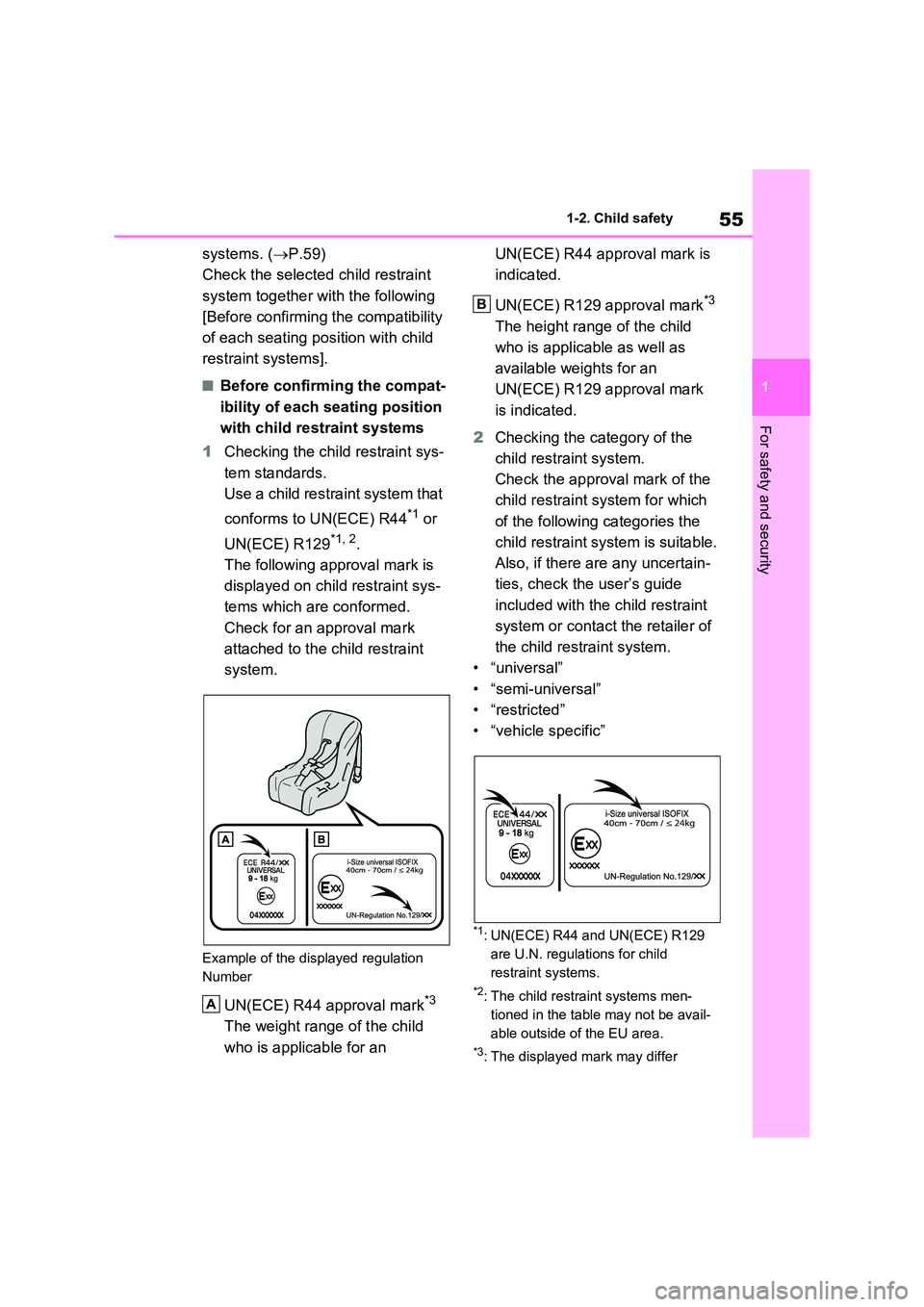
The following approval mark is
displayed on child restraint sys-
tems which are conformed.
Check for an approval mark
attached to the child restraint
system.
Example of the displayed regulation
Number
UN(ECE) R44 approval mark*3
The weight range of the child
who is applicable for an
UN(ECE) R44 approval mark is
indicated.
UN(ECE) R129 approval mark*3
The height range of the child
who is applicable as well as
available weights for an
UN(ECE) R129 approval mark
is indicated.
2 Checking the category of the
child restraint system.
Check the approval mark of the
child restraint system for which
of the following categories the
child restraint system is suitable.
Also, if there are any uncertain-
ties, check the user’s guide
included with the child restraint
system or contact the retailer of
the child restraint system.
• “universal”
• “semi-universal”
• “restricted”
• “vehicle specific”
*1: UN(ECE) R44 and UN(ECE) R129
are U.N. regulations for child
restraint systems.
*2: The child restraint systems men-
tioned in the table may not be avail-
able outside of the EU area.
*3: The displayed mark may differ
A
B
Page 61 of 718
59
1
1-2. Child safety
For safety and security
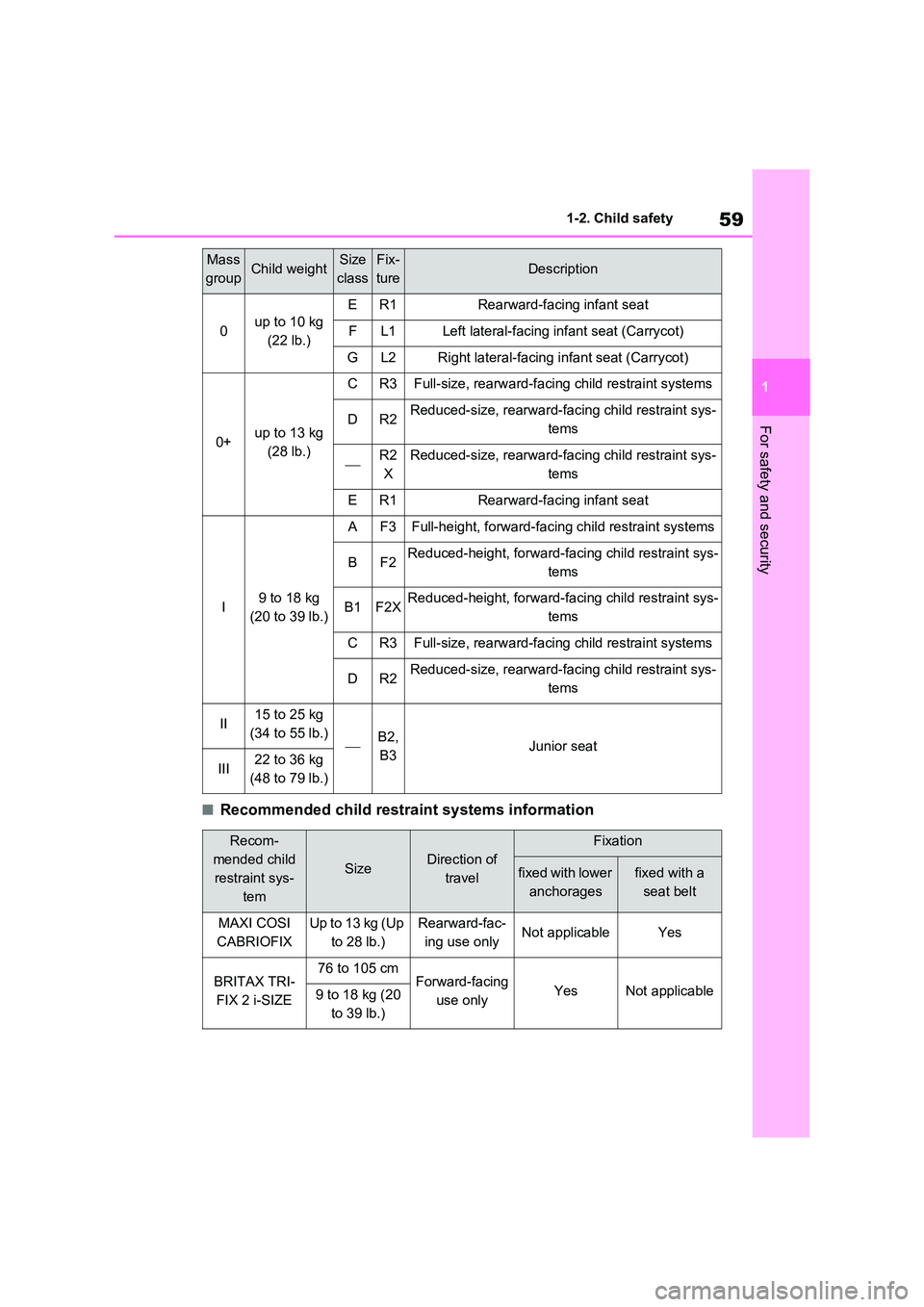
■Recommended child restraint systems information
Mass
groupChild weightSize
class
Fix-
tureDescription
0up to 10 kg
(22 lb.)
ER1Rearward-facing infant seat
FL1Left lateral-facing infant seat (Carrycot)
GL2Right lateral-facing infant seat (Carrycot)
0+up to 13 kg
(28 lb.)
CR3Full-size, rearward-facing child restraint systems
DR2Reduced-size, rearward-facing child restraint sys-
tems
R2
X
Reduced-size, rearward-facing child restraint sys-
tems
ER1Rearward-facing infant seat
I9 to 18 kg
(20 to 39 lb.)
AF3Full-height, forward-facing child restraint systems
BF2Reduced-height, forward-facing child restraint sys-
tems
B1F2XReduced-height, forward-facing child restraint sys-
tems
CR3Full-size, rearward-facing child restraint systems
DR2Reduced-size, rearward-facing child restraint sys-
tems
II15 to 25 kg
(34 to 55 lb.)B2,
B3Junior seat
III22 to 36 kg
(48 to 79 lb.)
Recom-
mended child
restraint sys-
tem
SizeDirection of
travel
Fixation
fixed with lower
anchorages
fixed with a
seat belt
MAXI COSI
CABRIOFIX
Up to 13 kg (Up
to 28 lb.)
Rearward-fac-
ing use onlyNot applicableYes
BRITAX TRI-
FIX 2 i-SIZE
76 to 105 cmForward-facing
use onlyYesNot applicable9 to 18 kg (20
to 39 lb.)
Page 297 of 718
295
5
5-1. Before driving
Driving
WARNING
●Do not place cargo or luggage in or on the following locations.
• At the feet of the driver
• On the front passenger or rear seats (when stacking items)
• On the luggage cover (if equipped)
• On the instrument panel
• On the dashboard
●Secure all items in the occupant compartment.
■Load and distribution
●Do not overload your vehicle.
●Do not apply loads unevenly.
Improper loading may cause deterio-
ration of steering or braking control which may cause death or serious injury.
■When loading cargo on the roof luggage carrier (if equipped)
Observe the following precautions:
●Place the cargo so that its weight is distributed evenly between the front
and rear axles.
●If loading long or wide cargo, never
exceed the vehicle overall length or width. ( P.584)
●Before driving, make sure the cargo is securely fastened on the roof lug-gage carrier.
●Loading cargo on the roof luggage carrier will make the center of grav-
ity of the vehicle higher. Avoid high speeds, sudden starts, sharp turns, sudden braking or abrupt maneu-
vers, otherwise it may result in loss of control or vehicle rollover due to failure to operate this vehicle cor-
rectly and result in death or serious injury.
●If driving for a long distance, on rough roads, or at high speeds, stop the vehicle now and then
during the trip to make sure the cargo remains in its place.
●Do not exceed 80 kg (176.4 lb.) cargo weight on the roof luggage carrier.
NOTICE
■When loading cargo on the roof luggage carrier (if equipped)
Be careful not to scratch the surface
of the panoramic moon roof (if equipped).
Page 298 of 718
2965-1. Before driving
■Tire information
●Increase the tire inflation pressure to
20.0 kPa (0.2 kgf/cm2 or bar, 3 psi)
greater than the recommended value
when towing. (P.590)
●Increase the air pressure of the trailer tires in accordance with the total
trailer weight and according to the val-
ues recommended by the manufac-
turer of your trailer.
■Safety checks before towing
●Check that the maximum load limit for
the towing hitch/bracket and hitch ball
is not exceeded. Bear in mind that the
coupling weight of the trailer will add
to the load exerted on the vehicle.
Also make sure that the total load
exerted on the vehicle is within the
range of the weight limits. (P.298)
●Ensure that the trailer load is secure.
●Supplementary outside rear view mir-
rors should be added to the vehicle if
the traffic behind cannot be clearly
seen with standard mirrors. Adjust the
extending arms of these mirrors on
both sides of the vehicle so that they
always provide maximum visibility of
the road behind.
■When towing a trailer
Disable the following systems, as the
systems may not operate properly.
●LTA (Lane Tracing Assist) (if
equipped) (P.353)
●Dynamic radar cruise control with full-
speed range (if equipped) (P.368)
●Cruise control (if equipped) (P.381)
●PKSB (Parking Support Brake) (if
equipped) (P.403)
●BSM (Blind Spot Monitor) (if
equipped) (P.386)
●Toyota parking assist-sensor
(P.395)
●RCTA (Rear Cross Traffic Alert) func-
tion (if equipped) (P.386)
Trailer towing
Your vehicle is designed pri-
marily as a passenger carry-
ing vehicle. Towing a trailer
will have an adverse effect on
handling, performance, brak-
ing, durability, and fuel con-
sumption. Your safety and
satisfaction depend on the
proper use of correct equip-
ment and cautious driving hab-
its. For your safety and the
safety of others, do not over-
load the vehicle or trailer.
To tow a trailer safely, use
extreme care and drive the
vehicle in accordance with the
trailer’s characteristics and
operating conditions.
Toyota warranties do not apply
to damage or malfunction
caused by towing a trailer for
commercial purposes.
Ask your local authorized
Toyota retailer or Toyota
authorized repairer, or any reli-
able repairer for further details
before towing, as there are
additional legal requirements
in some countries.
Page 299 of 718
297
5
5-1. Before driving
Driving
Check the allowable towing capac-
ity, GVM (Gross Vehicle Mass),
MPAC (Maximum Permissible Axle
Capacity), and permissible drawbar
load before towing. ( P.584)
Toyota recommends the use of the
Toyota hitch/bracket for your vehi-
cle. Other products of a suitable
nature and comparable quality may
also be used.
For vehicles where the towing
device blocks any of the lights or
license plate, the following shall be
observed:
Do not use towing devices that
cannot be easily removed or
repositioned.
Towing devices must be
removed or repositioned when
not in use.
Please consult any authorized
Toyota retailer or Toyota authorized
repairer, or any reliable repairer
when installing trailer lights, as
incorrect installation may cause
damage to the vehicle’s lights.
Please take care to comply with
your state’s laws when installing
trailer lights.
WARNING
Follow all the instructions described in this section.
Failure to do so could cause an acci- dent resulting in death or serious injury.
■Trailer towing precautions
When towing, make sure that none of the weight limits are exceeded.
( P.298)
■To avoid accident or injury
●Vehicles with compact spare tire: Do not tow a trailer when the com-pact spare tire is installed on your
vehicle.
●Vehicles with emergency tire punc-
ture repair kit: Do not tow a trailer when the tire installed is repaired with the emer-
gency tire puncture repair kit.
●Do not use dynamic radar cruise
control with full-speed range (if equipped) or cruise control (if equipped) when trailer towing.
■Vehicle speed in towing
Observe the legal maximum speeds
for trailer towing.
■Before descending hills or long
declines
Reduce speed and downshift. How- ever, never downshift suddenly while
descending steep or long downhill grades.
■Operation of the brake pedal
Do not hold the brake pedal depressed often or for long periods of
time. Doing so may result in the brake over-heating or reduce braking effects.
Weight limits
Towing hitch/bracket
Connecting trailer lights
Page 300 of 718
2985-1. Before driving
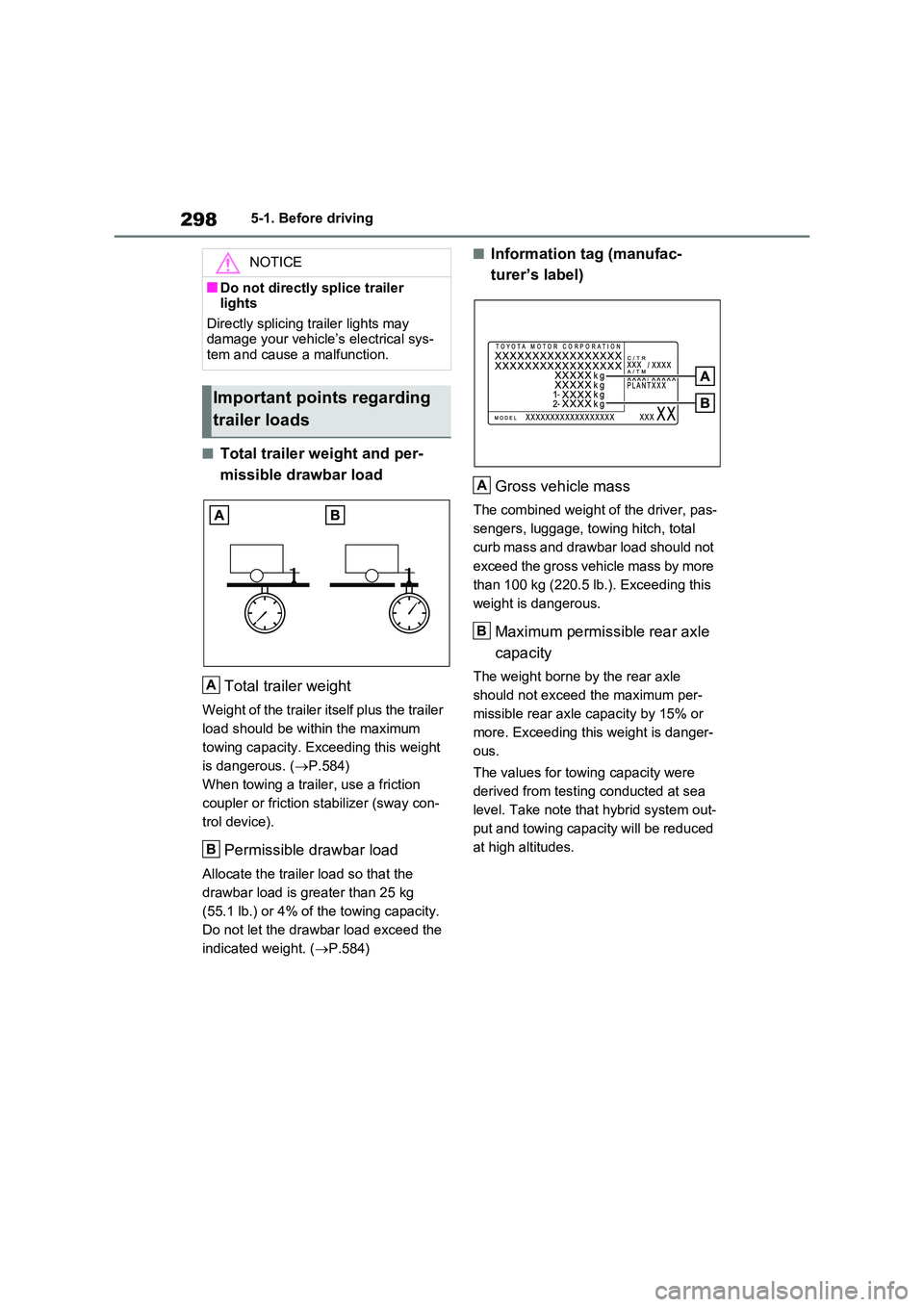
■Total trailer weight and per-
missible drawbar load
Total trailer weight
Weight of the trailer itself plus the trailer
load should be within the maximum
towing capacity. Exceeding this weight
is dangerous. ( P.584)
When towing a trailer, use a friction
coupler or friction stabilizer (sway con-
trol device).
Permissible drawbar load
Allocate the trailer load so that the
drawbar load is greater than 25 kg
(55.1 lb.) or 4% of the towing capacity.
Do not let the drawbar load exceed the
indicated weight. ( P.584)
■Information tag (manufac-
turer’s label)
Gross vehicle mass
The combined weight of the driver, pas-
sengers, luggage, towing hitch, total
curb mass and drawbar load should not
exceed the gross vehicle mass by more
than 100 kg (220.5 lb.). Exceeding this
weight is dangerous.
Maximum permissible rear axle
capacity
The weight borne by the rear axle
should not exceed the maximum per-
missible rear axle capacity by 15% or
more. Exceeding this weight is danger-
ous.
The values for towing capacity were
derived from testing conducted at sea
level. Take note that hybrid system out-
put and towing capacity will be reduced
at high altitudes.
NOTICE
■Do not directly splice trailer lights
Directly splicing trailer lights may damage your vehicle’s electrical sys-tem and cause a malfunction.
Important points regarding
trailer loads
A
B
A
B
Page 310 of 718
3085-1. Before driving
is especially true when driving on
wet or slippery road surfaces.
■Sudden acceleration/steering
input/cornering
Executing sharp turns when towing
may result in the trailer colliding
with your vehicle. Decelerate well in
advance when approaching turns
and take them slowly and carefully
to avoid sudden braking.
■Important points regarding
turning
The wheels of the trailer will travel
closer to the inside of the curve
than the wheels of the vehicle. To
make allowance for this, take the
turns wider than you would nor-
mally do.
■Important points regarding
stability
Vehicle movement resulting from
uneven road surfaces and strong
crosswinds will affect handling. The
vehicle may also be rocked by
passing buses or large trucks. Fre-
quently check behind when moving
alongside such vehicles. As soon
as such vehicle movement occurs,
immediately start to decelerate
smoothly by slowly applying the
brakes. Always steer the vehicle
straight ahead while braking.
■Passing other vehicles
Consider the total combined length
of your vehicle and trailer and
ensure that the vehicle-to-vehicle
distance is sufficient before execut-ing lane changes.
■Transmission information
To maintain engine braking effi-
ciency, when using engine braking,
do not use the transmission in D.
(P.315)
■If the hybrid system overheats
Towing a loaded trailer up a long,
steep incline in temperatures
exceeding 30°C (85°F) may result
in the hybrid system overheating. If
the high coolant temperature warn-
ing light indicates that the hybrid
system is overheating, turn the air
conditioning off immediately, leave
the road and stop the vehicle in a
safe place. (P.578)
■When parking the vehicle
Always place wheel chocks under
the wheels of both the vehicle and
trailer. Firmly set the parking brake
and shift the shift lever to P.
■Break-in schedule
Toyota recommends that vehicles fitted
with new power train components
should not be used for towing trailers for
the first 800 km (500 miles).
■Maintenance
●Maintenance must be performed more
frequently when using the vehicle for
towing due to the greater weight bur-
den placed on the vehicle compared
to normal driving.
●Retighten all bolts securing the hitch-
ing ball and bracket after towing for
approximately 1000 km (600 miles).
■If trailer sway occurs
One or more factors (crosswinds, pass-
ing vehicles, rough roads, etc.) can
Page 311 of 718
309
5 5-1. Before driving
Driving
adversely affect handling of your vehicle
and trailer, causing instability.
●If trailer swaying occurs:
• Firmly grip the steering wheel. Steer
straight ahead.
Do not try to control trailer swaying by
turning the steering wheel.
• Begin releasing the accelerator pedal
immediately but very gradually to
reduce speed.
Do not increase speed. Do not apply
vehicle brakes.
If you make no extreme correction with
the steering or brakes, your vehicle and
trailer should stabilize (if enabled, Trailer
Sway Control can also help to stabilize
the vehicle and trailer.).
●After the trailer swaying has stopped:
• Stop in a safe place. Get all occupants
out of the vehicle.
• Check the tires of the vehicle and the
trailer.
• Check the load in the trailer.
Make sure the load has not shifted.
Make sure the tongue weight is appro-
priate, if possible.
• Check the load in the vehicle.
Make sure the vehicle is not overloaded
after occupants get in.
If you cannot find any problems, the
speed at which trailer swaying occurred
is beyond the limit of your particular
vehicle-trailer combination. Drive at a
lower speed to prevent instability.
Remember that swaying of the towing
vehicle-trailer increases as speed
increases.
Page 462 of 718
4606-4. Using the other interior features
device and portable device will get
warmer, however this is not a mal- function.When a portable device gets warm
while charging, charging may stop due to the protection function on the portable device side. In this case,
when the temperature of the portable device drops significantly, charge again.
The fan may start operating to lower the
temperature inside the wireless charger,
however this is not a malfunction.
■Operation sounds
A buzzing noise may be heard when pressing the power supply switch to turn the power supply on, when turning the
power switch to ACC or ON while the wireless charger power supply is on, or when detecting a portable device. How-
ever, this is not a malfunction.
■If the smartphone OS has been updated
If the smartphone OS has been updated
to a newer version, its charging specifi- cations may have changed significantly. For details, check the information on the
manufacturer’s website.
■Trademark information
iPhone is a trademark of Apple Inc., reg- istered in the U.S. and other countries.
WARNING
■Caution while driving
When charging a portable device, for safety reasons, the driver should not
operate the main part of the portable device while driving.
■Caution while in motion
Do not charge lightweight devices such as wireless headphones while in
motion. These devices are very light and may be ejected from the charging tray, which may lead to unforeseen
accidents.
■Caution regarding interference with electronic devices
People with implantable cardiac pace-
makers, cardiac resynchronization therapy-pacemakers or implantable cardioverters, as well as any other
electrical medical device, should con- sult their physician about the usage of the wireless charger.
■To prevent malfunctions or burns
Observe the following precautions. Failure to do so may result in a equip-ment failure and damage, catch fire,
burns due to overheat or electric shock.
●Do not insert any metallic objects
between the charge area and the portable device while charging
●Do not attach an aluminum sticker or other metallic object to the charge area
●Do not attach an aluminum sticker or other metallic object to the side
of the portable device (or to its case or cover) that touches the charge area
●Do not use the charging tray as a small storage space
●Do not subject to a strong force or impact
●Do not disassemble, modify or remove
●Do not charge devices other than specified portable devices
●Keep away from magnetic items
●Do not charge devices if the charge area is covered in dust
●Do not cover with a cloth or similar material