check engine TOYOTA SUPRA 2022 Owners Manual
[x] Cancel search | Manufacturer: TOYOTA, Model Year: 2022, Model line: SUPRA, Model: TOYOTA SUPRA 2022Pages: 498, PDF Size: 104.06 MB
Page 28 of 498
262-1. QUICK REFERENCE
2-1.QUICK REFERENCE
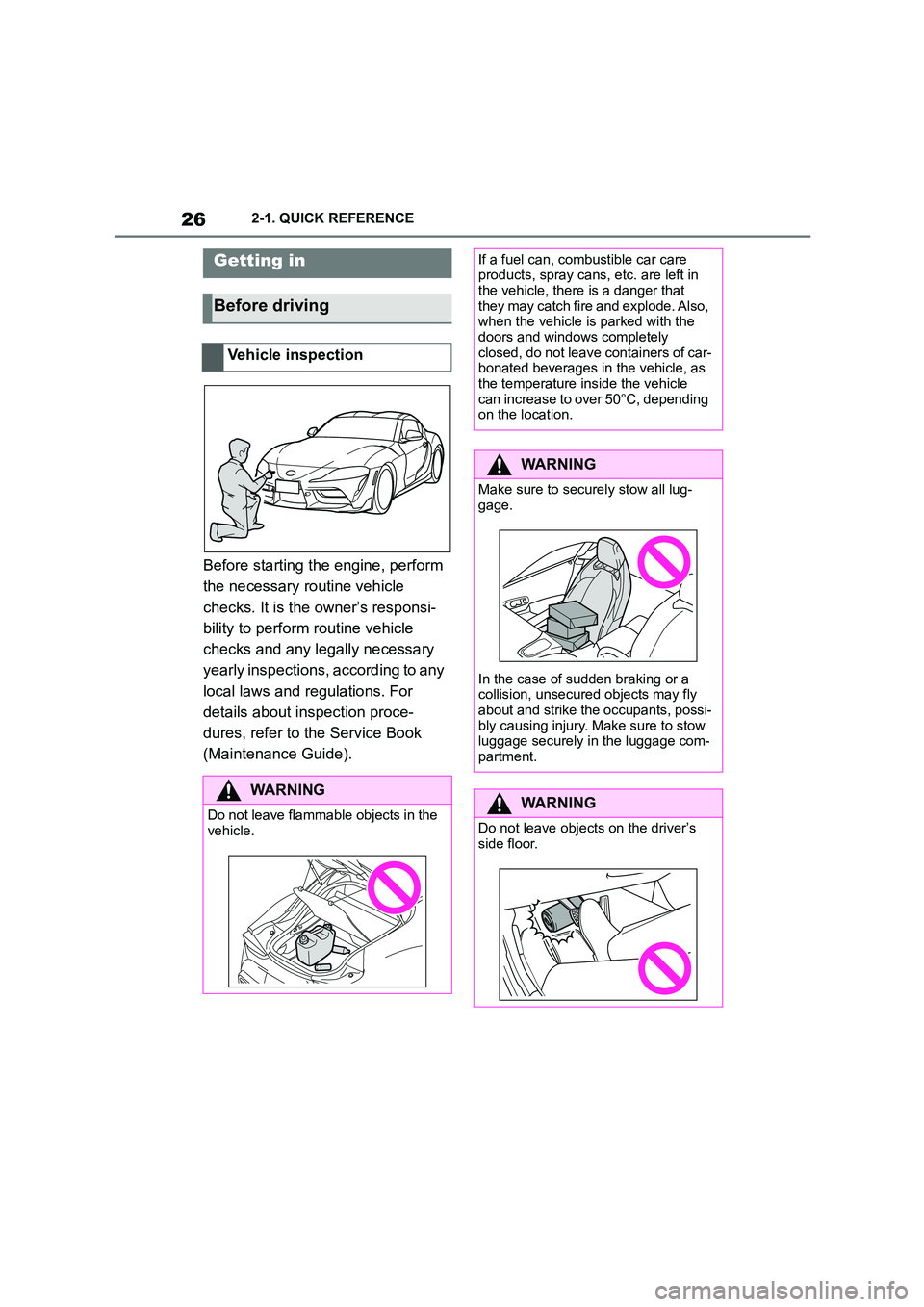
Before starting the engine, perform
the necessary routine vehicle
checks. It is the owner’s responsi-
bility to perform routine vehicle
checks and any legally necessary
yearly inspections, according to any
local laws and regulations. For
details about inspection proce-
dures, refer to the Service Book
(Maintenance Guide).
Getting in
Before driving
Vehicle inspection
WA R N I N G
Do not leave flammable objects in the vehicle.
If a fuel can, combustible car care products, spray cans, etc. are left in
the vehicle, there is a danger that
they may catch fire and explode. Also, when the vehicle is parked with the
doors and windows completely
closed, do not leave containers of car- bonated beverages in the vehicle, as
the temperature inside the vehicle
can increase to over 50°C, depending on the location.
WA R N I N G
Make sure to secu rely stow all lug-
gage.
In the case of sudden braking or a
collision, unsecure d objects may fly
about and strike the occupants, possi- bly causing injury. Ma ke sure to stow
luggage securely in the luggage com-
partment.
WA R N I N G
Do not leave objects on the driver’s
side floor.
Page 29 of 498
27
2
2-1. QUICK REFERENCE
QUICK REFERENCE
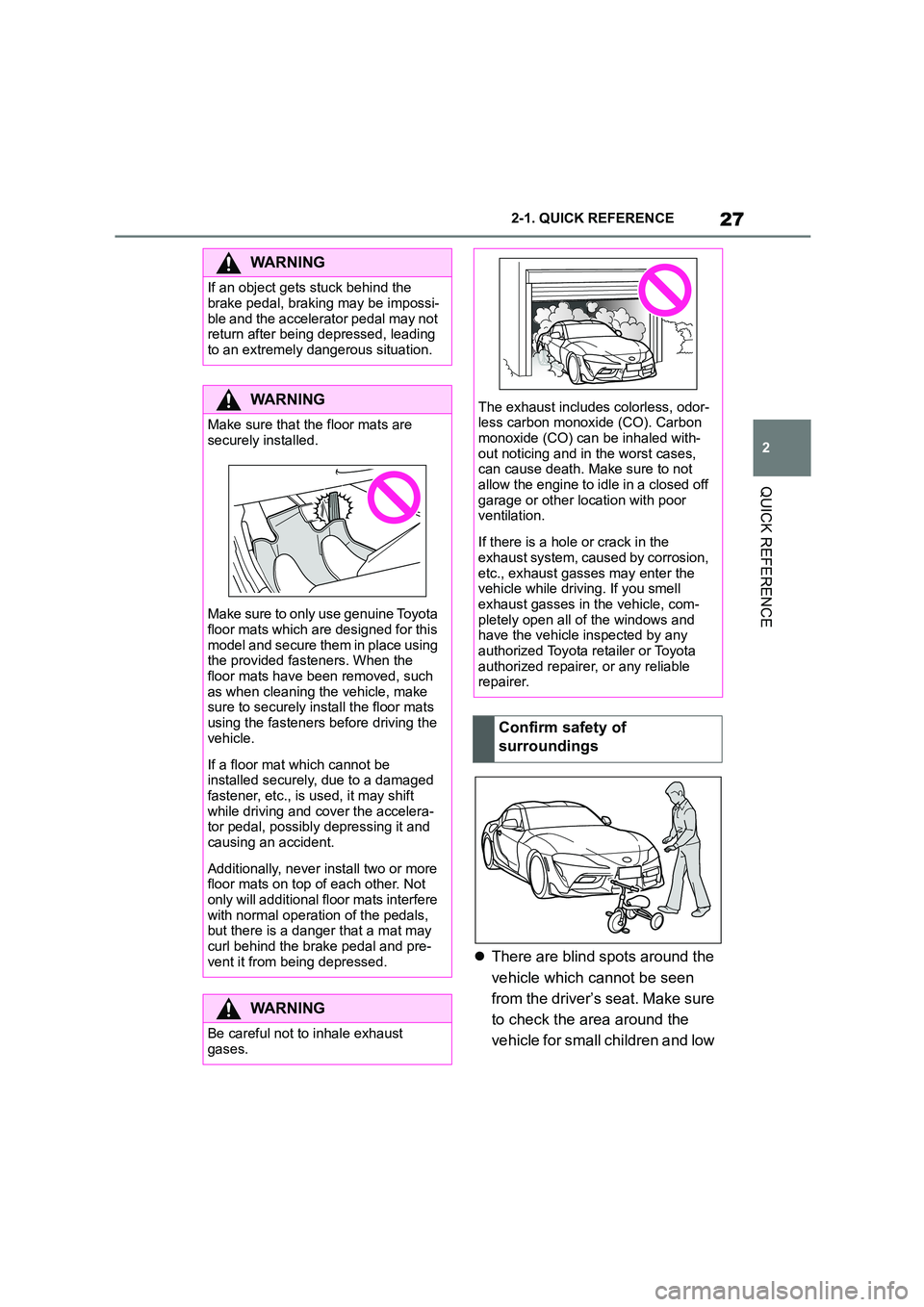
There are blind spots around the
vehicle which cannot be seen
from the driver’s seat. Make sure
to check the area around the
vehicle for small children and low
WA R N I N G
If an object gets stuck behind the
brake pedal, braking may be impossi-
ble and the accelerator pedal may not return after being depressed, leading
to an extremely dangerous situation.
WA R N I N G
Make sure that the floor mats are
securely installed.
Make sure to only use genuine Toyota
floor mats which are designed for this model and secure them in place using
the provided fasteners. When the
floor mats have been removed, such as when cleaning the vehicle, make
sure to securely install the floor mats
using the fasteners before driving the
vehicle.
If a floor mat which cannot be
installed securely, due to a damaged fastener, etc., is used, it may shift
while driving and cover the accelera-
tor pedal, possibly depressing it and causing an accident.
Additionally, never install two or more floor mats on top of each other. Not
only will additional floor mats interfere
with normal operation of the pedals, but there is a danger that a mat may
curl behind the brake pedal and pre-
vent it from being depressed.
WA R N I N G
Be careful not to inhale exhaust
gases.
The exhaust includes colorless, odor- less carbon monoxide (CO). Carbon
monoxide (CO) can be inhaled with-
out noticing and in the worst cases, can cause death. Make sure to not
allow the engine to idle in a closed off
garage or other location with poor ventilation.
If there is a hole or crack in the exhaust system, caused by corrosion,
etc., exhaust gasses may enter the
vehicle while driving. If you smell exhaust gasses in the vehicle, com-
pletely open all of the windows and
have the vehicle inspected by any authorized Toyota retailer or Toyota
authorized repairer, or any reliable
repairer.
Confirm safety of
surroundings
Page 32 of 498
302-1. QUICK REFERENCE
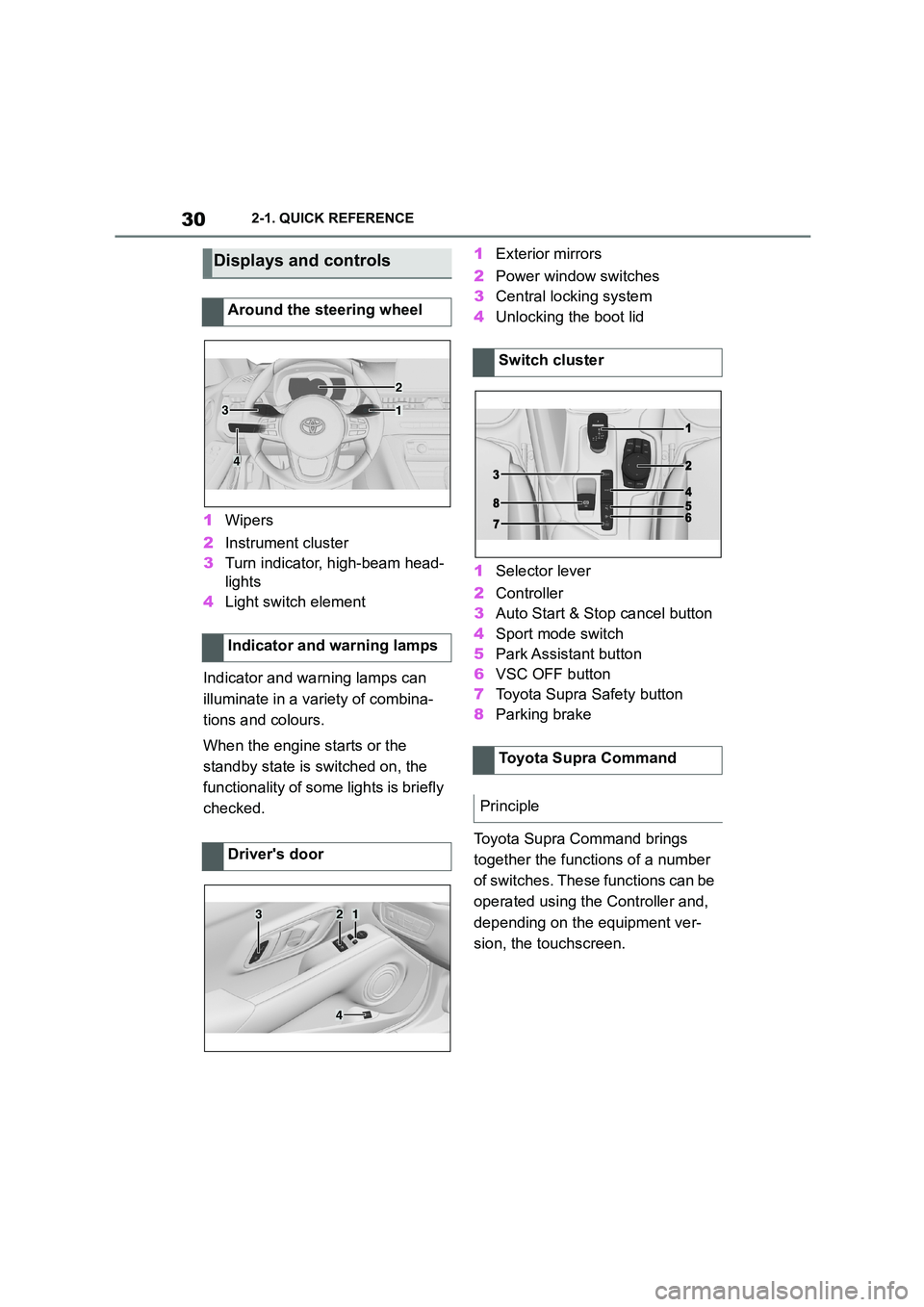
1Wipers
2 Instrument cluster
3 Turn indicator, high-beam head-
lights
4 Light switch element
Indicator and warning lamps can
illuminate in a variety of combina-
tions and colours.
When the engine starts or the
standby state is switched on, the
functionality of some lights is briefly
checked.
1 Exterior mirrors
2 Power window switches
3 Central locking system
4 Unlocking the boot lid
1 Selector lever
2 Controller
3 Auto Start & Stop cancel button
4 Sport mode switch
5 Park Assistant button
6 VSC OFF button
7 Toyota Supra Safety button
8 Parking brake
Toyota Supra Command brings
together the functions of a number
of switches. These functions can be
operated using the Controller and,
depending on the equipment ver-
sion, the touchscreen.
Displays and controls
Around the steering wheel
Indicator and warning lamps
Driver's door
1
2
3
4
321
4
Switch cluster
Toyota Supra Command
Principle
Page 43 of 498
41
2
2-1. QUICK REFERENCE
QUICK REFERENCE
in sulphur content.
Fuels labelled on the pump as con-
taining metal must not be used.
P. 3 2 2
Information about the recom-
mended petrol grade is provided in
the Owner’s Manual.
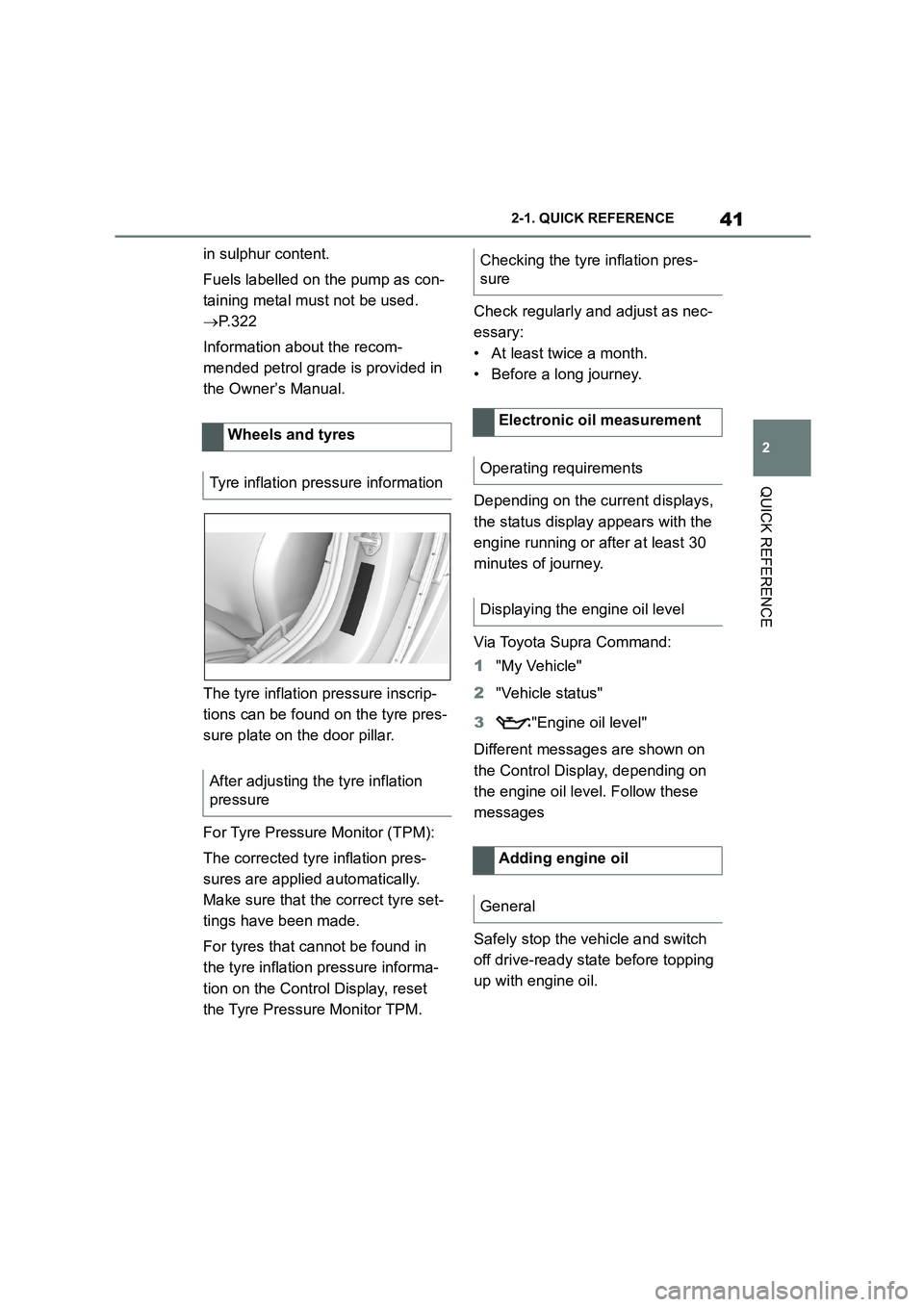
The tyre inflation pressure inscrip-
tions can be found on the tyre pres-
sure plate on the door pillar.
For Tyre Pressure Monitor (TPM):
The corrected tyre inflation pres-
sures are applied automatically.
Make sure that the correct tyre set-
tings have been made.
For tyres that cannot be found in
the tyre inflation pressure informa-
tion on the Control Display, reset
the Tyre Pressure Monitor TPM.
Check regularly and adjust as nec-
essary:
• At least twice a month.
• Before a long journey.
Depending on the current displays,
the status display appears with the
engine running or after at least 30
minutes of journey.
Via Toyota Supra Command:
1 "My Vehicle"
2 "Vehicle status"
3 "Engine oil level"
Different messages are shown on
the Control Display, depending on
the engine oil le vel. Follow these
messages
Safely stop the vehicle and switch
off drive-ready state before topping
up with engine oil.
Wheels and tyres
Tyre inflation pres sure information
After adjusting the tyre inflation
pressure
Checking the tyre inflation pres-
sure
Electronic oil measurement
Operating requirements
Displaying the engine oil level
Adding engine oil
General
Page 150 of 498
1483-1. CONTROLS
example in order to leave it.
1 Press the start/stop button.
Drive-ready state is switched off.
Standby state is switched on.
Selector lever position P is auto-
matically engaged.
2 Apply the parking brake.
In certain situations the Auto
Start/Stop is deactivated automati-
cally for safety reasons, for exam-
ple if the absence of the driver is
detected.
The Auto Start/Stop no longer shuts
down the engine automatically. A
vehicle message is shown. It is
possible to keep driving. Have the
system checked by any authorized
Toyota retailer or Toyota authorized
repairer, or any reliable repairer.
The parking brake is used to pre-
vent the vehicle from rolling when it
is parked.
Automatic deactivation
General
Malfunction
Parking brake
Principle
Safety notes
WA R N I N G
An unsecured vehicle can start mov-
ing and rolling away. There is a risk of accident. Before leaving the vehicle,
secure it to prevent it from rolling
away.
Observe the following to ensure that
the vehicle is secured against rolling
away:
●Apply the parking brake.
●Turn the front wheels towards the kerb on upward or downward gradi-
ents.
●Additionally secure the vehicle on
upward or downward gradients, for
example with a chock.
WA R N I N G
Unsupervised children or pets in the
vehicle can set the vehicle in motion
and endanger themselves or other road users, for example by the follow-
ing actions:
●Pressing the start/stop button.
●Releasing the parking brake.
●Opening and closing doors or win-
dows.
●Engaging selector lever position N.
●Operating vehicle equipment.
There is a risk of accidents or injury. Do not leave children or pets unsu-
pervised in the vehicle. When leaving
the vehicle, take the remote control with you and lock the vehicle.
Page 169 of 498
167
3
3-1. CONTROLS
CONTROLS
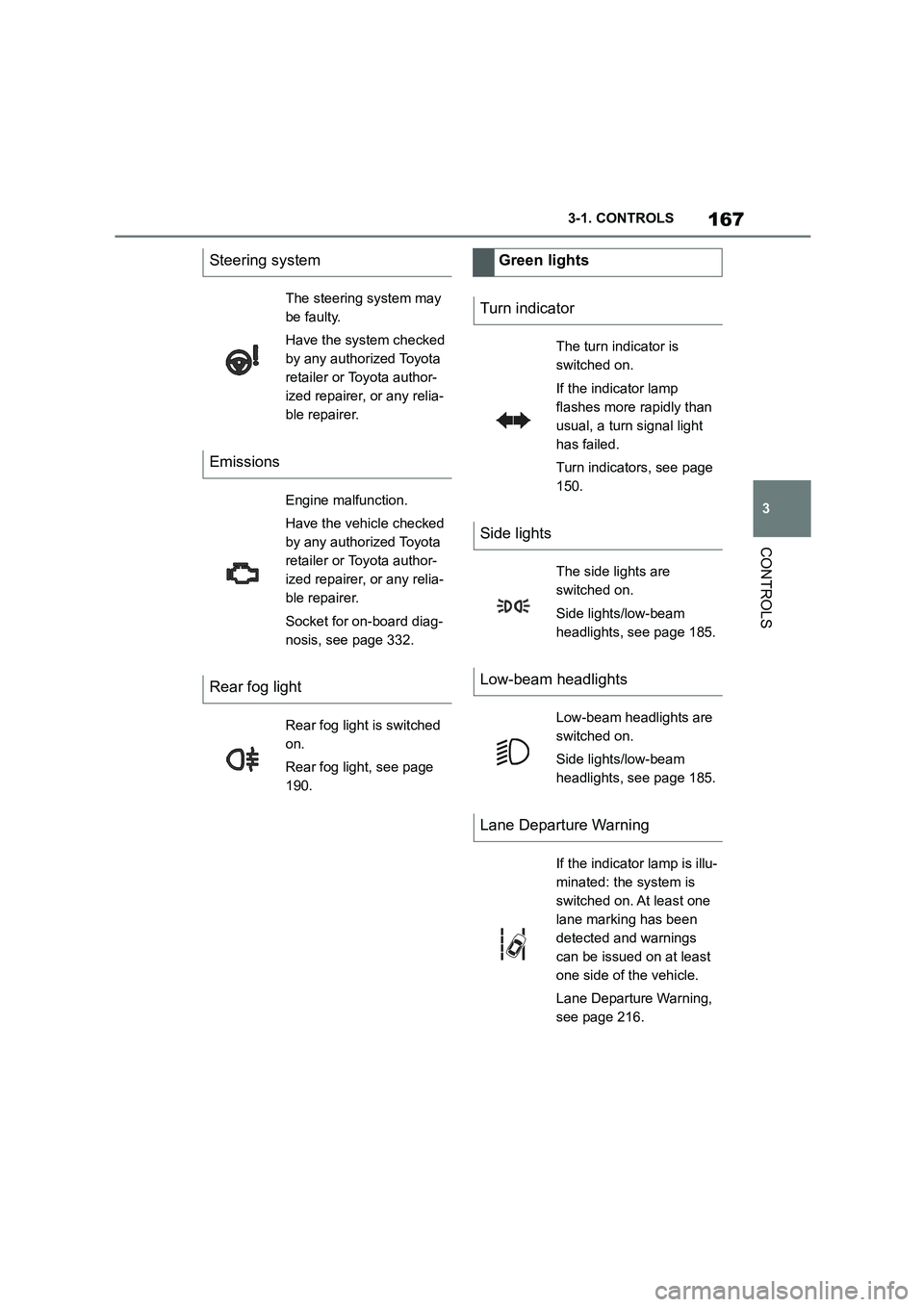
Steering system
The steering system may
be faulty.
Have the system checked
by any authorized Toyota
retailer or Toyota author-
ized repairer, or any relia-
ble repairer.
Emissions
Engine malfunction.
Have the vehicle checked
by any authorized Toyota
retailer or Toyota author-
ized repairer, or any relia-
ble repairer.
Socket for on-board diag-
nosis, see page 332.
Rear fog light
Rear fog light is switched
on.
Rear fog light, see page
190.
Green lights
Turn indicator
The turn indicator is
switched on.
If the indicator lamp
flashes more rapidly than
usual, a turn signal light
has failed.
Turn indicators, see page
150.
Side lights
The side lights are
switched on.
Side lights/low-beam
headlights, see page 185.
Low-beam headlights
Low-beam headlights are
switched on.
Side lights/low-beam
headlights, see page 185.
Lane Departure Warning
If the indicator lamp is illu-
minated: the system is
switched on. At least one
lane marking has been
detected and warnings
can be issued on at least
one side of the vehicle.
Lane Departure Warning,
see page 216.
Page 171 of 498
169
3
3-1. CONTROLS
CONTROLS
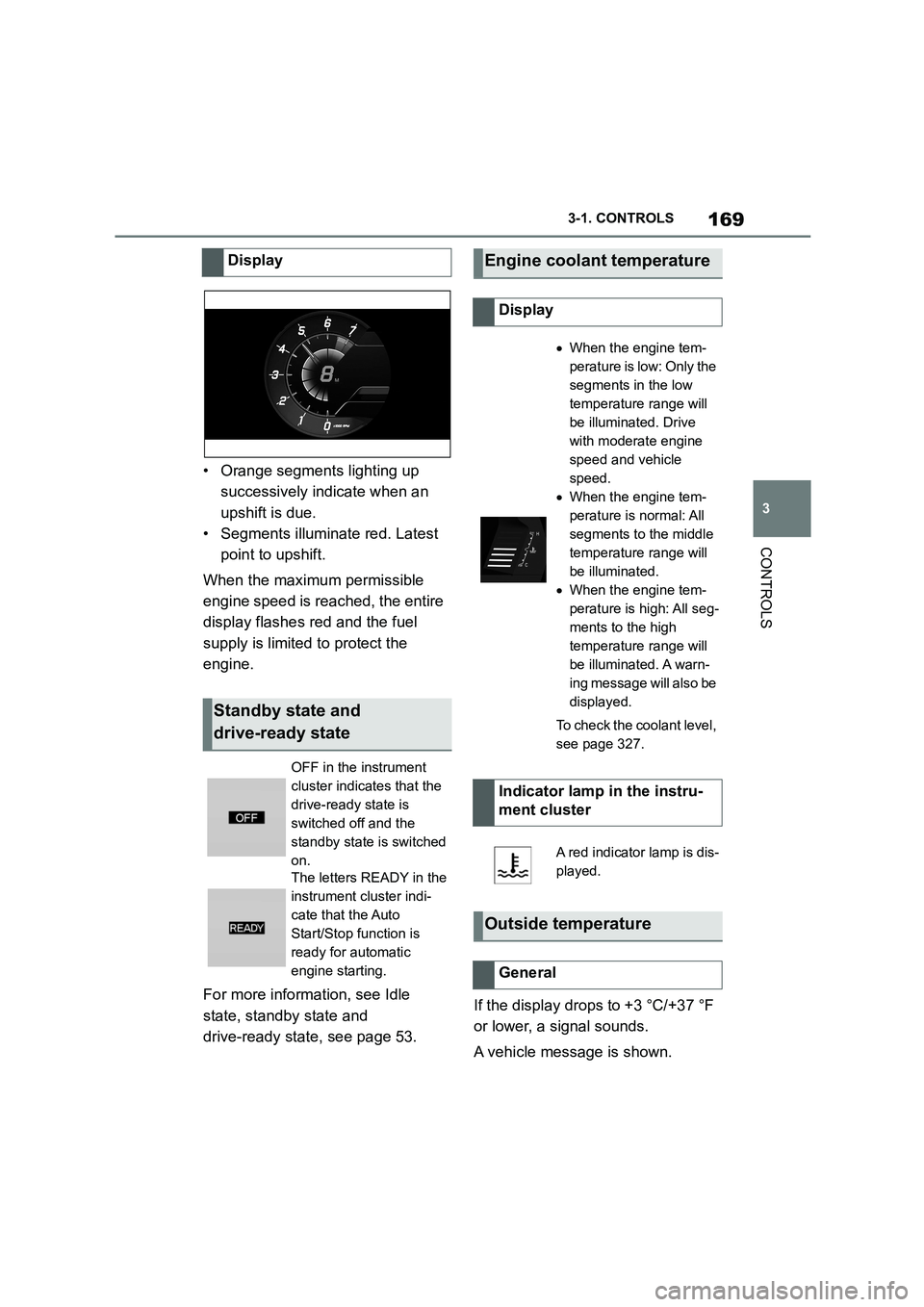
• Orange segments lighting up
successively indicate when an
upshift is due.
• Segments illuminate red. Latest
point to upshift.
When the maximum permissible
engine speed is reached, the entire
display flashes red and the fuel
supply is limited to protect the
engine.
For more informat ion, see Idle
state, standby state and
drive-ready state, see page 53.
If the display drops to +3 °C/+37 °F
or lower, a signal sounds.
A vehicle message is shown.
Display
Standby state and
drive-ready state
OFF in the instrument
cluster indicates that the
drive-ready state is
switched off and the
standby state is switched
on.
The letters READY in the
instrument cluster indi-
cate that the Auto
Start/Stop function is
ready for automatic
engine starting.
Engine coolant temperature
Display
When the engine tem-
perature is low: Only the
segments in the low
temperature range will
be illuminated. Drive
with moderate engine
speed and vehicle
speed.
When the engine tem-
perature is normal: All
segments to the middle
temperature range will
be illuminated.
When the engine tem-
perature is high: All seg-
ments to the high
temperature range will
be illuminated. A warn-
ing message will also be
displayed.
To check the coolant level,
see page 327.
Indicator lamp in the instru-
ment cluster
A red indicator lamp is dis-
played.
Outside temperature
General
Page 181 of 498
179
3
3-1. CONTROLS
CONTROLS
A vehicle message is displayed
briefly if the remaining range is low.
If a sporty driving style is adopted,
for example fast cornering, engine
function is not always ensured.
If the range drops below approxi-
mately 50 km, 30 miles the vehicle
message is continuously displayed.
■Safety note
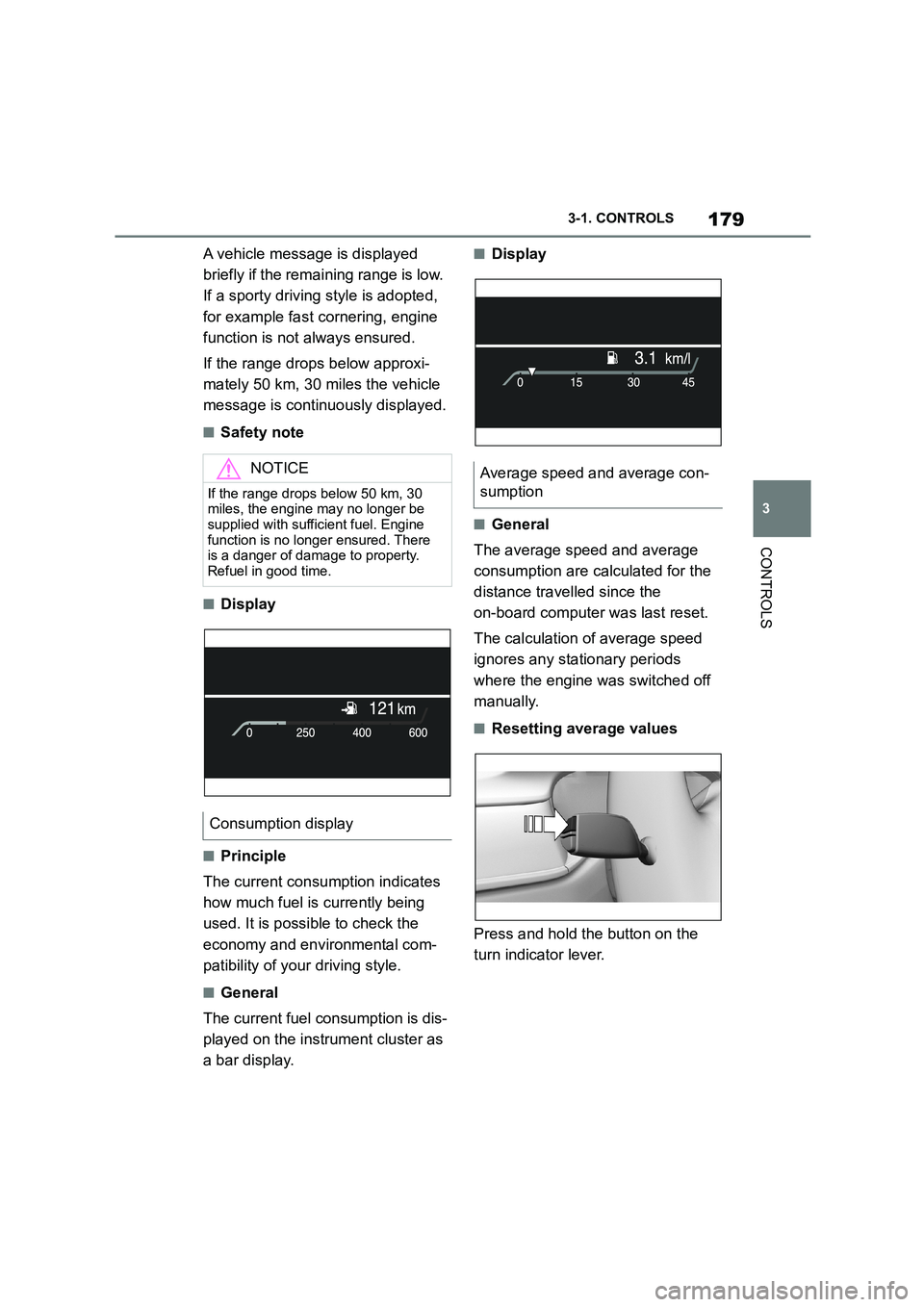
■Display
■Principle
The current consumption indicates
how much fuel is currently being
used. It is possible to check the
economy and environmental com-
patibility of your driving style.
■General
The current fuel consumption is dis-
played on the instrument cluster as
a bar display.
■Display
■General
The average speed and average
consumption are calculated for the
distance travelled since the
on-board computer was last reset.
The calculation of average speed
ignores any stationary periods
where the engine was switched off
manually.
■Resetting average values
Press and hold the button on the
turn indicator lever.
NOTICE
If the range drops below 50 km, 30
miles, the engine may no longer be supplied with sufficient fuel. Engine
function is no longer ensured. There
is a danger of damage to property. Refuel in good time.
Consumption display
Average speed and average con-
sumption
Page 287 of 498
285
4
4-1. DRIVING HINTS
DRIVING HINTS
Ensure that you do not obstruct
other road users when doing so.
The heat generated by braking
dries the brake discs and brake
pads and protects them against
corrosion.
This way, brake power is available
immediately, whenever it is needed.
■General
When driving on long or steep
downhill stretches, use the gear in
which the least braking is required.
Otherwise the brake system can
overheat and the braking effect is
reduced.
Engine braking effect can be addi-
tionally increased by manually shift-
ing down, even into first gear, if
applicable.
■Safety notes
Corrosion of the brake discs and
contamination of the brake pads
increase in the following circum-
stances:
Low mileage.
Extended periods when the vehi-
cle is not used.
Infrequent use of the brakes.
Aggressive, acidic or alkaline
cleaning agents.
During braking, corroded brake
discs may cause brake judder
which usually cannot be eliminated.
When the automatic air condition-
ing is in operation, condensation
develops and exits underneath the
vehicle.
The higher mechanical and thermal
loads involved in driving on racing
tracks lead to increased wear. This
wear is not covered by the war-
ranty. The vehicle is not conceived
for use in motor sports competi-
tions.
Before and after driving on a racing
track, have the vehicle checked at
any authorized Toyota retailer or
Toyota authorized repairer, or any
reliable repairer.
Downhill gradients
WA R N I N G
Even slight continuous pressure on the brake pedal can cause overheat-
ing, brake pad wear or even brake
system failure. There is a danger of accidents. Avoid excessive loads on
the brake.
WA R N I N G
When idling or with the engine switched off, safety-relevant func-
tions, for example engine braking
effect or steering and braking force assistance, are either restricted or not
available at all. There is a risk of acci-
dent. Do not drive at idle speed or with the engine switched off.
Corrosion of the brake discs
Condensation when vehicle
is parked
Driving on a racing track
Page 288 of 498
2864-1. DRIVING HINTS
This chapter describes all standard,
country-specific and special equip-
ment available for the model series.
It may therefore describe equip-
ment and functions which are not
installed in your vehicle, for exam-
ple on account of the special equip-
ment selected or the country
specification. This also applies to
safety-relevant functions and sys-
tems. Please comply with the rele-
vant laws and regulations when
using the corresponding functions
and systems.
The vehicle has a wide range of
technologies for reducing con-
sumption and emissions.
The fuel consumption depends on
various factors, for example driving
style, road conditions, service or
environmental factors.
A number of measures, such as a
moderate driving style and regular
maintenance, can influence fuel
consumption and reduce the bur-
den on the environment.
Extra weight increases fuel con-
sumption.
Add-on parts on the vehicle can
adversely affect its aerodynamic
performance and increase fuel con-
sumption.
Open windows increase drag and
consequently fuel consumption.
Tyres can have diff ering effects on
fuel consumption figures. The tyre
size, for example, can influence
how much fuel a vehicle uses.
Check and, if necessary, correct the
tyre inflation pressures at least
twice a month and before setting off
on a longer journey.
Insufficient tyre inflation pressure
increases rolling resistance and
consequently fuel consumption and
tyre wear.
Do not warm up the engine with the
vehicle at a stands till, but instead
Saving fuel
Vehicle equipment
Reducing fuel consumption
General
Remove unnecessary loads
Remove add-on parts after
use
Close windows
Ty r e s
General
Checking tyre inflation pressure
regularly
Drive off immediately