ECO mode TOYOTA SUPRA 2022 User Guide
[x] Cancel search | Manufacturer: TOYOTA, Model Year: 2022, Model line: SUPRA, Model: TOYOTA SUPRA 2022Pages: 498, PDF Size: 104.06 MB
Page 165 of 498
163
3
3-1. CONTROLS
CONTROLS
The display can be changed for
sport mode.
The driving mode will change to
sport mode.
The vehicle messages monitors
vehicle functions and alerts you to
any faults in the monitored sys-
tems.
A vehicle message is displayed as
a combination of indicator or warn-
ing lamps and text messages in the
instrument cluster and, if applica-
ble, in the Head-Up Display.
If applicable, the text message
shown in the Control Display is
accompanied by an additional
acoustic signal.
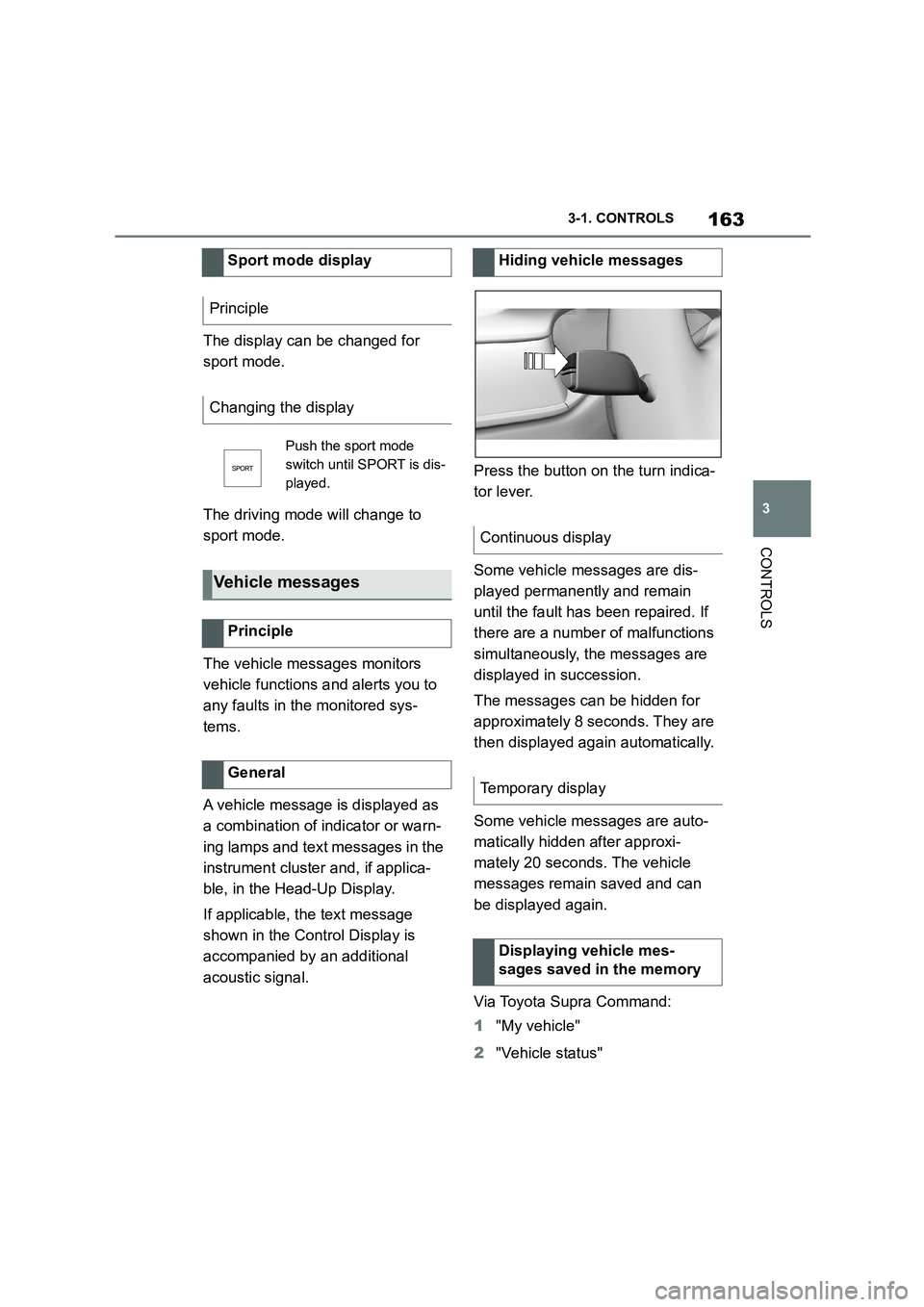
Press the button on the turn indica-
tor lever.
Some vehicle messages are dis-
played permanently and remain
until the fault has been repaired. If
there are a number of malfunctions
simultaneously, the messages are
displayed in succession.
The messages can be hidden for
approximately 8 seconds. They are
then displayed again automatically.
Some vehicle messages are auto-
matically hidden after approxi-
mately 20 seconds. The vehicle
messages remain saved and can
be displayed again.
Via Toyota Supra Command:
1 "My vehicle"
2 "Vehicle status"
Sport mode display
Principle
Changing the display
Push the sport mode
switch until SPORT is dis-
played.
Vehicle messages
Principle
General
Hiding vehicle messages
Continuous display
Temporary display
Displaying vehicle mes-
sages saved in the memory
Page 173 of 498
171
3
3-1. CONTROLS
CONTROLS
2 "Vehicle status"
3 "Service requirements"
4 "Date:"
5 Select the desired setting.
The optimum shift indicator recom-
mends the most optimum gear for
the current driving situation and
supports an efficient driving style.
Depending on the equipment and
the country specifications, the shift
position indicator is active in the
manual mode of the automatic
transmission.
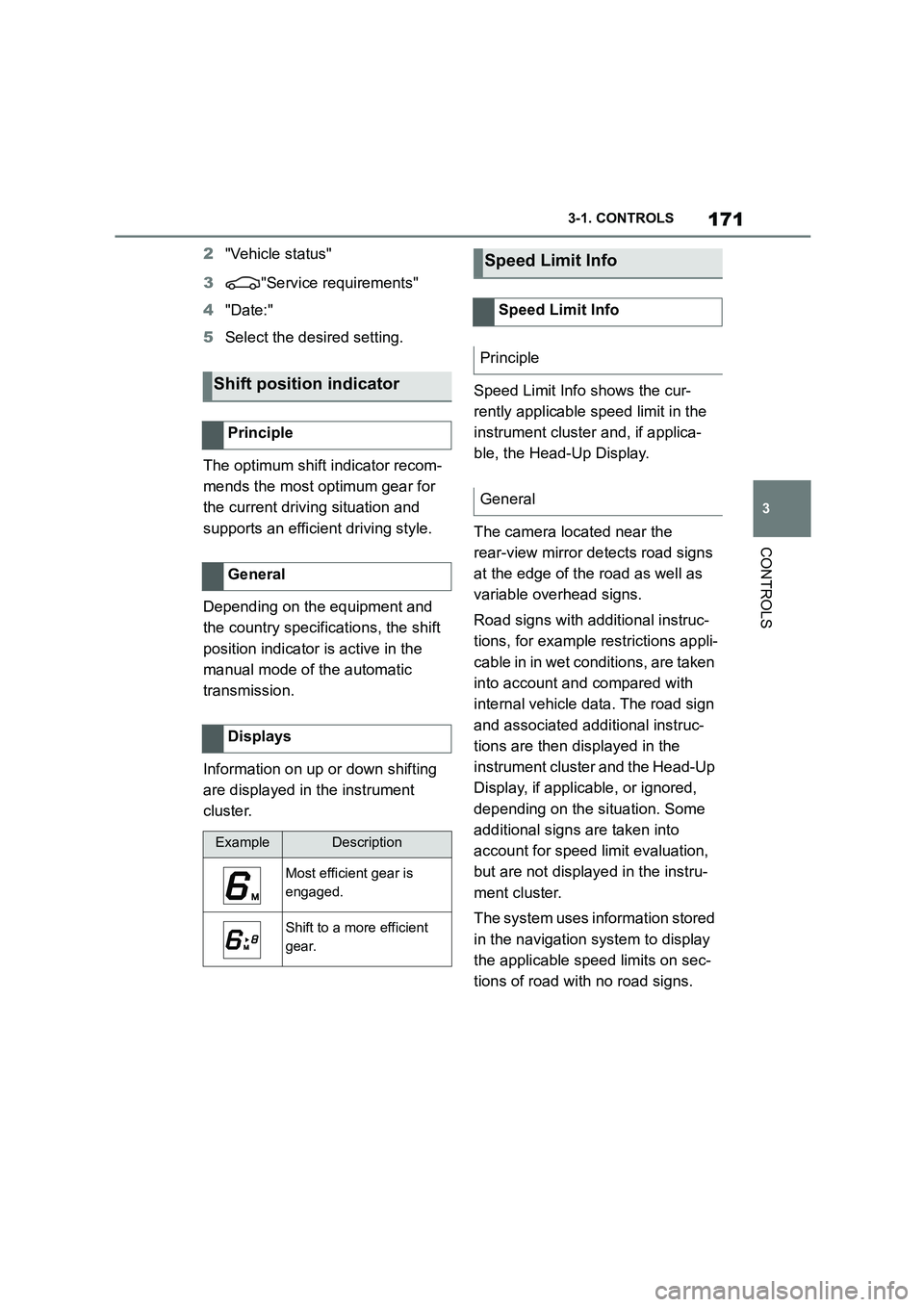
Information on up or down shifting
are displayed in the instrument
cluster.
Speed Limit Info shows the cur-
rently applicable speed limit in the
instrument cluster and, if applica-
ble, the Head-Up Display.
The camera located near the
rear-view mirror detects road signs
at the edge of the road as well as
variable overhead signs.
Road signs with additional instruc-
tions, for example restrictions appli-
cable in in wet conditions, are taken
into account and compared with
internal vehicle data. The road sign
and associated additional instruc-
tions are then displayed in the
instrument cluster and the Head-Up
Display, if applic able, or ignored,
depending on the situation. Some
additional signs are taken into
account for speed limit evaluation,
but are not displayed in the instru-
ment cluster.
The system uses information stored
in the navigation system to display
the applicable speed limits on sec-
tions of road with no road signs.
Shift position indicator
Principle
General
Displays
ExampleDescription
Most efficient gear is
engaged.
Shift to a more efficient
gear.
Speed Limit Info
Speed Limit Info
Principle
General
Page 186 of 498
1843-1. CONTROLS
cover.
Dirt on the inside or outside of
the windscreen.
Sunglasses with certain polarisa-
tion filters.
Wet road.
Unfavourable lighting conditions.
If the image is di storted, have the
default settings checked by any
authorized Toyota retailer or Toyota
authorized repairer, or any reliable
repairer.
The windscreen is an integral part
of the system.
The shape of the windscreen ena-
bles a sharp image to be projected.
A film in the windscreen prevents
double images occurring.
Therefore if the special windscreen
needs to be replaced, it is strongly
recommended that this be carried
out by any authorized Toyota
retailer or Toyota authorized
repairer, or any reliable repairer if
required.
This chapter describes all standard,
country-specific and special equip-
ment available for the model series.
It may therefore describe equip-
ment and functions which are not
installed in your vehicle, for exam-
ple on account of the special equip-
ment selected or the country
specification. This also applies to
safety-relevant functions and sys-
tems. Please comply with the rele-
vant laws and regulations when
using the corresponding functions
and systems.
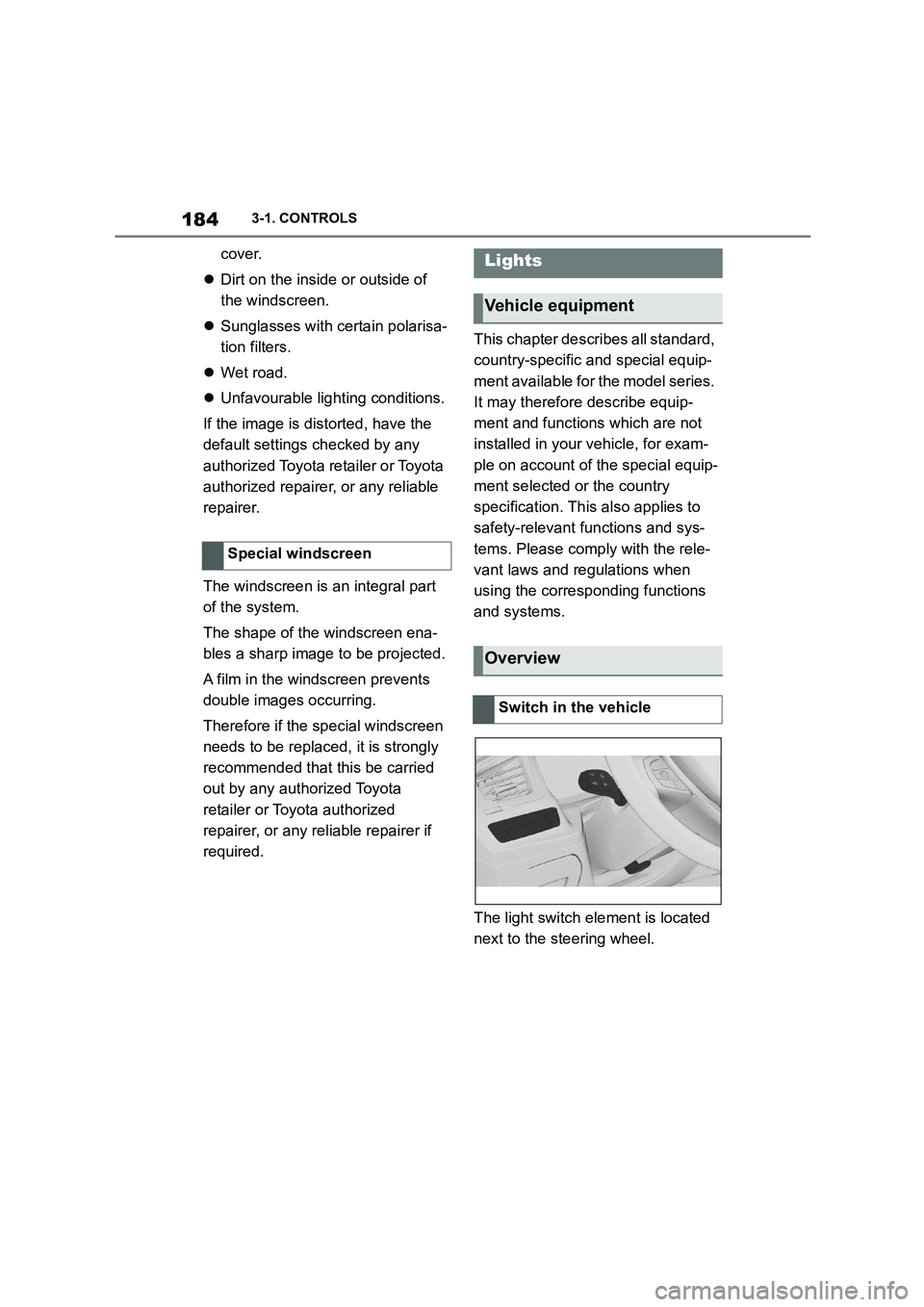
The light switch element is located
next to the steering wheel.
Special windscreen
Lights
Vehicle equipment
Overview
Switch in the vehicle
Page 289 of 498
287
4
4-1. DRIVING HINTS
DRIVING HINTS
set off straight away, driving at
moderate engine speeds.
This brings the cold engine up to
operating temperature as quickly as
possible.
Anticipating the road situation and
adopting a smooth driving style will
reduce fuel consumption.
Avoid accelerating and braking
unnecessarily.
Keep an appropriate distance from
the vehicle ahead.
Driving at low engine speeds
reduces fuel consumption and
wear.
Pay attention to the shift position
indicator, see page 171, in the vehi-
cle, if fitted.
When approaching a red traffic
light, take your foot off the accelera-
tor and allow the vehicle to coast to
a stop.
On downward stretc hes, take your
foot off the accelerator and allow
the vehicle to roll.
The fuel supply is interrupted in
overrun mode.
When you stop the vehicle for
longer periods, for example at traf-
fic lights, railway crossings or in
traffic jams, switch off the engine.
The Auto Start/Stop of the vehicle
shuts off the engine automatically
during a stop.
Switching the engine off and on
again reduces fuel consumption
and emissions compared with a
permanently running engine. Sav-
ings can be made just by shutting
down the engine for a few seconds.
Functions such as seat heating or
rear window heating require a great
deal of energy and increase fuel
consumption, especially in city traf-
fic and stop-and-go traffic.
Switch these functions off if they
are not required.
Have the vehicle serviced regularly
to achieve optimal economy and
lifetime. Toyota recommends hav-
ing maintenance work carried out
Think ahead
Avoid high engine speeds
Make use of overrun mode
Switch off the engine if stop-
ping for longer periods
Stopping the engine
Auto Start/Stop
Switch off functions which
are not currently required
Have maintenance work car-
ried out
Page 292 of 498
2905-1. MOBILITY
5-1.MOBILITY
This chapter describes all standard,
country-specific and special equip-
ment available for the model series.
It may therefore describe equip-
ment and functions which are not
installed in your vehicle, for exam-
ple on account of the special equip-
ment selected or the country
specification. This also applies to
safety-relevant functions and sys-
tems. Please comply with the rele-
vant laws and regulations when
using the corresponding functions
and systems.
Before refuelling, observe the notes
on fuel quality, see page 322.
When refuelling, insert the filler
nozzle fully into th e filler neck. Lift-
ing the filler nozzle during refuelling
results in the following:
The fuel supply being cut off pre-
maturely.
Fuel vapour and fumes being
recovered less effectively.
The fuel tank is full when the filler
nozzle cuts out for the first time.
For Korea: Make sure that the fuel
tank cap is closed properly after
refuelling, otherw ise the emissions
warning lamp may illuminate.
Please comply with the safety regu-
lations displayed at filling stations.
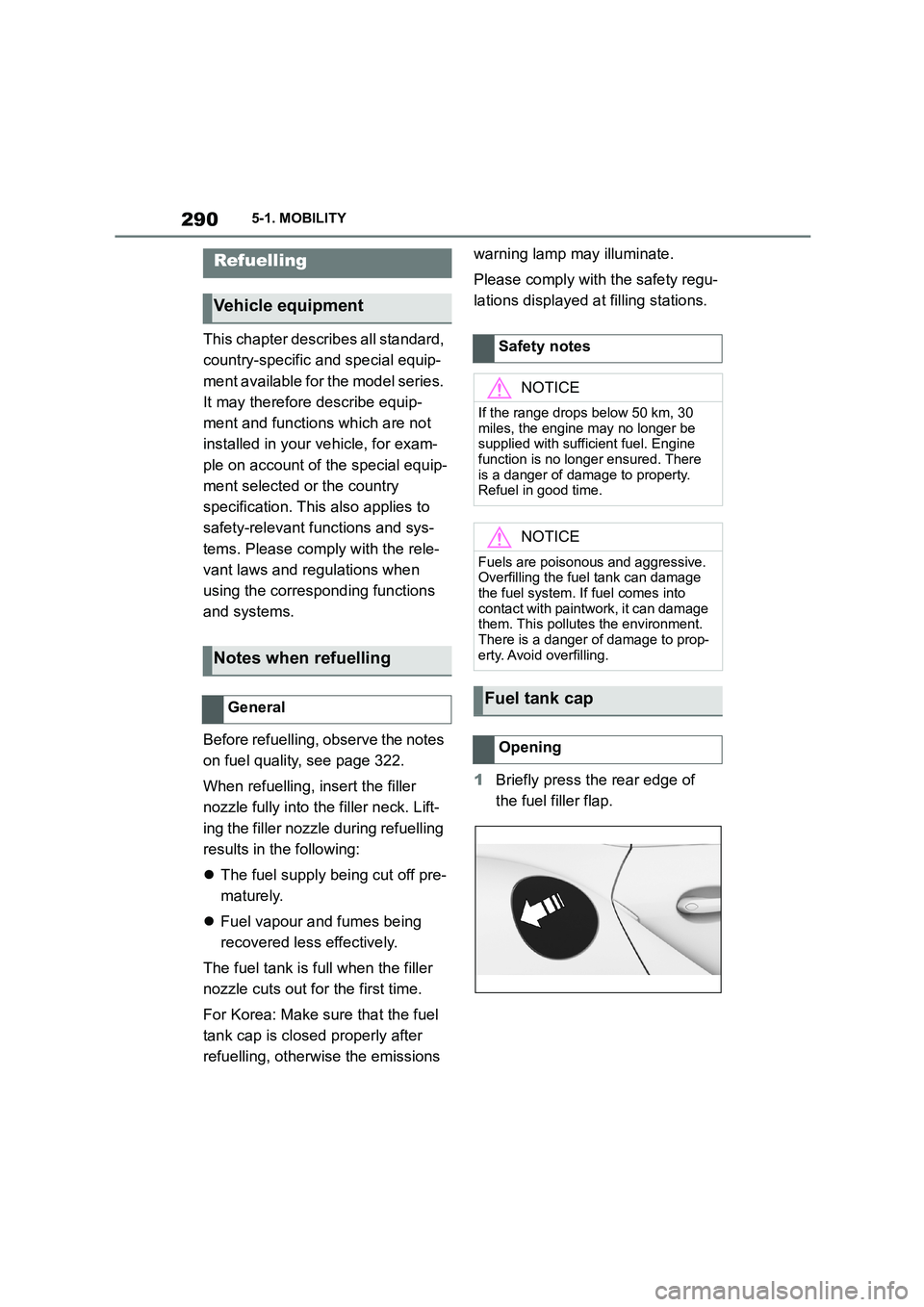
1 Briefly press the rear edge of
the fuel filler flap.
Refuelling
Vehicle equipment
Notes when refuelling
General
Safety notes
NOTICE
If the range drops below 50 km, 30
miles, the engine may no longer be
supplied with sufficient fuel. Engine function is no longer ensured. There
is a danger of damage to property.
Refuel in good time.
NOTICE
Fuels are poisonous and aggressive.
Overfilling the fuel tank can damage the fuel system. If fuel comes into
contact with paintwork, it can damage
them. This pollutes the environment. There is a danger of damage to prop-
erty. Avoid overfilling.
Fuel tank cap
Opening
Page 294 of 498
2925-1. MOBILITY
This chapter describes all standard,
country-specific and special equip-
ment available for the model series.
It may therefore describe equip-
ment and functions which are not
installed in your vehicle, for exam-
ple on account of the special equip-
ment selected or the country
specification. This also applies to
safety-relevant functions and sys-
tems. Please comply with the rele-
vant laws and regulations when
using the corresponding functions
and systems.
A tyre's condition and inflation pres-
sure influence the following:
• Lifetime of the tyre.
• Driving safety.
• Driving comfort.
• Fuel consumption.
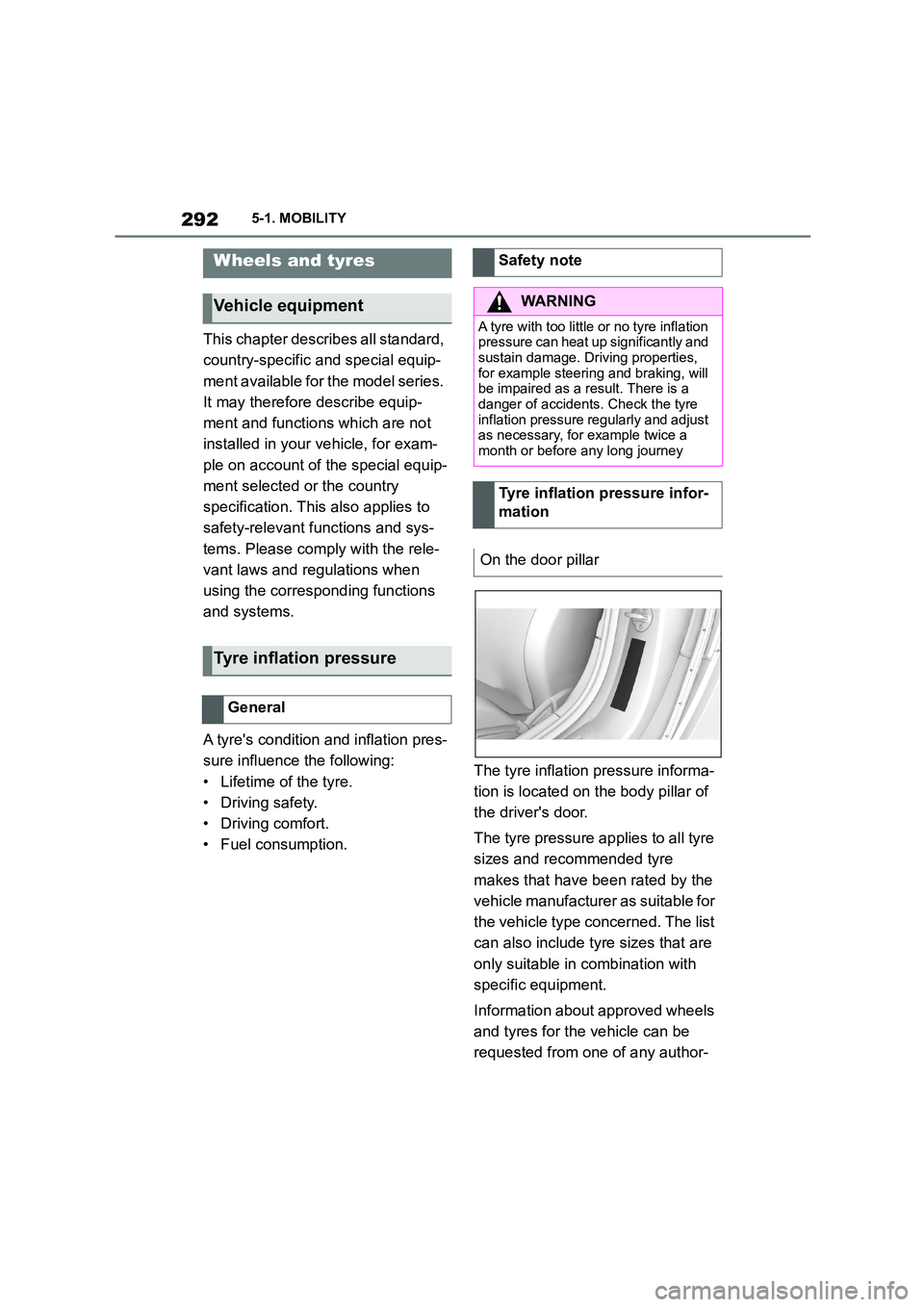
The tyre inflation pressure informa-
tion is located on the body pillar of
the driver's door.
The tyre pressure applies to all tyre
sizes and recommended tyre
makes that have been rated by the
vehicle manufacturer as suitable for
the vehicle type concerned. The list
can also include tyre sizes that are
only suitable in combination with
specific equipment.
Information about approved wheels
and tyres for the vehicle can be
requested from one of any author-
Wheels and tyres
Vehicle equipment
Tyre inflation pressure
General
Safety note
WA R N I N G
A tyre with too little or no tyre inflation
pressure can heat up significantly and sustain damage. Driving properties,
for example steering and braking, will
be impaired as a result. There is a danger of accidents. Check the tyre
inflation pressure regularly and adjust
as necessary, for example twice a
month or before any long journey
Tyre inflation pressure infor-
mation
On the door pillar
Page 299 of 498
297
5
5-1. MOBILITY
MOBILITY
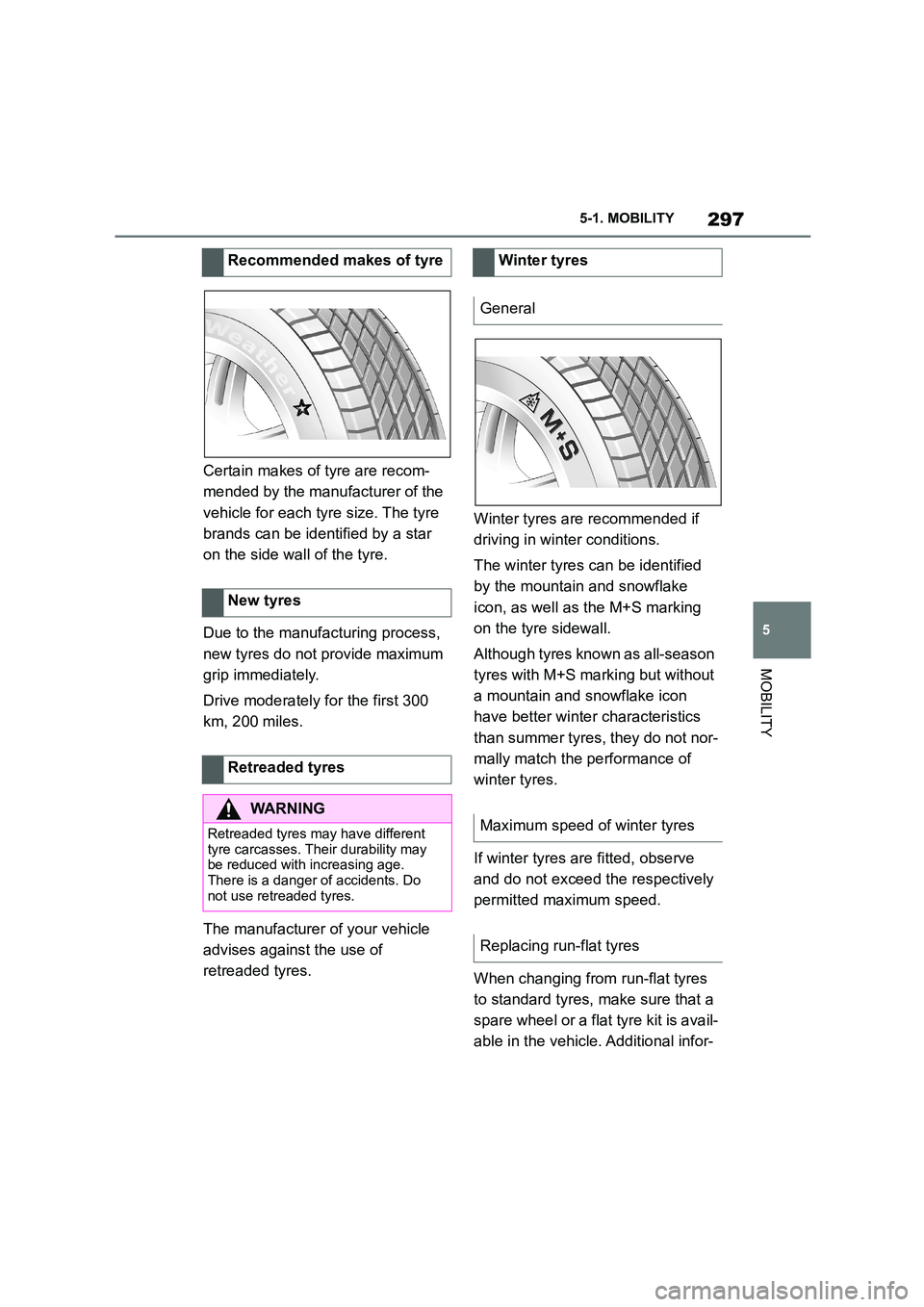
Certain makes of tyre are recom-
mended by the manufacturer of the
vehicle for each tyre size. The tyre
brands can be identified by a star
on the side wall of the tyre.
Due to the manufacturing process,
new tyres do not provide maximum
grip immediately.
Drive moderately for the first 300
km, 200 miles.
The manufacturer of your vehicle
advises against the use of
retreaded tyres.
Winter tyres are recommended if
driving in winter conditions.
The winter tyres can be identified
by the mountain and snowflake
icon, as well as the M+S marking
on the tyre sidewall.
Although tyres known as all-season
tyres with M+S marking but without
a mountain and snowflake icon
have better winter characteristics
than summer tyres, they do not nor-
mally match the performance of
winter tyres.
If winter tyres are fitted, observe
and do not exceed the respectively
permitted maximum speed.
When changing from run-flat tyres
to standard tyres, make sure that a
spare wheel or a flat tyre kit is avail-
able in the vehicle. Additional infor-
Recommended makes of tyre
New tyres
Retreaded tyres
WA R N I N G
Retreaded tyres may have different tyre carcasses. Their durability may
be reduced with increasing age.
There is a danger of accidents. Do not use retreaded tyres.
Winter tyres
General
Maximum speed of winter tyres
Replacing run-flat tyres
Page 325 of 498
323
5
5-1. MOBILITY
MOBILITY
SZ, SZ-R and RZ (DB41L-ZRLW,
DB42R-ZRRW) models
Super, RON 95.
Use this fuel to achieve the nominal
performance and consumption fig-
ures.
RZ (DB01L-ZULW,
DB02R-ZURW) models
Super, RON 98.
Use this fuel to achieve the nominal
performance and consumption fig-
ures.
Unleaded petrol, RON 91.
Engine oil consumption depends on
the driving style and operating con-
ditions.
Therefore check the engine oil level
regularly each time you fill up with
fuel by taking a detailed measure-
ment.
Engine oil consumption can be
increased, for example in the fol-
lowing situations:
• Sporty driving style.
• Running in the engine.
• Engine idling.
• Use of engine oil grades catego-
rised as unsuitable.
Different vehicle messages are
shown on the Control Display,
depending on the engine oil level.
NOTICE
After filling the wrong fuel, do not
press the start/stop button. Contact
any authorized Toyota retailer or Toyota authorized repairer, or any reli-
able repairer.
NOTICE
Incorrect fuels can damage the fuel
system and engine. There is a danger of damage to property. Do not refuel
with fuel with a higher ethanol content
than recommended. Do not refuel with fuel containing methanol, for
example M5 to M100.
NOTICE
Fuel below the specified minimum quality can adversely affect engine
function or lead to engine damage.
There is a danger of damage to prop- erty. Do not refuel with petrol below
the specified minimum quality.
Petrol grade
Minimum grade
Engine oil
General
Safety notes
NOTICE
Too little engine oil causes engine
damage. There is a danger of dam- age to property. Top up with engine oil
immediately.
Page 341 of 498
339
5
5-1. MOBILITY
MOBILITY
This chapter describes all standard,
country-specific and special equip-
ment available for the model series.
It may therefore describe equip-
ment and functions which are not
installed in your vehicle, for exam-
ple on account of the special equip-
ment selected or the country
specification. This also applies to
safety-relevant functions and sys-
tems. Please comply with the rele-
vant laws and regulations when
using the corresponding functions
and systems.
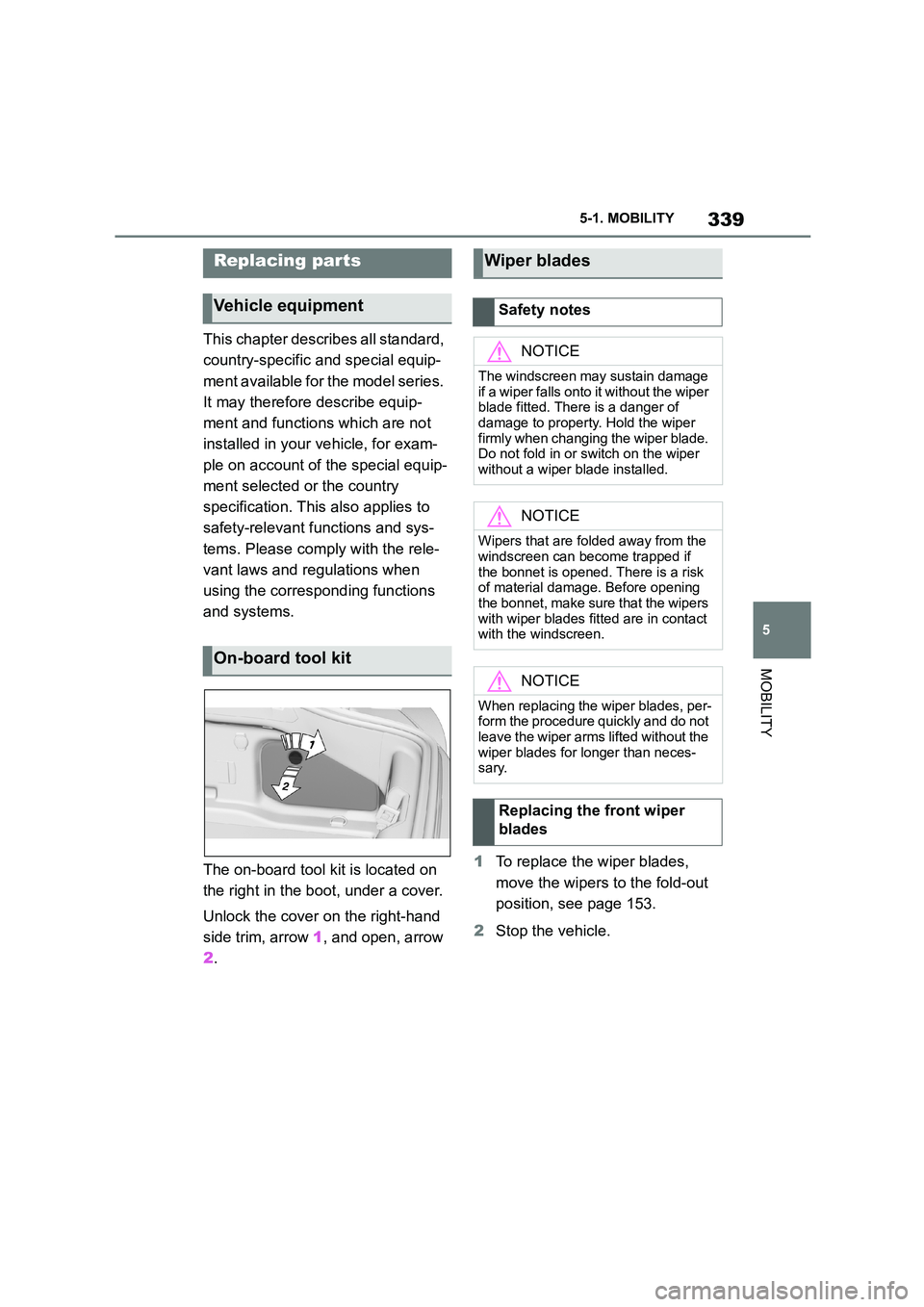
The on-board tool kit is located on
the right in the boot, under a cover.
Unlock the cover on the right-hand
side trim, arrow 1, and open, arrow
2 .
1 To replace the wiper blades,
move the wipers to the fold-out
position, see page 153.
2 Stop the vehicle.
Replacing par ts
Vehicle equipment
On-board tool kit
Wiper blades
Safety notes
NOTICE
The windscreen may sustain damage
if a wiper falls onto it without the wiper
blade fitted. There is a danger of
damage to property. Hold the wiper firmly when changing the wiper blade.
Do not fold in or switch on the wiper
without a wiper blade installed.
NOTICE
Wipers that are folded away from the
windscreen can become trapped if the bonnet is opened. There is a risk
of material damage. Before opening
the bonnet, make sure that the wipers with wiper blades fitted are in contact
with the windscreen.
NOTICE
When replacing the wiper blades, per- form the procedure quickly and do not
leave the wiper arms lifted without the
wiper blades for longer than neces- sary.
Replacing the front wiper
blades
Page 496 of 498
494Alphabetical Index
Tourist function, see
Left-hand/right-hand traffic ....... 190
Tow bar .......................................... 360
Tow fitting, see Towing eye ......... 360
Towing away ................................. 359
Towing eye .................................... 360
Towing rope .................................. 360
Towing, see Tow-starting and towing
..................................................... 359
Tow-starting .................................. 359
Toyota Supra Command ................ 57
Toyota Supra Command operating
principle ........................................ 57
Toyota Supra Safety ..................... 205
TPM Tyre Pressure Monitor ......... 304
Traction control ............................ 230
Traction mode ............................... 230
TRACTION, driving dynamics ..... 230
Trailer tow hitch, rear-view camera
..................................................... 255
Transmission lockout, unlocking
electronically .............................. 158
Tread, tyres ................................... 294
Triple turn signal .......................... 150
Turn indicator, indicator lamp ..... 167
Turn indicators, replacing Bulbs, see
Bulbs and lights ......................... 340
Turning circle ................................ 370
Turning circle lines, rear-view cam-
era ................................................ 255
Tyre damage.................................. 295
Tyre inflation pressure ................. 292
Tyre makes, recommendation ..... 297
Tyre pressure ................................ 292
Tyre Pressure Monitor TPM ......... 304
Tyre repair kit, see Mobility System
..................................................... 299
Tyre replacement .......................... 296
Tyre sealant, see Mobility System
..................................................... 299
Tyre settings ................................. 305
Tyre tread ...................................... 294
Tyres and wheels .......................... 292
Tyres with emergency running prop-
erties............................................ 298
U
Ultrasonic sensors, see Sensors of
the vehicle ..................................... 50
Units of measure............................. 73
Unloaded weight ...........................371
Unlock-button, Automatic transmis-
sion ..............................................154
Unlocking the fuel filler flap manu-
ally ............................................... 291
Unlocking with the remote control 89
Unlocking, automatic ................... 102
Unlocking, see Opening and closing
....................................................... 88
Unlocking, settings.......................101
USB connection .............................. 83
USB port, position in the vehicle 270
Use, intended ....................................6
V
Vanity mirror.................................. 269
Vehicle battery ..............................341
Vehicle breakdown, see Breakdown
Assist...........................................352
Vehicle care ...................................364
Vehicle equipment ............................4
Vehicle identification number ........ 22
Vehicle key, see Remote control ... 88
Vehicle messages ......................... 163
Vehicle paintwork ......................... 364
Vehicle position, vehicle positioning
....................................................... 73
Vehicle Stability Control VSC ...... 229
Vehicle status ................................181
Vehicle wash ................................. 362
Vehicle, running in ........................280
Ventilation......................................266
VIN, see Vehicle identification num-
ber .................................................. 22
Voice control system ...................... 68
VSC Vehicle Stability Control ...... 229