steering TOYOTA SUPRA 2022 Service Manual
[x] Cancel search | Manufacturer: TOYOTA, Model Year: 2022, Model line: SUPRA, Model: TOYOTA SUPRA 2022Pages: 498, PDF Size: 104.06 MB
Page 248 of 498
2463-1. CONTROLS
resume control of the vehicle's
speed.
The vehicle cannot drive off auto-
matically in some situations, for
example:
On steep upward gradients.
Before bumps or rises in the
road.
In such cases, de press the acceler-
ator pedal.
The following restrictions may apply
if the weather or lighting conditions
are unfavourable:
Impaired detection of vehicles.
Brief interruptions when vehicles
have already been detected.
Examples of unfavourable weather
or lighting conditions:
Wet roads.
Snowfall.
Slush.
Fog.
Oncoming light.
Pay attention when driving and
respond to the prev ailing traffic con-
ditions. If necessary, intervene
actively, for example by braking,
steering or taking evasive action.
The desired speed is also main-
tained when driving downhill. The
vehicle may drive slower than the
desired speed on uphill gradients if
there is not enough engine power.
*: if equipped
When the systems in the vehicle
(Speed Limit Info, for example)
detect a change in the speed limit
on the route, it is possible to adopt
this new speed lim it value for the
following systems:
Manual Speed Limiter.
Cruise Control.
Dynamic radar cruise control
with full-speed range.
The speed value is proposed as a
new desired speed for adopting.
The relevant system must be acti-
vated for the speed value to be
adopted.
Driving off
Weather
Engine power
Speed Limit Assist*
Principle
Page 249 of 498
247
3
3-1. CONTROLS
CONTROLS
Via Toyota Supra Command:
1 "My vehicle"
2 "Vehicle settings"
3 "Speed Assistant"
A message is displayed in the
instrument cluster if the system and
the Cruise Control are switched on.
In manual mode, a detected speed
limit can be manually adopted for
Cruise Control.
Safety notes
WA R N I N G
The system does not relieve you of
your personal responsibility to assess the traffic situation correctly. Due to
system limitations, it cannot respond
independently and appropriately in all traffic conditions. There is a danger of
accidents. Adapt your driving style to
the traffic conditions. Observe the
traffic situation and intervene actively if the situation warrants it.
WA R N I N G
The desired speed may be acciden-tally set incorrectly or called up by
mistake. There is a danger of acci-
dents. Adjust the desired speed to the traffic conditions. Observe the traffic
situation and intervene actively if the
situation warrants it.
Overview
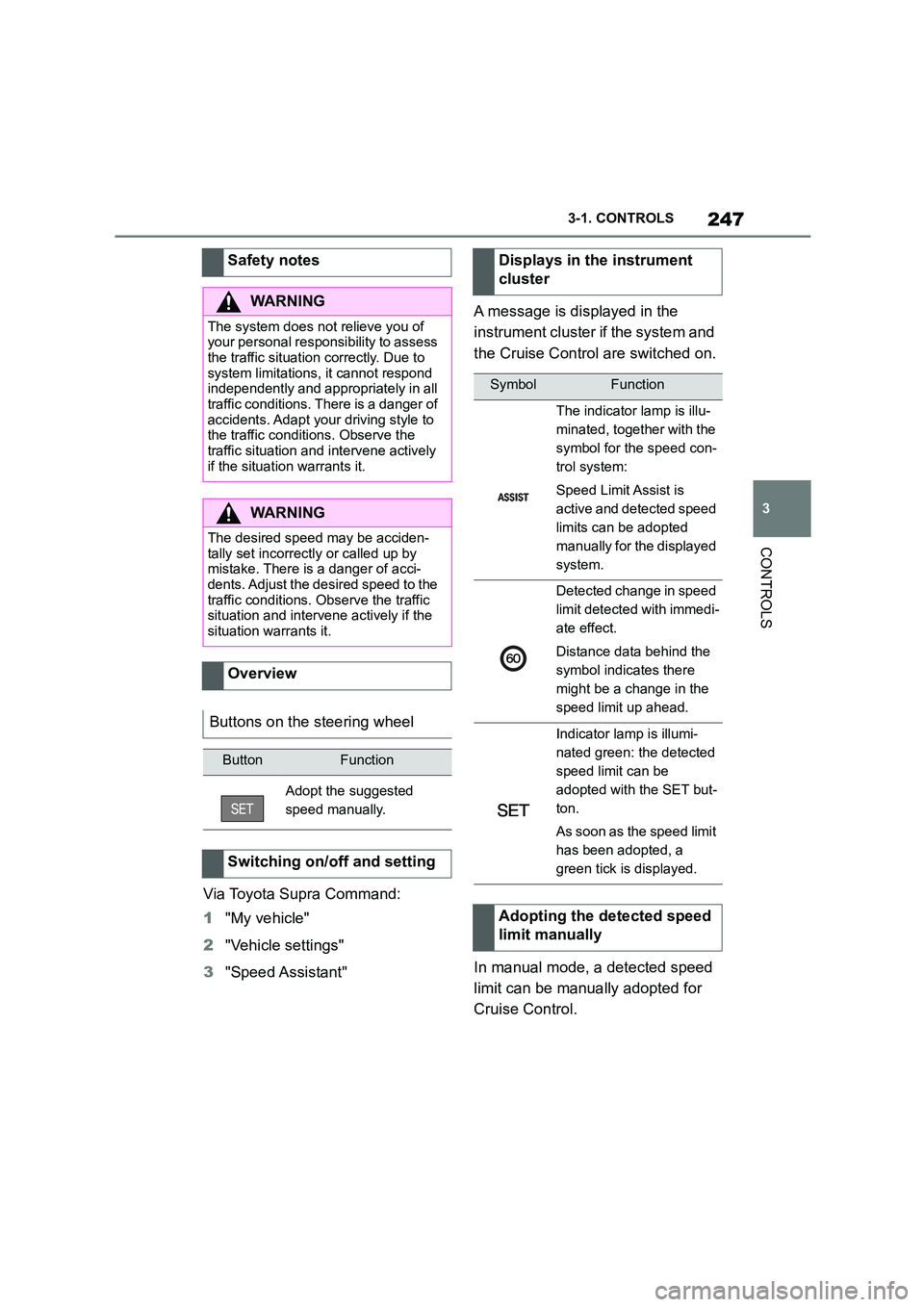
Buttons on the steering wheel
ButtonFunction
Adopt the suggested
speed manually.
Switching on/off and setting
Displays in the instrument
cluster
SymbolFunction
The indicator lamp is illu-
minated, together with the
symbol for the speed con-
trol system:
Speed Limit Assist is
active and detected speed
limits can be adopted
manually for the displayed
system.
Detected change in speed
limit detected with immedi-
ate effect.
Distance data behind the
symbol indicates there
might be a change in the
speed limit up ahead.
Indicator lamp is illumi-
nated green: the detected
speed limit can be
adopted with the SET but-
ton.
As soon as the speed limit
has been adopted, a
green tick is displayed.
Adopting the detected speed
limit manually
Page 257 of 498
255
3
3-1. CONTROLS
CONTROLS
A number of assistance functions
can be active simultaneously.
The assistance functions can be
activated manually.
1 If necessary, tilt the Controller to
the left.
2 With the corresponding equip-
ment: "Camera picture"
3
"Parking guide lines".
Driving path lines and turning circle
lines are shown, see page 255.
"Obstacle marking."
Depending on the equipment, the
obstacles detected by Parking Sensors
are displayed, see page 256, by mark-
ings.
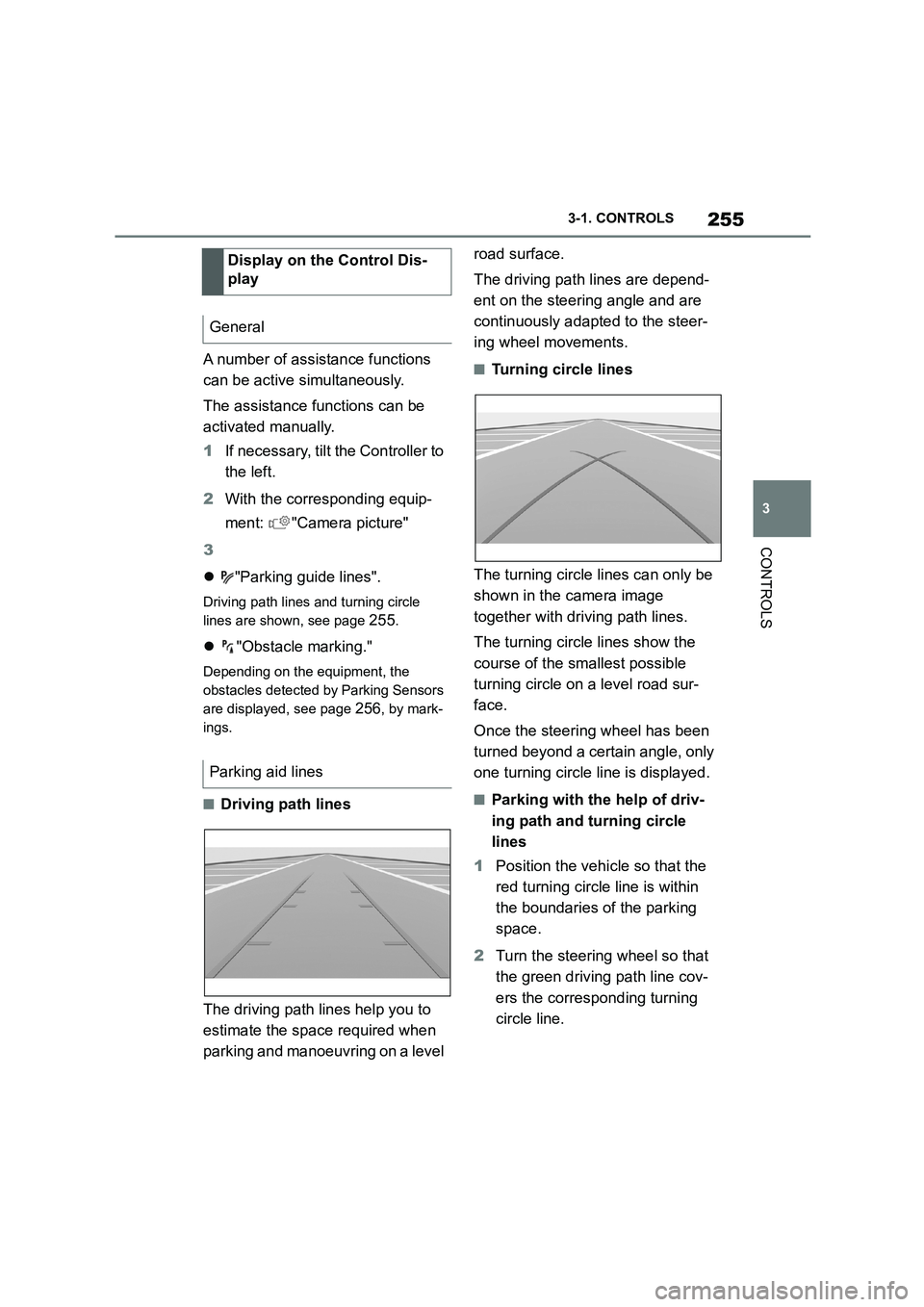
■Driving path lines
The driving path lines help you to
estimate the space required when
parking and manoeuvring on a level
road surface.
The driving path lines are depend-
ent on the steering angle and are
continuously adapted to the steer-
ing wheel movements.
■Turning circle lines
The turning circle lines can only be
shown in the camera image
together with driving path lines.
The turning circle lines show the
course of the smallest possible
turning circle on a level road sur-
face.
Once the steering wheel has been
turned beyond a certain angle, only
one turning circle line is displayed.
■Parking with the help of driv-
ing path and tu rning circle
lines
1 Position the vehicle so that the
red turning circle line is within
the boundaries of the parking
space.
2 Turn the steering wheel so that
the green driving path line cov-
ers the corresponding turning
circle line.
Display on the Control Dis-
play
General
Parking aid lines
Page 277 of 498
275
3
3-1. CONTROLS
CONTROLS
This chapter describes all standard,
country-specific and special equip-
ment available for the model series.
It may therefore describe equip-
ment and functions which are not
installed in your vehicle, for exam-
ple on account of the special equip-
ment selected or the country
specification. This also applies to
safety-relevant functions and sys-
tems. Please comply with the rele-
vant laws and regulations when
using the corresponding functions
and systems.
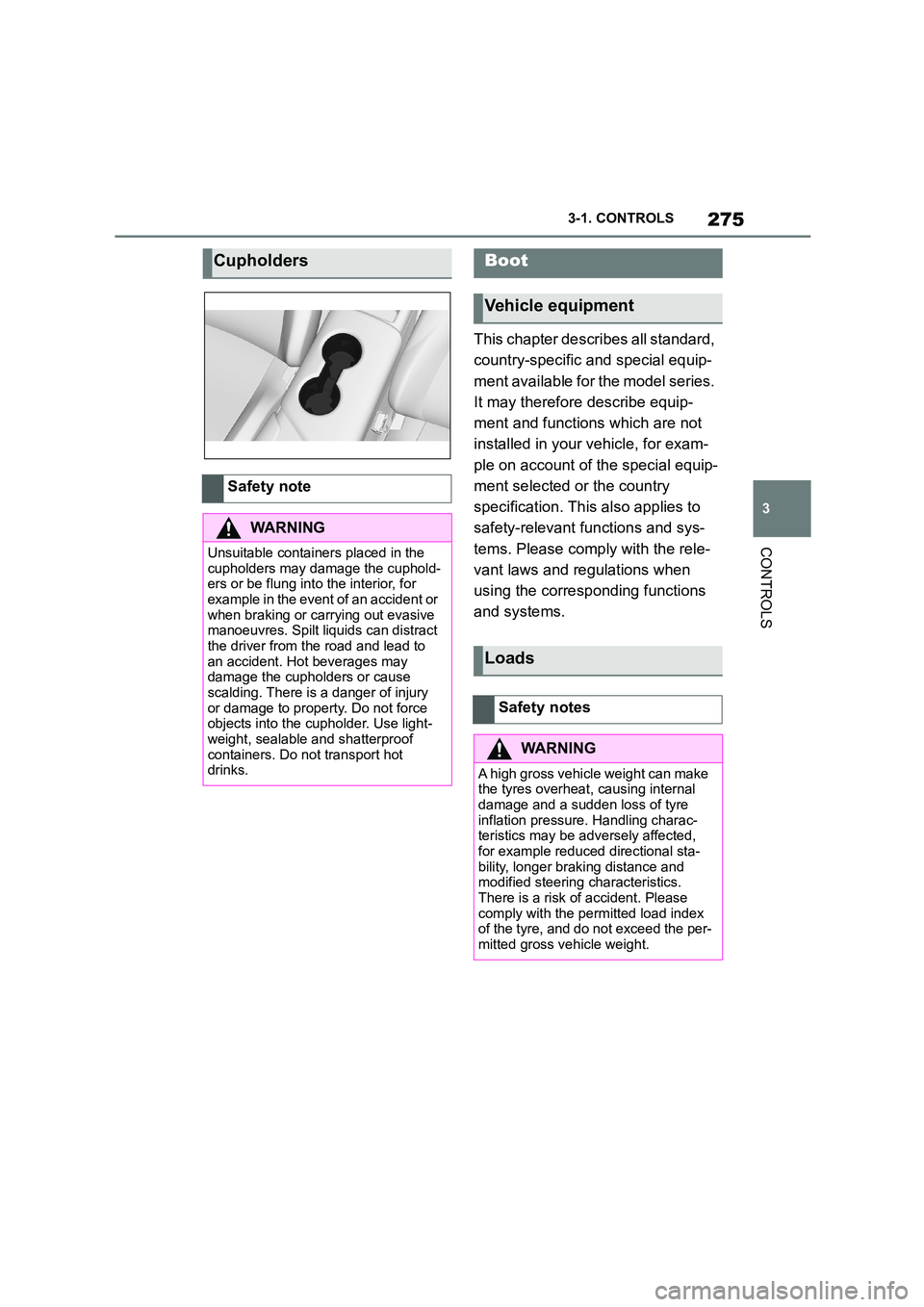
Cupholders
Safety note
WA R N I N G
Unsuitable containers placed in the
cupholders may damage the cuphold- ers or be flung into the interior, for
example in the event of an accident or
when braking or carrying out evasive manoeuvres. Spilt liquids can distract
the driver from the road and lead to
an accident. Hot beverages may damage the cupholders or cause
scalding. There is a danger of injury
or damage to property. Do not force objects into the cupholder. Use light-
weight, sealable and shatterproof
containers. Do not transport hot drinks.
Boot
Vehicle equipment
Loads
Safety notes
WA R N I N G
A high gross vehicle weight can make
the tyres overheat, causing internal
damage and a sudden loss of tyre inflation pressure. Handling charac-
teristics may be adversely affected,
for example reduced directional sta- bility, longer braking distance and
modified steering characteristics.
There is a risk of accident. Please comply with the permitted load index
of the tyre, and do not exceed the per-
mitted gross vehicle weight.
Page 285 of 498
283
4
4-1. DRIVING HINTS
DRIVING HINTS
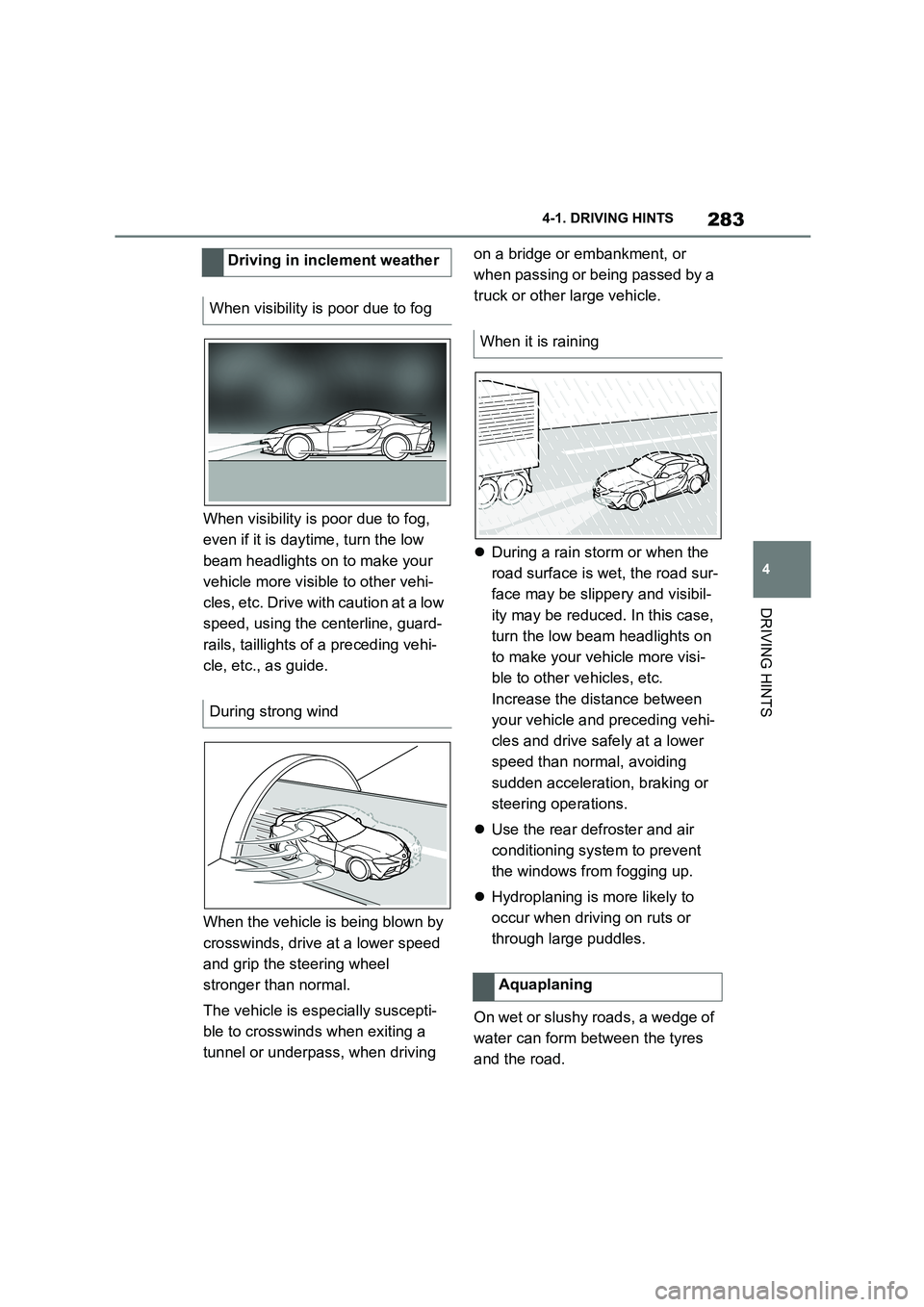
When visibility is poor due to fog,
even if it is daytime, turn the low
beam headlights on to make your
vehicle more visible to other vehi-
cles, etc. Drive with caution at a low
speed, using the centerline, guard-
rails, taillights of a preceding vehi-
cle, etc., as guide.
When the vehicle is being blown by
crosswinds, drive at a lower speed
and grip the steering wheel
stronger than normal.
The vehicle is especially suscepti-
ble to crosswinds when exiting a
tunnel or underpass, when driving
on a bridge or embankment, or
when passing or being passed by a
truck or other large vehicle.
During a rain storm or when the
road surface is wet, the road sur-
face may be slippery and visibil-
ity may be reduced. In this case,
turn the low beam headlights on
to make your vehicle more visi-
ble to other vehicles, etc.
Increase the distance between
your vehicle and preceding vehi-
cles and drive safely at a lower
speed than normal, avoiding
sudden acceleration, braking or
steering operations.
Use the rear defroster and air
conditioning system to prevent
the windows from fogging up.
Hydroplaning is more likely to
occur when driving on ruts or
through large puddles.
On wet or slushy roads, a wedge of
water can form between the tyres
and the road.
Driving in inclement weather
When visibility is poor due to fog
During strong wind
When it is raining
Aquaplaning
Page 287 of 498
285
4
4-1. DRIVING HINTS
DRIVING HINTS
Ensure that you do not obstruct
other road users when doing so.
The heat generated by braking
dries the brake discs and brake
pads and protects them against
corrosion.
This way, brake power is available
immediately, whenever it is needed.
■General
When driving on long or steep
downhill stretches, use the gear in
which the least braking is required.
Otherwise the brake system can
overheat and the braking effect is
reduced.
Engine braking effect can be addi-
tionally increased by manually shift-
ing down, even into first gear, if
applicable.
■Safety notes
Corrosion of the brake discs and
contamination of the brake pads
increase in the following circum-
stances:
Low mileage.
Extended periods when the vehi-
cle is not used.
Infrequent use of the brakes.
Aggressive, acidic or alkaline
cleaning agents.
During braking, corroded brake
discs may cause brake judder
which usually cannot be eliminated.
When the automatic air condition-
ing is in operation, condensation
develops and exits underneath the
vehicle.
The higher mechanical and thermal
loads involved in driving on racing
tracks lead to increased wear. This
wear is not covered by the war-
ranty. The vehicle is not conceived
for use in motor sports competi-
tions.
Before and after driving on a racing
track, have the vehicle checked at
any authorized Toyota retailer or
Toyota authorized repairer, or any
reliable repairer.
Downhill gradients
WA R N I N G
Even slight continuous pressure on the brake pedal can cause overheat-
ing, brake pad wear or even brake
system failure. There is a danger of accidents. Avoid excessive loads on
the brake.
WA R N I N G
When idling or with the engine switched off, safety-relevant func-
tions, for example engine braking
effect or steering and braking force assistance, are either restricted or not
available at all. There is a risk of acci-
dent. Do not drive at idle speed or with the engine switched off.
Corrosion of the brake discs
Condensation when vehicle
is parked
Driving on a racing track
Page 294 of 498
2925-1. MOBILITY
This chapter describes all standard,
country-specific and special equip-
ment available for the model series.
It may therefore describe equip-
ment and functions which are not
installed in your vehicle, for exam-
ple on account of the special equip-
ment selected or the country
specification. This also applies to
safety-relevant functions and sys-
tems. Please comply with the rele-
vant laws and regulations when
using the corresponding functions
and systems.
A tyre's condition and inflation pres-
sure influence the following:
• Lifetime of the tyre.
• Driving safety.
• Driving comfort.
• Fuel consumption.
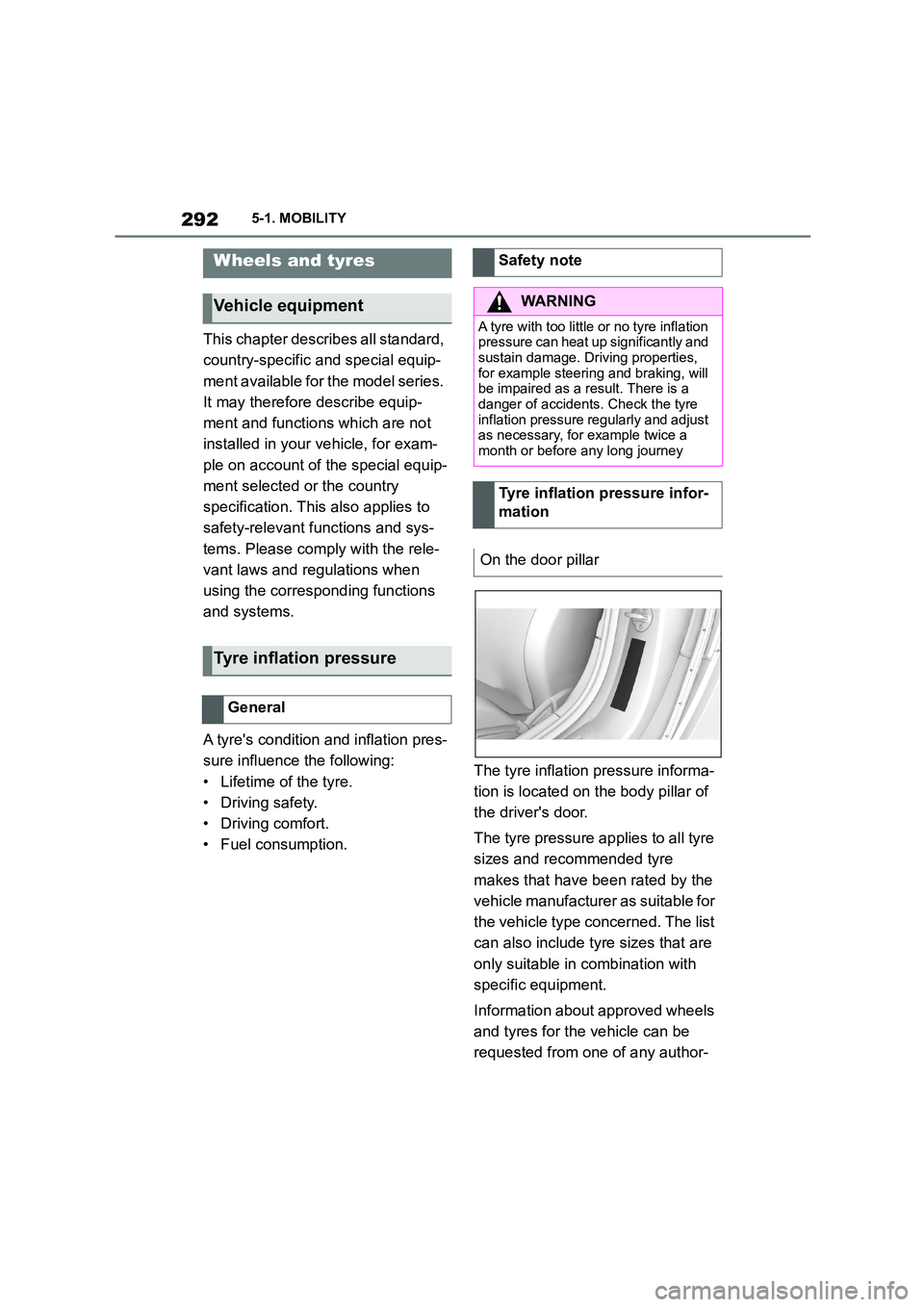
The tyre inflation pressure informa-
tion is located on the body pillar of
the driver's door.
The tyre pressure applies to all tyre
sizes and recommended tyre
makes that have been rated by the
vehicle manufacturer as suitable for
the vehicle type concerned. The list
can also include tyre sizes that are
only suitable in combination with
specific equipment.
Information about approved wheels
and tyres for the vehicle can be
requested from one of any author-
Wheels and tyres
Vehicle equipment
Tyre inflation pressure
General
Safety note
WA R N I N G
A tyre with too little or no tyre inflation
pressure can heat up significantly and sustain damage. Driving properties,
for example steering and braking, will
be impaired as a result. There is a danger of accidents. Check the tyre
inflation pressure regularly and adjust
as necessary, for example twice a
month or before any long journey
Tyre inflation pressure infor-
mation
On the door pillar
Page 300 of 498
2985-1. MOBILITY
mation is available from any
authorized Toyota retailer or Toyota
authorized repairer, or any reliable
repairer.
Do not exceed the maximum tyre
inflation pressure indicated on the
tyre's side wall.
• Store wheels and tyres in a cool,
dry and dark place when not in
use.
• Protect the tyres against contam-
ination from oil, grease and sol-
vents.
• Do not leave tyres in plastic
bags.
• Remove dirt from the wheels or
tyres.
In the event of a complete loss of
tyre inflation pressure, run-flat tyres
enable you to continue driving, with
certain restrictions.
The wheels are fitted with tyres
which are self-supporting to a lim-
ited degree. They may also have
special rims.
The reinforced side wall means that
the tyre keeps the vehicle mobile to
a degree even if tyre inflation pres-
sure has been lost.
Observe the notes on continuing to
drive with a flat tyre.
Swapping over front and rear
wheels
WA R N I N G
Swapping over of wheels between
axles on vehicles with different tyre
sizes or rim dimensions on the front and rear axles may cause tyre dam-
age and damage to the vehicle. There
is a risk of accident. Do not swap over wheels between axles on vehicles
with different tyre sizes or rim dimen-
sions on the front and rear axles.
Storing tyres
Tyre inflation pressure
Tyre storage
Run-flat tyres
Principle
General
Safety notes
WA R N I N G
A run-flat tyre which has low tyre infla-
tion pressure or no tyre inflation pres- sure at all will change the vehicle's
handling characteristics, for example
there may be reduced directional sta- bility when braking, longer braking
distances and different self-steering
characteristics. There is a danger of accidents. Drive with care and do not
exceed a speed of 80 km/h, 50 mph.
Page 301 of 498
299
5
5-1. MOBILITY
MOBILITY
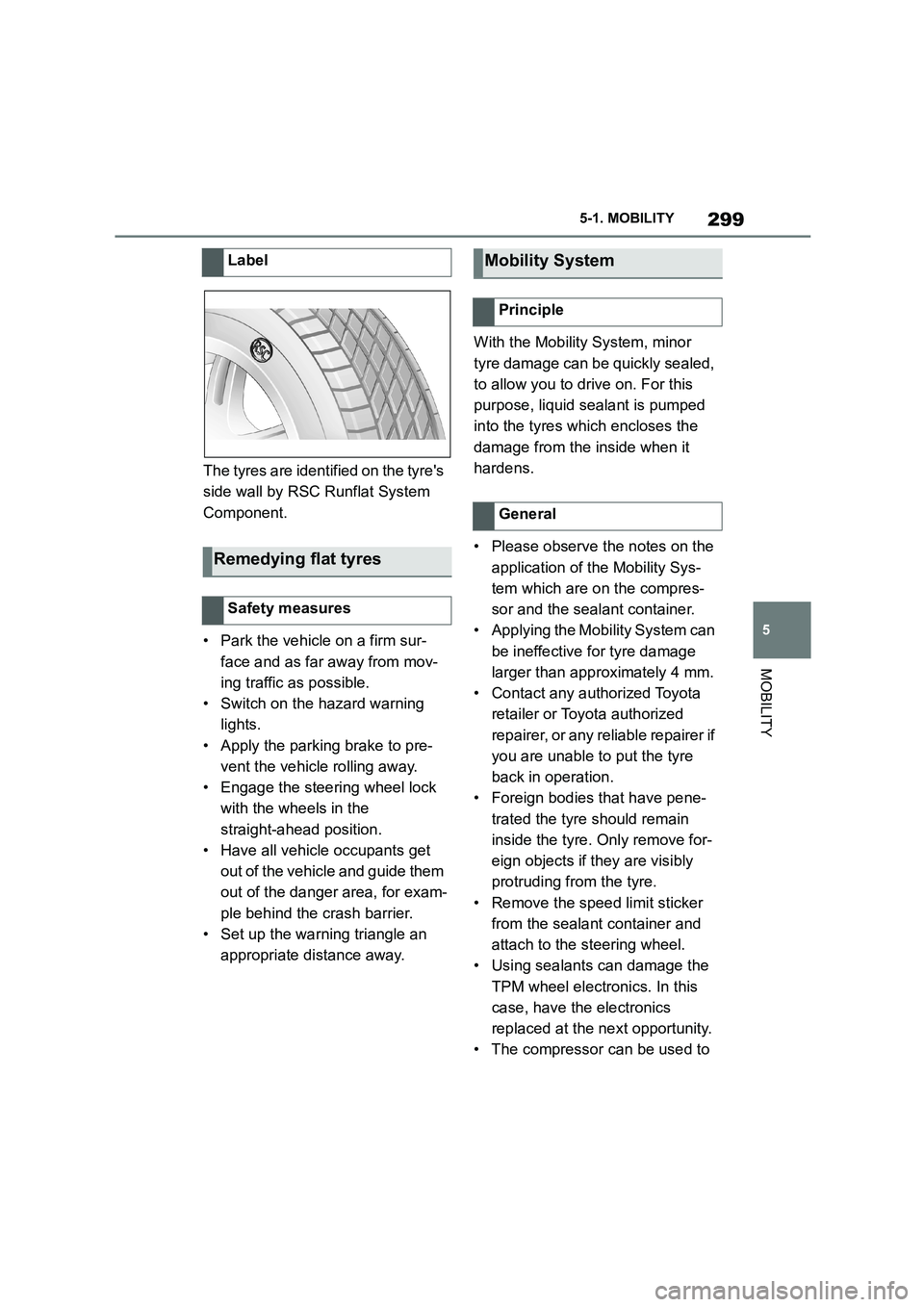
The tyres are identified on the tyre's
side wall by RSC Runflat System
Component.
• Park the vehicle on a firm sur-
face and as far away from mov-
ing traffic as possible.
• Switch on the hazard warning
lights.
• Apply the parking brake to pre-
vent the vehicle rolling away.
• Engage the steering wheel lock
with the wheels in the
straight-ahead position.
• Have all vehicle occupants get
out of the vehicle and guide them
out of the danger area, for exam-
ple behind the crash barrier.
• Set up the warning triangle an
appropriate distance away.
With the Mobility System, minor
tyre damage can be quickly sealed,
to allow you to drive on. For this
purpose, liquid sealant is pumped
into the tyres which encloses the
damage from the inside when it
hardens.
• Please observe the notes on the
application of the Mobility Sys-
tem which are on the compres-
sor and the sealant container.
• Applying the Mobility System can
be ineffective for tyre damage
larger than approximately 4 mm.
• Contact any authorized Toyota
retailer or Toyota authorized
repairer, or any reliable repairer if
you are unable to put the tyre
back in operation.
• Foreign bodies that have pene-
trated the tyre should remain
inside the tyre. Only remove for-
eign objects if they are visibly
protruding from the tyre.
• Remove the speed limit sticker
from the sealant container and
attach to the steering wheel.
• Using sealants can damage the
TPM wheel electronics. In this
case, have the electronics
replaced at the next opportunity.
• The compressor can be used to
Label
Remedying flat tyres
Safety measures
Mobility System
Principle
General
Page 302 of 498
3005-1. MOBILITY
check the tyre inflation pressure.
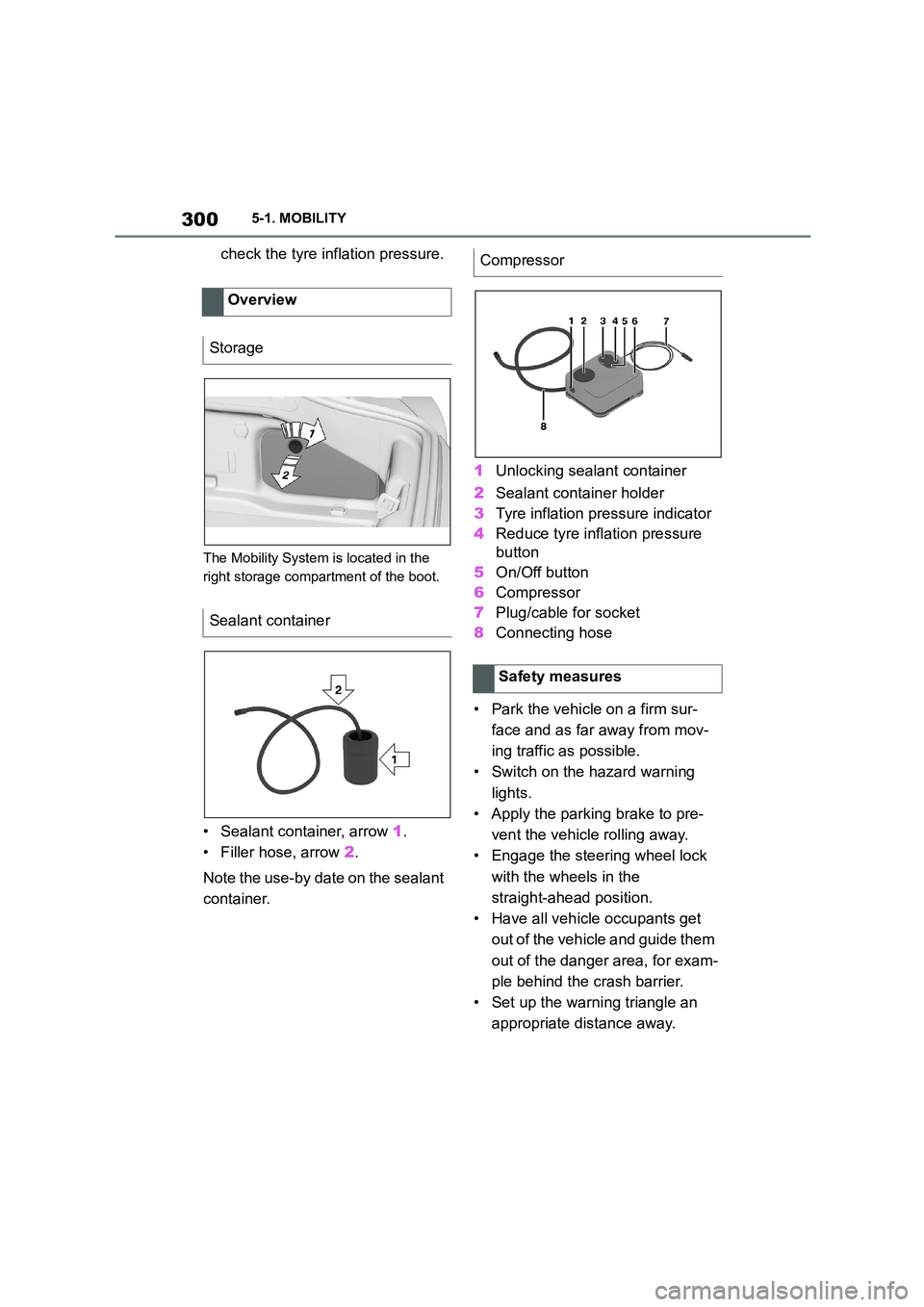
The Mobility System is located in the
right storage compartment of the boot.
• Sealant container, arrow 1.
• Filler hose, arrow 2.
Note the use-by date on the sealant
container.
1 Unlocking sealant container
2 Sealant container holder
3 Tyre inflation pressure indicator
4 Reduce tyre inflation pressure
button
5 On/Off button
6 Compressor
7 Plug/cable for socket
8 Connecting hose
• Park the vehicle on a firm sur-
face and as far away from mov-
ing traffic as possible.
• Switch on the hazard warning
lights.
• Apply the parking brake to pre-
vent the vehicle rolling away.
• Engage the steering wheel lock
with the wheels in the
straight-ahead position.
• Have all vehicle occupants get
out of the vehicle and guide them
out of the danger area, for exam-
ple behind the crash barrier.
• Set up the warning triangle an
appropriate distance away.
Overview
Storage
Sealant container
Compressor
Safety measures