engine TOYOTA SUPRA 2022 Workshop Manual
[x] Cancel search | Manufacturer: TOYOTA, Model Year: 2022, Model line: SUPRA, Model: TOYOTA SUPRA 2022Pages: 498, PDF Size: 104.06 MB
Page 289 of 498
287
4
4-1. DRIVING HINTS
DRIVING HINTS
set off straight away, driving at
moderate engine speeds.
This brings the cold engine up to
operating temperature as quickly as
possible.
Anticipating the road situation and
adopting a smooth driving style will
reduce fuel consumption.
Avoid accelerating and braking
unnecessarily.
Keep an appropriate distance from
the vehicle ahead.
Driving at low engine speeds
reduces fuel consumption and
wear.
Pay attention to the shift position
indicator, see page 171, in the vehi-
cle, if fitted.
When approaching a red traffic
light, take your foot off the accelera-
tor and allow the vehicle to coast to
a stop.
On downward stretc hes, take your
foot off the accelerator and allow
the vehicle to roll.
The fuel supply is interrupted in
overrun mode.
When you stop the vehicle for
longer periods, for example at traf-
fic lights, railway crossings or in
traffic jams, switch off the engine.
The Auto Start/Stop of the vehicle
shuts off the engine automatically
during a stop.
Switching the engine off and on
again reduces fuel consumption
and emissions compared with a
permanently running engine. Sav-
ings can be made just by shutting
down the engine for a few seconds.
Functions such as seat heating or
rear window heating require a great
deal of energy and increase fuel
consumption, especially in city traf-
fic and stop-and-go traffic.
Switch these functions off if they
are not required.
Have the vehicle serviced regularly
to achieve optimal economy and
lifetime. Toyota recommends hav-
ing maintenance work carried out
Think ahead
Avoid high engine speeds
Make use of overrun mode
Switch off the engine if stop-
ping for longer periods
Stopping the engine
Auto Start/Stop
Switch off functions which
are not currently required
Have maintenance work car-
ried out
Page 291 of 498
5
289
5
MOBILITY
MOBILITY
.5-1. MOBILITY
Refuelling.......................... 290
Wheels and tyres .............. 292
Engine compartment ........ 319
Operating fluids ................ 322
Maintenance ..................... 330
Scheduled maintenance
(except for Europe and
Australia) ........................ 334
Replacing parts................. 339
Breakdown Assist ............. 350
General care ..................... 362
Page 292 of 498
2905-1. MOBILITY
5-1.MOBILITY
This chapter describes all standard,
country-specific and special equip-
ment available for the model series.
It may therefore describe equip-
ment and functions which are not
installed in your vehicle, for exam-
ple on account of the special equip-
ment selected or the country
specification. This also applies to
safety-relevant functions and sys-
tems. Please comply with the rele-
vant laws and regulations when
using the corresponding functions
and systems.
Before refuelling, observe the notes
on fuel quality, see page 322.
When refuelling, insert the filler
nozzle fully into th e filler neck. Lift-
ing the filler nozzle during refuelling
results in the following:
The fuel supply being cut off pre-
maturely.
Fuel vapour and fumes being
recovered less effectively.
The fuel tank is full when the filler
nozzle cuts out for the first time.
For Korea: Make sure that the fuel
tank cap is closed properly after
refuelling, otherw ise the emissions
warning lamp may illuminate.
Please comply with the safety regu-
lations displayed at filling stations.
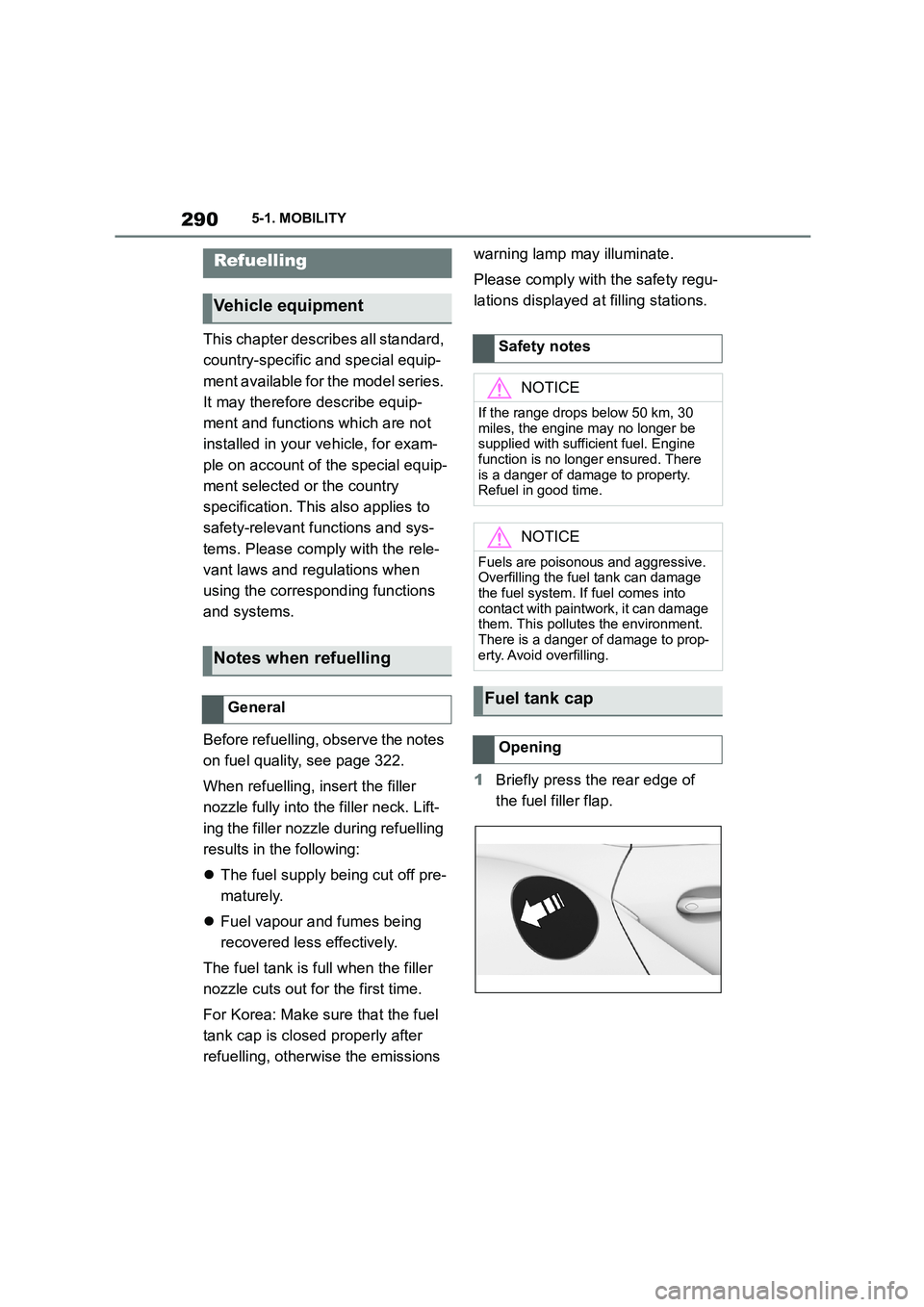
1 Briefly press the rear edge of
the fuel filler flap.
Refuelling
Vehicle equipment
Notes when refuelling
General
Safety notes
NOTICE
If the range drops below 50 km, 30
miles, the engine may no longer be
supplied with sufficient fuel. Engine function is no longer ensured. There
is a danger of damage to property.
Refuel in good time.
NOTICE
Fuels are poisonous and aggressive.
Overfilling the fuel tank can damage the fuel system. If fuel comes into
contact with paintwork, it can damage
them. This pollutes the environment. There is a danger of damage to prop-
erty. Avoid overfilling.
Fuel tank cap
Opening
Page 304 of 498
3025-1. MOBILITY
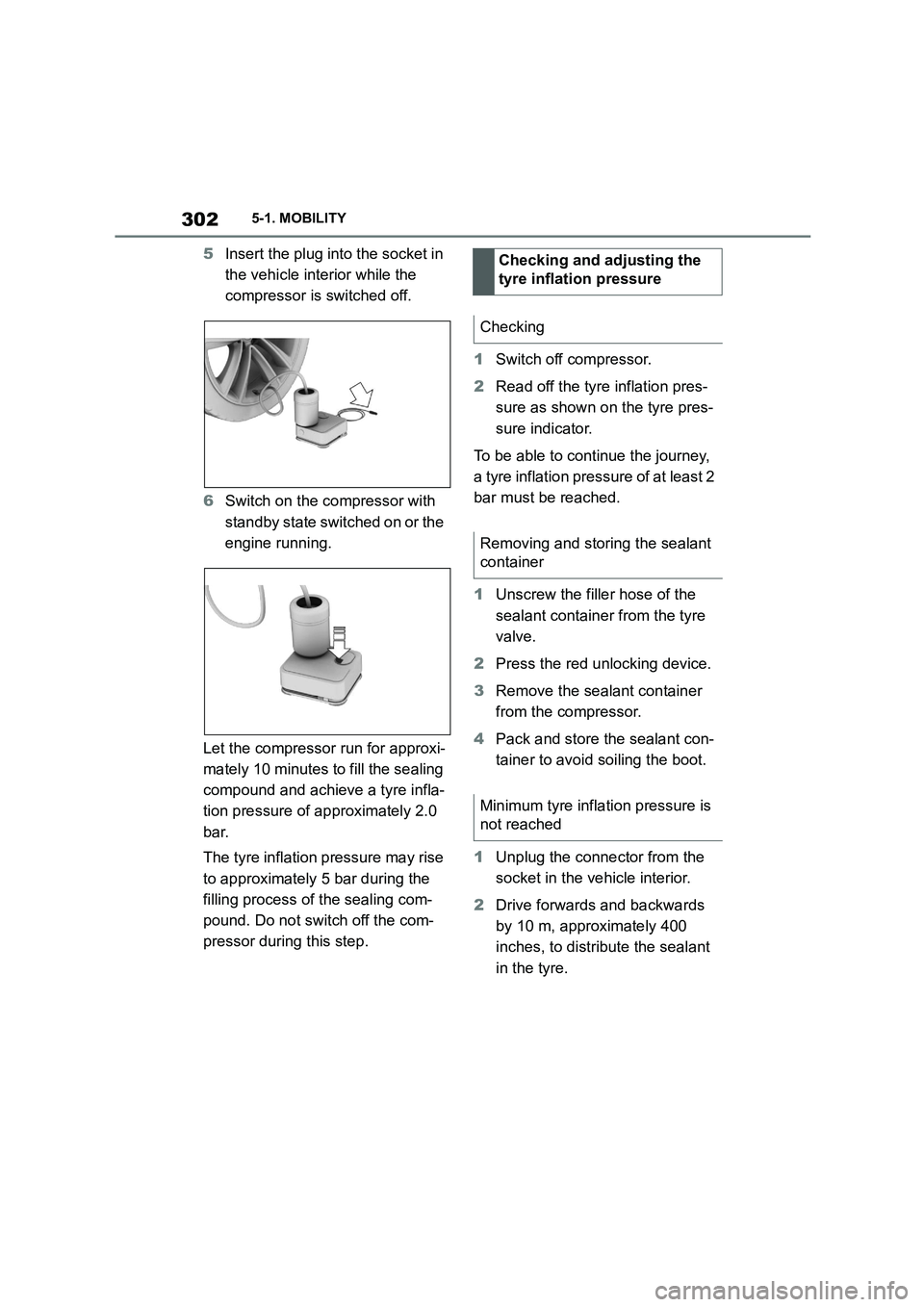
5Insert the plug into the socket in
the vehicle interior while the
compressor is switched off.
6 Switch on the compressor with
standby state switched on or the
engine running.
Let the compressor run for approxi-
mately 10 minutes to fill the sealing
compound and achieve a tyre infla-
tion pressure of approximately 2.0
bar.
The tyre inflation pressure may rise
to approximately 5 bar during the
filling process of the sealing com-
pound. Do not switch off the com-
pressor during this step.
1 Switch off compressor.
2 Read off the tyre inflation pres-
sure as shown on the tyre pres-
sure indicator.
To be able to continue the journey,
a tyre inflation pressure of at least 2
bar must be reached.
1 Unscrew the filler hose of the
sealant container from the tyre
valve.
2 Press the red unlocking device.
3 Remove the sealant container
from the compressor.
4 Pack and store the sealant con-
tainer to avoid soiling the boot.
1 Unplug the connector from the
socket in the vehicle interior.
2 Drive forwards and backwards
by 10 m, approximately 400
inches, to distribute the sealant
in the tyre.
Checking and adjusting the
tyre inflation pressure
Checking
Removing and storing the sealant
container
Minimum tyre inflation pressure is
not reached
Page 305 of 498
303
5
5-1. MOBILITY
MOBILITY
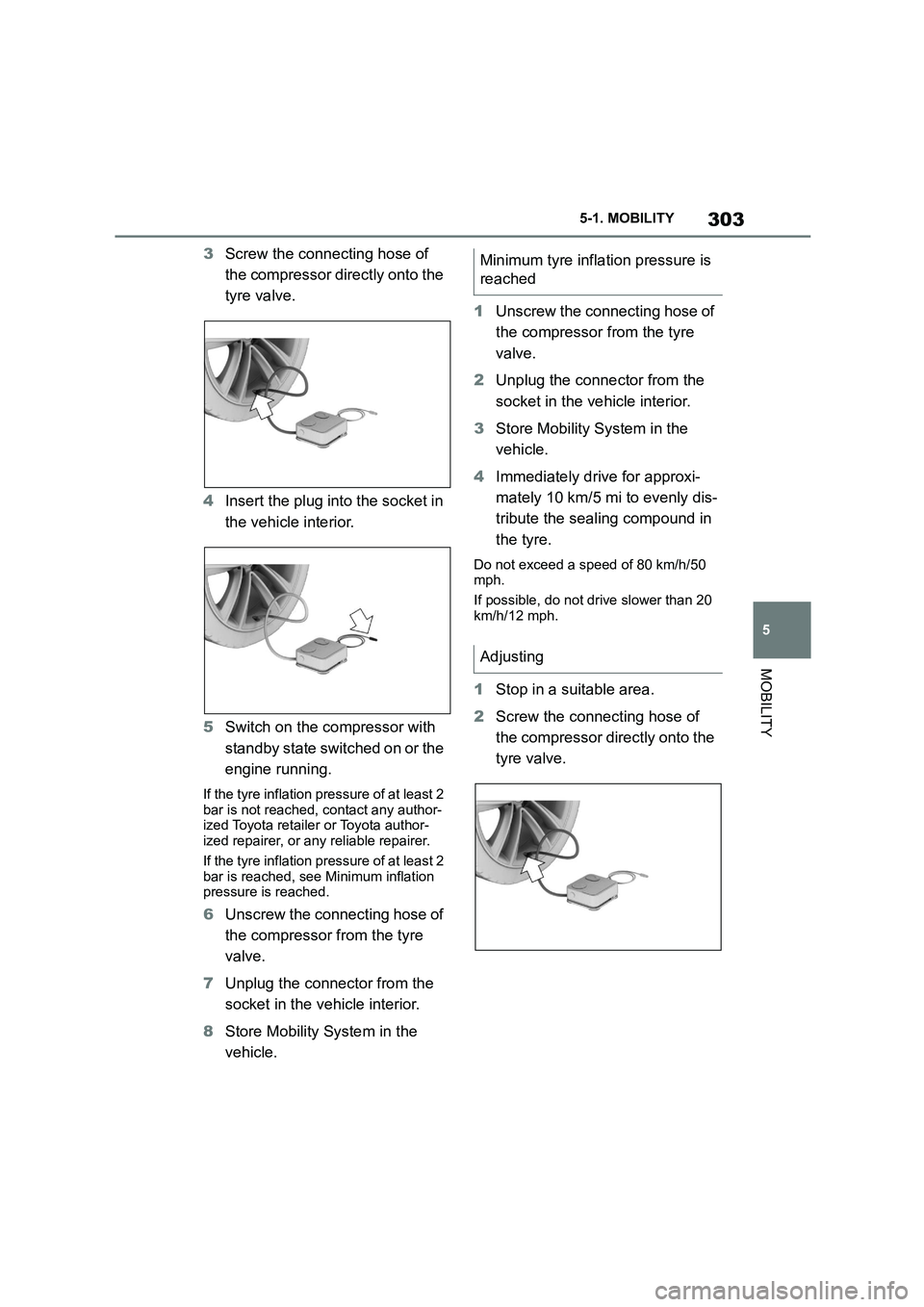
3 Screw the connecting hose of
the compressor directly onto the
tyre valve.
4 Insert the plug into the socket in
the vehicle interior.
5 Switch on the compressor with
standby state switched on or the
engine running.
If the tyre inflation pressure of at least 2
bar is not reached, contact any author-
ized Toyota retailer or Toyota author- ized repairer, or any reliable repairer.
If the tyre inflation pressure of at least 2
bar is reached, see Minimum inflation pressure is reached.
6 Unscrew the connecting hose of
the compressor from the tyre
valve.
7 Unplug the connector from the
socket in the vehicle interior.
8 Store Mobility System in the
vehicle.
1 Unscrew the connecting hose of
the compressor from the tyre
valve.
2 Unplug the connector from the
socket in the vehicle interior.
3 Store Mobility System in the
vehicle.
4 Immediately drive for approxi-
mately 10 km/5 mi to evenly dis-
tribute the sealing compound in
the tyre.
Do not exceed a speed of 80 km/h/50 mph.
If possible, do not drive slower than 20
km/h/12 mph.
1 Stop in a suitable area.
2 Screw the connecting hose of
the compressor directly onto the
tyre valve.
Minimum tyre inflation pressure is
reached
Adjusting
Page 306 of 498
3045-1. MOBILITY
3Insert the plug into the socket in
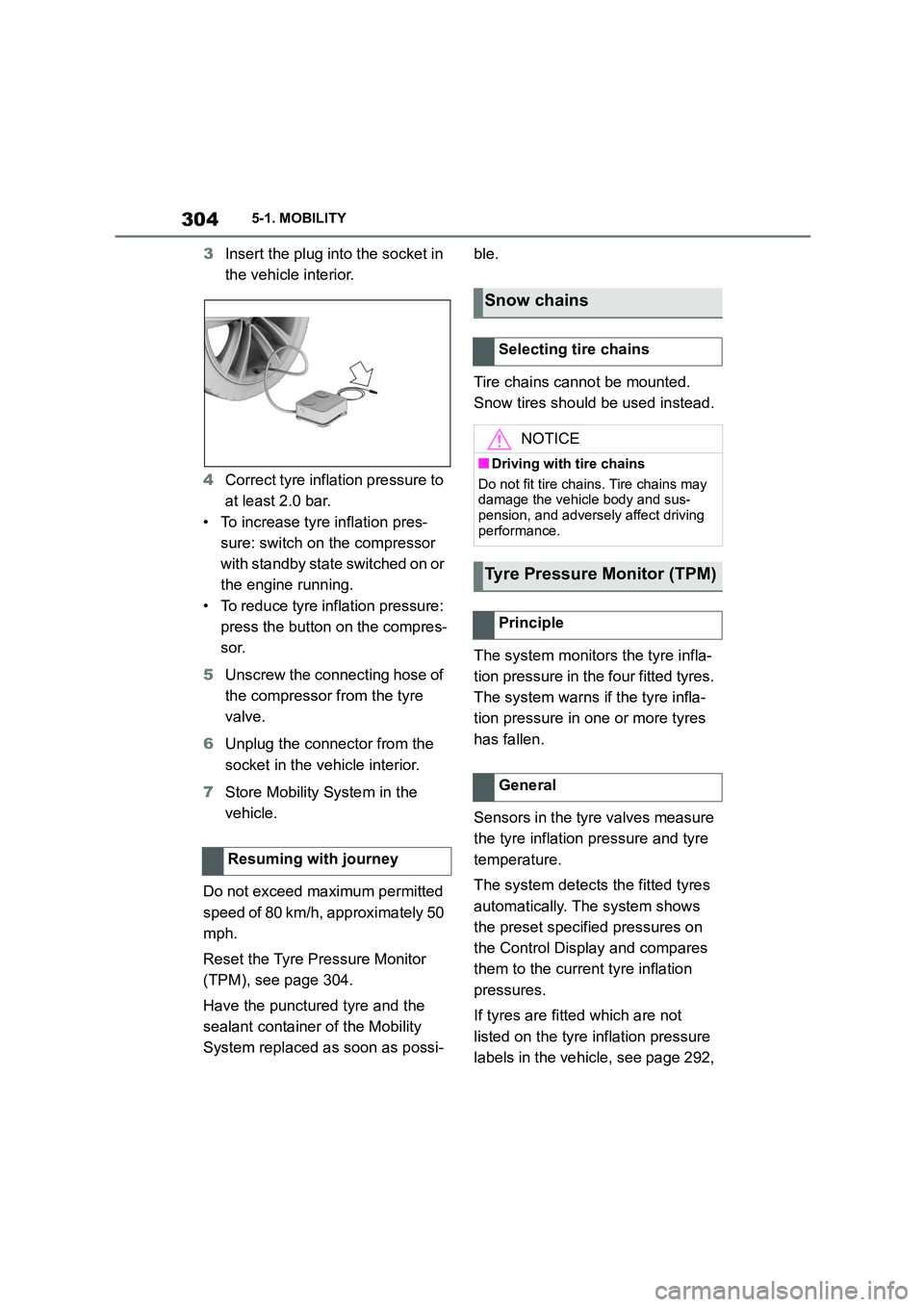
the vehicle interior.
4 Correct tyre inflation pressure to
at least 2.0 bar.
• To increase tyre inflation pres-
sure: switch on the compressor
with standby state switched on or
the engine running.
• To reduce tyre inflation pressure:
press the button on the compres-
sor.
5 Unscrew the connecting hose of
the compressor from the tyre
valve.
6 Unplug the connector from the
socket in the vehicle interior.
7 Store Mobility System in the
vehicle.
Do not exceed maximum permitted
speed of 80 km/h, approximately 50
mph.
Reset the Tyre Pressure Monitor
(TPM), see page 304.
Have the punctured tyre and the
sealant containe r of the Mobility
System replaced as soon as possi-
ble.
Tire chains cannot be mounted.
Snow tires should be used instead.
The system monitors the tyre infla-
tion pressure in the four fitted tyres.
The system warns if the tyre infla-
tion pressure in one or more tyres
has fallen.
Sensors in the tyre valves measure
the tyre inflation pressure and tyre
temperature.
The system detects the fitted tyres
automatically. The system shows
the preset specified pressures on
the Control Display and compares
them to the current tyre inflation
pressures.
If tyres are fitted which are not
listed on the tyre inflation pressure
labels in the vehicle, see page 292,
Resuming with journey
Snow chains
Selecting tire chains
NOTICE
■Driving with tire chains
Do not fit tire chains. Tire chains may
damage the vehicle body and sus- pension, and adversely affect driving
performance.
Tyre Pressure Monitor (TPM)
Principle
General
Page 315 of 498
313
5
5-1. MOBILITY
MOBILITY
any reliable repairer.
For run-flat tyres or when using a
flat tyre kit, it is not always neces-
sary to change a wheel immedi-
ately if tyre inflatio n pressure is lost
due to a flat tyre.
If required, the tools for changing
wheels are available as special
accessories from any authorized
Toyota retailer or Toyota authorized
repairer, or any reliable repairer.
Wheel change
General
Safety notes
WA R N I N G
The jack is only intended for raising
the vehicle briefly during a wheel
change. Even if the safety measures are complied with, there is a risk of
the raised vehicle falling over due to
the jack slipping. There is a danger of injury or even death. If the vehicle is
raised with the jack, do not lie under-
neath the vehicle and do not start the engine.
WA R N I N G
Supports such as wooden blocks
under the vehicle jack can prevent it from achieving its load capacity due
to the restricted height. The load
capacity of the wooden blocks may be exceeded, causing the vehicle to tip
over. There is a danger of injury or
even death. Do not place supports under the vehicle jack.
WA R N I N G
The jack, issued by the vehicle manu-
facturer, is provided in order to per-
form a wheel change in the event of a breakdown. The jack is not designed
for frequent use; for example, chang-
ing from summer to winter tyres. Using the jack frequently may cause it
to become jammed or damaged.
There is a danger of injury and dam-
age to property. Only use the jack to change an emergency wheel or a
spare wheel in the event of a flat tyre.
WA R N I N G
On soft, uneven or slippery ground,
for example, snow, ice, tiles or similar,
the jack may slip. There is a danger of injury. Perform the wheel change on a
level, firm and non-slip surface if at all
possible.
WA R N I N G
The jack is only optimised for raising
the vehicle and for use with the jack-
ing points on the vehicle. There is a danger of injury. Do not lift another
vehicle or other items with the jack.
WA R N I N G
If the jack has not been guided into the jacking point provided, the vehicle
might be damaged when the jack is
extended, or the jack could slip. There is a danger of injury or damage to
property. When extending, make sure
that the jack is guided into the jacking point adjacent to the wheelhouse.
Page 321 of 498
319
5
5-1. MOBILITY
MOBILITY
1 Stow the emergency wheel and
the tools for changing wheels in
the bag.
2 Place the bag in the boot.
3 Hook the lashing straps onto the
lashing eyes.
4 Tie the lashing straps. Make
sure that it is seated correctly
and firmly.
This chapter describes all standard,
country-specific and special equip-
ment available for the model series.
It may therefore describe equip-
ment and functions which are not
installed in your vehicle, for exam-
ple on account of the special equip-
ment selected or the country
specification. This also applies to
safety-relevant functions and sys-
tems. Please comply with the rele-
vant laws and regulations when
using the corresponding functions
and systems.
Inserting the emergency
wheel
Engine compar tment
Vehicle equipment
Page 322 of 498
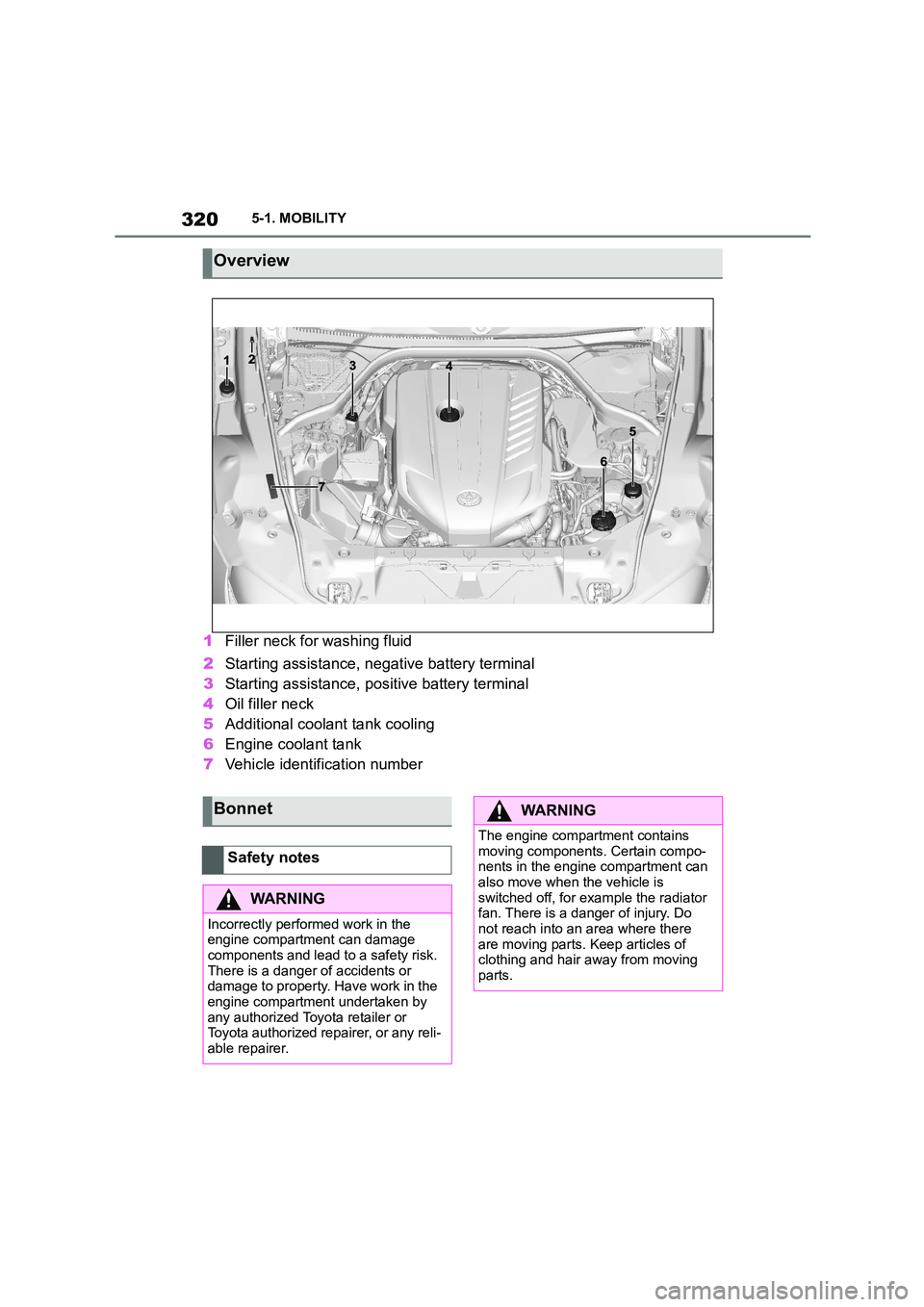
3205-1. MOBILITY
1Filler neck for washing fluid
2 Starting assistance, negative battery terminal
3 Starting assistance, positive battery terminal
4 Oil filler neck
5 Additional coolant tank cooling
6 Engine coolant tank
7 Vehicle identification number
Overview
Bonnet
Safety notes
WA R N I N G
Incorrectly performed work in the
engine compartment can damage components and lead to a safety risk.
There is a danger of accidents or
damage to property. Have work in the engine compartment undertaken by
any authorized Toyota retailer or
Toyota authorized repairer, or any reli- able repairer.
WA R N I N G
The engine compartment contains
moving components. Certain compo- nents in the engine compartment can
also move when the vehicle is
switched off, for example the radiator fan. There is a danger of injury. Do
not reach into an area where there
are moving parts. Keep articles of clothing and hair away from moving
parts.
Page 324 of 498
3225-1. MOBILITY
This chapter describes all standard,
country-specific and special equip-
ment available for the model series.
It may therefore describe equip-
ment and functions which are not
installed in your vehicle, for exam-
ple on account of the special equip-
ment selected or the country
specification. This also applies to
safety-relevant functions and sys-
tems. Please comply with the rele-
vant laws and regulations when
using the corresponding functions
and systems.
Depending on the region, many fill-
ing stations sell fuel that is adapted
to winter or summer conditions.
Fuel that is sold in winter facilitates
cold starting, for example.
For optimal fuel consumption, the
petrol should be sulphur-free or
have a low sulphur content.
Fuels labelled on the pump as con-
taining metal must not be used.
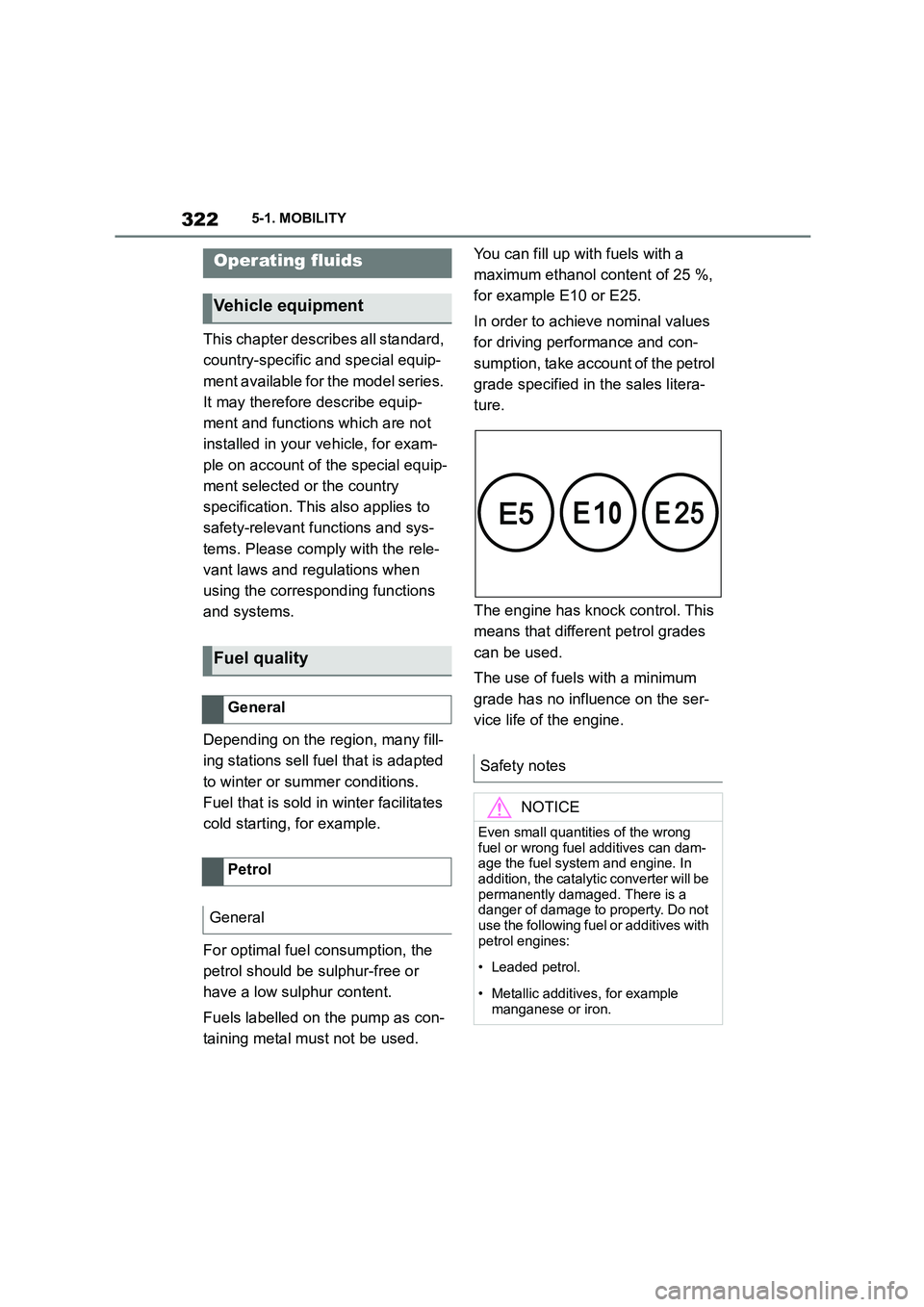
You can fill up with fuels with a
maximum ethanol content of 25 %,
for example E10 or E25.
In order to achieve nominal values
for driving performance and con-
sumption, take account of the petrol
grade specified in the sales litera-
ture.
The engine has knock control. This
means that different petrol grades
can be used.
The use of fuels with a minimum
grade has no influence on the ser-
vice life of the engine.
Operating fluids
Vehicle equipment
Fuel quality
General
Petrol
General
Safety notes
NOTICE
Even small quantities of the wrong
fuel or wrong fuel additives can dam- age the fuel system and engine. In
addition, the catalytic converter will be
permanently damaged. There is a danger of damage to property. Do not
use the following fuel or additives with
petrol engines:
• Leaded petrol.
• Metallic additives, for example
manganese or iron.