light TOYOTA SUPRA 2022 Manual PDF
[x] Cancel search | Manufacturer: TOYOTA, Model Year: 2022, Model line: SUPRA, Model: TOYOTA SUPRA 2022Pages: 498, PDF Size: 104.06 MB
Page 280 of 498
2783-1. CONTROLS
2.
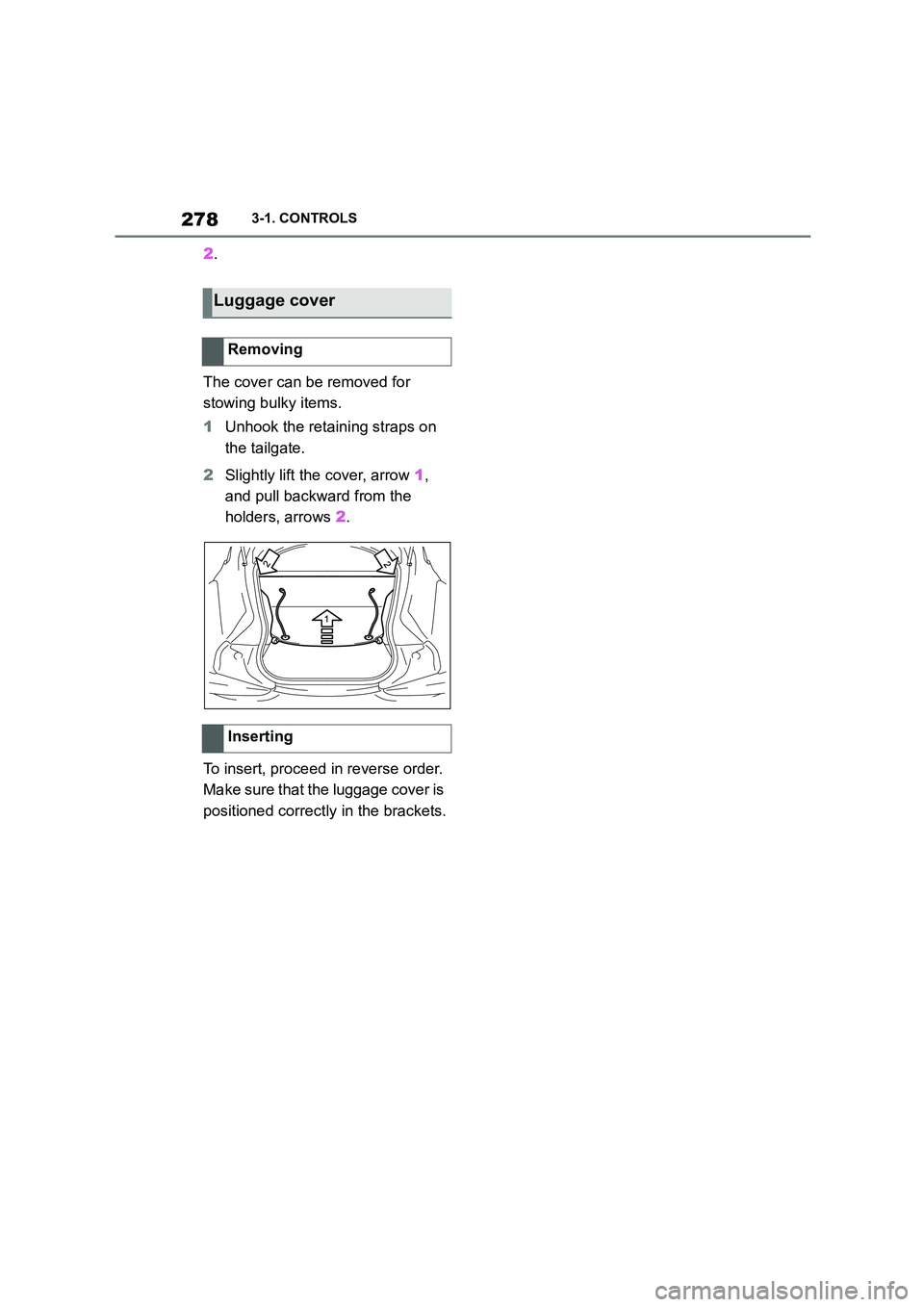
The cover can be removed for
stowing bulky items.
1 Unhook the retaining straps on
the tailgate.
2 Slightly lift the cover, arrow 1,
and pull backward from the
holders, arrows 2.
To insert, proceed in reverse order.
Make sure that the luggage cover is
positioned correctly in the brackets.
Luggage cover
Removing
Inserting
Page 284 of 498
2824-1. DRIVING HINTS
temperatures to clean the exhaust
gas particle filter as necessary.
The cleaning process takes a few
minutes, during which the following
may occur:
Engine temporarily runs a bit
roughly.
A slightly higher engine speed is
required to achieve the usual
power output.
A small amount of smoke from
the exhaust, even after stopping
the engine.
Noise, for example from radiator
fan operation, may be heard,
even some minutes after stop-
ping the engine.
It is normal for the radiator fan to
keep running for several minutes,
even after short trips.
The self-cleaning function of the
exhaust particle filter is an auto-
matic process that is supported by
different measures, for example
additional heating.
General
Cleaning the exhaust gas
particle filter while driving
Radio signals
WA R N I N G
Certain vehicle functions may be
affected by interference from high-fre- quency radio signals. Such signals
are output from a series of transmis-
sion systems, for example from air traffic beacons or relay stations for
mobile telecommunications.
We recommend you consult any
authorized Toyota retailer or Toyota authorized repairer, or any reliable
repairer should you experience any
difficulties in this regard.
Mobile communication in the
vehicle
WA R N I N G
There is a possibility of reciprocal
interference between the vehicle elec- tronics and mobile radio devices.
Radiation is generated when mobile
radio devices are transmitting. There
is a danger of injury or damage to property. If possible, only use mobile
radio devices, for example mobile
telephones, in the interior if they are connected directly to an external
antenna in order to eliminate recipro-
cal interference and to dissipate the radiation from vehicle's interior.
Page 285 of 498
283
4
4-1. DRIVING HINTS
DRIVING HINTS
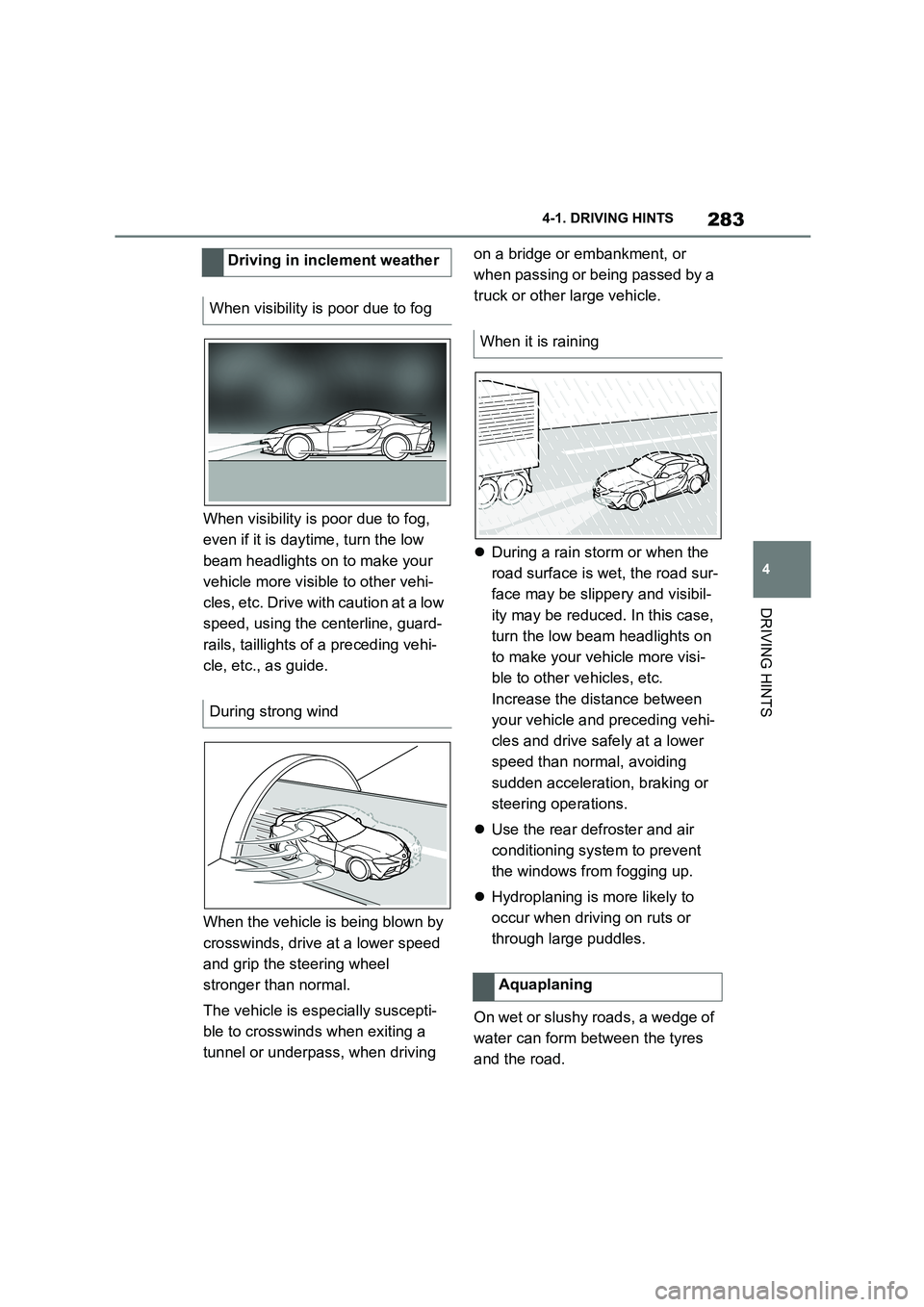
When visibility is poor due to fog,
even if it is daytime, turn the low
beam headlights on to make your
vehicle more visible to other vehi-
cles, etc. Drive with caution at a low
speed, using the centerline, guard-
rails, taillights of a preceding vehi-
cle, etc., as guide.
When the vehicle is being blown by
crosswinds, drive at a lower speed
and grip the steering wheel
stronger than normal.
The vehicle is especially suscepti-
ble to crosswinds when exiting a
tunnel or underpass, when driving
on a bridge or embankment, or
when passing or being passed by a
truck or other large vehicle.
During a rain storm or when the
road surface is wet, the road sur-
face may be slippery and visibil-
ity may be reduced. In this case,
turn the low beam headlights on
to make your vehicle more visi-
ble to other vehicles, etc.
Increase the distance between
your vehicle and preceding vehi-
cles and drive safely at a lower
speed than normal, avoiding
sudden acceleration, braking or
steering operations.
Use the rear defroster and air
conditioning system to prevent
the windows from fogging up.
Hydroplaning is more likely to
occur when driving on ruts or
through large puddles.
On wet or slushy roads, a wedge of
water can form between the tyres
and the road.
Driving in inclement weather
When visibility is poor due to fog
During strong wind
When it is raining
Aquaplaning
Page 286 of 498
2844-1. DRIVING HINTS
This situation, known as aquaplan-
ing, means that the tyre can actu-
ally lose contact completely with
the road surface and the vehicle
can neither be steered, nor the
brakes properly applied.
Please comply with the following
when driving through water:
Deactivate the Automatic
Start/Stop function.
Only drive through still water.
Only drive through water up to a
max. depth of 25 cm, 9.8 in.
Drive through water at a walking
speed of no more than 5 km/h, 3
mph.
The vehicle is equipped with the
Anti-lock Brake System ABS as
standard.
Perform full brakin g in situations
that require it.
The vehicle remains steerable. Any
obstacles can be avoided by steer-
ing as smoothly as possible.
A pulsing of the brake pedal and
hydraulic regulating sounds indi-
cate that the anti-lock brake system
ABS is functioning.
In certain braking situations, the
perforated brake discs can cause
functional noise. However, func-
tional noises have no effect on the
efficiency and operational safety of
the brakes.
In wet weather, on gritted roads and
in heavy rain, apply the brakes
lightly every few kilometres/miles.
Driving through water
General
Safety note
NOTICE
Driving through excessively deep water too fast can result in water
entering the engine compartment,
electrical system or transmission. There is a danger of damage to prop-
erty. When driving through water, do
not exceed the maximum water depth and speed specified above.
Safe braking
General
Objects in the range of movement
of the pedals
WA R N I N G
Objects in the driver's footwell can
restrict the pedal travel or block a
pedal that has been pressed. There is a risk of accident. Ensure that items in
the vehicle are stowed securely and
cannot get into the driver's footwell. Only use floor mats that are suitable
for the vehicle and can be securely
fastened to the floor. Do not use loose floor mats, and do not place several
floor mats on top of one another.
Make sure that there is sufficient space for the pedals. Ensure that floor
mats are securely reattached after
removal, for example for cleaning.
Wet roads
Page 287 of 498
285
4
4-1. DRIVING HINTS
DRIVING HINTS
Ensure that you do not obstruct
other road users when doing so.
The heat generated by braking
dries the brake discs and brake
pads and protects them against
corrosion.
This way, brake power is available
immediately, whenever it is needed.
■General
When driving on long or steep
downhill stretches, use the gear in
which the least braking is required.
Otherwise the brake system can
overheat and the braking effect is
reduced.
Engine braking effect can be addi-
tionally increased by manually shift-
ing down, even into first gear, if
applicable.
■Safety notes
Corrosion of the brake discs and
contamination of the brake pads
increase in the following circum-
stances:
Low mileage.
Extended periods when the vehi-
cle is not used.
Infrequent use of the brakes.
Aggressive, acidic or alkaline
cleaning agents.
During braking, corroded brake
discs may cause brake judder
which usually cannot be eliminated.
When the automatic air condition-
ing is in operation, condensation
develops and exits underneath the
vehicle.
The higher mechanical and thermal
loads involved in driving on racing
tracks lead to increased wear. This
wear is not covered by the war-
ranty. The vehicle is not conceived
for use in motor sports competi-
tions.
Before and after driving on a racing
track, have the vehicle checked at
any authorized Toyota retailer or
Toyota authorized repairer, or any
reliable repairer.
Downhill gradients
WA R N I N G
Even slight continuous pressure on the brake pedal can cause overheat-
ing, brake pad wear or even brake
system failure. There is a danger of accidents. Avoid excessive loads on
the brake.
WA R N I N G
When idling or with the engine switched off, safety-relevant func-
tions, for example engine braking
effect or steering and braking force assistance, are either restricted or not
available at all. There is a risk of acci-
dent. Do not drive at idle speed or with the engine switched off.
Corrosion of the brake discs
Condensation when vehicle
is parked
Driving on a racing track
Page 289 of 498
287
4
4-1. DRIVING HINTS
DRIVING HINTS
set off straight away, driving at
moderate engine speeds.
This brings the cold engine up to
operating temperature as quickly as
possible.
Anticipating the road situation and
adopting a smooth driving style will
reduce fuel consumption.
Avoid accelerating and braking
unnecessarily.
Keep an appropriate distance from
the vehicle ahead.
Driving at low engine speeds
reduces fuel consumption and
wear.
Pay attention to the shift position
indicator, see page 171, in the vehi-
cle, if fitted.
When approaching a red traffic
light, take your foot off the accelera-
tor and allow the vehicle to coast to
a stop.
On downward stretc hes, take your
foot off the accelerator and allow
the vehicle to roll.
The fuel supply is interrupted in
overrun mode.
When you stop the vehicle for
longer periods, for example at traf-
fic lights, railway crossings or in
traffic jams, switch off the engine.
The Auto Start/Stop of the vehicle
shuts off the engine automatically
during a stop.
Switching the engine off and on
again reduces fuel consumption
and emissions compared with a
permanently running engine. Sav-
ings can be made just by shutting
down the engine for a few seconds.
Functions such as seat heating or
rear window heating require a great
deal of energy and increase fuel
consumption, especially in city traf-
fic and stop-and-go traffic.
Switch these functions off if they
are not required.
Have the vehicle serviced regularly
to achieve optimal economy and
lifetime. Toyota recommends hav-
ing maintenance work carried out
Think ahead
Avoid high engine speeds
Make use of overrun mode
Switch off the engine if stop-
ping for longer periods
Stopping the engine
Auto Start/Stop
Switch off functions which
are not currently required
Have maintenance work car-
ried out
Page 301 of 498
299
5
5-1. MOBILITY
MOBILITY
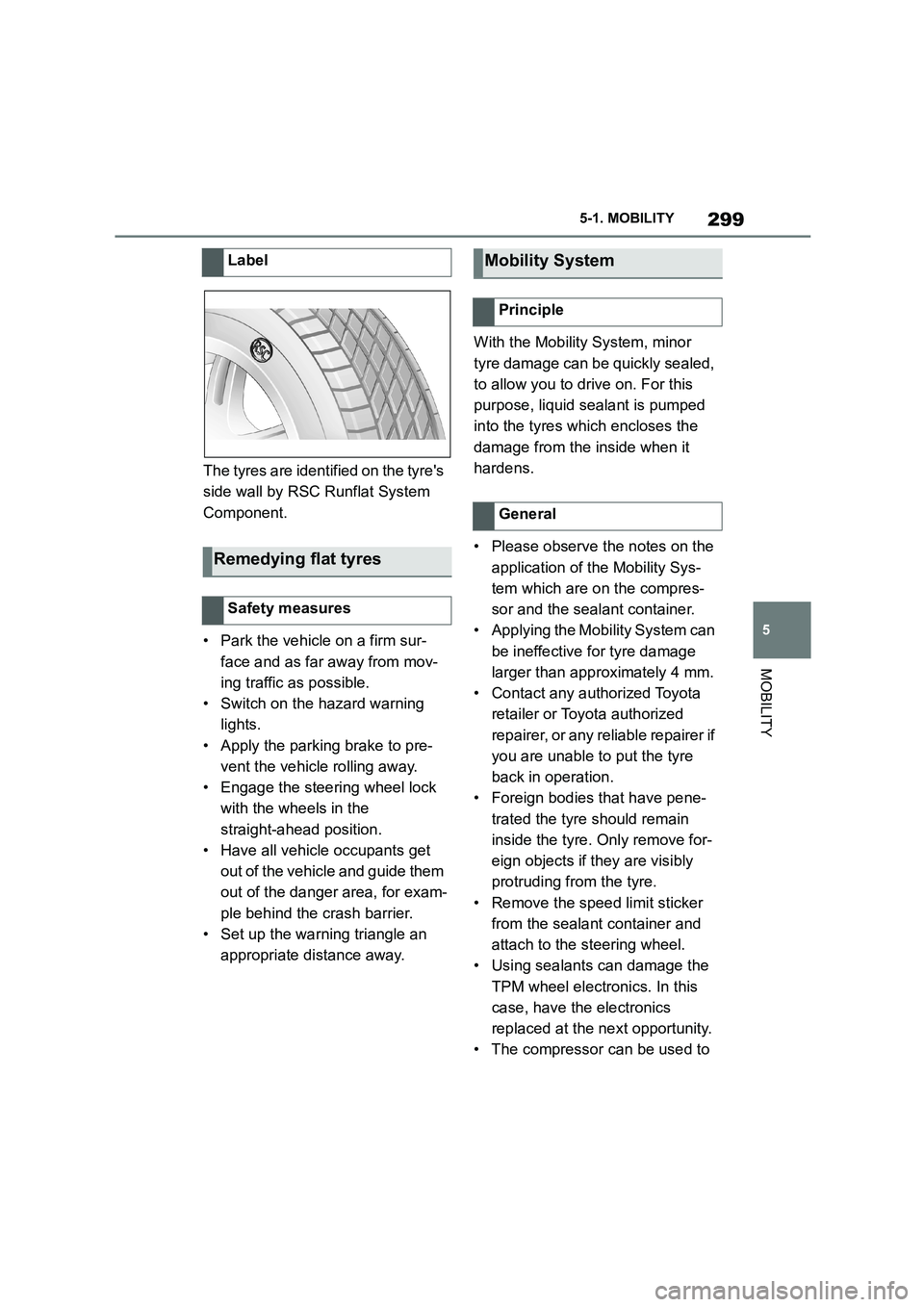
The tyres are identified on the tyre's
side wall by RSC Runflat System
Component.
• Park the vehicle on a firm sur-
face and as far away from mov-
ing traffic as possible.
• Switch on the hazard warning
lights.
• Apply the parking brake to pre-
vent the vehicle rolling away.
• Engage the steering wheel lock
with the wheels in the
straight-ahead position.
• Have all vehicle occupants get
out of the vehicle and guide them
out of the danger area, for exam-
ple behind the crash barrier.
• Set up the warning triangle an
appropriate distance away.
With the Mobility System, minor
tyre damage can be quickly sealed,
to allow you to drive on. For this
purpose, liquid sealant is pumped
into the tyres which encloses the
damage from the inside when it
hardens.
• Please observe the notes on the
application of the Mobility Sys-
tem which are on the compres-
sor and the sealant container.
• Applying the Mobility System can
be ineffective for tyre damage
larger than approximately 4 mm.
• Contact any authorized Toyota
retailer or Toyota authorized
repairer, or any reliable repairer if
you are unable to put the tyre
back in operation.
• Foreign bodies that have pene-
trated the tyre should remain
inside the tyre. Only remove for-
eign objects if they are visibly
protruding from the tyre.
• Remove the speed limit sticker
from the sealant container and
attach to the steering wheel.
• Using sealants can damage the
TPM wheel electronics. In this
case, have the electronics
replaced at the next opportunity.
• The compressor can be used to
Label
Remedying flat tyres
Safety measures
Mobility System
Principle
General
Page 302 of 498
3005-1. MOBILITY
check the tyre inflation pressure.
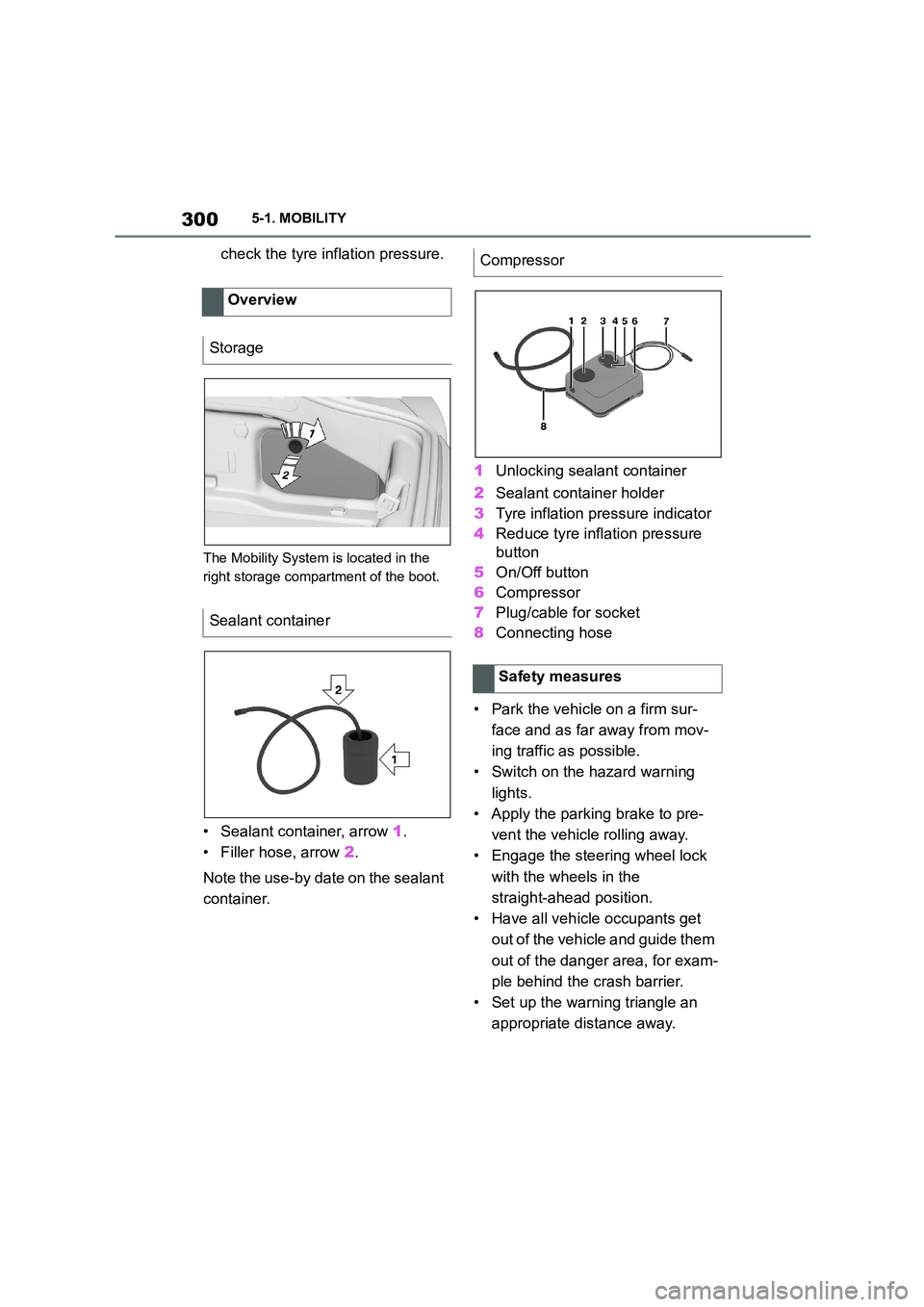
The Mobility System is located in the
right storage compartment of the boot.
• Sealant container, arrow 1.
• Filler hose, arrow 2.
Note the use-by date on the sealant
container.
1 Unlocking sealant container
2 Sealant container holder
3 Tyre inflation pressure indicator
4 Reduce tyre inflation pressure
button
5 On/Off button
6 Compressor
7 Plug/cable for socket
8 Connecting hose
• Park the vehicle on a firm sur-
face and as far away from mov-
ing traffic as possible.
• Switch on the hazard warning
lights.
• Apply the parking brake to pre-
vent the vehicle rolling away.
• Engage the steering wheel lock
with the wheels in the
straight-ahead position.
• Have all vehicle occupants get
out of the vehicle and guide them
out of the danger area, for exam-
ple behind the crash barrier.
• Set up the warning triangle an
appropriate distance away.
Overview
Storage
Sealant container
Compressor
Safety measures
Page 314 of 498
3125-1. MOBILITY
■Final tyre failure
Vibration or loud noises during the
journey may be an indication that
the tyre has finally failed.
Reduce your speed and stop the
vehicle. Parts of the tyre could
detach, which might lead to an acci-
dent.
Do not continue driving, but contact
any authorized Toyota retailer or
Toyota authorized repairer, or any
reliable repairer.
The tyre inflation pressure depends
on the temperature of the tyre.
The tyre inflation pressure
increases as the tyre temperature
increases, for example during driv-
ing or due to exposure to sunlight.
Tyre inflation pressure decreases if
the tyre temperature drops.
Due to the given warning thresh-
olds, therefore, this behaviour may
trigger a warning if there are major
temperature drops.
After a temperature-related warn-
ing, the specified pressures are dis-
played again on the Control Display
after driving a short distance.
No warning can be given in the
event of extreme, sudden tyre fail-
ure caused by external factors.
Tyres with special approval: the
system will not function correctly if
a reset has not been carried out, for
example, a flat ty re is reported in
spite of the correct tyre pressure.
• A wheel without TPM wheel elec-
tronics is fitted, for example
emergency wheel: have the
wheels checked if necessary.
• Malfunction: have the system
checked.
• Fault due to systems or devices
with the same radio frequency:
the system is automatically reac-
tivated upon leaving the field of
interference.
• Tyre Pressure Monitor malfunc-
tion: have the system checked
by any authorized Toyota retailer
or Toyota authorized repairer, or
System limits
Temperature
Sudden loss of tyre inflation pres-
sure
Reset not carried out
Malfunction
Message
The yellow warning lamp
flashes and is then illumi-
nated continuously. A
vehicle message is
shown. Tyre pressure
losses cannot be
detected.
Measure
Page 316 of 498
3145-1. MOBILITY
The vehicle manufacturer recom-
mends that the vehicle should addi-
tionally be protec ted against rolling
away during a wheel change.
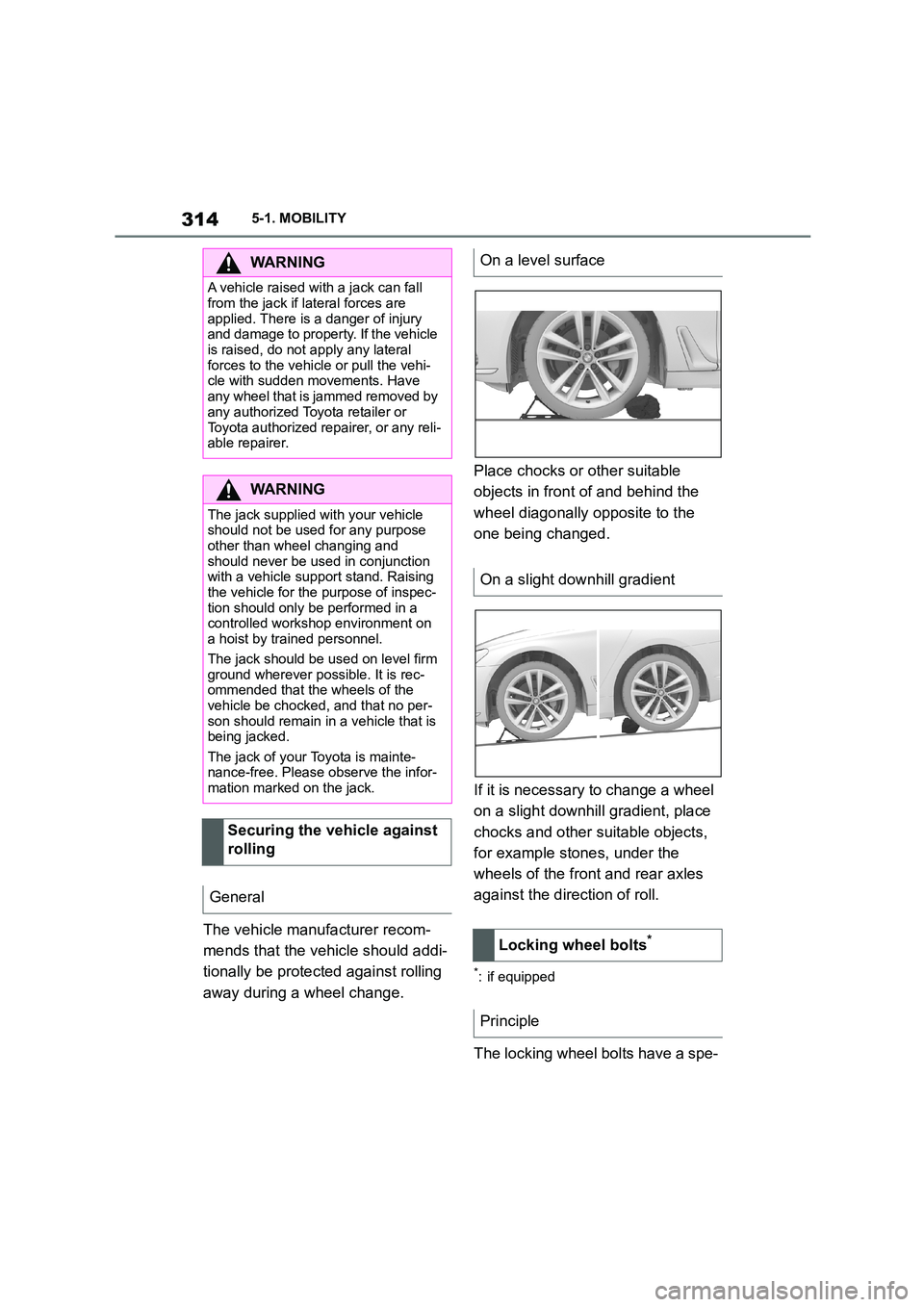
Place chocks or other suitable
objects in front of and behind the
wheel diagonally opposite to the
one being changed.
If it is necessary to change a wheel
on a slight downh ill gradient, place
chocks and other suitable objects,
for example stones, under the
wheels of the front and rear axles
against the direction of roll.
*: if equipped
The locking wheel bolts have a spe-
WA R N I N G
A vehicle raised with a jack can fall
from the jack if lateral forces are
applied. There is a danger of injury and damage to property. If the vehicle
is raised, do not apply any lateral
forces to the vehicle or pull the vehi- cle with sudden movements. Have
any wheel that is jammed removed by
any authorized Toyota retailer or
Toyota authorized repairer, or any reli- able repairer.
WA R N I N G
The jack supplied with your vehicle should not be used for any purpose
other than wheel changing and
should never be used in conjunction with a vehicle support stand. Raising
the vehicle for the purpose of inspec-
tion should only be performed in a controlled workshop environment on
a hoist by trained personnel.
The jack should be used on level firm ground wherever possible. It is rec-
ommended that the wheels of the
vehicle be chocked, and that no per-
son should remain in a vehicle that is being jacked.
The jack of your Toyota is mainte-
nance-free. Please observe the infor- mation marked on the jack.
Securing the vehicle against
rolling
General
On a level surface
On a slight downhill gradient
Locking wheel bolts*
Principle