air condition TOYOTA VERSO 2017 Repair Manual
[x] Cancel search | Manufacturer: TOYOTA, Model Year: 2017, Model line: VERSO, Model: TOYOTA VERSO 2017Pages: 668, PDF Size: 49.7 MB
Page 480 of 668
480
4-3. Do-it-yourself maintenance
VERSO_EE_OM64517E
WARNING
■ Proper inflation is critical to save tire performance
Keep your tires properly inflated.
If the tires are not properly inflated, the following conditions may occur which
could lead to an accident resulting in death or serious injury:
● Excessive wear
● Uneven wear
● Poor handling
● Possibility of blowouts resulting from overheated tires
● Air leaking from between tire and wheel
● Wheel deformation and/or tire damage
● Greater possibility of tire damage while driving (due to road hazards,
expansion joints, sharp edges in the road, etc.)
NOTICE
■ When inspecting and adjusting tire inflation pressure
Be sure to reinstall the tire valve caps.
If a valve cap is not installed, dirt or moisture may get into the valve and
cause an air leak, resulting in decreased tire inflation pressure.
Page 484 of 668
484
4-3. Do-it-yourself maintenance
VERSO_EE_OM64517E
Air conditioning filter
The air conditioning filter must be changed regularly to maintain air
conditioning efficiency.
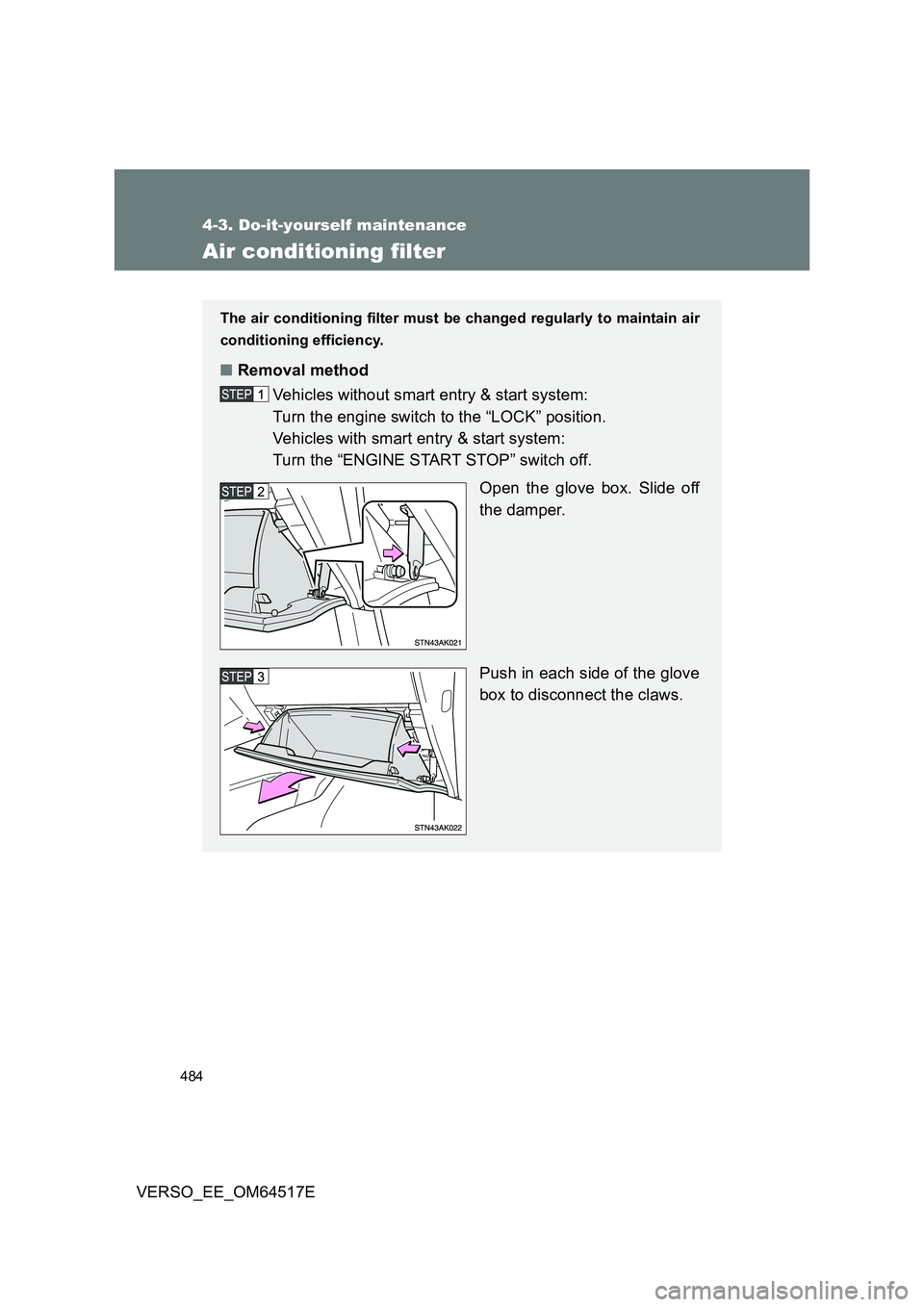
■ Removal method
Vehicles without smart entry & start system:
Turn the engine switch to the “LOCK” position.
Vehicles with smart entry & start system:
Turn the “ENGINE START STOP” switch off.
Open the glove box. Slide off
the damper.
Push in each side of the glove
box to disconnect the claws.
Page 485 of 668
485
4-3. Do-it-yourself maintenance
4
Maintenance and care
VERSO_EE_OM64517E
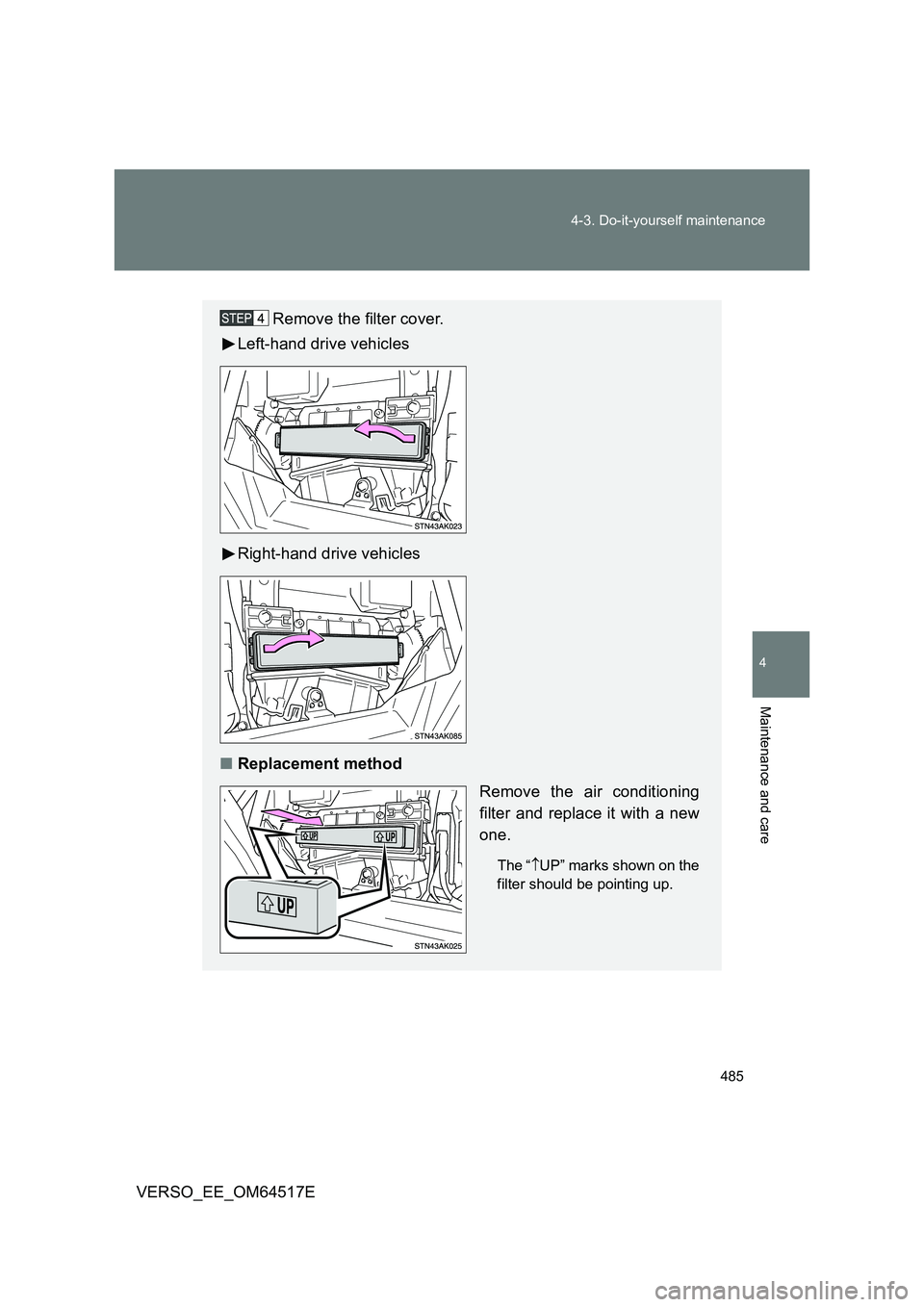
Remove the filter cover.
Left-hand drive vehicles
Right-hand drive vehicles
■ Replacement method
Remove the air conditioning
filter and replace it with a new
one.
The “UP” marks shown on the
filter should be pointing up.
Page 486 of 668
486
4-3. Do-it-yourself maintenance
VERSO_EE_OM64517E
■ Checking interval
Inspect and replace the air conditioning filter according to the maintenance
schedule. In dusty areas or areas with heavy traffic flow, early replacement
may be required. (For scheduled maintenance information, please refer to
the “Toyota Service Booklet” or “Toyota Warranty Booklet”.)
■ If air flow from the vents decreases dramatically
The filter may be clogged. Check the filter and replace if necessary.
NOTICE
■When using the air conditioning system
Make sure that a filter is always installed.
Using the air conditioning system without a filter may cause damage to the
system.
Page 496 of 668
496
4-3. Do-it-yourself maintenance
VERSO_EE_OM64517E
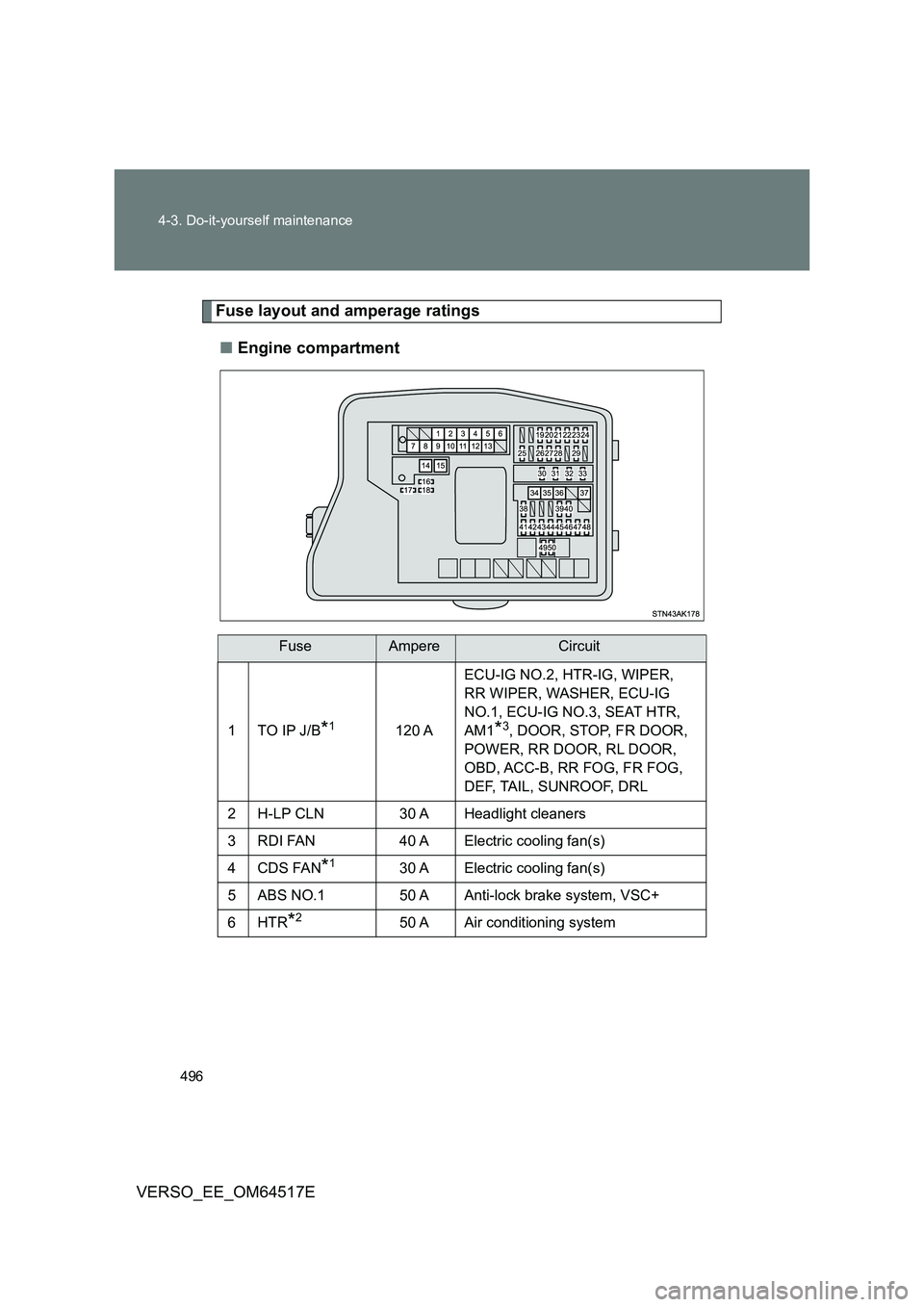
Fuse layout and amperage ratings
■ Engine compartment
FuseAmpereCircuit
1TO IP J/B*1120 A
ECU-IG NO.2, HTR-IG, WIPER,
RR WIPER, WASHER, ECU-IG
NO.1, ECU-IG NO.3, SEAT HTR,
AM1*3, DOOR, STOP, FR DOOR,
POWER, RR DOOR, RL DOOR,
OBD, ACC-B, RR FOG, FR FOG,
DEF, TAIL, SUNROOF, DRL
2H-LP CLN30 A Headlight cleaners
3RDI FAN40 A Electric cooling fan(s)
4CDS FAN*130 A Electric cooling fan(s)
5 ABS NO.1 50 A Anti-lock brake system, VSC+
6HTR*250 A Air conditioning system
Page 499 of 668
499
4-3. Do-it-yourself maintenance
4
Maintenance and care
VERSO_EE_OM64517E
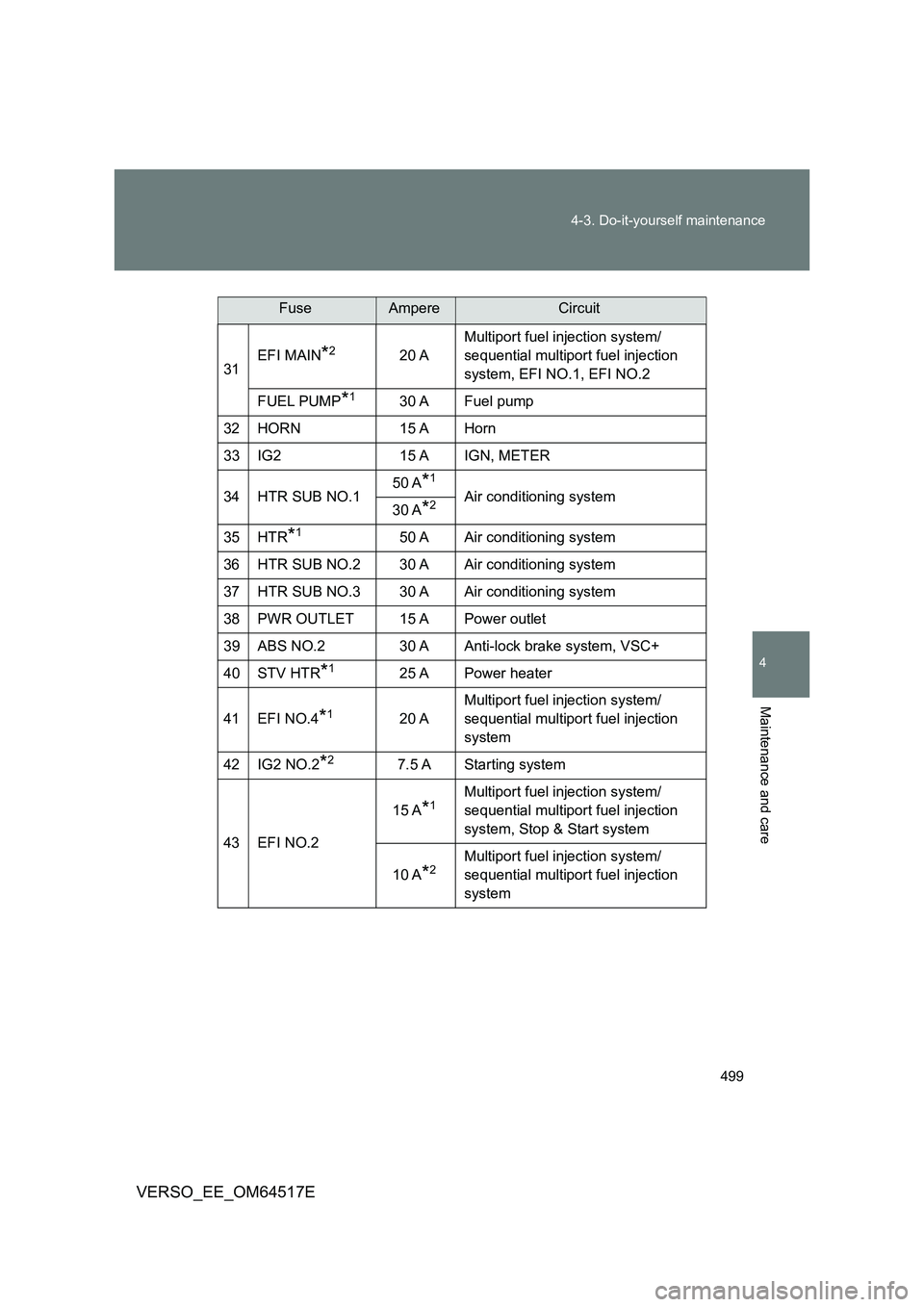
31 EFI MAIN*220 A
Multiport fuel injection system/
sequential multiport fuel injection
system, EFI NO.1, EFI NO.2
FUEL PUMP*130 A Fuel pump
32 HORN 15 A Horn
33 IG2 15 A IGN, METER
34 HTR SUB NO.1 50 A*1
Air conditioning system 30 A*2
35 HTR*150 A Air conditioning system
36 HTR SUB NO.2 30 A Air conditioning system
37 HTR SUB NO.3 30 A Air conditioning system
38PWR OUTLET15 APower outlet
39 ABS NO.2 30 A Anti-lock brake system, VSC+
40 STV HTR*125 A Power heater
41 EFI NO.4*120 A
Multiport fuel injection system/
sequential multiport fuel injection
system
42 IG2 NO.2*27.5 A Starting system
43 EFI NO.2
15 A*1Multiport fuel injection system/
sequential multiport fuel injection
system, Stop & Start system
10 A*2Multiport fuel injection system/
sequential multiport fuel injection
system
FuseAmpereCircuit
Page 502 of 668
502
4-3. Do-it-yourself maintenance
VERSO_EE_OM64517E
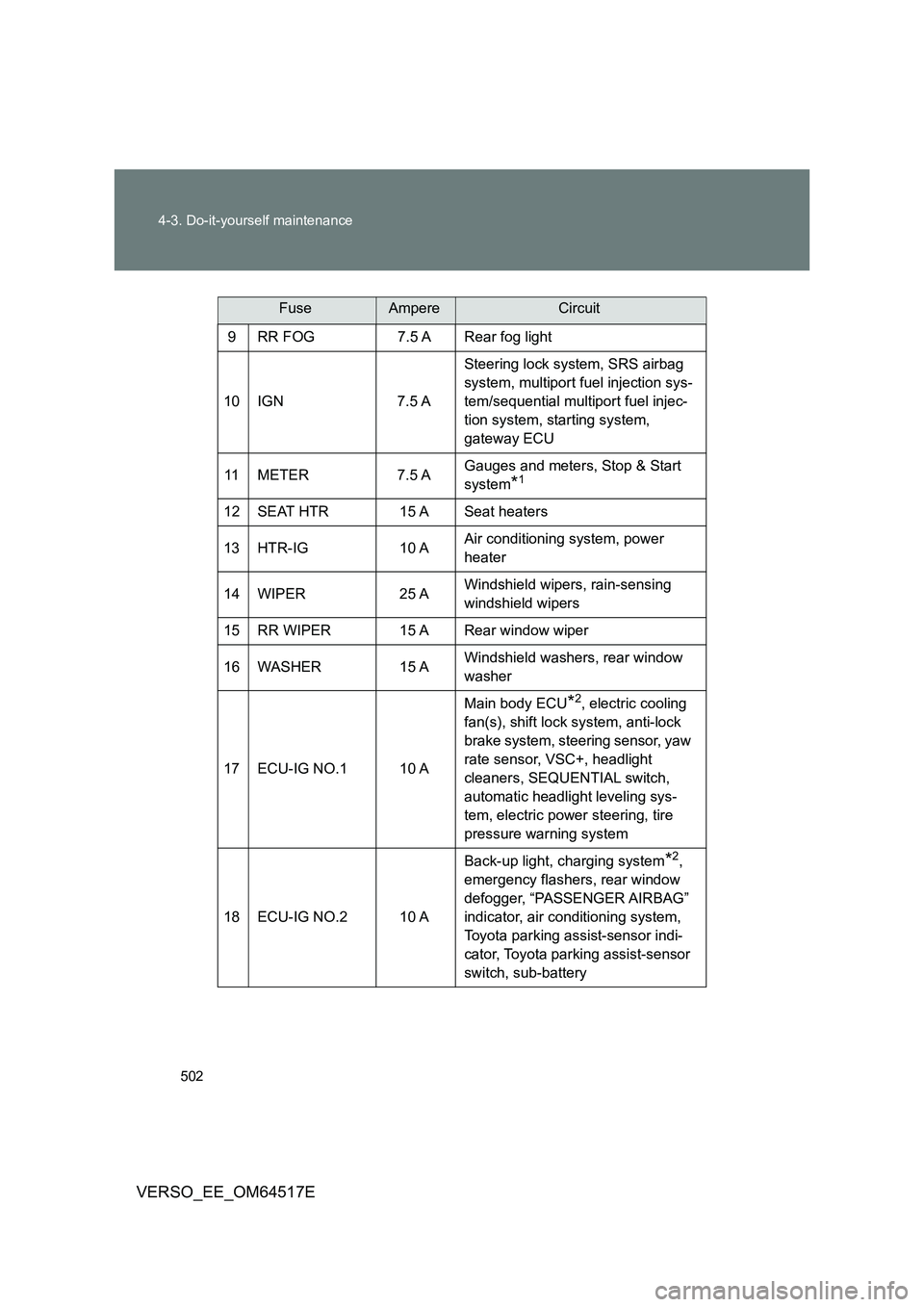
9 RR FOG 7.5 A Rear fog light
10 IGN 7.5 A
Steering lock system, SRS airbag
system, multiport fuel injection sys-
tem/sequential multiport fuel injec-
tion system, starting system,
gateway ECU
11 M E T E R 7 . 5 A Gauges and meters, Stop & Start
system*1
12 SEAT HTR 15 A Seat heaters
13 HTR-IG 10 A Air conditioning system, power
heater
14 WIPER 25 A Windshield wipers, rain-sensing
windshield wipers
15 RR WIPER 15 A Rear window wiper
16 WASHER 15 A Windshield washers, rear window
washer
17 ECU-IG NO.1 10 A
Main body ECU*2, electric cooling
fan(s), shift lock system, anti-lock
brake system, steering sensor, yaw
rate sensor, VSC+, headlight
cleaners, SEQUENTIAL switch,
automatic headlight leveling sys-
tem, electric power steering, tire
pressure warning system
18 ECU-IG NO.2 10 A
Back-up light, charging system*2,
emergency flashers, rear window
defogger, “PASSENGER AIRBAG”
indicator, air conditioning system,
Toyota parking assist-sensor indi-
cator, Toyota parking assist-sensor
switch, sub-battery
FuseAmpereCircuit
Page 540 of 668
540
5-1. Essential information
VERSO_EE_OM64517E
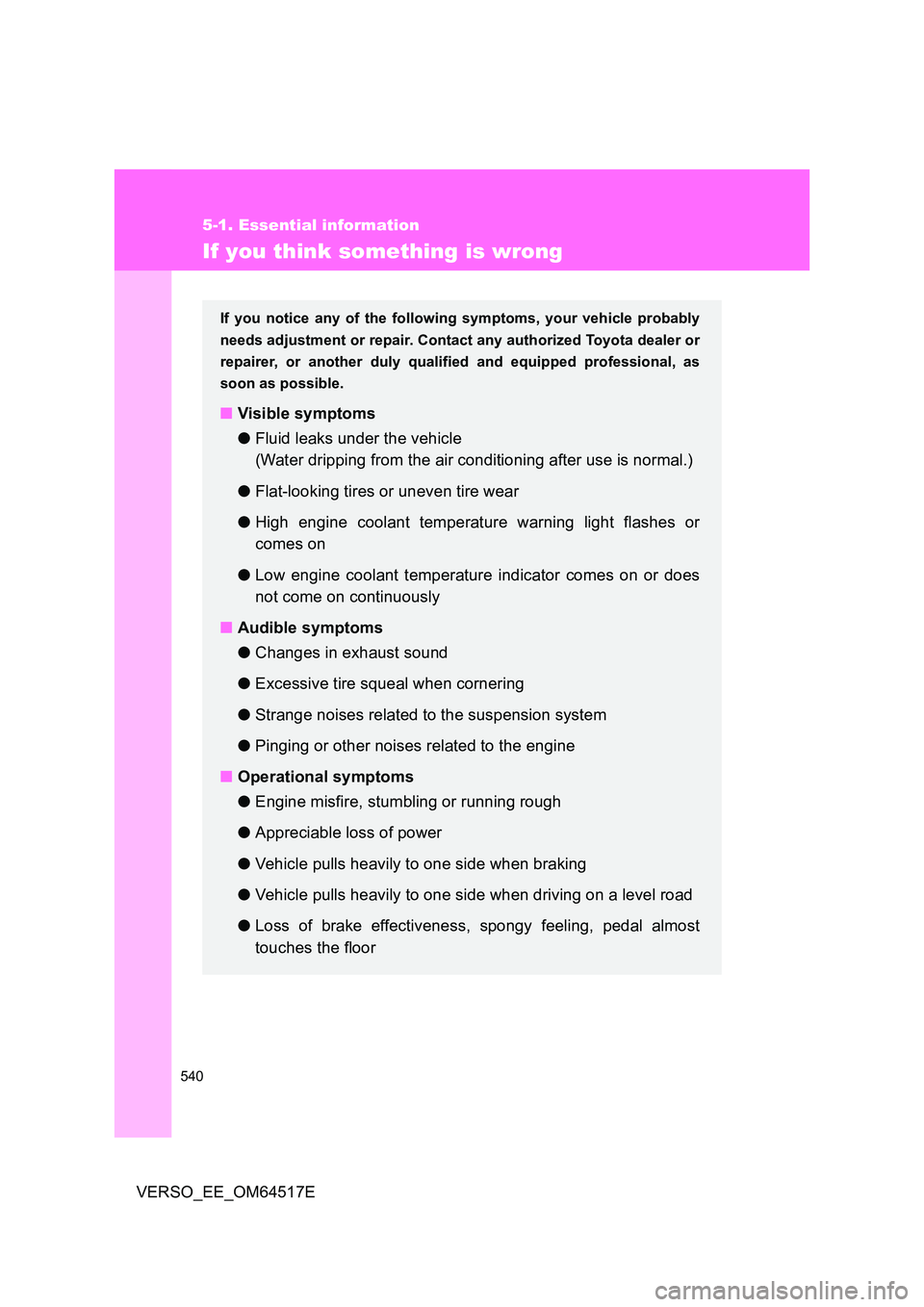
If you think something is wrong
If you notice any of the following symptoms, your vehicle probably
needs adjustment or repair. Contact any authorized Toyota dealer or
repairer, or another duly qualified and equipped professional, as
soon as possible.
■ Visible symptoms
● Fluid leaks under the vehicle
(Water dripping from the air conditioning after use is normal.)
● Flat-looking tires or uneven tire wear
● High engine coolant temperature warning light flashes or
comes on
● Low engine coolant temperature indicator comes on or does
not come on continuously
■ Audible symptoms
● Changes in exhaust sound
● Excessive tire squeal when cornering
● Strange noises related to the suspension system
● Pinging or other noises related to the engine
■ Operational symptoms
● Engine misfire, stumbling or running rough
● Appreciable loss of power
● Vehicle pulls heavily to one side when braking
● Vehicle pulls heavily to one side when driving on a level road
● Loss of brake effectiveness, spongy feeling, pedal almost
touches the floor
Page 549 of 668
5
549
5-2. Steps to take in an emergency
When trouble arises
VERSO_EE_OM64517E
■ If the tire pressure warning system is not functioning (vehicles with a
tire pressure warning light system)
The tire pressure warning system will be disabled in the following conditions:
(When the condition becomes normal, the system will work properly.)
● If tires not equipped with tire pressure warning valves and transmitters
are used
● If the ID code on the tire pressure warning valves and transmitters is not
registered in the tire pressure warning computer
● If the tire inflation pressure is 380 kPa (3.9 kgf/cm2 or bar, 55 psi) or
higher
The tire pressure warning system may be disabled in the following condi-
tions:
(When the condition becomes normal, the system will work properly.)
● If electronic devices or facilities using similar radio wave frequencies are
nearby
● If a radio set at a similar frequency is in use in the vehicle
● If a window tint that affects the radio wave signals is installed
● If there is a lot of snow or ice on the vehicle, particularly around the
wheels or wheel housings
● If non-genuine Toyota wheels are used (Even if you use Toyota wheels,
the tire pressure warning system may not work properly with some types
of tires.)
● If tire chains are used
■ If the tire pressure warning light frequently comes on after blinking for
1 minute (vehicles with a tire pressure warning light system)
If the tire pressure warning light frequently comes on after blinking for 1 min-
ute when the engine switch (vehicles without smart entry & start system) or
the “ENGINE START STOP” switch (vehicles with smart entry & start sys-
tem) is turned on, have it checked by any authorized Toyota dealer or
repairer, or another duly qualified and equipped professional.
Page 598 of 668

598
5-2. Steps to take in an emergency
VERSO_EE_OM64517E
WARNING
■ Driving to spread the liquid sealant evenly
Observe the following precautions to reduce the risk of accidents.
Failing to do so may result in a loss of vehicle control and cause death or
serious injury.
● Drive the vehicle carefully at a low speed. Be especially careful when turn-
ing and cornering.
● If the vehicle does not drive straight or you feel a pull through the steering
wheel, stop the vehicle and check the following.
• Tire condition. The tire may have separated from the wheel.
• Tire inflation pressure. If the tire inflation pressure is 130 kPa (1.3
kgf/cm2 or bar, 19 psi) or less, the tire may be severely damaged.
NOTICE
■ When performing an emergency repair
● A tire should only be repaired with the emergency tire puncture repair kit if
the damage is caused by a sharp object such as nail or screw passing
through the tire tread.
Do not remove the sharp object from the tire. Removing the object may
widen the opening and disenable emergenc y repair with the repair kit.
● The repair kit is not waterproof. Make sure that the repair kit is not
exposed to water, such as when it is being used in the rain.
● Do not put the repair kit directly onto dusty ground such as sand at the
side of the road. If the repair kit vacuums up dust etc., a malfunction may
occur.