Vehicle spec TOYOTA YARIS 2021 Repair Manual
[x] Cancel search | Manufacturer: TOYOTA, Model Year: 2021, Model line: YARIS, Model: TOYOTA YARIS 2021Pages: 568, PDF Size: 110.34 MB
Page 324 of 568
324
YARIS(HB) Owner's Manual_Europe_MK0001_en
6-3. Do-it-yourself maintenance
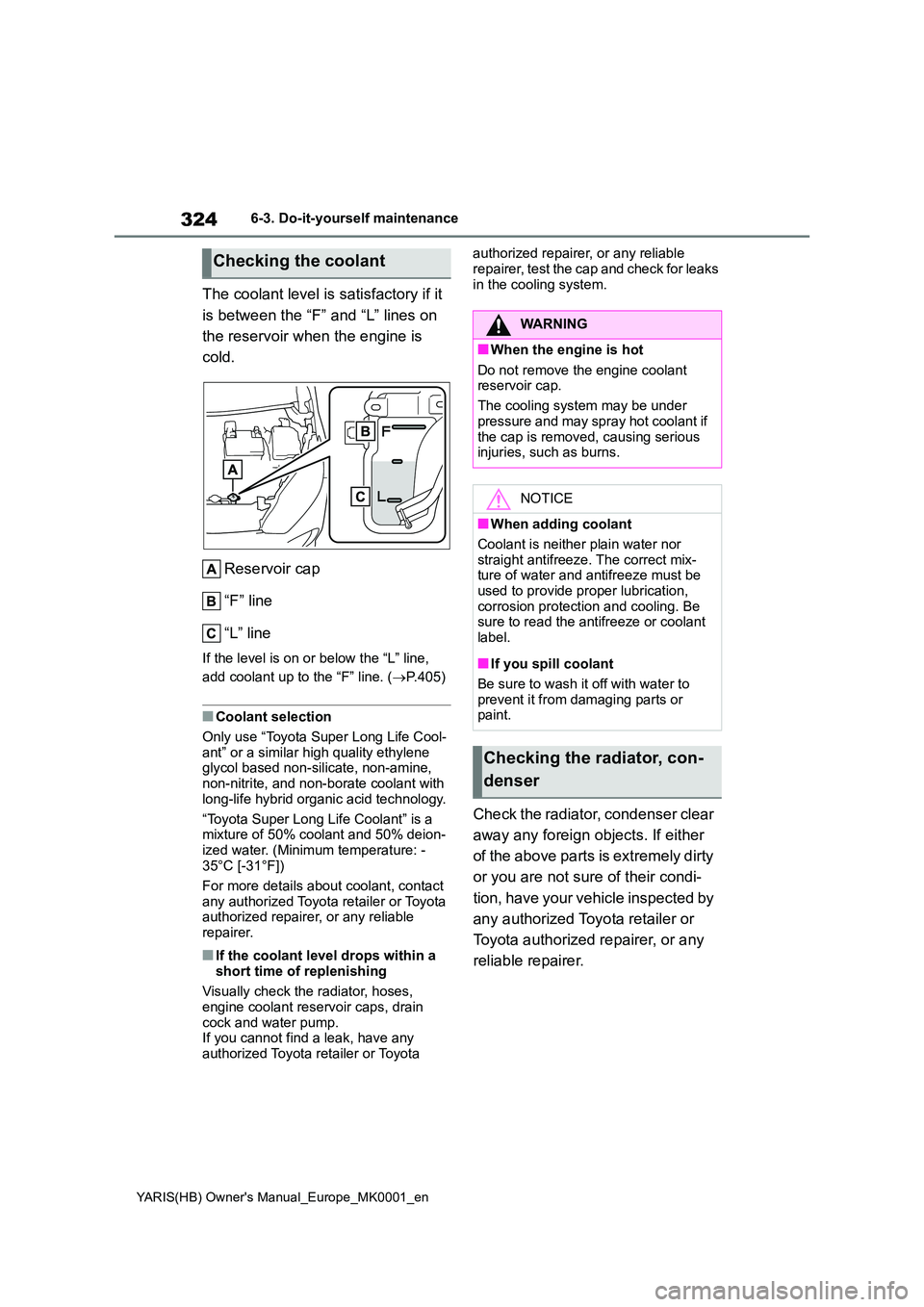
The coolant level is satisfactory if it
is between the “F” and “L” lines on
the reservoir when the engine is
cold.
Reservoir cap
“F” line
“L” line
If the level is on or below the “L” line,
add coolant up to the “F” line. ( →P.405)
■Coolant selection
Only use “Toyota Super Long Life Cool-
ant” or a similar high quality ethylene glycol based non-silicate, non-amine, non-nitrite, and non-borate coolant with
long-life hybrid organic acid technology.
“Toyota Super Long Life Coolant” is a mixture of 50% coolant and 50% deion-
ized water. (Minimum temperature: - 35°C [-31°F])
For more details about coolant, contact
any authorized Toyota retailer or Toyota authorized repairer, or any reliable repairer.
■If the coolant level drops within a
short time of replenishing
Visually check the radiator, hoses, engine coolant reservoir caps, drain
cock and water pump. If you cannot find a leak, have any authorized Toyota retailer or Toyota
authorized repairer, or any reliable
repairer, test the cap and check for leaks in the cooling system.
Check the radiator, condenser clear
away any foreign objects. If either
of the above parts is extremely dirty
or you are not sure of their condi-
tion, have your vehicle inspected by
any authorized Toyota retailer or
Toyota authorized repairer, or any
reliable repairer.
Checking the coolant
WARNING
■When the engine is hot
Do not remove the engine coolant reservoir cap.
The cooling system may be under
pressure and may spray hot coolant if the cap is removed, causing serious injuries, such as burns.
NOTICE
■When adding coolant
Coolant is neither plain water nor
straight antifreeze. The correct mix- ture of water and antifreeze must be used to provide proper lubrication,
corrosion protection and cooling. Be sure to read the antifreeze or coolant label.
■If you spill coolant
Be sure to wash it off with water to
prevent it from damaging parts or paint.
Checking the radiator, con-
denser
Page 325 of 568
325
6
YARIS(HB) Owner's Manual_Europe_MK0001_en
6-3. Do-it-yourself maintenance
Maintenance and care
Check the battery as follows.
■Battery exterior
Make sure that the battery termi-
nals are not corroded and that there
are no loose connections, cracks,
or loose clamps.
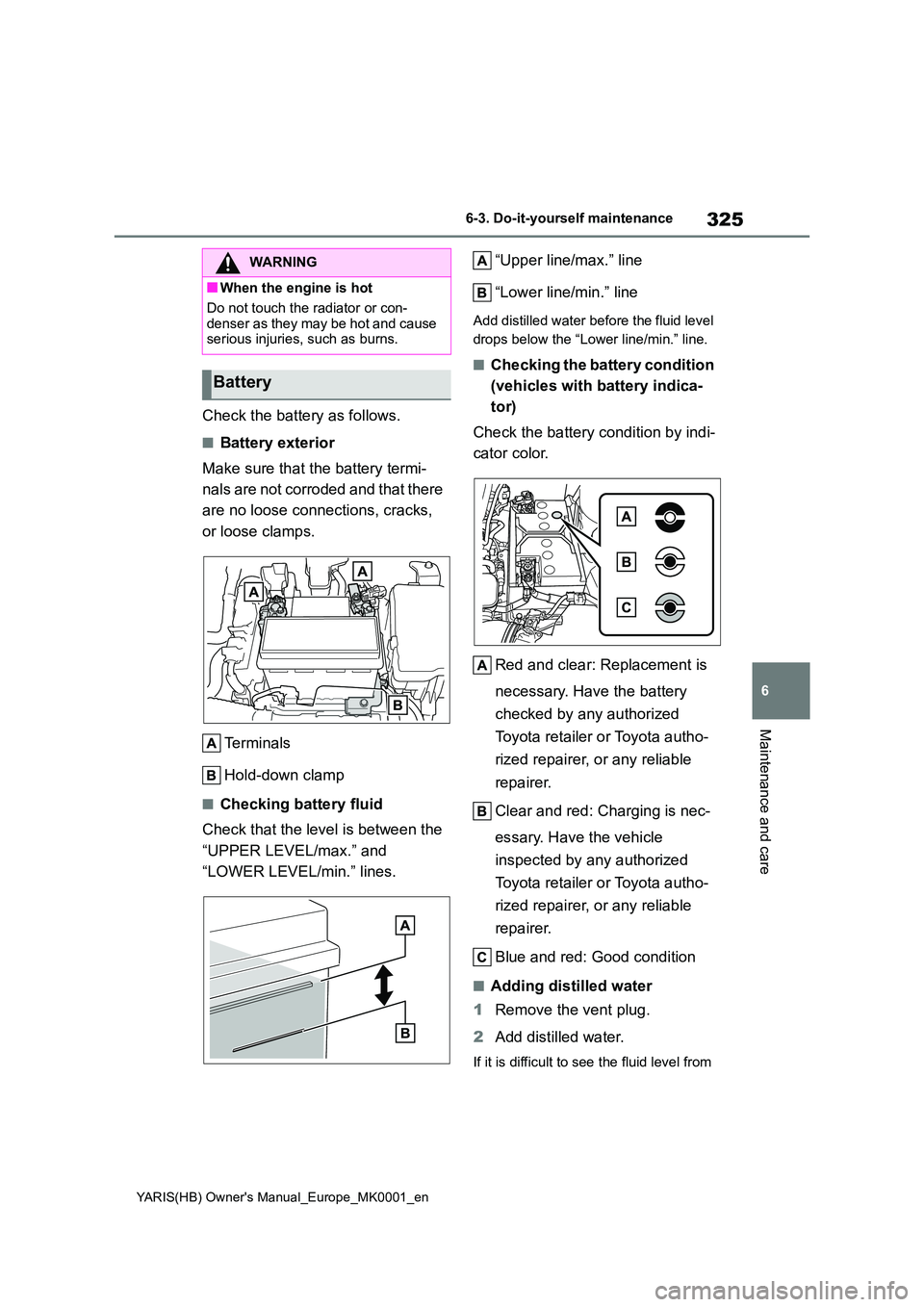
Terminals
Hold-down clamp
■Checking battery fluid
Check that the level is between the
“UPPER LEVEL/max.” and
“LOWER LEVEL/min.” lines.
“Upper line/max.” line
“Lower line/min.” line
Add distilled water before the fluid level
drops below the “Lower line/min.” line.
■Checking the battery condition
(vehicles with battery indica-
tor)
Check the battery condition by indi-
cator color.
Red and clear: Replacement is
necessary. Have the battery
checked by any authorized
Toyota retailer or Toyota autho-
rized repairer, or any reliable
repairer.
Clear and red: Charging is nec-
essary. Have the vehicle
inspected by any authorized
Toyota retailer or Toyota autho-
rized repairer, or any reliable
repairer.
Blue and red: Good condition
■Adding distilled water
1 Remove the vent plug.
2 Add distilled water.
If it is difficult to see the fluid level from
WARNING
■When the engine is hot
Do not touch the radiator or con-
denser as they may be hot and cause serious injuries, such as burns.
Battery
Page 331 of 568
331
6
YARIS(HB) Owner's Manual_Europe_MK0001_en
6-3. Do-it-yourself maintenance
Maintenance and care
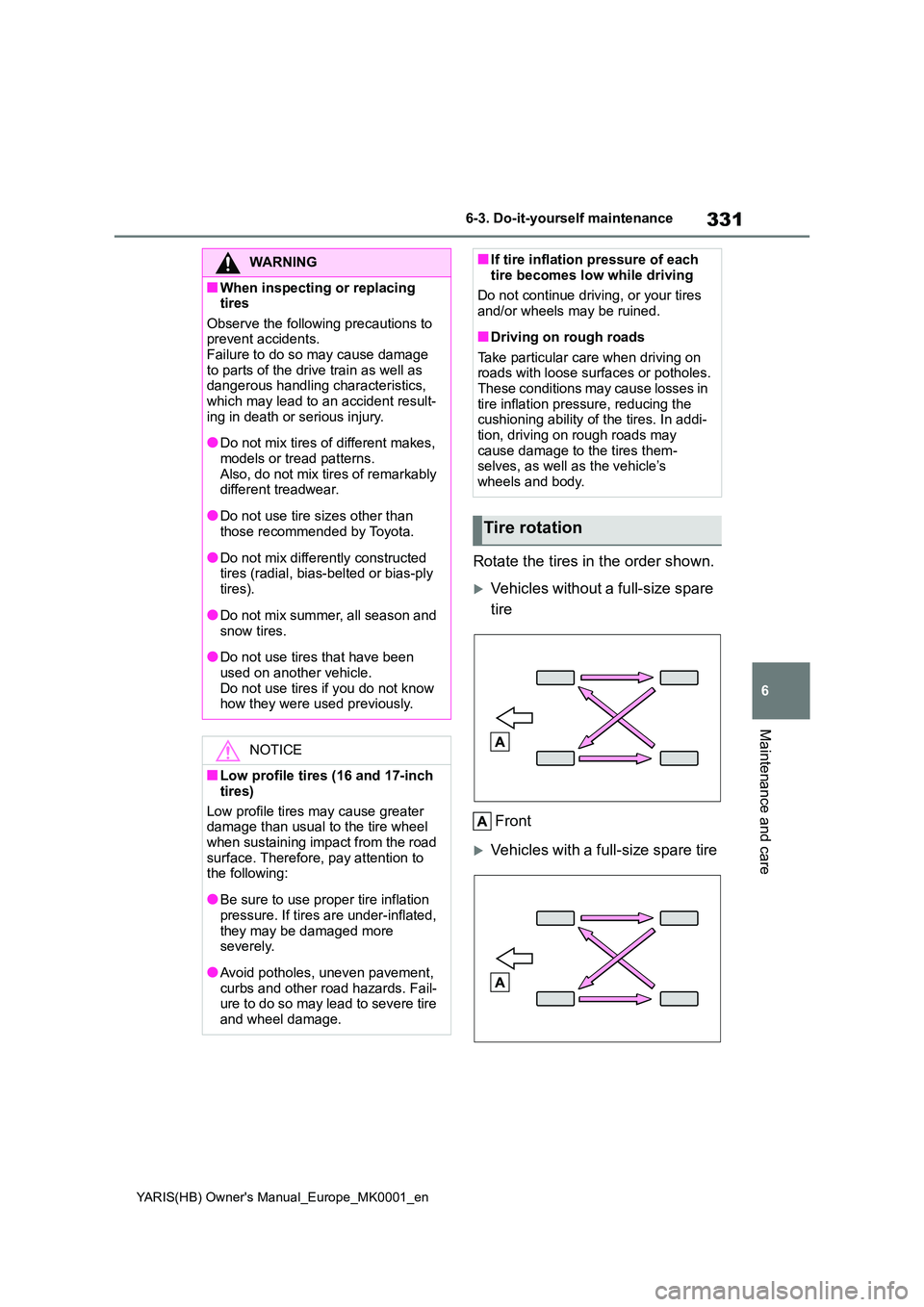
Rotate the tires in the order shown.
Vehicles without a full-size spare
tire
Front
Vehicles with a full-size spare tire
WARNING
■When inspecting or replacing tires
Observe the following precautions to prevent accidents.Failure to do so may cause damage
to parts of the drive train as well as dangerous handling characteristics, which may lead to an accident result-
ing in death or serious injury.
●Do not mix tires of different makes,
models or tread patterns. Also, do not mix tires of remarkably different treadwear.
●Do not use tire sizes other than those recommended by Toyota.
●Do not mix differently constructed tires (radial, bias-belted or bias-ply
tires).
●Do not mix summer, all season and
snow tires.
●Do not use tires that have been
used on another vehicle. Do not use tires if you do not know how they were used previously.
NOTICE
■Low profile tires (16 and 17-inch
tires)
Low profile tires may cause greater damage than usual to the tire wheel
when sustaining impact from the road surface. Therefore, pay attention to the following:
●Be sure to use proper tire inflation pressure. If tires are under-inflated,
they may be damaged more severely.
●Avoid potholes, uneven pavement, curbs and other road hazards. Fail-ure to do so may lead to severe tire
and wheel damage.
■If tire inflation pressure of each tire becomes low while driving
Do not continue driving, or your tires
and/or wheels may be ruined.
■Driving on rough roads
Take particular care when driving on roads with loose surfaces or potholes.These conditions may cause losses in
tire inflation pressure, reducing the cushioning ability of the tires. In addi-tion, driving on rough roads may
cause damage to the tires them- selves, as well as the vehicle’s wheels and body.
Tire rotation
Page 333 of 568
333
6
YARIS(HB) Owner's Manual_Europe_MK0001_en
6-3. Do-it-yourself maintenance
Maintenance and care
5Press / to select “TPWS
setting” and then press .
6Press / to select “Setting
Unit”.
7Press / to select the
desired unit and then press .
■Routine tire inflation pressure
checks
The tire pressure warning system does
not replace routine tire inflation pressure
checks. Make sure to check tire inflation
pressure as part of your routine of daily
vehicle checks.
■Tire inflation pressure
●It may take a few minutes to display
the tire inflation pressure after the
engine switch is turned to ON. It may
also take a few minutes to display the
tire inflation pressure after inflation
pressure has been adjusted.
●Tire inflation pressure changes with
temperature. The displayed values
may also be different from the values
measured using a tire pressure
gauge.
■Situations in which the tire pres-
sure warning system may not oper-
ate properly
●In the following cases, the tire pres-
sure warning system may not operate
properly.
• If non-genuine Toyota wheels are
used.
• A tire has been replaced with a tire
that is not an OE (Original Equipment)
tire.
• A tire has been replaced with a tire
that is not of the specified size.
• Tire chains, etc. are equipped.
• An auxiliary-supported run-flat tire is
equipped.• If a window tint that affects the radio
wave signals is installed.
• If there is a lot of snow or ice on the
vehicle, particularly around the wheels
or wheel housings.
• If the tire inflation pressure is
extremely higher than the specified
level.
• If tires not equipped with tire pressure
warning valves and transmitters are
used.
• If the ID code on the tire pressure
warning valves and transmitters is not
registered in the tire pressure warning
computer.
●Performance may be affected in the
following situations.
• Near a TV tower, electric power plant,
gas station, radio station, large dis-
play, airport or other facility that gen-
erates strong radio waves or electrical
noise.
• When carrying a portable radio, cellu-
lar phone, cordless phone or other
wireless communication device.
●When the vehicle is parked, the time
taken for the warning to start or go off
could be extended.
●When tire inflation pressure declines
rapidly for example when a tire has
burst, the warning may not function.
■Warning performance of the tire
pressure warning system
The warning of the tire pressure warning
system will change in accordance with
driving conditions. For this reason, the
system may give a warning even if the
tire pressure does not reach a low
enough level, or if the pressure is higher
than the pressure that was adjusted to
when the system was initialized.
When replacing tires or wheels, tire
pressure warning valves and trans-
mitters must also be installed.
Installing tire pressure warn-
ing valves and transmitters
Page 335 of 568
335
6
YARIS(HB) Owner's Manual_Europe_MK0001_en
6-3. Do-it-yourself maintenance
Maintenance and care
■How to initialize the tire pres-
sure warning system
1Park the vehicle in a safe place
and turn the engine switch off.
Initialization cannot be performed while
the vehicle is moving.
2Adjust the tire inflation pressure
to the specified cold tire inflation
pressure level. (→P.417)
Make sure to adjust the tire pressure to
the specified cold tire inflation pressure
level. The tire pressure warning system
will operate based on this pressure
level.
3Turn the engine switch to ON.
4Press / (vertical display)
or / (horizontal display)
of the meter control switch to
select .
5Press / (vertical display)
or / (horizontal display)
to select “Vehicle Settings” and
then press and hold .
6Press / to select “TPWS
setting” and then press .
7Press / to select “Setting
Pressure”. Then press and hold
until the tire pressure warn-
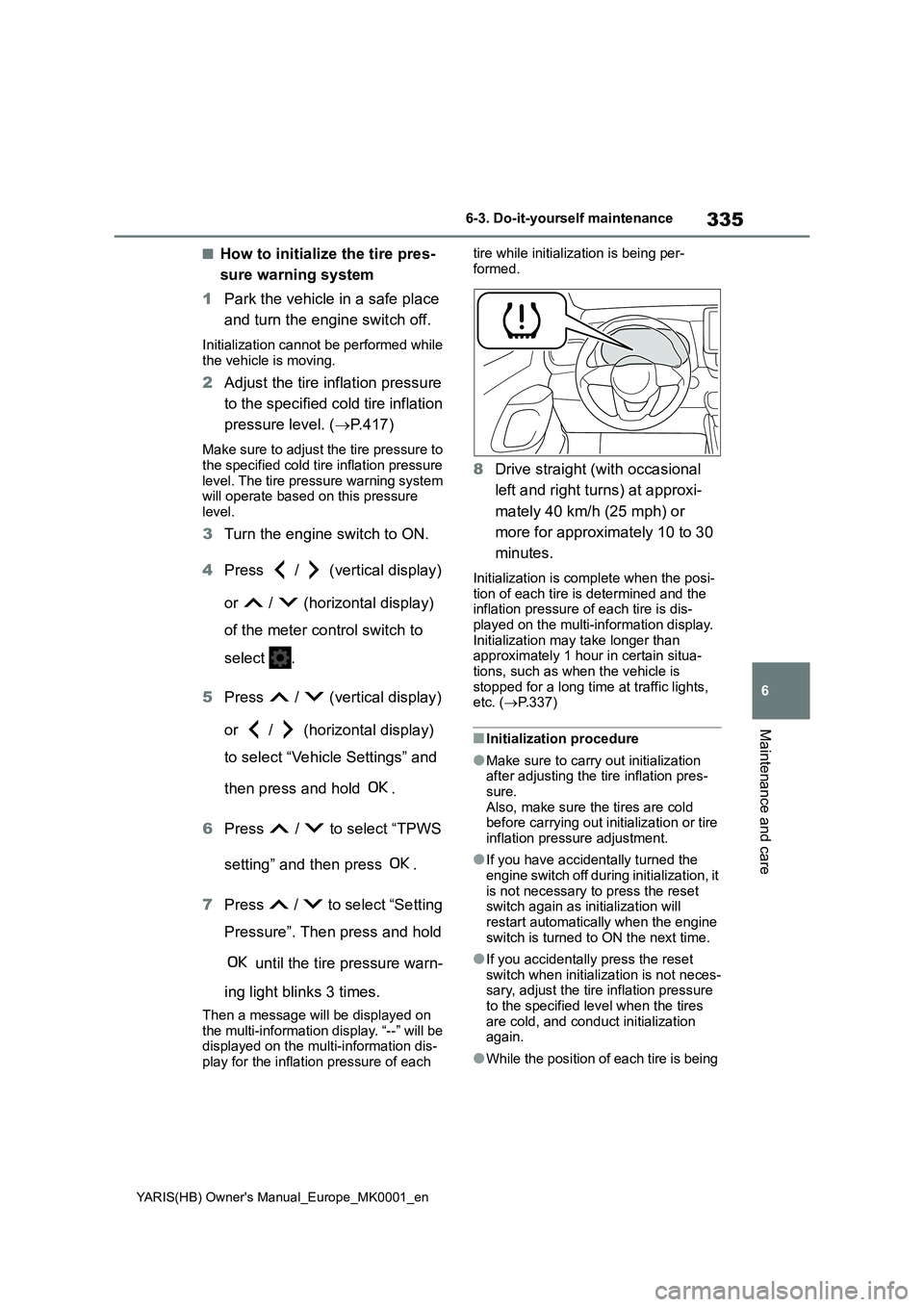
ing light blinks 3 times.
Then a message will be displayed on
the multi-information display. “--” will be
displayed on the multi-information dis-
play for the inflation pressure of each tire while initialization is being per-
formed.
8Drive straight (with occasional
left and right turns) at approxi-
mately 40 km/h (25 mph) or
more for approximately 10 to 30
minutes.
Initialization is complete when the posi-
tion of each tire is determined and the
inflation pressure of each tire is dis-
played on the multi-information display.
Initialization may take longer than
approximately 1 hour in certain situa-
tions, such as when the vehicle is
stopped for a long time at traffic lights,
etc. (→P.337)
■Initialization procedure
●Make sure to carry out initialization
after adjusting the tire inflation pres-
sure.
Also, make sure the tires are cold
before carrying out initialization or tire
inflation pressure adjustment.
●If you have accidentally turned the
engine switch off during initialization, it
is not necessary to press the reset
switch again as initialization will
restart automatically when the engine
switch is turned to ON the next time.
●If you accidentally press the reset
switch when initialization is not neces-
sary, adjust the tire inflation pressure
to the specified level when the tires
are cold, and conduct initialization
again.
●While the position of each tire is being
Page 336 of 568
336
YARIS(HB) Owner's Manual_Europe_MK0001_en
6-3. Do-it-yourself maintenance
determined and the inflation pres-
sures are not being displayed on the multi-information display, if the infla-tion pressure of a tire drops, the tire
pressure warning light will come on.
■If the tire pressure warning system is not initialized properly
●In the following situations, initialization may take longer than usual to be com-pleted or may not be possible. (Usu-
ally, the vehicle will need to be driven for approximately 10 to 30 minutes to complete initialization.) If initialization
is not complete after driving approxi- mately 30 minutes, continue driving for a while.
• If the vehicle is driven on an unpaved road, it may take longer to complete initialization.
• If the vehicle is backed up while per- forming initialization, data collected during initialization will be cleared and
it will take longer than normal to com- plete.• If the vehicle is driven in heavy traffic
or another situation where other vehi- cles are driven close by, it may take time for the system to recognize the
tire pressure warning valve and trans- mitters of your vehicle over those of other vehicles.
If initialization is not complete after driv-
ing for approximately 1 hour, park the
vehicle in a safe place for approximately
20 minutes and then drive the vehicle
again.
●In the following situations, initialization will not be started or was not com-
pleted properly and the system will not operate properly. Perform the initial-ization procedure again.
• If, when attempting to start initializa- tion, the tire pressure warning light does not blink 3 times.
• If, when the vehicle has been driven for about 20 minutes after performing initialization, the tire pressure warning
light blinks for approximately 1 minute and then illuminates.
●If initialization cannot be completed
after performing the above procedure,
contact any authorized Toyota retailer or Toyota authorized repairer, or any reliable repairer.
The tire pressure warning valve
and transmitter is equipped with a
unique ID code. When replacing a
tire pressure warning valve and
transmitter, it is necessary to regis-
ter the ID code.
The ID codes can be registered on
of the multi-information display.
1 Press / (vertical display)
or / (horizontal display)
of the meter control switch to
select .
2 Press / (vertical display)
or / (horizontal display)
to select “Vehicle Settings” and
then press .
WARNING
■When initializing the tire pres- sure warning system
Do not initialize the tire pressure
warning system without first adjusting the tire inflation pressure to the speci-fied level. Otherwise, the tire pressure
warning light may not come on even if the tire inflation pressure is low, or it may come on when the tire inflation
pressure is actually normal.
Registering ID codes
Page 340 of 568
340
YARIS(HB) Owner's Manual_Europe_MK0001_en
6-3. Do-it-yourself maintenance
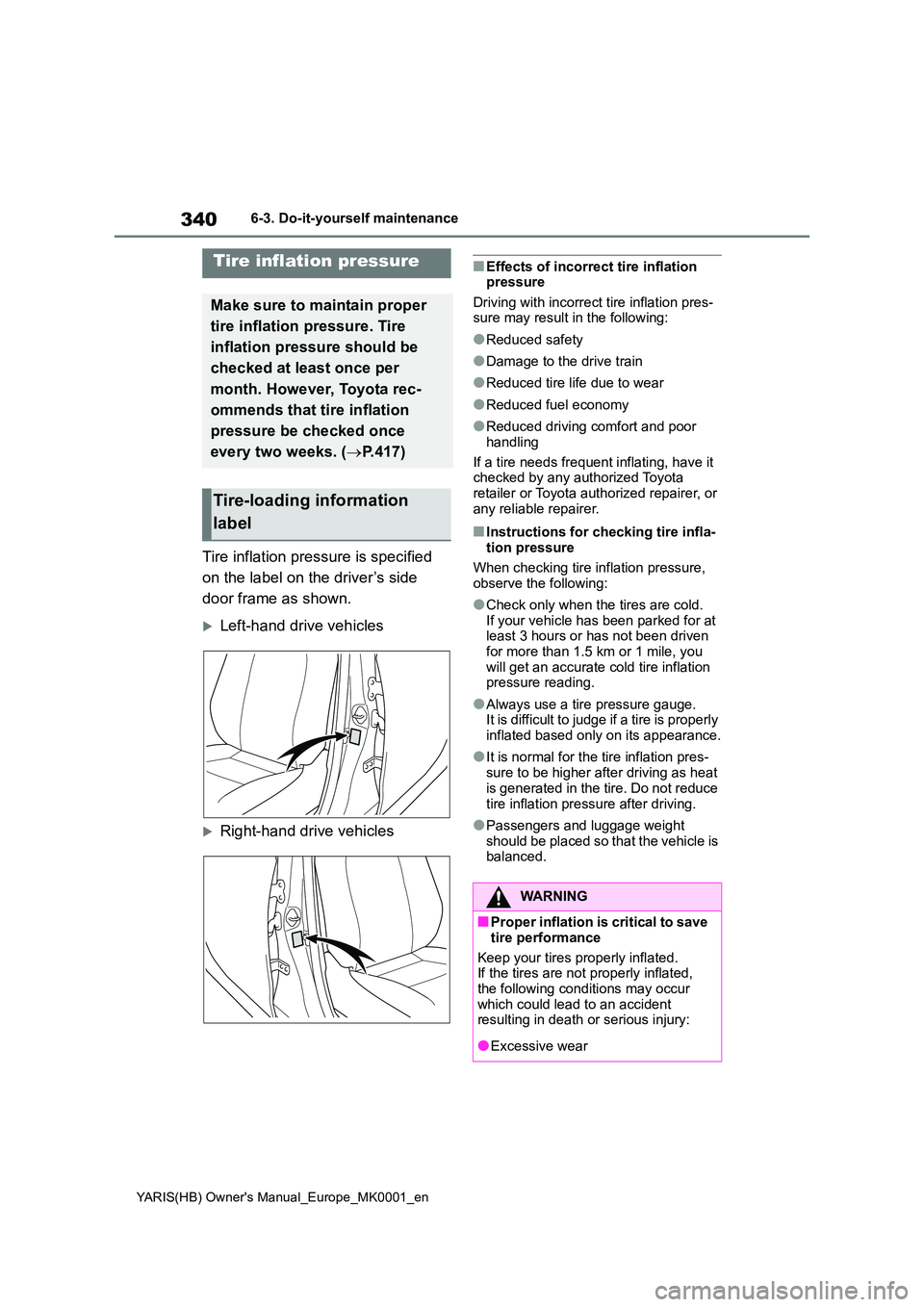
Tire inflation pressure is specified
on the label on the driver’s side
door frame as shown.
Left-hand drive vehicles
Right-hand drive vehicles
■Effects of incorrect tire inflation pressure
Driving with incorrect tire inflation pres- sure may result in the following:
●Reduced safety
●Damage to the drive train
●Reduced tire life due to wear
●Reduced fuel economy
●Reduced driving comfort and poor
handling
If a tire needs frequent inflating, have it checked by any authorized Toyota
retailer or Toyota authorized repairer, or any reliable repairer.
■Instructions for checking tire infla-tion pressure
When checking tire inflation pressure, observe the following:
●Check only when the tires are cold.If your vehicle has been parked for at least 3 hours or has not been driven
for more than 1.5 km or 1 mile, you will get an accurate cold tire inflation pressure reading.
●Always use a tire pressure gauge.It is difficult to judge if a tire is properly
inflated based only on its appearance.
●It is normal for the tire inflation pres-
sure to be higher after driving as heat is generated in the tire. Do not reduce
tire inflation pressure after driving.
●Passengers and luggage weight
should be placed so that the vehicle is balanced.
Tire inflation pressure
Make sure to maintain proper
tire inflation pressure. Tire
inflation pressure should be
checked at least once per
month. However, Toyota rec-
ommends that tire inflation
pressure be checked once
every two weeks. ( →P.417)
Tire-loading information
label
WARNING
■Proper inflation is critical to save
tire performance
Keep your tires properly inflated. If the tires are not properly inflated,
the following conditions may occur which could lead to an accident resulting in death or serious injury:
●Excessive wear
Page 341 of 568
341
6
YARIS(HB) Owner's Manual_Europe_MK0001_en
6-3. Do-it-yourself maintenance
Maintenance and care
When replacing wheels, care
should be taken to ensure that they
are equivalent to those removed in
load capacity, diameter, rim width
and inset*.
Replacement wheels are available
at any authorized Toyota retailer or
Toyota authorized repairer, or any
reliable repairer.
*: Conventionally referred to as offset.
Toyota does not recommend using
the following:
z Wheels of different sizes or types
z Used wheels
z Bent wheels that have been
straightened
■When replacing wheels
The wheels of your vehicle are equipped with tire pressure warning valves and
transmitters that allow the tire pressure warning system to provide advance warning in the event of a loss in tire
inflation pressure. Whenever wheels are replaced, the tire pressure warning valves and transmitters must be
installed. ( →P.333)
WARNING
●Uneven wear
●Poor handling
●Possibility of blowouts resulting
from overheated tires
●Air leaking from between tire and
wheel
●Wheel deformation and/or tire dam-
age
●Greater possibility of tire damage
while driving (due to road hazards, expansion joints, sharp edges on the road, etc.)
NOTICE
■When inspecting and adjusting tire inflation pressure
Be sure to put the tire valve caps back
on. If a valve cap is not installed, dirt or moisture may get into the valve and
cause an air leak, resulting in decreased tire inflation pressure.
Wheels
If a wheel is bent, cracked or
heavily corroded, it should be
replaced. Otherwise, the tire
may separate from the wheel
or cause a loss of handling
control.
Wheel selection
Page 350 of 568
350
YARIS(HB) Owner's Manual_Europe_MK0001_en
6-3. Do-it-yourself maintenance
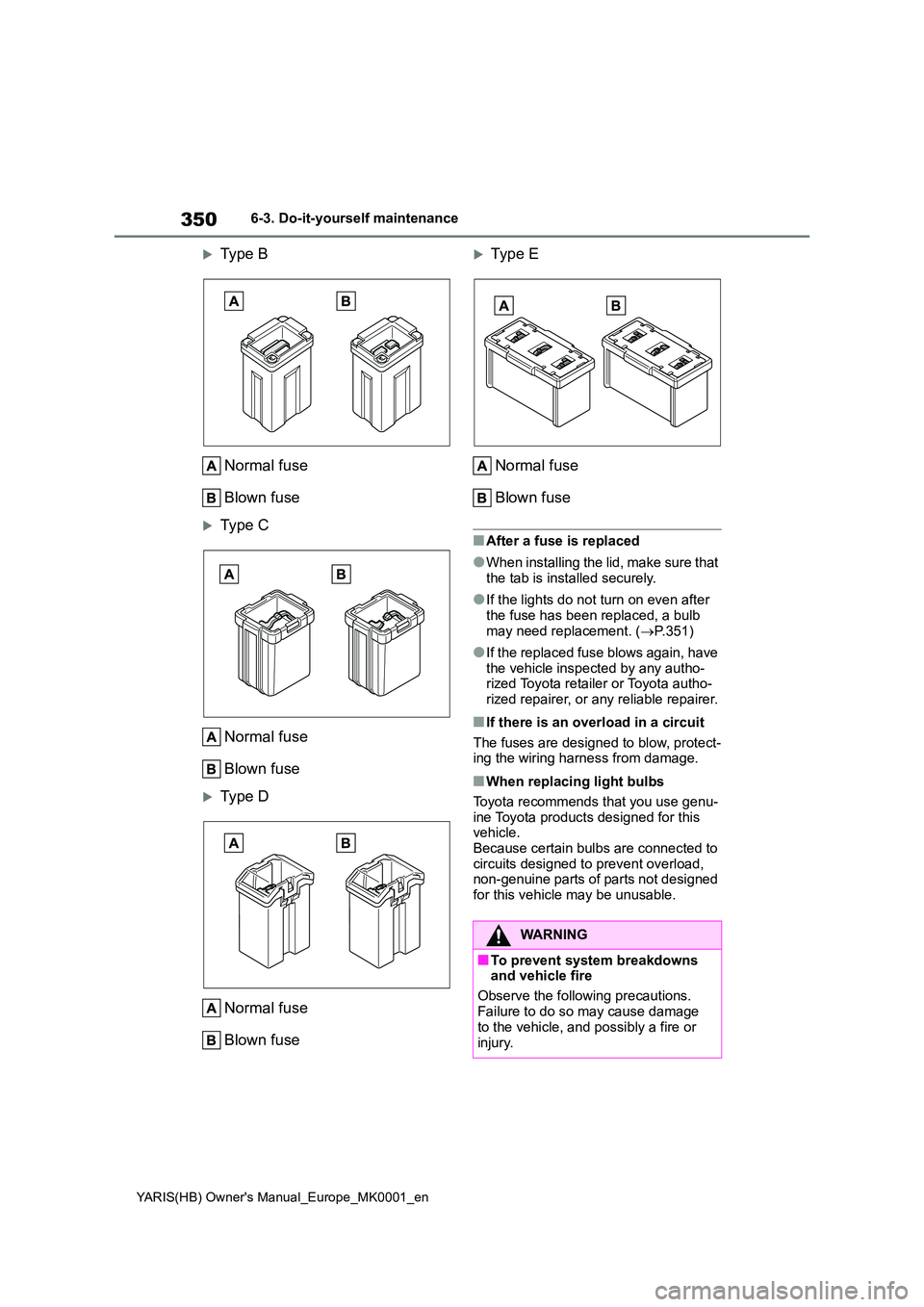
Type B
Normal fuse
Blown fuse
Type C
Normal fuse
Blown fuse
Type D
Normal fuse
Blown fuse
Typ e E
Normal fuse
Blown fuse
■After a fuse is replaced
●When installing the lid, make sure that the tab is installed securely.
●If the lights do not turn on even after the fuse has been replaced, a bulb
may need replacement. ( →P.351)
●If the replaced fuse blows again, have
the vehicle inspected by any autho- rized Toyota retailer or Toyota autho-rized repairer, or any reliable repairer.
■If there is an overload in a circuit
The fuses are designed to blow, protect- ing the wiring harness from damage.
■When replacing light bulbs
Toyota recommends that you use genu-
ine Toyota products designed for this vehicle.Because certain bulbs are connected to
circuits designed to prevent overload, non-genuine parts of parts not designed for this vehicle may be unusable.
WARNING
■To prevent system breakdowns and vehicle fire
Observe the following precautions.
Failure to do so may cause damage to the vehicle, and possibly a fire or
injury.
Page 367 of 568
367
7
YARIS(HB) Owner's Manual_Europe_MK0001_en
7-2. Steps to take in an emergency
When trouble arises
zVehicle pulls heavily to one side
when braking
z Vehicle pulls heavily to one side
when driving on a level road
z Loss of brake effectiveness,
spongy feeling, pedal almost
touches the floor
Follow the procedure below to
restart the engine after the system
is activated.
1 Turn the engine switch to ACC
or OFF.
2 Restart the engine.
Fuel pump shut off sys-
tem
To minimize the risk of fuel
leakage when the engine stalls
or when an airbag inflates
upon collision, the fuel pump
shut off system stops the sup-
ply of fuel to the engine.
Restarting the engine
NOTICE
■Before starting the engine
Inspect the ground under the vehicle. If you find that fuel has leaked onto the ground, the fuel system has been
damaged and is in need of repair. Do not restart the engine.