Vehicle spec TOYOTA YARIS 2021 Owner's Manual
[x] Cancel search | Manufacturer: TOYOTA, Model Year: 2021, Model line: YARIS, Model: TOYOTA YARIS 2021Pages: 568, PDF Size: 110.34 MB
Page 118 of 568
118
YARIS(HB) Owner's Manual_Europe_MK0001_en
3-2. Opening, closing and locking the doors
buzzer, and lock the doors again.
■Alarm (if equipped)
Locking the doors will set the alarm sys- tem. ( →P.78)
■Conditions affecting the operation of the smart entry & start system or
wireless remote control
Vehicles without a smart entry & start system
→ P. 1 1 4
Vehicles with a smart entry & start system
→ P. 1 2 4
■If the smart entry & start system or the wireless remote control does not operate properly
Vehicles without a smart entry & start system
Replace the key battery with a new one
if it is depleted. ( →P.345)
Vehicles with a smart entry & start
system
Use the mechanical key to lock and
unlock the doors. ( →P.400)
Replace the key battery with a new one
if it is depleted. ( →P.345)
■If the battery is discharged (vehi- cles with a smart entry & start sys-tem)
The doors cannot be locked and unlocked using the entry function or wireless remote control. Lock or unlock
the doors using the mechanical key. ( →P.400)
■Customization
Some functions can be customized.
( →P.422)
WARNING
■To prevent an accident
Observe the following precautions
while driving the vehicle. Failure to do so may result in a door opening and an occupant being
thrown out of the vehicle, resulting in death or serious injury.
●Ensure that all doors are properly closed and locked.
●Do not pull the inside door handle while driving.Be especially careful of the front
doors, as the doors may be opened even if the inside lock buttons are in the locked position.
●Set the rear door child-protector locks when children are seated in
the rear seats.
■When opening or closing a door
Check the surroundings of the vehicle such as whether the vehicle is on an incline, whether there is enough
space for a door to open and whether a strong wind is blowing. When open-ing or closing the door, hold the door
handle tightly to prepare for any unpredictable movement.
■When using the wireless remote control or the key and operating the power windows
Operate the power windows after checking to make sure that there is no possibility of any passenger having
any of their body parts caught in the windows. Also, do not allow children to operate the wireless remote control
or the key. It is possible for children and other passengers to get caught in the power windows.
Page 140 of 568
140
YARIS(HB) Owner's Manual_Europe_MK0001_en
3-5. Opening and closing the windows
direction, and hold it there for
approximately 4 seconds or more.
6 Pull and hold the power window switch in the one-touch closing direction again. After the side win-
dow is completely closed, continue holding the switch for a further 1 sec-ond or more.
If you release the switch while the win- dow is moving, start again from the beginning.
If the window reverses and cannot be fully closed or opened, have the vehicle inspected by any authorized Toyota
retailer or Toyota authorized repairer, or any reliable repairer.
■Door lock linked window operation
●The power windows can be opened
and closed using the key (vehicles without a smart entry & start system)
or mechanical key (vehicles with a
smart entry & start system).* ( →P.117, 400)
●The power windows can be opened
and closed using the wireless remote
control.* ( →P. 1 1 6 )*: These settings must be customized at
any authorized Toyota retailer or
Toyota authorized repairer, or any reli-
able repairer.
■Customization
Some functions can be customized.
( →P.422)
WARNING
Observe the following precautions. Failure to do so may result in death or
serious injury.
■Closing the windows
●The driver is responsible for all the power window operations, including
the operation for the passengers. In order to prevent accidental opera-tion, especially by a child, do not let
a child operate the power windows. It is possible for children and other passengers to have body parts
caught in the power window. Also, when riding with a child, it is recom-mended to use the window lock
switch. ( →P.141)
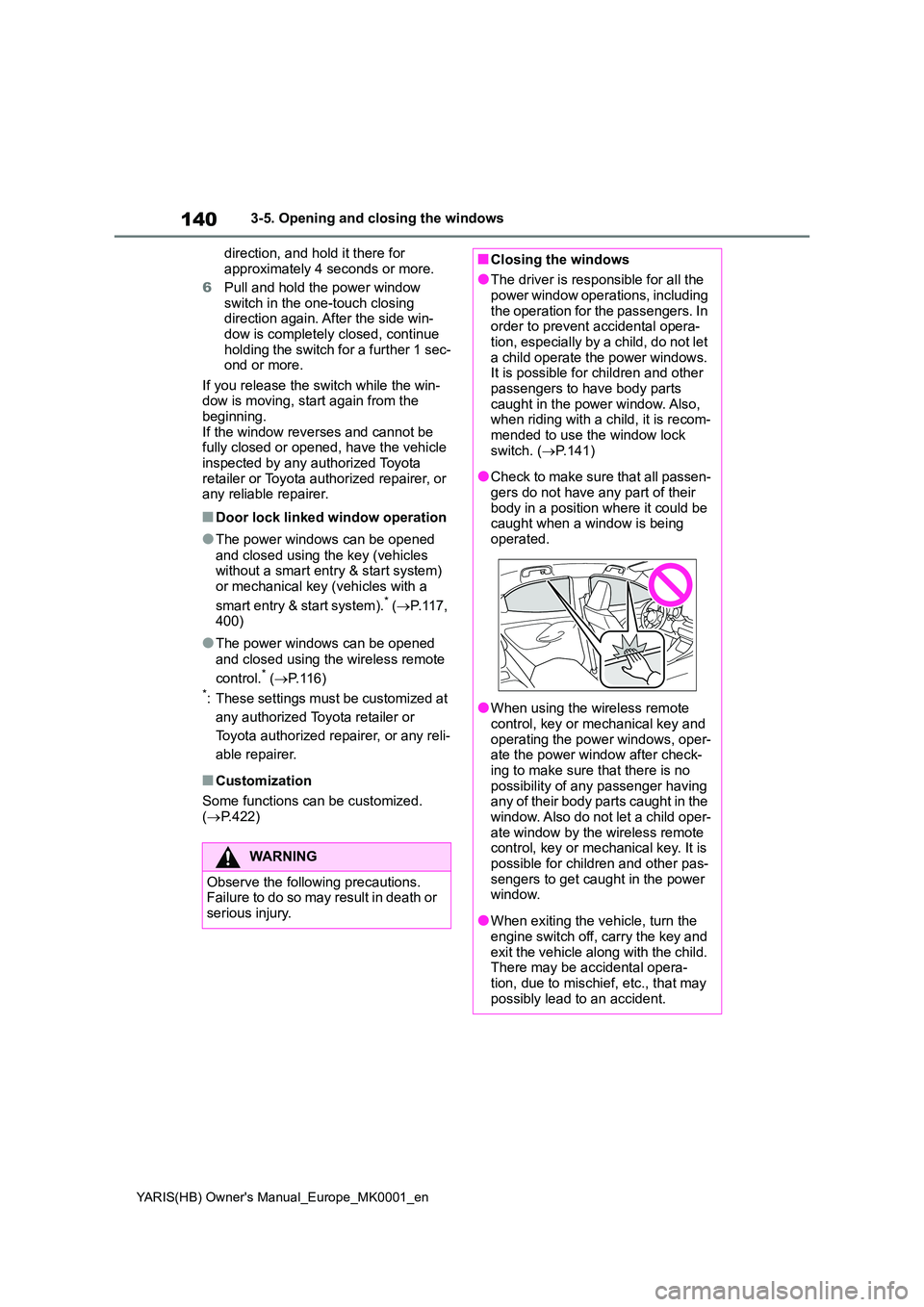
●Check to make sure that all passen-
gers do not have any part of their body in a position where it could be caught when a window is being
operated.
●When using the wireless remote
control, key or mechanical key and operating the power windows, oper-ate the power window after check-
ing to make sure that there is no possibility of any passenger having any of their body parts caught in the
window. Also do not let a child oper- ate window by the wireless remote control, key or mechanical key. It is
possible for children and other pas- sengers to get caught in the power window.
●When exiting the vehicle, turn the engine switch off, carry the key and
exit the vehicle along with the child. There may be accidental opera-tion, due to mischief, etc., that may
possibly lead to an accident.
Page 145 of 568
145
4
YARIS(HB) Owner's Manual_Europe_MK0001_en
4-1. Before driving
Driving
Manual transmission
1While depressing the clutch
pedal, depress the brake pedal.
2Set the parking brake. (→P.171)
Check that the parking brake indicator
is illuminated.
3Shift the shift lever to N.
(→P.168)
If parking on a hill, shift the shift lever to
1 or R and block the wheels as needed.
4Turn the engine switch to OFF
to stop the engine.
5Slowly release the brake pedal.
6Lock the door, making sure that
you have the key on your per-
son.
■Starting off on a steep uphill
Multidrive
1Make sure that the parking
brake is set and shift the shift
lever to D.
2Gently depress the accelerator
pedal.
3Release the parking brake.
Manual transmission
1Make sure that the parking
brake is set and shift the shift
lever to 1.
2Lightly depress the accelerator
pedal at the same time as grad-
ually releasing the clutch pedal.
3Release the parking brake.
■Driving in the rain
●Drive carefully when it is raining,
because visibility will be reduced, the windows may become fogged-up, and
the road will be slippery.
●Drive carefully when it starts to rain,
because the road surface will be
especially slippery.
●Refrain from high speeds when driv-
ing on an expressway in the rain,
because there may be a layer of water
between the tires and the road sur-
face, preventing the steering and
brakes from operating properly.
■Engine speed while driving (vehi-
cles with a Multidrive)
In the following conditions, the engine
speed may become high while driving.
This is due to automatic up-shifting con-
trol or down-shifting implementation to
meet driving conditions. It does not indi-
cate sudden acceleration.
●The vehicle is judged to be driving
uphill or downhill
●When the accelerator pedal is
released
●When the brake pedal is depressed
while power mode is selected
■Restraining the engine output
(Brake Override System)
●When the accelerator and brake ped-
als are depressed at the same time,
the engine output may be restrained.
●A warning message is displayed on
the multi-information display while the
system is operating.
■Restraining sudden start (Drive-
Start Control [vehicles with a Multi-
drive])
●When the following unusual operation
is performed, the engine output may
be restrained.
• When the shift lever is shifted from R
to D, D to R, N to R, P to D, or P to R
(D includes M) with the accelerator
pedal depressed, a warning message
appears on the multi-information dis-
play. If a warning message is shown
on the multi-information display, read
the message and follow the instruc-
tion.
Page 149 of 568
149
4
YARIS(HB) Owner's Manual_Europe_MK0001_en
4-1. Before driving
Driving
WARNING
■When braking
●When the brakes are wet, drive
more cautiously. Braking distance increases when the brakes are wet, and this may
cause one side of the vehicle to brake differently than the other side. Also, the parking brake may
not securely hold the vehicle.
●If the brake booster device does not
operate, do not follow other vehi- cles closely and avoid hills or sharp turns that require braking.
In this case, braking is still possible, but the brake pedal should be depressed more firmly than usual.
Also, the braking distance will increase. Have your brakes fixed immediately.
●Do not pump the brake pedal if the engine stalls.
Each push on the brake pedal uses up the reserve for the power-assisted brakes.
●The brake system consists of 2 indi-vidual hydraulic systems; if one of
the systems fails, the other will still operate. In this case, the brake pedal should be depressed more
firmly than usual and the braking distance will increase. Have your brakes fixed immediately.
■If the vehicle becomes stuck
Do not spin the wheels excessively
when a driven wheel is up in the air, or the vehicle is stuck in sand, mud, etc. This may damage the driveline
components or propel the vehicle for- ward or backward, causing an acci-dent.
NOTICE
■When driving the vehicle (vehi-cles with a Multidrive)
●Do not depress the accelerator and brake pedals at the same time during driving, as this may restrain
the engine output.
●Do not use the accelerator pedal or
depress the accelerator and brake pedals at the same time to hold the vehicle on a hill.
■When driving the vehicle (vehi-cles with a manual transmission)
●Do not depress the accelerator and brake pedals at the same time during driving, as this may restrain
the engine output.
●Do not shift gears unless the clutch
pedal is fully depressed. After shift- ing, do not release the clutch pedal abruptly. Doing so may damage the
clutch, transmission and gears.
●Observe the following precautions.
Failure to do so may cause exces- sive premature wear or damage to the clutch, eventually making it diffi-
cult to accelerate and start off from a stop. Have the vehicle inspected by any authorized Toyota retailer or
Toyota authorized repairer, or any reliable repairer.
• Do not rest your foot on the clutch pedal or depress it any time other than when shifting.
Doing so may cause clutch trouble.
• Do not use any gear other than the
1st gear when starting off and mov- ing forward.Doing so may damage the clutch.
Page 156 of 568
156
YARIS(HB) Owner's Manual_Europe_MK0001_en
4-1. Before driving
when towing:
■Checking connections
between trailer and lights
Stop the vehicle and check the
operation of the connection
between the trailer and lights after
driving for a brief period as well as
before starting off.
■Practicing driving with a cou-
pled trailer
zGet the feel for turning, stopping
and reversing with the trailer
coupled by practicing in an area
with no or light traffic.
zWhen reversing with a coupled
trailer, hold the section of the
steering wheel nearest to you
and rotate clockwise to turn the
trailer left or counterclockwise to
turn it right. Always rotate a little
at a time to prevent steering
error. Have someone guide you
when reversing to lessen the risk
of an accident.
■Increasing vehicle-to-vehicle
distance
At a speed of 10 km/h (6 mph), the
distance to the vehicle running
ahead of you should be equivalent
to or greater than the combined
length of your vehicle and trailer.
Avoid sudden braking that may
cause skidding. Otherwise, the
vehicle may spin out of control. This
is especially true when driving on
wet or slippery road surfaces.
■Sudden acceleration/steering
input/cornering
Executing sharp turns when towing
may result in the trailer colliding
with your vehicle. Decelerate well in
advance when approaching turns
and take them slowly and carefully
to avoid sudden braking.
■Important points regarding
turning
The wheels of the trailer will travel
closer to the inside of the curve
than the wheels of the vehicle. To
make allowance for this, take the
turns wider than you would nor-
mally do.
■Important points regarding
stability
Vehicle movement resulting from
uneven road surfaces and strong
crosswinds will affect handling. The
vehicle may also be rocked by
passing buses or large trucks. Fre-
quently check behind when moving
alongside such vehicles. As soon
as such vehicle movement occurs,
immediately start to decelerate
smoothly by slowly applying the
brakes. Always steer the vehicle
straight ahead while braking.
■Passing other vehicles
Consider the total combined length
of your vehicle and trailer and
ensure that the vehicle-to-vehicle
distance is sufficient before execut-
ing lane changes.
Page 164 of 568
164
YARIS(HB) Owner's Manual_Europe_MK0001_en
4-2. Driving procedures
*: If equipped
*: To improve fuel efficiency and reduce
noise, shift the shift lever to D for nor-
mal driving.
■To protect the Multidrive
If the Multidrive fluid temperature is
high, “Transmission Oil Temp. High Stop
in a safe place and See owner’s man-
ual” will be displayed on the multi-infor-
mation display and the vehicle will go
into transmission protection mode auto-
matically. Have the vehicle inspected by
any authorized Toyota retailer or Toyota
authorized repairer, or any reliable
repairer.
■Multidrive fail-safe control
The system detects malfunctioning parts
targeted (all of the solenoids that per-form the shifting function) by the On-
Board Diagnostics, and performs fail-
safe mechanisms, such as restricting
the shifting function or transmission ratio
control. In this event, the malfunction
indicator lamp turns on.
■When driving with dynamic radar
cruise control activated (if
equipped)
Even when switching the driving mode
to power mode with the intent of
enabling engine braking, engine braking
will not occur because dynamic radar
cruise control will not be canceled.
(→P.266)
■Restraining sudden start (Drive-
Start Control)
→P. 1 4 5
■AI-SHIFT
AI-SHIFT automatically selects the suit-
able gear step according to driver per-
formance and driving conditions. AI-
SHIFT automatically operates when the
driving mode is set to Normal mode with
the shift lever in D. (Shifting the shift
lever to M cancels the function.)
■G AI-SHIFT
G AI-SHIFT automatically selects a suit-
able gear for sporty driving according to
driver’s input and driving conditions. G
AI-SHIFT operates automatically when
the shift lever is in D and power mode is
selected for the driving mode. (Selecting
other than power mode or shifting the
shift lever to the other position cancels
this function)
■After recharging/reconnecting the
battery
→P. 4 0 3
Multidrive*
Select the shift position
depending on your purpose
and situation.
Shift position purpose and
functions
Shift posi-
tionObjective or function
PParking the vehicle/start-
ing the engine
RReversing
N
Neutral
(Condition in which the
power is not transmitted)
DNormal driving*
M
10-speed sport sequen-
tial shiftmatic mode driving
(→P.167)
Page 165 of 568
165
4
YARIS(HB) Owner's Manual_Europe_MK0001_en
4-2. Driving procedures
Driving
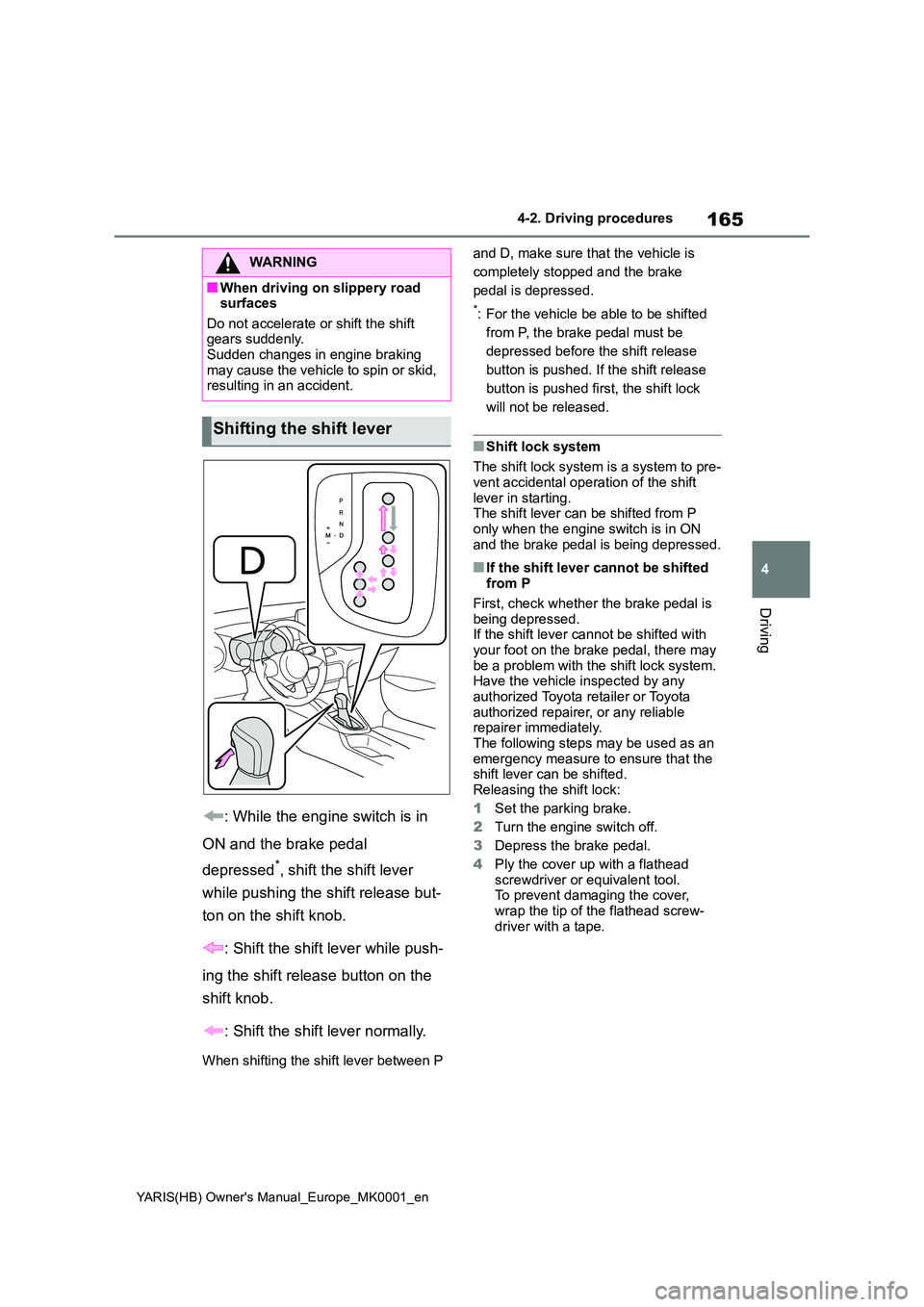
: While the engine switch is in
ON and the brake pedal
depressed*, shift the shift lever
while pushing the shift release but-
ton on the shift knob.
: Shift the shift lever while push-
ing the shift release button on the
shift knob.
: Shift the shift lever normally.
When shifting the shift lever between P
and D, make sure that the vehicle is
completely stopped and the brake
pedal is depressed.
*: For the vehicle be able to be shifted
from P, the brake pedal must be
depressed before the shift release
button is pushed. If the shift release
button is pushed first, the shift lock
will not be released.
■Shift lock system
The shift lock system is a system to pre- vent accidental operation of the shift
lever in starting. The shift lever can be shifted from P only when the engine switch is in ON
and the brake pedal is being depressed.
■If the shift lever cannot be shifted from P
First, check whether the brake pedal is
being depressed. If the shift lever cannot be shifted with your foot on the brake pedal, there may
be a problem with the shift lock system. Have the vehicle inspected by any authorized Toyota retailer or Toyota
authorized repairer, or any reliable repairer immediately.The following steps may be used as an
emergency measure to ensure that the shift lever can be shifted.
Releasing the shift lock:
1 Set the parking brake.
2 Turn the engine switch off.
3 Depress the brake pedal.
4 Ply the cover up with a flathead screwdriver or equivalent tool.To prevent damaging the cover,
wrap the tip of the flathead screw- driver with a tape.
WARNING
■When driving on slippery road surfaces
Do not accelerate or shift the shift gears suddenly. Sudden changes in engine braking
may cause the vehicle to spin or skid, resulting in an accident.
Shifting the shift lever
Page 168 of 568
168
YARIS(HB) Owner's Manual_Europe_MK0001_en
4-2. Driving procedures
■Downshifting restriction warning
buzzer
To help ensure safety and driving perfor- mance, downshifting operation may
sometimes be restricted. In some cir- cumstances, downshifting may not be possible even when the shift lever is
operated. (A buzzer will sound twice.)
■If the 10-speed sport sequential shiftmatic mode indicator does not come on even after shifting the
shift lever to M
This may indicate a malfunction in the Multidrive system. Have the vehicle
inspected by any authorized Toyota retailer or Toyota authorized repairer, or any reliable repairer immediately.
(In this situation, the transmission will operate in the same manner as when the shift lever is in D.)
*: If equipped
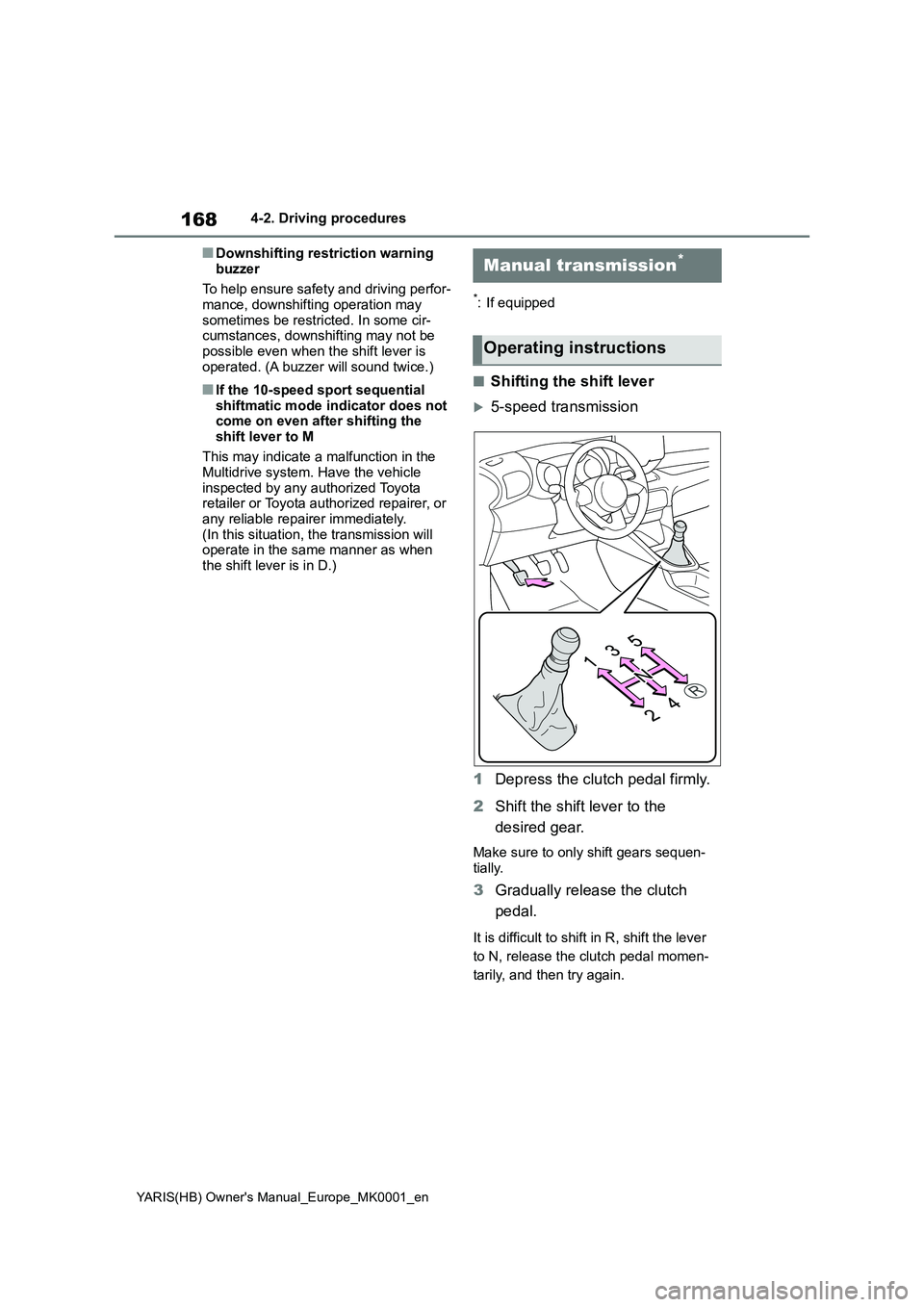
■Shifting the shift lever
5-speed transmission
1 Depress the clutch pedal firmly.
2 Shift the shift lever to the
desired gear.
Make sure to only shift gears sequen- tially.
3 Gradually release the clutch
pedal.
It is difficult to shift in R, shift the lever
to N, release the clutch pedal momen-
tarily, and then try again.
Manual transmission*
Operating instructions
Page 186 of 568
186
YARIS(HB) Owner's Manual_Europe_MK0001_en
4-4. Refueling
4-4.Refuelin g
zTurn the engine switch off and
ensure that all the doors and
windows are closed.
z Confirm the type of fuel.
■Fuel types
→ P. 4 2 0
■Fuel tank opening for unleaded gasoline
To help prevent incorrect fueling, your vehicle has a fuel tank opening that only accommodates the special nozzle on
unleaded fuel pumps.
Opening the fuel tank
cap
Perform the following steps to
open the fuel tank cap:
Before refueling the vehicle
WARNING
■When refueling the vehicle
Observe the following precautions
while refueling the vehicle. Failure to do so may result in death or serious injury.
●After exiting the vehicle and before opening the fuel door, touch an
unpainted metal surface to dis- charge any static electricity. It is important to discharge static elec-
tricity before refueling because sparks resulting from static electric-ity can cause fuel vapors to ignite
while refueling.
●Always hold the grips on the fuel tank cap and turn it slowly to remove it.
A whooshing sound may be heard when the fuel tank cap is loosened. Wait until the sound cannot be
heard before fully removing the cap. In hot weather, pressurized fuel may spray out the filler neck
and cause injury.
●Do not allow anyone that has not
discharged static electricity from their body to come close to an open fuel tank.
●Do not inhale vaporized fuel.Fuel contains substances that are
harmful if inhaled.
●Do not smoke while refueling the
vehicle. Doing so may cause the fuel to ignite and cause a fire.
●Do not return to the vehicle or touch any person or object that is stati-
cally charged. This may cause static electricity to build up, resulting in a possible igni-
tion hazard.
■When refueling
Observe the following precautions to prevent fuel overflowing from the fuel tank:
●Securely insert the fuel nozzle into the fuel filler neck.
●Stop filling the tank after the fuel nozzle automatically clicks off.
●Do not top off the fuel tank.
Page 189 of 568
189
4
YARIS(HB) Owner's Manual_Europe_MK0001_en
4-5. Using the driving support systems
Driving
WARNING
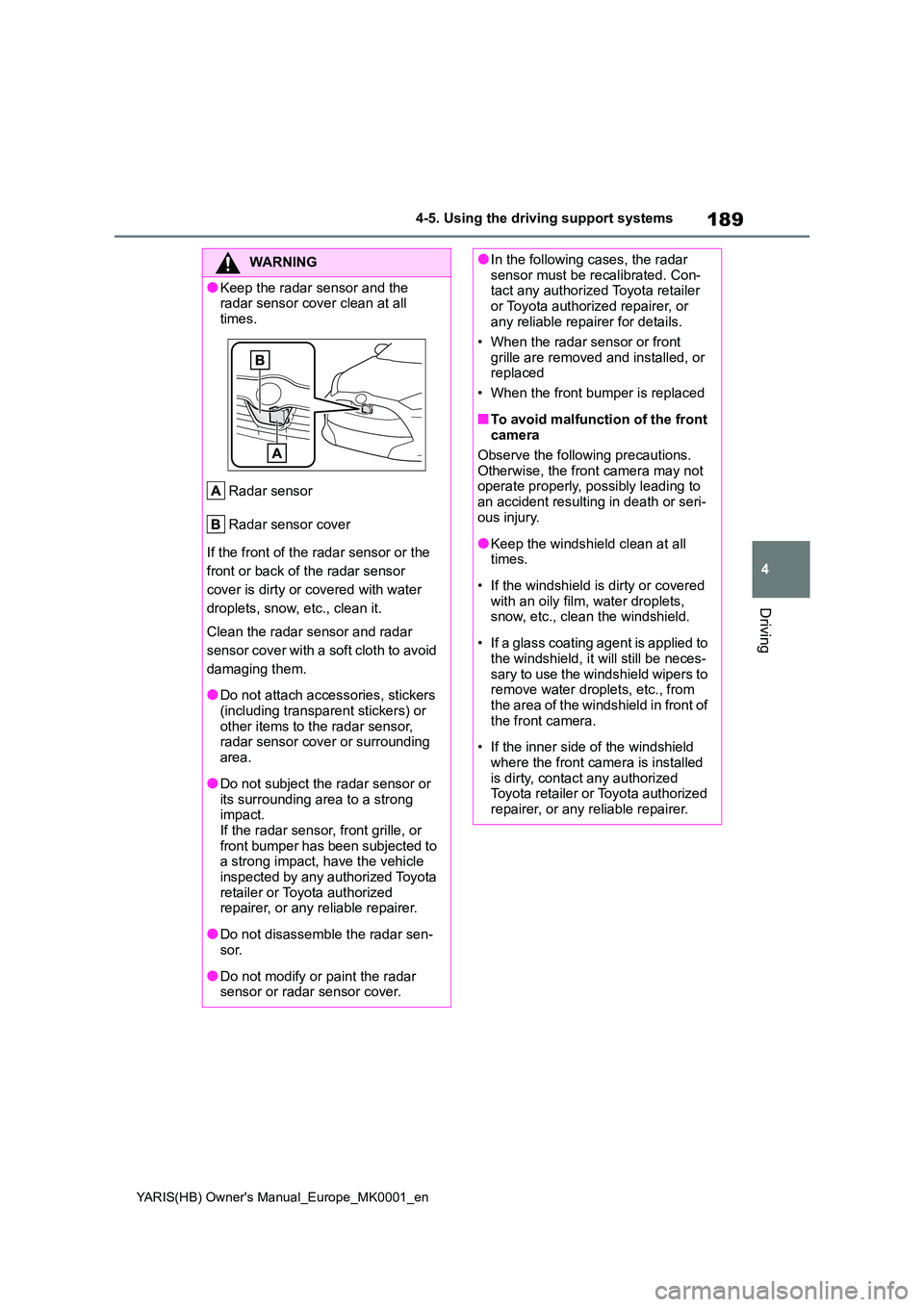
●Keep the radar sensor and the radar sensor cover clean at all
times.
Radar sensor
Radar sensor cover
If the front of the radar sensor or the
front or back of the radar sensor
cover is dirty or covered with water
droplets, snow, etc., clean it.
Clean the radar sensor and radar
sensor cover with a soft cloth to avoid
damaging them.
●Do not attach accessories, stickers
(including transparent stickers) or other items to the radar sensor, radar sensor cover or surrounding
area.
●Do not subject the radar sensor or
its surrounding area to a strong impact.If the radar sensor, front grille, or
front bumper has been subjected to a strong impact, have the vehicle inspected by any authorized Toyota
retailer or Toyota authorized repairer, or any reliable repairer.
●Do not disassemble the radar sen-sor.
●Do not modify or paint the radar sensor or radar sensor cover.
●In the following cases, the radar sensor must be recalibrated. Con-tact any authorized Toyota retailer
or Toyota authorized repairer, or any reliable repairer for details.
• When the radar sensor or front
grille are removed and installed, or replaced
• When the front bumper is replaced
■To avoid malfunction of the front camera
Observe the following precautions. Otherwise, the front camera may not operate properly, possibly leading to
an accident resulting in death or seri- ous injury.
●Keep the windshield clean at all times.
• If the windshield is dirty or covered with an oily film, water droplets, snow, etc., clean the windshield.
• If a glass coating agent is applied to the windshield, it will still be neces-
sary to use the windshield wipers to remove water droplets, etc., from the area of the windshield in front of
the front camera.
• If the inner side of the windshield
where the front camera is installed is dirty, contact any authorized Toyota retailer or Toyota authorized
repairer, or any reliable repairer.