engine TOYOTA YARIS HYBRID 2014 Owners Manual
[x] Cancel search | Manufacturer: TOYOTA, Model Year: 2014, Model line: YARIS HYBRID, Model: TOYOTA YARIS HYBRID 2014Pages: 464, PDF Size: 23.4 MB
Page 4 of 464

TABLE OF CONTENTS4
6-1. Using the air conditioning sys-
tem and defogger
Automatic air conditioning sys-
tem...................................260
Seat heaters ......................269
6-2. Using the interior lights
Interior lights list .................271
• Interior light ....................271
• Personal lights ...............272
6-3. Using the storage features
List of storage features ......273
• Glove box ......................274
• Cup holders ...................275
• Bottle holders ................276
• Auxiliary box ..................276
Luggage compartment fea-
tures.................................277
6-4. Using the other interior fea-
tures
Other interior features ........280
• Sun visors ......................280
• Vanity mirrors ................280
• Portable ashtray ............281
• Cigarette lighter .............281
• Power outlet ..................282
• Armrest ..........................283
• Panoramic roof shade ...283
• Assist grips ....................2847-1. Maintenance and care
Cleaning and protecting the
vehicle exterior ................ 286
Cleaning and protecting the
vehicle interior ................. 289
7-2. Maintenance
Maintenance requirements 292
7-3. Do-it-yourself maintenance
Do-it-yourself service precau-
tions ................................ 295
Hood.................................. 298
Positioning a floor jack ...... 300
Engine compartment ......... 302
12-volt battery ................... 309
Tires .................................. 315
Tire inflation pressure........ 328
Wheels .............................. 330
Air conditioning filter .......... 333
Wireless remote control/elec-
tronic key battery............. 335
Checking and replacing
fuses................................ 339
Light bulbs ......................... 344
6Interior features7Maintenance and care
Page 13 of 464
13Pictorial index
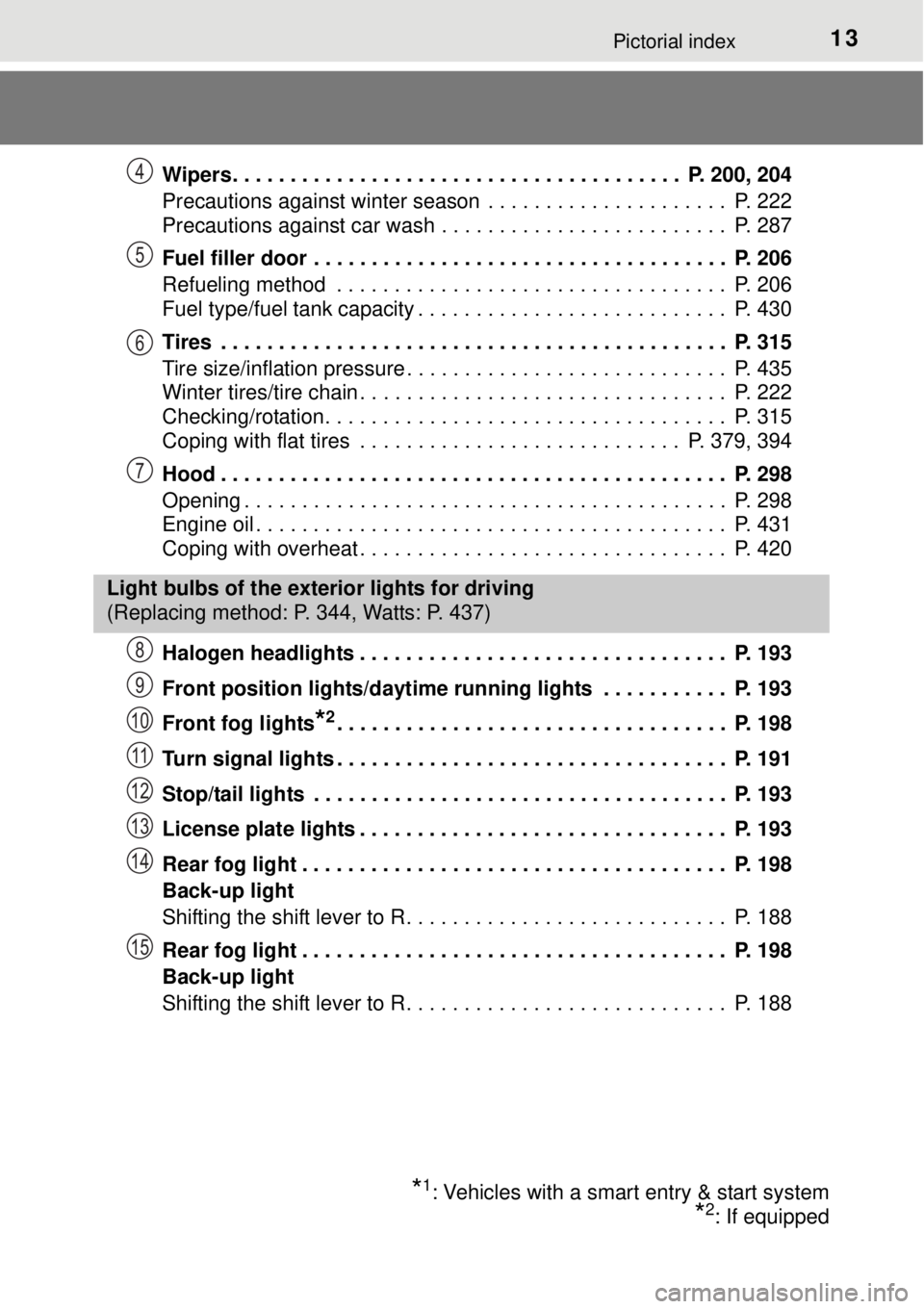
Wipers. . . . . . . . . . . . . . . . . . . . . . . . . . . . . . . . . . . . . . . P. 200, 204
Precautions against winter season . . . . . . . . . . . . . . . . . . . . . P. 222
Precautions against car wash . . . . . . . . . . . . . . . . . . . . . . . . . P. 287
Fuel filler door . . . . . . . . . . . . . . . . . . . . . . . . . . . . . . . . . . . . P. 206
Refueling method . . . . . . . . . . . . . . . . . . . . . . . . . . . . . . . . . . P. 206
Fuel type/fuel tank capacity . . . . . . . . . . . . . . . . . . . . . . . . . . . P. 430
Tires . . . . . . . . . . . . . . . . . . . . . . . . . . . . . . . . . . . . . . . . . . . . P. 315
Tire size/inflation pressure . . . . . . . . . . . . . . . . . . . . . . . . . . . . P. 435
Winter tires/tire chain . . . . . . . . . . . . . . . . . . . . . . . . . . . . . . . . P. 222
Checking/rotation. . . . . . . . . . . . . . . . . . . . . . . . . . . . . . . . . . . P. 315
Coping with flat tires . . . . . . . . . . . . . . . . . . . . . . . . . . . . P. 379, 394
Hood . . . . . . . . . . . . . . . . . . . . . . . . . . . . . . . . . . . . . . . . . . . . P. 298
Opening . . . . . . . . . . . . . . . . . . . . . . . . . . . . . . . . . . . . . . . . . . P. 298
Engine oil . . . . . . . . . . . . . . . . . . . . . . . . . . . . . . . . . . . . . . . . . P. 431
Coping with overheat . . . . . . . . . . . . . . . . . . . . . . . . . . . . . . . . P. 420
Halogen headlights . . . . . . . . . . . . . . . . . . . . . . . . . . . . . . . . P. 193
Front position lights/daytime running lights . . . . . . . . . . . P. 193
Front fog lights
*2. . . . . . . . . . . . . . . . . . . . . . . . . . . . . . . . . . P. 198
Turn signal lights . . . . . . . . . . . . . . . . . . . . . . . . . . . . . . . . . . P. 191
Stop/tail lights . . . . . . . . . . . . . . . . . . . . . . . . . . . . . . . . . . . . P. 193
License plate lights . . . . . . . . . . . . . . . . . . . . . . . . . . . . . . . . P. 193
Rear fog light . . . . . . . . . . . . . . . . . . . . . . . . . . . . . . . . . . . . . P. 198
Back-up light
Shifting the shift lever to R. . . . . . . . . . . . . . . . . . . . . . . . . . . . P. 188
Rear fog light . . . . . . . . . . . . . . . . . . . . . . . . . . . . . . . . . . . . . P. 198
Back-up light
Shifting the shift lever to R. . . . . . . . . . . . . . . . . . . . . . . . . . . . P. 188
4
5
6
7
Light bulbs of the exterior lights for driving
(Replacing method: P. 344, Watts: P. 437)
*1: Vehicles with a smart entry & start system
*2: If equipped
8
9
10
11
12
13
14
15
Page 73 of 464

73
1
1-2. Hybrid system
For safety and security
Hybrid system features
The illustration is an example for explanation and may differ from
actual item.
Gasoline engine
Electric motor (traction motor)
Your vehicle is a hybrid vehicle. It has characteristics different
from conventional vehicles. Be sure you are closely familiar with
the characteristics of your vehicle, and operate it with care.
The hybrid system combines the use of a gasoline engine and
an electric motor (traction motor) according to driving condi-
tions, improving fuel efficiency and reducing exhaust emis-
sions.
1
2
Page 74 of 464

741-2. Hybrid system
When stopped/during start off
The gasoline engine stops
* when the vehicle is stopped. During
start off, the electric motor (traction motor) drives the vehicle. At
slow speeds or when traveling down a gentle slope, the engine is
stopped
* and the electric motor (traction motor) is used.
When the shift lever is in N, the hybrid battery (traction battery) is
not charged. When the vehicle is stopped, always put the shift lever
to P.
Also, even in heavy traffic conditions, drive the vehicle in D or B.
*: When the hybrid battery (traction battery) requires charging or the engine
is warming up, etc., the gasoline engine will not automatically stop.
(P. 75)
During normal driving
The gasoline engine is predominantly used. The electric motor
(traction motor) charges the hybrid battery (traction battery) as nec-
essary.
When accelerating sharply
When the accelerator pedal is depressed heavily, the power of the
hybrid battery (traction battery) is added to that of the gasoline
engine via the electric motor (traction motor).
When braking (regenerative braking)
The wheel operates the electric motor as a power generator, and
the hybrid battery (traction battery) is charged.
Page 75 of 464

751-2. Hybrid system
1
For safety and security
Regenerative braking
In the following situations, kinetic energy is converted to electric energy and
deceleration force can be obtained in conjunction with the recharging of the
hybrid battery (traction battery).
The accelerator pedal is released while driving with the shift lever in D or B.
The brake pedal is depressed while driving with the shift lever in D or B.
EV indicator
Conditions in which the gasoline engine may not stop
The gasoline engine starts and stops automatically. However, it may not stop
automatically in the following conditions:
During gasoline engine warm-up
During hybrid battery (traction battery) charging
When the temperature of the hybrid battery (traction battery) is high or low
When the heater is switched on
Charging the hybrid battery (traction battery)
As the gasoline engine charges the hybrid battery (traction battery), the bat-
tery does not need to be charged from an outside source. However, if the
vehicle is left parked for a long time the hybrid battery will slowly discharge.
For this reason, be sure to drive the vehicle at least once every few months
for at least 30 minutes or 16 km (10 miles). If the hybrid battery becomes fully
discharged and you are unable to start the hybrid system, contact any autho-
rized Toyota dealer or repairer, or another duly qualified and equipped profes-
sional.
Charging the 12-volt battery
P. 417 The EV indicator comes on when the
vehicle is driven using only the electric
motor (traction motor) or the gasoline
engine is stopped.
Page 76 of 464

761-2. Hybrid system
After the 12-volt battery has discharged or when the terminal has been
removed and installed during exchange, etc.
The gasoline engine may not stop even if the vehicle is being driven by the
hybrid battery (traction battery). If this continues for a few days, contact any
authorized Toyota dealer or repairer, or another duly qualified and equipped
professional.
Sounds and vibrations specific to a hybrid vehicle
There may be no engine sound or vibration even though the vehicle is able to
move with the “READY” indicator is illuminated. For safety, apply the parking
brake and make sure to shift the shift lever to P when parked.
The following sounds or vibrations may occur when the hybrid system is
operating and are not a malfunction:
Motor sounds may be heard from the engine compartment.
Sounds may be heard from the hybrid battery (traction battery) behind the
rear seats when the hybrid system starts or stops.
Relay operating sounds such as a snap or soft clank will be emitted from the
hybrid battery (traction battery), behind the rear seats, when the hybrid sys-
tem is started or stopped.
Sounds from the hybrid system may be heard when the back door is open.
Sounds may be heard from the transmission when the gasoline engine
starts or stops, when driving at low speeds, or during idling.
Engine sounds may be heard when accelerating sharply.
Sounds may be heard due to regenerative braking when the brake pedal is
depressed or as the accelerator pedal is released.
Operating sounds or motor sounds that occur when the brake pedal is oper-
ated.
Vibration may be felt when the gasoline engine starts or stops.
Cooling fan sounds may be heard from the air intake vent on the side of the
lower part of the rear left seats.
Maintenance, repair, recycling, and disposal
Contact any authorized Toyota dealer or repairer, or another duly qualified
and equipped professional regarding maintenance, repair, recycling and dis-
posal. Do not dispose of the vehicle yourself.
Customization
Settings (e.g. on/off operation of the EV indicator) can be changed.
(Customizable features P. 439)
Page 91 of 464
912. Instrument cluster
2
Instrument cluster
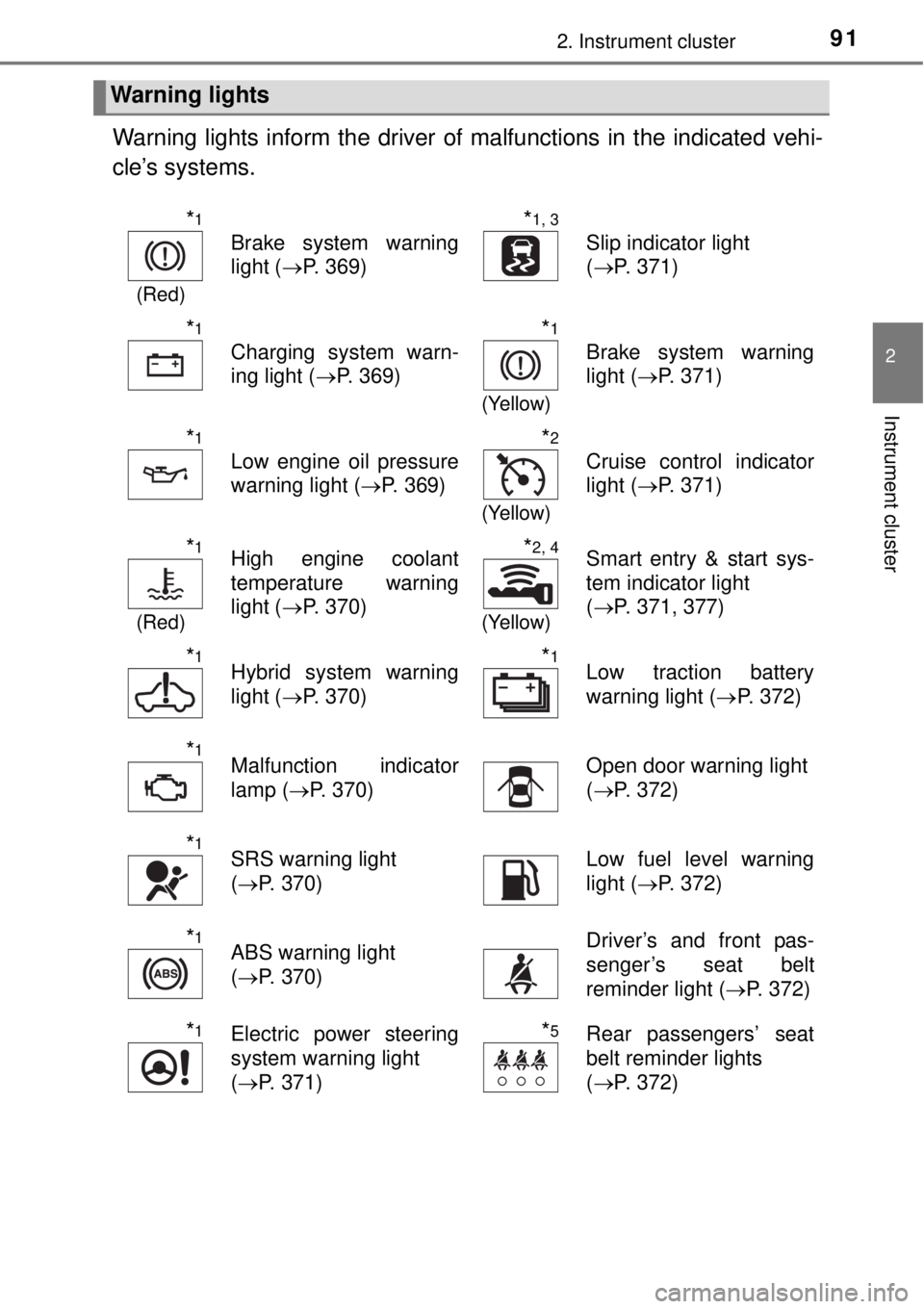
Warning lights inform the driver of malfunctions in the indicated vehi-
cle’s systems.
Warning lights
*1
(Red)
Brake system warning
light (P. 369)
*1, 3
Slip indicator light
(P. 371)
*1
Charging system warn-
ing light (P. 369)
*1
(Yellow)
Brake system warning
light (P. 371)
*1
Low engine oil pressure
warning light (P. 369)
*2
(Yellow)
Cruise control indicator
light (P. 371)
*1
(Red)
High engine coolant
temperature warning
light (P. 370)*2, 4
(Yellow)
Smart entry & start sys-
tem indicator light
(P. 371, 377)
*1Hybrid system warning
light (P. 370)*1Low traction battery
warning light (P. 372)
*1Malfunction indicator
lamp (P. 370)Open door warning light
(P. 372)
*1SRS warning light
(P. 370)Low fuel level warning
light (P. 372)
*1ABS warning light
(P. 370)Driver’s and front pas-
senger’s seat belt
reminder light (P. 372)
*1Electric power steering
system warning light
(P. 371)*5Rear passengers’ seat
belt reminder lights
(P. 372)
Page 94 of 464

942. Instrument cluster
*1: These lights turn on when the power switch is turned to the “ON” position
(vehicles without a smart entry & start system) or ON mode (vehicles with
a smart entry & start system) to indicate that a system check is being per-
formed. They will turn off after the hybrid system on, or after a few sec-
onds. There may be a malfunction in a system if a light does not come on,
or if the lights do not turn off. Have the vehicle inspected by any authorized
Toyota dealer or repairer, or another duly qualified and equipped profes-
sional.
*2: If equipped
*3: The light flashes to indicate that the system is operating.
*4: This light illuminates on the center panel.
WARNING
If a safety system warning light does not come on
Should a safety system light such as the ABS and SRS warning light not
come on when you start the hybrid system, this could mean that these sys-
tems are not available to help protect you in an accident, which could result
in death or serious injury. Have the vehicle inspected by any authorized
Toyota dealer or repairer, or another duly qualified and equipped profes-
sional immediately if this occurs.
NOTICE
To prevent damage to the engine and its components
The engine may be overheating if the high engine coolant temperature
warning light flashes or turns on. In this case, immediately stop the vehicle
in a safe place, and check the engine after it has cooled completely.
(P. 420)
Page 101 of 464
1012. Instrument cluster
2
Instrument cluster
When disconnecting and reconnecting battery terminals
The following information data will be reset.
Average fuel consumption
Driving range
Average vehicle speed
Clock data
Liquid crystal display
Small spots or light spots may appear on the display. This phenomenon is
characteristic of liquid crystal display, and there is no problem continuing to
use the display.
WARNING
Cautions during setting up the display
As the engine needs to be running during setting up the display, ensure that
the vehicle is parked in a place with adequate ventilation. In a closed area
such as a garage, exhaust gases including harmful carbon monoxide (CO)
may collect and enter the vehicle. This may lead to death or a serious
health hazard.
NOTICE
The Multi-information display at low temperatures
Allow the interior of the vehicle to warm up before using the liquid crystal
information display. At extremely low temperatures, the display monitor may
respond slowly, and display changes may be delayed.
Page 102 of 464
1022. Instrument cluster
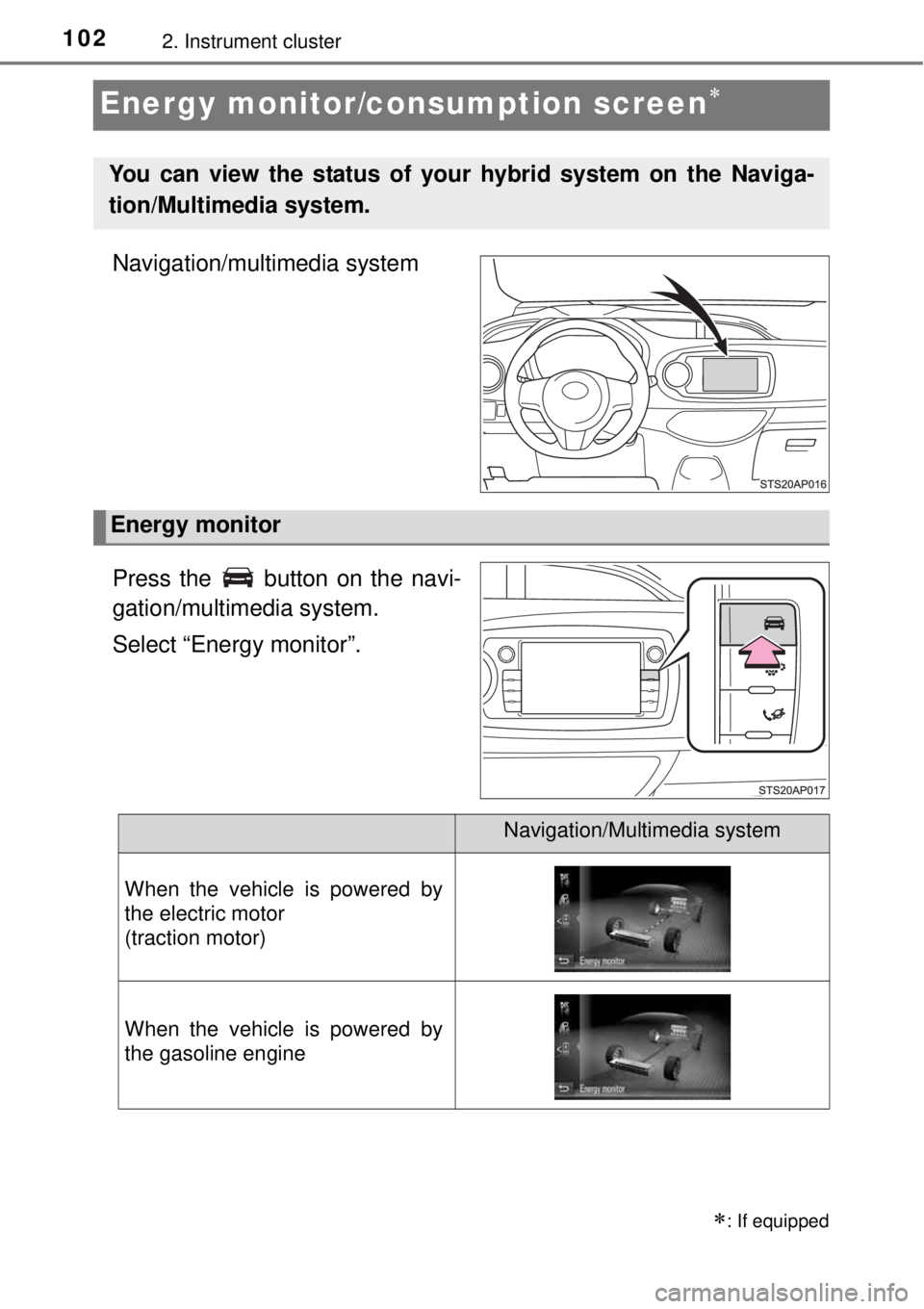
Energy monitor/consumption screen
Navigation/multimedia system
Press the button on the navi-
gation/multimedia system.
Select “Energy monitor”.
: If equipped
You can view the status of your hybrid system on the Naviga-
tion/Multimedia system.
Energy monitor
Navigation/Multimedia system
When the vehicle is powered by
the electric motor
(traction motor)
When the vehicle is powered by
the gasoline engine