engine VOLKSWAGEN CORRADO 1993 Manual Online
[x] Cancel search | Manufacturer: VOLKSWAGEN, Model Year: 1993, Model line: CORRADO, Model: VOLKSWAGEN CORRADO 1993Pages: 920, PDF Size: 6.92 MB
Page 333 of 920
A/C COMPRESSOR OIL CHECKING
Article Text (p. 19)
1993 Volkswagen Corrado
For Volkswagen Technical Site: http://vw.belcom.ru
Copyright © 1998 Mitchell Repair Information Company, LLC
Wednesday, March 22, 2000 08:47PMÄÄÄÄÄÄÄÄÄÄÄÄÄÄÄÄÄÄÄÄÄÄÄÄÄÄÄÄÄÄÄÄÄÄÄÄÄÄÄÄÄÄÄÄÄÄÄÄÄÄÄÄÄÄÄÄÄÄÄÄ Jaguar (XJS)
1) Operate engine at idle speed for 10 minutes, to return
refrigerant oil to compressor. Stop engine. Discharge refrigerant. See
SERVICING PRECAUTIONS. Clean area around compressor filler plug and
remove plug slowly.
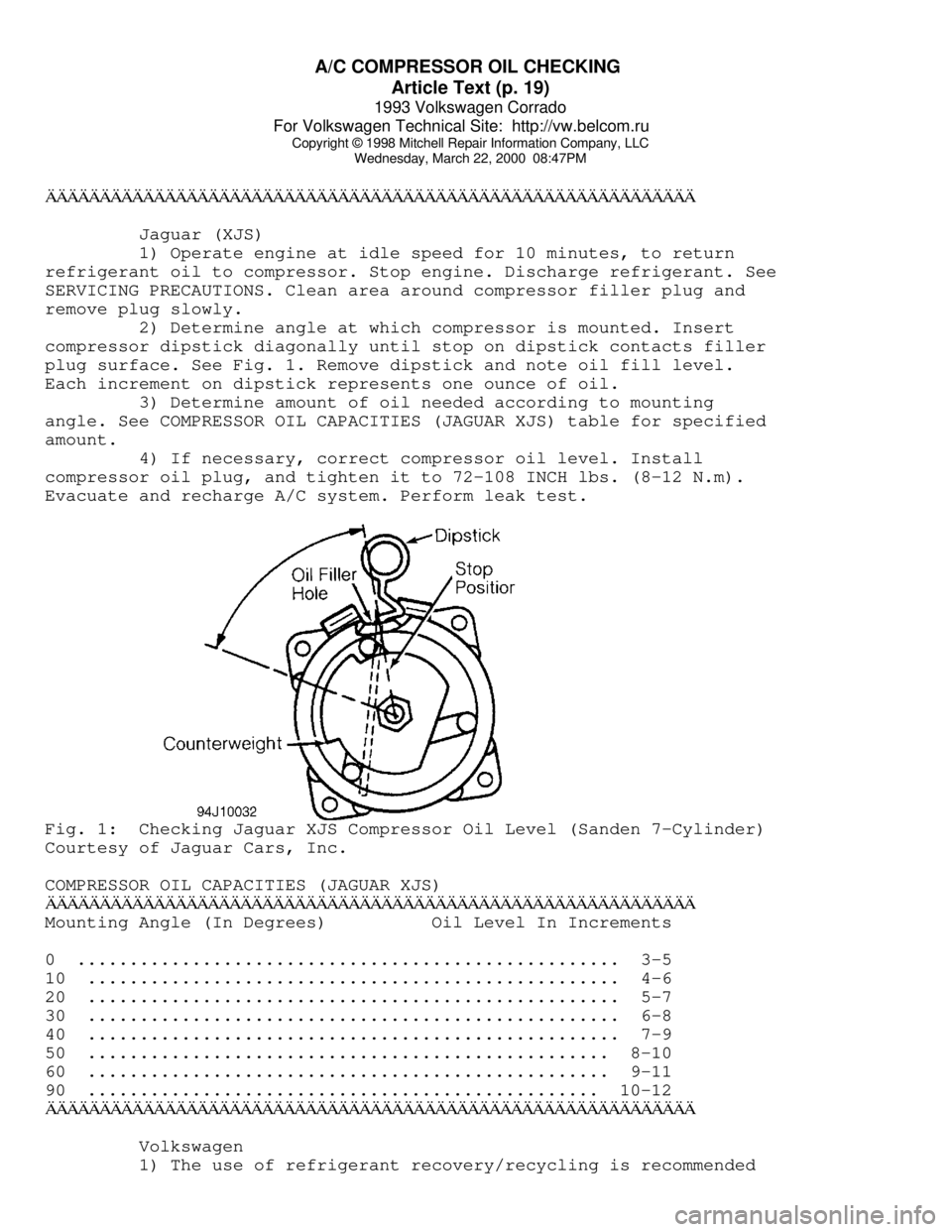
2) Determine angle at which compressor is mounted. Insert
compressor dipstick diagonally until stop on dipstick contacts filler
plug surface. See Fig. 1. Remove dipstick and note oil fill level.
Each increment on dipstick represents one ounce of oil.
3) Determine amount of oil needed according to mounting
angle. See COMPRESSOR OIL CAPACITIES (JAGUAR XJS) table for specified
amount.
4) If necessary, correct compressor oil level. Install
compressor oil plug, and tighten it to 72-108 INCH lbs. (8-12 N.m).
Evacuate and recharge A/C system. Perform leak test.Fig. 1: Checking Jaguar XJS Compressor Oil Level (Sanden 7-Cylinder)
Courtesy of Jaguar Cars, Inc.
COMPRESSOR OIL CAPACITIES (JAGUAR XJS)
ÄÄÄÄÄÄÄÄÄÄÄÄÄÄÄÄÄÄÄÄÄÄÄÄÄÄÄÄÄÄÄÄÄÄÄÄÄÄÄÄÄÄÄÄÄÄÄÄÄÄÄÄÄÄÄÄÄÄÄÄMounting Angle (In Degrees) Oil Level In Increments
0 .................................................... 3-5
10 ................................................... 4-6
20 ................................................... 5-7
30 ................................................... 6-8
40 ................................................... 7-9
50 .................................................. 8-10
60 .................................................. 9-11
90 ................................................. 10-12
ÄÄÄÄÄÄÄÄÄÄÄÄÄÄÄÄÄÄÄÄÄÄÄÄÄÄÄÄÄÄÄÄÄÄÄÄÄÄÄÄÄÄÄÄÄÄÄÄÄÄÄÄÄÄÄÄÄÄÄÄ Volkswagen
1) The use of refrigerant recovery/recycling is recommended
Page 334 of 920

A/C COMPRESSOR OIL CHECKING
Article Text (p. 20)
1993 Volkswagen Corrado
For Volkswagen Technical Site: http://vw.belcom.ru
Copyright © 1998 Mitchell Repair Information Company, LLC
Wednesday, March 22, 2000 08:47PM
by manufacturer. After refrigerant recovery process is completed, the
amount of compressor oil removed must be measured and the same amount
added to A/C system.
2) On Cabriolet, add 2/3 ounce of refrigerant oil when
replacing evaporator. When replacing condenser or receiver-drier, add
1/3 ounce of refrigerant oil per component replaced.
3) On Corrado SLC, Golf, GTI, Jetta and Passat, add 2/3 ounce
of refrigerant oil when replacing evaporator. When replacing condenser
or receiver-drier, add 1/3 ounce of refrigerant oil per component
replaced.
4) On EuroVan, add one ounce of refrigerant oil when
replacing evaporator. Add 1/2 ounce when replacing condenser (2/3
ounce on vehicles with rear A/C). When replacing receiver-drier, add
1/3 ounce (2/3 ounce on vehicles with rear A/C).
SEIKO-SEIKI
ROTARY VANE
Saab (9000)
The A/C system is filled with 6.6 ounces of compressor oil.
The compressor must be topped off with the specified amount. See
COMPONENT REFRIGERANT OIL CAPACITIES (SEIKO-SEIKI ROTARY VANE) table.
Topping off should be carried out on the high pressure side of the
compressor.
COMPONENT REFRIGERANT OIL CAPACITIES (SEIKO-SEIKI ROTARY VANE)ÄÄÄÄÄÄÄÄÄÄÄÄÄÄÄÄÄÄÄÄÄÄÄÄÄÄÄÄÄÄÄÄÄÄÄÄÄÄÄÄÄÄÄÄÄÄÄÄÄÄÄÄÄÄÄÄÄÄÄÄÄÄÄComponent Ounces
Compressor .......................................... (1) 2.3
Condenser ............................................... 1.3
Expansion Valve ......................................... 0.6
Evaporator .............................................. 1.3
Receiver-Drier .......................................... 1.3
Refrigerant Lines ....................................... 0.6
(1) - To avoid an excessive amount of oil in the A/C system, oil
must be drained from the compressor before it is installed.
ÄÄÄÄÄÄÄÄÄÄÄÄÄÄÄÄÄÄÄÄÄÄÄÄÄÄÄÄÄÄÄÄÄÄÄÄÄÄÄÄÄÄÄÄÄÄÄÄÄÄÄÄÄÄÄÄÄÄÄÄÄÄÄ ZEXEL
NOTE: Isuzu and Subaru compressor oil checking procedures are not
available from manufacturer.
ROTARY VANE
Nissan
1) Before checking and adjusting oil level, operate engine at
1200 RPM. Set controls at maximum cooling and high blower motor speed
for 10 minutes to return oil to compressor.
Page 335 of 920

A/C COMPRESSOR OIL CHECKING
Article Text (p. 21)
1993 Volkswagen Corrado
For Volkswagen Technical Site: http://vw.belcom.ru
Copyright © 1998 Mitchell Repair Information Company, LLC
Wednesday, March 22, 2000 08:47PM
2) Stop engine. Discharge refrigerant. See SERVICING
PRECAUTIONS. Measure the amount of oil drained/discharged into
refrigerant recovery/recycling equipment.
3) Remove compressor from vehicle. Drain compressor oil from
compressor drain plug and measure oil amount. Add this amount to
amount drained in step 2), to obtain total amount drained.
4) Fill compressor with total amount drained, using new oil.
If any major components of the system were also replaced, determine
the amount of additional oil needed. See COMPONENT REFRIGERANT OIL
CAPACITIES (ZEXEL ROTARY VANE & 6-CYLINDER) table for specified
amount.
COMPONENT REFRIGERANT OIL CAPACITIES (ZEXEL ROTARY VANE & 6-CYLINDER)ÄÄÄÄÄÄÄÄÄÄÄÄÄÄÄÄÄÄÄÄÄÄÄÄÄÄÄÄÄÄÄÄÄÄÄÄÄÄÄÄÄÄÄÄÄÄÄÄÄÄÄÄÄÄÄÄÄÄÄÄÄÄÄÄÄÄÄÄÄÄComponent Ounces
Condenser
Altima & Maxima ............................................... 2.5
NX, Pickup, Sentra & 300ZX ................................ 1.0-1.7
Evaporator
Altima & Maxima ............................................... 2.5
NX, Pickup, Sentra & 300ZX ................................ 1.5-2.5
Receiver-Drier
Altima & Maxima ............................................... 0.2
NX, Pickup, Sentra & 300ZX ................................ 0.5-0.8
Refrigerant Lines (1) .......................................... 1.0
(1) - Add only if a refrigerant oil leak is indicated.
ÄÄÄÄÄÄÄÄÄÄÄÄÄÄÄÄÄÄÄÄÄÄÄÄÄÄÄÄÄÄÄÄÄÄÄÄÄÄÄÄÄÄÄÄÄÄÄÄÄÄÄÄÄÄÄÄÄÄÄÄÄÄÄÄÄÄÄÄÄÄ 6-CYLINDER
Audi
1) The use of refrigerant recovery/recycling is recommended
by manufacturer. After refrigerant recovery process is completed, the
amount of compressor oil removed must be measured and the same amount
added to A/C system.
2) Add one ounce of refrigerant oil when replacing
accumulator. When replacing condenser, add amount drained from
condenser plus 1/3 ounce of refrigerant oil. When replacing
evaporator, add amount drained from evaporator plus 2/3 ounce of
refrigerant oil.
Nissan
1) Before checking and adjusting oil level, operate engine at
1200 RPM. Set controls at maximum cooling and high blower motor speed
for 10 minutes to return oil to compressor.
2) Stop engine. Discharge refrigerant. See SERVICING
PRECAUTIONS. Measure the amount of oil drained/discharged into
refrigerant recovery/recycling equipment.
3) Remove compressor from vehicle. Drain compressor oil from
compressor drain plug and measure oil amount. Add this amount to
Page 363 of 920

A/C SYSTEM GENERAL DIAGNOSTIC PROCEDURES
Article Text
1993 Volkswagen Corrado
For Volkswagen Technical Site: http://vw.belcom.ru
Copyright © 1998 Mitchell Repair Information Company, LLC
Wednesday, March 22, 2000 08:48PM
ARTICLE BEGINNING
1993 AIR CONDITIONING & HEAT
A/C General Diagnostic Procedures
Diagnosis is an important first step in A/C system servicing.
To save time and effort, systems should be carefully checked to
identify the causes of poor performance. By using the following
diagnostic charts, defective components or system problems can be
quickly located. To identify problems that are specific to one system,
refer to the repair section of this manual. The charts in this section
apply to all systems.
PREPARATION FOR TESTING
1) Attach Low and High pressure gauges.
2) Start engine and allow to warm up.
3) Set system to COOL and blower to HIGH.
4) Open car doors and hood.
5) Run engine at fast idle for 2-3 minutes.
AIR CONDITIONING SYSTEM PERFORMANCE CHECK
AIR CONDITIONING SYSTEM PERFORMANCE CHECK TABLEÄÄÄÄÄÄÄÄÄÄÄÄÄÄÄÄÄÄÄÄÄÄÄÄÄÄÄÄÄÄÄÄÄÄÄÄÄÄÄÄÄÄÄÄÄÄÄÄÄÄÄÄÄÄÄÄÄÄÄÄÄÄÄÄÄÄÄÄÄPERFORM TESTS: SHOULD BE: IF:
ÄÄÄÄÄÄÄÄÄÄÄÄÄÄÄÄÄÄÄÄÄÄÄÄÄÄÄÄÄÄÄÄÄÄÄÄÄÄÄÄÄÄÄÄÄÄÄÄÄÄÄÄÄÄÄÄÄÄÄÄÄÄÄÄÄÄÄÄÄTemperature Check Temperature Check Is:
* Switch to LOW blower.
* Close doors.
* Check outlet temperature. 35-45
ø F Too warm - Check
control lever
operation, heater
water valve, cooling
system and gauge readings.
ÄÄÄÄÄÄÄÄÄÄÄÄÄÄÄÄÄÄÄÄÄÄÄÄÄÄÄÄÄÄÄÄÄÄÄÄÄÄÄÄÄÄÄÄÄÄÄÄÄÄÄÄÄÄÄÄÄÄÄÄÄÄÄÄÄÄÄÄÄPERFORM TESTS: SHOULD BE: IF:
ÄÄÄÄÄÄÄÄÄÄÄÄÄÄÄÄÄÄÄÄÄÄÄÄÄÄÄÄÄÄÄÄÄÄÄÄÄÄÄÄÄÄÄÄÄÄÄÄÄÄÄÄÄÄÄÄÄÄÄÄÄÄÄÄÄÄÄÄÄVisual Check Visual Check Shows:
* Compressor Quiet with no leaks Noisy - Check belts,
oil level, seals,
gaskets, reed valves.
* Condenser Free of obstructions Blocked - Clean off.
Plugged - Flush or
replace.
* Receiver-Drier Dry and warm to touch Frosty - Check for
restriction, replace
desiccant.
Page 375 of 920

A/C SYSTEM GENERAL SERVICING
Article Text (p. 7)
1993 Volkswagen Corrado
For Volkswagen Technical Site: http://vw.belcom.ru
Copyright © 1998 Mitchell Repair Information Company, LLC
Wednesday, March 22, 2000 08:48PM
Vigor). Use High-Side Adapter (J-25498).
(3) - On low pressure line (near battery on Integra; near
right rear of engine on Legend; near compressor on
Vigor).
(4) - On high pressure (discharge) hose/line.
(5) - On low pressure (suction) hose/line.
(6) - On high pressure line, between compressor and condenser.
(7) - On suction accumulator/drier.
(8) - On low and high pressure hoses, behind compressor.
(9) - On receiver/drier and low pressure hose (near
compressor).
(1)(0) - On compressor discharge hose and accumulator.
(1)(1) - On compressor discharge and suction ports.
(1)(2) - Front of condenser on right side.
(1)(3) - Towards rear of compressor.ÄÄÄÄÄÄÄÄÄÄÄÄÄÄÄÄÄÄÄÄÄÄÄÄÄÄÄÄÄÄÄÄÄÄÄÄÄÄÄÄÄÄÄÄÄÄÄÄÄÄÄÄÄÄÄÄÄÄÄÄÄÄ REFRIGERANT RECOVERY/RECYCLING
Refrigerant recovery/recycling equipment is used to remove
refrigerant from vehicle's A/C system without polluting atmosphere. To
remove and recycle refrigerant, connect the recovery/recycling system
and follow instructions provided with the system.
The removed refrigerant is filtered, dried and stored in a
tank within the recovery/recycling system until it is ready to be
pumped back into the vehicle's A/C system. With refrigerant stored in
the recovery/recycling system, A/C system can be opened without
polluting atmosphere.
NOTE: Separate sets of hoses, gauges and refrigerant
recovery/recycling equipment MUST be used for R-12 and
R-134a based systems. DO NOT mix R-12 and R-134a
refrigerants, as their refrigerant oils and desiccants are
not compatible. On systems with R-134a refrigerant, use
Polyalkylene Glycol (PAG) wax-free refrigerant oil.
END OF ARTICLE
Page 379 of 920

A/C-HEATER SYSTEM - MANUAL
Article Text (p. 4)
1993 Volkswagen Corrado
For Volkswagen Technical Site: http://vw.belcom.ru
Copyright © 1998 Mitchell Repair Information Company, LLC
Wednesday, March 22, 2000 08:49PM
too low. This protects compressor if not enough refrigerant is in
system. Low-pressure cut-out switch shuts compressor off at about 29
psi (2.0 kg/cmý).
THERMOSWITCH
Thermoswitch shuts compressor off if coolant temperature is
greater than 248
øF (120øC).
ADJUSTMENTS
AIR DISTRIBUTION CONTROL
1) Move air distribution control knob to defrost position.
Connect 3-foot long control cable to footwell/defrost flap lever. Push
flap lever toward cable and secure cable sheath with retainer clip.
2) Move air distribution control knob to panel (vent)
position. Connect 2-foot long control cable to center flap lever. Push
flap lever away from cable and secure cable sheath with retainer clip.
TEMPERATURE CONTROL
Move temperature knob to full cool position. Connect
temperature control cable (Blue sheath) to temperature flap lever.
Push flap lever away from cable and secure cable sheath with retainer
clip.
TROUBLE SHOOTING
NO COOLING
1) Ensure blower fan motor operates in all 4 speeds. Ensure
air duct closes off outside air and heater water valve is closed.
Clean condenser.
2) Inspect receiver-drier pressure seal. If seal is good, go
to step 3). If seal is broken, replace seal. Evacuate and recharge
system. If system cools properly, testing is complete. If system does
not cool, connect pressure gauges.
3) Adjust engine speed to 2500 RPM. Set controls for maximum
cooling and high fan. Insert thermometer in left air duct and close
all other ducts. With vehicle in shade, close windows and doors and
connect pressure gauges. Operate system for 10 minutes.
4) If fan does not operate, replace pressure switch. Ensure
system is okay. If fan does come on, turn engine off, and check for
condenser obstructions and blocked airflow.
5) Turn air conditioner on and off with temperature control.
Ensure compressor clutch engages. Push lever to extreme right position
and back again. A click should be heard from compressor clutch. If a
click is not heard, check for voltage at clutch coil wire with switch
on. If voltage is present, replace clutch coil. If voltage is not
present, check wiring or replace thermostatic switch.
6) If compressor clutch operates, check gauge readings. If
Page 380 of 920

A/C-HEATER SYSTEM - MANUAL
Article Text (p. 5)
1993 Volkswagen Corrado
For Volkswagen Technical Site: http://vw.belcom.ru
Copyright © 1998 Mitchell Repair Information Company, LLC
Wednesday, March 22, 2000 08:49PM
both gauges read too low, locate leak and recharge system. If both
gauges read too high, replace expansion valve. If low side is too high
and high side is too low, replace compressor.
INSUFFICIENT COOLING
1) Ensure blower fan motor operates at all 4 speeds. Ensure
air duct closes off outside air intake and heater water valve is
closed. Clean condenser.
2) Adjust engine speed to 2500 RPM. Set controls for maximum
cooling and high fan. Insert thermometer in left air duct and close
all other ducts. With vehicle in shade, close windows and doors and
connect pressure gauges. Operate system for 10 minutes.
3) If both gauges read too high, replace expansion valve. If
both gauges read low, locate leak and recharge system. If both gauge
readings are normal, go to next step. If high side is too high and
suction side is normal, go to step 5). If high side is too low and
suction side is too high, go to step 6). If high side is normal and
suction side is too low, go to step 7).
4) Turn compressor off and observe gauges. If readings
equalize in 30 seconds, replace compressor. If readings take longer to
equalize, ensure capillary tube installed length is 13" (330 mm).
5) If capillary tube installation is correct, run system at
maximum cooling for 15 minutes. If thermometer indicates temperature
is less than 36øF (2øC) when compressor is turned off, or temperature
is greater than 48
øF (9øC) with compressor on, replace thermostatic
switch.
6) Check condenser fins and clean or straighten. If operation
is still not correct, discharge system until bubbles appear in sight
glass. Recharge system until bubbles disappear, and recheck pressures.
If operation is still incorrect, locate leaks and tighten fittings.
Discharge A/C system using approved refrigerant recovery/recycling
equipment. Evacuate system to remove all air and recharge system.
7) Check for bubbles at sight glass. If bubbles are present,
repair leaks and recharge system. If no bubbles are present, check
condenser-to-expansion valve line for kinks and repair if necessary.
Check line (from condenser to expansion valve) for restrictions by
feeling line for cold spots. If there are no cold spots, replace
expansion valve.
8) If cold spot is felt, remove and flush out lines and
condenser. Check for bubbles at sight glass. If there are no bubbles
present, replace compressor. If bubbles are present, check for leaks.
Repair and recharge system.
INTERMITTENT COOLING
1) Ensure blower fan motor operates in all 4 speeds. Ensure
air duct closes off outside air and heater water valve is closed.
Clean condenser.
2) Adjust engine speed to 2500 RPM. Set controls for maximum
cooling and high fan. Insert thermometer in left air duct and close
all other ducts. With vehicle in shade, close windows and doors and
Page 381 of 920

A/C-HEATER SYSTEM - MANUAL
Article Text (p. 6)
1993 Volkswagen Corrado
For Volkswagen Technical Site: http://vw.belcom.ru
Copyright © 1998 Mitchell Repair Information Company, LLC
Wednesday, March 22, 2000 08:49PM
connect pressure gauges. Operate system for 10 minutes.
3) Check for cool air from left duct. Low pressure gauge
should read more than 16 psi (1.1 kg/cmý). If low pressure gauge
reading is incorrect, place hands around expansion valve to warm
valve. If pressure rises, moisture is present in system. Discharge A/C
system using approved refrigerant recovery/recycling equipment.
Evacuate and recharge system. If pressure does not rise, go to next
step.
4) Check temperature on thermometer when thermostatic switch
turns compressor off. If temperature is 39
øF (4øC), system is okay. If
temperature is lower than 39
øF (4øC), ensure capillary tube installed
length is 13" (330 mm). If capillary tube installation is correct,
replace thermostatic switch.
TESTING
A/C SYSTEM PERFORMANCE
1) Park vehicle out of direct sunlight. Start engine and
operate engine at 2500 RPM. Set A/C controls to outside air, panel
(vent) mode, full cold, and A/C button on.
2) Set blower/fan on high speed and open windows. Operate
system for 6-7 minutes to allow system to stabilize. Insert
thermometer in center vent, and measure temperature. Temperature at
center vent must be 19-40
øF (-7 to 4øC) at center vent, with high side
and low side pressures within specification. See SPECIFICATIONS table
at beginning of article.
AMBIENT TEMPERATURE SWITCH
1) Remove air intake grille from right side cowl. Remove
switch from panel on right side of tray area. Place switch in freezer.
2) Using a DVOM, check switch resistance. Switch resistance
must be infinite (no continuity) below 30
øF (-1øC). Allow switch to
warm above 45
øF (7øC). Switch resistance must be zero ohms
(continuity). Replace switch if necessary.
COMPRESSOR CLUTCH COIL
Disconnect compressor clutch harness connector. Check
resistance between clutch connector terminals. Resistance reading
should be 3.6 ohms. If resistance reading is not as specified, replace
clutch coil.
DUAL-PRESSURE SWITCH
High-Pressure Cut-Out Switch
Locate dual-pressure switch on refrigerant line (right strut
tower). Switch is identified by its 4 wires. Ensure switch opens at
464 psi (32 kg/cm
ý). Ensure switch closes at 348 psi (24 kg/cmý).
NOTE: Dual-pressure switch may be removed without discharging
Page 387 of 920

AA - USING THIS SECTION (GENERAL HELP INFORMATION)
Article Text
1993 Volkswagen Corrado
For Volkswagen Technical Site: http://vw.belcom.ru
Copyright © 1998 Mitchell Repair Information Company, LLC
Wednesday, March 22, 2000 08:49PM
ARTICLE BEGINNING
ENGINE PERFORMANCE
How To Use This Section
INTRODUCTION
NOTE: Because there are so many possible combinations of
articles for the different manufacturers and models,
the new hyper-text capabilities built into this product
DO NOT apply to this article.
It is the purpose of this repair information system to help
professional automotive technicians maintain top vehicle performance
and correct driveability problems related to today's high tech
vehicles.
Because of the limited amount of space allowable for the this
product, our titles have been condensed to fit into the menus. An
alphabetical designation has been added to the front of each title to
allow the titles to be displayed in a way that reflects their
respective order of use. References to the titles in some of the
diagnostic flow charts sometimes will not correlate with the titles in
the this product menu. If not, refer to the MENU CROSS-REFERENCE table
below.
MENU CROSS-REFERENCE TABLEÄÄÄÄÄÄÄÄÄÄÄÄÄÄÄÄÄÄÄÄÄÄÄÄÄÄÄÄÄÄÄÄÄÄÄÄÄÄÄÄÄÄÄÄÄÄÄÄÄÄÄÄÄÄÄÄÄÄÄÄÄÄÄÄÄÄÄÄÄÄTitle Associate Print (Book) Title:
A - ENGINE/VIN I D .................................... Introduction
B - EMISSION APPLICATION ..................... Emission Applications
C - TUNE-UP SPECS .............. Service & Adjustment Specifications
C - SPECIFICATIONS ............. Service & Adjustment Specifications
D - ADJUSTMENTS ............................. On-Vehicle Adjustments
E - THEORY/OPERATION ............................ Theory & Operation
F - BASIC TESTING ...................... Basic Diagnostic Procedures
G - TESTS W/ CODES ................................ Self-Diagnostics
H - TESTS W/O CODES .................... Trouble Shooting - No Codes
I - SYS/COMP TESTS ..................... Systems & Component Testing
J - PIN VOLTAGE CHARTS .......................... Pin Voltage Charts
K - SENSOR RANGE CHARTS .............. Sensor Operating Range Charts
L - WIRING DIAGRAMS ................................ Wiring Diagrams
M - VACUUM DIAGRAMS ................................ Vacuum Diagrams
N - REMOVE/INSTALL/OHAUL .......... Removal, Overhaul & Installation
ÄÄÄÄÄÄÄÄÄÄÄÄÄÄÄÄÄÄÄÄÄÄÄÄÄÄÄÄÄÄÄÄÄÄÄÄÄÄÄÄÄÄÄÄÄÄÄÄÄÄÄÄÄÄÄÄÄÄÄÄÄÄÄÄÄÄÄÄÄÄ Because of this we recommend that you read the rest of these
INTRODUCTION paragraphs to better understand why the information is
presented in this new format.
The A - ENGINE/VIN I D article will help you identify the
vehicle and its systems. It will also explain the VIN code and in many
cases, show its location.
Page 388 of 920

AA - USING THIS SECTION (GENERAL HELP INFORMATION)
Article Text (p. 2)
1993 Volkswagen Corrado
For Volkswagen Technical Site: http://vw.belcom.ru
Copyright © 1998 Mitchell Repair Information Company, LLC
Wednesday, March 22, 2000 08:49PM
If you want "TUNE-UP" type information, see D - ADJUSTMENTS
for the adjustment procedures. If you are familiar with the
procedures, but need a quick way to find the specification, go to C -
TUNE-UP SPECS or C - SPECIFICATIONS for the specifications pertaining
to the vehicle.
When diagnosing driveability problems, first go to F - BASIC
TESTING. This article is here to help eliminate wasted diagnostic
time. If the basic systems are working properly, go to G - TESTS W/
CODES.
If the vehicle still is having a driveability problem or if
the vehicle has no self-diagnostic system, go to H - TESTS W/O CODES.
This article will help you diagnose the problem by symptom, locate the
symptom exhibited by the vehicle, and inspect or test the items which
may be causing the problem.
After finding which specific system or component requires
testing, use the I - SYS/COMP TESTS article to tests the systems and
components. We have also included (when available) pin voltage charts
and sensor range charts. These can be found in J - PIN VOLTAGE CHARTS
and K - SENSOR RANGE CHARTS.
Also included in this section are wiring diagrams and vacuum
diagrams. These can be found in L - WIRING DIAGRAMS and M - VACUUM
DIAGRAMS.
When all diagnostic tests have been performed and the problem
has been discovered, it may be necessary to replace or overhaul the
defective part. This information can be found in
N - REMOVE/INSTALL/OHAUL.
The content of each of these articles is outlined below. As a
summary of the driveability diagnosis, see ROUTINE OUTLINE in this
article.
A - ENGINE/VIN ID
This article shows how to identify the model and engine by
its Vehicle Identification Number (VIN). A model coverage chart shows
each model and engine, the fuel system, ignition system and engine
code. The engine serial number locations are also included in this
article.
B - EMISSION APPLICATION
These charts identify the emission systems and sub-systems
applicable to each model and engine combination.
C - TUNE-UP SPECS
This is a collection of quick-reference type specifications.
This article is helpful when you are familiar with proper adjustment
procedures and only need specifications. Included in this section are:
* Battery specifications.
* Fluid capacities.