connect VOLKSWAGEN T-ROC 2021 Owner´s Manual
[x] Cancel search | Manufacturer: VOLKSWAGEN, Model Year: 2021, Model line: T-ROC, Model: VOLKSWAGEN T-ROC 2021Pages: 502, PDF Size: 9.42 MB
Page 345 of 502
Replace the defective bulb with a new bulb of the same type.
Insert the bulb holder into the headlight and turn it clockwise as far as it will go.
Connect the connector to the bulb holder. The connector must audibly click into place.
Push the headlight from the outside into the openings and insert into the bumper.
Use the screwdriver to tighten the securing screws ⇒ Fig. 169 ①.
Fit the cover in the bumper ⇒ Fig. 169 .
Stow the wire hook and screwdriver in the vehicle toolkit.
Changing bulbs in the tail light clusters (LED lights)
First read and observe the introductoryinformation and safety warnings⇒Introduction
These lamps use LED technology. The LEDs cannot be replaced by customers. If some LEDs fail, this
may be an indication that more elements are on the point of failure. In this case, have the lights
checked and renewed if necessary at a qualified workshop. Volkswagen recommends using a
Volkswagen dealership for this purpose.
Changing bulbs in the number plate light (LED lights)
First read and observe the introductoryinformation and safety warnings⇒Introduction
These lamps use LED technology. The LEDs cannot be replaced by customers. If some LEDs fail, this
may be an indication that more elements are on the point of failure. In this case, have the lights
checked and renewed if necessary at a qualified workshop.
Troubleshooting
First read and observe the introductoryinformation and safety warnings⇒Introduction
Fault in vehicle lighting
The indicator lamp lights up yellow.
Fault in vehicle lighting or fault in cornering lights.
Check the vehicle lighting and change the appropriate bulb as required ⇒ Changing bulbs . If all
bulbs are OK or there is a fault in the dynamic cornering light, go to a qualified workshop.
Changing fuses
Introduction
This chapter contains information on the followingsubjects:
⇒ Fuses in the dash panel
Page 352 of 502

Introduction
This chapter contains information on the followingsubjects:
⇒ Jump lead connection point (earth connection)
⇒ Jump starting the vehicle
If the engine fails to start because the 12-volt vehicle battery is flat, the discharged battery can be
connected to the 12-volt battery of another vehicle to start the engine.
Suitable jump leads are needed for jump starting.
2 for vehicles with petrol engines.
WARNING
Using the jump leads incorrectly or performing the jump start procedure incorrectly can cause the
12-volt vehicle battery to explode, which can lead to severe injuries. Please note the following in
order to reduce the risk of the 12-volt vehicle battery exploding:
-volt vehicle battery and the electrical system can cause serious chemical burns,
fire or electric shocks. Always read the warnings and safety information before carrying out any kind
of work on the 12-volt vehicle battery ⇒ 12-volt vehicle battery .
volts) and approximately
the same capacity (see label on battery) as the flat 12-volt vehicle battery.
-volt vehicle battery. Discharged 12-volt vehicle batteries can
already freeze at temperatures of around 0°C (+32°F).
-volt vehicle battery should be replaced if it is or has ever been frozen.
-volt vehicle battery is jump started.
Always keep fire, sparks, naked flames and lit cigarettes away from the 12-volt vehicle battery.
Never use a mobile telephone when the jump leads are being connected or disconnected.
compartment.
rectly.
NOTICE
Please note the following in order to avoid considerable damage to the vehicle electrical system:
Page 353 of 502
les must not touch each other, as any contact could mean that electricity could flow as
soon as the positive terminals are connected.
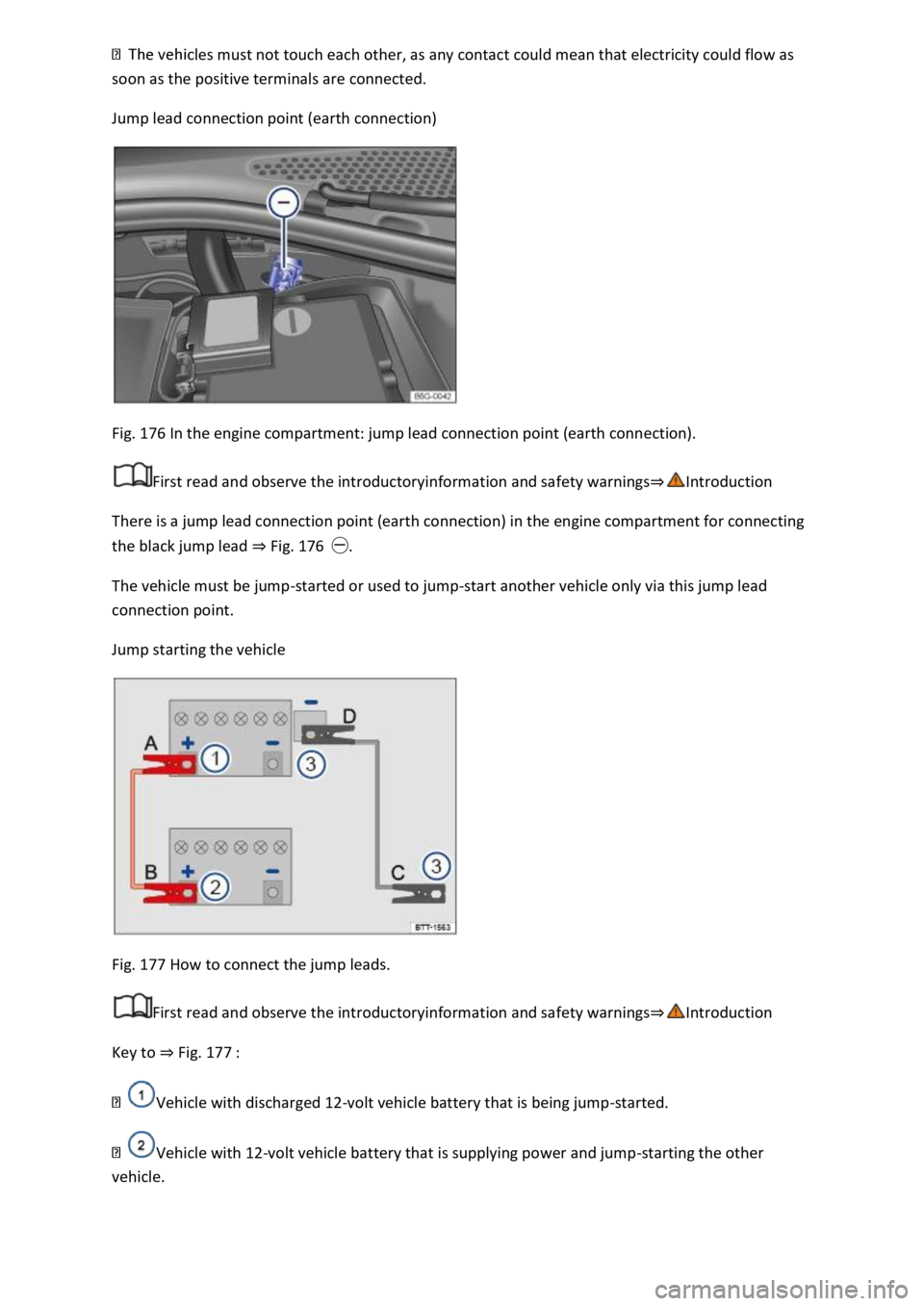
Jump lead connection point (earth connection)
Fig. 176 In the engine compartment: jump lead connection point (earth connection).
First read and observe the introductoryinformation and safety warnings⇒Introduction
There is a jump lead connection point (earth connection) in the engine compartment for connecting
the black jump lead ⇒ Fig. 176 ㊀.
The vehicle must be jump-started or used to jump-start another vehicle only via this jump lead
connection point.
Jump starting the vehicle
Fig. 177 How to connect the jump leads.
First read and observe the introductoryinformation and safety warnings⇒Introduction
Key to ⇒ Fig. 177 :
Vehicle with discharged 12-volt vehicle battery that is being jump-started.
Vehicle with 12-volt vehicle battery that is supplying power and jump-starting the other
vehicle.
Page 354 of 502
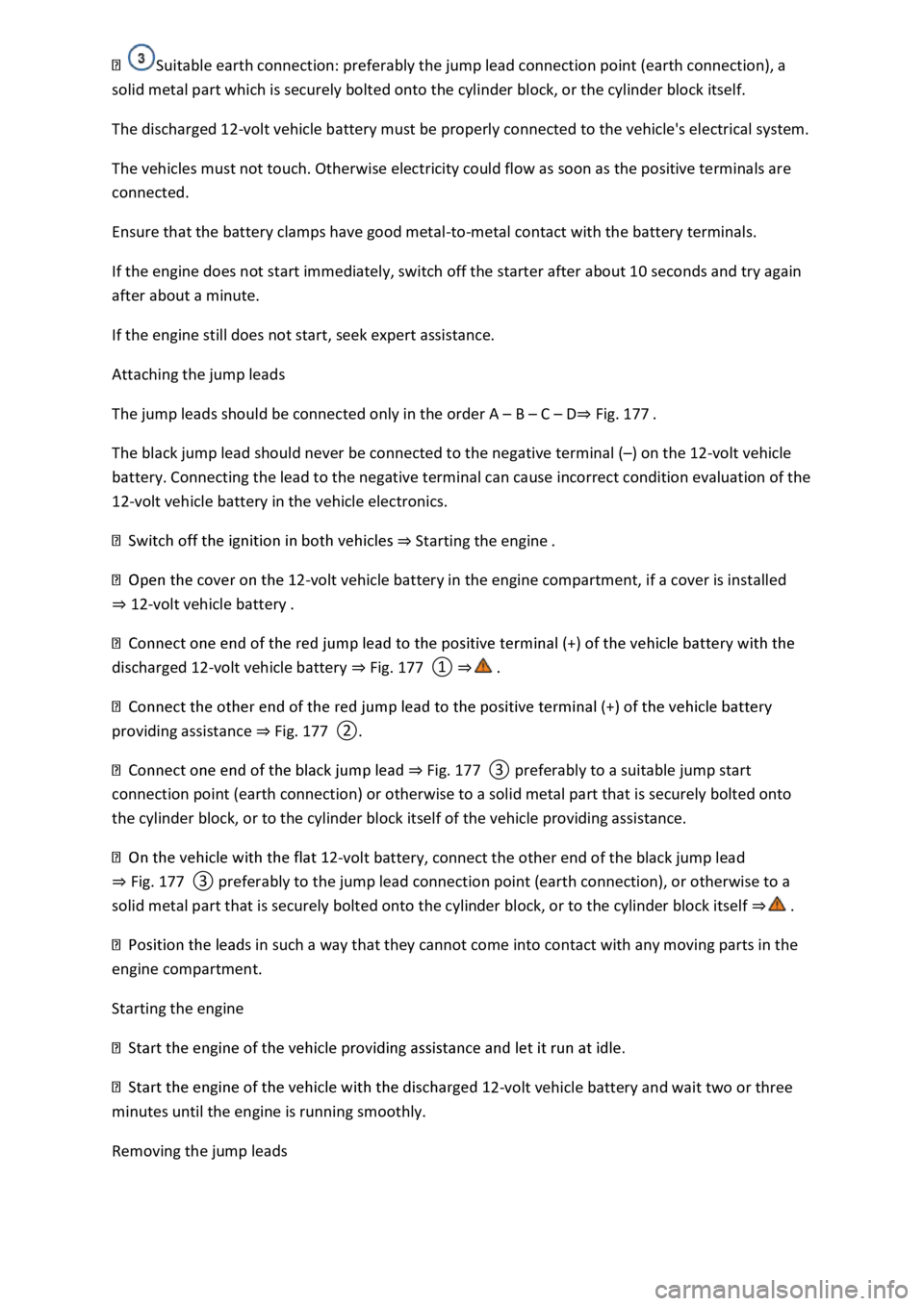
Suitable earth connection: preferably the jump lead connection point (earth connection), a
solid metal part which is securely bolted onto the cylinder block, or the cylinder block itself.
The discharged 12-volt vehicle battery must be properly connected to the vehicle's electrical system.
The vehicles must not touch. Otherwise electricity could flow as soon as the positive terminals are
connected.
Ensure that the battery clamps have good metal-to-metal contact with the battery terminals.
If the engine does not start immediately, switch off the starter after about 10 seconds and try again
after about a minute.
If the engine still does not start, seek expert assistance.
Attaching the jump leads
The jump leads should be connected only in the order A – B – C – D⇒ Fig. 177 .
The black jump lead should never be connected to the negative terminal (–) on the 12-volt vehicle
battery. Connecting the lead to the negative terminal can cause incorrect condition evaluation of the
12-volt vehicle battery in the vehicle electronics.
⇒ Starting the engine .
-volt vehicle battery in the engine compartment, if a cover is installed
⇒ 12-volt vehicle battery .
discharged 12-volt vehicle battery ⇒ Fig. 177 ① ⇒ .
providing assistance ⇒ Fig. 177 ②.
⇒ Fig. 177 ③ preferably to a suitable jump start
connection point (earth connection) or otherwise to a solid metal part that is securely bolted onto
the cylinder block, or to the cylinder block itself of the vehicle providing assistance.
-volt battery, connect the other end of the black jump lead
⇒ Fig. 177 ③ preferably to the jump lead connection point (earth connection), or otherwise to a
solid metal part that is securely bolted onto the cylinder block, or to the cylinder block itself ⇒ .
s in such a way that they cannot come into contact with any moving parts in the
engine compartment.
Starting the engine
2-volt vehicle battery and wait two or three
minutes until the engine is running smoothly.
Removing the jump leads
Page 364 of 502

Additional insulating materials such as blankets in the engine compartment could disrupt the
operation of the engine, start fires and lead to severe injuries.
WARNING
Service fluids and some materials in the engine compartment are highly flammable and can cause
fires and serious injuries!
ty of the engine compartment.
injuries.
tem or the electrical
system:
-volt vehicle battery. Ensure that the vehicle is unlocked when the 12-
volt vehicle battery is disconnected as otherwise the anti-theft alarm will be activated.
of heating systems, water heaters or any other open flames.
NOTICE
When filling or changing service fluids, please ensure that the correct service fluids are filled through
the correct openings. The use of incorrect service fluids could result in serious malfunctions and
engine damage.
Service fluids that leak from the vehicle are harmful to the environment. For this reason, you should
regularly check the ground underneath your vehicle. If there are spots of oil or other fluids on the
ground, the vehicle should be inspected by a qualified workshop. Any spilt service fluids must be
disposed of properly.
Preparing the vehicle for working in the engine compartment
Checklist
The following steps should always be carried out in the specified order before working in the engine
compartment ⇒ :
Park the vehicle on a level and stable surface.
Page 384 of 502

reduce braking efficiency, considerably increase braking distance and can cause the brake system to
fail completely.
with VW standard 501 14.
fluid or low-quality brake fluid can affect the functioning of the brakes and reduce
their effectiveness.
501 14 is not available, use a high-quality brake fluid
compliant with DIN ISO 4925 CLASS 4 or the US standard FMVSS 116 DOT 4, but only in exceptional
circumstances.
WARNING
Brake fluid is toxic.
brake fluid. There is always a risk of someone drinking from such containers, even if they are labelled
appropriately.
children.
NOTICE
Brake fluid that has leaked or been spilt can damage the vehicle paintwork, plastic parts and tyres.
Immediately wipe off brake fluid that has leaked or been spilt from all parts of the vehicle.
Brake fluid can pollute the environment. Any service fluids that have escaped or been spilt must be
collected and disposed of properly.
12-volt vehicle battery
Introduction
This chapter contains information on the followingsubjects:
⇒ Checking the electrolyte level of the 12-volt vehicle battery
⇒ Charging, replacing, disconnecting and connecting the 12-volt vehicle battery
⇒ Troubleshooting
The 12-volt vehicle battery is a component of the electrical system and serves to supply power in the
vehicle.
Page 385 of 502

Do not work on the electrical system unless you are familiar with the task, aware of the general
safety procedures and have the correct equipment, service fluids and suitable tools. Serious injuries
can be caused by carrying out work incorrectly ⇒ . All work should be carried out by a qualified
workshop. Volkswagen recommends using a Volkswagen dealership for this purpose.
Information for warning and indicator lamps lit up can be found in the troubleshooting at the end of
the chapter ⇒ Troubleshooting .
Location of the 12-volt vehicle battery
The 12-volt vehicle battery is located in the engine compartment.
Explanation of the warnings on the 12-volt vehicle battery
Always wear eye protection!Electrolyte is very corrosive and caustic. Always wear
protective gloves and eye protection!Fire, sparks, naked lights and smoking are prohibited!
A highly explosive mixture of gases is given off when the 12-volt vehicle battery is charging!
Always keep children away from electrolyte and the 12-volt vehicle battery!Always
observe the owner's manual!
WARNING
Any work on the 12-volt vehicle battery and the electrical system can cause serious chemical burns,
fire or electric shocks. Always read and observe the following warnings and safety information
before carrying out any kind of work:
any work on the 12-volt
vehicle battery and also disconnect the negative cable from the 12-volt vehicle battery.
-volt vehicle battery.
12-volt vehicle battery, ensure that your hands, arms and face in particular are protected from acid
spillages.
r work near naked flames or sparks.
discharge.
-volt vehicle battery. It can explode. Damaged 12-volt vehicle batteries
must be replaced as soon as possible.
Page 388 of 502
te is very aggressive. It can burn the skin and can cause blindness. When working with the
12-volt vehicle battery, ensure that your hands, arms and face in particular are protected from acid
spillages.
-volt vehicle battery. Electrolyte may spill out of the battery vents and cause
chemical burns.
-volt vehicle battery.
Then consult a doctor immediately.
lyte is swallowed, consult a doctor immediately.
Charging, replacing, disconnecting and connecting the 12-volt vehicle battery
First read and observe the introductoryinformation and safety warnings⇒Introduction
If you suspect that the 12-volt vehicle battery is damaged or faulty, go to a qualified workshop and
have the 12-volt vehicle battery checked.
Charging the 12-volt vehicle battery
The 12-volt vehicle battery should be charged by a qualified workshop, as the technology used in
factory-fitted 12-volt vehicle batteries requires voltage-limited charging ⇒ . Volkswagen
recommends using a Volkswagen dealership for this purpose.
Replacing the 12-volt vehicle battery
The 12-volt vehicle battery has been developed to suit the conditions of its installation location and
has special safety features. If a 12-volt vehicle battery has to be replaced, find out about the
electromagnetic compatibility, size and necessary maintenance, power and safety requirements for
the new 12-volt vehicle battery at a Volkswagen dealership before purchase. The ventilation opening
of the vehicle battery must always be on the negative terminal side: the ventilation opening on the
positive terminal side must always be sealed.
Only maintenance-free vehicle batteries compliant with the standards TL 825 06 and VW 7 50 73
should be used. These standards must be dated October 2014 or later.
Always have the 12-volt vehicle battery replaced by a qualified workshop, as the vehicle electronics
must be adapted as part of the replacement process. Only qualified workshops have the technology
required to carry out this adjustment correctly. Volkswagen recommends that the 12-volt vehicle
battery is replaced by a Volkswagen dealership.
Disconnecting the 12-volt vehicle battery
Please observe the following if the 12-volt vehicle battery has to be disconnected from the electrical
system in the vehicle:
-theft
alarm.
⇒ .
Page 389 of 502

Connecting the 12-volt vehicle battery
-volt vehicle
battery.
e cable and then the negative cable ⇒ .
Various indicator lamps may light up after the 12-volt vehicle battery has been connected and the
ignition is switched on. They will go out when you drive a short distance at a speed of approximately
15 – 20 km/h (10 – 12 mph). If the indicator lamps remain lit up, the vehicle should be checked by a
qualified workshop.
If the 12-volt vehicle battery was disconnected for an extended period, the system may not able to
calculate or correctly display the time when the next service is due ⇒ Instrument cluster . Observe
the maximum permissible service intervals ⇒ Service .
Automatic switch-off for electrical consumers
The intelligent vehicle electrical system management function automatically implements a range of
measures to prevent the 12-volt vehicle battery from discharging under high loads:
power supply to the 12-volt socket and the cigarette lighter may be interrupted temporarily
while the engine is being started.
The vehicle electrics management system cannot always prevent the 12-volt vehicle battery from
being discharged, for example if the ignition is left on over a long period with the engine off or the
side lights or parking lights are left on over a long period of time.
12-volt vehicle battery is discharged
gnition is switched on.
⇒ Auxiliary heater and ventilation .
WARNING
Incorrectly mounting the battery and using incorrect 12-volt vehicle batteries can cause short
circuits, fire and serious injuries.
-free and leak-proof 12-volt vehicle batteries that have the same
properties, specifications and dimensions as the factory-fitted 12-volt vehicle battery.
WARNING
A highly explosive mixture of gases is given off when the 12-volt vehicle battery is being charged.
Page 430 of 502
⇒ Fig. 209① to switch on the air compressor.
– 2.5 bar (29 – 36 psi/200 –
250 kPa) ⇒ . Maximum running time: 8 minutes⇒ .
– 2.5 bar (29 – 36 psi/200 – 250 kPa) cannot be achieved, unscrew the tyre
filler hose from the tyre valve.
metres forward or back so that the sealing compound is evenly
distributed in the tyre.
again.
. The tyre cannot be
sealed with the breakdown set. Do not drive on. Seek expert assistance ⇒ .
km/h (50 mph) if a tyre pressure of 2.0 – 2.5 bar (29 –
36 psi/200 – 250 kPa) has been reached.
minutes⇒ Check after driving for 10 minutes .
WARNING
The tyre filler hose and the air compressor can get hot during inflation.
r hands and skin from the hot components.
bar (29 psi/200 kPa), the tyre is too damaged. The sealant
is unable to seal the tyre. Do not drive on. Seek expert assistance.
NOTICE
Switch the air compressor off after a maximum of 8 minutes to avoid overheating. Let the air
compressor cool down for a few minutes before switching it back on.
Check after driving for 10 minutes
First read and observe the introductoryinformation and safety warnings⇒Introduction
Reconnect the tyre filler hose ⇒ Fig. 209④ and read off the tyre pressure on the tyre pressure
display ③.
1.3 bar (19 psi/130 kPa) and lower: