engine VOLVO V60 2014 Workshop Manual
[x] Cancel search | Manufacturer: VOLVO, Model Year: 2014, Model line: V60, Model: VOLVO V60 2014Pages: 442, PDF Size: 13.85 MB
Page 153 of 442
06 Locks and alarm
06
151
Mes- sageSpecification
Insert car keyError when reading the remote control key duringstarting - Remove the keyfrom the ignition switch, pressit in again and make a newstart attempt.
Car key notfoundError reading the remote con- trol key during starting - Try tostart again. If the error persists: Insert the remote control key into theignition switch and try to startagain.
Immobi- liser TrystartagainError in immobiliser system during starting. If the errorpersists: Contact a workshop- an authorised Volvo work-shop is recommended.
For starting the car, see Starting the engine (p. 264).
Related information
•Remote-controlled immobiliser with tracking system (p. 151)
Remote-controlled immobiliser with tracking system
Remote-controlled immobiliser with tracking system makes it possible to track and locatethe car, and to remotely activate the immobi-liser to switch off the engine. Contact your nearest Volvo dealer for more information and assistance with activating thesystem.
Related information
•Remote control key with key blade (p. 149)
• Immobiliser (p. 150)
Remote control key - functions
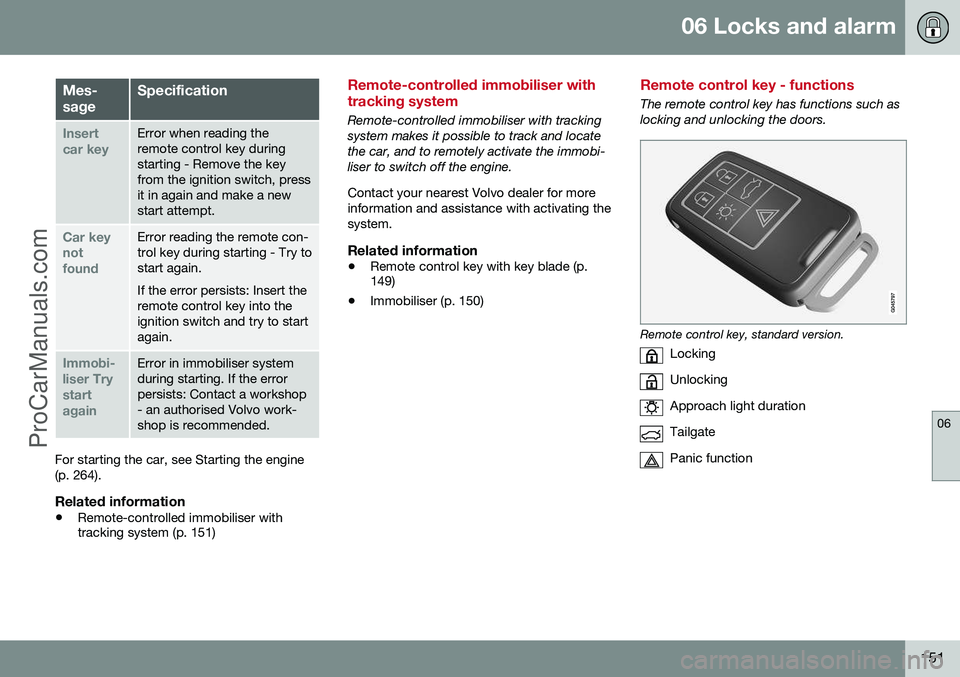
The remote control key has functions such as locking and unlocking the doors.
Remote control key, standard version.
Locking
Unlocking
Approach light duration
Tailgate
Panic function
ProCarManuals.co’
Page 155 of 442
06 Locks and alarm
06
* Option/accessory, for more information, see Introduction.153
Remote control key - range
Remote control key (p. 149) functions have a range of about 20 metres from the car. If the car does not verify a button being pressed - move closer and try again.
NOTE
The remote control key functions may be disrupted by surrounding radio waves,buildings, topographical conditions, etc.The car can always be locked/unlockedwith the key blade, Detachable key blade -unlocking doors (p. 156).
If the remote control key is removed from the car when the engine is running or key position(p. 70) I or II is active, and if all doors are
closed, then a warning message is shown inthe information display in the combinedinstrument panel and an audio reminder sig-nal sounds at the same time. The message is extinguished and the audible reminder signal stops when the remote con-trol key is brought back to the car aftereither/or:
• The remote control key has been inserted into the ignition switch.
• Speed exceeds 30 km/h.
• the
OK button has been pressed.
Related information
• Remote control key - functions (p. 151)
PCC* - unique functions
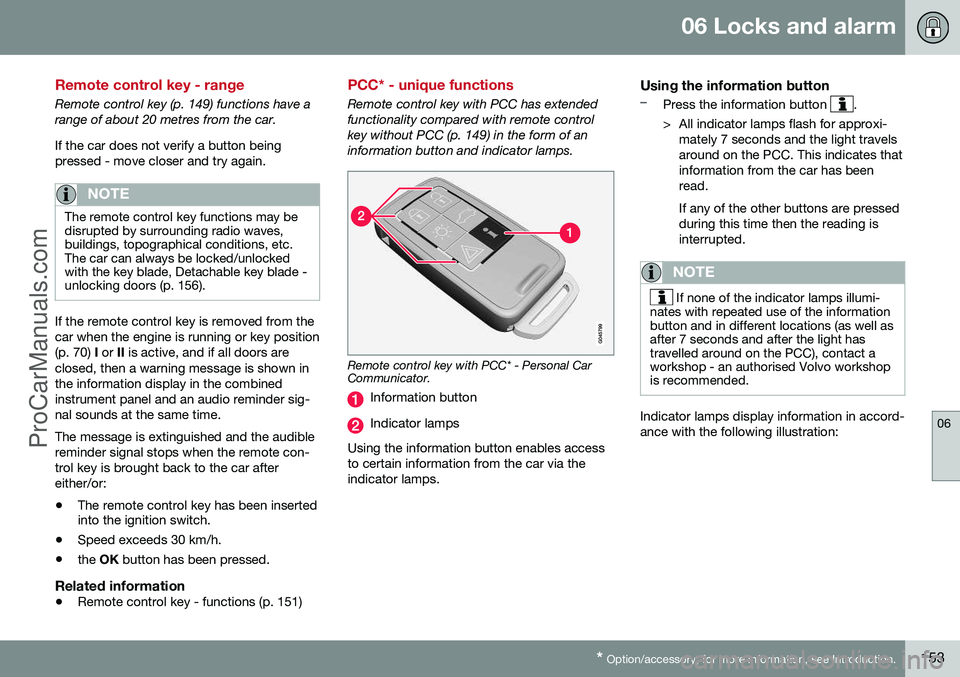
Remote control key with PCC has extended functionality compared with remote controlkey without PCC (p. 149) in the form of aninformation button and indicator lamps.
Remote control key with PCC* - Personal Car Communicator.
Information button
Indicator lamps
Using the information button enables access to certain information from the car via theindicator lamps.
Using the information button–Press the information button .
> All indicator lamps flash for approxi- mately 7 seconds and the light travels around on the PCC. This indicates thatinformation from the car has beenread. If any of the other buttons are pressed during this time then the reading isinterrupted.
NOTE
If none of the indicator lamps illumi-
nates with repeated use of the information button and in different locations (as well asafter 7 seconds and after the light hastravelled around on the PCC), contact aworkshop - an authorised Volvo workshopis recommended.
Indicator lamps display information in accord- ance with the following illustration:
ProCarManuals.co’
Page 161 of 442
06 Locks and alarm
06
* Option/accessory, for more information, see Introduction.159
NOTE
Volvo recommends that the batteries to be used in the remote control key/PCC fulfilUN Manual of Test and Criteria, Part III,sub-section 38.3. Batteries fitted in thefactory or replaced by an authorised Volvoworkshop fulfil the above criteria.
Assembly1. Press the remote control key together.
2. Hold the remote control key with the slot
pointed up and lower the key blade into its slot.
3. Lightly press the key blade. You should hear a "click" when the key blade islocked in.
IMPORTANT
Make sure that exhausted batteries are disposed of in a manner which is kind tothe environment.
Related information
• Remote control key with key blade (p. 149)
• Remote control key - functions (p. 151)
Keyless drive*
Keyless drive, only with PCC (p. 153) 2
means
that the car's lock and starting systems can be operated keylessly. The Keyless drive function in the PCC allows the car to be unlocked (p. 161), driven andlocked without the need for a key. You simplyhave to have the PCC with you. The systemmakes it easier and more convenient to openthe car, e.g. when your hands are full. Both of the car's PCCs incorporate the Keyless function. Additional PCCs can beordered, see Remote control key with keyblade (p. 149). The car's electrical system can be set to three different levels - key position 0, I and II
(p. 70) - with the remote control key.
Related information
• Keyless drive* - PCC range (p. 159)
• Keyless drive* - handling the PCC safely (p. 160)
• Keyless drive* - interference to PCC func-tion (p. 160)
Keyless drive* - PCC range
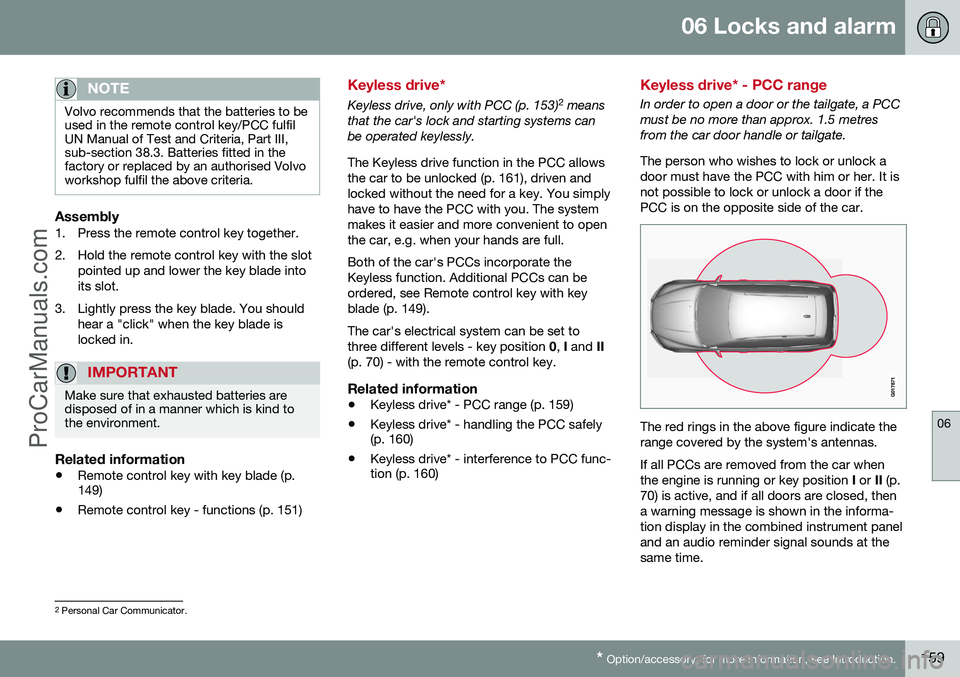
In order to open a door or the tailgate, a PCC must be no more than approx. 1.5 metresfrom the car door handle or tailgate. The person who wishes to lock or unlock a door must have the PCC with him or her. It isnot possible to lock or unlock a door if thePCC is on the opposite side of the car.
The red rings in the above figure indicate the range covered by the system's antennas. If all PCCs are removed from the car when the engine is running or key position
I or II (p.
70) is active, and if all doors are closed, thena warning message is shown in the informa-tion display in the combined instrument paneland an audio reminder signal sounds at thesame time.
2 Personal Car Communicator.
ProCarManuals.co’
Page 172 of 442
||
06 Locks and alarm
06
170* Option/accessory, for more information, see Introduction.
WARNING
Each rear door has two knob controls - do not mix up the child safety locks with man-ual door locks.
NOTE
• A door's knob control only blocks that particular door - not both rear doorssimultaneously.
• Cars with an electric child safety lockdo not have a manual child lock.
Related information
•
Child safety locks - electrical activation* (p. 170)
• Locking/unlocking - from the inside (p.165)
• Locking/unlocking - from the outside (p.164)
Child safety locks - electrical activation*
Child safety locks with electrical activation prevent children from opening the rear doorsor windows from the inside.
ActivationThe child safety locks can be activated/deac-tivated in all key positions (p. 70) higher than0
. Activation/deactivation can be performed
up to 2 minutes after switching off the engine,provided that no door is opened. To activate the child safety locks:
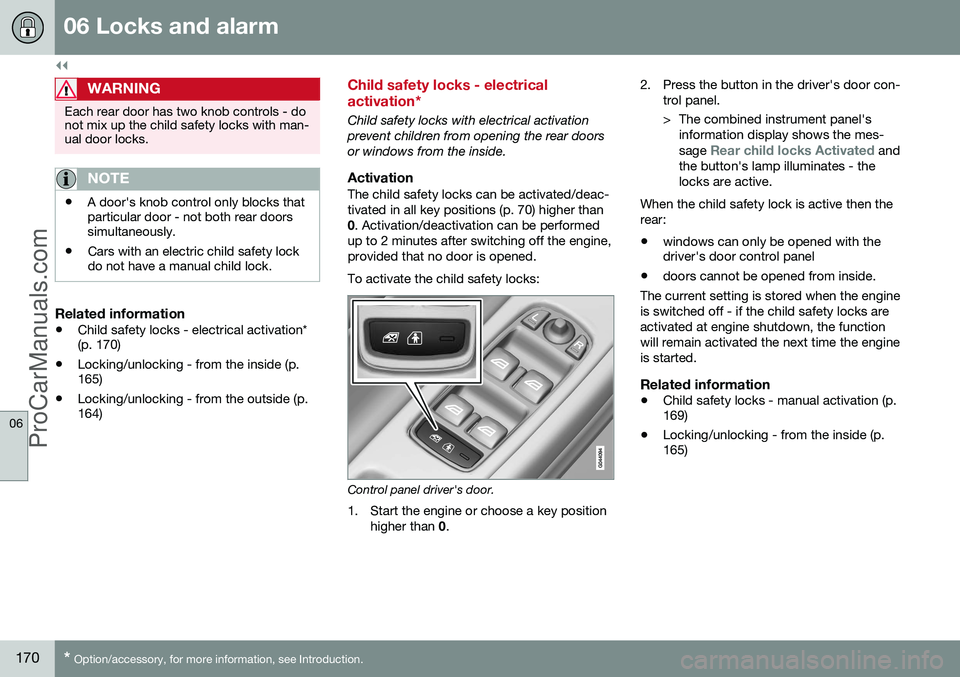
Control panel driver's door.
1. Start the engine or choose a key position higher than 0. 2. Press the button in the driver's door con-
trol panel.
> The combined instrument panel'sinformation display shows the mes- sage
Rear child locks Activated and
the button's lamp illuminates - the locks are active.
When the child safety lock is active then therear:
• windows can only be opened with the driver's door control panel
• doors cannot be opened from inside.
The current setting is stored when the engine is switched off - if the child safety locks areactivated at engine shutdown, the functionwill remain activated the next time the engineis started.
Related information
• Child safety locks - manual activation (p. 169)
• Locking/unlocking - from the inside (p.165)
ProCarManuals.co’
Page 174 of 442
06 Locks and alarm
06
172
Alarm indicator
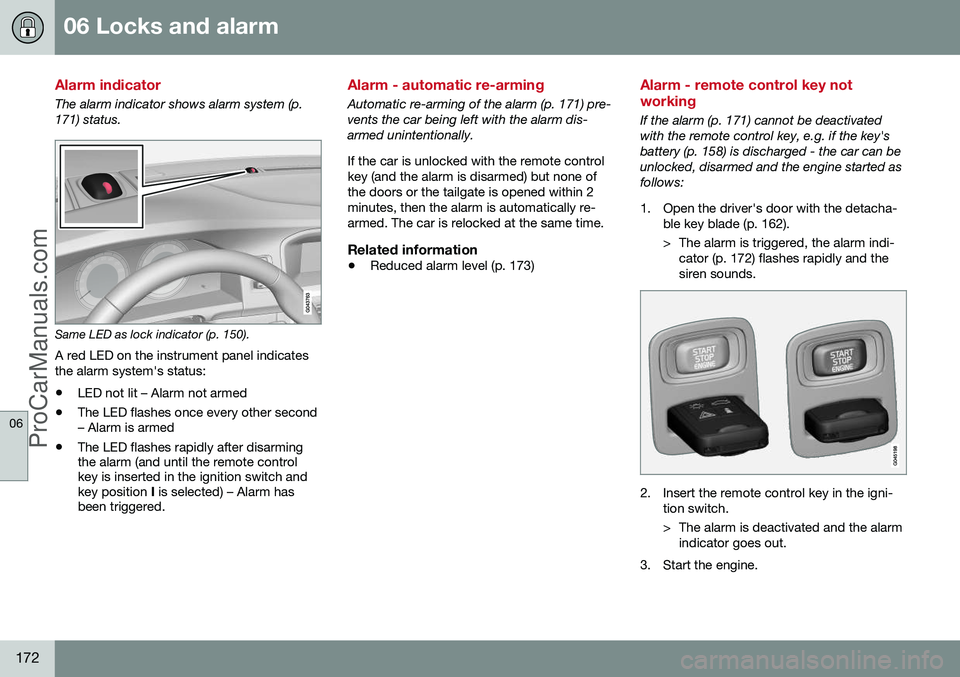
The alarm indicator shows alarm system (p. 171) status.
Same LED as lock indicator (p. 150).
A red LED on the instrument panel indicates the alarm system's status:
• LED not lit – Alarm not armed
• The LED flashes once every other second – Alarm is armed
• The LED flashes rapidly after disarmingthe alarm (and until the remote controlkey is inserted in the ignition switch andkey position
I is selected) – Alarm has
been triggered.
Alarm - automatic re-arming
Automatic re-arming of the alarm (p. 171) pre- vents the car being left with the alarm dis-armed unintentionally. If the car is unlocked with the remote control key (and the alarm is disarmed) but none ofthe doors or the tailgate is opened within 2minutes, then the alarm is automatically re-armed. The car is relocked at the same time.
Related information
• Reduced alarm level (p. 173)
Alarm - remote control key not working
If the alarm (p. 171) cannot be deactivated with the remote control key, e.g. if the key'sbattery (p. 158) is discharged - the car can beunlocked, disarmed and the engine started asfollows:
1. Open the driver's door with the detacha-
ble key blade (p. 162).
> The alarm is triggered, the alarm indi-cator (p. 172) flashes rapidly and the siren sounds.
2. Insert the remote control key in the igni- tion switch.
> The alarm is deactivated and the alarmindicator goes out.
3. Start the engine.
ProCarManuals.co’
Page 177 of 442
07 Driver support
07
* Option/accessory, for more information, see Introduction.175
Active chassis - Four C*
Active chassis "Four-C" (Continously Controlled Chassis Concept), regulates thecharacteristics of the shock absorbers so thatthe car's driving characteristics can beadjusted. There are three settings: Comfort,
Sport and Advanced .
ComfortThis setting means that the car is perceivedas being more comfortable on rough anduneven road surfaces. Shock absorption issoft and the movement of the body is smoothand gentle.
SportThis setting means that the car is perceivedas being more sporty and is recommendedfor more active driving. Steering response isfaster than in the Comfort mode. Shockabsorption is harder and the body follows theroad in order to reduce rolling during corner-ing.
AdvancedThis setting is only recommended on veryeven and smooth road surfaces. The shock absorbers are optimised for maxi- mum roadholding and rolling in bends is fur-ther minimised.
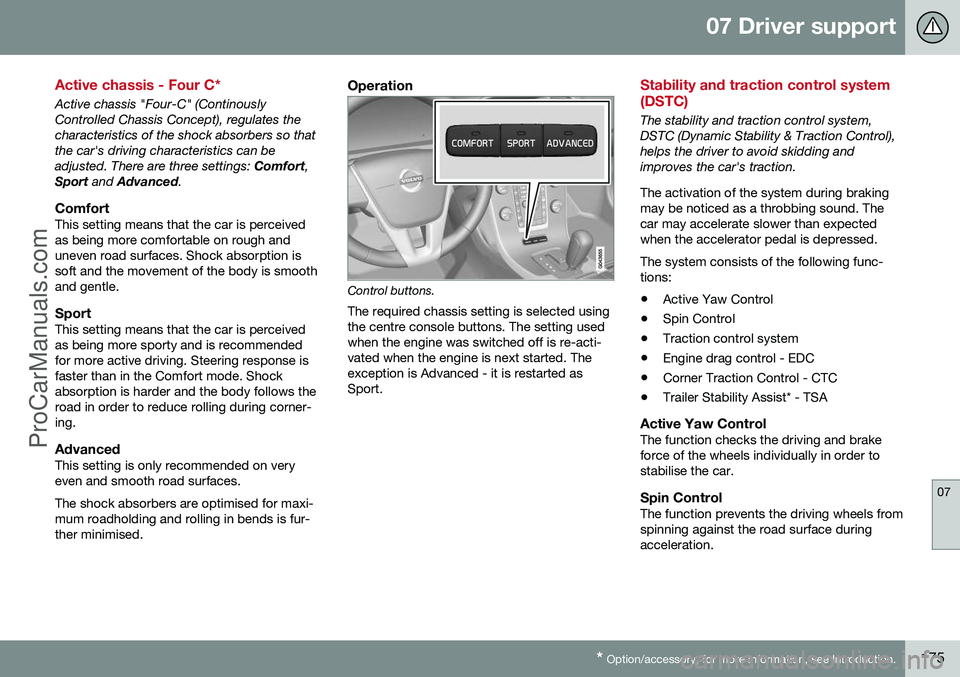
Operation
Control buttons.
The required chassis setting is selected using the centre console buttons. The setting usedwhen the engine was switched off is re-acti-vated when the engine is next started. Theexception is Advanced - it is restarted asSport.
Stability and traction control system (DSTC)
The stability and traction control system, DSTC (Dynamic Stability & Traction Control),helps the driver to avoid skidding andimproves the car's traction. The activation of the system during braking may be noticed as a throbbing sound. Thecar may accelerate slower than expectedwhen the accelerator pedal is depressed. The system consists of the following func- tions: • Active Yaw Control
• Spin Control
• Traction control system
• Engine drag control - EDC
• Corner Traction Control - CTC
• Trailer Stability Assist* - TSA
Active Yaw ControlThe function checks the driving and brake force of the wheels individually in order tostabilise the car.
Spin ControlThe function prevents the driving wheels fromspinning against the road surface duringacceleration.
ProCarManuals.co’
Page 178 of 442
||
07 Driver support
07
176* Option/accessory, for more information, see Introduction.
Traction control systemThe function is active at low speed and trans- fers power from the driving wheel that is spin-ning to the one that is not.
Engine drag control (EDC)EDC (Engine Drag Control) prevents involun-tary wheel locking, e.g. after shifting down orengine braking when driving in low gears onslippery road surfaces. Involuntary wheel locking while driving can, amongst other things, impair the driver's abil-ity to steer the car.
Corner Traction Control (CTC)*CTC compensates for understeer and allowshigher than normal acceleration in a bendwithout wheelspin on the inner wheel, e.g. onan arcing motorway entrance road to quicklyreach the prevailing traffic speed.
Trailer Stability Assist 1Trailer stability assist (p. 312) function is tostabilise the car and trailer combination if itbegins to snake. For more information, seeDriving with a trailer (p. 306).
NOTE
The function is deactivated if the driver selects
Sport mode.
Related information
•Stability and traction control system (DSTC) - operation (p. 176)
• Stability and traction control system(DSTC) - symbols and messages (p. 178)
Stability and traction control system (DSTC) - operation
The stability and traction control system (p. 175) (DSTC - Dynamic Stability & TractionControl), helps the driver to avoid skiddingand improves the car's traction.
Selection of level - Sport modeThe stability and traction control system isalways activated - it cannot be switched off. However, the driver can select the
Sport
mode, which allows for a more active driving experience. In Sport mode the system
detects whether the accelerator pedal, steer-ing wheel movements and cornering are moreactive than in normal driving and then allowscontrolled skidding with the rear section up toa certain level before it intervenes and stabil-ises the car. If the driver interrupts a controlled skid by releasing the accelerator pedal then the sta-bility and traction control system intervenesand stabilises the car. With Sport mode, maximum traction is
obtained if the car has become stuck, or when driving on a loose surface - e.g. sand ordeep snow. Sport mode is selected in the menu system
MY CAR. For a description of the menu sys- tem, see MY CAR (p. 103).
1 Included in the installation of Volvo genuine towbar.
ProCarManuals.co’
Page 179 of 442
07 Driver support
07
177
The
Sport mode is active until the driver
deselects it or until the engine is switched off - after the engine is started the next time thestability and traction control system is back inits normal mode again.
Related information
• Stability and traction control system (DSTC) - symbols and messages (p. 178)
ProCarManuals.co’
Page 180 of 442
07 Driver support
07
178
Stability and traction control system (DSTC) - symbols and messages
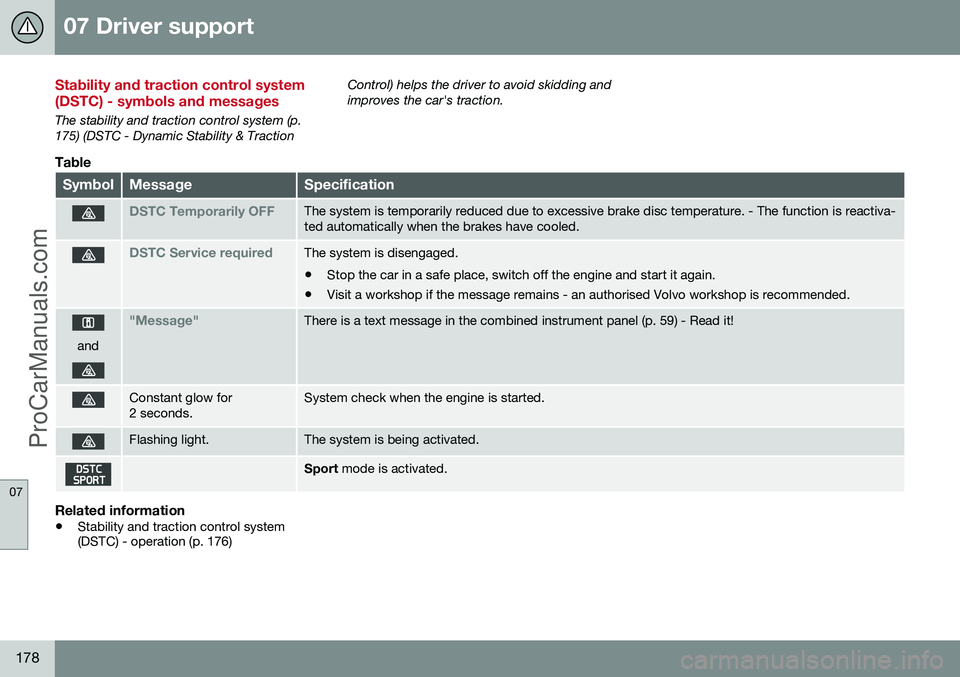
The stability and traction control system (p. 175) (DSTC - Dynamic Stability & TractionControl) helps the driver to avoid skidding andimproves the car's traction.
Table
SymbolMessageSpecification
DSTC Temporarily OFFThe system is temporarily reduced due to excessive brake disc temperature. - The function is reactiva- ted automatically when the brakes have cooled.
DSTC Service requiredThe system is disengaged.
• Stop the car in a safe place, switch off the engine and start it again.
• Visit a workshop if the message remains - an authorised Volvo workshop is recommended.
and
"Message"There is a text message in the combined instrument panel (p. 59) - Read it!
Constant glow for 2 seconds.System check when the engine is started.
Flashing light.The system is being activated.
Sport
mode is activated.
Related information
•Stability and traction control system (DSTC) - operation (p. 176)
ProCarManuals.co’
Page 186 of 442
||
07 Driver support
07
184* Option/accessory, for more information, see Introduction.
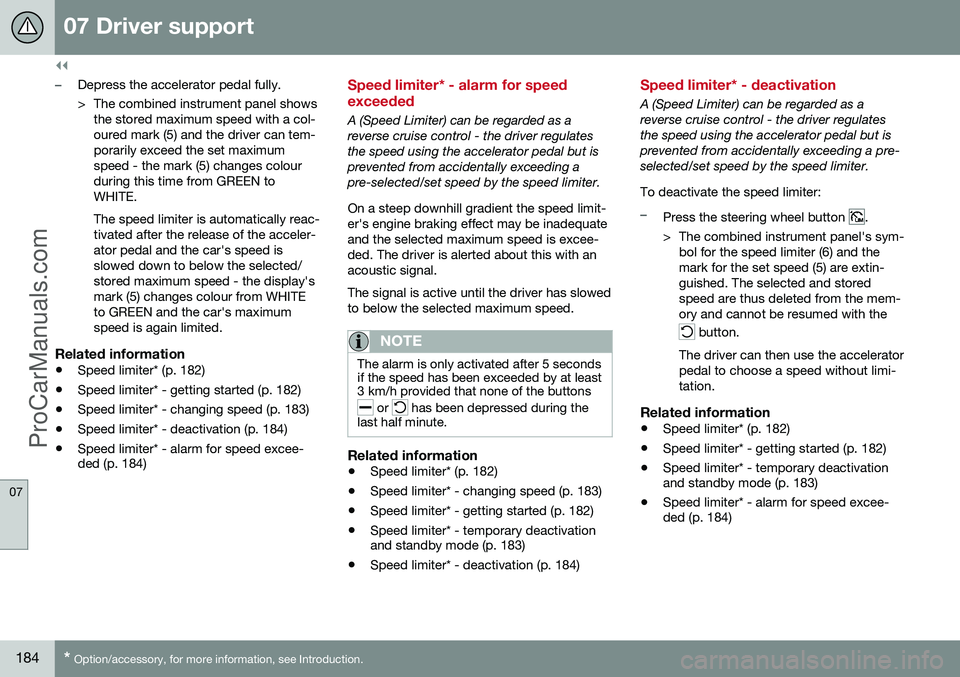
–Depress the accelerator pedal fully.
> The combined instrument panel shows
the stored maximum speed with a col- oured mark (5) and the driver can tem-porarily exceed the set maximumspeed - the mark (5) changes colourduring this time from GREEN toWHITE. The speed limiter is automatically reac- tivated after the release of the acceler-ator pedal and the car's speed isslowed down to below the selected/stored maximum speed - the display'smark (5) changes colour from WHITEto GREEN and the car's maximumspeed is again limited.
Related information
• Speed limiter* (p. 182)
• Speed limiter* - getting started (p. 182)
• Speed limiter* - changing speed (p. 183)
• Speed limiter* - deactivation (p. 184)
• Speed limiter* - alarm for speed excee- ded (p. 184)
Speed limiter* - alarm for speed exceeded
A (Speed Limiter) can be regarded as a reverse cruise control - the driver regulatesthe speed using the accelerator pedal but isprevented from accidentally exceeding apre-selected/set speed by the speed limiter. On a steep downhill gradient the speed limit- er's engine braking effect may be inadequateand the selected maximum speed is excee-ded. The driver is alerted about this with anacoustic signal. The signal is active until the driver has slowed to below the selected maximum speed.
NOTE
The alarm is only activated after 5 seconds if the speed has been exceeded by at least3 km/h provided that none of the buttons
or has been depressed during the
last half minute.
Related information
• Speed limiter* (p. 182)
• Speed limiter* - changing speed (p. 183)
• Speed limiter* - getting started (p. 182)
• Speed limiter* - temporary deactivation and standby mode (p. 183)
• Speed limiter* - deactivation (p. 184)
Speed limiter* - deactivation
A (Speed Limiter) can be regarded as a reverse cruise control - the driver regulatesthe speed using the accelerator pedal but isprevented from accidentally exceeding a pre-selected/set speed by the speed limiter. To deactivate the speed limiter:
–Press the steering wheel button .
> The combined instrument panel's sym- bol for the speed limiter (6) and the mark for the set speed (5) are extin-guished. The selected and storedspeed are thus deleted from the mem-ory and cannot be resumed with the
button.
The driver can then use the accelerator pedal to choose a speed without limi-tation.
Related information
• Speed limiter* (p. 182)
• Speed limiter* - getting started (p. 182)
• Speed limiter* - temporary deactivation and standby mode (p. 183)
• Speed limiter* - alarm for speed excee-ded (p. 184)
ProCarManuals.co’