stop start VOLVO V60 2014 Workshop Manual
[x] Cancel search | Manufacturer: VOLVO, Model Year: 2014, Model line: V60, Model: VOLVO V60 2014Pages: 442, PDF Size: 13.85 MB
Page 304 of 442
08 Starting and driving
08
302
Fuel - petrol
Petrol is used as fuel. Petrol must fulfil the EN 228 standard. Most engines can be run with octane ratings of 95and 98 RON. Only in exceptional casesshould 91 RON be used.
• 95 RON can be used for normal driving.
• 98 RON is recommended for optimum performance and minimum fuel consump-tion.
When driving in temperatures above +38 °C, fuel with the highest possible octane rating isrecommended for optimum performance andfuel economy.
IMPORTANT
• Always refuel with unleaded petrol so as not to damage the catalytic con-verter.
• Do not use additives not recom-mended by Volvo.
Related information
•
Fuel - handling (p. 301)
• Economical driving (p. 305)
• Fuel consumption and CO2 emissions (p. 403)
• Fuel tank - volume (p. 402)
Fuel - diesel
Diesel is used as fuel. Only use diesel fuel from well-known produc- ers. Never use diesel of dubious quality. Die-sel should fulfil the EN 590 or JIS K2204standards. Diesel engines are sensitive tocontaminants in the fuel, such as excessivelyhigh volumes of sulphur particles for exam-ple. At low temperatures (-6 °C to -40 °C), a par- affin precipitate may form in the diesel fuel,which may lead to ignition problems. Specialdiesel fuel designed for low temperaturesaround freezing point is available from themajor oil companies. This fuel is less viscousat low temperatures and reduces the risk ofparaffin precipitate. The risk of condensation in the fuel tank is reduced if the tank is kept well filled. Whenrefuelling, check that the area around the fuelfiller pipe is clean. Avoid spilling fuel onto thepaintwork. Wash off any spillage with deter-gent and water.
IMPORTANT
Only ever use fuel that fulfils the European diesel standard. The sulphur content must be a maximum of 50 ppm.
IMPORTANT
Diesel type fuels that must not be used:
• Special additives
• Marine diesel fuel
• Heating oil
• FAME 15
(Fatty Acid Methyl Ester) and
vegetable oil.
These fuels do not fulfil the requirements in accordance with Volvo recommendationsand generate increased wear and enginedamage that is not covered by the Volvowarranty.
Empty tankThe design of the fuel system in a diesel engine means that if the vehicle runs out offuel, the tank may need to be vented in theworkshop in order to restart the engine afterfuelling. Once the engine has stopped due to fuel starvation, the fuel system needs a fewmoments to carry out a check. Do this beforestarting the engine, once the fuel tank hasbeen filled with diesel:
1. Insert the remote control key in the igni- tion switch and push it in to the end posi-
15Diesel fuel may contain a certain amount of FAME, but further amounts must not be added.
ProCarManuals.co’
Page 305 of 442
08 Starting and driving
08
303
tion, see Key positions (p. 70) for more information.
2. Press the START button without
depressing the brake and/or clutch pedal.
3. Wait approx. 1 minute.
4. To start the engine: Depress the brake and/or clutch pedal and then press the START button again.
NOTE
Before filling with fuel in the event of fuel shortage:
• Stop the car on as flat/level ground as possible - if the car is tilting there is arisk of air pockets in the fuel supply.
Draining condensation from the fuel filter
The fuel filter separates condensation from the fuel. Condensation can disrupt engineoperation. The fuel filter must be drained at the intervals specified in the Service and Warranty Bookletor if you suspect that the car has been filledwith contaminated fuel. For more information,see Volvo service programme (p. 340).
IMPORTANT
Certain special additives remove the water separation in the fuel filter.
Related information
•
Fuel - handling (p. 301)
• Diesel particle filter (DPF) (p. 305)
• Fuel consumption and CO2 emissions (p. 403)
Catalytic converters
The purpose of the catalytic converters is to purify exhaust gases. They are located closeto the engine so that operating temperature isreached quickly. The catalytic converters consist of a monolith (ceramic or metal) with channels. The channelwalls are lined with a thin layer of platinum/rhodium/palladium. These metals act as cata-lysts, i.e. they participate in and accelerate achemical reaction without being used upthemselves.
Lambda-sond TM
oxygen sensorThe Lambda-sond is part of a control systemintended to reduce emissions and improvefuel economy (see Fuel consumption andCO2 emissions (p. 403)). An oxygen sensor monitors the oxygen con- tent of the exhaust gases leaving the engine.This value is fed into an electronic systemthat continuously controls the injectors. Theratio of fuel to air directed to the engine iscontinuously adjusted. These adjustmentscreate optimal conditions for efficient com-bustion, and together with the three-way cat-alytic converter reduce harmful emissions(hydrocarbons, carbon monoxide and nitrousoxides).
ProCarManuals.co’
Page 309 of 442
08 Starting and driving
08
* Option/accessory, for more information, see Introduction.307
•
Do not tow a heavy trailer when the car is brand new. Wait until it has been drivenat least 1000 km.
• The brakes are loaded much more thanusual on long and steep downhill slopes.Downshift to a lower gear and adjust yourspeed.
• For safety reasons, the maximum permit-ted speed for the car when coupled witha trailer should not be exceeded. Followthe regulations in force for the permittedspeeds and weights.
• Maintain a low speed when driving with atrailer up long, steep ascents.
• Avoid driving with a trailer on inclines ofmore than 12%.
Trailer cableAn adapter is required if the car's towing bracket has 13 pin electrics and the trailerhas 7 pin electrics. Use an adapter cableapproved by Volvo. Make sure the cable doesnot drag on the ground.
Direction indicators and brake lights on
the trailer
If any of the trailer's lamps for direction indi-cators are broken, then the combined instru-ment panel's symbol for direction indicatorsflashes faster than normal and the information display shows the text
Bulb fail - Ind. signal
trailer. If any of the trailer's lamps for the brake light are broken then the
Bulb fail - Stop lamp
trailer text is shown.
Level control*The rear shock absorbers maintain a constant height irrespective of the car's load (up to themaximum permissible weight). When the caris stationary the rear of the car lowers slightly,which is normal.
Trailer weightsFor information on Volvo's permitted trailerweights, see Towing capacity and towballload (p. 391).
NOTE
The stated maximum permitted trailer weights are those permitted by Volvo.National vehicle regulations can furtherlimit trailer weights and speeds. Towbarscan be certified for higher towing weightsthan the car can actually tow.
WARNING
Follow the stated recommendations for trailer weights. Otherwise, the car andtrailer may be difficult to control in theevent of sudden movement and braking.
Related information
• Driving with a trailer - manual gearbox (p. 308)
• Driving with a trailer - automatic gearbox(p. 308)
• Towing bracket/Towbar (p. 309)
• Lamp replacement (p. 352)
ProCarManuals.co’
Page 314 of 442
||
08 Starting and driving
08
312
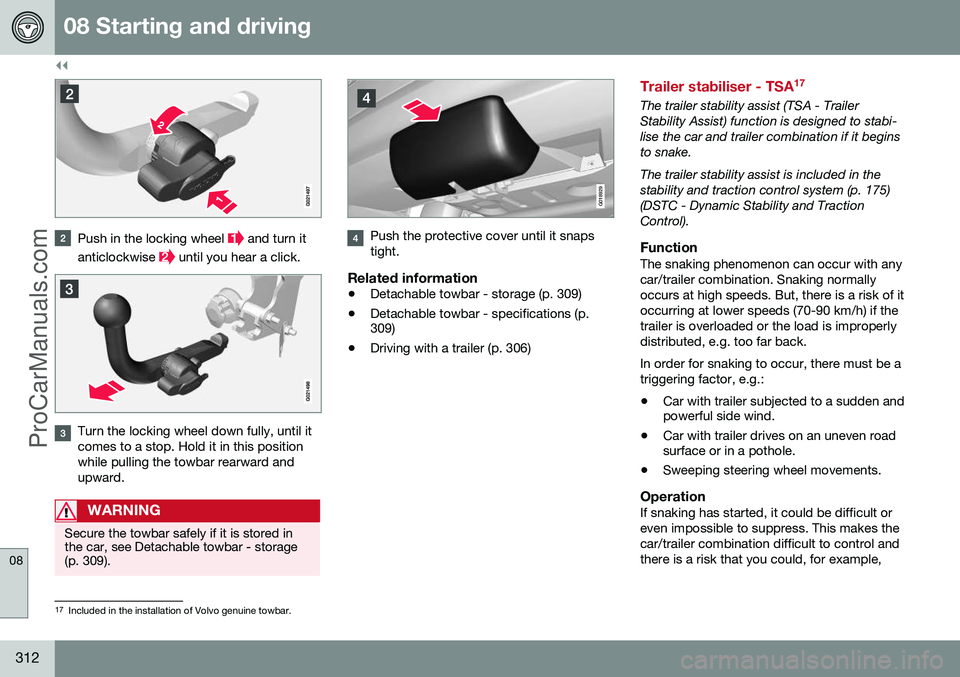
Push in the locking wheel and turn it
anticlockwise
until you hear a click.
Turn the locking wheel down fully, until it comes to a stop. Hold it in this positionwhile pulling the towbar rearward andupward.
WARNING
Secure the towbar safely if it is stored in the car, see Detachable towbar - storage(p. 309).
G018929
Push the protective cover until it snaps tight.
Related information
• Detachable towbar - storage (p. 309)
• Detachable towbar - specifications (p. 309)
• Driving with a trailer (p. 306)
Trailer stabiliser - TSA 17
The trailer stability assist (TSA - Trailer Stability Assist) function is designed to stabi-lise the car and trailer combination if it beginsto snake. The trailer stability assist is included in the stability and traction control system (p. 175)(DSTC - Dynamic Stability and TractionControl).
FunctionThe snaking phenomenon can occur with anycar/trailer combination. Snaking normallyoccurs at high speeds. But, there is a risk of itoccurring at lower speeds (70-90 km/h) if thetrailer is overloaded or the load is improperlydistributed, e.g. too far back. In order for snaking to occur, there must be a triggering factor, e.g.:
• Car with trailer subjected to a sudden and powerful side wind.
• Car with trailer drives on an uneven roadsurface or in a pothole.
• Sweeping steering wheel movements.
OperationIf snaking has started, it could be difficult or even impossible to suppress. This makes thecar/trailer combination difficult to control andthere is a risk that you could, for example,
17
Included in the installation of Volvo genuine towbar.
ProCarManuals.co’
Page 315 of 442
08 Starting and driving
08
313
end up in the wrong lane or leave the car- riageway. The trailer stability assist continually monitors the car's movements, particularly lateralmovements. If snaking is detected, the frontwheels are individually braked. This serves tostabilise the car/trailer combination. This isoften enough to help the driver regain controlof the car. If snaking is not eliminated the first time the trailer stability assist comes into action, thecar/trailer combination is braked with allwheels and engine power is reduced. Oncesnaking has been gradually suppressed andthe car/trailer combination is stable onceagain, the system stops regulating and thedriver once again has full control of the car.For more information, see Stability and trac-tion control system (DSTC) - operation (p.176)
MiscellaneousThe trailer stability assist can engage withinthe speed interval 60-160 km/h.
NOTE
TSA function is switched off if the driver selects Sport mode, see Stability and
traction control system (DSTC) (p. 175).
The trailer stability assist may fail to engage if the driver uses sudden steering wheel move-ments to try to rectify the snaking because in such a situation the system cannot determinewhether it is the trailer or the driver that iscausing the snaking.
When the trailer stability assist isworking, the combined instrument
panel's DSTC symbol flashes.
Related information
•Stability and traction control system (DSTC) - symbols and messages (p. 178)
Towing
During towing, one vehicle is towed by another vehicle using a tow rope.
IMPORTANT
Note that the car must always be towed with the wheels rolling forward. Do not tow the vehicle at speeds higher than 80 km/h or for distances in excess of80 km.
Find out the statutory maximum speed limit for towing before towing begins.
1. Unlock the steering lock by inserting the
remote control key in the ignition switch and giving a long press on the START/
STOP ENGINE button - key position II is
activated, see Key positions (p. 70) formore information about key positions.
2. The remote control key must remain in the ignition switch while the car is beingtowed.
3. Keep the towline taut when the towing vehicle reduces speed by holding yourfoot gently pressed on the brake pedal -thereby avoiding unnecessary jerking.
4. Be prepared to brake to stop.
ProCarManuals.co’
Page 337 of 442
09 Wheels and tyres
09
}}
335
Emergency puncture repair - operation
Emergency puncture repair, where the emer- gency puncture repair kit (TMK - TemporaryMobility Kit) is used to seal a puncture andcheck and adjust the tyre pressure (p. 407).
Emergency puncture repair
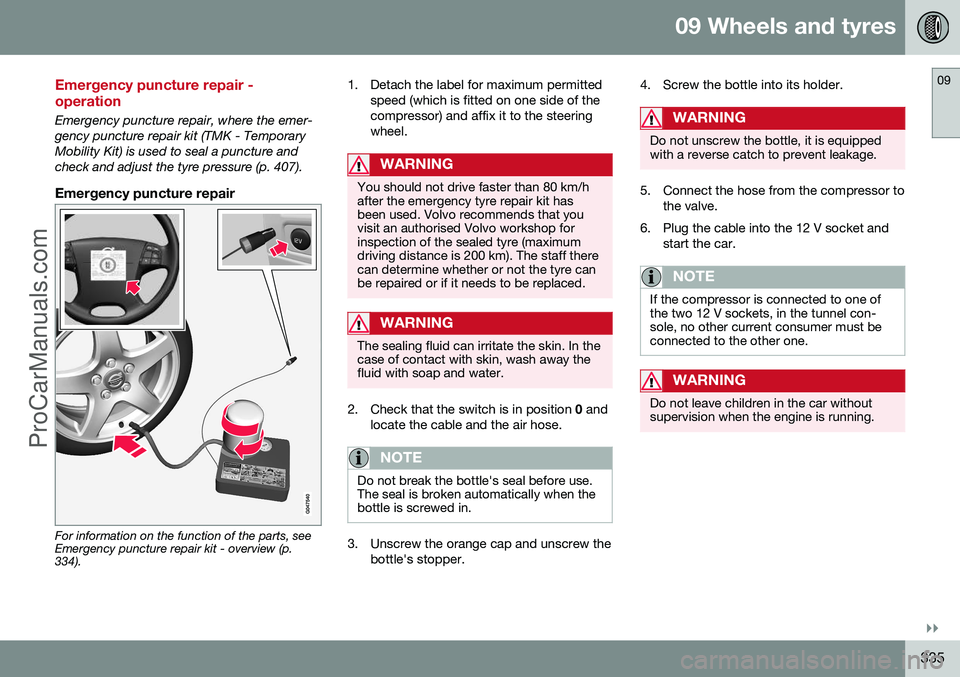
For information on the function of the parts, see Emergency puncture repair kit - overview (p.334).1. Detach the label for maximum permitted
speed (which is fitted on one side of the compressor) and affix it to the steeringwheel.
WARNING
You should not drive faster than 80 km/h after the emergency tyre repair kit hasbeen used. Volvo recommends that youvisit an authorised Volvo workshop forinspection of the sealed tyre (maximumdriving distance is 200 km). The staff therecan determine whether or not the tyre canbe repaired or if it needs to be replaced.
WARNING
The sealing fluid can irritate the skin. In the case of contact with skin, wash away thefluid with soap and water.
2. Check that the switch is in position 0 and
locate the cable and the air hose.
NOTE
Do not break the bottle's seal before use. The seal is broken automatically when thebottle is screwed in.
3. Unscrew the orange cap and unscrew the bottle's stopper. 4. Screw the bottle into its holder.
WARNING
Do not unscrew the bottle, it is equipped with a reverse catch to prevent leakage.
5. Connect the hose from the compressor to
the valve.
6. Plug the cable into the 12 V socket and start the car.
NOTE
If the compressor is connected to one of the two 12 V sockets, in the tunnel con-sole, no other current consumer must beconnected to the other one.
WARNING
Do not leave children in the car without supervision when the engine is running.
ProCarManuals.co’
Page 361 of 442
10 Maintenance and service
10
359
LightingWAType
–––
Reversing lamp21P21W LL
Rear fog lamp21H21W LL
A
Watt
Related information
• Lamp replacement (p. 352)
• Lamp replacement - location of rear lamps (p. 357)
• Lamp replacement - vanity mirror lighting(p. 358)
Wiper blades
The wiper blades sweep water away from the windscreen and rear window. Together withthe washer fluid they clean the windows andensure visibility for driving. The windscreen wiper blades must be in serv- ice position when they are to be replaced.
Service position
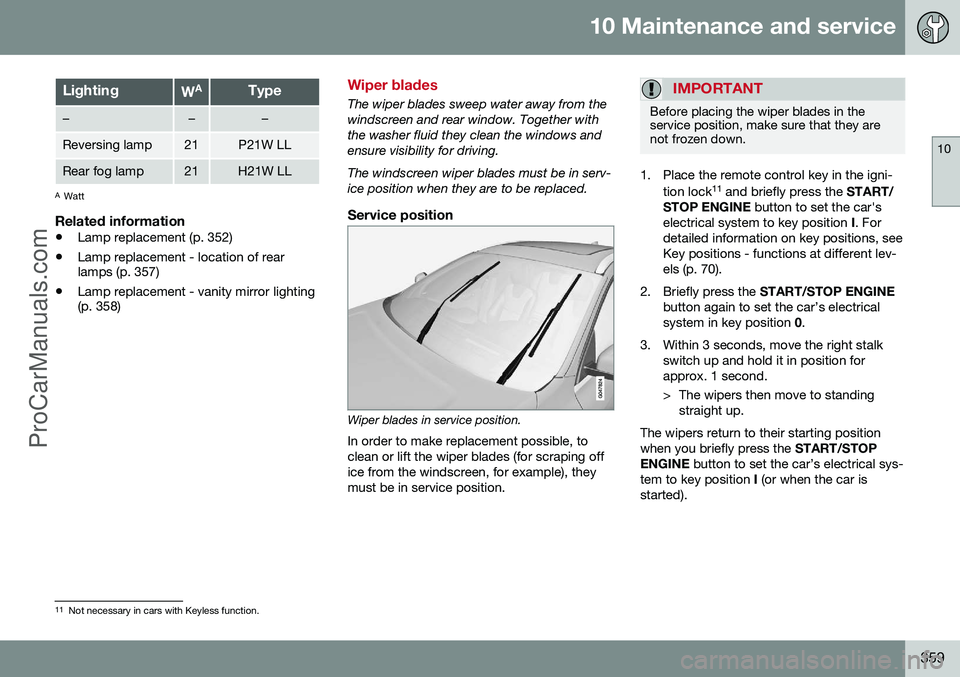
Wiper blades in service position.
In order to make replacement possible, to clean or lift the wiper blades (for scraping office from the windscreen, for example), theymust be in service position.
IMPORTANT
Before placing the wiper blades in the service position, make sure that they arenot frozen down.
1. Place the remote control key in the igni- tion lock 11
and briefly press the START/
STOP ENGINE button to set the car's
electrical system to key position I. For
detailed information on key positions, see Key positions - functions at different lev-els (p. 70).
2. Briefly press the START/STOP ENGINE
button again to set the car’s electricalsystem in key position 0.
3. Within 3 seconds, move the right stalk switch up and hold it in position forapprox. 1 second.
> The wipers then move to standingstraight up.
The wipers return to their starting position when you briefly press the START/STOP
ENGINE button to set the car’s electrical sys-
tem to key position I (or when the car is
started).
11 Not necessary in cars with Keyless function.
ProCarManuals.co’
Page 362 of 442
||
10 Maintenance and service
10
360
IMPORTANT
If the wiper arms in service position have been folded up from the windscreen, theymust be folded back down onto the wind-screen before the wipers are allowed toreturn to their starting position. This is toavoid scraping the paint on the bonnet.
Replacing the wiper blades
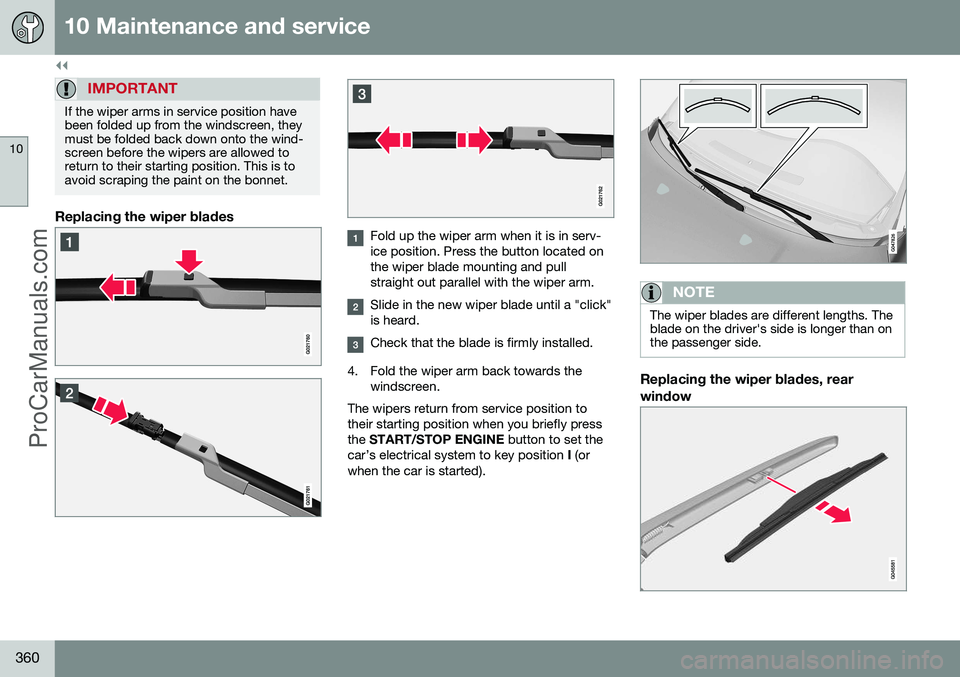
Fold up the wiper arm when it is in serv- ice position. Press the button located onthe wiper blade mounting and pullstraight out parallel with the wiper arm.
Slide in the new wiper blade until a "click" is heard.
Check that the blade is firmly installed.
4. Fold the wiper arm back towards the windscreen.
The wipers return from service position to their starting position when you briefly pressthe START/STOP ENGINE button to set the
car’s electrical system to key position I (or
when the car is started).
NOTE
The wiper blades are different lengths. The blade on the driver's side is longer than onthe passenger side.
Replacing the wiper blades, rear window
ProCarManuals.com
Page 364 of 442
||
10 Maintenance and service
10
362
IMPORTANT
If the following instruction is not observed then the energy saving function for info-tainment may be temporarily disengaged,and/or the message in the information dis-play about the main battery's state ofcharge may be temporarily inapplicable,following the connection of an externalbattery or battery charger:
• The negative battery terminal on the car's starter battery must
never be
used for connecting an external bat-tery or battery charger - only the car
chassis may be used as the ground-
ing point.
See Jump starting with battery (p. 270) for a description of how the cable clampsmust be attached.
NOTE
The life of the battery is shortened if it becomes discharged repeatedly. The life of the battery is affected by several factors, including driving conditions andclimate. Battery starting capacity decrea-ses gradually with time and thereforeneeds to be recharged if the car is notused for a longer time or when it is onlydriven short distances. Extreme cold fur-ther limits starting capacity. To maintain the battery in good condition, at least 15 minutes of driving/week is rec-ommended or that the battery is con-nected to a battery charger with automatictrickle charging. A battery that is kept fully charged has a maximum service life.
Related information
• Battery - symbols (p. 362)
• Starter battery - replacement (p. 363)
• Battery - Start/Stop (p. 365)
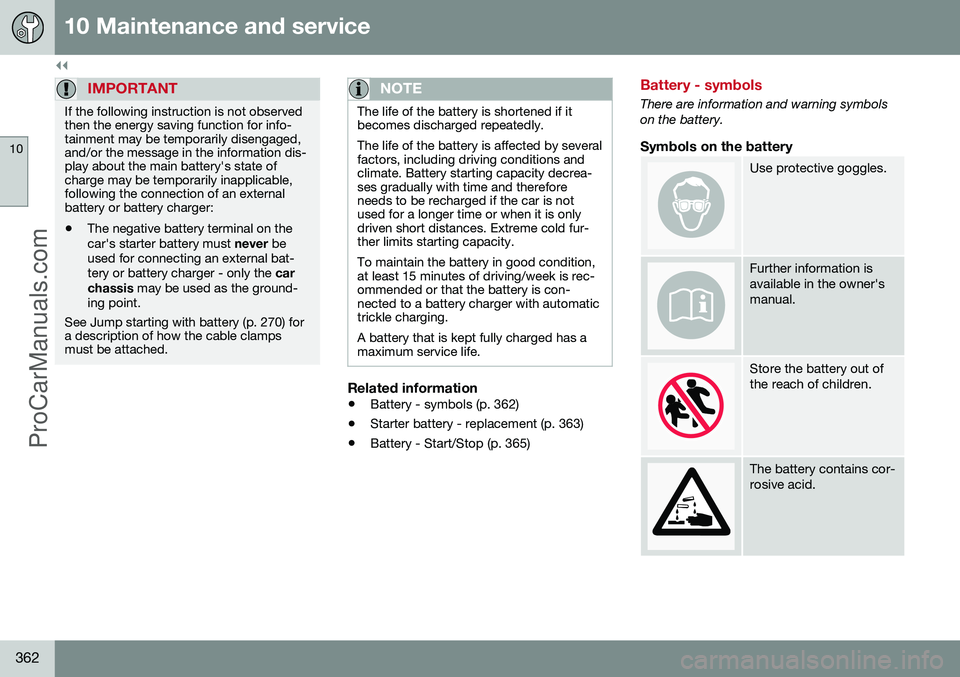
Battery - symbols
There are information and warning symbols on the battery.
Symbols on the battery
Use protective goggles.
Further information is available in the owner'smanual.
Store the battery out of the reach of children.
The battery contains cor- rosive acid.
ProCarManuals.co’
Page 367 of 442
10 Maintenance and service
10
* Option/accessory, for more information, see Introduction.365
For more information on the car's battery - Electrical system (p. 410).
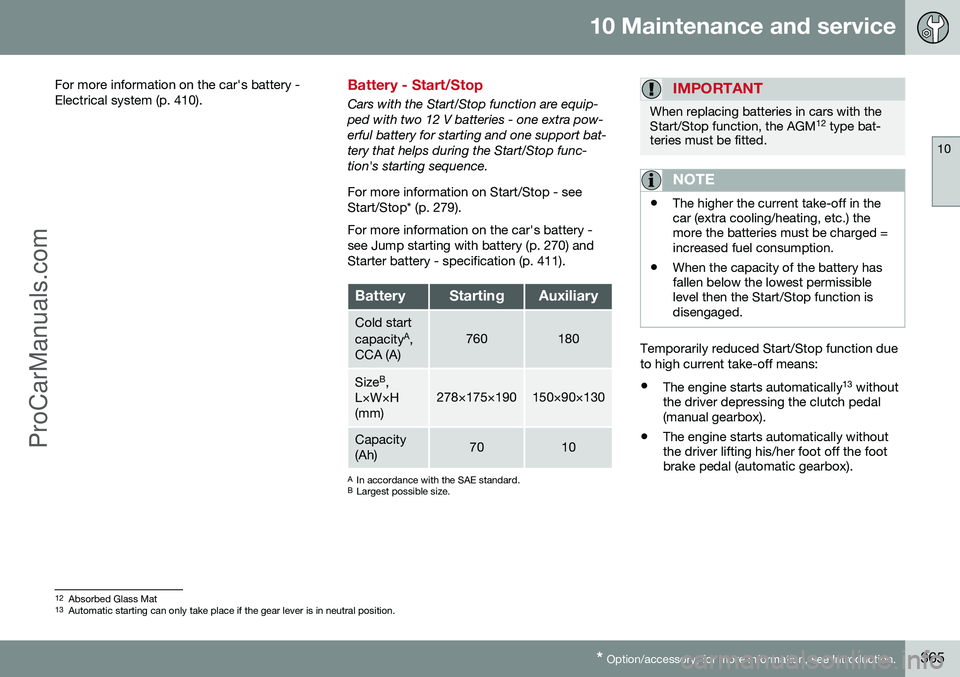
Battery - Start/Stop
Cars with the Start/Stop function are equip- ped with two 12 V batteries - one extra pow-erful battery for starting and one support bat-tery that helps during the Start/Stop func-tion's starting sequence. For more information on Start/Stop - see Start/Stop* (p. 279). For more information on the car's battery - see Jump starting with battery (p. 270) andStarter battery - specification (p. 411).
BatteryStartingAuxiliary
Cold start capacity
A
,
CCA (A)760180
Size B
,
L×W×H (mm)278×175×190150×90×130
Capacity (Ah)7010
A In accordance with the SAE standard.
B Largest possible size.
IMPORTANT
When replacing batteries in cars with the Start/Stop function, the AGM 12
type bat-
teries must be fitted.
NOTE
• The higher the current take-off in the car (extra cooling/heating, etc.) themore the batteries must be charged =increased fuel consumption.
• When the capacity of the battery hasfallen below the lowest permissiblelevel then the Start/Stop function isdisengaged.
Temporarily reduced Start/Stop function due to high current take-off means: •
The engine starts automatically 13
without
the driver depressing the clutch pedal (manual gearbox).
• The engine starts automatically withoutthe driver lifting his/her foot off the footbrake pedal (automatic gearbox).
12
Absorbed Glass Mat
13 Automatic starting can only take place if the gear lever is in neutral position.
ProCarManuals.co’