lock VOLVO XC60 2009 Owner´s Manual
[x] Cancel search | Manufacturer: VOLVO, Model Year: 2009, Model line: XC60, Model: VOLVO XC60 2009Pages: 297, PDF Size: 21.16 MB
Page 239 of 297

06 Maintenance and specifications
Replacing bulbs06
}}
237Brake light
Backup light
Turn signal
Brake lights (LED)
NOTE
If an error message remains in the display
after a faulty bulb has been replaced, con-
tact an authorized Volvo workshop.
Brake lights and Taillights
The brake lights and taillights are replaced from
inside the cargo area.
NOTE Before starting to replace a bulb, see the
general information on page 232.
1. Open the panel.
2.
Remove the bulb holder by turning it coun-
terclockwise.
3. Remove the burned out bulb by pressing it
in and turning it counterclockwise.
4. Insert a new bulb, press it in and turn it clockwise.
5. Reinsert the bulb holder and turn it clock- wise.
License plate lighting 1. Remove the screws with a screwdriver.2. Carefully detach the entire bulb housing
and pull it out.
3. Replace the bulb.
4. Reinsert the entire bulb housing and screw
it into place.
Footwell lighting 1.
Insert a screwdriver at the short end of the
lens closest to the tunnel console (the cen-
ter of the vehicle) and turn gently so that
the lens comes loose. (Applies to both
lights).
2. Turn carefully until the lens comes loose.
3. Replace the bulb.
4. Press the lens back into place. G032485 G031940 G031941
Page 251 of 297
06 Maintenance and specifications
Fuses06
}}
* Option/accessory, for more information, see Introduction. 249
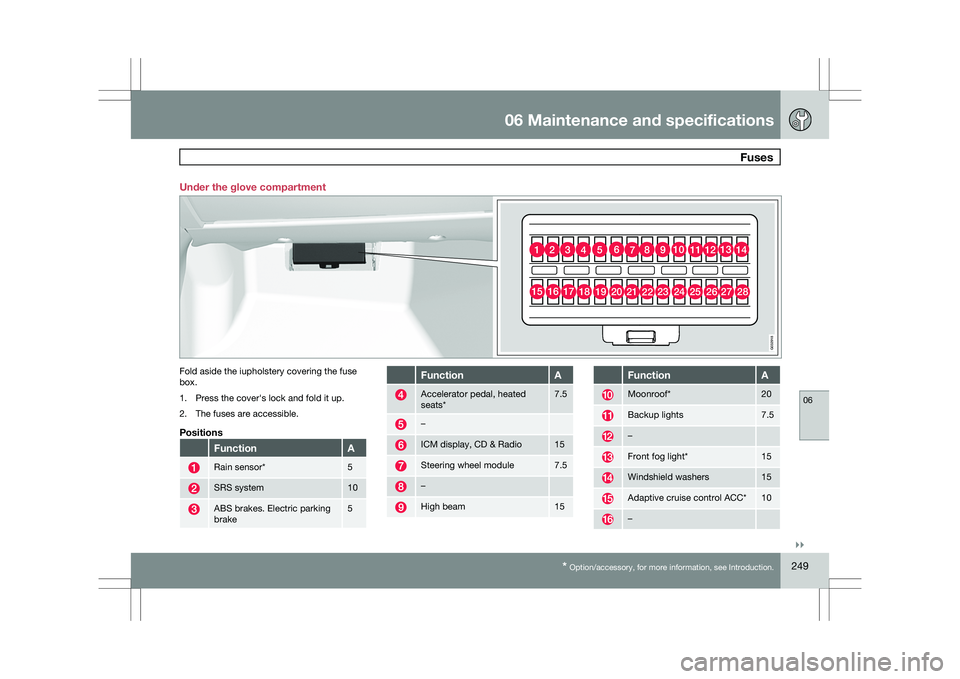
Under the glove compartment
Fold aside the iupholstery covering the fuse
box.
1. Press the cover\fs lock and fold it up.
2. The fuses are accessible.
Positions
Function A
Rain sensor* 5
SRS system 10
ABS brakes. Electric parking
brake 5 Function A
Accelerator pedal, heated
seats* 7.5
–
ICM display, CD & Radio 15
Steering wheel module 7.5
–
High beam 15 Function A
Moonroof* 20
Backup lights 7.5
–
Front fog light* 15
Windshield washers 15
Adaptive cruise control ACC* 10
– 1011121314123456789
2322212019181716152425262728
G032918
Page 252 of 297
06 Maintenance and specificationsFuses 06
250
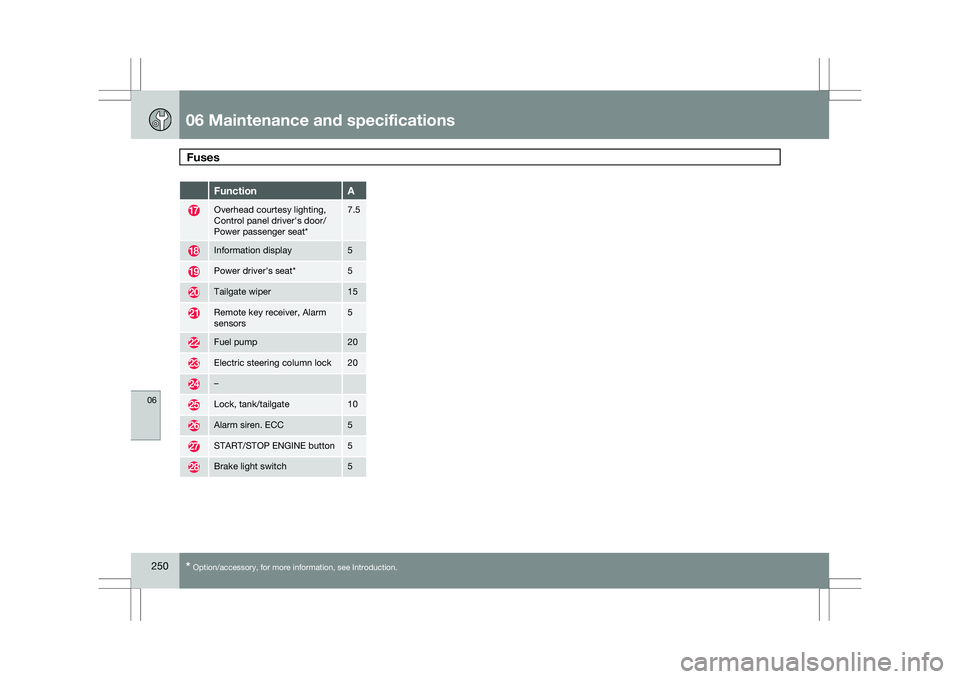
* Option/accessory, for more information, see Introduction. Function A
Overhead courtesy lighting,
Control panel driver\fs door/
Power passenger seat* 7.5
Information display 5
Power driver\fs seat* 5
Tailgate wiper 15
Remote key receiver, Alarm
sensors 5
Fuel pump 20
Electric steering column lock 20
–
Lock, tank/tailgate 10
Alarm siren. ECC 5
START/STOP ENGINE button 5
Brake light switch 5
Page 265 of 297
06 Maintenance and specifications
Wheels and tires06
}}
263
chains in some cases CANNOT be used.
Sufficient clearances between chains and
brakes, suspension and body components
must be maintained.
\b Some strap-on type chains will interfere
with brake components and therefore
CANNOT be used.
\b All Wheel Drive models: Snow chains
should only be installed on the front
wheels. Only chains adapted for AWD
models should be used.
Consult your Volvo retailer for additional snow
chain information.
CAUTION \b
Check local regulations regarding the
use of snow chains before installing.
\b Use single-sided snow chains only.
\b Always follow the chain manufacturer\fs
installation instructions carefully. Install
chains as tightly as possible and
retighten periodically.
\b Never exceed the chain manufacturer\fs
specified maximum speed limit. (Under
no circumstances should you exceed
31 mph (50 km/h).
\b Avoid bumps, holes or sharp turns
when driving with snow chains.
\b The handling of the vehicle can be
adversely affected when driving with
chains. Avoid fast or sharp turns as well
as locked wheel braking.
Snow tires, studded tires 2
Tires for winter use:
\b Owners who live in or regularly commute
through areas with sustained periods of
snow or icy driving conditions are strongly
advised to fit suitable winter tires to help
retain the highest degree of traction.
\b It is important to install winter tires on all
four wheels to help retain traction during cornering, braking, and accelerating. Fail-
ure to do so could reduce traction to an
unsafe level or adversely affect handling.
\b Do not mix tires of different design as this
could also negatively affect overall tire road
grip.
\b Winter tires wear more quickly on dry roads
in warm weather. They should be removed
when the winter driving season has ended.
\b Studded tires should be run-in
300 – 600 miles (500 – 1000 km) during
which the vehicle should be driven as
smoothly as possible to give the studs the
opportunity to seat properly in the tires.
The tires should have the same rotational
direction throughout their entire lifetime.
NOTE Please consult state or provincial regula-
tions restricting the use of studded winter
tires before installing such tires.
2
Where permitted
Page 266 of 297
06 Maintenance and specificationsWheels and tires 06
264 Temporary Spare
The spare tire in your vehicle is called a "Tem-
porary Spare".
Recommended tire pressure (see the placard
on the B-pillar or on the fuel filler door) should
be maintained irrespective of which position on
the vehicle the temporary spare tire is used on.
In the event of damage to this tire, a new one
can be purchased from your Volvo retailer.
WARNING
Current legislation prohibits the use of the
"Temporary Spare" tire other than as a tem-
porary replacement for a punctured tire. It
must be replaced as soon as possible by a
standard tire. Road holding and handling
may be affected with the "Temporary
Spare" in use. Do not exceed 50 mph
(80 km/h).
CAUTION
The vehicle must not be driven with wheels
of different dimensions or with a spare tire
other than the one that came with the vehi-
cle. The use of different size wheels can
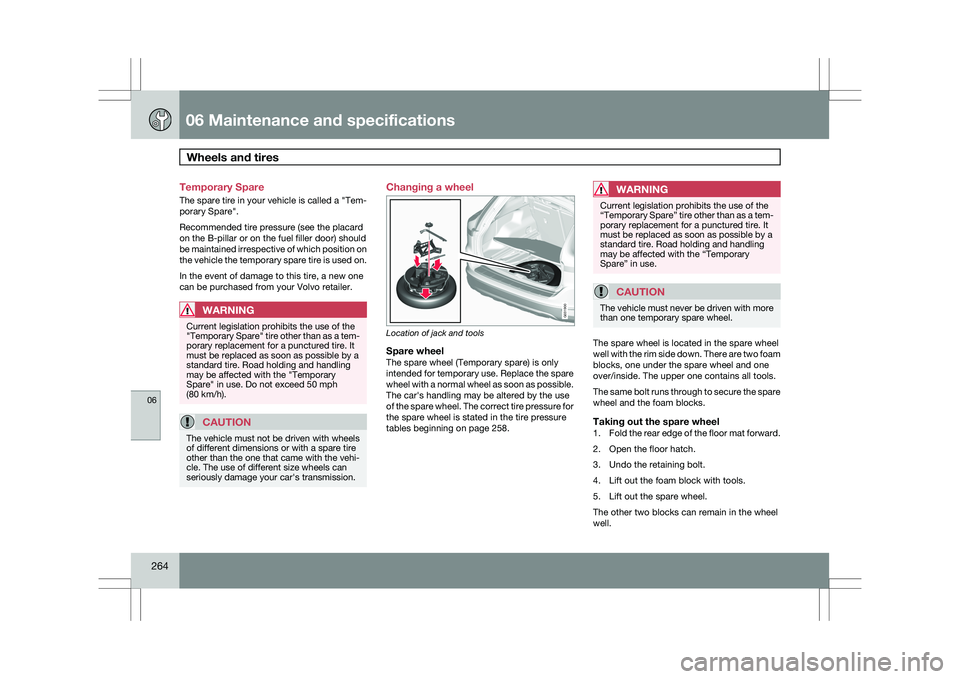
seriously damage your car\fs transmission. Changing a wheel
Location of jack and tools
Spare wheelThe spare wheel (Temporary spare) is only
intended for temporary use. Replace the spare
wheel with a normal wheel as soon as possible.
The car\fs handling may be altered by the use
of the spare wheel. The correct tire pressure for
the spare wheel is stated in the tire pressure
tables beginning on page 258.
WARNING Current legislation prohibits the use of the
“Temporary Spare” tire other than as a tem-
porary replacement for a punctured tire. It
must be replaced as soon as possible by a
standard tire. Road holding and handling
may be affected with the “Temporary
Spare” in use.
CAUTION
The vehicle must never be driven with more
than one temporary spare wheel.
The spare wheel is located in the spare wheel
well with the rim side down. There are two foam
blocks, one under the spare wheel and one
over/inside. The upper one contains all tools.
The same bolt runs through to secure the spare
wheel and the foam blocks.
Taking out the spare wheel1.
Fold the rear edge of the floor mat forward.
2. Open the floor hatch.
3. Undo the retaining bolt.
4. Lift out the foam block with tools.
5. Lift out the spare wheel.
The other two blocks can remain in the wheel
well. G031900
Page 267 of 297
06 Maintenance and specifications
Wheels and tires06
}}
265
After useThe foam block and spare wheel must be
replaced in the reverse order. Note the arrow
on the upper foam block. It should point for-
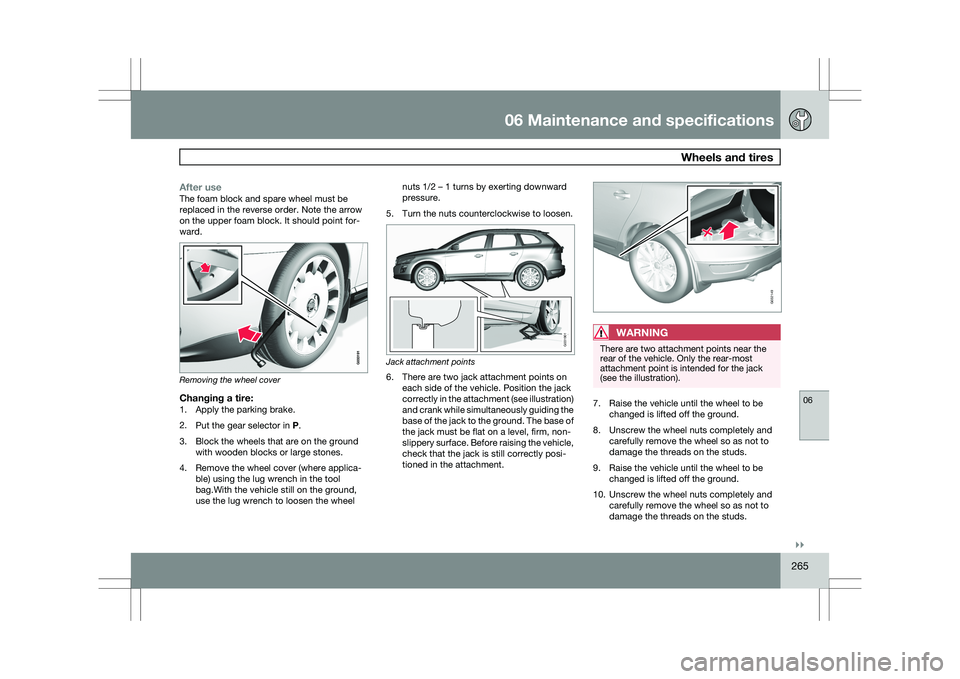
ward.Removing the wheel cover
Changing a tire:1. Apply the parking brake.
2.
Put the gear selector in P.
3. Block the wheels that are on the ground with wooden blocks or large stones.
4. Remove the wheel cover (where applica- ble) using the lug wrench in the tool
bag.With the vehicle still on the ground,
use the lug wrench to loosen the wheel nuts 1/2 – 1 turns by exerting downward
pressure.
5. Turn the nuts counterclockwise to loosen. Jack attachment points
6. There are two jack attachment points on
each side of the vehicle. Position the jack
correctly in the attachment (see illustration)
and crank while simultaneously guiding the
base of the jack to the ground. The base of
the jack must be flat on a level, firm, non-
slippery surface. Before raising the vehicle,
check that the jack is still correctly posi-
tioned in the attachment.
WARNING There are two attachment points near the
rear of the vehicle. Only the rear-most
attachment point is intended for the jack
(see the illustration).
7. Raise the vehicle until the wheel to be
changed is lifted off the ground.
8. Unscrew the wheel nuts completely and carefully remove the wheel so as not to
damage the threads on the studs.
9. Raise the vehicle until the wheel to be changed is lifted off the ground.
10. Unscrew the wheel nuts completely and carefully remove the wheel so as not to
damage the threads on the studs. G031901 G032149
Page 268 of 297
06 Maintenance and specificationsWheels and tires 06
266
* Option/accessory, for more information, see Introduction.
WARNING \b
The jack must correctly engage the jack
attachment.
\b Be sure the jack is on a firm, level, non-
slippery surface.
\b Never allow any part of your body to be
extended under a vehicle supported by
a jack.
\b Use the jack intended for the vehicle
when changing a tire. For any other job,
use stands to support the vehicle.
\b Apply the parking brake and put the
gear selector in the Park (
P) position.
\b Block the wheels standing on the
ground, use rigid wooden blocks or
large stones.
\b The jack should be kept well-greased
and clean, and should not be damaged.
\b No objects should be placed between
the base of jack and the ground, or
between the jack and the attachment
bar on the vehicle.
Re-installing the wheel1. Clean the contact surfaces on the wheel
and hub.
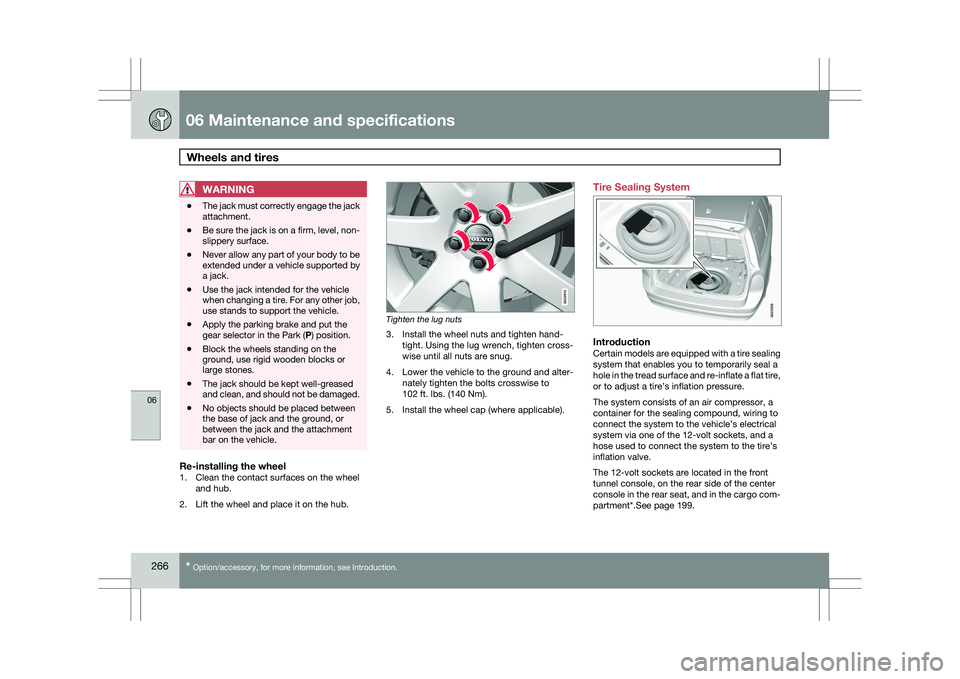
2. Lift the wheel and place it on the hub. Tighten the lug nuts
3. Install the wheel nuts and tighten hand-
tight. Using the lug wrench, tighten cross-
wise until all nuts are snug.
4. Lower the vehicle to the ground and alter- nately tighten the bolts crosswise to
102 ft. lbs. (140 Nm).
5. Install the wheel cap (where applicable). Tire Sealing System
IntroductionCertain models are equipped with a tire sealing
system that enables you to temporarily seal a
hole in the tread surface and re-inflate a flat tire,
or to adjust a tire’s inflation pressure.
The system consists of an air compressor, a
container for the sealing compound, wiring to
connect the system to the vehicle’s electrical
system via one of the 12-volt sockets, and a
hose used to connect the system to the tire’s
inflation valve.
The 12-volt sockets are located in the front
tunnel console, on the rear side of the center
console in the rear seat, and in the cargo com-
partment*.See page 199. G022916 G023309
Page 269 of 297
06 Maintenance and specifications
Wheels and tires06
}}
267
Accessing the tire sealing systemThe tire sealing system is stowed under the
floor of the cargo area. To access it:
1.
Fold up or remove any protective floor cov-
ering or carpet.
2. Open the floor hatch.
3. Remove the retaining screws.
4. Lift out the foam plastic block holding the jack and lug wrench.
5. Lift out the tire sealing system.
NOTE \b
The tire sealing system is only intended
to seal holes on the tire’s tread area, not
the sidewall.
\b Tires with large holes or tears cannot be
repaired with the tire sealing system.
WARNING \b
After using the tire sealing system, the
vehicle should not be driven farther than
approximately 120 miles (200 km).
\b Have the tire inspected by a trained and
qualified Volvo service technician as
soon as possible to determine if it can
be permanently repaired or must be
replaced.
\b The vehicle should not be driven faster
than 50 mph (80 km/h) while using a tire
that has been temporarily repaired with
the tire sealing system.
\b After using the tire sealing system, drive
carefully and avoid abrupt steering
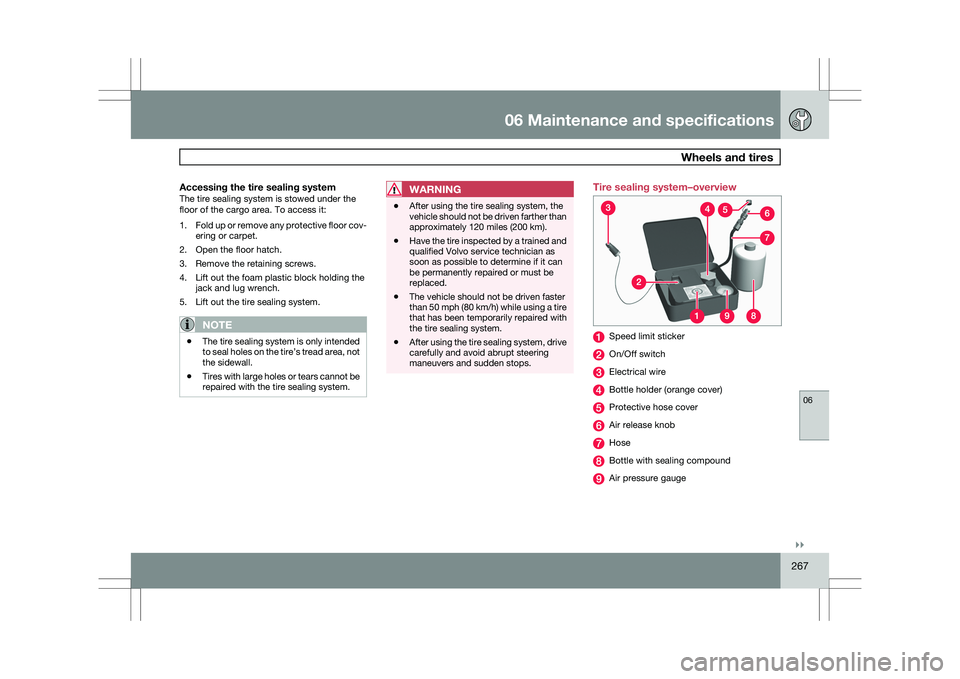
maneuvers and sudden stops. Tire sealing system–overview
Speed limit sticker
On/Off switch
Electrical wire
Bottle holder (orange cover)
Protective hose cover
Air release knob
Hose
Bottle with sealing compound
Air pressure gauge
Page 272 of 297
06 Maintenance and specificationsWheels and tires 06
270
CAUTION The compressor should not be used for
more than 10 minutes at a time to avoid
overheating.
WARNING
If the pressure remains below 22 psi
(1.8 bar) after approximately seven minutes,
turn off the compressor. In this case, the
hole is too large to be sealed and the vehicle
should not be driven.
11.
Switch off the compressor and disconnect
the electrical wire from the 12-volt
socket.
12. Unscrew the hose from the tire’s inflation valve and reinstall the valve cap.
13. Immediately drive the vehicle for approxi- mately 2 miles (3 km) at a maximum speed
of 50 mph (80 km/h) to distribute the seal-
ing compound in the tire.
NOTE \b
Safely stow the tire sealing system in a
convenient place as it will soon be used
again to check the tire’s inflation pres-
sure.
\b The empty bottle of sealing compound
cannot be removed from the bottle
holder. Consult a trained and qualified
Volvo service technician to have the
bottle removed and properly disposed
of.
WARNING If heavy vibrations, unsteady steering
behavior, or noises should occur while driv-
ing, reduce speed and park the vehicle in a
safe place. Recheck the tire for bumps,
cracks, or other visible damage, and
recheck its inflation pressure. If the pressure
is below 19 psi (1.3 bar), do not continue
driving. Have the vehicle towed to a trained
and qualified Volvo service technician.
Stage 2: Checking inflation pressure1. Connect the tire sealing system as descri-
bed in stage 1.
2. Refer to the inflation pressure tablesfor the
correct inflation pressure. If the tire needs
to be inflated, start the tire sealing system’s compressor. If necessary, release air from
the tire by turning the air release knob
counterclockwise.
CAUTION The compressor should not be used for
more than 10 minutes at a time to avoid
overheating.
WARNING
If you interrupt your trip for more than 1
hour, check the inflation pressure in the
damaged tire again before continuing.
Replacing the sealing compound
container
The sealing compound container must be
replaced if:
\b
the tire sealing system has been used to
repair a tire
\b the container’s expiration date has passed
(see the date on decal).
Page 273 of 297
06 Maintenance and specifications
Wheels and tires06
}}
271
NOTE\b
After use, the sealing compound bottle,
the hose, and certain other system
components must be replaced. Please
consult your Volvo retailer for replace-
ment parts.
\b If the sealing compound bottle’s expi-
ration date has passed, please take it to
a Volvo retailer or a recycling station
that can properly dispose of harmful
substances. Inflating tires
The tire sealing system can be used to inflate
the tires. To do so:
1. Park the car in a safe place.
2. The compressor should be switched off.
Ensure that the on/off switch is in position
0 (the 0 side of the switch should be
pressed down).
3. Take out the electrical wire and hose.
4. Remove the valve cap from the tire’s infla-
tion valve and screw the hose connector
onto the valve as tightly as possible by
hand.
5. Connect the electrical wire to the nearest 12-volt socket in the vehicle. 6. Start the vehicle’s engine.
WARNING \b
The vehicle’s engine should be running
when the tire sealing system is used to
avoid battery drain. Therefore, be sure
the vehicle is parked in a well ventilated
place, or outdoors, before using the sys-
tem.
\b Children should never be left unattended
in the vehicle when the engine is running. 7. Check the tire’s inflation pressure on the
gauge. Switch off the compressor briefly to
get a clear reading from the pressure
gauge.
8. Refer to the tire inflation tables for the cor-
rect inflation pressure. If the tire needs to
be inflated, start the tire sealing system’s
compressor (press the on/off switch to
position I). If necessary, release air from the
tire by turning the air release knob coun-
terclockwise.
CAUTION The compressor should not be used for
more than 10 minutes at a time to avoid
overheating. 9. Turn off the compressor (press the on/off
switch to position 0) when the correct infla-
tion pressure has been reached.
10. Unscrew the hose from the tire’s inflation valve and reinstall the valve cap.
11. Disconnect the electrical wire from the 12-volt socket.
Tire Pressure Monitoring System
(TPMS)–U.S models only
NOTE USA – FCC ID: KR5S122780002
This device complies with part 15 of the
FCC rules. Operation is subject to the fol-
lowing conditions: (1) This device may not
cause harmful interference, and (2) this
device must accept any interference
received, including interference that may
cause undesired operation.
The tire pressure monitoring system uses sen-
sors mounted in the tire valves to check infla-
tion pressure levels. When the vehicle is mov-
ing at a speed of approximately 20 mph
(30 km/h) or faster, these sensors transmit
inflation pressure data to a receiver located in
the vehicle.