service VOLVO XC60 2009 Owner´s Manual
[x] Cancel search | Manufacturer: VOLVO, Model Year: 2009, Model line: XC60, Model: VOLVO XC60 2009Pages: 297, PDF Size: 21.16 MB
Page 25 of 297
01 Safety
Occupant Weight Sensor01
}}
23
WARNING\b
Never try to open, remove, or repair any
components in the OWS system. This
could result in system malfunction.
Maintenance or repairs should only be
carried out by an a trained and qualified
Volvo service technician.
\b The front passenger\fs seat should not
be modified in any way. This could
reduce pressure on the seat cushion,
which might interfere with the OWS sys-
tem\fs function. Passeng-
er\fs seat
occu-
pancy sta-
tus OWS indi-
cator light
status Passeng-
er\fs side
front air-
bag status
Seat unoc-
cupied OWS indica-
tor light
lights up. Passenger\fs
side front
airbag disa-
bled
Seat occu-
pied by low
weight
occupant/
object
A OWS indica-
tor light
lights up Passenger\fs
side front
airbag disa-
bled
Seat occu-
pied by
heavy occu-
pant/object OWS indica-
tor light is
not lit Passenger\fs
side front
airbag ena-
bled
A
Volvo recommends that children always be properly
restrained in appropriate child restraints in the rear seats. Do
not assume that the passenger\fs side front airbag is disabled
unless the PASSENGER AIRBAG OFF indicator lamp is lit.
Make sure the child restraint is properly installed. If there is
any doubt as to the status of the passenger\fs side front air-
bag, move the child restraint to the rear seat.
The OWS is designed to enable (may inflate)
the passenger\fs side front airbag anytime the
system senses that a person of adult size is
sitting properly in the front passenger\fs seat. The PASSENGER AIRBAG OFF indicator lamp
will be off and remain off.
If a person of adult size is sitting in the front
passenger\fs seat, but the PASSENGER AIR-
BAG OFF indicator lamp is on, it is possible that
the person isn\ft sitting properly in the seat. If
this happens:
\b
Turn the vehicle off and ask the person to
place the seatback in an upright position.
\b Have the person sit upright in the seat,
centered on the seat cushion, with the per-
son\fs legs comfortably extended.
\b Restart the vehicle and have the person
remain in this position for about two
minutes. This will allow the system to
detect that person and enable the pas-
senger\fs frontal airbag.
\b If the PASSENGER AIRBAG OFF indicator
lamp remains on even after this, the person
should be advised to ride in the rear seat.
This condition reflects limitations of the OWS
classification capability. It does not indicate
OWS malfunction.
ModificationsIf you are considering modifying your vehicle in
any way to accommodate a disability, for
example by altering or adapting the driver\fs or
front passenger\fs seat(s) and/or airbag sys-
tems, please contact Volvo at:
Page 26 of 297
01 SafetyOccupant Weight Sensor 01
24 In the USA
Volvo Cars of North America, LLC
Customer Care Center
P.O. Box 914 Rockleigh, New Jersey
07647-0914
1-800-458-1552
In Canada
Volvo Cars of Canada Corp.
National Customer Service
175 Gordon Baker Road North York, Ontario
M2H 2N7
1-800-663-8255
WARNING
\b
No objects that add to the total weight
on the seat should be placed on the
front passenger\fs seat. If a child is
seated in the front passenger\fs seat
with any additional weight, this extra
weight could cause the OWS system to
enable the airbag, which might cause it
to deploy in the event of a collision,
thereby injuring the child.
\b The seat belt should never be wrapped
around an object on the front passeng-
er\fs seat. This could interfere with the
OWS system\fs function.
\b The front passenger\fs seat belt should
never be used in a way that exerts more
pressure on the passenger than normal.
This could increase the pressure exer-
ted on the weight sensor by a child, and
could result in the airbag being enabled,
which might cause it to deploy in the
event of a collision, thereby injuring the
child.WARNING \b
Keep the following points in mind with
respect to the OWS system. Failure to
follow these instructions could
adversely affect the system\fs function
and result in serious injury to the occu-
pant of the front passenger\fs seat:
\b The full weight of the front seat passen-
ger should always be on the seat cush-
ion. The passenger should never lift
him/herself off the seat cushion using
the armrest in the door or the center
console, by pressing the feet on the
floor, by sitting on the edge of the seat
cushion, or by pressing against the
backrest in a way that reduces pressure
on the seat cushion. This could cause
OWS to disable the front, passenger\fs
side airbag.
Page 29 of 297
01 Safety
Side impact protection (SIPS) airbags01
27
WARNING\b
The SIPS airbag system is a supple-
ment to the structural Side Impact Pro-
tection System and the three-point seat
belt system. It is not designed to deploy
during collisions from the front or rear of
the vehicle or in rollover situations.
\b The use of seat covers on the front seats
may impede SIPS airbag deployment.
\b No objects, accessory equipment or
stickers may be placed on, attached to
or installed near the SIPS airbag system
or in the area affected by SIPS airbag
deployment.
\b Never try to open or repair any compo-
nents of the SIPS airbag system. This
should be done only by a trained and
qualified Volvo service technician.
\b In order for the SIPS airbag to provide
its best protection, both front seat
occupants should sit in an upright posi-
tion with the seat belt properly fastened.
\b Failure to follow these instructions can
result in injury to the occupants of the
vehicle in the event of an accident.
Page 30 of 297
01 SafetyVolvo Inflatable Curtain (VIC) 01
28 General information
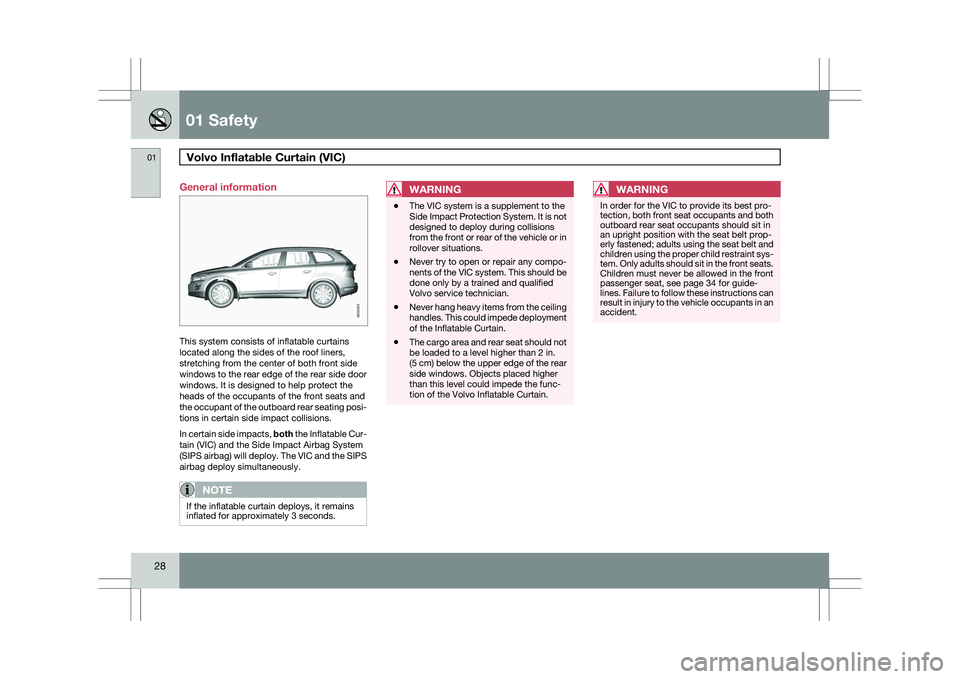
This system consists of inflatable curtains
located along the sides of the roof liners,
stretching from the center of both front side
windows to the rear edge of the rear side door
windows. It is designed to help protect the
heads of the occupants of the front seats and
the occupant of the outboard rear seating posi-
tions in certain side impact collisions.
In certain side impacts, both the Inflatable Cur-
tain (VIC) and the Side Impact Airbag System
(SIPS airbag) will deploy. The VIC and the SIPS
airbag deploy simultaneously.
NOTE
If the inflatable curtain deploys, it remains
inflated for approximately 3 seconds.
WARNING \b
The VIC system is a supplement to the
Side Impact Protection System. It is not
designed to deploy during collisions
from the front or rear of the vehicle or in
rollover situations.
\b Never try to open or repair any compo-
nents of the VIC system. This should be
done only by a trained and qualified
Volvo service technician.
\b Never hang heavy items from the ceiling
handles. This could impede deployment
of the Inflatable Curtain.
\b The cargo area and rear seat should not
be loaded to a level higher than 2 in.
(5 cm) below the upper edge of the rear
side windows. Objects placed higher
than this level could impede the func-
tion of the Volvo Inflatable Curtain.WARNING In order for the VIC to provide its best pro-
tection, both front seat occupants and both
outboard rear seat occupants should sit in
an upright position with the seat belt prop-
erly fastened; adults using the seat belt and
children using the proper child restraint sys-
tem. Only adults should sit in the front seats.
Children must never be allowed in the front
passenger seat, see page 34 for guide-
lines. Failure to follow these instructions can
result in injury to the vehicle occupants in an
accident. G032025
Page 31 of 297
01 Safety
Whiplash Protection System – WHIPS01
}}
29
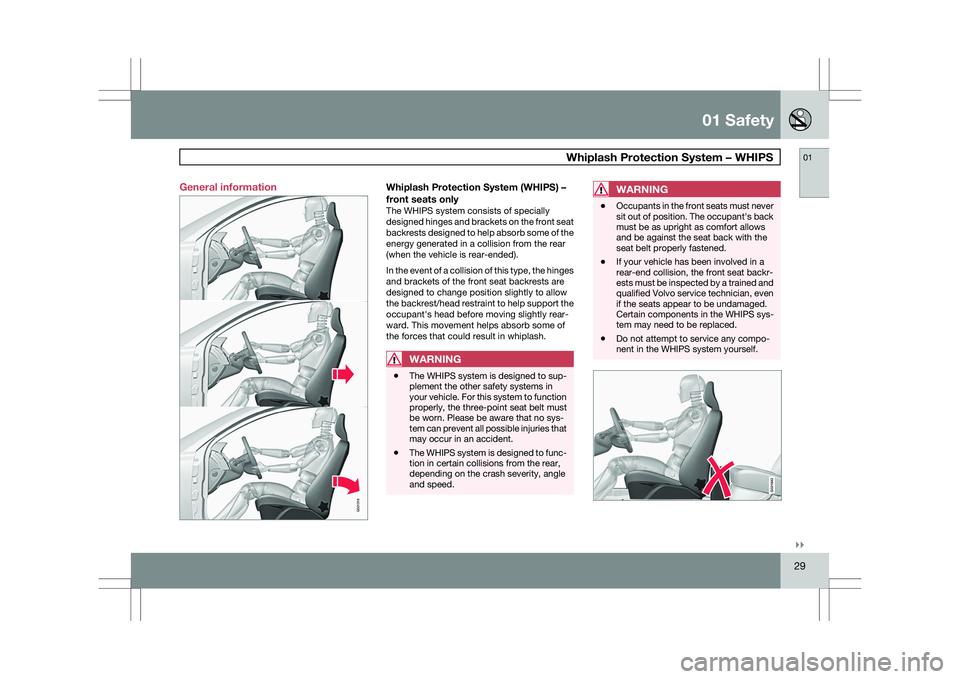
General information
Whiplash Protection System (WHIPS) –
front seats only
The WHIPS system consists of specially
designed hinges and brackets on the front seat
backrests designed to help absorb some of the
energy generated in a collision from the rear
(when the vehicle is rear-ended).
In the event of a collision of this type, the hinges
and brackets of the front seat backrests are
designed to change position slightly to allow
the backrest/head restraint to help support the
occupant\fs head before moving slightly rear-
ward. This movement helps absorb some of
the forces that could result in whiplash.
WARNING
\b
The WHIPS system is designed to sup-
plement the other safety systems in
your vehicle. For this system to function
properly, the three-point seat belt must
be worn. Please be aware that no sys-
tem can prevent all possible injuries that
may occur in an accident.
\b The WHIPS system is designed to func-
tion in certain collisions from the rear,
depending on the crash severity, angle
and speed.
WARNING \b
Occupants in the front seats must never
sit out of position. The occupant\fs back
must be as upright as comfort allows
and be against the seat back with the
seat belt properly fastened.
\b If your vehicle has been involved in a
rear-end collision, the front seat backr-
ests must be inspected by a trained and
qualified Volvo service technician, even
if the seats appear to be undamaged.
Certain components in the WHIPS sys-
tem may need to be replaced.
\b Do not attempt to service any compo-
nent in the WHIPS system yourself. G02101
8 G021842
Page 34 of 297
01 SafetyCrash mode 01
32
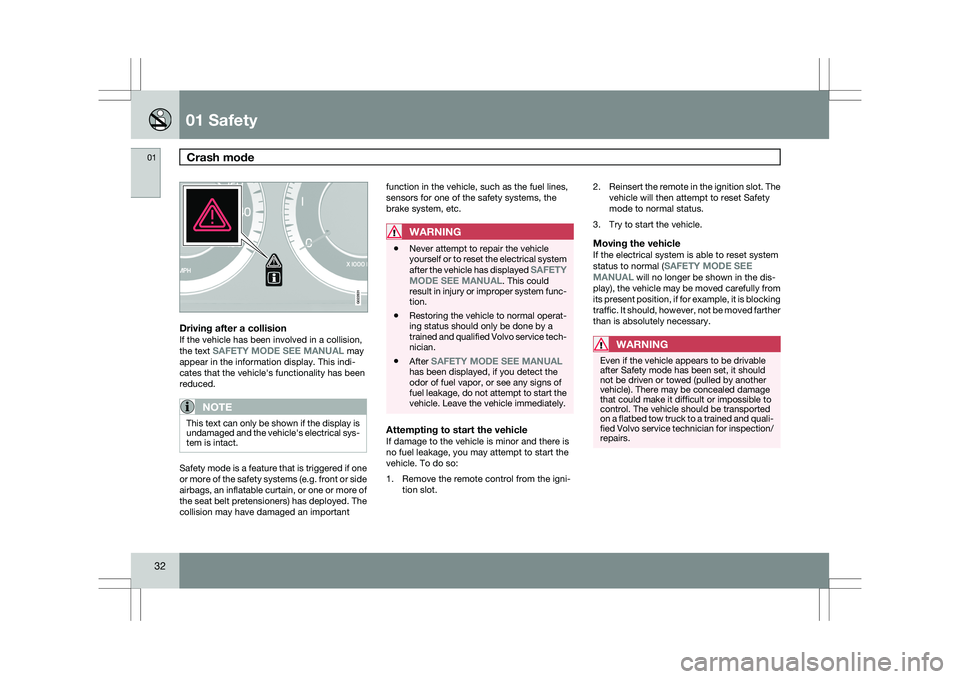
Driving after a collisionIf the vehicle has been involved in a collision,
the text SAFETY MODE SEE MANUAL may
appear in the information display. This indi-
cates that the vehicle\fs functionality has been
reduced.
NOTE This text can only be shown if the display is
undamaged and the vehicle\fs electrical sys-
tem is intact.
Safety mode is a feature that is triggered if one
or more of the safety systems (e.g. front or side
airbags, an inflatable curtain, or one or more of
the seat belt pretensioners) has deployed. The
collision may have damaged an important function in the vehicle, such as the fuel lines,
sensors for one of the safety systems, the
brake system, etc.
WARNING \b
Never attempt to repair the vehicle
yourself or to reset the electrical system
after the vehicle has displayed SAFETY
MODE SEE MANUAL. This could
result in injury or improper system func-
tion.
\b Restoring the vehicle to normal operat-
ing status should only be done by a
trained and qualified Volvo service tech-
nician.
\b After SAFETY MODE SEE MANUAL
has been displayed, if you detect the
odor of fuel vapor, or see any signs of
fuel leakage, do not attempt to start the
vehicle. Leave the vehicle immediately.
Attempting to start the vehicleIf damage to the vehicle is minor and there is
no fuel leakage, you may attempt to start the
vehicle. To do so:
1. Remove the remote control from the igni-
tion slot. 2.
Reinsert the remote in the ignition slot. The
vehicle will then attempt to reset Safety
mode to normal status.
3. Try to start the vehicle.
Moving the vehicleIf the electrical system is able to reset system
status to normal (SAFETY MODE SEE
MANUAL will no longer be shown in the dis-
play), the vehicle may be moved carefully from
its present position, if for example, it is blocking
traffic. It should, however, not be moved farther
than is absolutely necessary.
WARNING Even if the vehicle appears to be drivable
after Safety mode has been set, it should
not be driven or towed (pulled by another
vehicle). There may be concealed damage
that could make it difficult or impossible to
control. The vehicle should be transported
on a flatbed tow truck to a trained and quali-
fied Volvo service technician for inspection/
repairs. G022831
Page 49 of 297
01 Safety
Integrated booster cushion01
47
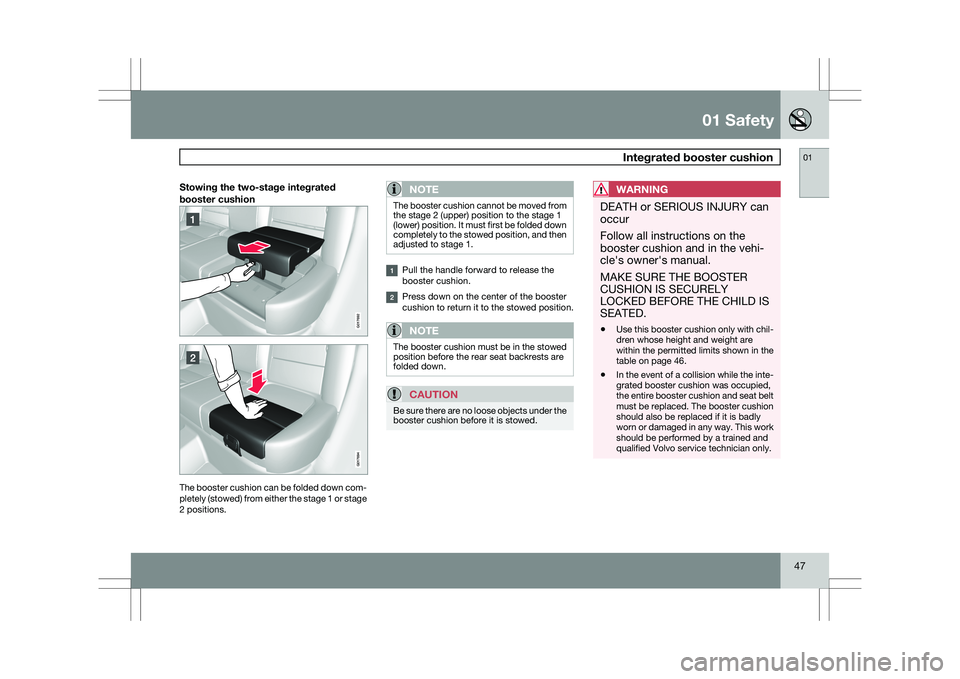
Stowing the two-stage integrated
booster cushionThe booster cushion can be folded down com-
pletely (stowed) from either the stage 1 or stage
2 positions.NOTE The booster cushion cannot be moved from
the stage 2 (upper) position to the stage 1
(lower) position. It must first be folded down
completely to the stowed position, and then
adjusted to stage 1.
Pull the handle forward to release the
booster cushion.
Press down on the center of the booster
cushion to return it to the stowed position.
NOTE
The booster cushion must be in the stowed
position before the rear seat backrests are
folded down.
CAUTION
Be sure there are no loose objects under the
booster cushion before it is stowed.
WARNING DEATH or SERIOUS INJURY can
occur
Follow all instructions on the
booster cushion and in the vehi-
cle\fs owner\fs manual.
MAKE SURE THE BOOSTER
CUSHION IS SECURELY
LOCKED BEFORE THE CHILD IS
SEATED.
\b
Use this booster cushion only with chil-
dren whose height and weight are
within the permitted limits shown in the
table on page 46.
\b In the event of a collision while the inte-
grated booster cushion was occupied,
the entire booster cushion and seat belt
must be replaced. The booster cushion
should also be replaced if it is badly
worn or damaged in any way. This work
should be performed by a trained and
qualified Volvo service technician only. G01769
2 G017694
Page 52 of 297
02 Locks and alarmRemote key and key blade 02
50 Introduction
Two remote keys or optional Personal Car
Communicators (PCC) are provided with your
vehicle. They enable you to unlock the doors
and tailgate, and also function as ignition keys
to start the vehicle or operate electrical com-
ponents. The remote keys contain detachable
metal key blades for manually locking or
unlocking the driver\fs door and the glove com-
partment. Up to six remotes can be pro-
grammed for use on the same vehicle.
The PCCs have enhanced functionality com-
pared with the standard remote control.
NOTE
In the remainder of this chapter, all referen-
ces to the remote key also pertain to the
PCC unless otherwise stated.
WARNING
Never leave the remote key in the ignition if
children are to remain in the vehicle.
Detachable key bladeEach remote key or PCC contains a detachable
metal key blade for mechanically locking or
unlocking the driver\fs door and the glove com-
partment. The key blades have a unique code,
which is used if new ones need to be produced. This code is available at an authorized Volvo
retailer.
Loss of a remote keyIf a remote key is lost, the other one must be
taken with the vehicle to a trained and qualified
Volvo service technician. As an anti-theft
measure, the code of the lost remote must be
erased from the system.
The number of registered keys for the vehicle
can be found in the vehicle\fs menu under
Car
settings Car key memory Number of
keys. See page 122 for a description of the
menu system.
USA-5WK49264
FCC ID:KR55WK49264 + Siemens VDO
5WK49236
FCC ID:KR55WK49236, 5WK49266
FCC ID:KR55WK49266 + Siemens VDO
5WK49233
FCC ID:KR55WK49233
This device complies with part 15 of the FCC
rules and RSS-210. Operation is subject to the
following conditions: (1) This device may not
cause harmful interference, and (2) this device
must accept any interference received, includ-
ing interference that may cause undesired
operation. Canada-5WK49264
IC:267T-5WK49264 + Siemens VDO
5WK49236
IC:267T-5WK49236, 5WK49266
IC:267T-5WK49266 + Siemens VDO
5WK49233
IC:267T-5WK49233
Operation is subject to the following condi-
tions: (1) this device may not cause interfer-
ence, and (2) this device must accept any inter-
ference, including interference that may cause
undesired operation of the device.
Key memory – door mirrors and driver\fs
seat
The position of the side door mirrors and
optional power driver\fs seat are stored in the
remote keys when the vehicle is locked. The
next time the driver\fs door is unlocked with the
same remote key and the door is opened within
2 minutes, the power driver\fs seat and side
door mirrors will automatically move to the
position that they were in when the doors were
most recently locked with the same remote
key. See page 82 for more information.
This feature can be activated or deactivated in
the vehicle\fs menu under
Car settings Car
key memory Seat & mirror positions
.
See
Page 53 of 297
02 Locks and alarm
Remote key and key blade02
}}
51
page 122 for a description of the menu sys-
tem.
See also page 58 for information regarding
vehicles with the optional keyless drive.
Confirmation when locking/unlocking
the vehicle
When the vehicle is locked with a remote key,
the turn signals will flash once to confirm that
this has been completed correctly.
When the vehicle is locked, confirmation will
only be given if all of the locks are locked after
the doors have been closed.
NOTE
If you do not receive confirmation when
locking the vehicle, check whether a door or
the tailgate is ajar, or if this feature has been
turned off in the menu.
This function can be activated or deactivated
under Car settings
Light settings Lock
confirmation, light, or Car settings Light
settings Unlock confirmation, light. See
page 122 for a description of the menu sys-
tem.
Immobilizer (start inhibitor)Each of the keys supplied with your vehicle
contains a coded transponder. The code in the
key is transmitted to an antenna in the ignition
slot where it is compared to the code stored in
the start inhibitor module. The vehicle will start
only with a properly coded key. If you misplace
a key, take the other keys to a trained and
qualified Volvo service technician for reprog-
ramming as an antitheft measure. The follow-
ing messages (which may appear in the instru-
ment panel display) are related to the immobil-
izer: Message Meaning
Key error Reinsert
key Remote key not rec-
ognized during start.
Try to start the vehi-
cle again.
Car key Not found PCC with keyless
drive only. Remote
key not recognized
during start. Try to
start the vehicle
again.
Immobilizer See
manual Remote key fault
during start. Contact
an authorized Volvo
workshop.
CAUTION
Never use force when inserting the remote
key in the ignition slot. The vehicle cannot
be started if the transponder is damaged.
USA–FCC ID: LTQWFS 125VO
This device complies with part 15 of the FCC
rules. Operation is subject to the following con-
dition: (1) This device may not cause harmful
interference, and (2) this device must accept
any interference received, including interfer-
ence that may cause undesired operation.
Page 56 of 297
02 Locks and alarmRemote key and key blade 02
54 cate that the PCC is receiving information
from the vehicle. If any of the buttons are
pressed during this 7-second period,
transmission of information to the PCC will
be interrupted.
NOTE
If none of the indicator lights flash when the
information button has been pressed sev-
eral times from different places in relation to
the vehicle, contact an authorized Volvo
service technician.
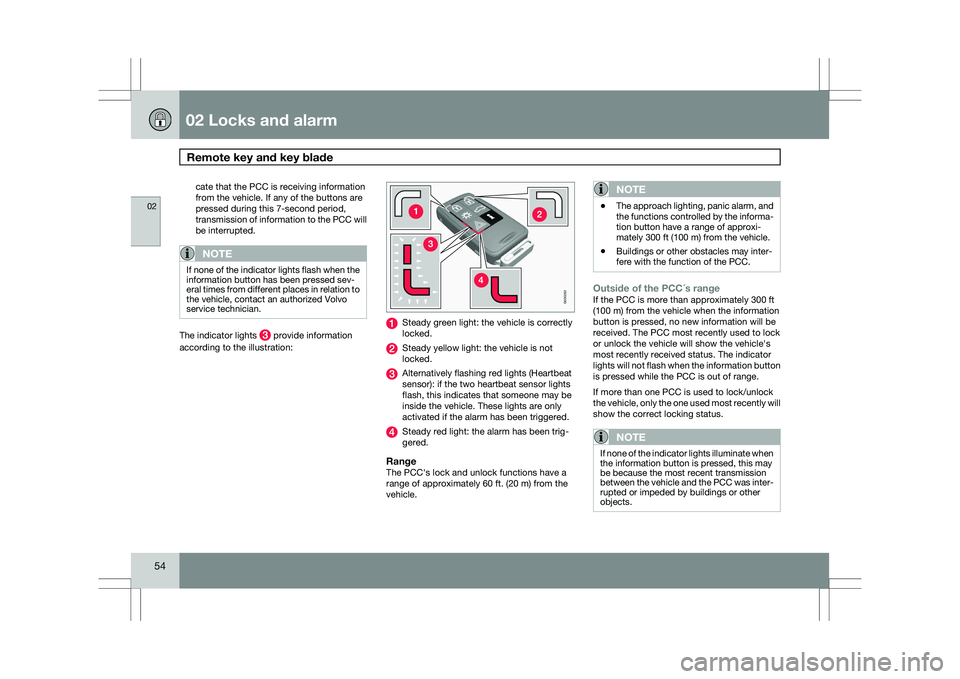
The indicator lights provide information
according to the illustration: Steady green light: the vehicle is correctly
locked.
Steady yellow light: the vehicle is not
locked.
Alternatively flashing red lights (Heartbeat
sensor): if the two heartbeat sensor lights
flash, this indicates that someone may be
inside the vehicle. These lights are only
activated if the alarm has been triggered.
Steady red light: the alarm has been trig-
gered.
RangeThe PCC\fs lock and unlock functions have a
range of approximately 60 ft. (20 m) from the
vehicle.
NOTE \b
The approach lighting, panic alarm, and
the functions controlled by the informa-
tion button have a range of approxi-
mately 300 ft (100 m) from the vehicle.
\b Buildings or other obstacles may inter-
fere with the function of the PCC.
Outside of the PCC´s rangeIf the PCC is more than approximately 300 ft
(100 m) from the vehicle when the information
button is pressed, no new information will be
received. The PCC most recently used to lock
or unlock the vehicle will show the vehicle\fs
most recently received status. The indicator
lights will not flash when the information button
is pressed while the PCC is out of range.
If more than one PCC is used to lock/unlock
the vehicle, only the one used most recently will
show the correct locking status.
NOTE If none of the indicator lights illuminate when
the information button is pressed, this may
be because the most recent transmission
between the vehicle and the PCC was inter-
rupted or impeded by buildings or other
objects. G03026
2