lights YAMAHA JOG50R 2008 Owners Manual
[x] Cancel search | Manufacturer: YAMAHA, Model Year: 2008, Model line: JOG50R, Model: YAMAHA JOG50R 2008Pages: 72, PDF Size: 2.06 MB
Page 5 of 72
SAFETY INFORMATION.....................1-1
Further safe-riding points .................1-4
DESCRIPTION.....................................2-1
Left view ...........................................2-1
Right view .........................................2-3
Controls and instruments .................2-5
INSTRUMENT AND CONTROL
FUNCTIONS........................................3-1
Main switch/steering lock .................3-1
Indicator and warning lights .............3-2
Speedometer ....................................3-3
Multi-function display .......................3-4
Handlebar switches ..........................3-6
Front brake lever...............................3-6
Rear brake lever................................3-7
Fuel and 2-stroke engine oil tank
caps ...............................................3-7
Fuel ...................................................3-8
Catalytic converter............................3-8
2-stroke engine oil ............................3-9
2-stroke engine oil tank ....................3-9
Kickstarter.......................................3-10
Seat.................................................3-10
Storage compartment.....................3-11
Luggage hook .................................3-12
PRE-OPERATION CHECKS...............4-1
Pre-operation check list....................4-2OPERATION AND IMPORTANT
RIDING POINTS..................................5-1
Starting a cold engine ......................5-1
Starting off ........................................5-2
Acceleration and deceleration ..........5-2
Braking..............................................5-3
Tips for reducing fuel
consumption..................................5-3
Engine break-in.................................5-4
Parking ..............................................5-4
PERIODIC MAINTENANCE AND
MINOR REPAIR...................................6-1
Periodic maintenance and
lubrication chart ............................6-2
Removing and installing the
cowling and panel .........................6-5
Checking the spark plug ..................6-6
Final transmission oil ........................6-7
Coolant (only for liquid-cooled
models) ..........................................6-8
Air filter element ................................6-9
Adjusting the carburetor .................6-10
Adjusting the throttle cable
free play .......................................6-10
Tires ................................................6-11
Cast wheels ....................................6-12
Checking the front brake lever
free play .......................................6-13
Adjusting the rear brake lever
free play .......................................6-13Checking the front brake pads
and rear brake shoes ..................6-14
Checking the brake fluid level ........6-15
Changing the brake fluid ................6-16
Checking and lubricating the
throttle grip and cable .................6-16
Lubricating the front and rear
brake levers .................................6-16
Checking and lubricanting the
centerstand .................................6-17
Checking the front fork ...................6-17
Checking the steering.....................6-18
Checking the wheel bearings .........6-19
Battery ............................................6-19
Replacing the fuse ..........................6-20
Replacing the headlight bulb
or a front turn signal light
bulb .............................................6-21
Replacing the tail/brake light
bulb or a rear turn signal light
bulb .............................................6-22
Replacing an auxiliary light
bulb .............................................6-23
Troubleshooting ..............................6-24
Troubleshooting charts ...................6-25
SCOOTER CARE AND STORAGE.....7-1
Matte color caution...........................7-1
Care ..................................................7-1
Storage .............................................7-3
TABLE OF CONTENTS
5RW-F8199-E4.QXD 19/11/07 08:01 Página 5
Page 9 of 72
When loading within this weight limit,
keep the following in mind:
●Cargo and accessory weight
should be kept as low and close
to the scooter as possible. Make
sure to distribute the weight as
evenly as possible on both sides
of the scooter to minimize imba-
lance or instability.
●Shifting weights can create a
sudden imbalance. Make sure
that accessories and cargo are
securely attached to the scooter
before riding. Check accessory
mounts and cargo restraints fre-
quently.
●Never attach any large or heavy
items to the handlebar, front fork,
or front fender. Such items can
create unstable handling or a
slow steering response.
Accessories
Genuine Yamaha accessories have
been specifically designed for use onthis scooter. Since Yamaha cannot
test all other accessories that may be
available, you must personally be res-
ponsible for the proper selection, ins-
tallation and use of non-Yamaha
accessories. Use extreme caution
when selecting and installing any
accessories.
Keep the following guidelines in mind,
as well as those provided under “Loa-
ding” when mounting accessories.
●Never install accessories or carry
cargo that would impair the per-
formance of your scooter. Care-
fully inspect the accessory befo-
re using it to make sure that it
does not in any way reduce
ground clearance or cornering
clearance, limit suspension tra-
vel, steering travel or control ope-
ration, or obscure lights or reflec-
tors.
• Accessories fitted to the hand-
lebar or the front fork area can
create instability due to impro-
per weight distribution or
aerodynamic changes. If
accessories are added to the
handlebar or front fork area,they must be as lightweight as
possible and should be kept to
a minimum.
• Bulky or large accessories may
seriously affect the stability of
the scooter due to aerodyna-
mic effects. Wind may attempt
to lift the scooter, or the scoo-
ter may become unstable in
cross winds. These accesso-
ries may also cause instability
when passing or being passed
by large vehicles.
• Certain accessories can dis-
place the operator from his or
her normal riding position. This
improper position limits the fre-
edom of movement of the ope-
rator and may limit control abi-
lity, therefore, such
accessories are not recom-
mended.
●Use caution when adding electri-
cal accessories. If electrical
accessories exceed the capacity
of the scooter’s electrical system
an electric failure could result,
which could cause a dangerous
loss of lights or engine power.
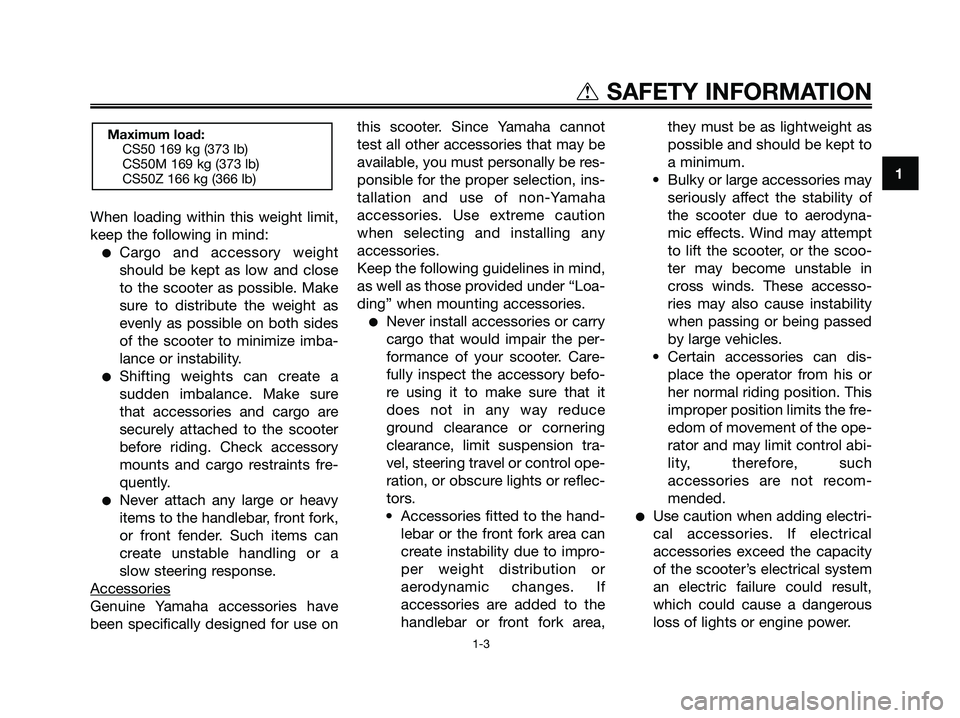
Maximum load:
CS50 169 kg (373 lb)
CS50M 169 kg (373 lb)
CS50Z 166 kg (366 lb)
1
tSAFETY INFORMATION
1-3
5RW-F8199-E4.QXD 19/11/07 08:01 Página 9
Page 18 of 72
EAU11003
Indicator and warning lights
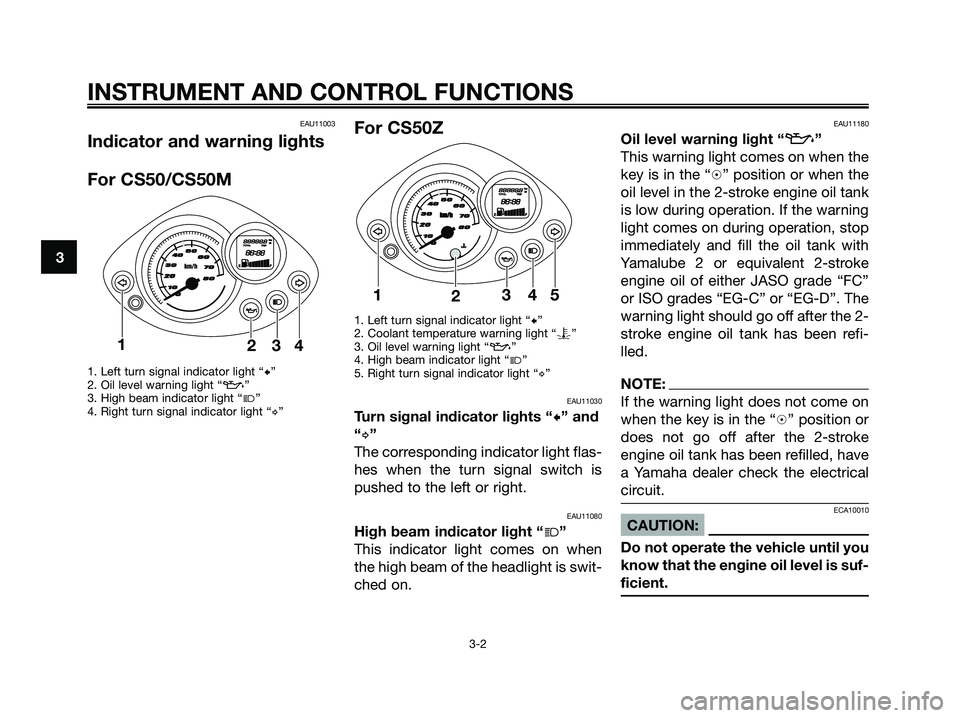
For CS50/CS50M
1. Left turn signal indicator light “c”
2. Oil level warning light “z”
3. High beam indicator light “j”
4. Right turn signal indicator light “d”
For CS50Z
1. Left turn signal indicator light “c”
2. Coolant temperature warning light “y”
3. Oil level warning light “z”
4. High beam indicator light “j”
5. Right turn signal indicator light “d”
EAU11030
Turn signal indicator lights “c” and
“d”
The corresponding indicator light flas-
hes when the turn signal switch is
pushed to the left or right.
EAU11080
High beam indicator light “j”
This indicator light comes on when
the high beam of the headlight is swit-
ched on.
EAU11180
Oil level warning light “z”
This warning light comes on when the
key is in the “h” position or when the
oil level in the 2-stroke engine oil tank
is low during operation. If the warning
light comes on during operation, stop
immediately and fill the oil tank with
Yamalube 2 or equivalent 2-stroke
engine oil of either JASO grade “FC”
or ISO grades “EG-C” or “EG-D”. The
warning light should go off after the 2-
stroke engine oil tank has been refi-
lled.
NOTE:
If the warning light does not come on
when the key is in the “h” position or
does not go off after the 2-stroke
engine oil tank has been refilled, have
a Yamaha dealer check the electrical
circuit.
ECA10010
CAUTION:
Do not operate the vehicle until you
know that the engine oil level is suf-
ficient.
km/h
01020304050607080
1
2345
km/h
01020304050607080
1
234
INSTRUMENT AND CONTROL FUNCTIONS
3-2
3
5RW-F8199-E4.QXD 19/11/07 08:01 Página 18
Page 22 of 72
EAU12347
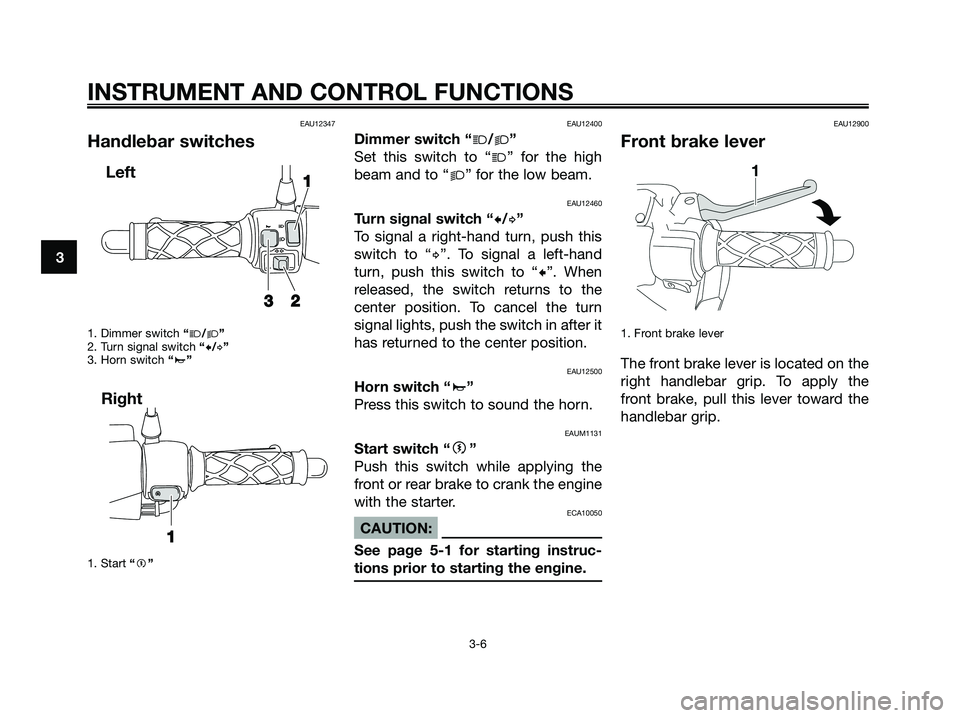
Handlebar switches
1. Dimmer switch “j/k”
2. Turn signal switch “c/d”
3. Horn switch “a”
1. Start “g”
EAU12400
Dimmer switch “j/k”
Set this switch to “j” for the high
beam and to “k” for the low beam.
EAU12460
Turn signal switch “c/d”
To signal a right-hand turn, push this
switch to “d”. To signal a left-hand
turn, push this switch to “c”. When
released, the switch returns to the
center position. To cancel the turn
signal lights, push the switch in after it
has returned to the center position.
EAU12500
Horn switch “a”
Press this switch to sound the horn.
EAUM1131
Start switch “g”
Push this switch while applying the
front or rear brake to crank the engine
with the starter.
ECA10050
CAUTION:
See page 5-1 for starting instruc-
tions prior to starting the engine.
EAU12900
Front brake lever
1. Front brake lever
The front brake lever is located on the
right handlebar grip. To apply the
front brake, pull this lever toward the
handlebar grip.
1
Right
1
2
3 Left
INSTRUMENT AND CONTROL FUNCTIONS
3-6
3
5RW-F8199-E4.QXD 19/11/07 08:01 Página 22
Page 31 of 72
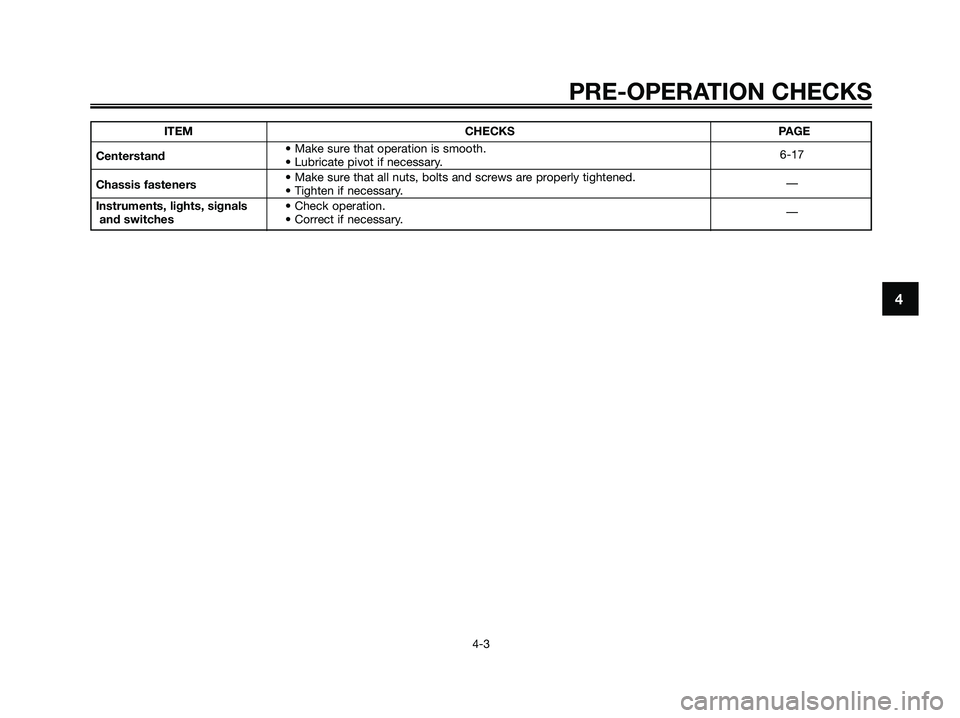
PRE-OPERATION CHECKS
4-3
4
ITEM CHECKS PAGE
Centerstand• Make sure that operation is smooth.
• Lubricate pivot if necessary.6-17
Chassis fasteners• Make sure that all nuts, bolts and screws are properly tightened.
• Tighten if necessary.—
Instruments, lights, signals• Check operation.
and switches• Correct if necessary.—
5RW-F8199-E4.QXD 19/11/07 08:01 Página 31
Page 34 of 72
EAU16792
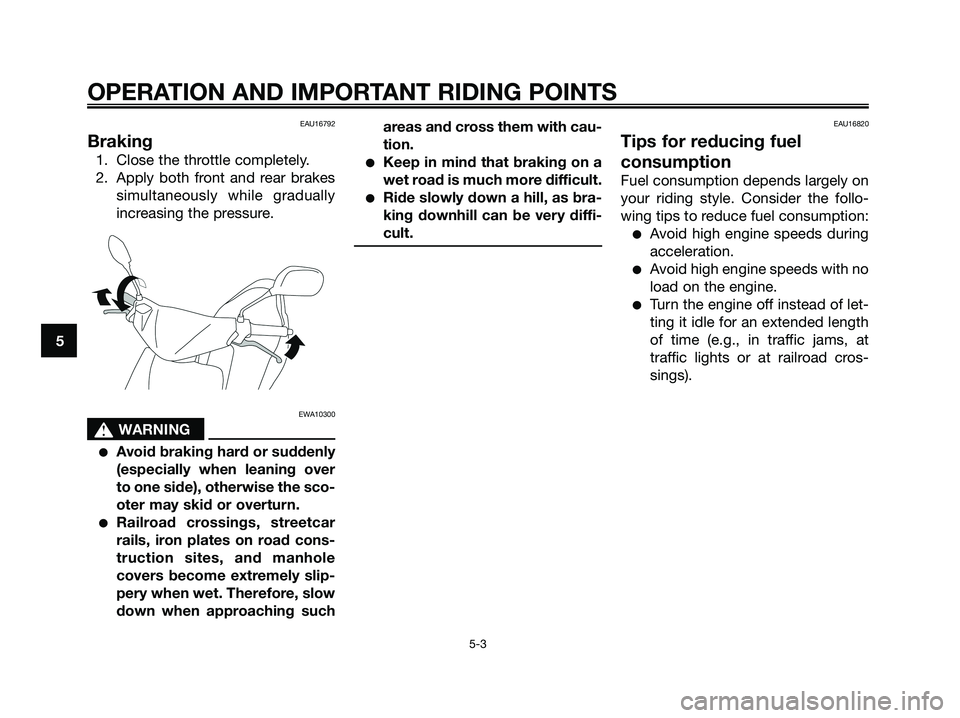
Braking
1. Close the throttle completely.
2. Apply both front and rear brakes
simultaneously while gradually
increasing the pressure.
EWA10300
s s
WARNING
●Avoid braking hard or suddenly
(especially when leaning over
to one side), otherwise the sco-
oter may skid or overturn.
●Railroad crossings, streetcar
rails, iron plates on road cons-
truction sites, and manhole
covers become extremely slip-
pery when wet. Therefore, slow
down when approaching suchareas and cross them with cau-
tion.
●Keep in mind that braking on a
wet road is much more difficult.
●Ride slowly down a hill, as bra-
king downhill can be very diffi-
cult.
EAU16820
Tips for reducing fuel
consumption
Fuel consumption depends largely on
your riding style. Consider the follo-
wing tips to reduce fuel consumption:
●Avoid high engine speeds during
acceleration.
●Avoid high engine speeds with no
load on the engine.
●Turn the engine off instead of let-
ting it idle for an extended length
of time (e.g., in traffic jams, at
traffic lights or at railroad cros-
sings).
OPERATION AND IMPORTANT RIDING POINTS
5-3
5
5RW-F8199-E4.QXD 19/11/07 08:01 Página 34
Page 39 of 72
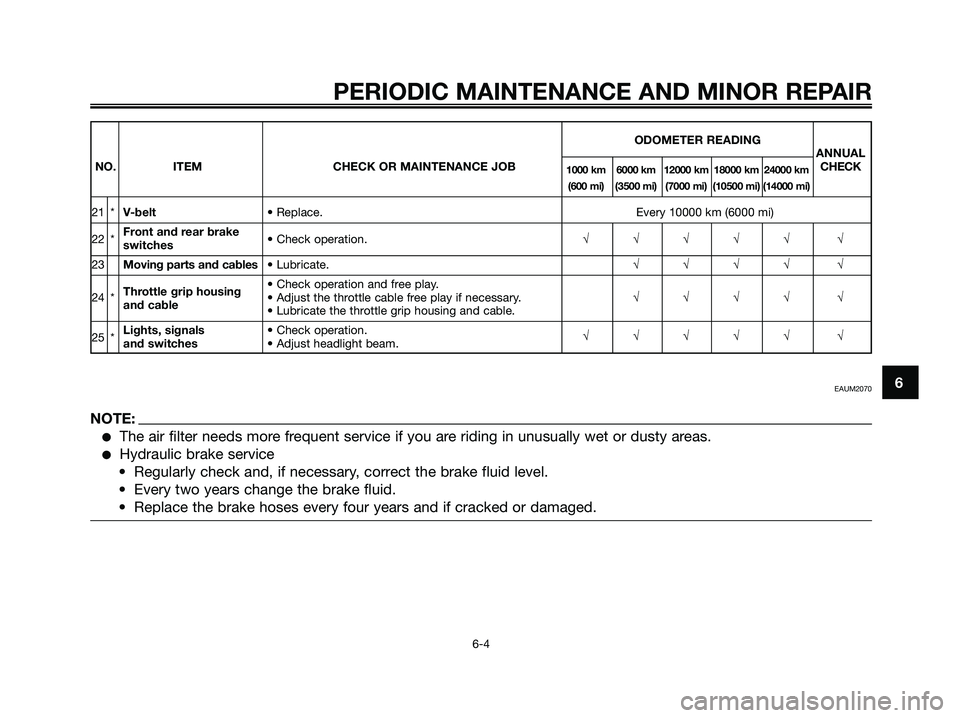
PERIODIC MAINTENANCE AND MINOR REPAIR
6-4
6
ODOMETER READING
ANNUAL
NO. ITEM CHECK OR MAINTENANCE JOB
1000 km 6000 km 12000 km 18000 km 24000 kmCHECK
(600 mi) (3500 mi) (7000 mi) (10500 mi) (14000 mi)
21 *V-belt• Replace. Every 10000 km (6000 mi)
22 *Front and rear brake
• Check operation.√√√√√ √
switches
23Moving parts and cables• Lubricate.√√√√ √
Throttle grip housing • Check operation and free play.
24 * • Adjust the throttle cable free play if necessary.√√√√ √
and cable
• Lubricate the throttle grip housing and cable.
25 *Lights, signals • Check operation.
and switches• Adjust headlight beam.√√√√√ √
EAUM2070
NOTE:
●The air filter needs more frequent service if you are riding in unusually wet or dusty areas.
●Hydraulic brake service
• Regularly check and, if necessary, correct the brake fluid level.
• Every two years change the brake fluid.
• Replace the brake hoses every four years and if cracked or damaged.
5RW-F8199-E4.QXD 19/11/07 08:01 Página 39
Page 58 of 72
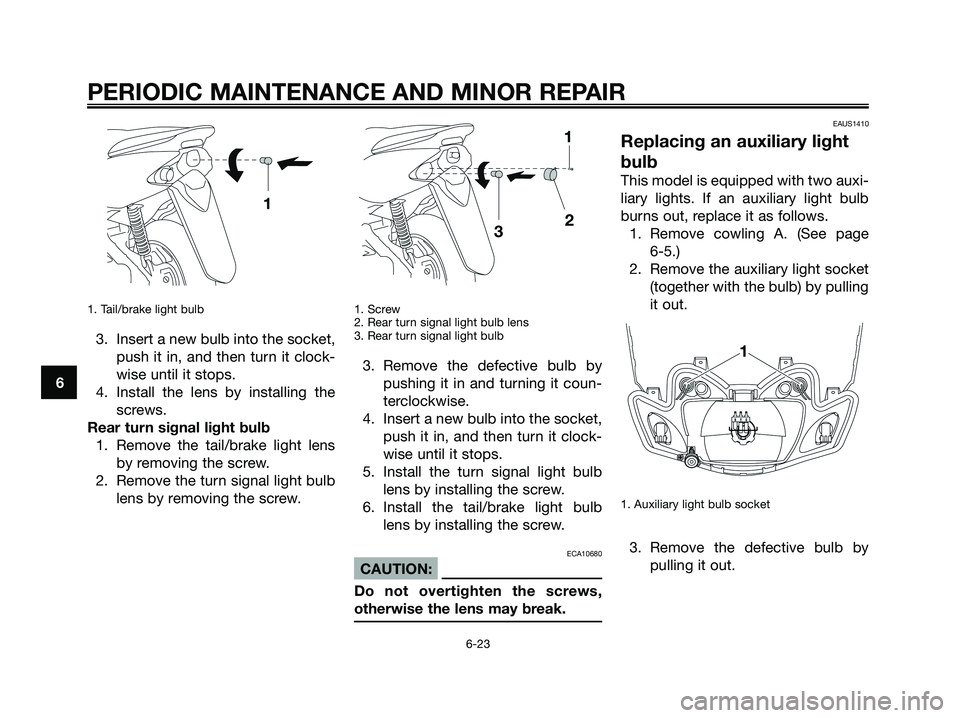
1. Tail/brake light bulb
3. Insert a new bulb into the socket,
push it in, and then turn it clock-
wise until it stops.
4. Install the lens by installing the
screws.
Rear turn signal light bulb
1. Remove the tail/brake light lens
by removing the screw.
2. Remove the turn signal light bulb
lens by removing the screw.
1. Screw
2. Rear turn signal light bulb lens
3. Rear turn signal light bulb
3. Remove the defective bulb by
pushing it in and turning it coun-
terclockwise.
4. Insert a new bulb into the socket,
push it in, and then turn it clock-
wise until it stops.
5. Install the turn signal light bulb
lens by installing the screw.
6. Install the tail/brake light bulb
lens by installing the screw.
ECA10680
CAUTION:
Do not overtighten the screws,
otherwise the lens may break.
EAUS1410
Replacing an auxiliary light
bulb
This model is equipped with two auxi-
liary lights. If an auxiliary light bulb
burns out, replace it as follows.
1. Remove cowling A. (See page
6-5.)
2. Remove the auxiliary light socket
(together with the bulb) by pulling
it out.
1. Auxiliary light bulb socket
3. Remove the defective bulb by
pulling it out.
PERIODIC MAINTENANCE AND MINOR REPAIR
6-23
6
5RW-F8199-E4.QXD 19/11/07 08:01 Página 58
Page 63 of 72
cleaning products, solvent or
thinner, fuel (gasoline), rust
removers or inhibitors, brake
fluid, antifreeze or electrolyte.
●Do not use high-pressure was-
hers or steam-jet cleaners sin-
ce they cause water seepage
and deterioration in the follo-
wing areas: seals (of wheel and
swingarm bearings, fork and
brakes), electric components
(couplers, connectors, instru-
ments, switches and lights),
breather hoses and vents.
●For scooters equipped with a
windshield: Do not use strong
cleaners or hard sponges as
they will cause dulling or scrat-
ching. Some cleaning com-
pounds for plastic may leave
scratches on the windshield.
Test the product on a small hid-
den part of the windshield to
make sure that it does not lea-
ve any marks. If the windshield
is scratched, use a quality
plastic polishing compound
after washing.
After normal use
Remove dirt with warm water, a mild
detergent, and a soft, clean sponge,
and then rinse thoroughly with clean
water. Use a toothbrush or bottle-
brush for hard-to-reach areas. Stub-
born dirt and insects will come off
more easily if the area is covered with
a wet cloth for a few minutes before
cleaning.
After riding in the rain, near the sea or
on salt-sprayed roads
Since sea salt or salt sprayed on the
roads during winter are extremely
corrosive in combination with water,
carry out the following steps after
each ride in the rain, near the sea or
on salt-sprayed roads.
NOTE:
Salt sprayed on roads in the winter
may remain well into spring.
1. Clean the scooter with cold water
and a mild detergent after the
engine has cooled down.
ECA10790
CAUTION:
Do not use warm water since it
increases the corrosive action of
the salt.
2. Apply a corrosion protection
spray on all metal, including
chrome- and nickel-plated, surfa-
ces to prevent corrosion.
After cleaning
1. Dry the scooter with a chamois or
an absorbing cloth.
2. Use a chrome polish to shine
chrome, aluminum and stainless-
steel parts, including the exhaust
system. (Even the thermally indu-
ced discoloring of stainless-steel
exhaust systems can be removed
through polishing.)
3. To prevent corrosion, it is recom-
mended to apply a corrosion pro-
tection spray on all metal, inclu-
ding chrome- and nickel-plated,
surfaces.
4. Use spray oil as a universal clea-
ner to remove any remaining dirt.
5. Touch up minor paint damage
caused by stones, etc.
SCOOTER CARE AND STORAGE
7-2
7
5RW-F8199-E4.QXD 19/11/07 08:01 Página 63
Page 71 of 72
2-stroke engine oil tank .............................3-9
AAcceleration and deceleration ...................5-2
Air filter element .........................................6-9
Auxiliary light bulb, replacing ...................6-23
BBattery......................................................6-19
Brake fluid level, checking .......................6-15
Brake fluid, changing ...............................6-16
Brake lever, front ........................................3-6
Brake lever, rear .........................................3-7
Brake levers, lubricating ..........................6-16
Brake pads and shoes, checking ............6-14
Braking .......................................................5-3
C
Carburetor,adjusting.................................6-10
Care............................................................7-1
Catalytic converter .....................................3-8
Centerstand,Checking and lubricating ....6-17
Coolant.......................................................6-8
Coolant temperature warning light ............3-3
Cowling and panel, removing
and installing............................................6-5
DDimmer switch ...........................................3-6
EEngine break-in ..........................................5-4
Engine oil ...................................................3-9
FFinal transmission oil .................................6-7
Front brake lever free play, checking.......6-13
Front fork, checking .................................6-17
Fuel ............................................................3-8
Fuel and 2-stroke engine oil tank caps .....3-7Fuel consumption, tips for reducing ..........5-3
Fuse, replacing.........................................6-20
HHandlebar switches ...................................3-6
Headlight and front turn signal light
bulb, replacing .......................................6-21
High beam indicator light...........................3-2
Horn switch ................................................3-6
IIdentification numbers ...............................9-1
Indicator and warning lights ......................3-2
KKey identification number ..........................9-1
Kickstarter ................................................3-10
LLuggage hook ..........................................3-12
MMain switch/steering lock ..........................3-1
Matte color, caution ...................................7-1
Model label ................................................9-2
Multi-function display ................................3-4
OOil level warning light .................................3-2
PParking .......................................................5-4
Part locations .............................................2-1
Periodic maintenance and lubrication
chart .........................................................6-2
Pre-operation check list .............................4-2
RRear brake lever free play, adjusting .......6-13
SSafe-riding points.......................................1-4
Safety information ......................................1-1Seat ..........................................................3-10
Spark plug, checking .................................6-6
Specifications.............................................8-1
Speedometer .............................................3-3
Start switch ................................................3-6
Starting a cold engine ................................5-1
Starting off .................................................5-2
Steering, checking ...................................6-18
Storage.......................................................7-3
Storage compartment ..............................3-11
TTail/brake light bulb or rear turn signal
light bulb, replacing ...............................6-22
Throttle cable free play, adjusting ............6-10
Throttle grip and cable, checking and
lubricating ..............................................6-16
Tires .........................................................6-11
Troubleshooting .......................................6-24
Troubleshooting charts ............................6-25
Turn signal indicator lights .........................3-2
Turn signal switch ......................................3-6
VVehicle identification number .....................9-1
WWheel bearings, checking........................6-19
Wheels .....................................................6-12
1
INDEX
5RW-F8199-E4.QXD 19/11/07 08:01 Página 71