light YAMAHA SR400 2016 User Guide
[x] Cancel search | Manufacturer: YAMAHA, Model Year: 2016, Model line: SR400, Model: YAMAHA SR400 2016Pages: 96, PDF Size: 2.52 MB
Page 32 of 96

For your safety – pre-operation checks
4-2
1
2
3
4
5
6
7
8
9
10
11
12
13
14
Drive chain Check chain slack.
Adjust if necessary.
Check chain condition.
Lubricate if necessary. 6-25,
6-26
Wheels and tires Check for damage.
Check tire condition and tread depth.
Check air pressure.
Correct if necessary. 6-15,
6-17
Shift pedal Make sure that operation is smooth.
Correct if necessary. 6-21
Brake pedal Make sure that operation is smooth.
Lubricate pedal pivoting point if necessary. 6-28
Brake and clutch
levers Make sure that operation is smooth.
Lubricate lever pivoting points if necessary.
6-28
Centerstand, sidestand Make sure that operation is smooth.
Lubricate pivots if necessary. 6-29
Chassis fasteners Make sure that all nuts, bol
ts and screws are properly
tightened.
Tighten if necessary. —
Instruments, lights,
signals and switches Check operation.
Correct if necessary.
—
Sidestand switch Check operation of ignition circuit cut-off system.
If system is not working correctly, have Yamaha dealer
check vehicle. 3-14
ITEM CHECKS PAGE
2RD-28199-E1.book 2 ページ 2015年9月3日 木曜日 午後3時42分
Page 34 of 96

Operation and important riding points
5-2
1
2
3
4
5
6
7
8
9
10
11
12
13
14
EAU59532
Starting the engine
In order for the ignition circuit cut-off
system (page 3-15) to enable starting,
one of the following conditions must be
met:
The transmission is in the neutral
position.
The transmission is in gear with
the clutch lever pulled and the sid-
estand up.
1. Turn the fuel cock lever to “ON”.
2. Turn the key to “ON” and set the engine stop switch to “ ”.
The engine trouble warning light
and fuel level warning light should
come on for a few seconds, then
go off.
NOTICE
ECA23270
If a warning light does not come on
initially when the key is turned to
“ON”, or if a warning light remains
on, see page 3-2 for the correspond-
ing warning light circuit check.
3. Shift the transmission into the neu- tral position. The neutral indicator
light should come on. If not, ask a
Yamaha dealer to check the elec-
trical circuit.
4. Completely close the throttle and apply the decompression lever.
5. Slowly push the kickstarter lever down until the starting mark shows
on the kick indicator. 6. Release the decompression lever,
release the kickstarter lever, and
then push the kickstarter lever
down forcefully to start the engine.
NOTICE
ECA11043
For maximum engine life, never ac-
celerate hard when the engine is
cold!
1. Starting mark
2. Kick indicator
21
2RD-28199-E1.book 2 ページ 2015年9月3日 木曜日 午後3時42分
Page 35 of 96

Operation and important riding points
5-3
1
2
3
4
5
6
7
8
9
10
11
12
13
14
EAU59470
Starting trouble
If the engine fails to start after 4 to 5
kicks, clear out the combustion cham-
ber with the following procedure. 1. Turn the key to “OFF”.
2. While applying the decompression lever, fully open the throttle grip
and push the kickstarter lever
down 4 to 5 times.
3. Turn the key to “ON” and retry starting the engine.
EAU16673
Shifting
Shifting gears lets you control the
amount of engine power available for
starting off, accelerating, climbing hills,
etc.
The gear positions are shown in the il-
lustration.
TIP
To shift the transmission into the neu-
tral position, press the shift pedal down
repeatedly until it reaches the end of its
travel, and then slightly raise it.
NOTICE
ECA10261
Even with the transmission in
the neutral position, do not
coast for long periods of time
with the engine off, and do not
tow the motorcycle for long dis-
tances. The transmission is
properly lubricated only when
the engine is running. Inade-
quate lubrication may damage
the transmission.
Always use the clutch while
changing gears to avoid damag-
ing the engine, transmission,
and drive train, which are not
designed to withstand the
1. Shift pedal
2. Neutral position
1
2
1 3 4 5
N
2
2RD-28199-E1.book 3 ページ 2015年9月3日 木曜日 午後3時42分
Page 36 of 96
Operation and important riding points
5-4
1
2
3
4
5
6
7
8
9
10
11
12
13
14
shock of forced shifting.
EAU16682To start out and accelerate 1. Pull the clutch lever to disengage the clutch.
2. Shift the transmission into first gear. The neutral indicator light
should go out.
3. Open the throttle gradually, and at the same time, release the clutch
lever slowly.
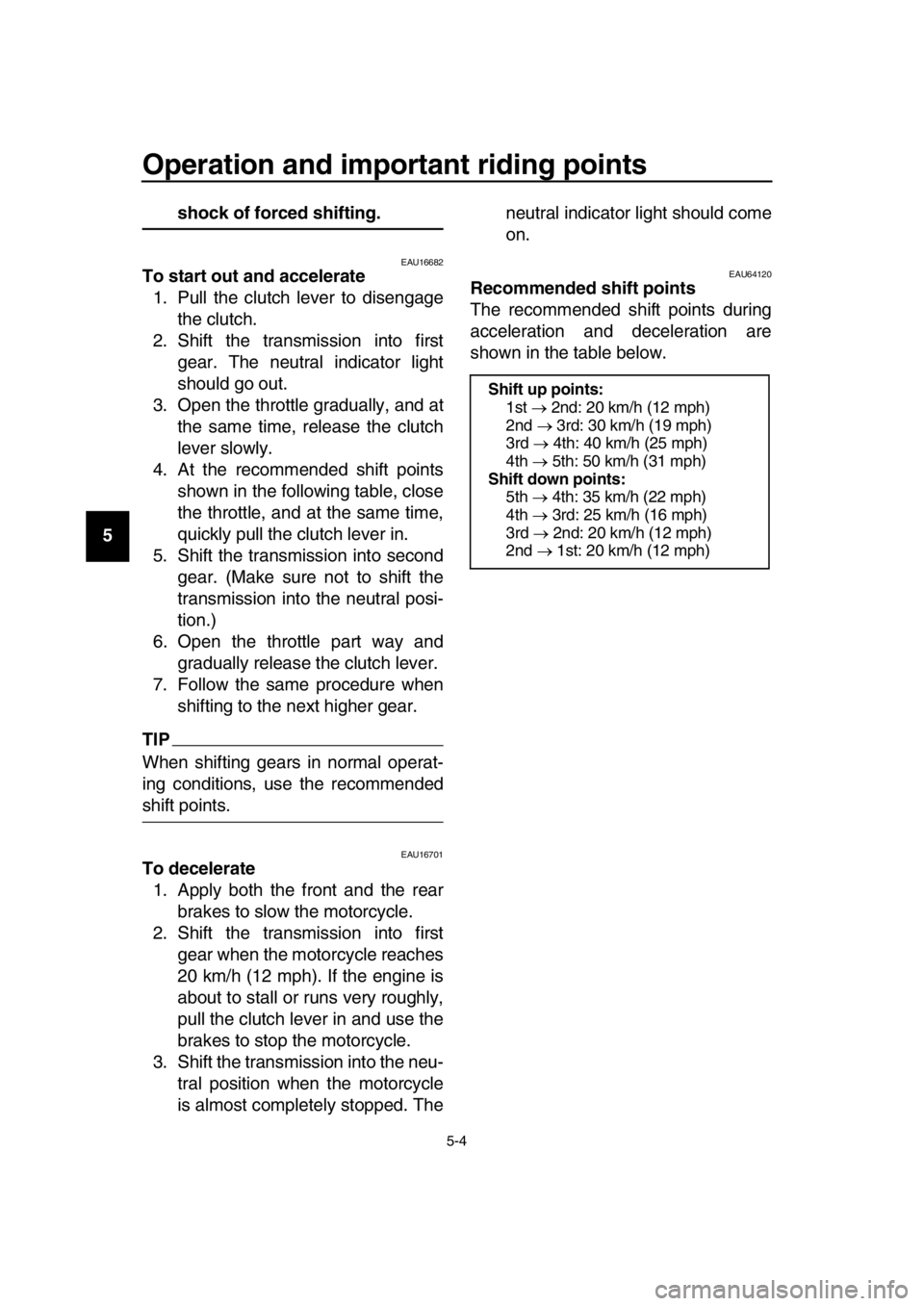
4. At the recommended shift points shown in the following table, close
the throttle, and at the same time,
quickly pull the clutch lever in.
5. Shift the transmission into second gear. (Make sure not to shift the
transmission into the neutral posi-
tion.)
6. Open the throttle part way and gradually release the clutch lever.
7. Follow the same procedure when shifting to the next higher gear.
TIP
When shifting gears in normal operat-
ing conditions, use the recommended
shift points.
EAU16701To decelerate1. Apply both the front and the rear brakes to slow the motorcycle.
2. Shift the transmission into first gear when the motorcycle reaches
20 km/h (12 mph). If the engine is
about to stall or runs very roughly,
pull the clutch lever in and use the
brakes to stop the motorcycle.
3. Shift the transmission into the neu- tral position when the motorcycle
is almost completely stopped. The neutral indicator light should come
on.
EAU64120Recommended shift points
The recommended shift points during
acceleration and deceleration are
shown in the table below.
Shift up points:
1st 2nd: 20 km/h (12 mph)
2nd 3rd: 30 km/h (19 mph)
3rd 4th: 40 km/h (25 mph)
4th 5th: 50 km/h (31 mph)
Shift down points: 5th 4th: 35 km/h (22 mph)
4th 3rd: 25 km/h (16 mph)
3rd 2nd: 20 km/h (12 mph)
2nd 1st: 20 km/h (12 mph)
2RD-28199-E1.book 4 ページ 2015年9月3日 木曜日 午後3時42分
Page 37 of 96

Operation and important riding points
5-5
1
2
3
4
5
6
7
8
9
10
11
12
13
14
EAU16811
Tips for reducing fuel
consumption
Fuel consumption depends largely on
your riding style. Consider the following
tips to reduce fuel consumption:
Shift up swiftly, and avoid high en-
gine speeds during acceleration.
Do not rev the engine while shifting
down, and avoid high engine
speeds with no load on the engine.
Turn the engine off instead of let-
ting it idle for an extended length of
time (e.g., in traffic jams, at traffic
lights or at railroad crossings).
EAU16842
Engine break-in
There is never a more important period
in the life of your engine than the period
between 0 and 1600 km (1000 mi). For
this reason, you should read the follow-
ing material carefully.
Since the engine is brand new, do not
put an excessive load on it for the first
1600 km (1000 mi). The various parts in
the engine wear and polish themselves
to the correct operating clearances.
During this period, prolonged full-throt-
tle operation or any condition that might
result in engine overheating must be
avoided.
EAU17094
0–1000 km (0–600 mi)
Avoid prolonged operation above 3500
r/min. NOTICE: After 1000 km (600
mi) of operation, the engine oil must
be changed and the oil filter car-
tridge or element replaced.
[ECA10303]
1000–1600 km (600–1000 mi)
Avoid prolonged operation above 4200
r/min.
1600 km (1000 mi) and beyond
The vehicle can now be operated nor-
mally.
NOTICE
ECA10311
Keep the engine speed out of
the tachometer red zone.
If any engine trouble should oc-
cur during the engine break-in
period, immediately have a
Yamaha dealer check the vehi-
cle.
2RD-28199-E1.book 5 ページ 2015年9月3日 木曜日 午後3時42分
Page 44 of 96
Periodic maintenance and adjustment
6-6
1
2
3
4
5
6
7
8
9
10
11
12
13
14
EAU59350
TIP
Air filter This model’s air intake system is equipped with a disposable oil-coated pa- per element. The air filter element cannot be cleaned with compressed air,
it must be replaced.
The air filter element needs to be replaced more frequently when riding in unusually wet or dusty areas.
Hydraulic brake service After disassembling the brake master cylinder and caliper, always change the fluid. Regularly check the brake fluid level and fill the reservoir as re-
quired.
Every two years replace the internal components of the brake master cylin- der and caliper, and change the brake fluid.
Replace the brake hose every four years and if cracked or damaged.
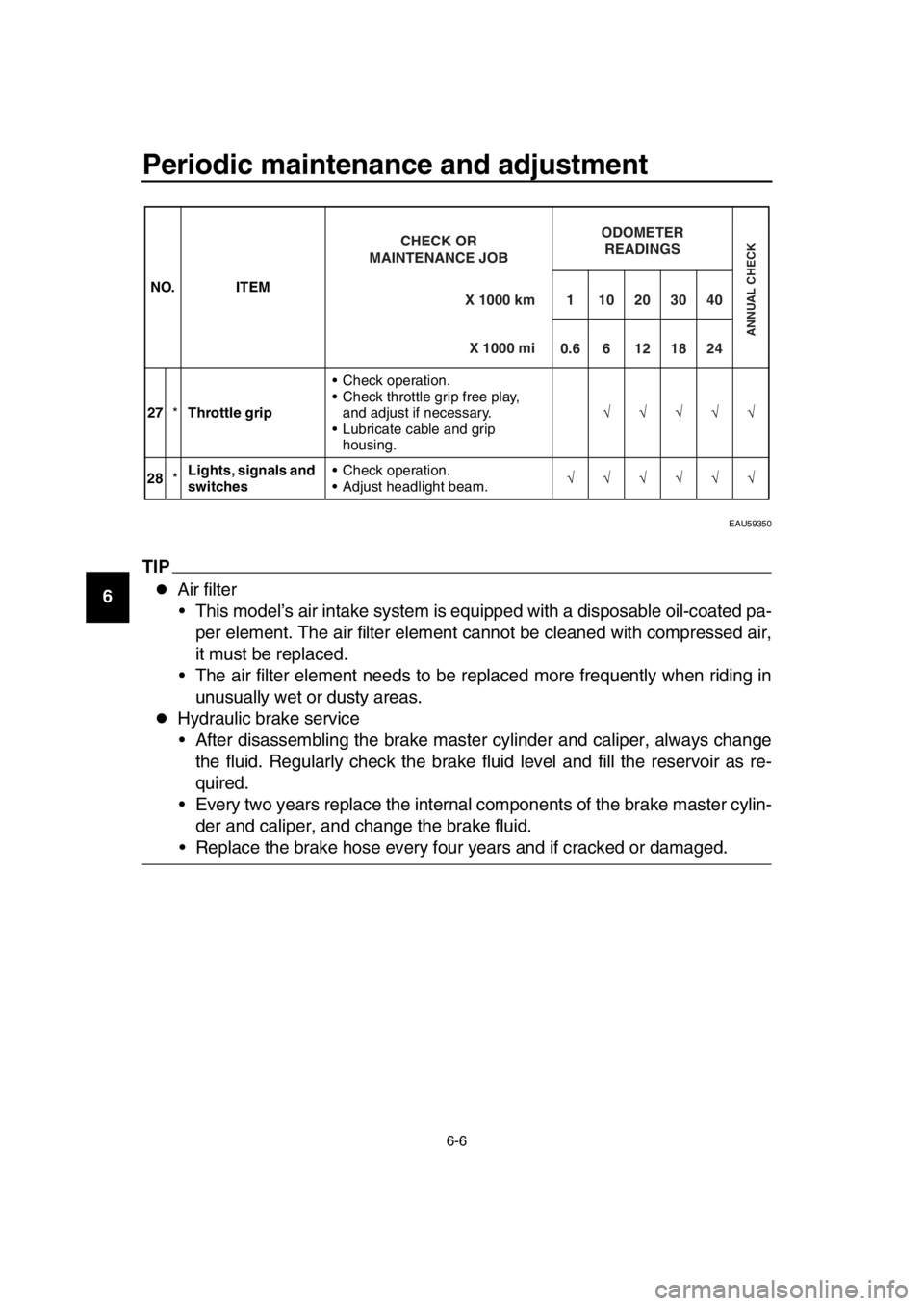
27 *Throttle grip Check operation.
Check throttle grip free play,
and adjust if necessary.
Lubricate cable and grip housing.
28 *Lights, signals and
switches Check operation.
Adjust headlight beam.
NO. ITEM
X 1000 km
CHECK OR
MAINTENANCE JOB
X 1000 mi
ODOMETER READINGS
ANNUAL CHECK
110203040
0.66121824
2RD-28199-E1.book 6 ページ 2015年9月3日 木曜日 午後3時42分
Page 46 of 96
Periodic maintenance and adjustment
6-8
1
2
3
4
5
6
7
8
9
10
11
12
13
14
EAU19605
Checking the spark plug
The spark plug is an important engine
component, which is easy to check.
Since heat and deposits will cause any
spark plug to slowly erode, the spark
plug should be removed and checked
in accordance with the periodic mainte-
nance and lubrication chart. In addition,
the condition of the spark plug can re-
veal the condition of the engine.
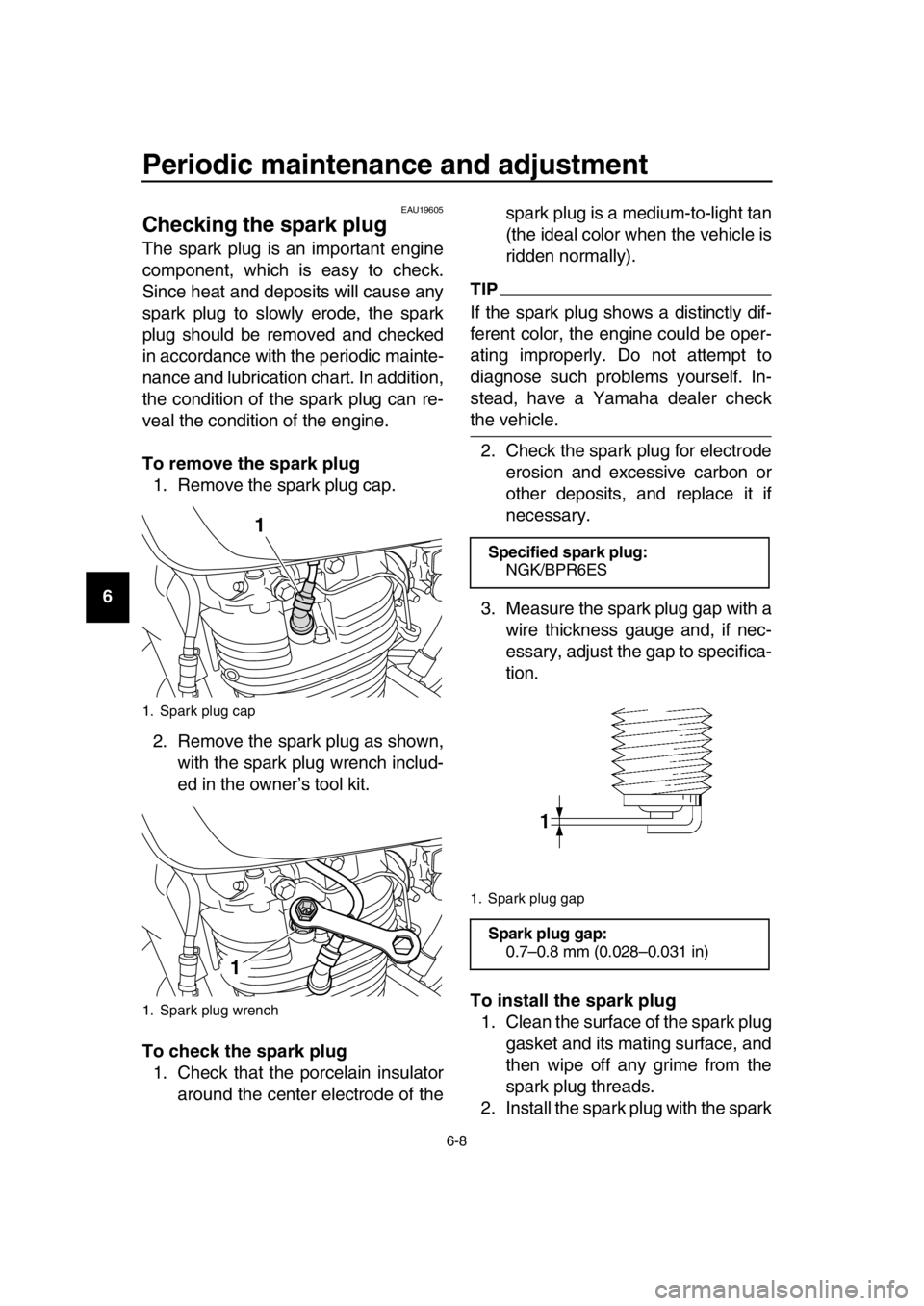
To remove the spark plug 1. Remove the spark plug cap.
2. Remove the spark plug as shown, with the spark plug wrench includ-
ed in the owner’s tool kit.
To check the spark plug 1. Check that the porcelain insulator around the center electrode of the spark plug is a medium-to-light tan
(the ideal color when the vehicle is
ridden normally).
TIP
If the spark plug shows a distinctly dif-
ferent color, the engine could be oper-
ating improperly. Do not attempt to
diagnose such problems yourself. In-
stead, have a Yamaha dealer check
the vehicle.
2. Check the spark plug for electrode erosion and excessive carbon or
other deposits, and replace it if
necessary.
3. Measure the spark plug gap with a wire thickness gauge and, if nec-
essary, adjust the gap to specifica-
tion.
To install the spark plug 1. Clean the surface of the spark plug gasket and its mating surface, and
then wipe off any grime from the
spark plug threads.
2. Install the spark plug with the spark
1. Spark plug cap
1. Spark plug wrench
1
1
Specified spark plug: NGK/BPR6ES
1. Spark plug gap
Spark plug gap:0.7–0.8 mm (0.028–0.031 in)
2RD-28199-E1.book 8 ページ 2015年9月3日 木曜日 午後3時42分
Page 59 of 96
Periodic maintenance and adjustment
6-21
1
2
3
4
5
6
7
8
9
10
11
12
13
14
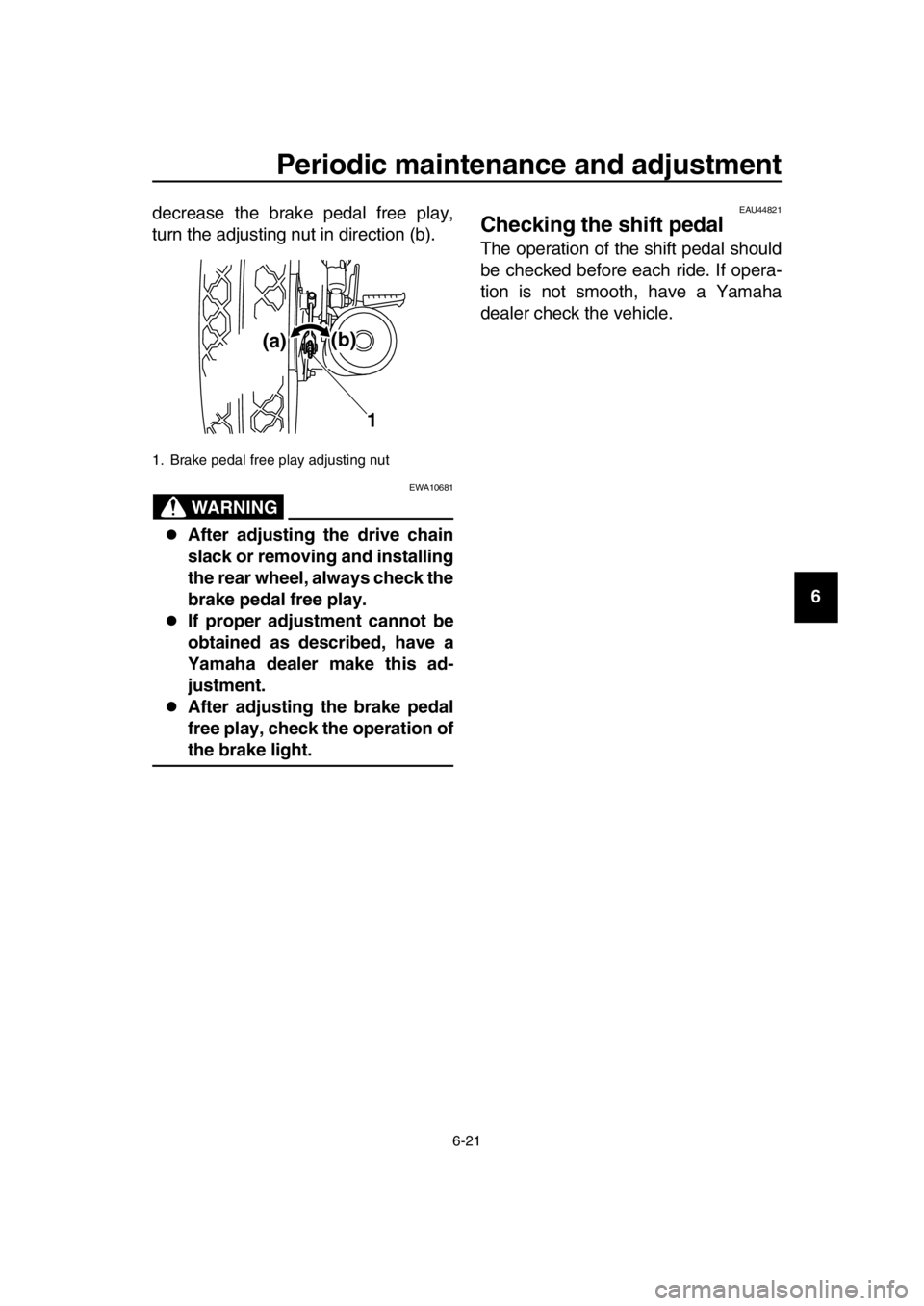
decrease the brake pedal free play,
turn the adjusting nut in direction (b).
WARNING
EWA10681
After adjusting the drive chain
slack or removing and installing
the rear wheel, always check the
brake pedal free play.
If proper adjustment cannot be
obtained as described, have a
Yamaha dealer make this ad-
justment.
After adjusting the brake pedal
free play, check the operation of
the brake light.
EAU44821
Checking the shift pedal
The operation of the shift pedal should
be checked before each ride. If opera-
tion is not smooth, have a Yamaha
dealer check the vehicle.
1. Brake pedal free play adjusting nut
(b)
(a)
1
2RD-28199-E1.book 21 ページ 2015年9月3日 木曜日 午後3時42分
Page 60 of 96
Periodic maintenance and adjustment
6-22
1
2
3
4
5
6
7
8
9
10
11
12
13
14
EAU22274
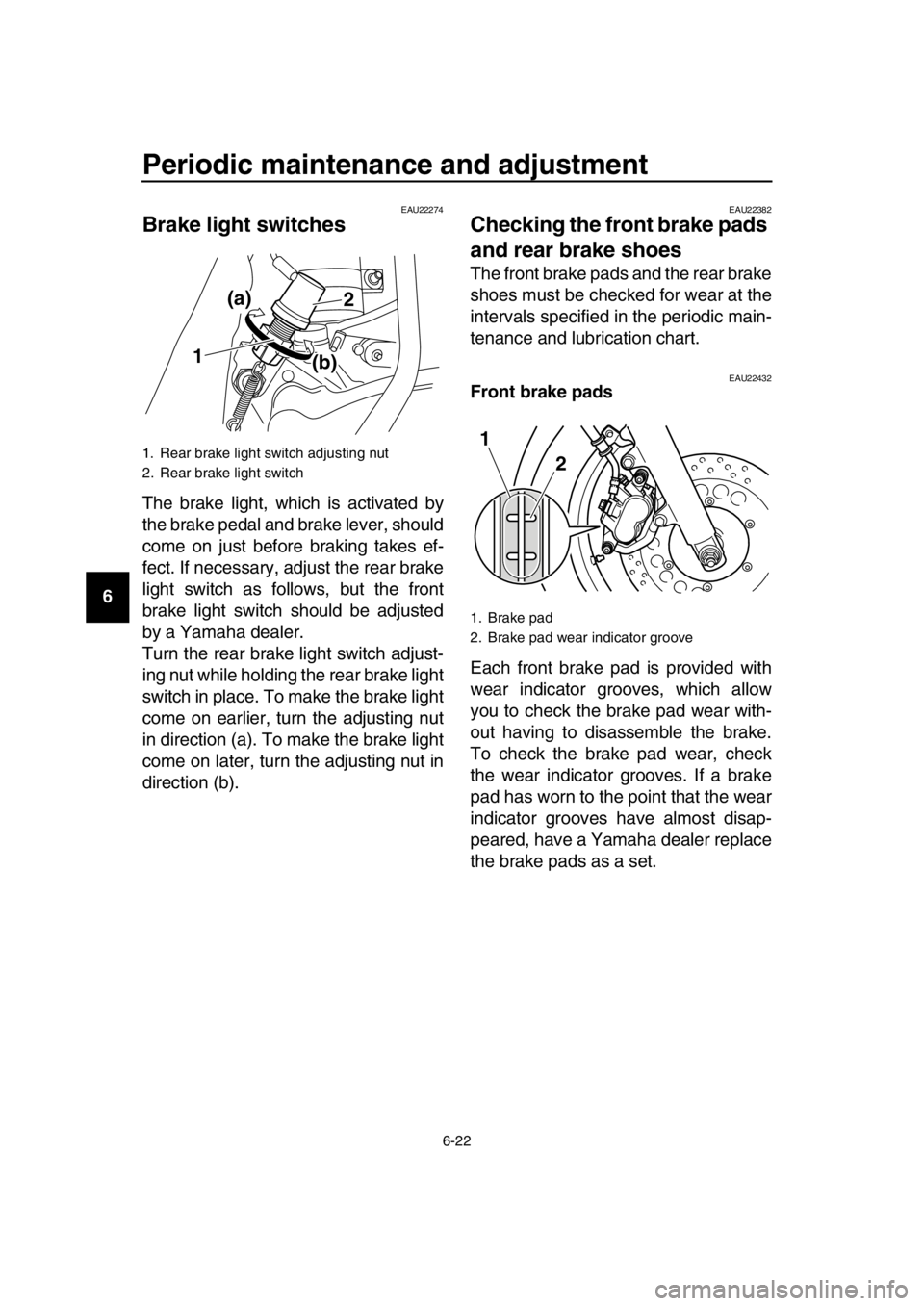
Brake light switches
The brake light, which is activated by
the brake pedal and brake lever, should
come on just before braking takes ef-
fect. If necessary, adjust the rear brake
light switch as follows, but the front
brake light switch should be adjusted
by a Yamaha dealer.
Turn the rear brake light switch adjust-
ing nut while holding the rear brake light
switch in place. To make the brake light
come on earlier, turn the adjusting nut
in direction (a). To make the brake light
come on later, turn the adjusting nut in
direction (b).
EAU22382
Checking the front brake pads
and rear brake shoes
The front brake pads and the rear brake
shoes must be checked for wear at the
intervals specified in the periodic main-
tenance and lubrication chart.
EAU22432Front brake pads
Each front brake pad is provided with
wear indicator grooves, which allow
you to check the brake pad wear with-
out having to disassemble the brake.
To check the brake pad wear, check
the wear indicator grooves. If a brake
pad has worn to the point that the wear
indicator grooves have almost disap-
peared, have a Yamaha dealer replace
the brake pads as a set.
1. Rear brake light switch adjusting nut
2. Rear brake light switch
2
1 (a)
(b)
1. Brake pad
2. Brake pad wear indicator groove
12
2RD-28199-E1.book 22 ページ 2015年9月3日 木曜日 午後3時42分
Page 64 of 96
Periodic maintenance and adjustment
6-26
1
2
3
4
5
6
7
8
9
10
11
12
13
14 6. Take the motorcycle off the center-
stand, and then put the sidestand
down.
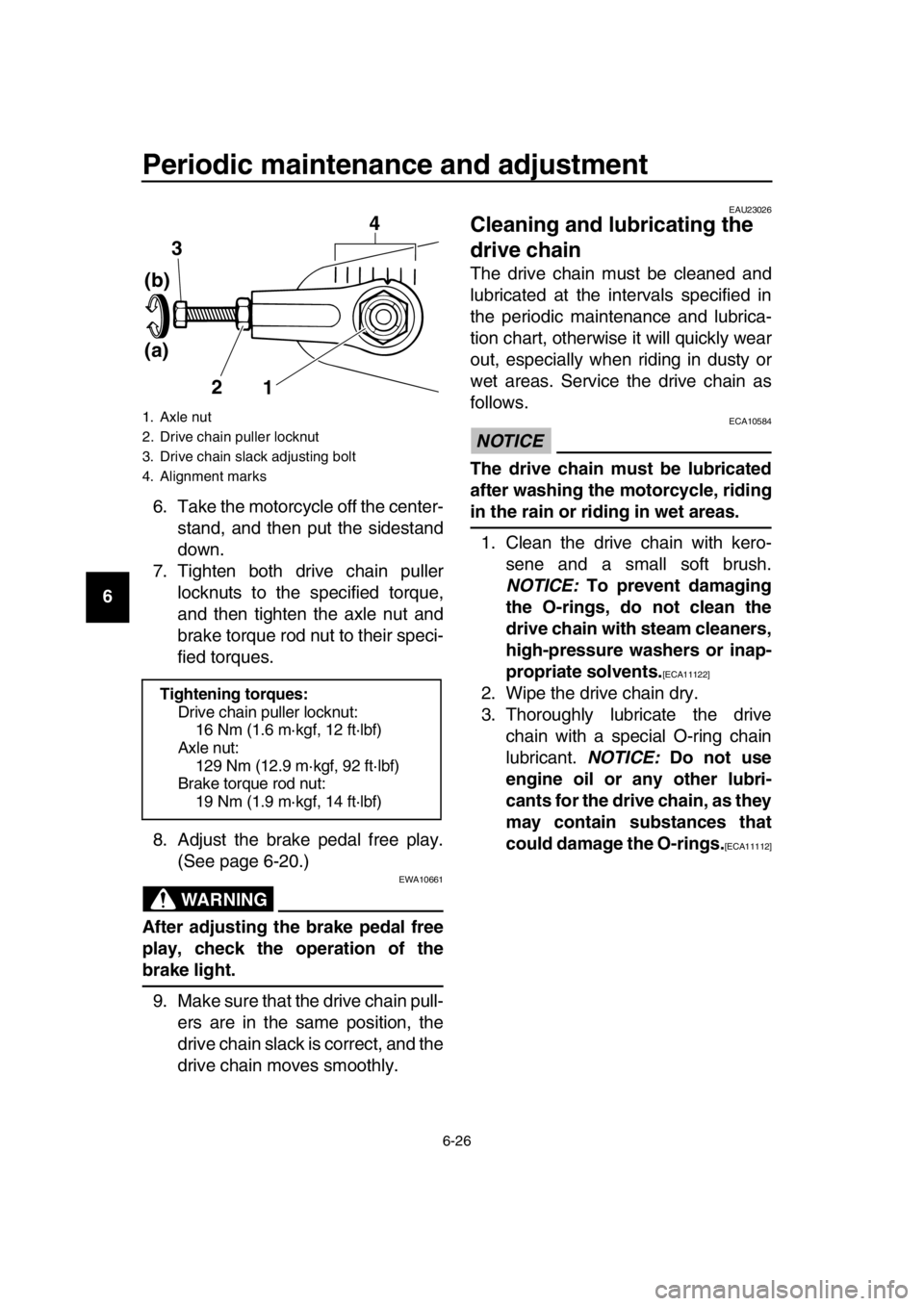
7. Tighten both drive chain puller locknuts to the specified torque,
and then tighten the axle nut and
brake torque rod nut to their speci-
fied torques.
8. Adjust the brake pedal free play. (See page 6-20.)
WARNING
EWA10661
After adjusting the brake pedal free
play, check the operation of the
brake light.
9. Make sure that the drive chain pull- ers are in the same position, the
drive chain slack is correct, and the
drive chain moves smoothly.
EAU23026
Cleaning and lubricating the
drive chain
The drive chain must be cleaned and
lubricated at the intervals specified in
the periodic maintenance and lubrica-
tion chart, otherwise it will quickly wear
out, especially when riding in dusty or
wet areas. Service the drive chain as
follows.
NOTICE
ECA10584
The drive chain must be lubricated
after washing the motorcycle, riding
in the rain or riding in wet areas.
1. Clean the drive chain with kero- sene and a small soft brush.
NOTICE: To prevent damaging
the O-rings, do not clean the
drive chain with steam cleaners,
high-pressure washers or inap-
propriate solvents.
[ECA11122]
2. Wipe the drive chain dry.
3. Thoroughly lubricate the drive chain with a special O-ring chain
lubricant. NOTICE: Do not use
engine oil or any other lubri-
cants for the drive chain, as they
may contain substances that
could damage the O-rings.
[ECA11112]
1. Axle nut
2. Drive chain puller locknut
3. Drive chain slack adjusting bolt
4. Alignment marks
Tightening torques: Drive chain puller locknut:16 Nm (1.6 m·kgf, 12 ft·lbf)
Axle nut: 129 Nm (12.9 m·kgf, 92 ft·lbf)
Brake torque rod nut:
19 Nm (1.9 m·kgf, 14 ft·lbf)
1
2
(a) (b)
3
4
2RD-28199-E1.book 26 ページ 2015年9月3日 木曜日 午後3時42分