All YAMAHA SR400 2016 Workshop Manual
[x] Cancel search | Manufacturer: YAMAHA, Model Year: 2016, Model line: SR400, Model: YAMAHA SR400 2016Pages: 96, PDF Size: 2.52 MB
Page 71 of 96
Periodic maintenance and adjustment
6-33
1
2
3
4
5
6
7
8
9
10
11
12
13
14
EAU59443
Replacing the fuses
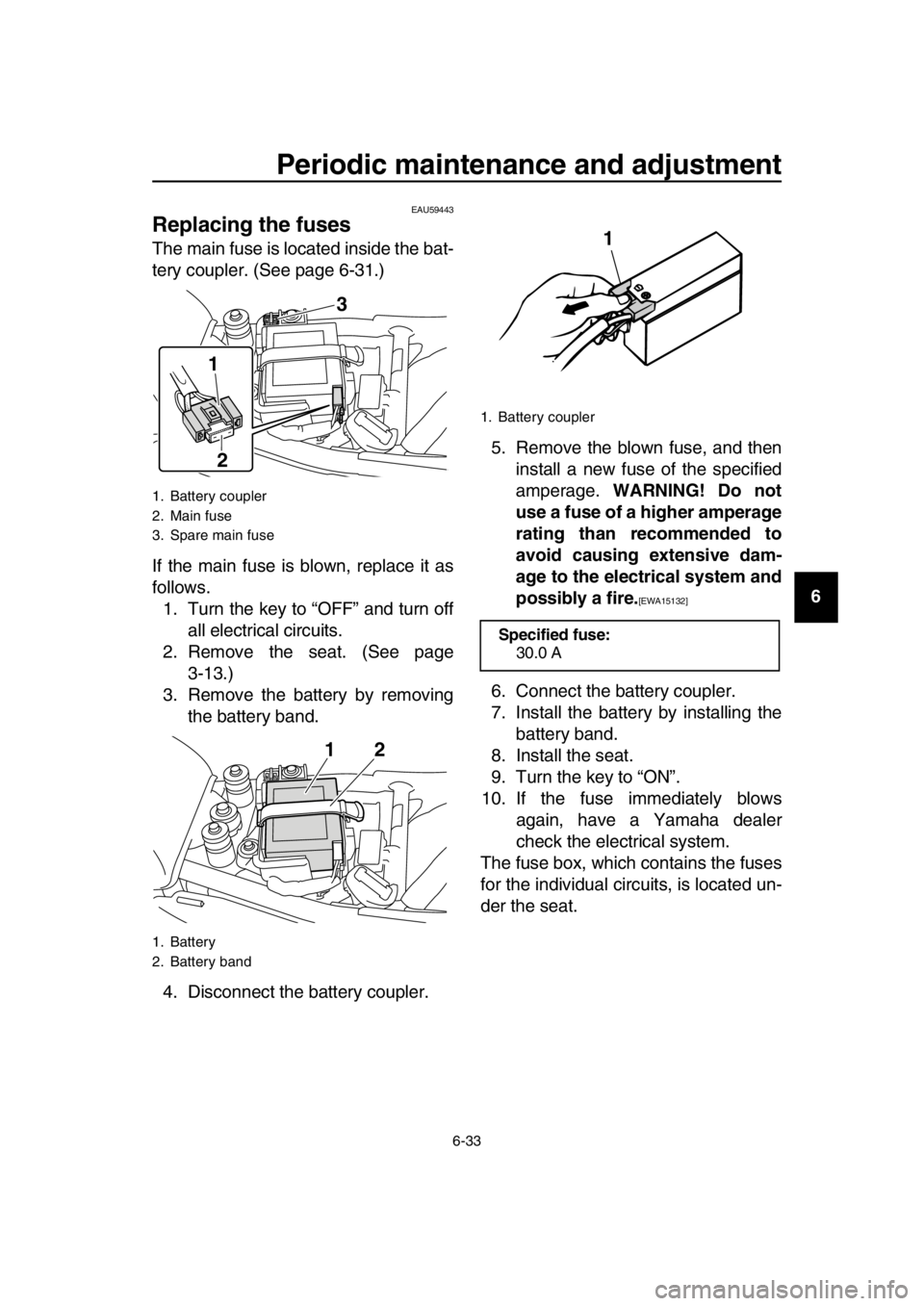
The main fuse is located inside the bat-
tery coupler. (See page 6-31.)
If the main fuse is blown, replace it as
follows. 1. Turn the key to “OFF” and turn off all electrical circuits.
2. Remove the seat. (See page 3-13.)
3. Remove the battery by removing the battery band.
4. Disconnect the battery coupler. 5. Remove the blown fuse, and then
install a new fuse of the specified
amperage. WARNING! Do not
use a fuse of a higher amperage
rating than recommended to
avoid causing extensive dam-
age to the electrical system and
possibly a fire.
[EWA15132]
6. Connect the battery coupler.
7. Install the battery by installing the battery band.
8. Install the seat.
9. Turn the key to “ON”.
10. If the fuse immediately blows again, have a Yamaha dealer
check the electrical system.
The fuse box, which contains the fuses
for the individual circ uits, is located un-
der the seat.
1. Battery coupler
2. Main fuse
3. Spare main fuse
1. Battery
2. Battery band
3
1
2
12
1. Battery coupler
Specified fuse: 30.0 A
1
2RD-28199-E1.book 33 ページ 2015年9月3日 木曜日 午後3時42分
Page 72 of 96

Periodic maintenance and adjustment
6-34
1
2
3
4
5
6
7
8
9
10
11
12
13
14 If a fuse is blown, replace it as follows.
1. Turn the key to “OFF” and turn off the electrical circuit in question.
2. Remove the seat. (See page 3-13.)
3. Remove the blown fuse, and then install a new fuse of the specified
amperage. WARNING! Do not
use a fuse of a higher amperage
rating than recommended to
avoid causing extensive dam-
age to the electrical system and
possibly a fire.
[EWA15132]
4. Turn the key to “ON” and turn on the electrical circuit in question to
check if the device operates.
5. If a fuse immediately blows again, have a Yamaha dealer check the
electrical system.
1. Fuse box
1. Headlight fuse
2. Signaling system fuse
3. Ignition fuse
4. Backup fuse
5. Fuel injection system fuse
6. Parking lighting fuse
7. Spare fuse
1
12
3 4
5
7
6
Specified fuses: Signaling system fuse:
15.0 A
Headlight fuse: 15.0 A
Ignition fuse: 10.0 A
Backup fuse:
7.5 A
Fuel injection system fuse: 7.5 A
Parking lighting fuse: 7.5 A
2RD-28199-E1.book 34 ページ 2015年9月3日 木曜日 午後3時42分
Page 74 of 96
Periodic maintenance and adjustment
6-36
1
2
3
4
5
6
7
8
9
10
11
12
13
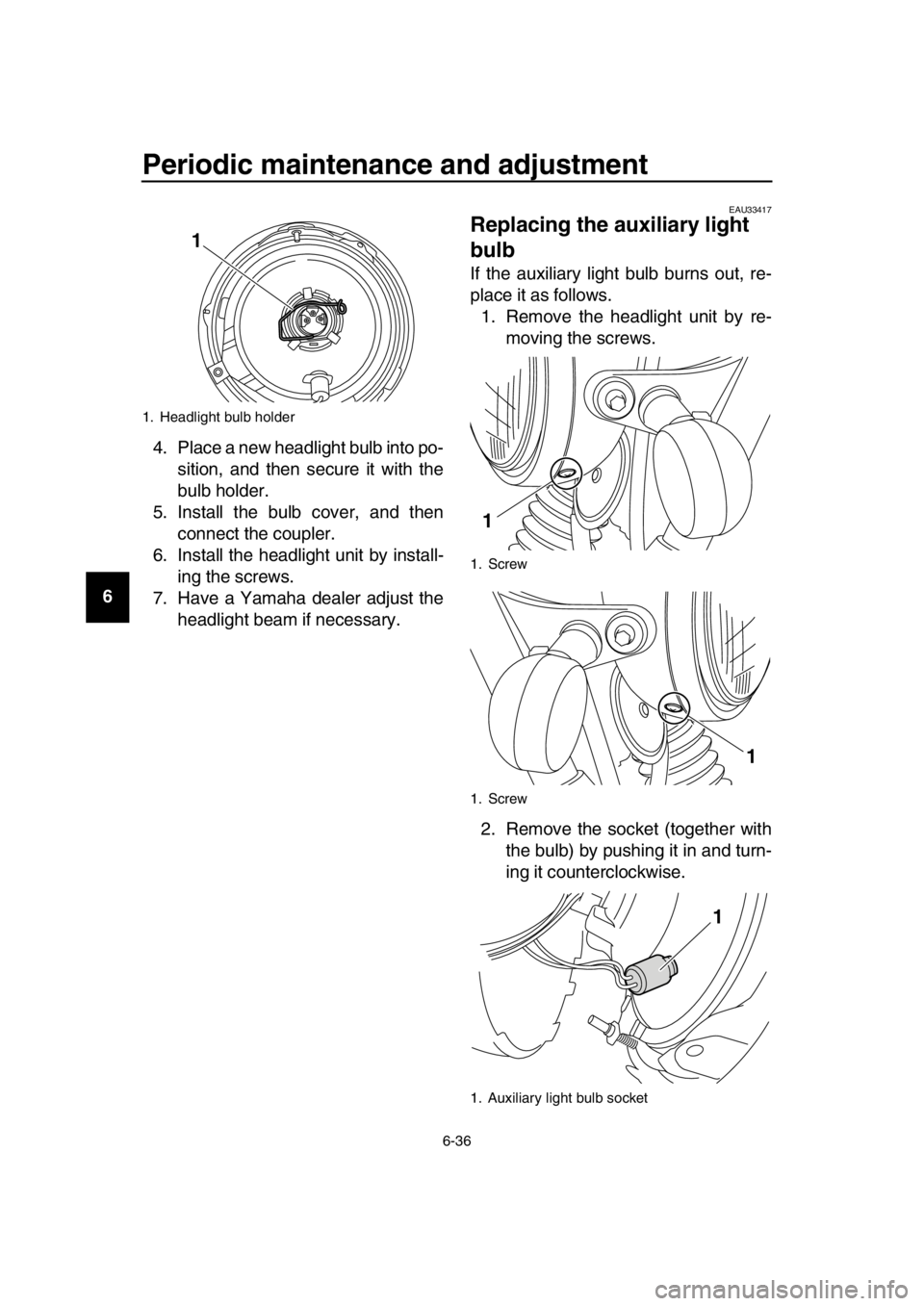
14 4. Place a new headlight bulb into po-
sition, and then secure it with the
bulb holder.
5. Install the bulb cover, and then connect the coupler.
6. Install the headlight unit by install- ing the screws.
7. Have a Yamaha dealer adjust the headlight beam if necessary.
EAU33417
Replacing the auxiliary light
bulb
If the auxiliary light bulb burns out, re-
place it as follows.1. Remove the headlight unit by re- moving the screws.
2. Remove the socket (together with the bulb) by pushing it in and turn-
ing it counterclockwise.
1. Headlight bulb holder
1
1. Screw
1. Screw
1. Auxiliary light bulb socket
1
1
1
2RD-28199-E1.book 36 ページ 2015年9月3日 木曜日 午後3時42分
Page 75 of 96
Periodic maintenance and adjustment
6-37
1
2
3
4
5
6
7
8
9
10
11
12
13
14
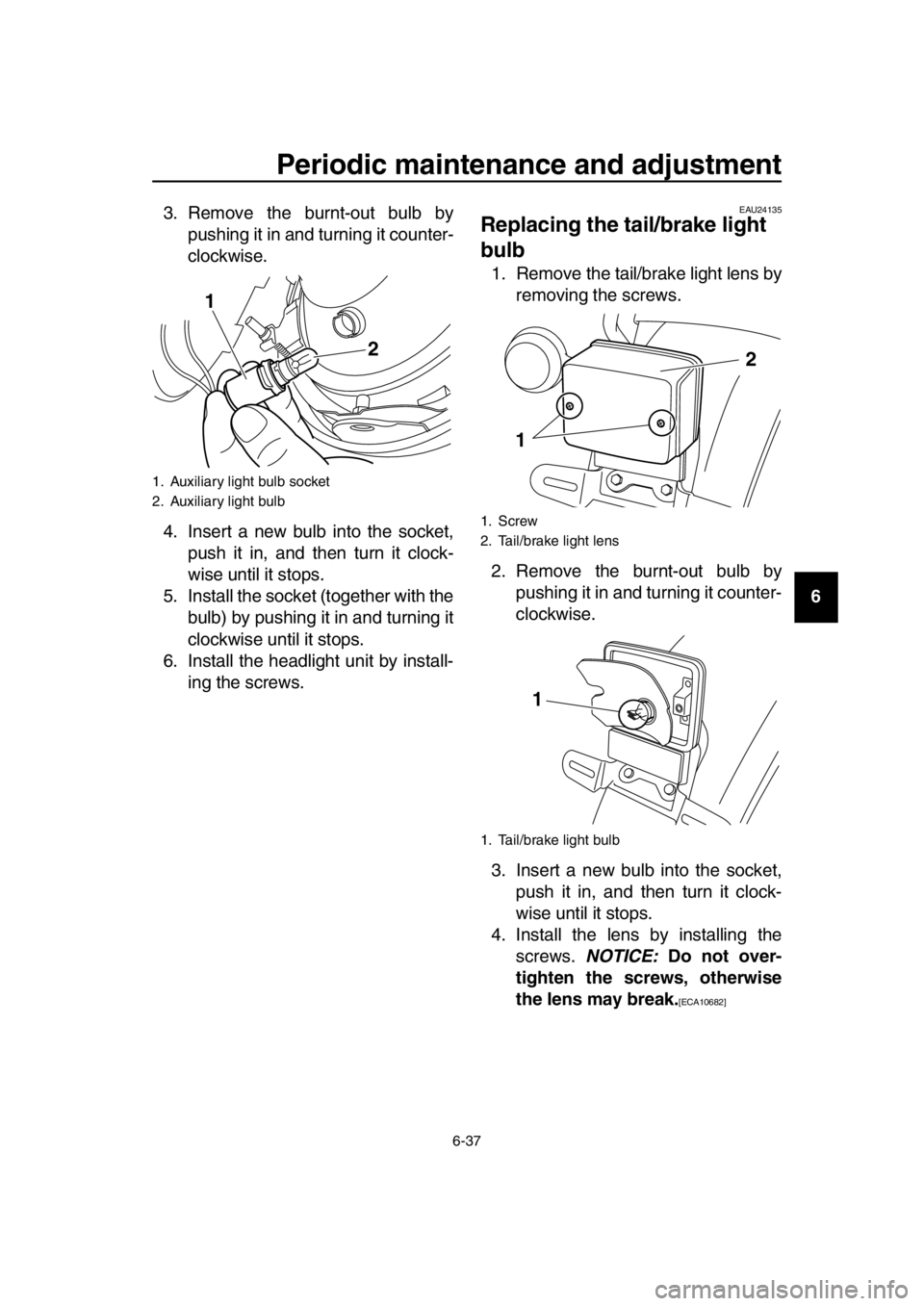
3. Remove the burnt-out bulb by
pushing it in and turning it counter-
clockwise.
4. Insert a new bulb into the socket, push it in, and then turn it clock-
wise until it stops.
5. Install the socket (together with the bulb) by pushing it in and turning it
clockwise until it stops.
6. Install the headlight unit by install- ing the screws.
EAU24135
Replacing the tail/brake light
bulb
1. Remove the tail/brake light lens byremoving the screws.
2. Remove the burnt-out bulb by pushing it in and turning it counter-
clockwise.
3. Insert a new bulb into the socket, push it in, and then turn it clock-
wise until it stops.
4. Install the lens by installing the screws. NOTICE: Do not over-
tighten the screws, otherwise
the lens may break.
[ECA10682]
1. Auxiliary light bulb socket
2. Auxiliary light bulb
1
2
1. Screw
2. Tail/brake light lens
1. Tail/brake light bulb
1 2
1
2RD-28199-E1.book 37 ページ 2015年9月3日 木曜日 午後3時42分
Page 76 of 96
Periodic maintenance and adjustment
6-38
1
2
3
4
5
6
7
8
9
10
11
12
13
14
EAU60010
Replacing a turn signal light
bulb
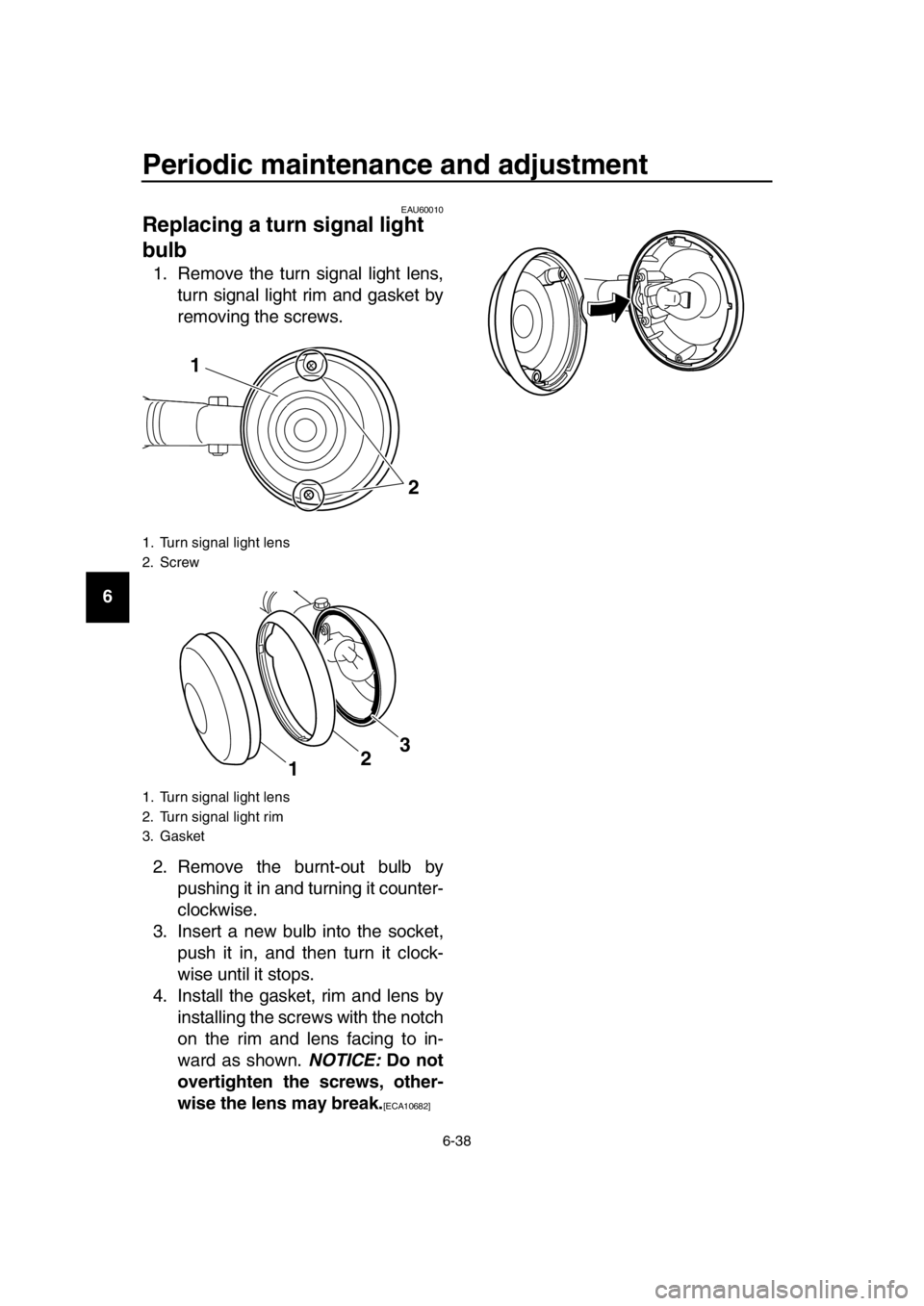
1. Remove the turn signal light lens, turn signal light rim and gasket by
removing the screws.
2. Remove the burnt-out bulb by pushing it in and turning it counter-
clockwise.
3. Insert a new bulb into the socket, push it in, and then turn it clock-
wise until it stops.
4. Install the gasket, rim and lens by installing the screws with the notch
on the rim and lens facing to in-
ward as shown. NOTICE: Do not
overtighten the screws, other-
wise the lens may break.
[ECA10682]
1. Turn signal light lens
2. Screw
1. Turn signal light lens
2. Turn signal light rim
3. Gasket
1
2
3
2
1
2RD-28199-E1.book 38 ページ 2015年9月3日 木曜日 午後3時42分
Page 77 of 96
Periodic maintenance and adjustment
6-39
1
2
3
4
5
6
7
8
9
10
11
12
13
14
EAU24361
Front wheel
EAU59603
To remove the front wheel
WARNING
EWA10822
To avoid injury, securely support the
vehicle so there is no danger of it
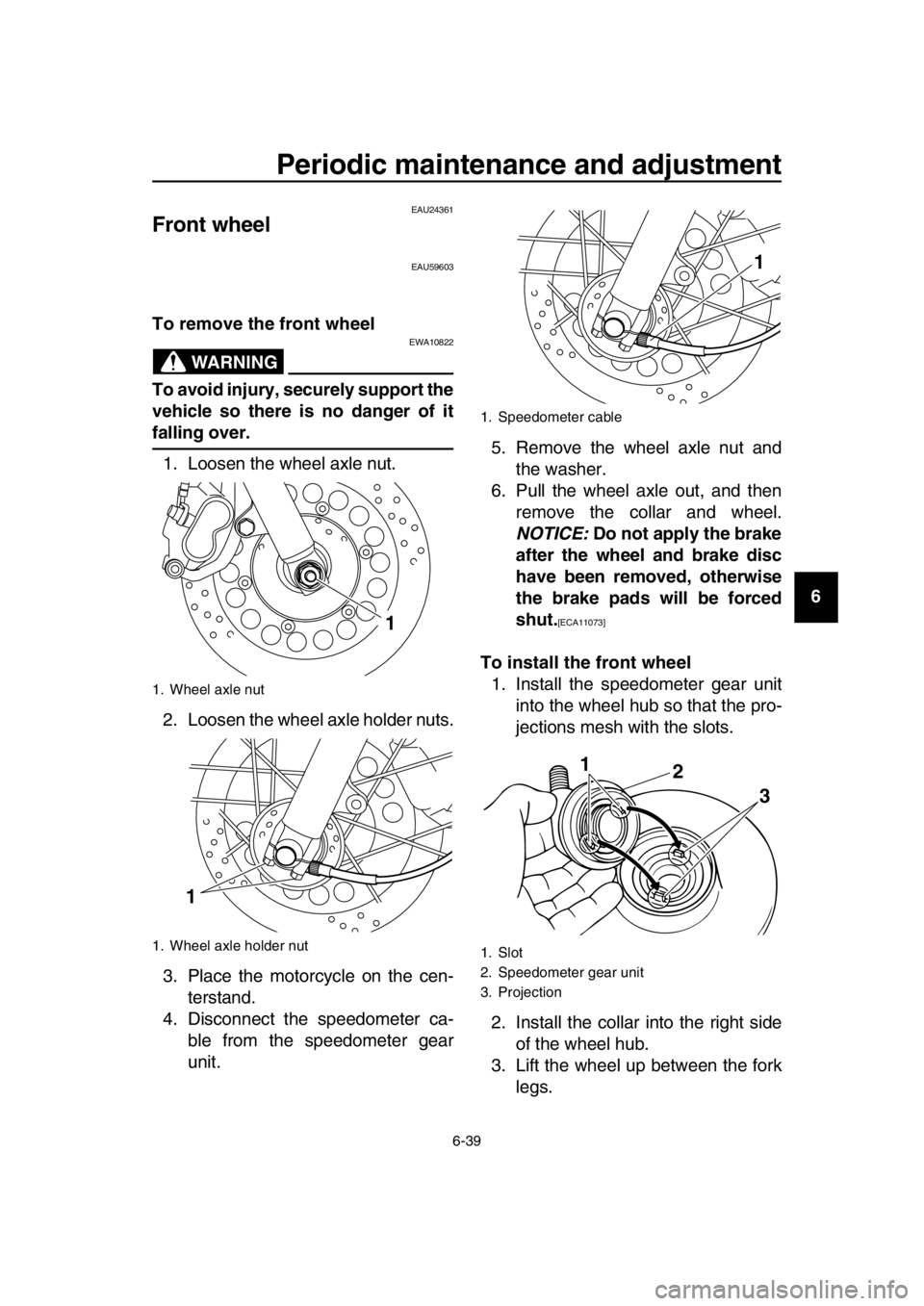
falling over. 1. Loosen the wheel axle nut.
2. Loosen the wheel axle holder nuts.
3. Place the motorcycle on the cen- terstand.
4. Disconnect the speedometer ca- ble from the speedometer gear
unit. 5. Remove the wheel axle nut and
the washer.
6. Pull the wheel axle out, and then remove the collar and wheel.
NOTICE: Do not apply the brake
after the wheel and brake disc
have been removed, otherwise
the brake pads will be forced
shut.
[ECA11073]
To install the front wheel1. Install the speedometer gear unit into the wheel hub so that the pro-
jections mesh with the slots.
2. Install the collar into the right side of the wheel hub.
3. Lift the wheel up between the fork legs.
1. Wheel axle nut
1. Wheel axle holder nut
1
1
1. Speedometer cable
1. Slot
2. Speedometer gear unit
3. Projection
1
2
3
1
2RD-28199-E1.book 39 ページ 2015年9月3日 木曜日 午後3時42分
Page 78 of 96
Periodic maintenance and adjustment
6-40
1
2
3
4
5
6
7
8
9
10
11
12
13
14
TIP
Make sure that there is enough space
between the brake pads before insert-
ing the brake disc and that the slot in
the speedometer gear unit fits over the
retainer on the fork leg.
4. Insert the wheel axle from the left side, and then install the washer
and axle nut.
5. Take the motorcycle off the center- stand so that the front wheel is on
the ground, and then put the side-
stand down.
6. Tighten the axle nut and the wheel axle holder nuts to their specified
torques.
7. While applying the front brake, push down hard on the handlebars
several times to check if the front
fork compresses and rebounds
smoothly.
8. Connect the speedometer cable.
EAU25081
Rear wheel
EAU59614
To remove the rear wheel
WARNING
EWA10822
To avoid injury, securely support the
vehicle so there is no danger of it
falling over.
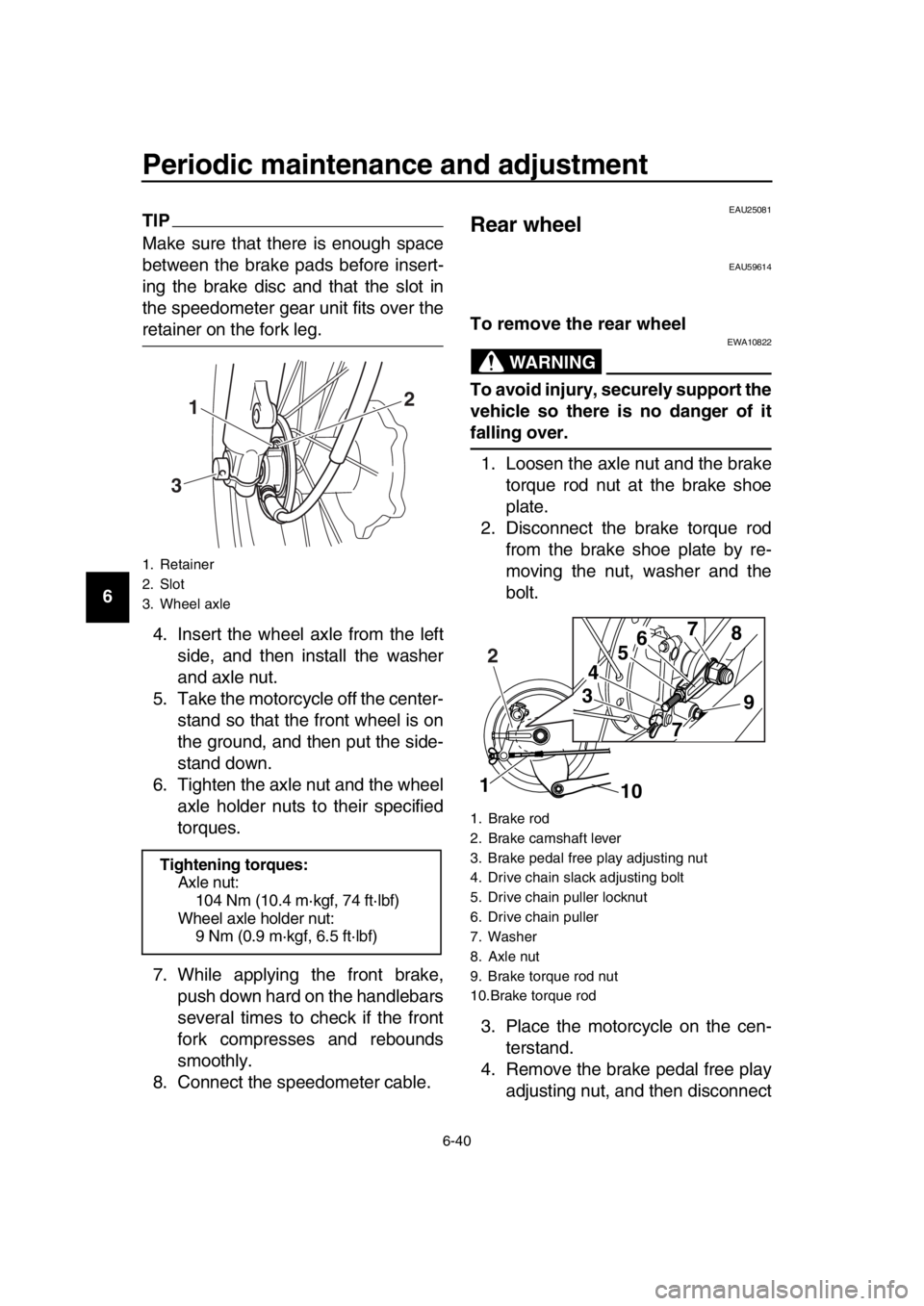
1. Loosen the axle nut and the brake torque rod nut at the brake shoe
plate.
2. Disconnect the brake torque rod from the brake shoe plate by re-
moving the nut, washer and the
bolt.
3. Place the motorcycle on the cen- terstand.
4. Remove the brake pedal free play adjusting nut, and then disconnect
1. Retainer
2. Slot
3. Wheel axle
Tightening torques:Axle nut:
104 Nm (10.4 m·kgf, 74 ft·lbf)
Wheel axle holder nut: 9 Nm (0.9 m·kgf, 6.5 ft·lbf)
1
3 2
1. Brake rod
2. Brake camshaft lever
3. Brake pedal free play adjusting nut
4. Drive chain slack adjusting bolt
5. Drive chain puller locknut
6. Drive chain puller
7. Washer
8. Axle nut
9. Brake torque rod nut
10.Brake torque rod
1
10
34
5
6
7
8
9
7
2
2RD-28199-E1.book 40 ページ 2015年9月3日 木曜日 午後3時42分
Page 79 of 96
Periodic maintenance and adjustment
6-41
1
2
3
4
5
6
7
8
9
10
11
12
13
14
the brake rod from the brake cam-
shaft lever.
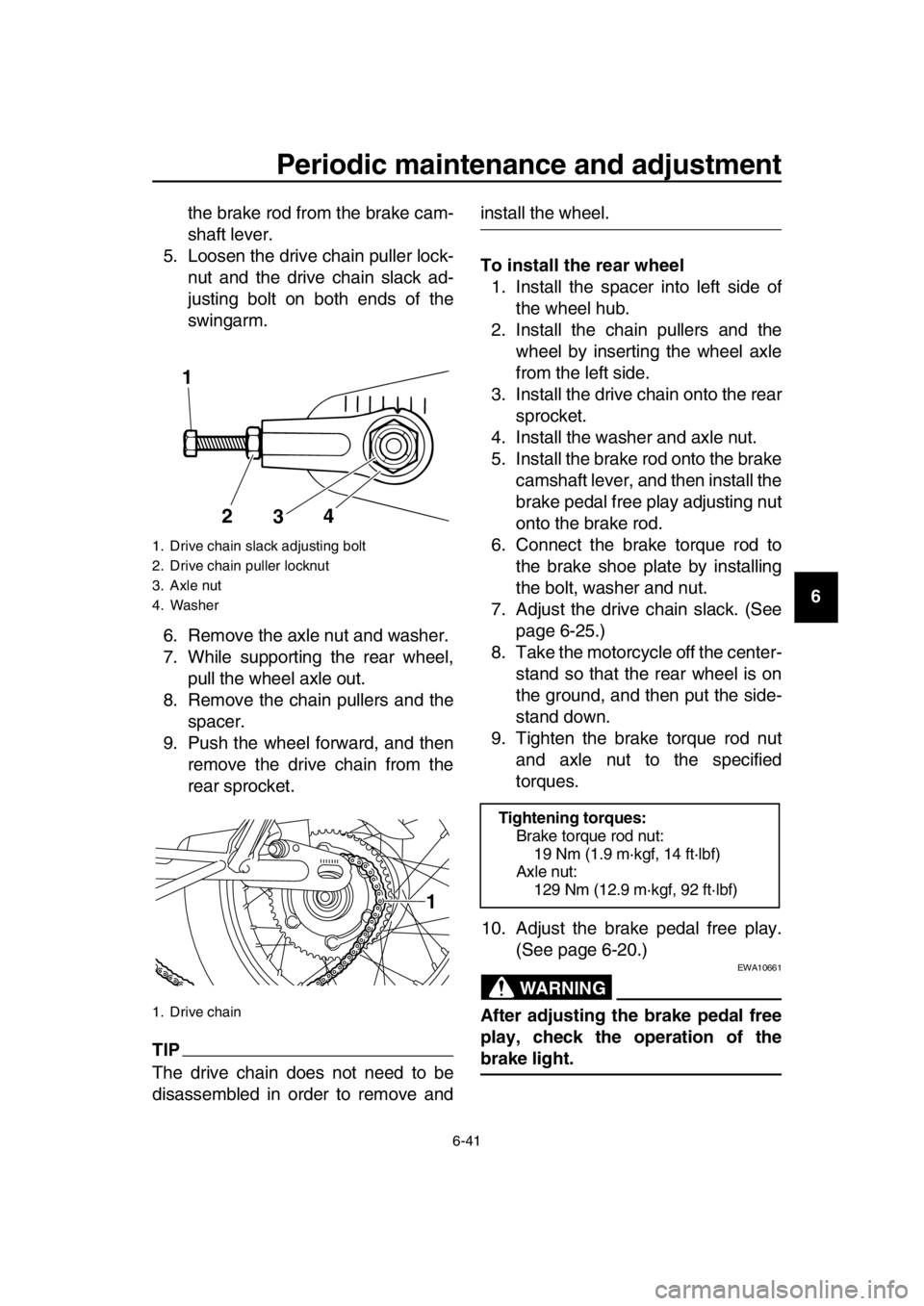
5. Loosen the drive chain puller lock- nut and the drive chain slack ad-
justing bolt on both ends of the
swingarm.
6. Remove the axle nut and washer.
7. While supporting the rear wheel, pull the wheel axle out.
8. Remove the chain pullers and the spacer.
9. Push the wheel forward, and then remove the drive chain from the
rear sprocket.
TIP
The drive chain does not need to be
disassembled in order to remove and
install the wheel.
To install the rear wheel1. Install the spacer into left side of the wheel hub.
2. Install the chain pullers and the wheel by inserting the wheel axle
from the left side.
3. Install the drive chain onto the rear sprocket.
4. Install the washer and axle nut.
5. Install the brake rod onto the brake camshaft lever, and then install the
brake pedal free play adjusting nut
onto the brake rod.
6. Connect the brake torque rod to the brake shoe plate by installing
the bolt, washer and nut.
7. Adjust the drive chain slack. (See page 6-25.)
8. Take the motorcycle off the center- stand so that the rear wheel is on
the ground, and then put the side-
stand down.
9. Tighten the brake torque rod nut and axle nut to the specified
torques.
10. Adjust the brake pedal free play. (See page 6-20.)
WARNING
EWA10661
After adjusting the brake pedal free
play, check the operation of the
brake light.
1. Drive chain slack adjusting bolt
2. Drive chain puller locknut
3. Axle nut
4. Washer
1. Drive chain
3
2
14
1
Tightening torques:
Brake torque rod nut: 19 Nm (1.9 m·kgf, 14 ft·lbf)
Axle nut: 129 Nm (12.9 m·kgf, 92 ft·lbf)
2RD-28199-E1.book 41 ページ 2015年9月3日 木曜日 午後3時42分
Page 82 of 96
7-1
1
2
3
4
5
6
7
8
9
10
11
12
13
14
Motorcycle care and storage
EAU37834
Matte color caution
NOTICE
ECA15193
Some models are equipped with
matte colored finished parts. Be
sure to consult a Yamaha dealer for
advice on what products to use be-
fore cleaning the vehicle. Using a
brush, harsh chemical products or
cleaning compounds when cleaning
these parts will scratch or damage
their surface. Wax also should not
be applied to any matte colored fin-
ished parts.
EAU26005
Care
While the open design of a motorcycle
reveals the attractiveness of the tech-
nology, it also makes it more vulnera-
ble. Rust and corrosion can develop
even if high-quality components are
used. A rusty exhaust pipe may go un-
noticed on a car, however, it detracts
from the overall appearance of a motor-
cycle. Frequent and proper care does
not only comply with the terms of the
warranty, but it will also keep your mo-
torcycle looking good, extend its life
and optimize its performance.
Before cleaning 1. Cover the muffler outlet with a plastic bag after the engine has
cooled down.
2. Make sure that all caps and covers as well as all electrical couplers
and connectors, including the
spark plug cap, are tightly in-
stalled.
3. Remove extremely stubborn dirt, like oil burnt onto the crankcase,
with a degreasing agent and a
brush, but never apply such prod-
ucts onto seals, gaskets, sprock-
ets, the drive chain and wheel
axles. Always rinse the dirt and de-
greaser off with water.
Cleaning
NOTICE
ECA10773
Avoid using strong acidic wheel
cleaners, especially on spoked
wheels. If such products are
used on hard-to-remove dirt, do
not leave the cleaner on the af-
2RD-28199-E1.book 1 ページ 2015年9月3日 木曜日 午後3時42分
Page 83 of 96
Motorcycle care and storage
7-2
1
2
3
4
5
6
7
8
9
10
11
12
13
14
fected area any longer than in-
structed. Also, thoroughly rinse
the area off with water, immedi-
ately dry it, and then apply a cor-
rosion protection spray.
Improper cleaning can damage
plastic parts (such as cowlings,
panels, windshields, headlight
lenses, meter lenses, etc.) and
the mufflers. Use only a soft,
clean cloth or sponge with wa-
ter to clean plastic. However, if
the plastic parts cannot be thor-
oughly cleaned with water, di-
luted mild detergent with water
may be used. Be sure to rinse
off any detergent residue using
plenty of water, as it is harmful
to plastic parts.
Do not use any harsh chemical
products on plastic parts. Be
sure to avoid using cloths or
sponges which have been in
contact with strong or abrasive
cleaning products, solvent or
thinner, fuel (gasoline), rust re-
movers or inhibitors, brake flu-
id, antifreeze or electrolyte.
Do not use high-pressure wash-
ers or steam-jet cleaners since
they cause water seepage and
deterioration in the following ar-
eas: seals (of wheel and swing-
arm bearings, fork and brakes),
electric components (couplers,
connectors, instruments,
switches and lights), breather
hoses and vents.
For motorcycles equipped with
a windshield: Do not use strong
cleaners or hard sponges as
they will cause dulling or scratching. Some cleaning com-
pounds for plastic may leave
scratches on the windshield.
Test the product on a small hid-
den part of the windshield to
make sure that it does not leave
any marks. If the windshield is
scratched, use a quality plastic
polishing compound after
washing.
After normal use
Remove dirt with warm water, a mild
detergent, and a soft, clean sponge,
and then rinse thoroughly with clean
water. Use a toothbrush or bottlebrush
for hard-to-reach areas. Stubborn dirt
and insects will come off more easily if
the area is covered with a wet cloth for
a few minutes before cleaning.
After riding in the rain, near the sea or
on salt-sprayed roads
Since sea salt or salt sprayed on roads
during winter are extremely corrosive in
combination with water, carry out the
following steps after each ride in the
rain, near the sea or on salt-sprayed
roads.
TIP
Salt sprayed on roads in the winter may
remain well into spring. 1. Clean the motorcycle with cold wa- ter and a mild detergent, after the
engine has cooled down.
NOTICE: Do not use warm water
since it increases the corrosive
action of the salt.
[ECA10792]
2. Apply a corrosion protection sprayon all metal, including chrome- and
nickel-plated, surfaces to prevent
2RD-28199-E1.book 2 ページ 2015年9月3日 木曜日 午後3時42分