transmission YAMAHA SR400 2016 Owners Manual
[x] Cancel search | Manufacturer: YAMAHA, Model Year: 2016, Model line: SR400, Model: YAMAHA SR400 2016Pages: 96, PDF Size: 2.52 MB
Page 11 of 96
Safety information
1-5
1
2
3
4
5
6
7
8
9
10
11
12
13
14
appropriate. Refer to page 6-15 for tire
specifications and more information on
replacing your tires.
Transporting the Motorcycle
Be sure to observe following instruc-
tions before transporting the motorcy-
cle in another vehicle.
Remove all loose items from the
motorcycle.
Check that the fuel cock (if
equipped) is in the “OFF” position
and that there are no fuel leaks.
Point the front wheel straight
ahead on the trailer or in the truck
bed, and choke it in a rail to pre-
vent movement.
Shift the transmission in gear (for
models with a manual transmis-
sion).
Secure the motorcycle with tie-
downs or suitable straps that are
attached to solid parts of the mo-
torcycle, such as the frame or up-
per front fork triple clamp (and not,
for example, to rubber-mounted
handlebars or turn signals, or parts
that could break). Choose the lo-
cation for the straps carefully so
the straps will not rub against
painted surfaces during transport.
The suspension should be com-
pressed somewhat by the tie-
downs, if possible, so that the mo-
torcycle will not bounce excessive-
ly during transport.
2RD-28199-E1.book 5 ページ 2015年9月3日 木曜日 午後3時42分
Page 16 of 96
Instrument and control functions
3-2
1
2
3
4
5
6
7
8
9
10
11
12
13
14 1. Insert the key.
2. With the key in the “LOCK” posi-
tion, push the key in and turn it to
“OFF”.
EAU59680 (Parking)
The hazard lights and turn signal lights
can be turned on, but all other electrical
systems are off. The key can be re-
moved.
The steering must be locked before the
key can be turned to “ ”.
NOTICE
ECA20760
Using the hazard or turn signal
lights for an extended length of time
may cause the battery to discharge.
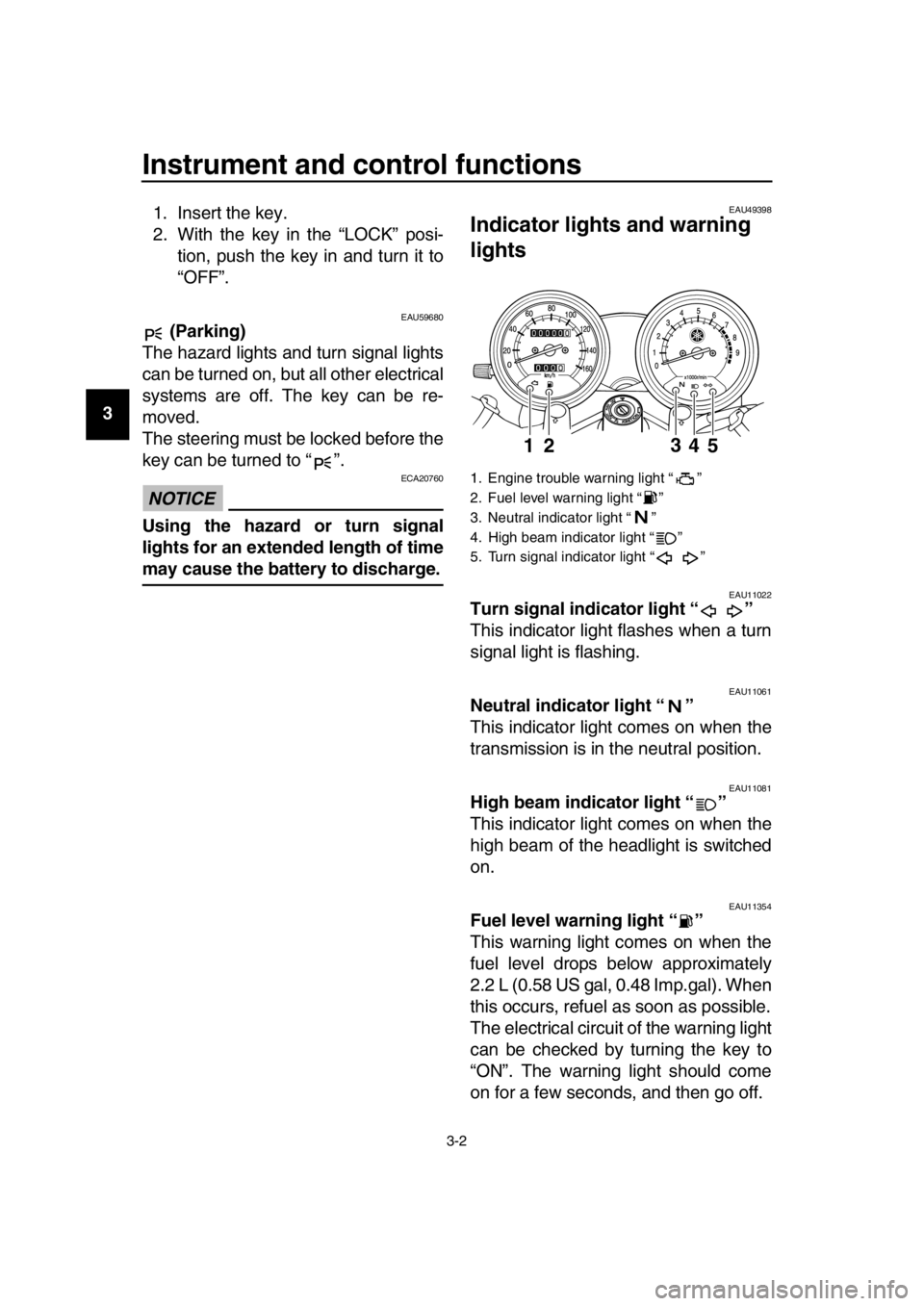
EAU49398
Indicator light s and warning
lights
EAU11022Turn signal indicator light “ ”
This indicator light flashes when a turn
signal light is flashing.
EAU11061Neutral indicator light “ ”
This indicator light comes on when the
transmission is in the neutral position.
EAU11081High beam indicator light “ ”
This indicator light comes on when the
high beam of the headlight is switched
on.
EAU11354Fuel level warning light “ ”
This warning light comes on when the
fuel level drops below approximately
2.2 L (0.58 US gal, 0.48 Imp.gal). When
this occurs, refuel as soon as possible.
The electrical circuit of the warning light
can be checked by turning the key to
“ON”. The warning light should come
on for a few seconds, and then go off.
1. Engine trouble warning light “ ”
2. Fuel level warning light “ ”
3. Neutral indicator light “ ”
4. High beam indicator light “ ”
5. Turn signal indicator light “ ”
4
2
153
2RD-28199-E1.book 2 ページ 2015年9月3日 木曜日 午後3時42分
Page 20 of 96
Instrument and control functions
3-6
1
2
3
4
5
6
7
8
9
10
11
12
13
14
EAU12822
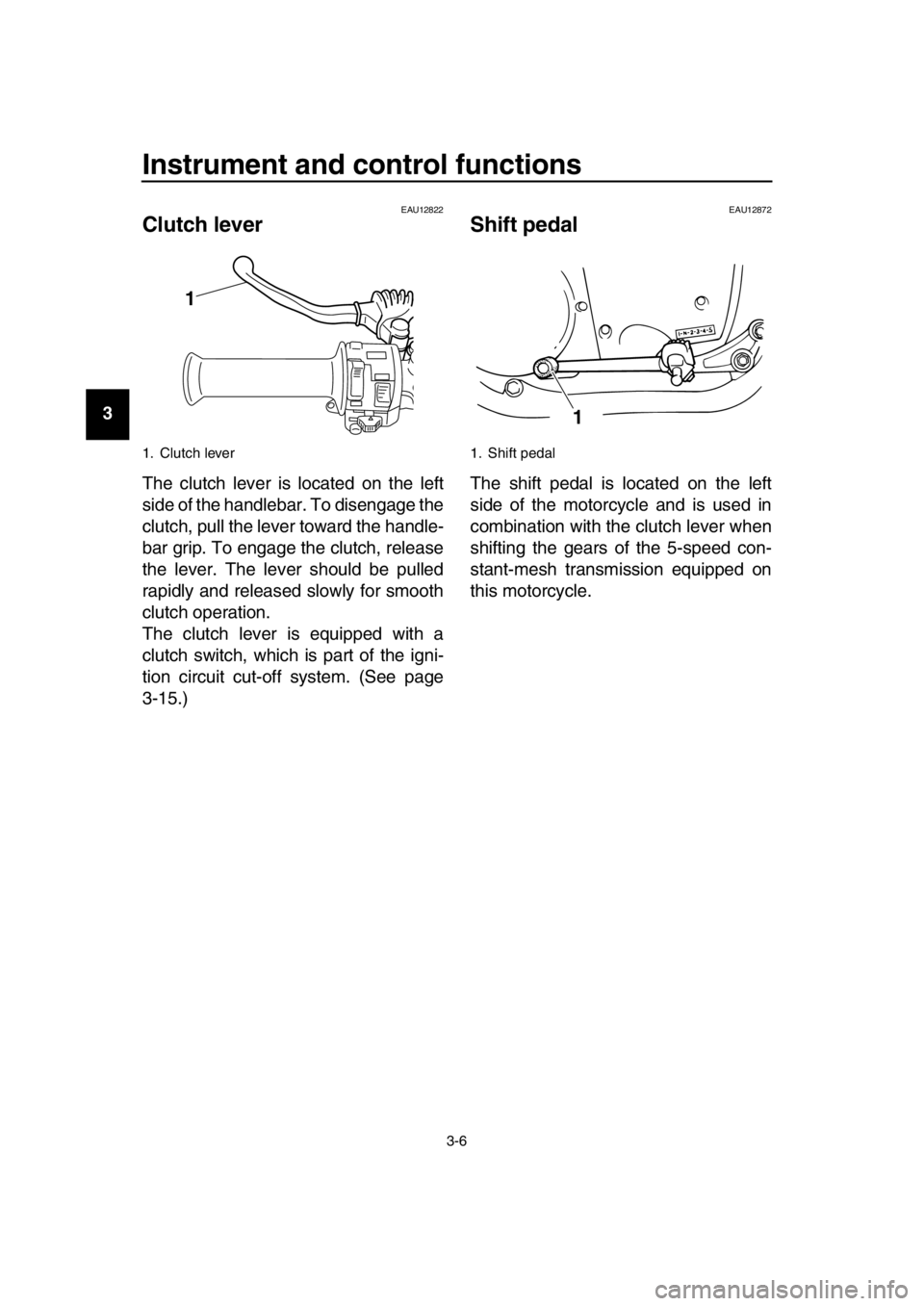
Clutch lever
The clutch lever is located on the left
side of the handlebar. To disengage the
clutch, pull the lever toward the handle-
bar grip. To engage the clutch, release
the lever. The lever should be pulled
rapidly and released slowly for smooth
clutch operation.
The clutch lever is equipped with a
clutch switch, which is part of the igni-
tion circuit cut-off system. (See page
3-15.)
EAU12872
Shift pedal
The shift pedal is located on the left
side of the motorcycle and is used in
combination with the clutch lever when
shifting the gears of the 5-speed con-
stant-mesh transmission equipped on
this motorcycle.
1. Clutch lever
1
1. Shift pedal
1
2RD-28199-E1.book 6 ページ 2015年9月3日 木曜日 午後3時42分
Page 26 of 96
Instrument and control functions
3-12
1
2
3
4
5
6
7
8
9
10
11
12
13
14
EAU13651
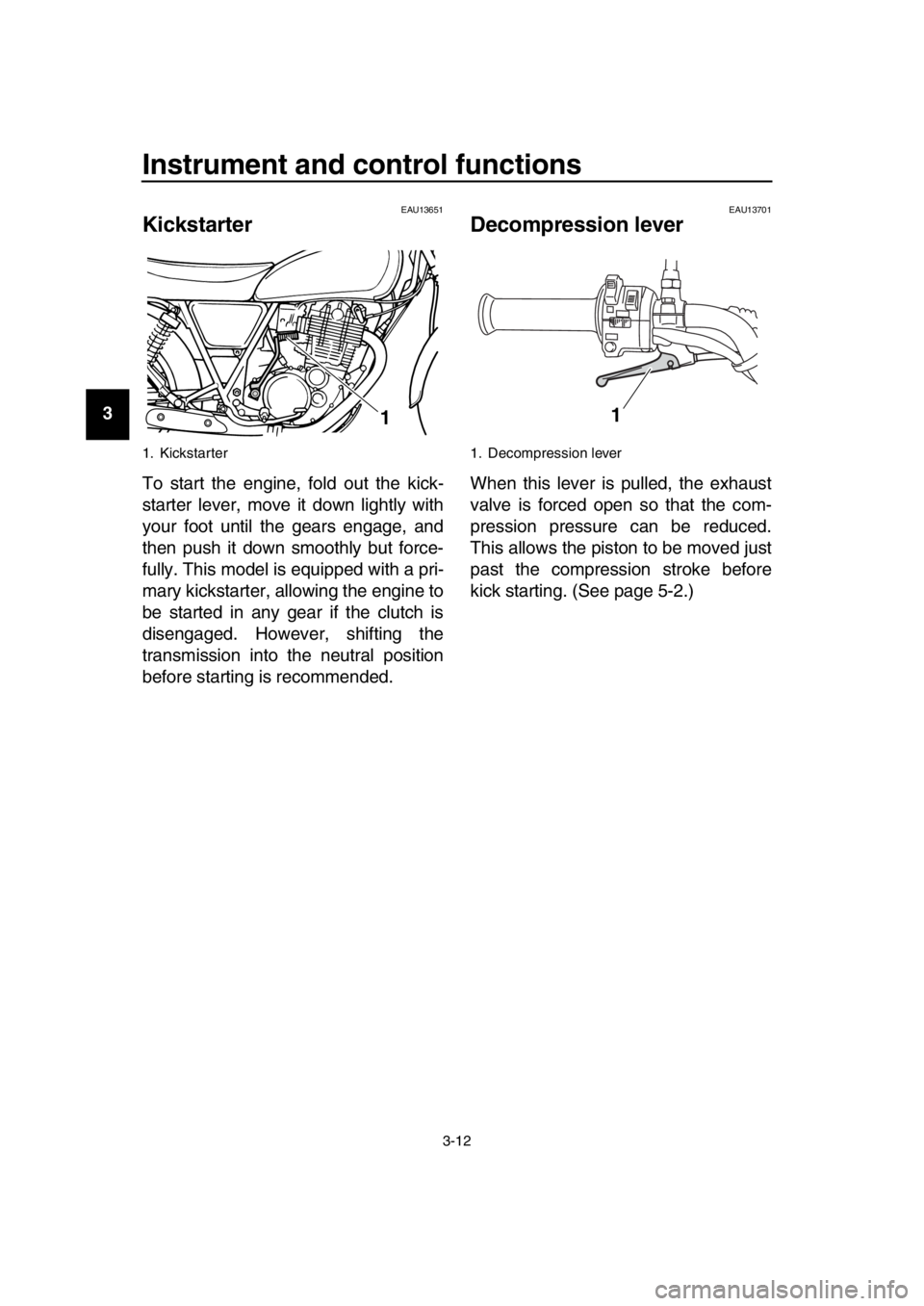
Kickstarter
To start the engine, fold out the kick-
starter lever, move it down lightly with
your foot until the gears engage, and
then push it down smoothly but force-
fully. This model is equipped with a pri-
mary kickstarter, allowing the engine to
be started in any gear if the clutch is
disengaged. However, shifting the
transmission into the neutral position
before starting is recommended.
EAU13701
Decompression lever
When this lever is pulled, the exhaust
valve is forced open so that the com-
pression pressure can be reduced.
This allows the piston to be moved just
past the compression stroke before
kick starting. (See page 5-2.)
1. Kickstarter
1
1. Decompression lever
1
2RD-28199-E1.book 12 ページ 2015年9月3日 木曜日 午後3時42分
Page 29 of 96

Instrument and control functions
3-15
1
2
3
4
5
6
7
8
9
10
11
12
13
14
EAU66820
Ignition circuit cut-off system
The ignition circuit cut-off system (com-
prising the sidestand switch, clutch
switch and neutral switch) has the fol-
lowing functions.
It prevents starting when the trans-
mission is in gear and the sides-
tand is up, but the clutch lever is
not pulled.
It prevents starting when the trans-
mission is in gear and the clutch le-
ver is pulled, but the sidestand is
still down.
It cuts the running engine when the
transmission is in gear and the sid-
estand is moved down.
Periodically check the operation of the
ignition circuit cut-of f system according
to the following procedure.
2RD-28199-E1.book 15 ページ 2015年9月3日 木曜日 午後3時42分
Page 30 of 96

Instrument and control functions
3-16
1
2
3
4
5
6
7
8
9
10
11
12
13
14
With the engine turned off:
1. Move the sidestand down.
2.
Make sure that the engine stop switch
is set to “ ”.
3. Turn the key on.
4. Shift the transmission into the neutral position.
5. Push the kick starter lever down.
Does the engine start?
With the engine still running:
6. Move the sidestand up.
7. Keep the clutch lever pulled.
8. Shift the transmission into gear.
9. Move the sidestand down.
Does the engine stall?
After the engine has stalled:
10. Move the sidestand up.
11. Keep the clutch lever pulled.
12. Push the kick starter lever down.
Does the engine start?
The system is OK. The motorcycle can
be ridden.
The neutral switch may not be working
correctly.
The motorcycle should not be ridden
until checked by a Yamaha dealer.
The sidestand switch may not be
working correctly.
The motorcycle should not be ridden
until checked by a Yamaha dealer.
The clutch switch may not be working
correctly.
The motorcycle should not be ridden
until checked by a Yamaha dealer.
WARNING
The vehicle must be placed on the centerstand during this inspection.
If a malfunction is noted, have a Yamaha dealer check the system
before riding.
YES NO
YESNO
YESNO
2RD-28199-E1.book 16 ページ 2015年9月3日 木曜日 午後3時42分
Page 34 of 96

Operation and important riding points
5-2
1
2
3
4
5
6
7
8
9
10
11
12
13
14
EAU59532
Starting the engine
In order for the ignition circuit cut-off
system (page 3-15) to enable starting,
one of the following conditions must be
met:
The transmission is in the neutral
position.
The transmission is in gear with
the clutch lever pulled and the sid-
estand up.
1. Turn the fuel cock lever to “ON”.
2. Turn the key to “ON” and set the engine stop switch to “ ”.
The engine trouble warning light
and fuel level warning light should
come on for a few seconds, then
go off.
NOTICE
ECA23270
If a warning light does not come on
initially when the key is turned to
“ON”, or if a warning light remains
on, see page 3-2 for the correspond-
ing warning light circuit check.
3. Shift the transmission into the neu- tral position. The neutral indicator
light should come on. If not, ask a
Yamaha dealer to check the elec-
trical circuit.
4. Completely close the throttle and apply the decompression lever.
5. Slowly push the kickstarter lever down until the starting mark shows
on the kick indicator. 6. Release the decompression lever,
release the kickstarter lever, and
then push the kickstarter lever
down forcefully to start the engine.
NOTICE
ECA11043
For maximum engine life, never ac-
celerate hard when the engine is
cold!
1. Starting mark
2. Kick indicator
21
2RD-28199-E1.book 2 ページ 2015年9月3日 木曜日 午後3時42分
Page 35 of 96

Operation and important riding points
5-3
1
2
3
4
5
6
7
8
9
10
11
12
13
14
EAU59470
Starting trouble
If the engine fails to start after 4 to 5
kicks, clear out the combustion cham-
ber with the following procedure. 1. Turn the key to “OFF”.
2. While applying the decompression lever, fully open the throttle grip
and push the kickstarter lever
down 4 to 5 times.
3. Turn the key to “ON” and retry starting the engine.
EAU16673
Shifting
Shifting gears lets you control the
amount of engine power available for
starting off, accelerating, climbing hills,
etc.
The gear positions are shown in the il-
lustration.
TIP
To shift the transmission into the neu-
tral position, press the shift pedal down
repeatedly until it reaches the end of its
travel, and then slightly raise it.
NOTICE
ECA10261
Even with the transmission in
the neutral position, do not
coast for long periods of time
with the engine off, and do not
tow the motorcycle for long dis-
tances. The transmission is
properly lubricated only when
the engine is running. Inade-
quate lubrication may damage
the transmission.
Always use the clutch while
changing gears to avoid damag-
ing the engine, transmission,
and drive train, which are not
designed to withstand the
1. Shift pedal
2. Neutral position
1
2
1 3 4 5
N
2
2RD-28199-E1.book 3 ページ 2015年9月3日 木曜日 午後3時42分
Page 36 of 96
Operation and important riding points
5-4
1
2
3
4
5
6
7
8
9
10
11
12
13
14
shock of forced shifting.
EAU16682To start out and accelerate 1. Pull the clutch lever to disengage the clutch.
2. Shift the transmission into first gear. The neutral indicator light
should go out.
3. Open the throttle gradually, and at the same time, release the clutch
lever slowly.
4. At the recommended shift points shown in the following table, close
the throttle, and at the same time,
quickly pull the clutch lever in.
5. Shift the transmission into second gear. (Make sure not to shift the
transmission into the neutral posi-
tion.)
6. Open the throttle part way and gradually release the clutch lever.
7. Follow the same procedure when shifting to the next higher gear.
TIP
When shifting gears in normal operat-
ing conditions, use the recommended
shift points.
EAU16701To decelerate1. Apply both the front and the rear brakes to slow the motorcycle.
2. Shift the transmission into first gear when the motorcycle reaches
20 km/h (12 mph). If the engine is
about to stall or runs very roughly,
pull the clutch lever in and use the
brakes to stop the motorcycle.
3. Shift the transmission into the neu- tral position when the motorcycle
is almost completely stopped. The neutral indicator light should come
on.
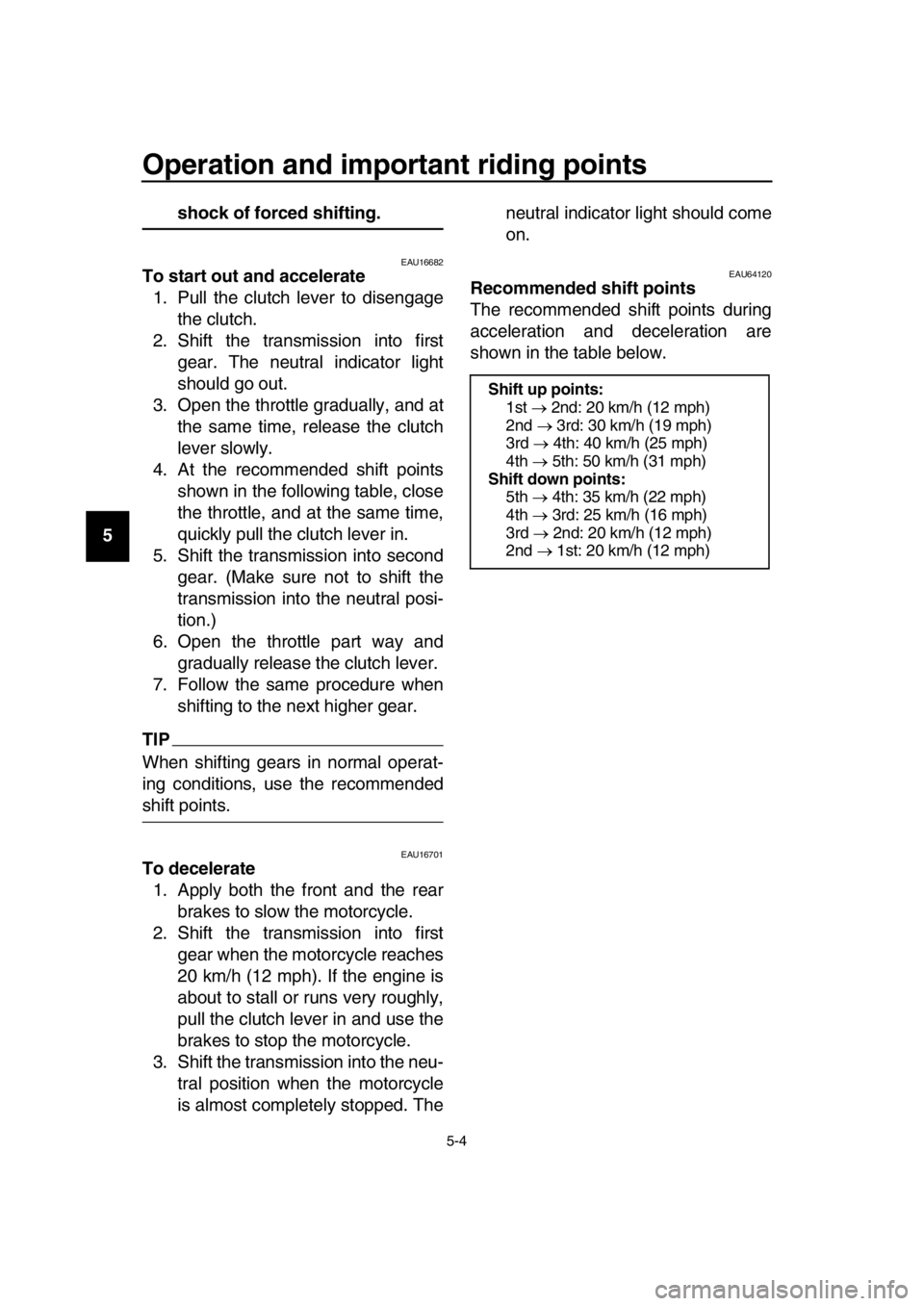
EAU64120Recommended shift points
The recommended shift points during
acceleration and deceleration are
shown in the table below.
Shift up points:
1st 2nd: 20 km/h (12 mph)
2nd 3rd: 30 km/h (19 mph)
3rd 4th: 40 km/h (25 mph)
4th 5th: 50 km/h (31 mph)
Shift down points: 5th 4th: 35 km/h (22 mph)
4th 3rd: 25 km/h (16 mph)
3rd 2nd: 20 km/h (12 mph)
2nd 1st: 20 km/h (12 mph)
2RD-28199-E1.book 4 ページ 2015年9月3日 木曜日 午後3時42分
Page 63 of 96
Periodic maintenance and adjustment
6-25
1
2
3
4
5
6
7
8
9
10
11
12
13
14
EAU22762
Drive chain slack
The drive chain slack should be
checked before each ride and adjusted
if necessary.
EAU59593To check the drive chain slack 1. Place the motorcycle on the cen- terstand.
2. Shift the transmission into the neu- tral position.
3. Push on the drive chain at the cen- ter point between the drive axle
and the rear wheel axle with a
force of 50 N (5.0 kgf, 11 lbf).
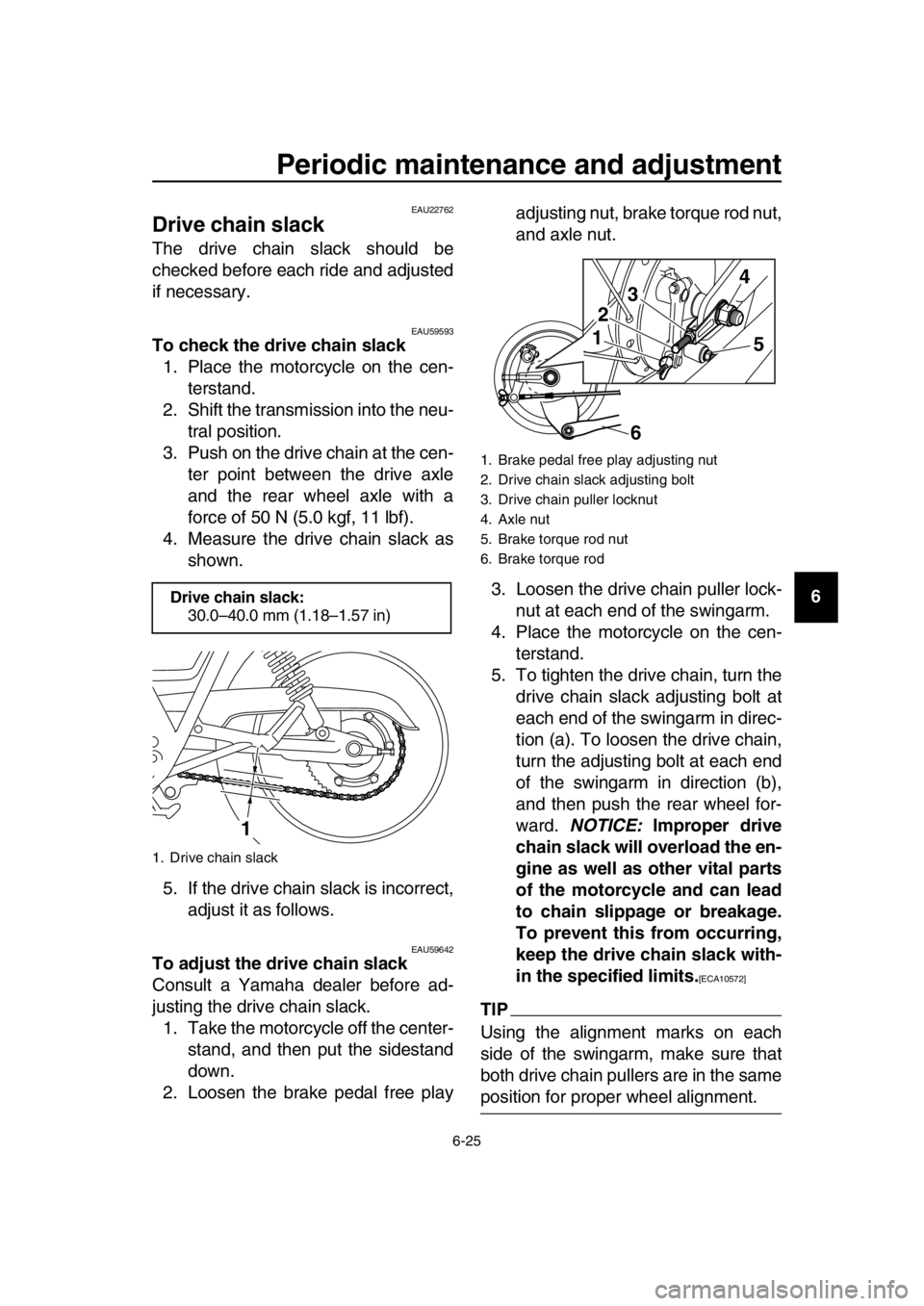
4. Measure the drive chain slack as shown.
5. If the drive chain slack is incorrect, adjust it as follows.
EAU59642To adjust the drive chain slack
Consult a Yamaha dealer before ad-
justing the drive chain slack.1. Take the motorcycle off the center- stand, and then put the sidestand
down.
2. Loosen the brake pedal free play adjusting nut, brake torque rod nut,
and axle nut.
3. Loosen the drive chain puller lock- nut at each end of the swingarm.
4. Place the motorcycle on the cen- terstand.
5. To tighten the drive chain, turn the drive chain slack adjusting bolt at
each end of the swingarm in direc-
tion (a). To loosen the drive chain,
turn the adjusting bolt at each end
of the swingarm in direction (b),
and then push the rear wheel for-
ward. NOTICE: Improper drive
chain slack will overload the en-
gine as well as other vital parts
of the motorcycle and can lead
to chain slippage or breakage.
To prevent this from occurring,
keep the drive chain slack with-
in the specified limits.[ECA10572]
TIP
Using the alignment marks on each
side of the swingarm, make sure that
both drive chain pullers are in the same
position for proper wheel alignment.
Drive chain slack: 30.0–40.0 mm (1.18–1.57 in)
1. Drive chain slack
1
1. Brake pedal free play adjusting nut
2. Drive chain slack adjusting bolt
3. Drive chain puller locknut
4. Axle nut
5. Brake torque rod nut
6. Brake torque rod
6
12
3
4
5
2RD-28199-E1.book 25 ページ 2015年9月3日 木曜日 午後3時42分