lights YAMAHA TMAX 2001 Owners Manual
[x] Cancel search | Manufacturer: YAMAHA, Model Year: 2001, Model line: TMAX, Model: YAMAHA TMAX 2001Pages: 100, PDF Size: 1.61 MB
Page 16 of 100
INSTRUMENT AND CONTROL FUNCTIONSMain switch/steering lock....................................................................3-1
Indicator lights ....................................................................................3-2
Speedometer unit ...............................................................................3-3
Fuel gauge..........................................................................................3-4
Coolant temperature gauge ................................................................3-4
Clock...................................................................................................3-5
Anti-theft alarm (optional) ...................................................................3-5
Self-diagnosis device..........................................................................3-6
Handlebar switches ............................................................................3-6
Front brake lever ................................................................................3-7
Rear brake lever .................................................................................3-8
Fuel tank cap ......................................................................................3-8
Fuel.....................................................................................................3-9
Seat ....................................................................................................3-9
Adjusting the rider backrest ..............................................................3-10
Helmet holder ...................................................................................3-11
Storage compartments .....................................................................3-12
Sidestand..........................................................................................3-12
Ignition circuit cut-off system ............................................................3-13
3
5GJ-9-EV 5/26/01 11:03 AM Page 15
Page 18 of 100

3-2
123
4
EAU00056
Indicator lights
EAU03797
Oil change indicator light “
7
”
This indicator light comes on at the
initial 1,000 km, then at 5,000 km and
every 5,000 km thereafter to indicate
that the engine oil should be
changed.
After changing the engine oil, reset
the oil change indicator light. (See
page 6-15 for the resetting proce-
dure.)If the engine oil is changed before the
oil change indicator comes on (i.e.
before the periodic oil change interval
has been reached), the indicator light
must be reset after the oil change for
the next periodic oil change to be
indicated at the correct time. (See
page 6-15 for the resetting proce-
dure.)
The electrical circuit of the indicator
light can be checked according to the
following procedure.
1. Set the engine stop switch to “#”
and turn the key to “ON”.
2. Check that the indicator comes
on for a few seconds and then
goes off.
3. If the indicator light does not
come on, have a Yamaha dealer
check the electrical circuit.
1. Oil change indicator light “
7
”
2. V-Belt replacement indicator light “V-BELT”
3. High beam indicator light “&”
4. Turn signal indicator lights “4”/“6”
INSTRUMENT AND CONTROL FUNCTIONS
1
23
4
5
6
7
8
9
NOTE:
The oil change indicator light may
flash when the engine is revved with
the scooter on the centerstand, but
this does not indicate a malfunction.
5GJ-9-EV 5/26/01 11:04 AM Page 17
Page 19 of 100

3-3
EAU00063
High beam indicator light “&”
This indicator light comes on when
the high beam of the headlight is
switched on.
EAU03299
Turn signal indicator lights
“4”/“6”
The corresponding indicator light
flashes when the turn signal switch is
pushed to the left or right.
EAU01586
Speedometer unit The speedometer unit is equipped
with a speedometer, an odometer
and a tripmeter. The speedometer
shows riding speed. The odometer
shows the total distance traveled.
The tripmeter shows the distance
traveled since it was last set to zero.
Pushing the “TRIP” button switches
the display between the odometer
mode “ODO” and the tripmeter mode
“TRIP”. To reset the tripmeter, enter
the “TRIP” mode, and then hold down
INSTRUMENT AND CONTROL FUNCTIONS
1
23
4
5
6
7
8
9
123
1. Speedometer
2. Odometer/tripmeter
3.“TRIP” button
123
4
EAU03798
V-belt replacement indicator light
“V-Belt”
This indicator light comes on when
the V-belt needs to be replaced.
The electrical circuit of the indicator
light can be checked according to the
following procedure.
1. Turn the key to “ON” and set the
engine stop switch to “#”.
2. If the indicator light does not
come on, have a Yamaha dealer
check the electrical circuit.1. Oil change indicator light “
7
”
2. V-Belt replacement indicator light “V-BELT”
3. High beam indicator light “&”
4. Turn signal indicator lights “4”/“6”
5GJ-9-EV 5/26/01 11:04 AM Page 18
Page 22 of 100
3-6
INSTRUMENT AND CONTROL FUNCTIONS
1
23
4
5
6
7
8
9
12
34
EAU00118
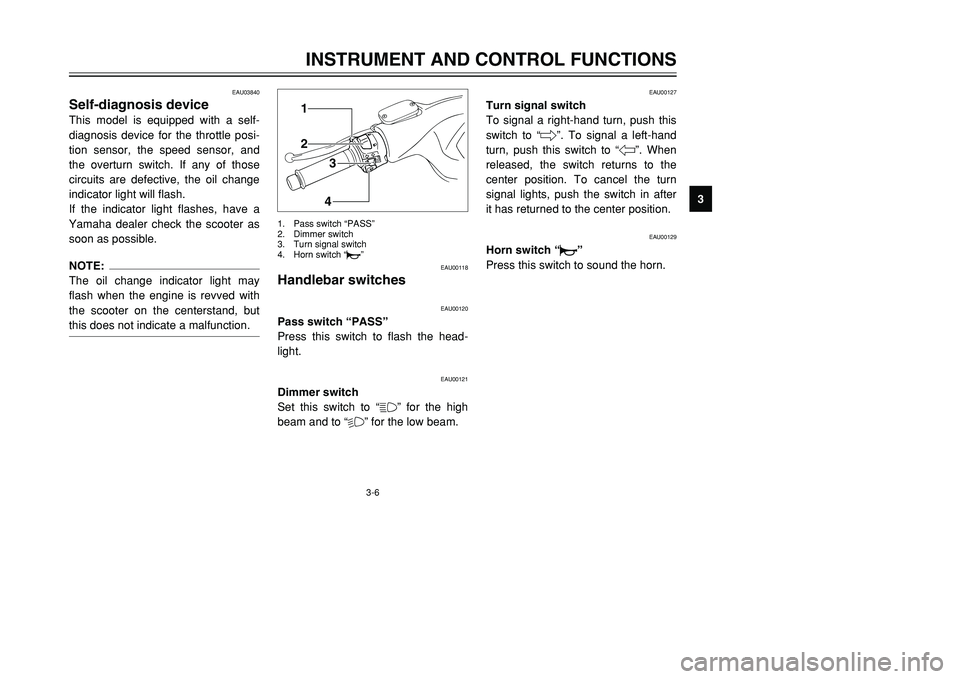
Handlebar switches
EAU00120
Pass switch “PASS”
Press this switch to flash the head-
light.
EAU00121
Dimmer switch
Set this switch to “&” for the high
beam and to “%” for the low beam.1. Pass switch “PASS”
2. Dimmer switch
3. Turn signal switch
4. Horn switch “*”
EAU03840
Self-diagnosis deviceThis model is equipped with a self-
diagnosis device for the throttle posi-
tion sensor, the speed sensor, and
the overturn switch. If any of those
circuits are defective, the oil change
indicator light will flash.
If the indicator light flashes, have a
Yamaha dealer check the scooter as
soon as possible.NOTE:
The oil change indicator light may
flash when the engine is revved with
the scooter on the centerstand, but
this does not indicate a malfunction.
EAU00127
Turn signal switch
To signal a right-hand turn, push this
switch to “6”. To signal a left-hand
turn, push this switch to “4”. When
released, the switch returns to the
center position. To cancel the turn
signal lights, push the switch in after
it has returned to the center position.
EAU00129
Horn switch “*”
Press this switch to sound the horn.
5GJ-9-EV 5/26/01 11:04 AM Page 21
Page 34 of 100
4-2
PRE-OPERATION CHECKS
1
2
34
5
6
7
8
9
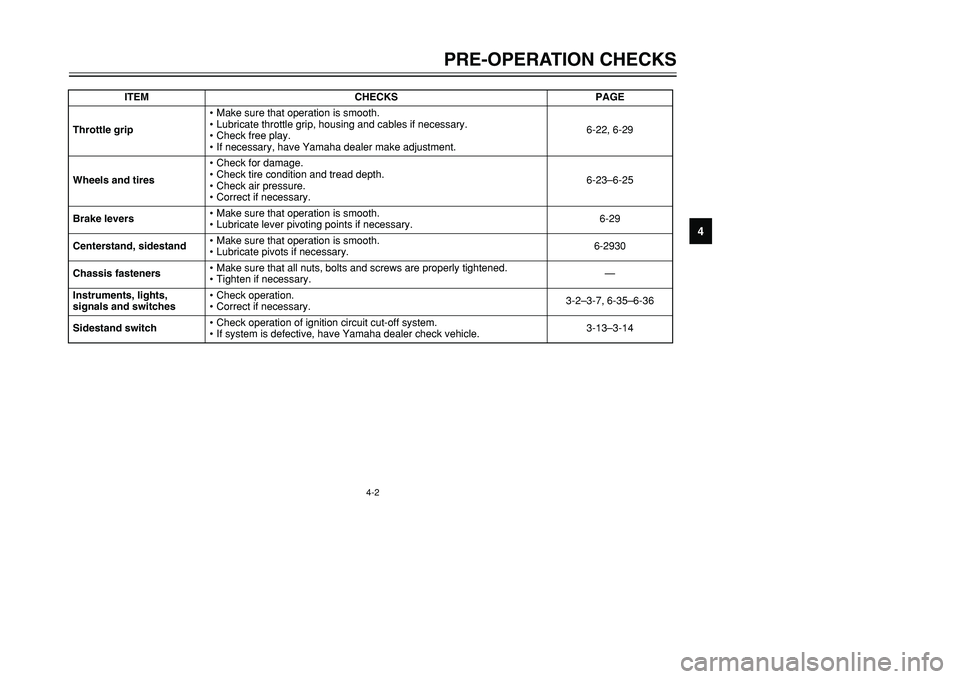
Throttle grip•Make sure that operation is smooth.
•Lubricate throttle grip, housing and cables if necessary.
•Check free play.
•If necessary, have Yamaha dealer make adjustment.6-22, 6-29
Wheels and tires•Check for damage.
•Check tire condition and tread depth.
•Check air pressure.
•Correct if necessary.6-23–6-25
Brake levers•Make sure that operation is smooth.
•Lubricate lever pivoting points if necessary.6-29
Centerstand, sidestand•Make sure that operation is smooth.
•Lubricate pivots if necessary.6-2930
Chassis fasteners•Make sure that all nuts, bolts and screws are properly tightened.
•Tighten if necessary.—
Instruments, lights,
signals and switches•Check operation.
•Correct if necessary.3-2–3-7, 6-35–6-36
Sidestand switch•Check operation of ignition circuit cut-off system.
•If system is defective, have Yamaha dealer check vehicle.3-13–3-14 ITEM CHECKS PAGE
5GJ-9-EV 5/26/01 11:04 AM Page 33
Page 39 of 100
5-3
EW000057
w8Avoid braking hard or sudden-
ly (especially when leaning
over to one side), otherwise
the scooter may skid or over-
turn.
8Railroad crossings, streetcar
rails, iron plates on road con-
struction sites, and manhole
covers become extremely slip-
pery when wet. Therefore,
slow down when approaching
such areas and cross them
with caution.
8Keep in mind that braking on a
wet road is much more diffi-
cult.
8Ride slowly down a hill, as
braking downhill can be very
difficult.
OPERATION AND IMPORTANT RIDING POINTS
1
2
3
45
6
7
8
9
EAU03093
Tips for reducing fuel
consumptionFuel consumption depends largely on
your riding style. Consider the follow-
ing tips to reduce fuel consumption:
8Thoroughly warm up the engine.
8Avoid high engine speeds during
acceleration.
8Avoid high engine speeds with
no load on the engine.
8Turn the engine off instead of let-
ting it idle for an extended length
of time (e.g., in traffic jams, at
traffic lights or at railroad cross-
ings).
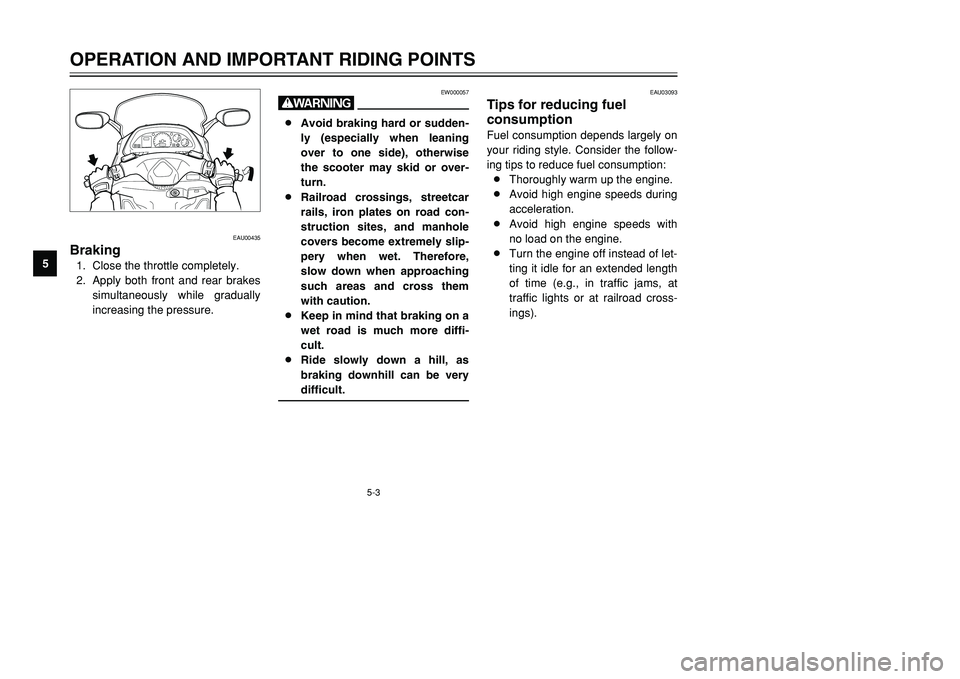
EAU00435
Braking1. Close the throttle completely.
2. Apply both front and rear brakes
simultaneously while gradually
increasing the pressure.
5GJ-9-EV 5/26/01 11:04 AM Page 38
Page 47 of 100

6-5
PERIODIC MAINTENANCE AND MINOR REPAIR
1
2
3
4
56
7
8
9
EAU03884
NOTE:
8The air filter needs more frequent service if you are riding in unusually wet or dusty areas.
8Hydraulic brake service
9Regularly check and, if necessary, correct the brake fluid level.
9Every two years replace the internal components of the brake master cylinders and calipers, and change the
brake fluid.
9Replace the brake hoses every four years and if cracked or damaged.20 Engine oil•Change. (See page 3-2 for more information about the oil
change indicator light.)√4,000 km after initial 1,000 km
When the oil change indicator light comes on
(every 5,000 km)
21 Engine oil filter cartridge•Replace.√√√
22
*Cooling system•Check coolant level and vehicle for coolant leakage.√√√√ √
•Change.Every 3 years
23 Chain drive oil•Check vehicle for oil leakage.
•Change.√√√√
24*V-belt•Replace.When the V-Belt replacement indicator light comes on
(every 20,000 km)
25*Front and rear brake
switches•Check operation.√√√√√ √
26 Moving parts and cables•Lubricate.√√√√ √
27*Lights, signals and
switches•Check operation.
•Adjust headlight beam.√√√√√ √ NO. ITEM CHECK OR MAINTENANCE JOBODOMETER READING (×1,000 km)
ANNUAL
CHECK
1 10203040
5GJ-9-EV 5/26/01 11:04 AM Page 46
Page 77 of 100
6-35
PERIODIC MAINTENANCE AND MINOR REPAIR
1
2
3
4
56
7
8
9
EC000103
cCDo not use a fuse of a higher
amperage rating than recommend-
ed to avoid causing extensive
damage to the electrical system
and possibly a fire.3. Turn the key to “ON” and turn on
the electrical circuit in question to
check if the device operates.
4. If the fuse immediately blows
again, have a Yamaha dealer
check the electrical system. Specified fuses:
Main fuse: 30 A
Signaling system fuse: 15 A
Headlight fuse: 15 A
Ignition fuse: 10 A
Radiator fan fuse: 15 A
Clock fuse: 10 A
1
2
EAU03874
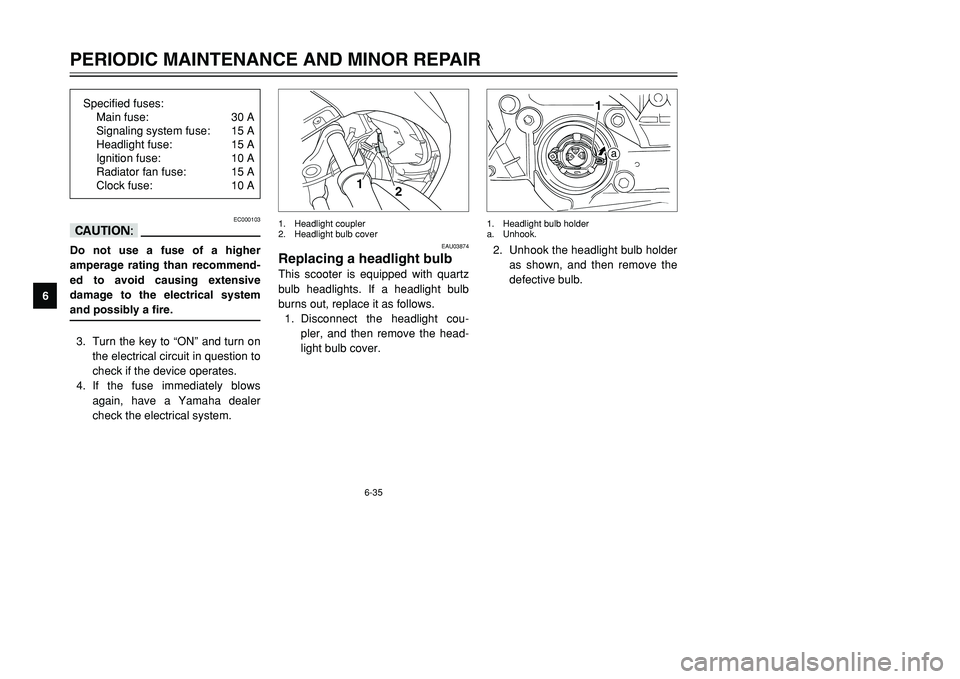
Replacing a headlight bulbThis scooter is equipped with quartz
bulb headlights. If a headlight bulb
burns out, replace it as follows.
1. Disconnect the headlight cou-
pler, and then remove the head-
light bulb cover.1. Headlight coupler
2. Headlight bulb cover
2. Unhook the headlight bulb holder
as shown, and then remove the
defective bulb.
a
1
1. Headlight bulb holder
a. Unhook.
5GJ-9-EV 5/26/01 11:04 AM Page 76
Page 84 of 100
7-2
SCOOTER CARE AND STORAGE
1
2
3
4
5
67
8
9 8Do not use any harsh chemical
products on plastic parts. Be
sure to avoid using cloths or
sponges which have been in
contact with strong or abra-
sive cleaning products, sol-
vent or thinner, fuel (gasoline),
rust removers or inhibitors,
brake fluid, antifreeze or elec-
trolyte.
8Do not use high-pressure
washers or steam-jet cleaners
since they cause water seep-
age and deterioration in the
following areas: seals (of
wheel and swingarm bearings,
fork and brakes), electric com-
ponents (couplers, connec-
tors, instruments, switches
and lights), breather hoses
and vents.8For scooters equipped with a
windshield: Do not use strong
cleaners or hard sponges as
they will cause dulling or
scratching. Some cleaning
compounds for plastic may
leave scratches on the wind-
shield. Test the product on a
small hidden part of the wind-
shield to make sure that it
does not leave any marks. If
the windshield is scratched,
use a quality plastic polishing
compound after washing.
After normal useRemove dirt with warm water, a mild
detergent, and a soft, clean sponge,
and then rinse thoroughly with clean
water. Use a toothbrush or bottle-
brush for hard-to-reach areas.
Stubborn dirt and insects will come
off more easily if the area is covered
with a wet cloth for a few minutes
before cleaning.After riding in the rain, near the sea
or on salt-sprayed roadsSince sea salt or salt sprayed on
roads during winter are extremely
corrosive in combination with water,
carry out the following steps after
each ride in the rain, near the sea or
on salt-sprayed roads.NOTE:
Salt sprayed on roads in the winter
may remain well into spring.1. Clean the scooter with cold water
and a mild detergent after the
engine has cooled down.
ECA00012
cCDo not use warm water since it
increases the corrosive action of
the salt.2. Apply a corrosion protection
spray on all metal, including
chrome- and nickel-plated, sur-
faces to prevent corrosion.
5GJ-9-EV 5/26/01 11:04 AM Page 83
Page 97 of 100
INDEX
F
Front and rear brake levers ...................6-25
Front and rear brake pads, checking.....6-26
Front fork, checking ...............................6-30
Fuel .........................................................3-9
Fuel consumption, tips for reducing ........5-3
Fuel gauge ..............................................3-4
Fuel tank cap ...........................................3-8
Fuses, replacing ....................................6-34
H
Handlebar switches .................................3-6
Pass switch ...........................................3-6
Dimmer switch ......................................3-6
Turn signal switch .................................3-6
Horn switch ...........................................3-6
Engine stop switch ................................3-7
Start switch ...........................................3-7
Headlight bulb, replacing .......................6-35
Helmet holder ........................................3-11
I
Identification numbers .............................9-1
Ignition circuit cut-off system .................3-13
Indicator lights .........................................3-2
Turn signal indicator lights ....................3-3
High beam indicator light ......................3-3
Oil change indicator light ......................3-2
V-belt replacement indicator light .........3-3
K
Key identification number ........................9-1
M
Main switch/steering lock ........................3-1
Model label ..............................................9-2
P
Parking ....................................................5-4
Part locations...........................................2-1
Periodic maintenance and lubrication
chart ......................................................6-3
Pre-operation check list ...........................4-1
R
Rider backrest, adjusting .......................3-10
S
Safe-riding points ....................................1-2
Seat .........................................................3-9
Sidestand ..............................................3-12
Self-diagnosis device ..............................3-6
Spark plugs, checking .............................6-9
Specifications ..........................................8-1
Speedometer unit ....................................3-3
Starting the engine ..................................5-1
Starting off ...............................................5-2
Steering, checking .................................6-31
Storage ....................................................7-4
Storage compartments ..........................3-12
T
Throttle cable free play, adjusting .........6-22
Throttle grip and cable, checking and
lubricating ...........................................6-29
Tires ......................................................6-23
A
Acceleration and deceleration .................5-2
Air filter element, cleaning .....................6-19
Anti-theft alarm (optional) ........................3-5
B
Battery ...................................................6-32
Brake fluid level, checking .....................6-27
Brake fluid, changing .............................6-28
Brake lever (front)....................................3-7
Brake lever (rear) ....................................3-8
Brake levers, lubricating ........................6-28
Braking ....................................................5-3
C
Carburetors, adjusting ...........................6-21
Care.........................................................7-1
Centerstand and sidestand, checking
and lubricating ....................................6-30
Chain drive oil........................................6-16
Clock .......................................................3-5
Conversion table .....................................8-5
Coolant ..................................................6-17
Coolant temperature gauge.....................3-4
Cowlings and panels, removing and
installing ................................................6-6
E
Engine break-in .......................................5-4
Engine idling speed ...............................6-21
Engine oil and oil filter cartridge ............6-12
5GJ-9-EV 5/26/01 11:04 AM Page 96