lock YAMAHA TMAX 2016 Owner's Manual
[x] Cancel search | Manufacturer: YAMAHA, Model Year: 2016, Model line: TMAX, Model: YAMAHA TMAX 2016Pages: 110, PDF Size: 6.26 MB
Page 76 of 110
Periodic maintenance and adjustment
7-19
1
2
3
4
5
6
7
8
9
10
11
12
13
14
WARNING
EWA16101
The front and rear tires should
be of the same make and de-
sign, otherwise the handling
characteristics of the vehicle
may be different, which could
lead to an accident.
Always make sure that the valve
caps are securely installed to
prevent air pressure leakage.
Use only the tire valves and
valve cores listed below to
avoid tire deflation during a ride.
After extensive tests, only the tires list-
ed below have been approved for this
model by Yamaha.
EAU51921
Cast wheels
To maximize the performance, durabil-
ity, and safe operation of your vehicle,
note the following points regarding the
specified wheels.
The wheel rims should be checked
for cracks, bends, warpage or oth-
er damage before each ride. If any
damage is found, have a Yamaha
dealer replace the wheel. Do not
attempt even the smallest repair to
the wheel. A deformed or cracked
wheel must be replaced.
The wheel should be balanced
whenever either the tire or wheel
has been changed or replaced. An
unbalanced wheel can result in
poor performance, adverse han-
dling characteristics, and a short-
ened tire life.
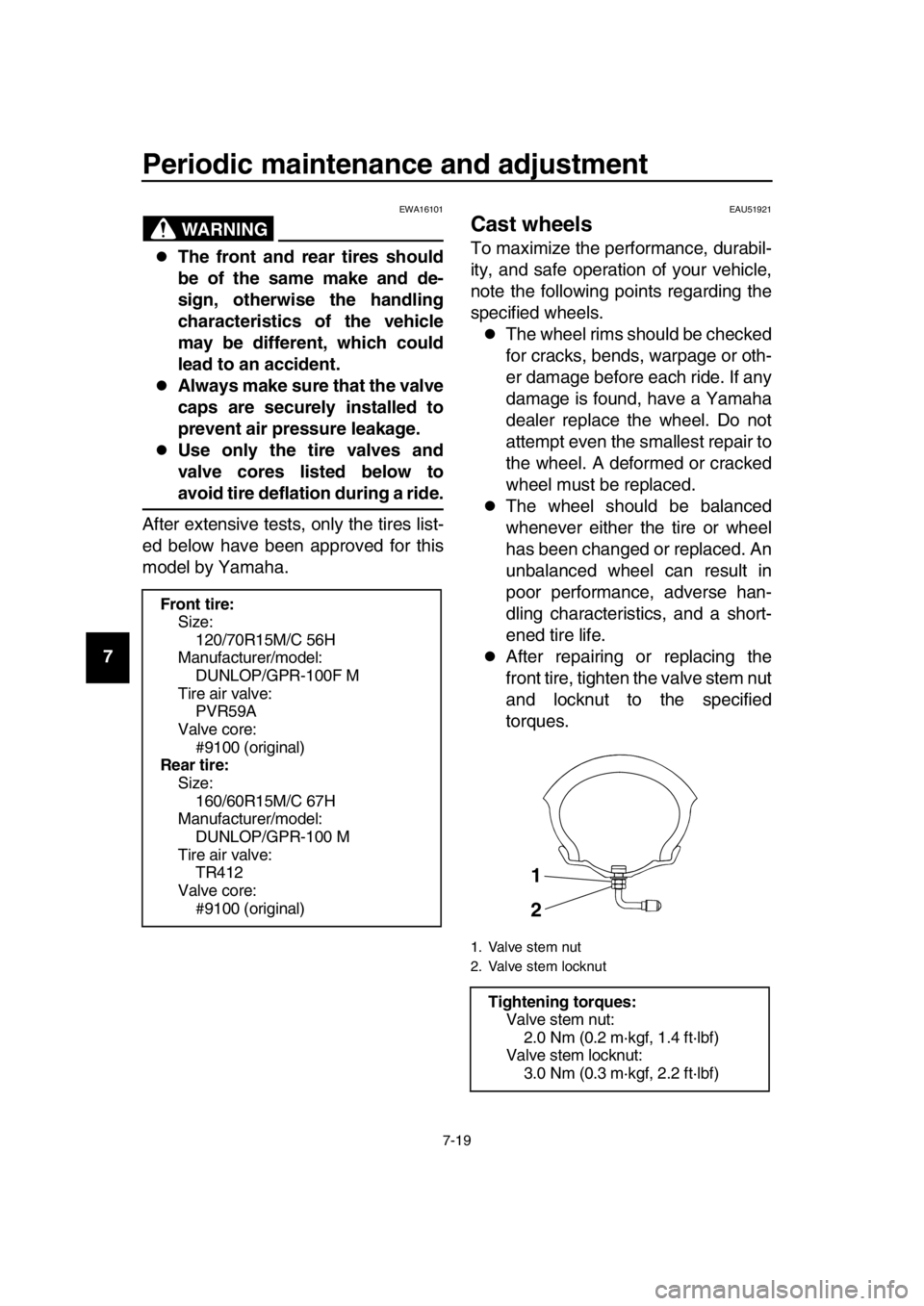
After repairing or replacing the
front tire, tighten the valve stem nut
and locknut to the specified
torques.
Front tire: Size:120/70R15M/C 56H
Manufacturer/model:
DUNLOP/GPR-100F M
Tire air valve: PVR59A
Valve core: #9100 (original)
Rear tire:
Size:160/60R15M/C 67H
Manufacturer/model:
DUNLOP/GPR-100 M
Tire air valve: TR412
Valve core: #9100 (original)
1. Valve stem nut
2. Valve stem locknut
Tightening torques:Valve stem nut:
2.0 Nm (0.2 m·kgf, 1.4 ft·lbf)
Valve stem locknut: 3.0 Nm (0.3 m·kgf, 2.2 ft·lbf)
1
2
2PW-9-E1.book 19 ページ 2015年9月10日 木曜日 午後5時17分
Page 78 of 110
Periodic maintenance and adjustment
7-21
1
2
3
4
5
6
7
8
9
10
11
12
13
14
EAU53032
Adjusting the rear brake lock
cable
Rear brake lock cable adjustment may
be required if the rear brake lock lever
does not hold properly. When the rear
brake lock lever is not in use, the rear
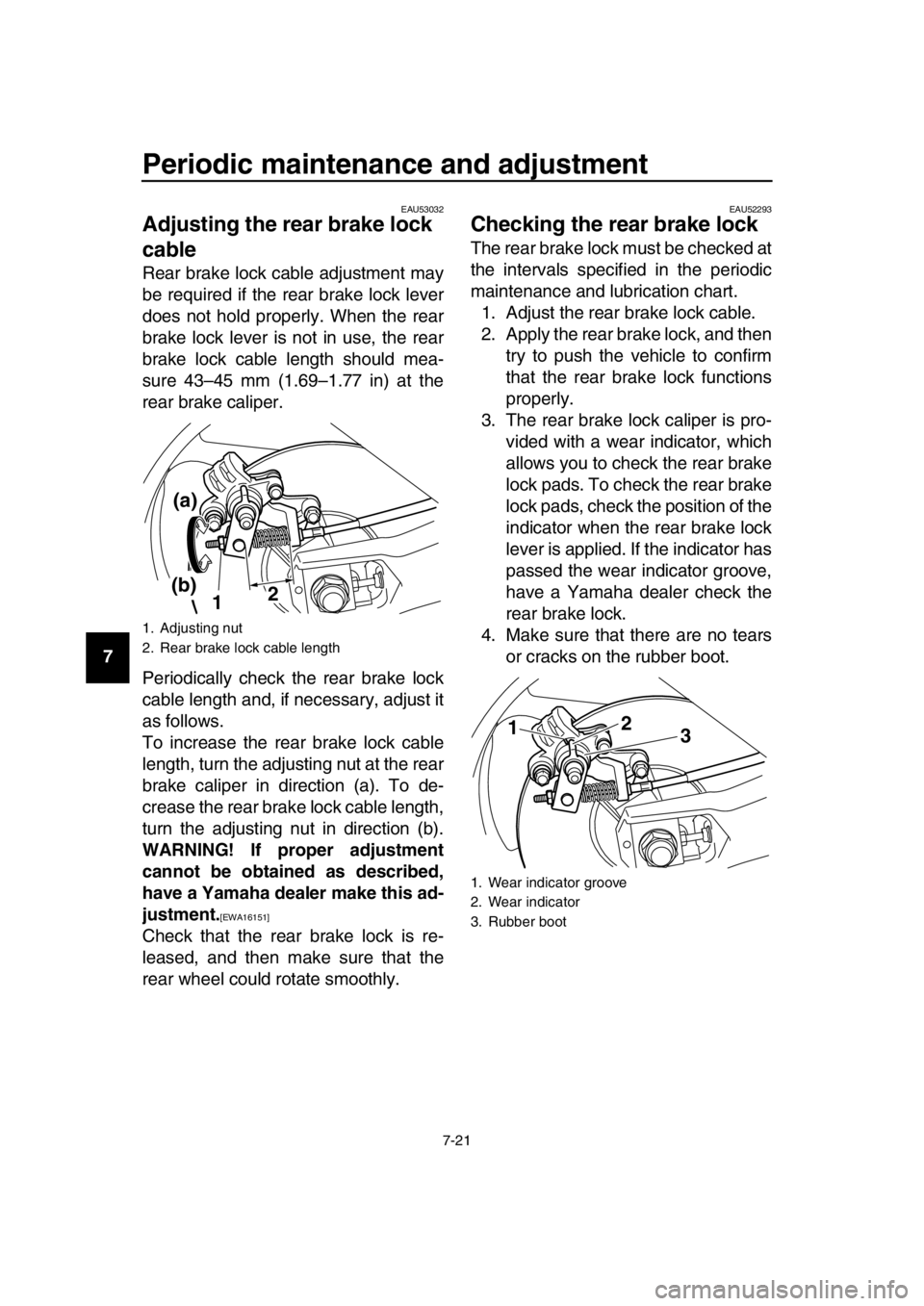
brake lock cable length should mea-
sure 43–45 mm (1.69–1.77 in) at the
rear brake caliper.
Periodically check the rear brake lock
cable length and, if necessary, adjust it
as follows.
To increase the rear brake lock cable
length, turn the adjusting nut at the rear
brake caliper in direction (a). To de-
crease the rear brake lock cable length,
turn the adjusting nut in direction (b).
WARNING! If proper adjustment
cannot be obtained as described,
have a Yamaha dealer make this ad-
justment.
[EWA16151]
Check that the rear brake lock is re-
leased, and then make sure that the
rear wheel could rotate smoothly.
EAU52293
Checking the rear brake lock
The rear brake lock must be checked at
the intervals specified in the periodic
maintenance and lubrication chart. 1. Adjust the rear brake lock cable.
2. Apply the rear brake lock, and then try to push the vehicle to confirm
that the rear brake lock functions
properly.
3. The rear brake lock caliper is pro- vided with a wear indicator, which
allows you to check the rear brake
lock pads. To check the rear brake
lock pads, check the position of the
indicator when the rear brake lock
lever is applied. If the indicator has
passed the wear indicator groove,
have a Yamaha dealer check the
rear brake lock.
4. Make sure that there are no tears or cracks on the rubber boot.
1. Adjusting nut
2. Rear brake lock cable length
2
1
(a)
(b)
1. Wear indicator groove
2. Wear indicator
3. Rubber boot
1 23
2PW-9-E1.book 21 ページ 2015年9月10日 木曜日 午後5時17分
Page 80 of 110
Periodic maintenance and adjustment
7-23
1
2
3
4
5
6
7
8
9
10
11
12
13
14
Clean the filler cap before re-
moving. Use only DOT 4 brake
fluid from a sealed container.
Use only the specified brake flu-
id; otherwise, the rubber seals
may deteriorate, causing leak-
age.
Refill with the same type of
brake fluid. Adding a brake fluid
other than DOT 4 may result in a
harmful chemical reaction.
Be careful that water does not
enter the brake fluid reservoir
when refilling. Water will signifi-
cantly lower the boiling point of
the fluid and may result in vapor
lock.
NOTICE
ECA17641
Brake fluid may damage painted sur-
faces or plastic parts. Always clean
up spilled fluid immediately.
As the brake pads wear, it is normal for
the brake fluid level to gradually go
down. A low brake fluid level may indi-
cate worn brake pads and/or brake sys-
tem leakage; therefore, be sure to
check the brake pads for wear and the
brake system for leakage. If the brake
fluid level goes down suddenly, have a
Yamaha dealer check the cause before
further riding.
EAU22733
Changing the brake fluid
Have a Yamaha dealer change the
brake fluid at the intervals specified in
the periodic maintenance and lubrica-
tion chart. In addition, have the oil seals
of the master cylinders and calipers as
well as the brake hoses replaced at the
intervals listed below or whenever they
are damaged or leaking.
Oil seals: Replace every two
years.
Brake hoses: Replace every four
years.
2PW-9-E1.book 23 ページ 2015年9月10日 木曜日 午後5時17分
Page 90 of 110
Periodic maintenance and adjustment
7-33
1
2
3
4
5
6
7
8
9
10
11
12
13
14
EAU52322
Replacing a fron t turn signal
light bulb
1. Place the scooter on the center-
stand.
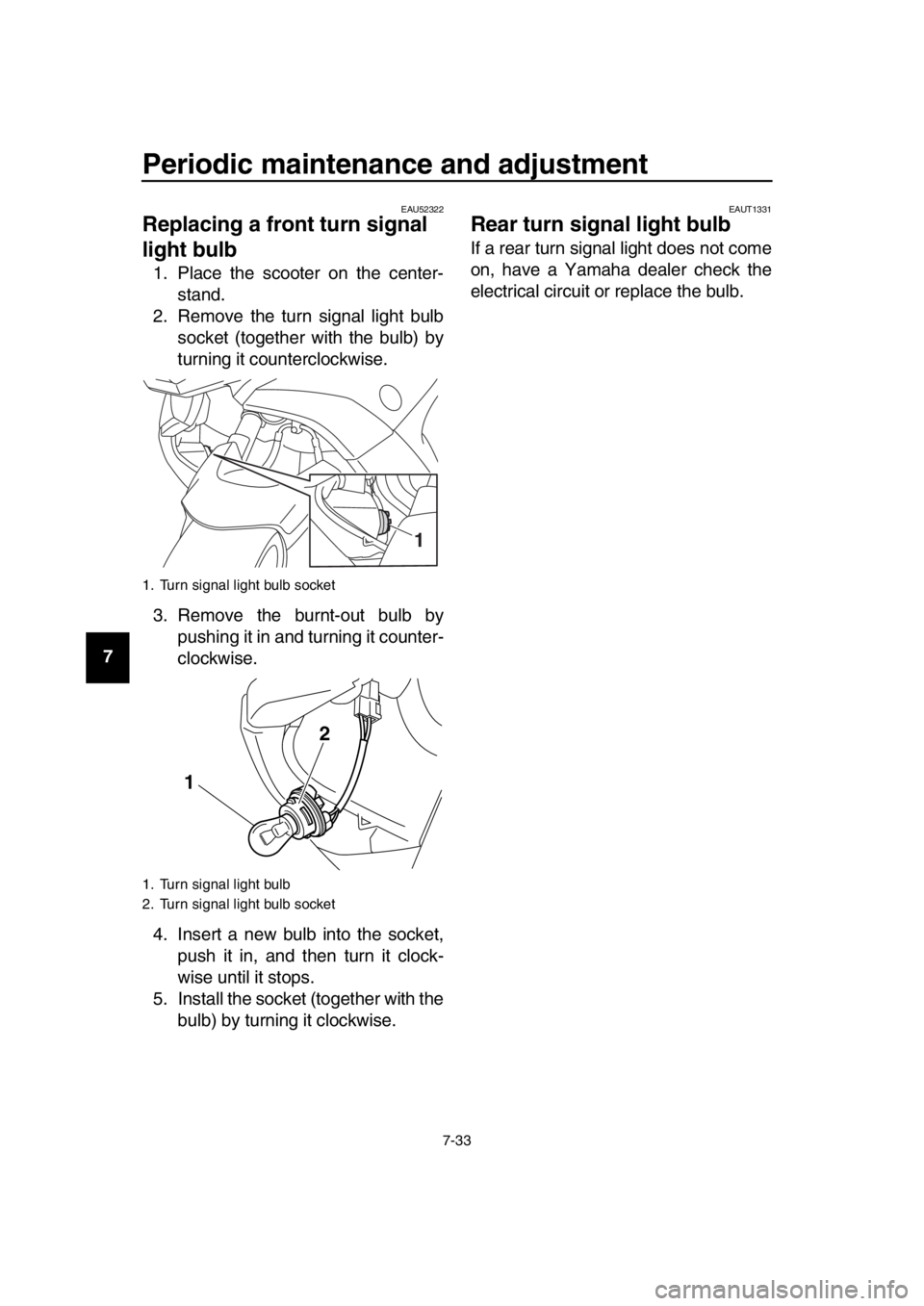
2. Remove the turn signal light bulb socket (together with the bulb) by
turning it counterclockwise.
3. Remove the burnt-out bulb by pushing it in and turning it counter-
clockwise.
4. Insert a new bulb into the socket, push it in, and then turn it clock-
wise until it stops.
5. Install the socket (together with the bulb) by turning it clockwise.
EAUT1331
Rear turn signal light bulb
If a rear turn signal light does not come
on, have a Yamaha dealer check the
electrical circuit or replace the bulb.
1. Turn signal light bulb socket
1. Turn signal light bulb
2. Turn signal light bulb socket
1
12
2PW-9-E1.book 33 ページ 2015年9月10日 木曜日 午後5時17分
Page 94 of 110
Periodic maintenance and adjustment
7-37
1
2
3
4
5
6
7
8
9
10
11
12
13
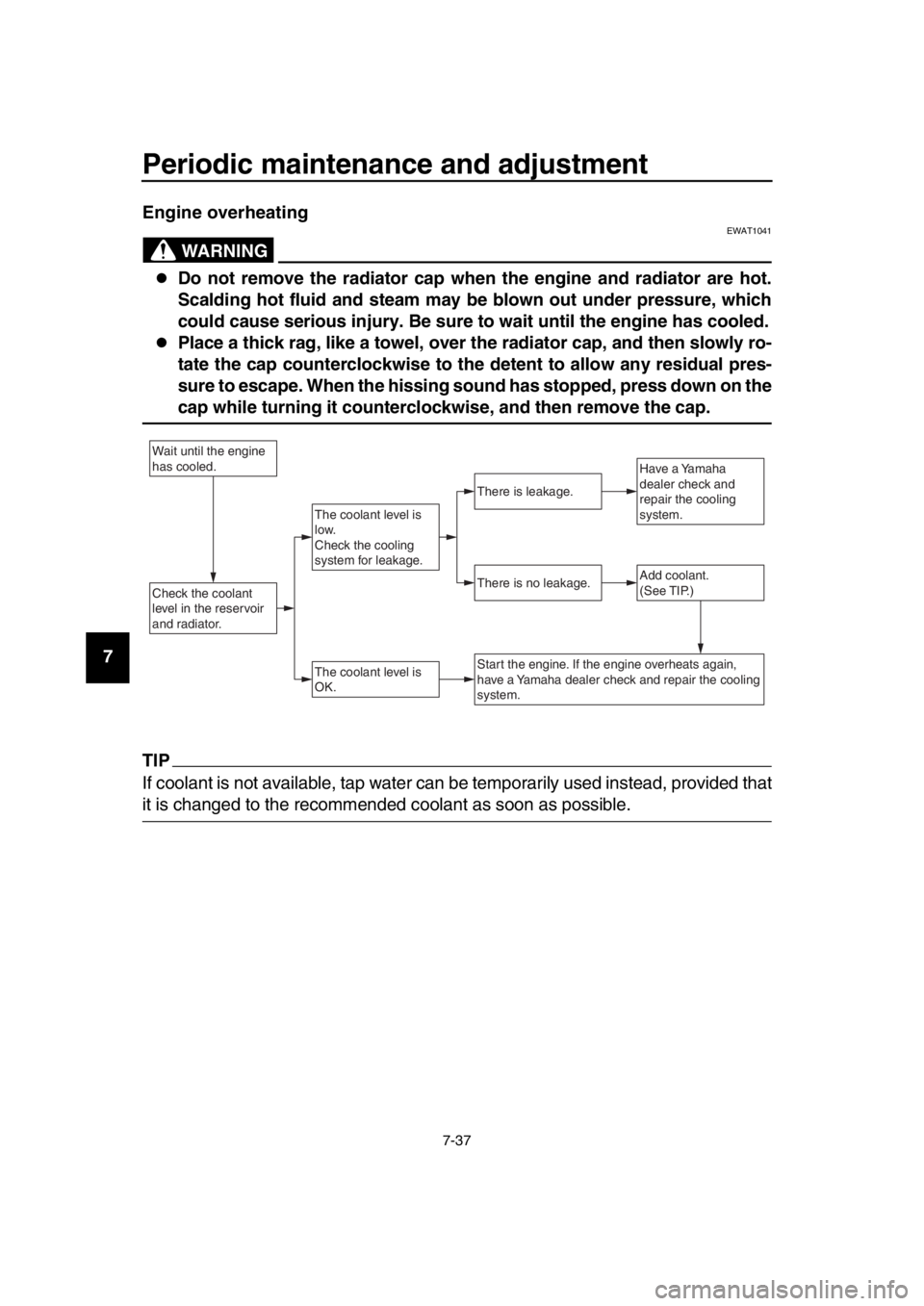
14 Engine overheating
WARNING
EWAT1041
Do not remove the radiator cap when the engine and radiator are hot.
Scalding hot fluid and steam may be blown out under pressure, which
could cause serious injury. Be sure to wait until the engine has cooled.
Place a thick rag, like a towel, over the radiator cap, and then slowly ro-
tate the cap counterclockwise to the detent to allow any residual pres-
sure to escape. When the hissing sound has stopped, press down on the
cap while turning it counterclockwise, and then remove the cap.
TIP
If coolant is not available, tap water c
an be temporarily used instead, provided that
it is changed to the recommended coolant as soon as possible.
Wait until the engine
has cooled.
Check the coolant
level in the reservoir
and radiator.Add coolant.
(See TIP.)
The coolant level is
OK.
There is no leakage.
There is leakage.
The coolant level is
low.
Check the cooling
system for leakage.
Have a Yamaha
dealer check and
repair the cooling
system.
Start the engine. If the engine overheats again,
have a Yamaha dealer check and repair the cooling
system.
2PW-9-E1.book 37 ページ 2015年9月10日 木曜日 午後5時17分
Page 95 of 110

Periodic maintenance and adjustment
7-38
1
2
3
4
5
6
7
8
9
10
11
12
13
14
EAU61545
Emergency mode
When the smart key is lost, damaged,
or its battery has discharged, the vehi-
cle can still be turned on and the engine
started. You will need a mechanical key
and the smart key system identification
number. (See page 3-3.) To operate
the vehicle in emergency mode, carry
out the following steps.
TIP
Emergency mode operation will be
cancelled if the respective steps are not
carried out within the time set for each
operation or if the “OFF/LOCK” switch
is pushed. 1. Stop the vehicle in a safe place.
2. Unlock the seat by inserting the mechanical key into the lock inside
the front storage compartment and
turn it clockwise.
3. Open the seat and check that the trunk light comes on.
4. Push the “ON/ ” switch once.
5. Without completely shutting the seat, raise and lower it three times
within 10 seconds.
TIP
Use the rear storage compartment light
as a guide when raising and lowering
the seat. The smart key system indicator
light on the speedometer will come
on for three seconds to indicate
the transition to emergency mode.
6. After the smart key system indica- tor light goes off, use the “SEAT
OPEN/ ” switch to enter the
identification number. Refer to the
following procedure on how to in-
put the identification number.
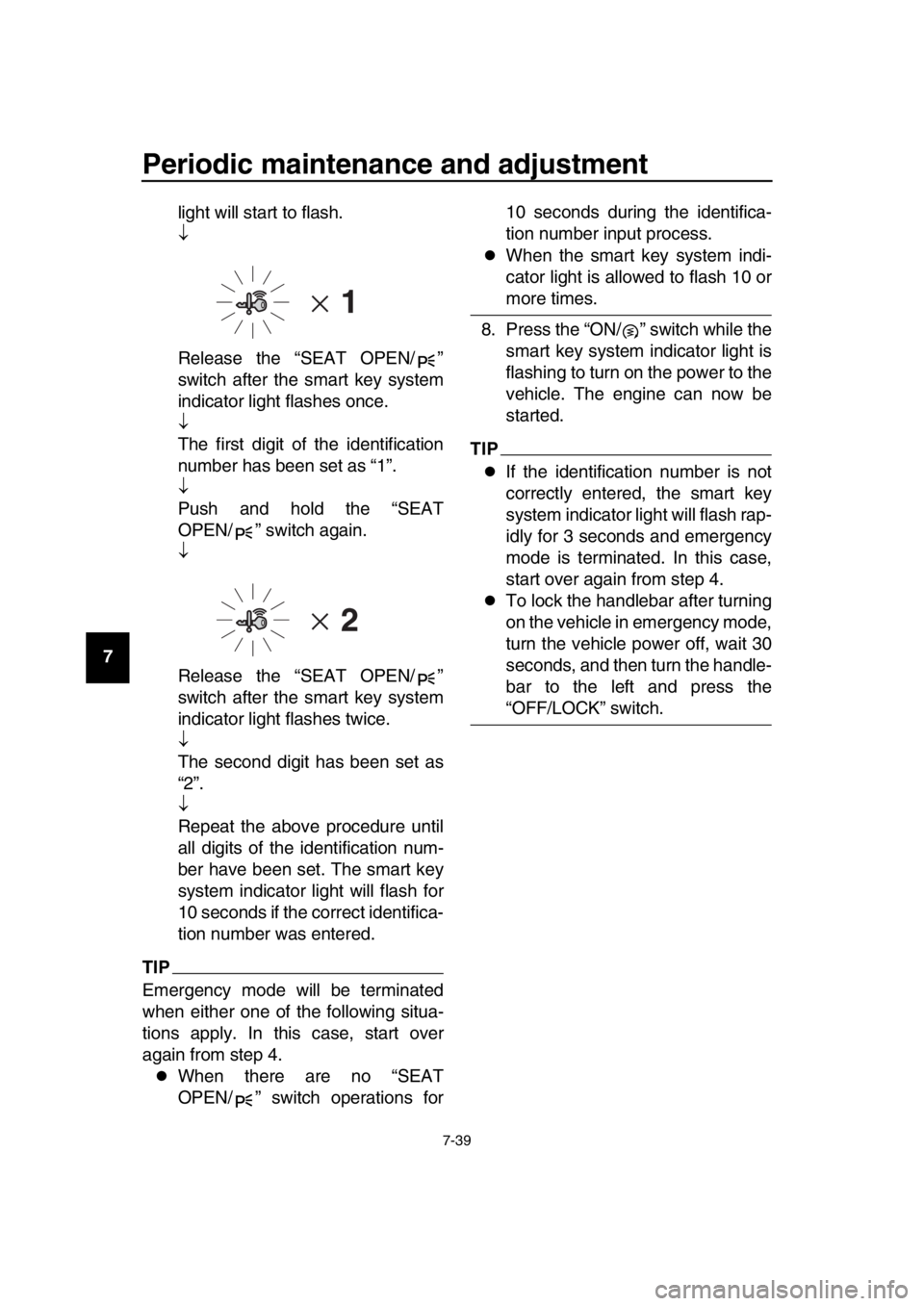
7. Inputting the identification number is done by counting the number of
flashes of the smart key system in-
dicator light.
For example, if the identification
number is 123456:
Push and hold the “SEAT
OPEN/ ” switch.
The smart key system indicator
1. Smart key system indicator light “ ”
1. Identification number
1
1 1
2PW-9-E1.book 38 ページ 2015年9月10日 木曜日 午後5時17分
Page 96 of 110
Periodic maintenance and adjustment
7-39
1
2
3
4
5
6
7
8
9
10
11
12
13
14 light will start to flash.
Release the “SEAT OPEN/ ”
switch after the smart key system
indicator light flashes once.
The first digit of the identification
number has been set as “1”.
Push and hold the “SEAT
OPEN/ ” switch again.
Release the “SEAT OPEN/ ”
switch after the smart key system
indicator light flashes twice.
The second digit has been set as
“2”.
Repeat the above procedure until
all digits of the identification num-
ber have been set. The smart key
system indicator light will flash for
10 seconds if the correct identifica-
tion number was entered.
TIP
Emergency mode will be terminated
when either one of the following situa-
tions apply. In this case, start over
again from step 4.
When there are no “SEAT
OPEN/ ” switch operations for 10 seconds during the identifica-
tion number input process.
When the smart key system indi-
cator light is allowed to flash 10 or
more times.
8. Press the “ON/ ” switch while the smart key system indicator light is
flashing to turn on the power to the
vehicle. The engine can now be
started.
TIP
If the identification number is not
correctly entered, the smart key
system indicator light will flash rap-
idly for 3 seconds and emergency
mode is terminated. In this case,
start over again from step 4.
To lock the handlebar after turning
on the vehicle in emergency mode,
turn the vehicle power off, wait 30
seconds, and then turn the handle-
bar to the left and press the
“OFF/LOCK” switch.
2PW-9-E1.book 39 ページ 2015年9月10日 木曜日 午後5時17分
Page 107 of 110

11-1
1
2
3
4
5
6
7
8
9
10
11
12
13
14
Index
A
ABS (for ABS models) ...........................4-13
ABS warning light (for ABS models)........4-1
Acceleration and deceleration .................6-3
Air filter element, replacing ....................7-15
Auxiliary DC jack ...................................4-24
Auxiliary lights .......................................7-32
B
Battery ...................................................7-28
Brake fluid, changing .............................7-23
Brake fluid level, checking .....................7-22
Brake lever, front ...................................4-11
Brake lever, rear ....................................4-12
Brake levers, lubricating ........................7-25
Braking ....................................................6-4
C
Cables, checking and lubricating...........7-24
Care.........................................................8-1
Catalytic converter.................................4-16
Centerstand and sidestand, checking and lubricating .....................7-26
Coolant ..................................................7-13
D
Dimmer switch .......................................4-10
Drive belt slack ......................................7-24
E
Emergency mode ..................................7-38
Engine break-in .......................................6-5
Engine idling speed ...............................7-16
Engine oil and oil filter cartridge ............7-10
Engine serial number ............................10-1
Engine stop switch ................................4-10
Engine trouble warning light ....................4-1
F
Front and rear brake lever free play,
checking ..............................................7-20
Front and rear brake pads, checking.....7-22
Front fork, checking ...............................7-26
Fuel .......................................................4-15
Fuel consumption, tips for reducing ........6-5
Fuel tank cap .........................................4-14
Fuses, replacing ....................................7-29
H
Handlebar switches ...............................4-10
Hazard switch ........................................4-10
Headlights .............................................7-31
Helmet holder ........................................4-17
High beam indicator light .........................4-1
Horn switch............................................4-10
How to lock the steering ........................3-10
I
Identification numbers ........................... 10-1
Ignition circuit cut-off system................. 4-22
Indicator lights and warning lights ........... 4-1
K
Key, handling of smart and mechanical
key ........................................................ 3-3
L
License plate light bulb, replacing ......... 7-34
M
Maintenance and lubrication, periodic .... 7-4
Maintenance, emission control system ... 7-3
Matte color, caution................................. 8-1
Model label............................................ 10-2
Multi-function display .............................. 4-3
O
ON/Start switch ..................................... 4-10
Operating range of the smart key system .................................................. 3-2
P
Panels, removing and installing .............. 7-7
Parking .................................................... 6-6
Parking mode ........................................ 3-11
Part locations .......................................... 2-1
Pass switch ........................................... 4-10
Powering off the vehicle .......................... 3-9
R
Rear brake lock cable, adjusting ........... 7-21
Rear brake lock, checking..................... 7-21
Rear brake lock lever ............................ 4-12
Rear view mirrors .................................. 4-21
Rider backrest, adjusting ...................... 4-17
S
Safe-riding points .................................... 1-5
Safety information ................................... 1-1
Seat opening and closing...................... 3-10
Shock absorber assembly..................... 4-21
Sidestand .............................................. 4-22
Smart key ................................................ 3-5
Smart key battery, replacing ................... 3-6
Smart key system ................................... 3-1
Smart key system indicator light ............. 4-2
Spark plugs, checking ............................. 7-9
Specifications .......................................... 9-1
Speedometer .......................................... 4-2
Starting off............................................... 6-3
Starting the engine .................................. 6-2
Steering, checking ................................ 7-27
Storage ................................................... 8-4
Storage compartments.......................... 4-18
2PW-9-E1.book 1 ページ 2015年9月10日 木曜日 午後5時17分
Page 108 of 110

Index
11-2
1
2
3
4
5
6
7
8
9
10
11
12
13
14
T
Tachometer ............................................. 4-3
Tail/brake light....................................... 7-32
Throttle grip and cable, checking and lubricating ........................................... 7-25
Throttle grip free play, checking ............ 7-16
Tires ...................................................... 7-17
Tool kit .................................................... 7-2
Troubleshooting .................................... 7-34
Troubleshooting charts ......................... 7-36
Turn signal indicator lights ...................... 4-1
Turn signal light bulb (front),
replacing ............................................. 7-33
Turn signal switch ................................. 4-10
V
Valve clearance .................................... 7-17
Vehicle identification number ................ 10-1
Vehicle power on and steering lock release .................................................. 3-8
W
Wheel bearings, checking ..................... 7-27
Wheels .................................................. 7-19
Windshield ............................................ 4-19
2PW-9-E1.book 2 ページ 2015年9月10日 木曜日 午後5時17分