lock YAMAHA TMAX 2017 Owner's Manual
[x] Cancel search | Manufacturer: YAMAHA, Model Year: 2017, Model line: TMAX, Model: YAMAHA TMAX 2017Pages: 124, PDF Size: 14.56 MB
Page 52 of 124

Instrument and control functions
5-19
1
2
3
4
5
6
7
8
9
10
11
12
13
14
EAU65580
ABS
The Yamaha ABS (Anti-lock Brake
System) features a dual electronic con-
trol system, which acts on the front and
rear brakes independently.
Operate the brakes with ABS as you
would conventional brakes. If the ABS
is activated, a pulsating sensation may
be felt at the brake levers. In this situa-
tion, continue to apply the brakes and
let the ABS work; do not “pump” the
brakes as this will reduce braking effec-
tiveness.
WARNING
EWA16051
Always keep a sufficient distance
from the vehicle ahead to match the
riding speed even with ABS.
The ABS performs best with
long braking distances.
On certain surfaces, such as
rough or gravel roads, the brak-
ing distance may be longer with
the ABS than without.
The ABS is monitored by an ECU,
which will revert the system to conven-
tional braking if a malfunction occurs.
TIP
The ABS performs a self-diagno-
sis test each time the vehicle is
turned on and travels at a speed of
10 km/h (6 mi/h) or higher. During
this test, a clicking noise can be
heard and if either brake lever is
even slightly applied, a vibration
can be felt at the lever, but this
does not indicate a malfunction.
This ABS has a test mode which
allows the owner to experience the
pulsation at the brake levers when the ABS is operating. However,
special tools are required, so
please consult your Yamaha deal-
er.
NOTICE
ECA20100
Be careful not to damage the wheel
sensor or wheel sensor rotor; other-
wise, improper performance of the
ABS will result.
1. Front wheel sensor rotor
2. Front wheel sensor
1. Rear wheel sensor rotor
2. Rear wheel sensor
1
2
1
2
BV1-28199-E0.book 19 ページ 2016年12月19日 月曜日 午前11時25分
Page 53 of 124
Instrument and control functions
5-20
1
2
3
4
5
6
7
8
9
10
11
12
13
14
EAU77322
Fuel tank cap
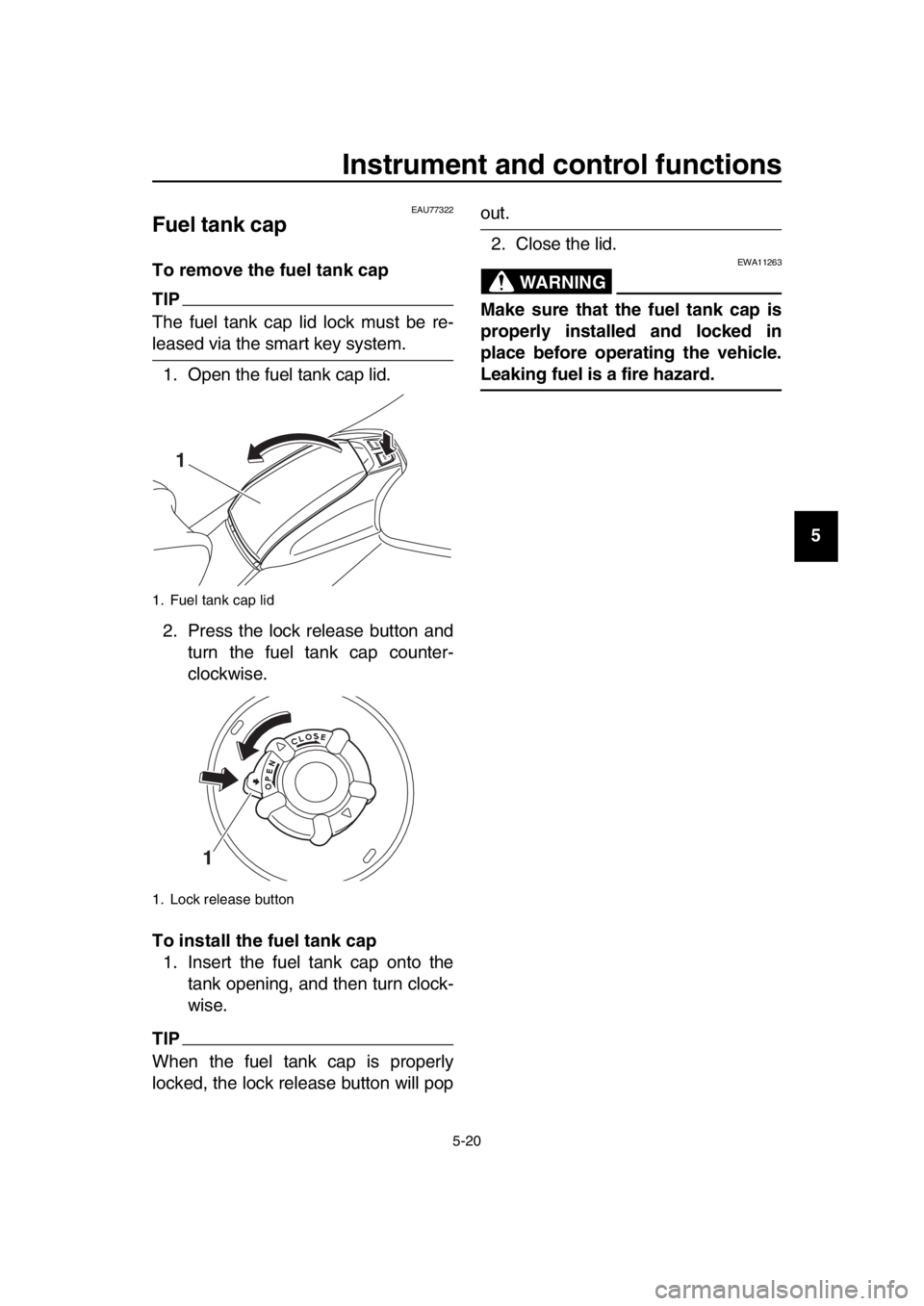
To remove the fuel tank cap
TIP
The fuel tank cap lid lock must be re-
leased via the smart key system. 1. Open the fuel tank cap lid.
2. Press the lock release button and turn the fuel tank cap counter-
clockwise.
To install the fuel tank cap 1. Insert the fuel tank cap onto the tank opening, and then turn clock-
wise.
TIP
When the fuel tank cap is properly
locked, the lock release button will pop
out.
2. Close the lid.
WARNING
EWA11263
Make sure that the fuel tank cap is
properly installed and locked in
place before operating the vehicle.
Leaking fuel is a fire hazard.
1. Fuel tank cap lid
1. Lock release button
1
1
BV1-28199-E0.book 20 ページ 2016年12月19日 月曜日 午前11時25分
Page 55 of 124

Instrument and control functions
5-22
1
2
3
4
5
6
7
8
9
10
11
12
13
14
TIP
This mark identifies the recom-
mended fuel for this vehicle as
specified by European regulation
(EN228).
Check that gasoline nozzle has the
same identifier when fueling.
Your Yamaha engine has been de-
signed to use regular unleaded gaso-
line with a research octane number of
95 or higher. If knocking (or pinging) oc-
curs, use a gasoline of a different
brand. Use of unleaded fuel will extend
spark plug life and reduce maintenance
costs.
Gasohol
There are two types of gasohol: gaso-
hol containing ethanol and that contain-
ing methanol. Gasohol containing
ethanol can be used if the ethanol con-
tent does not exceed 10% (E10). Gas-
ohol containing methanol is not
recommended by Yamaha because it
can cause damage to the fuel system
or vehicle performance problems.
EAU58301
Fuel tank overflow hose
Before operating the vehicle:
Check the fuel t ank overflow hose
connection and routing.
Check the fuel t ank overflow hose
for cracks or damage, and replace
it if necessary.
Make sure that the fuel tank over-
flow hose is not blocked, and clean
it if necessary.
E10
1. Fuel tank overflow hose
1
BV1-28199-E0.book 22 ページ 2016年12月19日 月曜日 午前11時25分
Page 57 of 124
![YAMAHA TMAX 2017 Owners Manual Instrument and control functions
5-24
1
2
3
4
5
6
7
8
9
10
11
12
13
14
partment. To prevent damaging the
seat hinges, do not place any items
in this area.
[ECA16092]
TIP
Some helmets cannot be stor](/img/51/51470/w960_51470-56.png "YAMAHA TMAX 2017 Owners Manual Instrument and control functions
5-24
1
2
3
4
5
6
7
8
9
10
11
12
13
14
partment. To prevent damaging the
seat hinges, do not place any items
in this area.
[ECA16092]
TIP
Some helmets cannot be stor")
Instrument and control functions
5-24
1
2
3
4
5
6
7
8
9
10
11
12
13
14
partment. To prevent damaging the
seat hinges, do not place any items
in this area.
[ECA16092]
TIP
Some helmets cannot be stored in
the rear storage compartment be-
cause of their size or shape.
Do not leave your scooter unat-
tended with the seat open.
Do not place the smart key inside
the rear storage compartment. It
may get locked inside and the
smart key system not operate nor-
mally.
NOTICE
ECA15963
Do not leave the seat open for
an extended period of time, oth-
erwise the light may cause the
battery to discharge.
Since the storage compartment
may get wet while the scooter is
being washed, wrap any articles
stored in the compartment in a
plastic bag.
To avoid humidity from spread-
ing through the storage com-
partment and to discourage
possible mold growth, wrap wet articles in a plastic bag before
storing them in the compart-
ment.
Do not keep anything valuable
or breakable in the storage com-
partment.
Since the storage compartment
accumulates heat from the en-
gine and from direct sunlight,
do not store anything suscepti-
ble to heat, such as food or
flammable items, inside the
compartment.
WARNING
EWA15401
Do not exceed the maximum load of
199 kg (439 lb) (XP530D-A)
202 kg (445 lb) (XP530-A, XP530E-A)
for the vehicle.
1. Rear storage compartment
2. Shaded area
2
1
BV1-28199-E0.book 24 ページ 2016年12月19日 月曜日 午前11時25分
Page 68 of 124
Operation and important riding points
7-2
1
2
3
4
5
6
7
8
9
10
11
12
13
14
EAU77082
Starting the engine
NOTICE
ECA10251
See page 7-5 for engine break-in in-
structions prior to operating the ve-
hicle for the first time.
In order for the ignition circuit cut-off
system to enable starting, the sides-
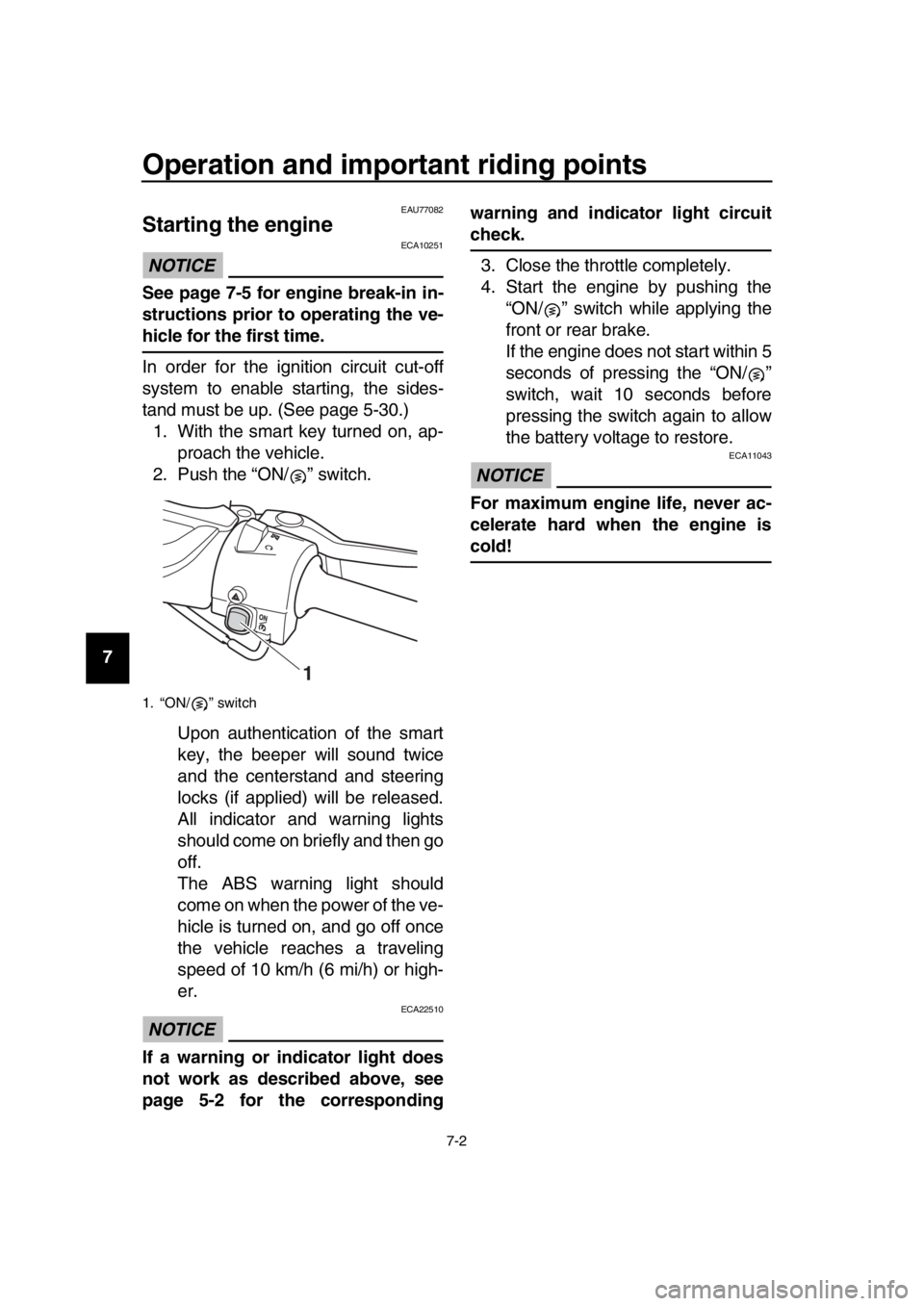
tand must be up. (See page 5-30.) 1. With the smart key turned on, ap- proach the vehicle.
2. Push the “ON/ ” switch.
Upon authentication of the smart
key, the beeper will sound twice
and the centerstand and steering
locks (if applied) will be released.
All indicator and warning lights
should come on briefly and then go
off.
The ABS warning light should
come on when the power of the ve-
hicle is turned on, and go off once
the vehicle reaches a traveling
speed of 10 km/h (6 mi/h) or high-
er.
NOTICE
ECA22510
If a warning or indicator light does
not work as described above, see
page 5-2 for the corresponding warning and indicator light circuit
check.
3. Close the throttle completely.
4. Start the engine by pushing the “ON/ ” switch while applying the
front or rear brake.
If the engine does not start within 5
seconds of pressing the “ON/ ”
switch, wait 10 seconds before
pressing the switch again to allow
the battery voltage to restore.
NOTICE
ECA11043
For maximum engine life, never ac-
celerate hard when the engine is
cold!
1. “ON/ ” switch
1
BV1-28199-E0.book 2 ページ 2016年12月19日 月曜日 午前11時25分
Page 72 of 124
Operation and important riding points
7-6
1
2
3
4
5
6
7
8
9
10
11
12
13
14
EAU77960
Parking
When parking, turn the vehicle power
off and then the smart key off.
When leaving the vehicle, make sure
you apply the steering lock and center-
stand lock. Take the smart key with
you. It is recommended that you turn
the smart key off.
WARNING
EWA10312
Since the engine and exhaust
system can become very hot,
park in a place where pedestri-
ans or children are not likely to
touch them and be burned.
Do not park on a slope or on soft
ground, otherwise the vehicle
may overturn, increasing the
risk of a fuel leak and fire.
Do not park near grass or other
flammable materials which
might catch fire.
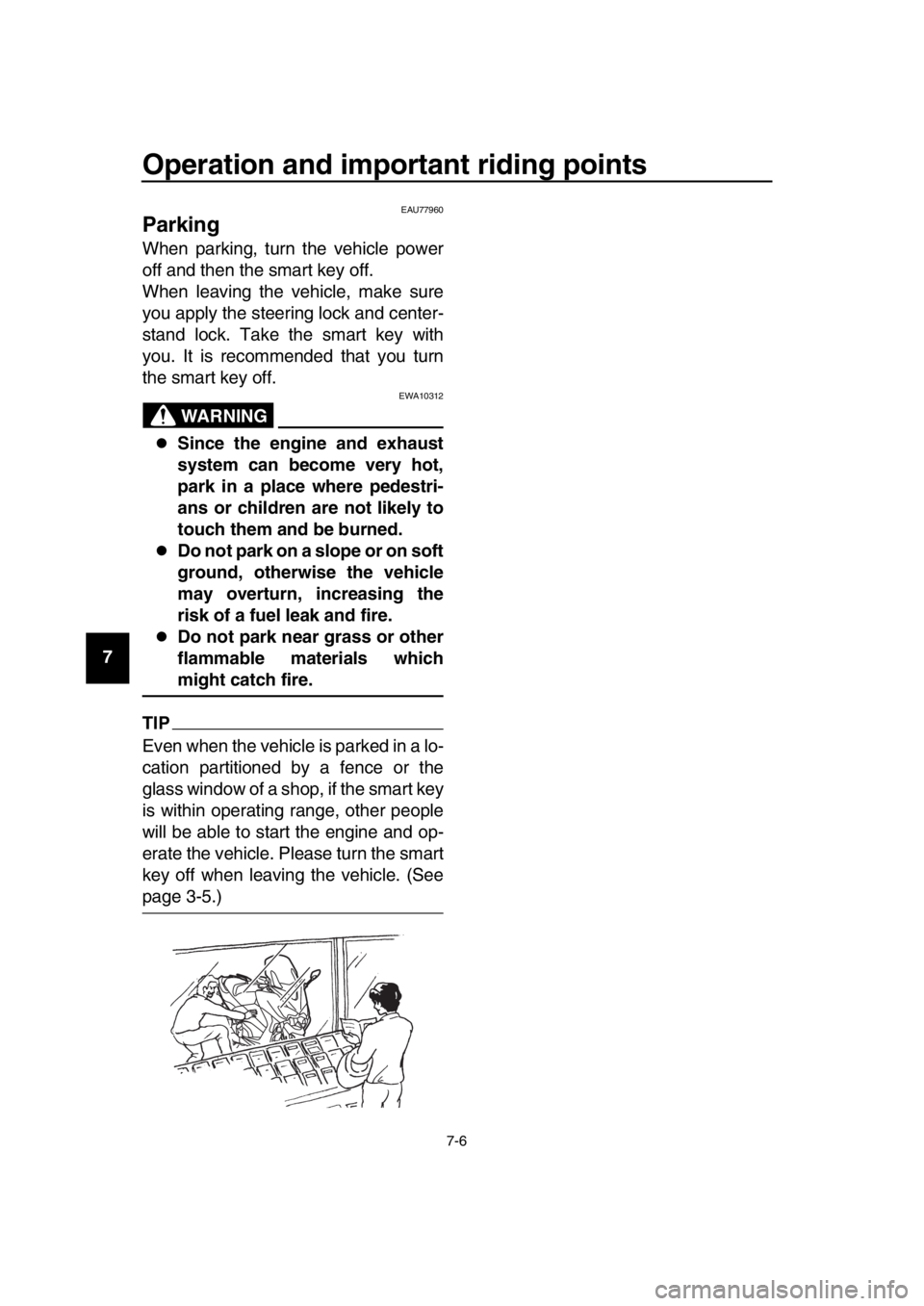
TIP
Even when the vehicle is parked in a lo-
cation partitioned by a fence or the
glass window of a shop, if the smart key
is within operating range, other people
will be able to start the engine and op-
erate the vehicle. Please turn the smart
key off when leaving the vehicle. (See
page 3-5.)
BV1-28199-E0.book 6 ページ 2016年12月19日 月曜日 午前11時25分
Page 76 of 124
Periodic maintenance and adjustment
8-4
1
2
3
4
5
6
7
8
9
10
11
12
13
14
EAU71372
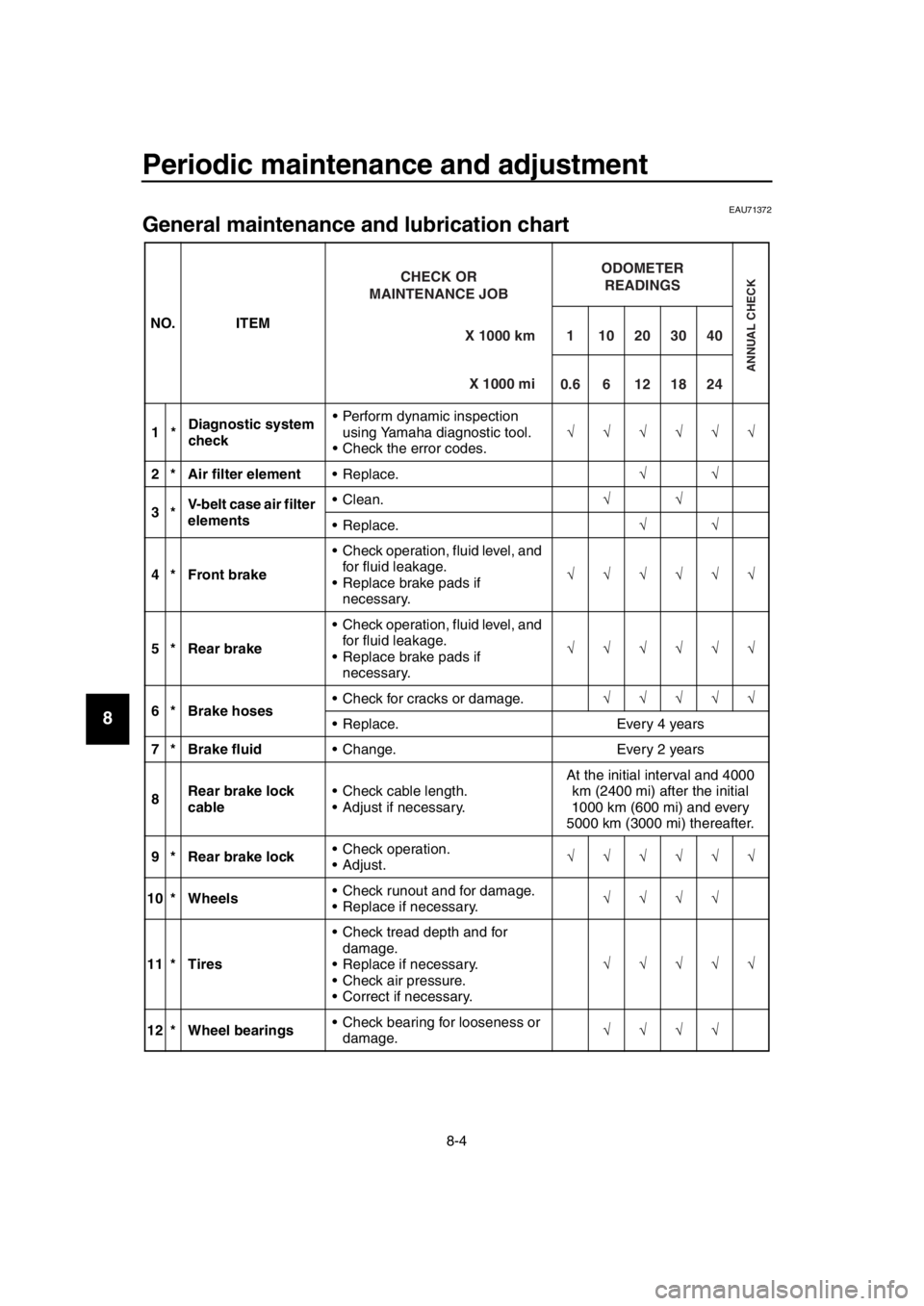
General maintenance and lubrication chart
NO. ITEM
1* Diagnostic system
check Perform dynamic inspection
using Yamaha diagnostic tool.
Check the error codes.
2 * Air filter element Replace.
3* V-belt case air filter
elements Clean.
Replace.
4 * Front brake Check operation, fluid level, and
for fluid leakage.
Replace brake pads if necessary.
5 * Rear brake Check operation, fluid level, and
for fluid leakage.
Replace brake pads if necessary.
6 * Brake hoses Check for cracks or damage.
Replace. Every 4 years
7 * Brake fluid Change. Every 2 years
8 Rear brake lock
cable Check cable length.
Adjust if necessary. At the initial interval and 4000
km (2400 mi) after the initial
1000 km (600 mi) and every
5000 km (3000 mi) thereafter.
9 * Rear brake lock Check operation.
Adjust.
10 * Wheels Check runout and for damage.
Replace if necessary.
11 * Tires Check tread depth and for
damage.
Replace if necessary.
Check air pressure.
Correct if necessary.
12 * Wheel bearings Check bearing for looseness or
damage. X 1000 km
CHECK OR
MAINTENANCE JOB
X 1000 mi
ODOMETER READINGS
ANNUAL CHECK
110203040
0.66121824
BV1-28199-E0.book 4 ページ 2016年12月19日 月曜日 午前11時25分
Page 82 of 124

Periodic maintenance and adjustment
8-10
1
2
3
4
5
6
7
8
9
10
11
12
13
14
EAU36112
Canister
This model is equipped with a canister
to prevent the discharging of fuel vapor
into the atmosphere. Before operating
this vehicle, make sure to check the fol-
lowing:
Check each hose connection.
Check each hose and canister for
cracks or damage. Replace if dam-
aged.
Make sure that the canister breath-
er is not blocked, and if necessary,
clean it.
EAU77360
Engine oil and oil filter
cartridge
The engine oil level should be checked
before each ride. In addition, the oil
must be changed and the oil filter car-
tridge replaced at the intervals speci-
fied in the periodic maintenance and
lubrication chart.
To check the engine oil level 1. Place the vehicle on the center- stand. A slight tilt to the side can
result in a false reading.
2. Start the engine, warm it up for two minutes, and then turn it off.
NOTICE
ECA11291
The engine must be cold before pro-
ceeding with the oil level check, oth-
erwise the check will result in a false
reading.
3. Wait two minutes until the oil set- tles, and then check the oil level
through the check window located
at the bottom-left side of the crank-
case.
TIP
The engine oil should be between the
minimum and maximum level marks.
1. Canister
2. Canister breather
12
BV1-28199-E0.book 10 ページ 2016年12月19日 月曜日 午前11時25分
Page 92 of 124
Periodic maintenance and adjustment
8-20
1
2
3
4
5
6
7
8
9
10
11
12
13
14
EAU51921
Cast wheels
To maximize the performance, durabil-
ity, and safe operation of your vehicle,
note the following points regarding the
specified wheels.
The wheel rims should be checked
for cracks, bends, warpage or oth-
er damage before each ride. If any
damage is found, have a Yamaha
dealer replace the wheel. Do not
attempt even the smallest repair to
the wheel. A deformed or cracked
wheel must be replaced.
The wheel should be balanced
whenever either the tire or wheel
has been changed or replaced. An
unbalanced wheel can result in
poor performance, adverse han-
dling characteristics, and a short-
ened tire life.
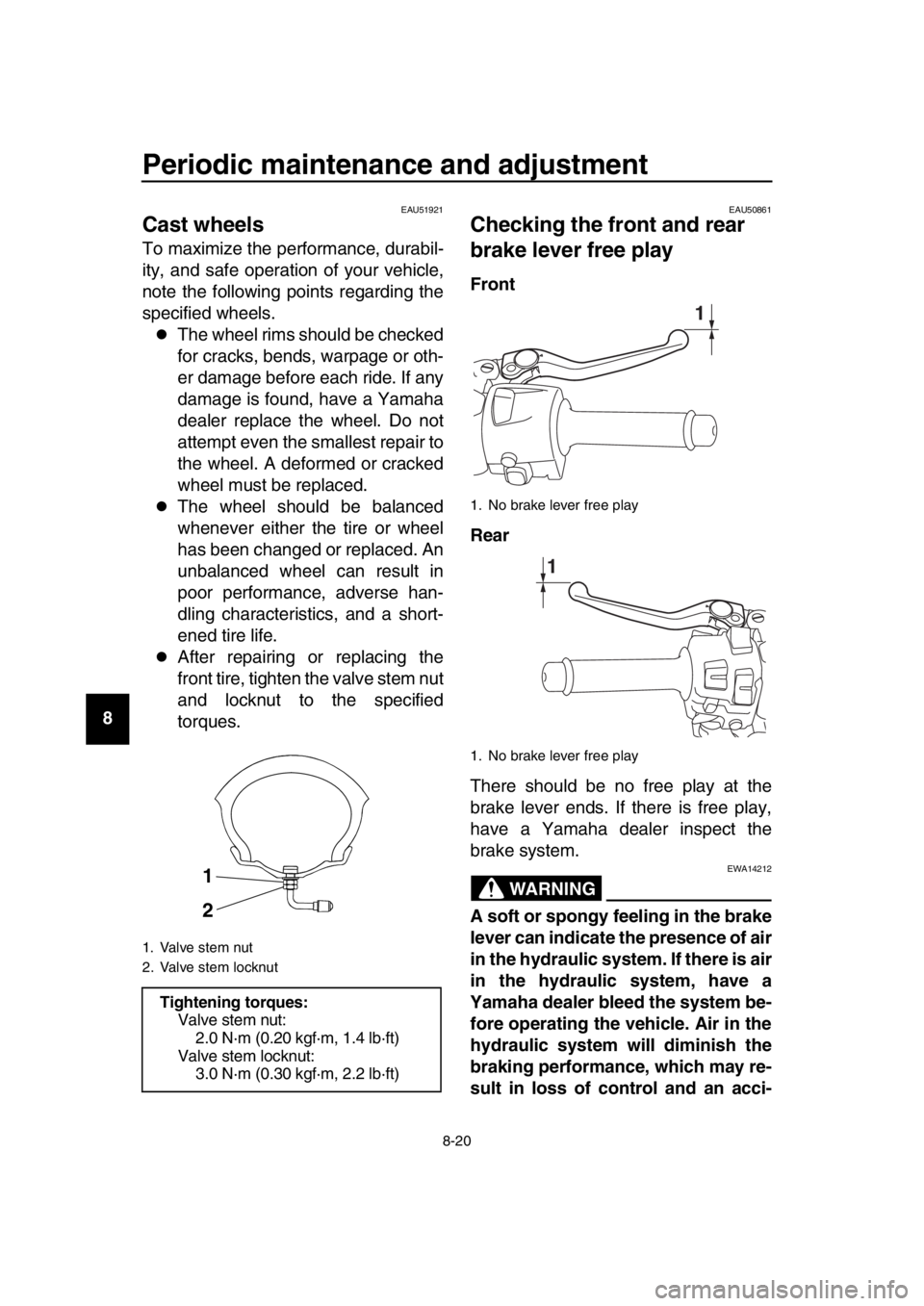
After repairing or replacing the
front tire, tighten the valve stem nut
and locknut to the specified
torques.
EAU50861
Checking the fr ont and rear
brake lever free play
Front
Rear
There should be no free play at the
brake lever ends. If there is free play,
have a Yamaha dealer inspect the
brake system.
WARNING
EWA14212
A soft or spongy feeling in the brake
lever can indicate the presence of air
in the hydraulic system. If there is air
in the hydraulic system, have a
Yamaha dealer bleed the system be-
fore operating the vehicle. Air in the
hydraulic system will diminish the
braking performance, which may re-
sult in loss of control and an acci-
1. Valve stem nut
2. Valve stem locknut
Tightening torques: Valve stem nut:
2.0 N·m (0.20 kgf·m, 1.4 lb·ft)
Valve stem locknut: 3.0 N·m (0.30 kgf·m, 2.2 lb·ft)
1
2
1. No brake lever free play
1. No brake lever free play
1
1
BV1-28199-E0.book 20 ページ 2016年12月19日 月曜日 午前11時25分
Page 93 of 124
Periodic maintenance and adjustment
8-21
1
2
3
4
5
6
7
8
9
10
11
12
13
14
dent.EAU53032
Adjusting the rear brake lock
cable
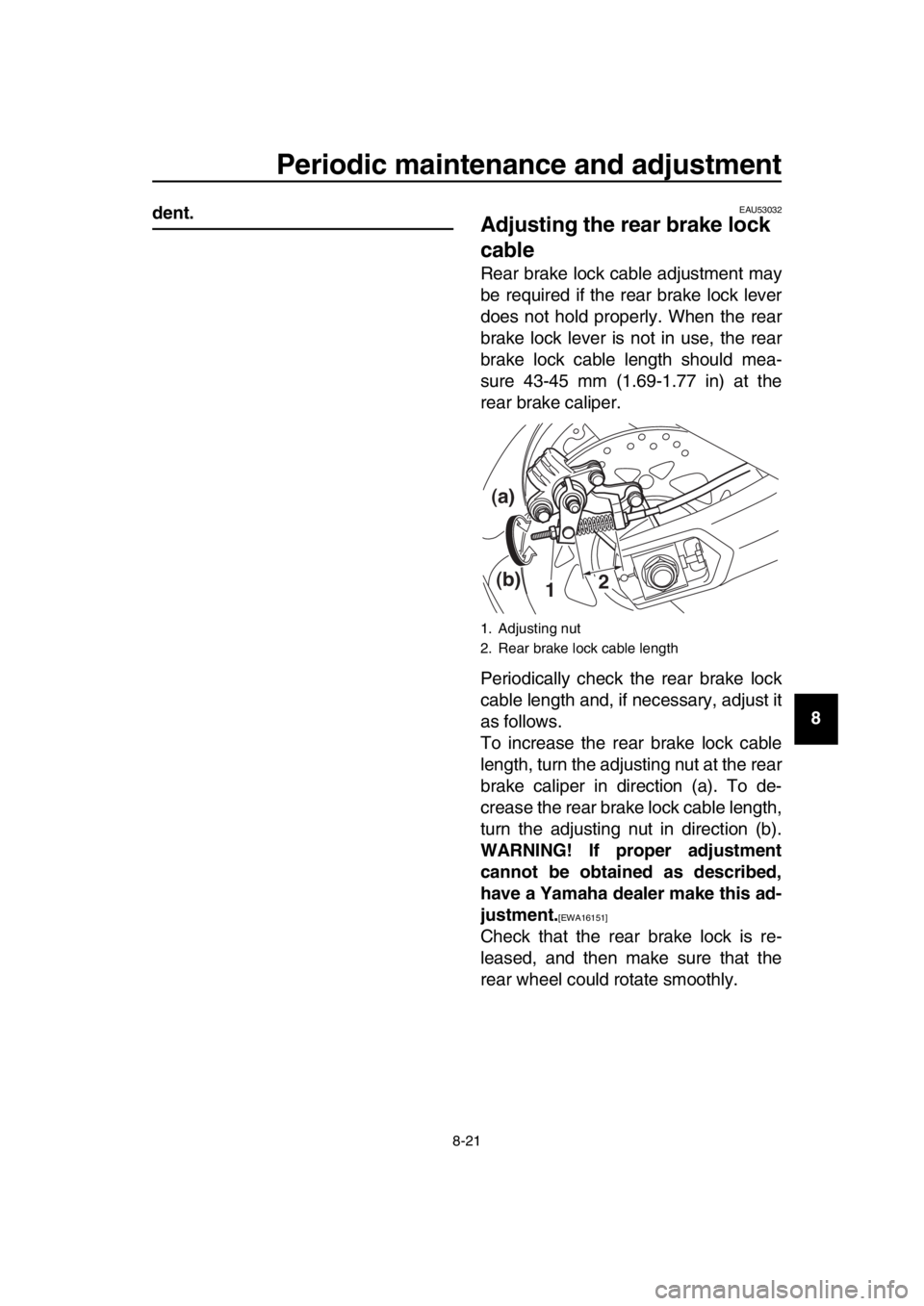
Rear brake lock cable adjustment may
be required if the rear brake lock lever
does not hold properly. When the rear
brake lock lever is not in use, the rear
brake lock cable length should mea-
sure 43-45 mm (1.69-1.77 in) at the
rear brake caliper.
Periodically check the rear brake lock
cable length and, if necessary, adjust it
as follows.
To increase the rear brake lock cable
length, turn the adjusting nut at the rear
brake caliper in direction (a). To de-
crease the rear brake lock cable length,
turn the adjusting nut in direction (b).
WARNING! If proper adjustment
cannot be obtained as described,
have a Yamaha dealer make this ad-
justment.
[EWA16151]
Check that the rear brake lock is re-
leased, and then make sure that the
rear wheel could rotate smoothly.
1. Adjusting nut
2. Rear brake lock cable length
12
(a)
(b)
BV1-28199-E0.book 21 ページ 2016年12月19日 月曜日 午前11時25分