engine YAMAHA TMAX 2019 Service Manual
[x] Cancel search | Manufacturer: YAMAHA, Model Year: 2019, Model line: TMAX, Model: YAMAHA TMAX 2019Pages: 122, PDF Size: 14.98 MB
Page 86 of 122
![YAMAHA TMAX 2019 Service Manual Periodic maintenance and adjustment
8-15
1
2
3
4
5
6
7
8
9
10
11
12
13
14 WARNING! Never attempt to remove
the radiator cap when the engine is
hot.
[EWA10382]
EAU52032
Engine air filter element
The en](/img/51/51454/w960_51454-85.png "YAMAHA TMAX 2019 Service Manual Periodic maintenance and adjustment
8-15
1
2
3
4
5
6
7
8
9
10
11
12
13
14 WARNING! Never attempt to remove
the radiator cap when the engine is
hot.
[EWA10382]
EAU52032
Engine air filter element
The en")
Periodic maintenance and adjustment
8-15
1
2
3
4
5
6
7
8
9
10
11
12
13
14 WARNING! Never attempt to remove
the radiator cap when the engine is
hot.
[EWA10382]
EAU52032
Engine air filter element
The engine air filter element should be
replaced at the intervals specified in the
periodic maintenance chart. Replace
the air filter element more frequently if
you often ride in wet or dusty condi-
tions.
To replace the air filter element
1. Remove panel C. (See page 8-7.)
2. Remove the air filter case cover by removing the screws.
3. Pull the air filter element out.
4. Insert a new air filter element into the air filter case. NOTICE: Make
sure that the air filter element is
properly seated in the air filter
case. The engine should never
be operated without the air filter
1. Screw
2. Air filter case cover
1. Air filter element
1 1
2
1
BV1-9-E2.book 15 ページ 2018年8月28日 火曜日 午後5時28分
Page 87 of 122
![YAMAHA TMAX 2019 Service Manual Periodic maintenance and adjustment
8-16
1
2
3
4
5
6
7
8
9
10
11
12
13
14
element installed, otherwise the
piston(s) and/or cylinder(s) may
become excessively worn.
[ECA10482]
5. Install the air filte](/img/51/51454/w960_51454-86.png "YAMAHA TMAX 2019 Service Manual Periodic maintenance and adjustment
8-16
1
2
3
4
5
6
7
8
9
10
11
12
13
14
element installed, otherwise the
piston(s) and/or cylinder(s) may
become excessively worn.
[ECA10482]
5. Install the air filte")
Periodic maintenance and adjustment
8-16
1
2
3
4
5
6
7
8
9
10
11
12
13
14
element installed, otherwise the
piston(s) and/or cylinder(s) may
become excessively worn.
[ECA10482]
5. Install the air filter case cover by in-
stalling the screws.
6. Install the panel.
EAU44735
Checking the engine idling
speed
Check the engine idling speed and, if
necessary, have it corrected by a
Yamaha dealer.
Engine idling speed: 1100–1300 r/min
BV1-9-E2.book 16 ページ 2018年8月28日 火曜日 午後5時28分
Page 88 of 122
Periodic maintenance and adjustment
8-17
1
2
3
4
5
6
7
8
9
10
11
12
13
14
EAU21386
Checking the throttle grip free
play
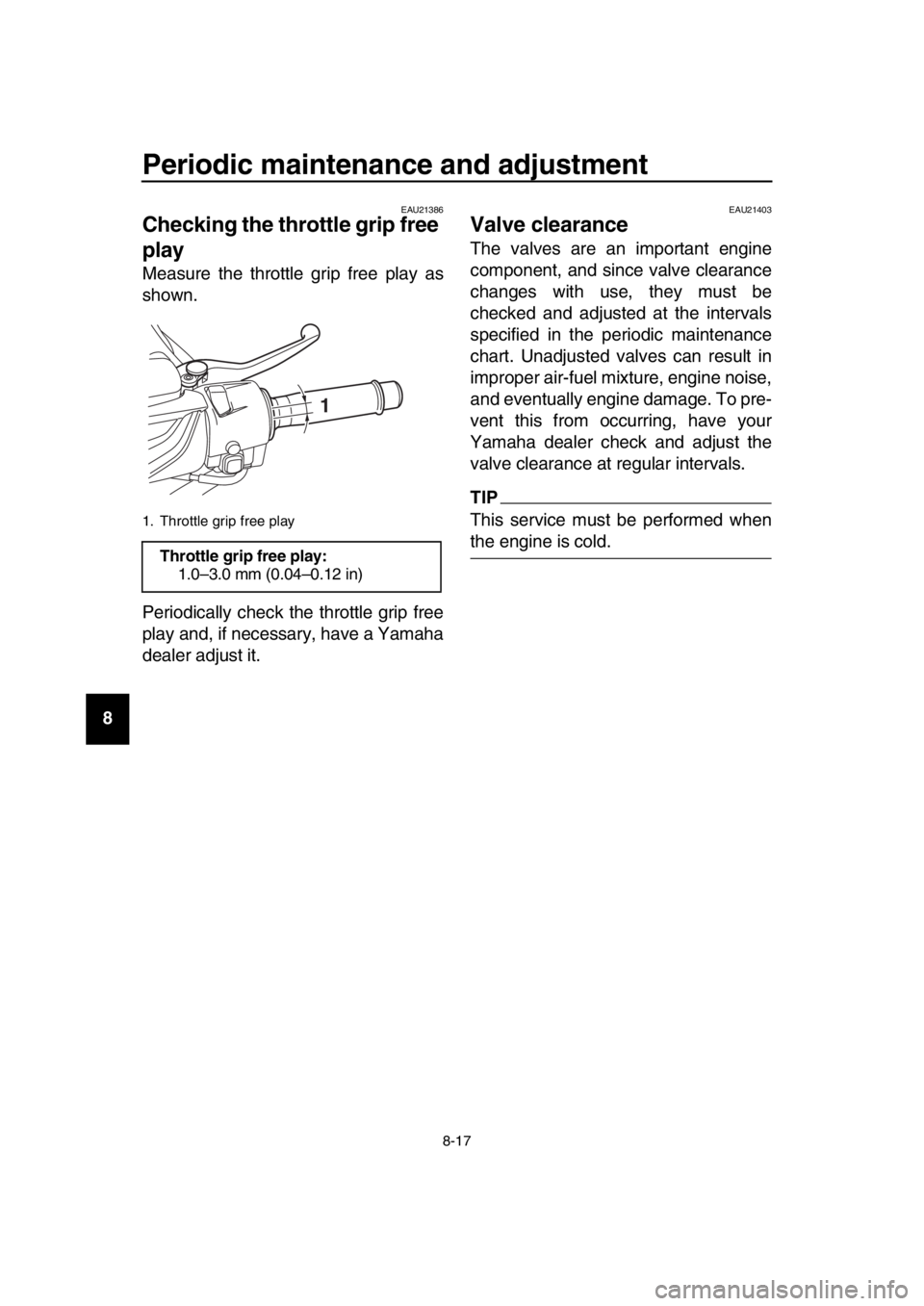
Measure the throttle grip free play as
shown.
Periodically check the throttle grip free
play and, if necessary, have a Yamaha
dealer adjust it.
EAU21403
Valve clearance
The valves are an important engine
component, and since valve clearance
changes with use, they must be
checked and adjusted at the intervals
specified in the periodic maintenance
chart. Unadjusted valves can result in
improper air-fuel mixture, engine noise,
and eventually engine damage. To pre-
vent this from occurring, have your
Yamaha dealer check and adjust the
valve clearance at regular intervals.
TIP
This service must be performed when
the engine is cold.
1. Throttle grip free play
Throttle grip free play: 1.0–3.0 mm (0.04–0.12 in)
1
BV1-9-E2.book 17 ページ 2018年8月28日 火曜日 午後5時28分
Page 105 of 122
Periodic maintenance and adjustment
8-34
1
2
3
4
5
6
7
8
9
10
11
12
13
14
Is the smart key battery installed
correctly? (See page 3-6.)
Is the smart key being used in a lo-
cation with strong radio waves or
other electromagnetic noise? (See
page 3-1.)
Are you using the smart key that is
registered to the vehicle?
Is the vehicle battery discharged?
When the vehicle battery is dis-
charged, the smart key system will
not operate. Please have the vehi-
cle battery charged or replaced.
(See page 8-28.)
If the smart key system does not work
after checking the above items, have a
Yamaha dealer check the smart key
system.
TIP
See Emergency mode on page 8-37 for
information on starting the engine with-
out the smart key.
BV1-9-E2.book 34 ページ 2018年8月28日 火曜日 午後5時28分
Page 106 of 122
Periodic maintenance and adjustment
8-35
1
2
3
4
5
6
7
8
9
10
11
12
13
14
EAU63470
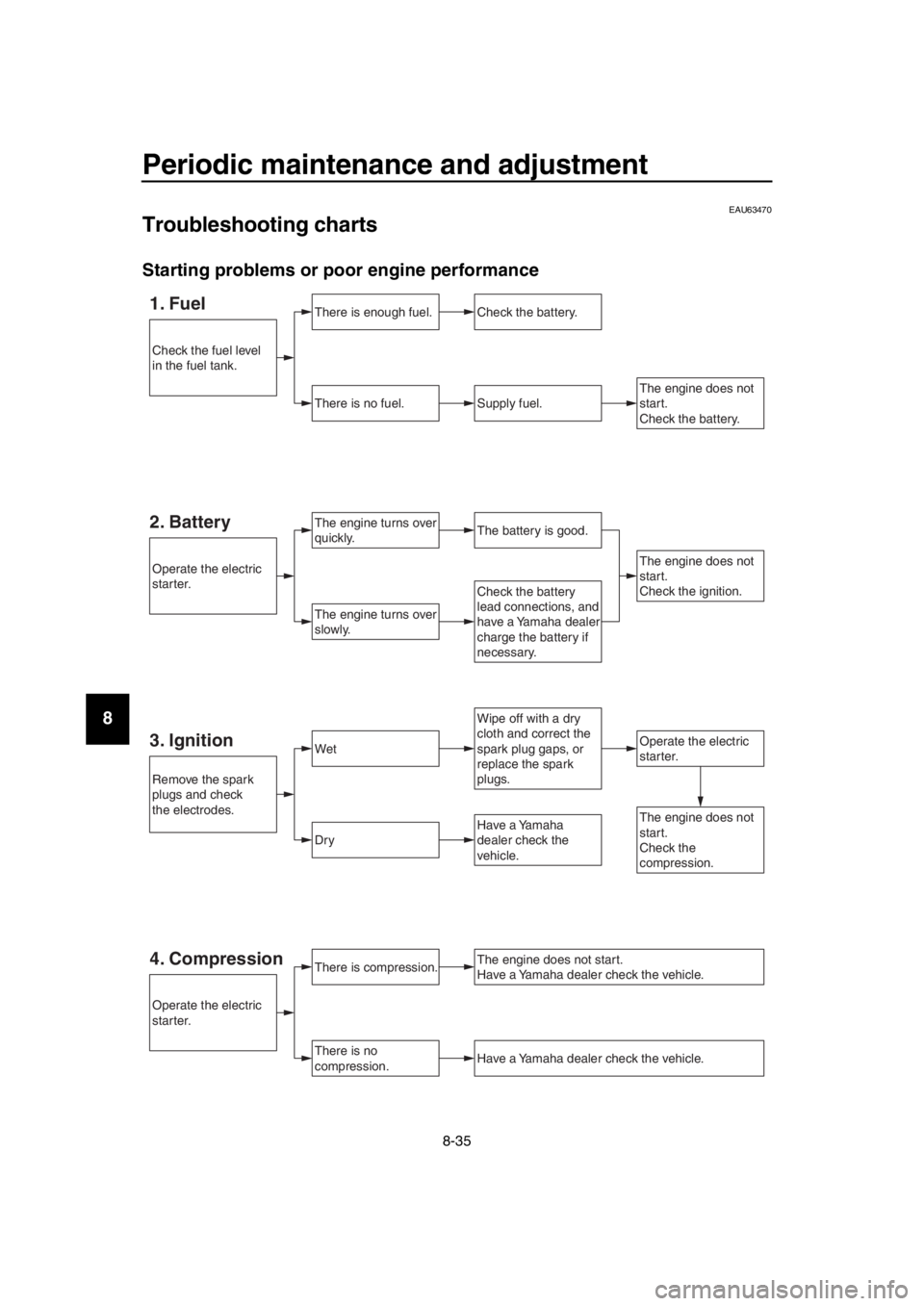
Troubleshooting charts
Starting problems or poor engine performance
1. FuelThere is enough fuel.
There is no fuel.
Check the battery.
Supply fuel.
The engine turns over
quickly.
The engine turns over
slowly.
The engine does not
start.
Check the battery.
Wipe off with a dry
cloth and correct the
spark plug gaps, or
replace the spark
plugs.
Check the battery
lead connections, and
have a Yamaha dealer
charge the battery if
necessary.
2. BatteryThe battery is good.
The engine does not
start.
Check the ignition.
3. IgnitionWetOperate the electric
starter.
Dry
There is compression.
There is no
compression.
The engine does not start.
Have a Yamaha dealer check the vehicle.
Have a Yamaha dealer check the vehicle.
The engine does not
start.
Check the
compression.Have a Yamaha
dealer check the
vehicle.
Remove the spark
plugs and check
the electrodes.
Operate the electric
starter.
Operate the electric
starter.
Check the fuel level
in the fuel tank.
4. Compression
BV1-9-E2.book 35 ページ 2018年8月28日 火曜日 午後5時28分
Page 107 of 122

Periodic maintenance and adjustment
8-36
1
2
3
4
5
6
7
8
9
10
11
12
13
14
Engine overheating
WARNING
EWAT1041
Do not remove the radiator cap when the engine and radiator are hot.
Scalding hot fluid and steam may be blown out under pressure, which
could cause serious injury. Be sure to wait until the engine has cooled.
Place a thick rag, like a towel, over the radiator cap, and then slowly ro-
tate the cap counterclockwise to the detent to allow any residual pres-
sure to escape. When the hissing sound has stopped, press down on the
cap while turning it counterclockwise, and then remove the cap.
TIP
If coolant is not available, tap water can be temporarily used instead, provided that
it is changed to the recommended
coolant as soon as possible.
Wait until the engine
has cooled.
Check the coolant
level in the reservoir
and radiator.Add coolant.
(See TIP.)
The coolant level is
OK.
There is no leakage.
There is leakage.
The coolant level is
low.
Check the cooling
system for leakage.
Have a Yamaha
dealer check and
repair the cooling
system.
Start the engine. If the engine overheats again,
have a Yamaha dealer check and repair the cooling
system.
BV1-9-E2.book 36 ページ 2018年8月28日 火曜日 午後5時28分
Page 108 of 122

Periodic maintenance and adjustment
8-37
1
2
3
4
5
6
7
8
9
10
11
12
13
14
EAU77372
Emergency mode
When the smart key is lost, damaged,
or its battery has discharged, the vehi-
cle can still be turned on and the engine
started. You will need a mechanical key
and the smart key system identification
number. To operate the vehicle in
emergency mode, carry out the follow-
ing steps.
TIP
Emergency mode operation will be
cancelled if the respective steps are not
carried out within the time set for each
operation or if the “OFF/LOCK” switch
is pushed. 1. Stop the vehicle in a safe place.
2. Unlock the seat by inserting the mechanical key into the lock locat-
ed right side of body and turn it
counter clockwise.
3. Open the seat and check that the trunk light comes on.
4. Push the “ON/ ” switch once.
5. Without completely shutting the seat, raise and lower it three times
within 10 seconds.
TIP
Use the rear storage compartment light
as a guide when raising and lowering
the seat. The smart key system indicator
light on the speedometer will come
on for three seconds to indicate
the transition to emergency mode.
6. After the smart key system indica- tor light goes off, use the “ / ”
switch to enter the identification
number.
7. Inputting the identification number is done by counting the number of
flashes of the smart key system in-
dicator light.
For example, if the identification
number is 123456:
Push and hold the “ / ” switch.
The smart key system indicator
light will start to flash.
1. Smart key system indicator light “ ”
1. Identification number
1
12345 6
1
BV1-9-E2.book 37 ページ 2018年8月28日 火曜日 午後5時28分
Page 109 of 122
Periodic maintenance and adjustment
8-38
1
2
3
4
5
6
7
8
9
10
11
12
13
14
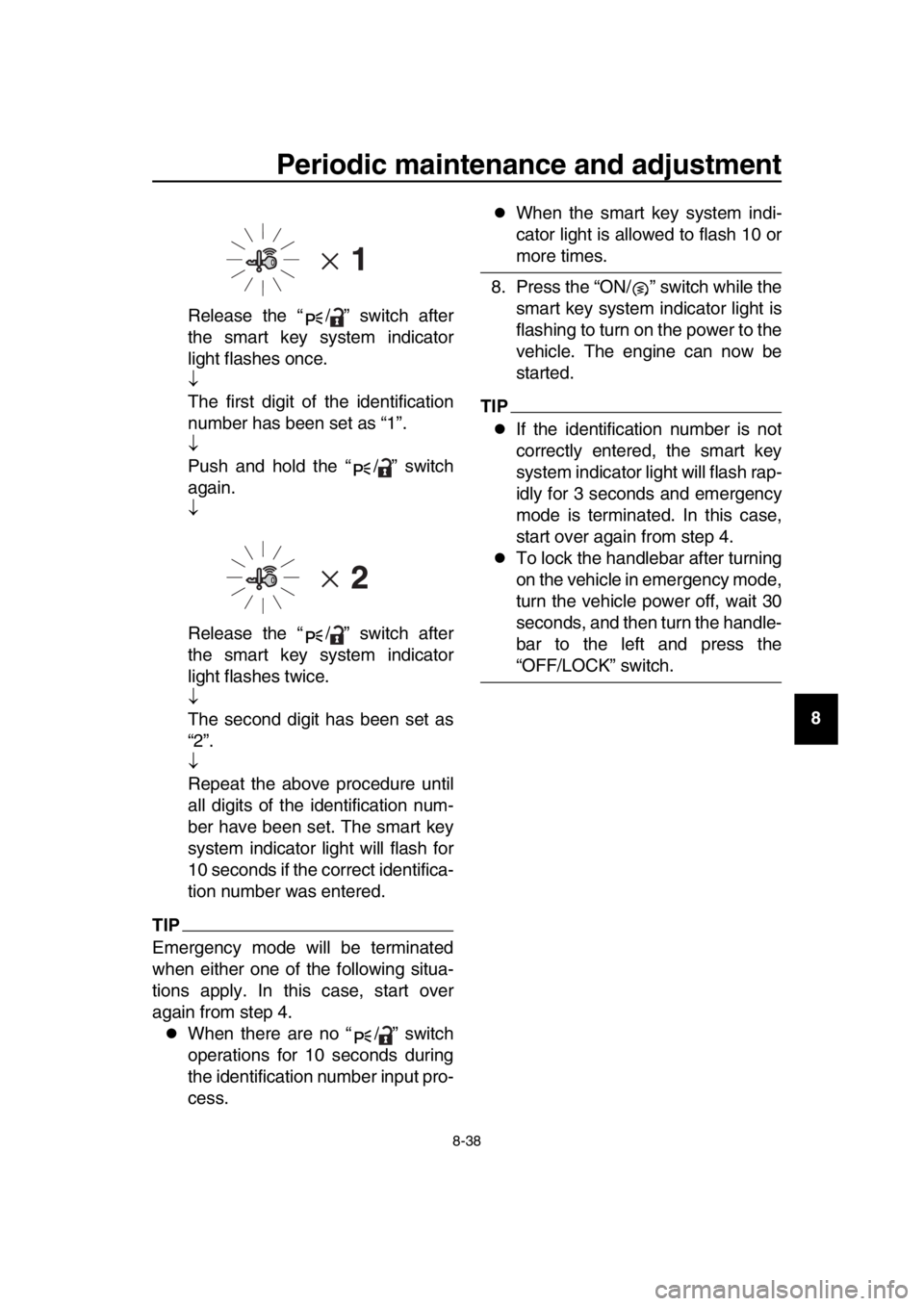
Release the “ / ” switch after
the smart key system indicator
light flashes once.
The first digit of the identification
number has been set as “1”.
Push and hold the “ / ” switch
again.
Release the “ / ” switch after
the smart key system indicator
light flashes twice.
The second digit has been set as
“2”.
Repeat the above procedure until
all digits of the identification num-
ber have been set. The smart key
system indicator light will flash for
10 seconds if the correct identifica-
tion number was entered.
TIP
Emergency mode will be terminated
when either one of the following situa-
tions apply. In this case, start over
again from step 4.
When there are no “ / ” switch
operations for 10 seconds during
the identification number input pro-
cess.
When the smart key system indi-
cator light is allowed to flash 10 or
more times.
8. Press the “ON/ ” switch while the smart key system indicator light is
flashing to turn on the power to the
vehicle. The engine can now be
started.
TIP
If the identification number is not
correctly entered, the smart key
system indicator light will flash rap-
idly for 3 seconds and emergency
mode is terminated. In this case,
start over again from step 4.
To lock the handlebar after turning
on the vehicle in emergency mode,
turn the vehicle power off, wait 30
seconds, and then turn the handle-
bar to the left and press the
“OFF/LOCK” switch.
BV1-9-E2.book 38 ページ 2018年8月28日 火曜日 午後5時28分
Page 112 of 122
Scooter care and storage
9-3
1
2
3
4
5
6
7
8
9
10
11
12
13
14 3. Use a chrome polish to shine
chrome, aluminum, and stainless
steel parts. Often the thermally in-
duced discoloring of stainless steel
exhaust systems can be removed
through polishing.
4. Apply a corrosion protection spray on all metal parts including chrome
or nickel-plated surfaces.
WARNING! Do not apply
silicone or oil spray to seats,
hand grips, rubber foot pegs or
tire treads. Otherwise these
parts will become slippery,
which could cause loss of con-
trol. Thoroughly clean the sur-
faces of these parts before
operating the vehicle.
[EWA20650]
5. Treat rubber, vinyl, and unpaintedplastic parts with a suitable care
product.
6. Touch up minor paint damage caused by stones, etc.
7. Wax all painted surfaces using a non-abrasive wax or use a detail
spray for motorcycles.
8. When finished cleaning, start the engine and let it idle for several
minutes to help dry any remaining
moisture.
9. If the headlight lens has fogged up, start the engine and turn on the
headlight to help remove the mois-
ture.
10. Let the vehicle dry completely be- fore storing or covering it.
NOTICE
ECA26320
Do not apply wax to rubber or
unpainted plastic parts.
Do not use abrasive polishing
compounds as they will wear away the paint.
Apply sprays and wax sparing-
ly. Wipe off excess afterwards.
WARNING
EWA20660
Contaminants left on the brakes or
tires can cause loss of control.
Make sure there is no lubricant
or wax on the brakes or tires.
If necessary, wash the tires with
warm water and a mild deter-
gent.
If necessary, clean the brake
discs and pads with brake
cleaner or acetone.
Before riding at higher speeds,
test the vehicle’s braking perfor-
mance and cornering behavior.
BV1-9-E2.book 3 ページ 2018年8月28日 火曜日 午後5時28分
Page 113 of 122
Scooter care and storage
9-4
1
2
3
4
5
6
7
8
9
10
11
12
13
14
EAU83472
Storage
Always store the vehicle in a cool, dry
place. If necessary, protect it against
dust with a porous cover. Be sure the
engine and the exhaust system are
cool before covering the vehicle. If the
vehicle often sits for weeks at a time be-
tween uses, the use of a quality fuel
stabilizer is recommended after each
fill-up.
NOTICE
ECA21170
Storing the vehicle in a poorly
ventilated room or covering it
with a tarp, while it is still wet,
will allow water and humidity to
seep in and cause rust.
To prevent corrosion, avoid
damp cellars, stables (because
of the presence of ammonia)
and areas where strong chemi-
cals are stored.
Long term storage
Before storing the vehicle long term (60
days or more): 1. Make all necessary repairs and perform any outstanding mainte-
nance.
2. Follow all instructions in the Care section of this chapter.
3. Fill up the fuel tank, adding fuel stabilizer according to product in-
structions. Run the engine for 5
minutes to distribute treated fuel
through the fuel system.
4. For vehicles equipped with a fuel cock: Turn the fuel cock lever to
the off position.
5. For vehicles with a carburetor: To prevent fuel deposits from building up, drain the fuel in the carburetor
float chamber into a clean contain-
er. Retighten the drain bolt and
pour the fuel back into the fuel
tank.
6. Use a quality engine fogging oil ac- cording to product instructions to
protect internal engine compo-
nents from corrosion. If engine fog-
ging oil is not available, perform
the following steps for each cylin-
der:
a. Remove the spark plug cap and spark plug.
b. Pour a teaspoonful of engine oil into the spark plug bore.
c. Install the spark plug cap onto the spark plug, and then place
the spark plug on the cylinder
head so that the electrodes are
grounded. (This will limit spark-
ing during the next step.)
d. Turn the engine over several times with the starter. (This will
coat the cylinder wall with oil.)
WARNING! To prevent dam-
age or injury from sparking,
make sure to ground the
spark plug electrodes while
turning the engine
over.
[EWA10952]
e. Remove the spark plug capfrom the spark plug, and then
install the spark plug and the
spark plug cap.
7. Lubricate all control cables, pivots, levers and pedals, as well as the
sidestand and centerstand (if
equipped).
8. Check and correct the tire air pres- sure, and then lift the vehicle so
that all wheels are off the ground.
BV1-9-E2.book 4 ページ 2018年8月28日 火曜日 午後5時28分