fuel cap YAMAHA TMAX 2019 Owners Manual
[x] Cancel search | Manufacturer: YAMAHA, Model Year: 2019, Model line: TMAX, Model: YAMAHA TMAX 2019Pages: 122, PDF Size: 14.98 MB
Page 6 of 122

Table of contents
Safety information............................1-1
Further safe-riding points.................1-5
Description ........................................2-1
Left view ..........................................2-1
Right view ........................................2-2
Controls and instrume nts.................2-3
Smart key system ............................3-1
Smart key system ....... .....................3-1
Operating range of the smart key system ....... ............................ .......3-2
Handling of the smart key and
mechanical key ............................3-3
Smart key ........................................3-5
Replacing the smart key battery ......3-6
Powering on the vehi cle ..................3-8
Powering off the vehi cle ..................3-9
How to lock the steering ................3-10
How to lock the centerstand ..........3-10
Storage compartment and fuel
tank access ................................3-11
Parking mode ................................3-13
Special features ................................4-1
Cruise control system (XP530D-A) ..................................4-1
D-mode (drive mode).......................4-3
Traction control system ...................4-4
Instrument and co ntrol functions....5-1
Handlebar switches .........................5-1
Indicator lights and warning lights ...5-2
Speedometer ...................................5-4
Tachometer .....................................5-4
Multi-function display .......................5-5
Front brake lever ...........................5-17
Rear brake lever ............................5-17
Rear brake lock lever.....................5-18
Anti-lock brake system (ABS) ........5-18
Fuel tank cap .................................5-19
Fuel................................................5-20
Fuel tank overflow hose.................5-22
Catalytic converter .........................5-22
Storage compartments ..................5-23
Windshield (XP530-A) ...................5-24 Rear view mirrors .......................... 5-26
Shock absorber assembly ............. 5-26
Auxiliary DC jack ........................... 5-28
Sidestand ...................................... 5-29
Ignition circuit cut-
off system ......... 5-29
For your safety – pre-operation
checks ............................................... 6-1
Operation and important riding
points ................................................. 7-1
Starting the engine .......................... 7-2
Starting off ....................................... 7-3
Acceleration and deceleration ......... 7-3
Braking ............................................ 7-4
Tips for reducing fuel
consumption ................................ 7-5
Engine break-in ............................... 7-5
Parking ............................................ 7-6
Periodic maintenance and
adjustment ........................................ 8-1
Tool kit............................................. 8-2
Periodic maintenance charts ........... 8-3
Periodic maintenance chart for the emission control syst em .............. 8-3
General maintenance and
lubrication chart ........................... 8-4
Removing and installing panels ...... 8-7
Checking the spark plugs ................ 8-9
Canister ......................................... 8-10
Engine oil and oil filter cartridge .... 8-10
Why Yamalube .............................. 8-13
Coolant .......................................... 8-13
Engine air filter element ................ 8-15
Checking the engine idling
speed ......................................... 8-16
Checking the throttle grip free play ............................................ 8-17
Valve clearance............................. 8-17
Tires .............................................. 8-18
Cast wheels................................... 8-20
Checking the front and rear brake lever free play ............................ 8-20
Adjusting the rear brake lock
cable .......................................... 8-21
BV1-9-E2.book 1 ページ 2018年8月28日 火曜日 午後5時28分
Page 13 of 122
2-1
1
2
3
4
5
6
7
8
9
10
11
12
13
14
Description
EAU63371
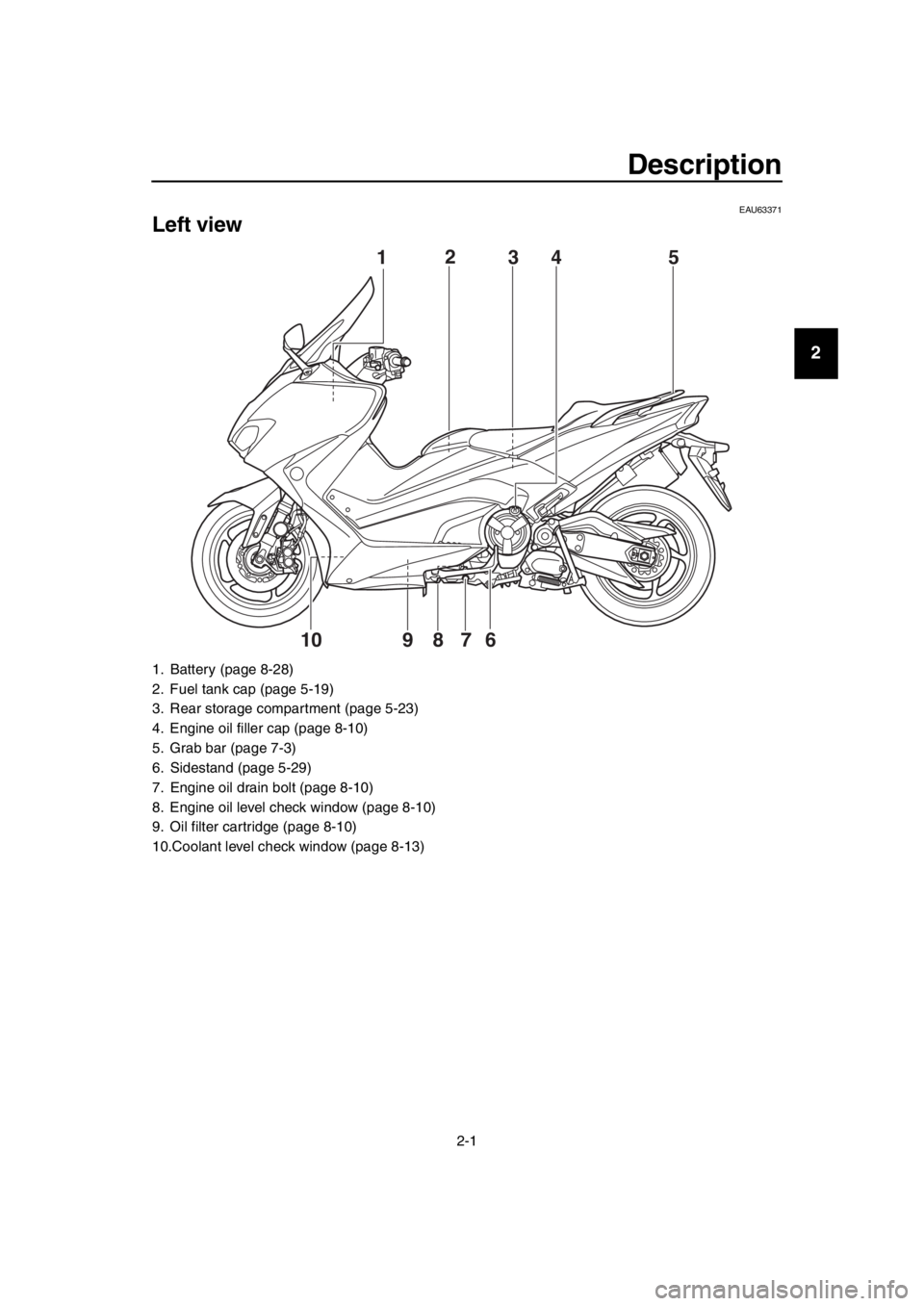
Left view
1. Battery (page 8-28)
2. Fuel tank cap (page 5-19)
3. Rear storage compartment (page 5-23)
4. Engine oil filler cap (page 8-10)
5. Grab bar (page 7-3)
6. Sidestand (page 5-29)
7. Engine oil drain bolt (page 8-10)
8. Engine oil level check window (page 8-10)
9. Oil filter cartridge (page 8-10)
10.Coolant level check window (page 8-13)
1 2
34 5
976 8
10
BV1-9-E2.book 1 ページ 2018年8月28日 火曜日 午後5時28分
Page 24 of 122
Smart key system
3-9
1
2
3
4
5
6
7
8
9
10
11
12
13
14
EAU78031
Powering off the vehicle
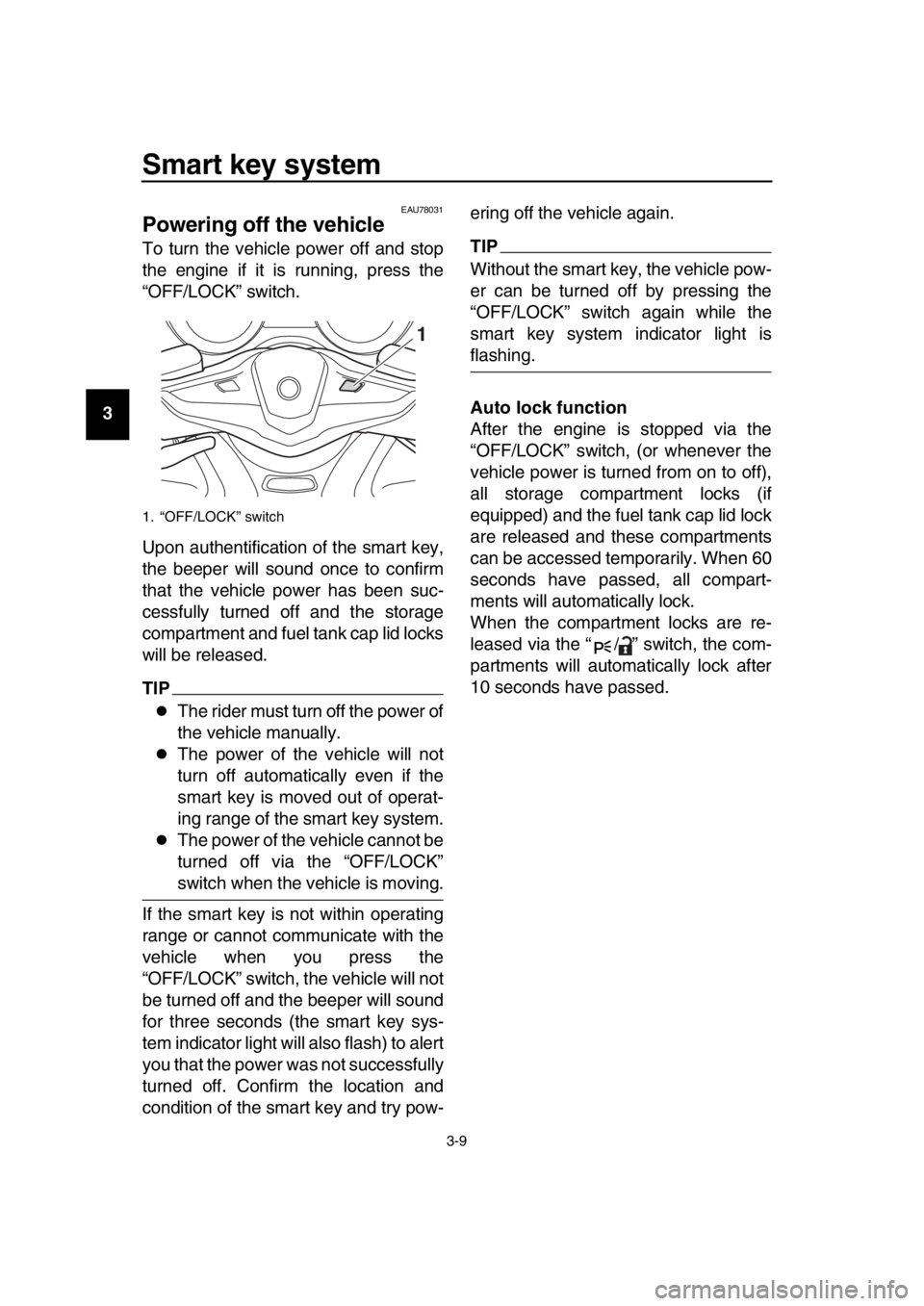
To turn the vehicle power off and stop
the engine if it is running, press the
“OFF/LOCK” switch.
Upon authentification of the smart key,
the beeper will sound once to confirm
that the vehicle power has been suc-
cessfully turned off and the storage
compartment and fuel tank cap lid locks
will be released.
TIP
The rider must turn off the power of
the vehicle manually.
The power of the vehicle will not
turn off automatically even if the
smart key is moved out of operat-
ing range of the smart key system.
The power of the vehicle cannot be
turned off via the “OFF/LOCK”
switch when the vehicle is moving.
If the smart key is not within operating
range or cannot communicate with the
vehicle when you press the
“OFF/LOCK” switch, the vehicle will not
be turned off and the beeper will sound
for three seconds (the smart key sys-
tem indicator light will also flash) to alert
you that the power was not successfully
turned off. Confirm the location and
condition of the smart key and try pow- ering off the vehicle again.
TIP
Without the smart key, the vehicle pow-
er can be turned off by pressing the
“OFF/LOCK” switch again while the
smart key system indicator light is
flashing.
Auto lock function
After the engine is stopped via the
“OFF/LOCK” switch, (or whenever the
vehicle power is turned from on to off),
all storage compartment locks (if
equipped) and the fuel tank cap lid lock
are released and these compartments
can be accessed temporarily. When 60
seconds have passed, all compart-
ments will automatically lock.
When the compartment locks are re-
leased via the “ / ” switch, the com-
partments will automatically lock after
10 seconds have passed.
1. “OFF/LOCK” switch
1
BV1-9-E2.book 9 ページ 2018年8月28日 火曜日 午後5時28分
Page 26 of 122
Smart key system
3-11
1
2
3
4
5
6
7
8
9
10
11
12
13
14
EAU81290
Storage compartment and fuel
tank access
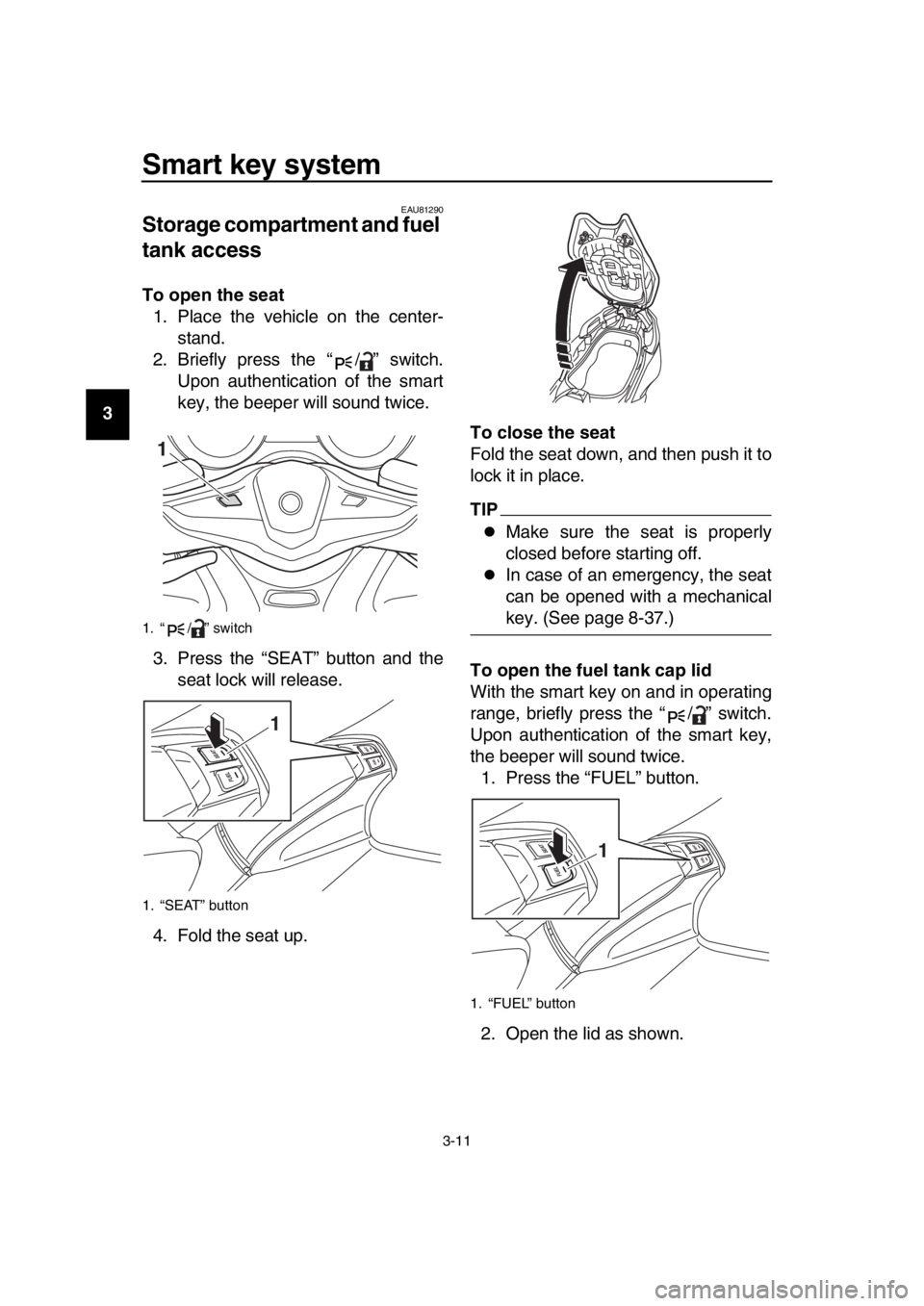
To open the seat 1. Place the vehicle on the center- stand.
2. Briefly press the “ / ” switch. Upon authentication of the smart
key, the beeper will sound twice.
3. Press the “SEAT” button and the seat lock will release.
4. Fold the seat up. To close the seat
Fold the seat down, and then push it to
lock it in place.
TIP
Make sure the seat is properly
closed before starting off.
In case of an emergency, the seat
can be opened with a mechanical
key. (See page 8-37.)
To open the fuel tank cap lid
With the smart key on and in operating
range, briefly press the “ / ” switch.
Upon authentication of the smart key,
the beeper will sound twice. 1. Press the “FUEL” button.
2. Open the lid as shown.1. “ / ” switch
1. “SEAT” button
1
1
1. “FUEL” button
1
BV1-9-E2.book 11 ページ 2018年8月28日 火曜日 午後5時28分
Page 27 of 122
Smart key system
3-12
1
2
3
4
5
6
7
8
9
10
11
12
13
14
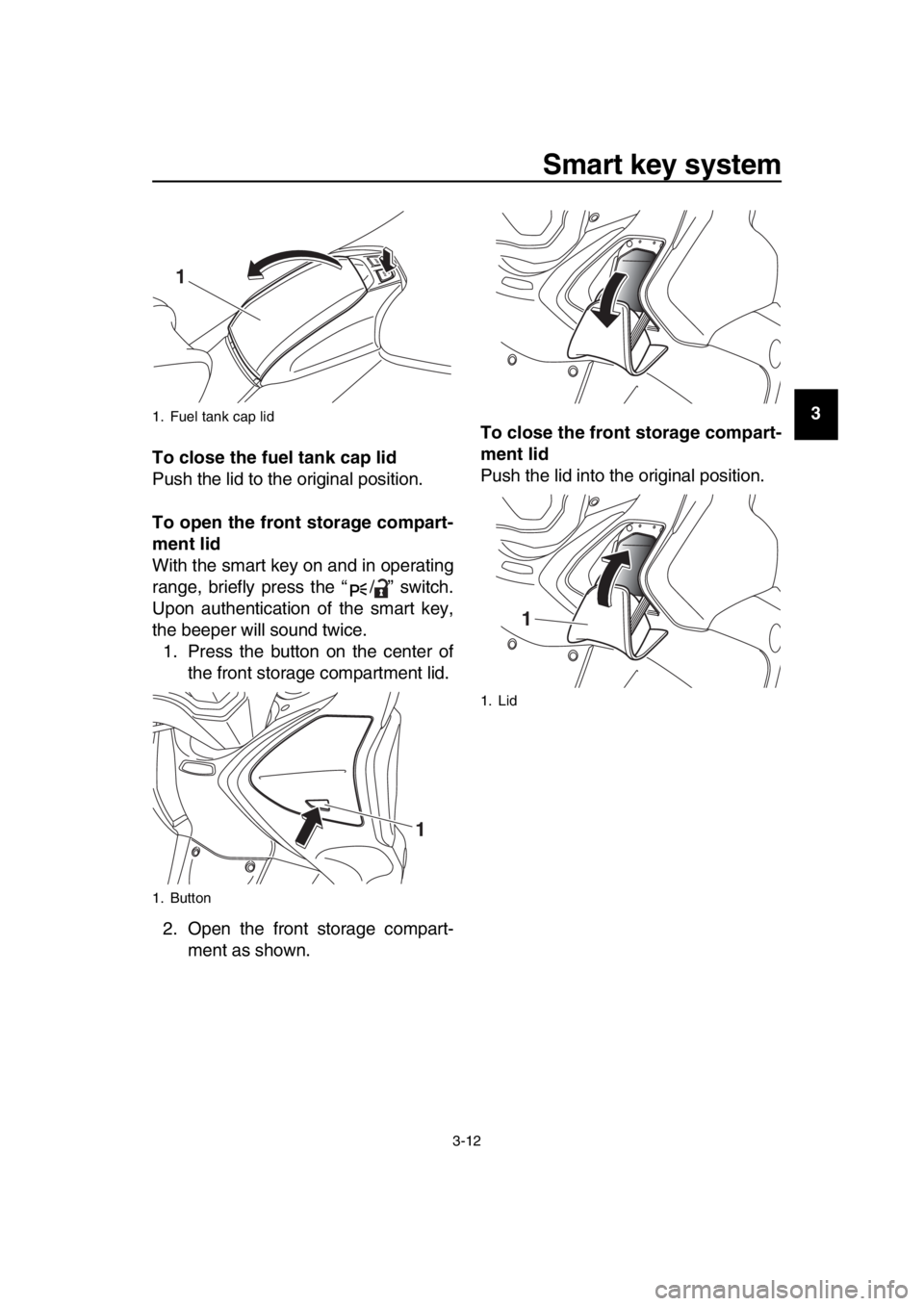
To close the fuel tank cap lid
Push the lid to the original position.
To open the front storage compart-
ment lid
With the smart key on and in operating
range, briefly press the “ / ” switch.
Upon authentication of the smart key,
the beeper will sound twice.
1. Press the button on the center of the front storage compartment lid.
2. Open the front storage compart- ment as shown. To close the front storage compart-
ment lid
Push the lid into the original position.1. Fuel tank cap lid
1. Button
1
1
1. Lid
1
BV1-9-E2.book 12 ページ 2018年8月28日 火曜日 午後5時28分
Page 28 of 122
Smart key system
3-13
1
2
3
4
5
6
7
8
9
10
11
12
13
14
EAU80841
Parking mode
The steering is locked, and the hazard
lights and turn signal lights can be
turned on, but all other electrical sys-
tems are off.
To enter parking mode 1. Lock the steering. (See page 3-10.)
2. Press the “ / ” switch for one second.
TIP
If the steering lock has not been ap-
plied, the beeper will sound for 3 sec-
onds (the smart key system indicator
light will also flash) and the vehicle will
not enter parking mode.
3. Upon authentification of the smart key, the beeper will sound twice
and the vehicle will enter parking
mode. The smart key system indi-
cator light will come on.
TIP
The seat, fuel tank cap lid, and the front
storage compartment cannot be
opened while in parking mode.
NOTICE
ECA20760
Using the hazard or turn signal
lights for an extended length of time
may cause the battery to discharge.
To exit parking mode
Press the “ / ” switch. Upon authen-
tication of the smart key, the beeper will
sound once and the smart key system
indicator light will go off.
BV1-9-E2.book 13 ページ 2018年8月28日 火曜日 午後5時28分
Page 52 of 122
Instrument and control functions
5-19
1
2
3
4
5
6
7
8
9
10
11
12
13
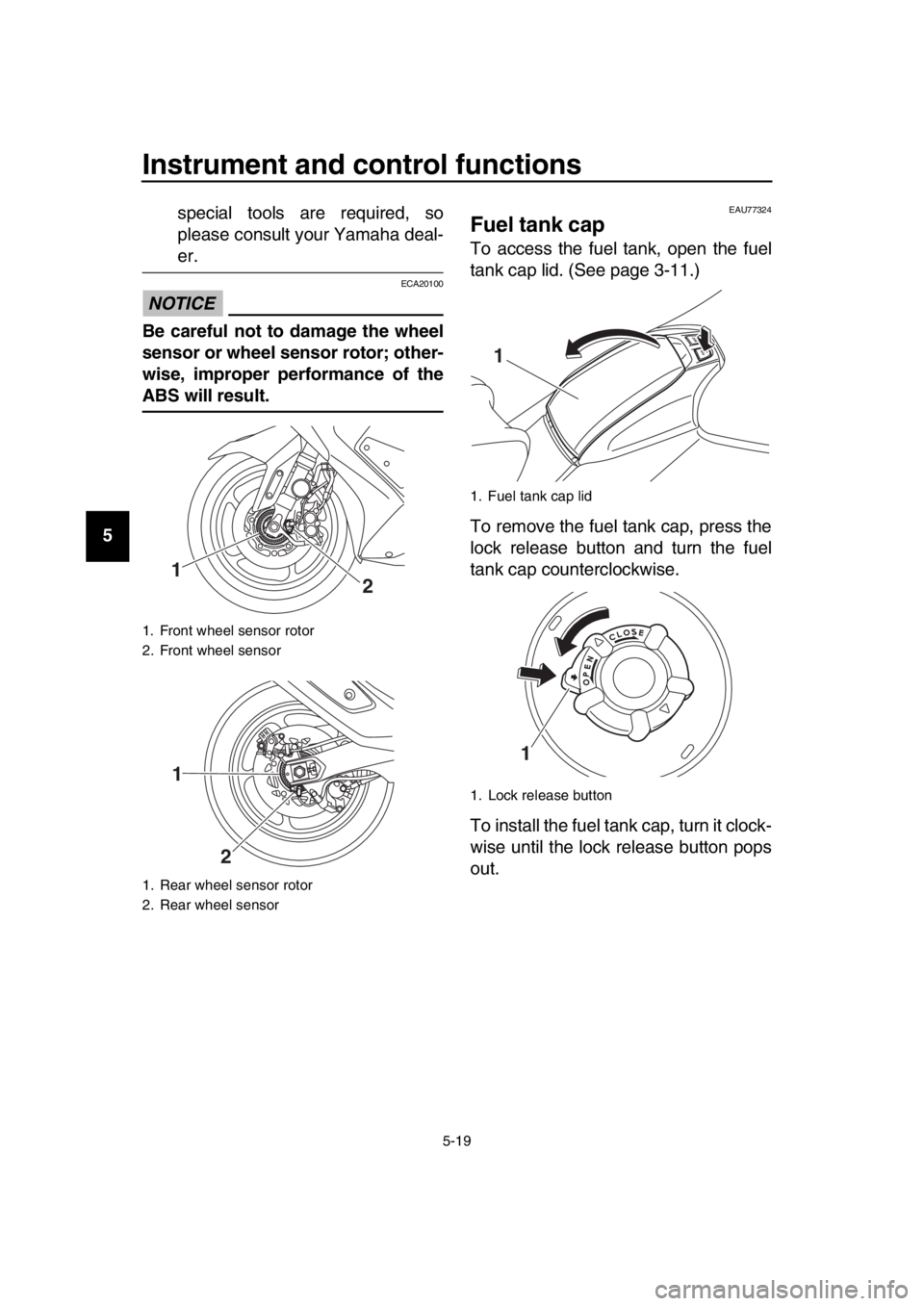
14 special tools are required, so
please consult your Yamaha deal-
er.
NOTICE
ECA20100
Be careful not to damage the wheel
sensor or wheel sensor rotor; other-
wise, improper performance of the
ABS will result.
EAU77324
Fuel tank cap
To access the fuel tank, open the fuel
tank cap lid. (See page 3-11.)
To remove the fuel tank cap, press the
lock release button and turn the fuel
tank cap counterclockwise.
To install the fuel tank cap, turn it clock-
wise until the lock release button pops
out.
1. Front wheel sensor rotor
2. Front wheel sensor
1. Rear wheel sensor rotor
2. Rear wheel sensor
1
2
1
2
1. Fuel tank cap lid
1. Lock release button
1
1
BV1-9-E2.book 19 ページ 2018年8月28日 火曜日 午後5時28分
Page 53 of 122
Instrument and control functions
5-20
1
2
3
4
5
6
7
8
9
10
11
12
13
14
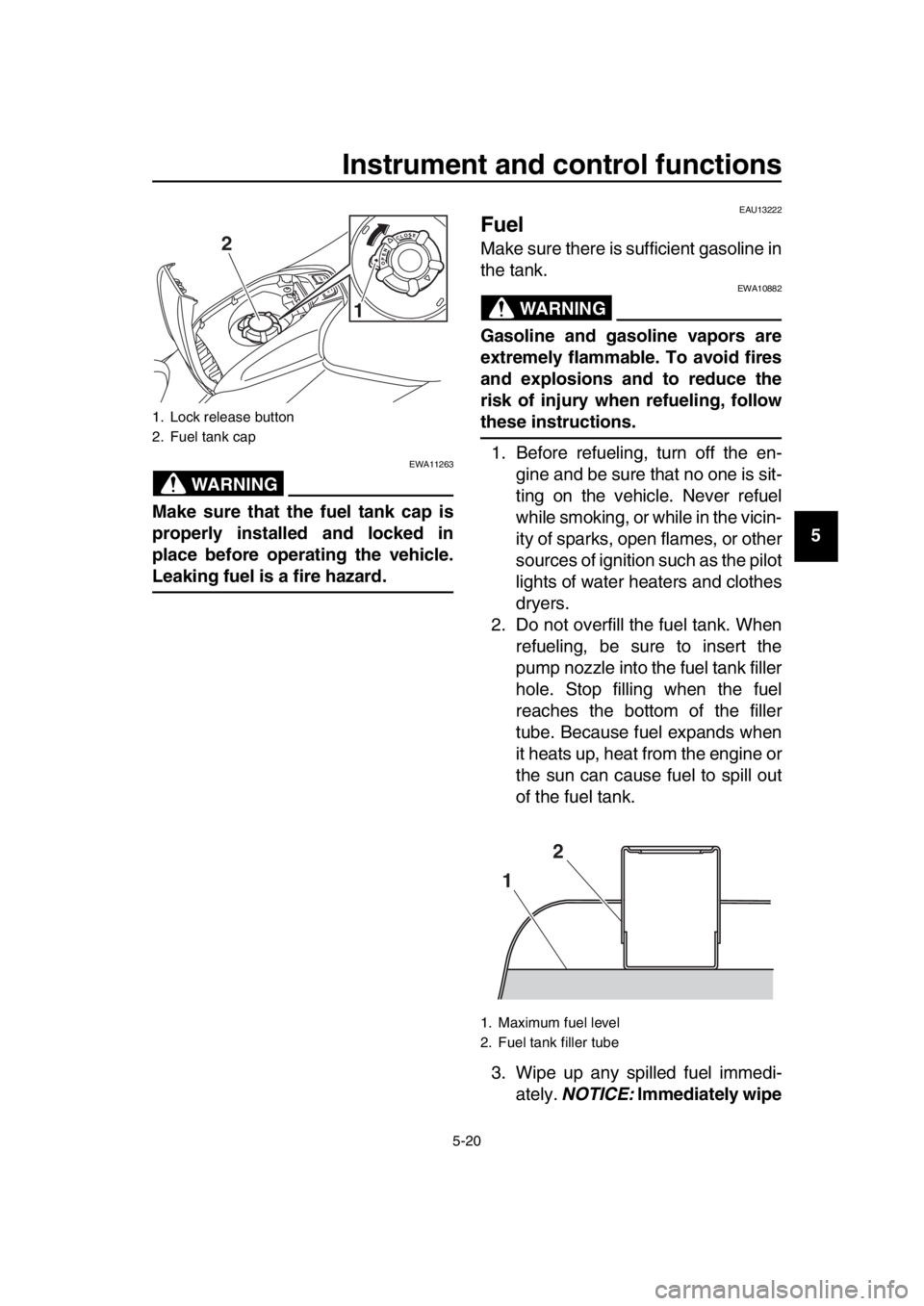
WARNING
EWA11263
Make sure that the fuel tank cap is
properly installed and locked in
place before operating the vehicle.
Leaking fuel is a fire hazard.
EAU13222
Fuel
Make sure there is sufficient gasoline in
the tank.
WARNING
EWA10882
Gasoline and gasoline vapors are
extremely flammable. To avoid fires
and explosions and to reduce the
risk of injury when refueling, follow
these instructions. 1. Before refueling, turn off the en- gine and be sure that no one is sit-
ting on the vehicle. Never refuel
while smoking, or while in the vicin-
ity of sparks, open flames, or other
sources of ignition such as the pilot
lights of water heaters and clothes
dryers.
2. Do not overfill the fuel tank. When refueling, be sure to insert the
pump nozzle into the fuel tank filler
hole. Stop filling when the fuel
reaches the bottom of the filler
tube. Because fuel expands when
it heats up, heat from the engine or
the sun can cause fuel to spill out
of the fuel tank.
3. Wipe up any spilled fuel immedi- ately. NOTICE: Immediately wipe1. Lock release button
2. Fuel tank cap
2
1
1. Maximum fuel level
2. Fuel tank filler tube
12
BV1-9-E2.book 20 ページ 2018年8月28日 火曜日 午後5時28分
Page 54 of 122
![YAMAHA TMAX 2019 Owners Manual Instrument and control functions
5-21
1
2
3
4
5
6
7
8
9
10
11
12
13
14 off spilled fuel with a clean, dry,
soft cloth, since fuel may deteri-
orate painted surfaces or plastic
parts.
[ECA10072]
4. Be](/img/51/51454/w960_51454-53.png "YAMAHA TMAX 2019 Owners Manual Instrument and control functions
5-21
1
2
3
4
5
6
7
8
9
10
11
12
13
14 off spilled fuel with a clean, dry,
soft cloth, since fuel may deteri-
orate painted surfaces or plastic
parts.
[ECA10072]
4. Be")
Instrument and control functions
5-21
1
2
3
4
5
6
7
8
9
10
11
12
13
14 off spilled fuel with a clean, dry,
soft cloth, since fuel may deteri-
orate painted surfaces or plastic
parts.
[ECA10072]
4. Be sure to securely close the fuel
tank cap.
WARNING
EWA15152
Gasoline is poisonous and can
cause injury or death. Handle gaso-
line with care. Never siphon gaso-
line by mouth. If you should swallow
some gasoline or inhale a lot of gas-
oline vapor, or get some gasoline in
your eyes, see your doctor immedi-
ately. If gasoline spills on your skin,
wash with soap and water. If gaso-
line spills on your clothing, change
your clothes.
EAU79080
NOTICE
ECA11401
Use only unleaded gasoline. The use
of leaded gasoline will cause severe
damage to internal engine parts,
such as the valves and piston rings,
as well as to the exhaust system.
TIP
This mark identifies the recom-
mended fuel for this vehicle as
specified by European regulation
(EN228).
Check that gasoline nozzle has the
same identifier when fueling.
Your Yamaha engine has been de-
signed to use regular unleaded gaso-
line with a research octane number of
95 or higher. If knocking (or pinging) oc-
curs, use a gasoline of a different
brand. Use of unleaded fuel will extend
spark plug life and reduce maintenance
costs.
Gasohol
There are two types of gasohol: gaso-
hol containing ethanol and that contain-
ing methanol. Gasohol containing
ethanol can be used if the ethanol con-
tent does not exceed 10% (E10). Gas-
ohol containing methanol is not
recommended by Yamaha because it
can cause damage to the fuel system
or vehicle performance problems.
Recommended fuel: Premium unleaded gasoline (Gaso-
hol [E10] acceptable)
Fuel tank capacity:
15 L (4.0 US gal, 3.3 Imp.gal)
Fuel reserve amount: 3.0 L (0.79 US gal, 0.66 Imp.gal)
E5E10
BV1-9-E2.book 21 ページ 2018年8月28日 火曜日 午後5時28分
Page 113 of 122
Scooter care and storage
9-4
1
2
3
4
5
6
7
8
9
10
11
12
13
14
EAU83472
Storage
Always store the vehicle in a cool, dry
place. If necessary, protect it against
dust with a porous cover. Be sure the
engine and the exhaust system are
cool before covering the vehicle. If the
vehicle often sits for weeks at a time be-
tween uses, the use of a quality fuel
stabilizer is recommended after each
fill-up.
NOTICE
ECA21170
Storing the vehicle in a poorly
ventilated room or covering it
with a tarp, while it is still wet,
will allow water and humidity to
seep in and cause rust.
To prevent corrosion, avoid
damp cellars, stables (because
of the presence of ammonia)
and areas where strong chemi-
cals are stored.
Long term storage
Before storing the vehicle long term (60
days or more): 1. Make all necessary repairs and perform any outstanding mainte-
nance.
2. Follow all instructions in the Care section of this chapter.
3. Fill up the fuel tank, adding fuel stabilizer according to product in-
structions. Run the engine for 5
minutes to distribute treated fuel
through the fuel system.
4. For vehicles equipped with a fuel cock: Turn the fuel cock lever to
the off position.
5. For vehicles with a carburetor: To prevent fuel deposits from building up, drain the fuel in the carburetor
float chamber into a clean contain-
er. Retighten the drain bolt and
pour the fuel back into the fuel
tank.
6. Use a quality engine fogging oil ac- cording to product instructions to
protect internal engine compo-
nents from corrosion. If engine fog-
ging oil is not available, perform
the following steps for each cylin-
der:
a. Remove the spark plug cap and spark plug.
b. Pour a teaspoonful of engine oil into the spark plug bore.
c. Install the spark plug cap onto the spark plug, and then place
the spark plug on the cylinder
head so that the electrodes are
grounded. (This will limit spark-
ing during the next step.)
d. Turn the engine over several times with the starter. (This will
coat the cylinder wall with oil.)
WARNING! To prevent dam-
age or injury from sparking,
make sure to ground the
spark plug electrodes while
turning the engine
over.
[EWA10952]
e. Remove the spark plug capfrom the spark plug, and then
install the spark plug and the
spark plug cap.
7. Lubricate all control cables, pivots, levers and pedals, as well as the
sidestand and centerstand (if
equipped).
8. Check and correct the tire air pres- sure, and then lift the vehicle so
that all wheels are off the ground.
BV1-9-E2.book 4 ページ 2018年8月28日 火曜日 午後5時28分