lock YAMAHA TMAX 2021 Owner's Manual
[x] Cancel search | Manufacturer: YAMAHA, Model Year: 2021, Model line: TMAX, Model: YAMAHA TMAX 2021Pages: 124, PDF Size: 7.93 MB
Page 55 of 124

Instrument and control functions
5-20
5
EAU77324
Fuel tank capTo access the fuel tank, open the fuel
tank cap lid. (See page 3-11.)
To remove the fuel tank cap, press the
lock release button and turn the fuel
tank cap counterclockwise. To install the fuel tank cap, turn it
clockwise until the lock release button
pops out.
WARNING
EWA11263
Make sure that the fuel tank cap is
properly installe
d an d locked in
place before operatin g the vehicle.
Leakin g fuel is a fire hazar d.
EAU13222
FuelMake sure there is sufficient gasoline in
the tank.
WARNING
EWA10882
Gasoline an d gasoline vapors are
extremely flammab le. To avoid fires
an d explosions an d to re duce the
risk of injury when refuelin g, follow
these instructions.1. Before refueling, turn off the en- gine and be sure that no one is sit-
ting on the vehicle. Never refuel
while smoking, or while in the vi-
cinity of sparks, open flames, or
other sources of ignition such as
the pilot lights of water heaters
and clothes dryers.
2. Do not overfill the fuel tank. When refueling, be sure to insert the
pump nozzle into the fuel tank filler
hole. Stop filling when the fuel
reaches the bottom of the filler
tube. Because fuel expands when
it heats up, heat from the engine or
the sun can cause fuel to spill out
of the fuel tank.
1. Fuel tank cap lid
1. Lock release button
2. Fuel tank cap
1
1 2
UB3TE1E0.book Page 20 Friday, September 11, 2020 8:48 AM
Page 57 of 124
Instrument and control functions
5-22
5
NOTICE
ECA11401
Use only unlea ded g asoline. The use
of lead ed g asoline will cause severe
d amag e to internal en gine parts,
such as the valves an d piston rin gs,
as well as to the exhaust system.
EAU80201
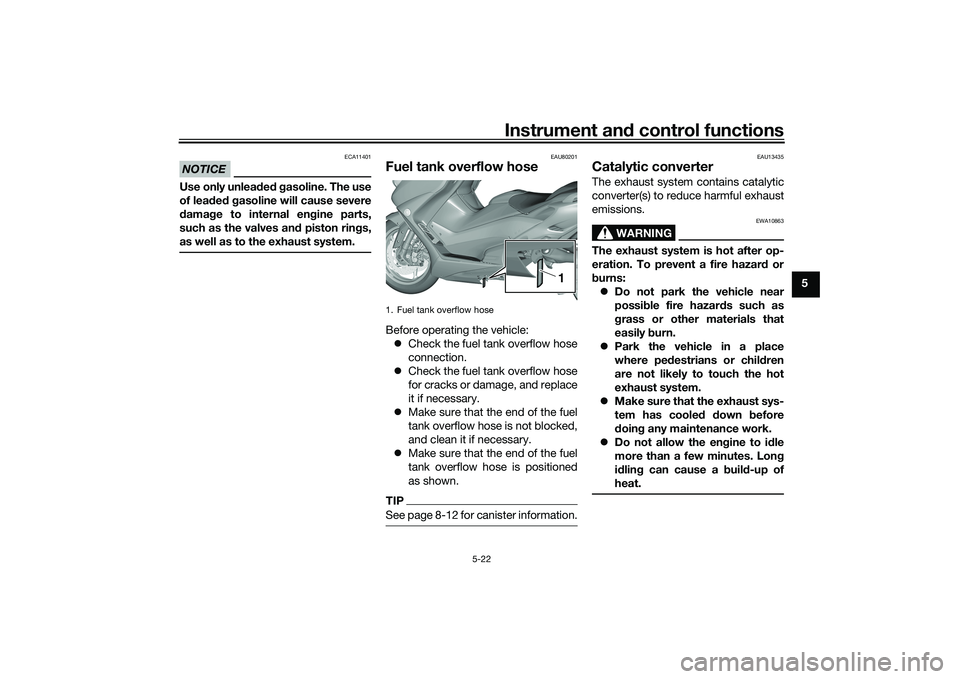
Fuel tank overflow hoseBefore operating the vehicle: Check the fuel tank overflow hose
connection.
Check the fuel tank overflow hose
for cracks or damage, and replace
it if necessary.
Make sure that the end of the fuel
tank overflow hose is not blocked,
and clean it if necessary.
Make sure that the end of the fuel
tank overflow hose is positioned
as shown.TIPSee page 8-12 for canister information.
EAU13435
Catalytic converterThe exhaust system contains catalytic
converter(s) to reduce harmful exhaust
emissions.
WARNING
EWA10863
The exhaust system is hot after op-
eration. To prevent a fire hazar d or
b urns:
Do not park the vehicle near
possi ble fire hazar ds such as
g rass or other materials that
easily burn.
Park the vehicle in a place
where pe destrians or child ren
are not likely to touch the hot
exhaust system.
Make sure that the exhaust sys-
tem has coole d down before
d oin g any maintenance work.
Do not allow the en gine to i dle
more than a few minutes. Lon g
i d lin g can cause a b uild-up of
heat.
1. Fuel tank overflow hose
1
UB3TE1E0.book Page 22 Friday, September 11, 2020 8:48 AM
Page 58 of 124

Instrument and control functions
5-23
5
EAU88752
Stora ge compartmentsFront stora ge compartment
To open the storage compartment,
press the button.
Open the lid as shown. To close the storage compartment,
push the lid into the original position.
TIPThis compartment has an electronic
lock. (See page 3-12.)Rear storag
e compartment
This storage compartment was de-
signed to hold one full-faced helmet or
two 3/4-faced helmets. NOTICE: The
shad ed area is not a storag e com-
partment. To prevent d amaging the
seat hin ges, do not place any items
in this area.
[ECA16092]
TIP Some helmets cannot be stored in
the rear storage compartment be-
cause of their size or shape.
Do not leave the vehicle unattend-
ed with the seat open.
Do not place the smart key inside
a storage compartment. It may get
locked inside and the smart key
system not operate normally.NOTICE
ECA15964
Do not leave the seat open for
an exten ded perio d of time, oth-
erwise the li ght may cause the
b attery to d ischarge.
1. Button
1. Lid
1
1
1. Lid1
1. Rear storage compartment
2. Shaded area
12
UB3TE1E0.book Page 23 Friday, September 11, 2020 8:48 AM
Page 68 of 124

Operation and important rid ing points
7-2
7
EAU88770
Startin g the eng ineThe ignition circuit cut-off system will
enable starting when the sidestand is
up.
To start the engine1. With the smart key turned on, ap-
proach the vehicle.
2. Push the “ON/ ” switch and set the engine stop switch to the run
position.
Upon authentication of the smart
key, the beeper will sound twice
and the centerstand and steering
locks (if applied) will be released.
3. Confirm the indicator and warning light(s) come on for a few sec-
onds, and the go off. (See page
5-2.)TIPDo not start the engine if the mal-
function indicator light remains on.
The ABS warning light should
come on and stay on until the ve-
hicle reaches a speed of 10 km/h
(6 mi/h).
NOTICE
ECA24110
If a warnin g or in dicator li ght does
not work as d escribed a bove, have a
Yamaha dealer check the vehicle.4. Close the throttle completely.
5. While applying the front or rear
brake, push the “ON/ ” switch.
6. Release the “ON/ ” switch when the engine starts, or after 5 sec-
onds. Wait 10 seconds before
pressing the switch again to allow
battery voltage to restore.NOTICE
ECA11043
For maximum en gine life, never ac-
celerate har d when the en gine is
col d!
EAU88780
TIPThis model is equipped with:
a lean angle sensor. This sensor
stops the engine in case of a vehi-
cle turnover. If this happens, the
malfunction indicator light will
come on, but this is not a malfunc-
tion. Turn the vehicle power off
and then back on again to cancel
the indicator light. Failing to do so
will prevent the engine from start-
ing even though the engine will
crank when pushing the start
switch.
an engine auto-stop system. The
engine stops automatically if left
idling for 20 minutes. If the engine
stops, simply push the start
switch to restart the engine.
UB3TE1E0.book Page 2 Friday, September 11, 2020 8:48 AM
Page 70 of 124

Operation and important rid ing points
7-4
7 Front
Rear
EAU16821
Tips for re
ducin g fuel con-
sumptionFuel consumption depends largely on
your riding style. Consider the follow-
ing tips to reduce fuel consumption:
Avoid high engine speeds during
acceleration.
Avoid high engine speeds with no
load on the engine.
Turn the engine off instead of let-
ting it idle for an extended length
of time (e.g., in traffic jams, at traf-
fic lights or at railroad crossings).
EAU77962
Parkin gWhen parking, turn the vehicle power
off and then turn the smart key off.
If the sidestand is lowered when the
engine is running, the engine will stop
and the beeper will sound to prevent
you from forgetting to turn off the vehi-
cle power. To stop the beeper, turn the
vehicle power off or raise the side-
stand. When leaving the vehicle, make sure
you apply the steering lock and center-
stand lock. Take the smart key with
you.
UB3TE1E0.book Page 4 Friday, September 11, 2020 8:48 AM
Page 76 of 124

Periodic maintenance an d a djustment
8-5
8
EAU71353
General maintenance an d lu brication chartNO. ITEM CHECK OR MAINTENANCE JOB ODOMETER READING
ANNUAL
CHECK
1000 km
(600 mi) 10000 km
(6000 mi) 20000 km
(12000 mi) 30000 km
(18000 mi) 40000 km
(24000 mi)
1 *Dia
gnostic system
check • Perform dynamic inspection us-
ing Yamaha diagnostic tool.
• Check the error codes. √√√√√√
2 *Air filter element • Replace. √√
3 *Air filter case check
hose • Clean.
√√√√√
4 *V-
belt case air filter
elements • Clean.
√√
• Replace. √√
5 *Front brake • Check operation, fluid level, and
for fluid leakage.
• Replace brake pads if necessary. √√√√√√
6 *Rear brake • Check operation, fluid level, and
for fluid leakage.
• Replace brake pads if necessary. √√√√√√
7 *Brake hoses • Check for cracks or damage.
√√√√√
• Replace. Every 4 years
8 *Brake flui d • Change. Every 2 years
9 Rear
brake lock ca-
b le • Check cable length.
• Adjust if necessary. At the initial interval and 4000 km (2400 mi) after the initial 1000 km (600 mi)
and every 5000 km (3000 mi) thereafter.
10 *Rear brake lock • Check operation.
•Adjust. √√√√√√
11 *Wheels • Check runout and for damage.
• Replace if necessary. √√√√
UB3TE1E0.book Page 5 Friday, September 11, 2020 8:48 AM
Page 83 of 124

Periodic maintenance an d a djustment
8-12
8
TIPIf a torque wrench is not available
when installing a spark plug, a good
estimate of the correct torque is 1/4–
1/2 turn past finger tight. However, the
spark plug should be tightened to the
specified torque as soon as possible.
EAU36112
CanisterThis model is equipped with a canister
to prevent the discharging of fuel vapor
into the atmosphere. Before operating
this vehicle, make sure to check the
following:
Check each hose connection.
Check each hose and canister for
cracks or damage. Replace if
damaged.
Make sure that the canister
breather is not blocked, and if
necessary, clean it.
EAU77364
Engine oil an d oil filter car-
tri dgeThe engine oil level should be checked
before each ride. In addition, the oil
must be changed and the oil filter car-
tridge replaced at the intervals speci-
fied in the periodic maintenance and
lubrication chart.
To check the en gine oil level
1. Place the vehicle on the center- stand. A slight tilt to the side can
result in a false reading.
2. Start the engine, warm it up for two minutes, and then turn it off.
3. Wait two minutes until the oil level settles.
4. Check the oil level through the check window located at the bot-
tom-left side of the crankcase.TIPThe engine oil should be between the
minimum and maximum level marks.
1. Canister
2. Canister breather
12
UB3TE1E0.book Page 12 Friday, September 11, 2020 8:48 AM
Page 92 of 124
Periodic maintenance an d a djustment
8-21
8 ageing. Old and aged tires shall be
checked by tire specialists to ascertain
their suitability for further use.
WARNING
EWA16101
The front an d rear tires shoul d
b e of the same make an d d e-
si gn, otherwise the han dlin g
characteristics of the vehicle
may be different, which coul d
lea d to an acci dent.
Always make sure that the valve
caps are securely installed to
prevent air pressure leakag e.
Use only the tire valves an d
valve cores listed below to
avoi d tire d eflation durin g a ri de.After extensive tests, only the tires list-
ed below have been approved for this
model by Yamaha.
EAU51921
Cast wheelsTo maximize the performance, durabil-
ity, and safe operation of your vehicle,
note the following points regarding the
specified wheels.
The wheel rims should be
checked for cracks, bends, warp-
age or other damage before each
ride. If any damage is found, have
a Yamaha dealer replace the
wheel. Do not attempt even the
smallest repair to the wheel. A de-
formed or cracked wheel must be
replaced.
The wheel should be balanced
whenever either the tire or wheel
has been changed or replaced. An
unbalanced wheel can result in
poor performance, adverse han-
dling characteristics, and a short-
ened tire life.
After repairing or replacing the
front tire, tighten the valve stem
nut and locknut to the specified
torques.
Front tire:
Size:
120/70R15M/C 56H
Manufacturer/model:
BRIDGESTONE/BATTLAX SCF
Tire air valve: PVR59A
Valve core: #9100 (original)
Rear tire:
Size:160/60R15M/C 67H
Manufacturer/model:
BRIDGESTONE/BATTLAX SCR
Tire air valve: TR412
Valve core: #9100 (original)
UB3TE1E0.book Page 21 Friday, September 11, 2020 8:48 AM
Page 93 of 124

Periodic maintenance an d a djustment
8-22
8
EAU50861
Checkin g the front an d rear
b rake lever free playFront
Rear There should be no free play at the
brake lever ends. If there is free play,
have a Yamaha dealer inspect the
brake system.
WARNING
EWA14212
A soft or spon
gy feelin g in the b rake
lever can in dicate the presence of
air in the hy draulic system. If there is
air in the hy draulic system, have a
Yamaha dealer blee d the system be-
fore operatin g the vehicle. Air in the
hy draulic system will diminish the
b rakin g performance, which may re-
sult in loss of control an d an acci-
d ent.
1. Valve stem nut
2. Valve stem locknutTi ghtenin g torques:
Valve stem nut: 2.0 N·m (0.20 kgf·m, 1.5 lb·ft)
Valve stem locknut:
3.0 N·m (0.30 kgf·m, 2.2 lb·ft)
1
2
1. No brake lever free play
1. No brake lever free play
1
1
UB3TE1E0.book Page 22 Friday, September 11, 2020 8:48 AM
Page 94 of 124

Periodic maintenance an d a djustment
8-23
8
EAU53033
A djustin g the rear brake lock
ca blePeriodically check the rear brake lock
cable length and adjust if necessary.
1. Release the rear brake lock lever.
2. To increase the rear brake lock ca- ble length, turn the adjusting nut at
the rear brake caliper in direction
(a). To decrease the rear brake
lock cable length, turn the adjust-
ing nut in direction (b). 3. Confirm that the rear brake lock
lever (page 5-18) functions prop-
erly and that the rear wheel rotates
freely when unlocked.
WARNING
EWA20290
If proper a djustment cannot be o b-
taine d as d escri bed , have a Yamaha
d ealer make this ad justment.
EAU52293
Checking the rear brake lockThe rear brake lock must be checked
at the intervals specified in the periodic
maintenance and lubrication chart.
1. Adjust the rear brake lock cable.
2. Apply the rear brake lock, and then try to push the vehicle to con-
firm that the rear brake lock func-
tions properly.
3. The rear brake lock caliper is pro- vided with a wear indicator, which
allows you to check the rear brake
lock pads. To check the rear brake
lock pads, check the position of
the indicator when the rear brake
lock lever is applied. If the indica-
tor has passed the wear indicator
groove, have a Yamaha dealer
check the rear brake lock.
4. Make sure that there are no tears or cracks on the rubber boot.
1. Adjusting nut
2. Rear brake lock cable lengthRear brake lock cab le length:
43–45 mm (1.69–1.77 in)
1
2
(b)
(a)
UB3TE1E0.book Page 23 Friday, September 11, 2020 8:48 AM