ECU YAMAHA VX 2021 User Guide
[x] Cancel search | Manufacturer: YAMAHA, Model Year: 2021, Model line: VX, Model: YAMAHA VX 2021Pages: 123, PDF Size: 5.72 MB
Page 69 of 123

Equipment operation
60
(2) Push the latch forward, and then lift upthe lid and remove it. To close the seat storage compartment:
(1) Insert the projections on the lid into the
slots on the seat storage compartment.
(2) Push the rear of the lid down.
(3) Securely install the rear seat in its original position.
EJU46030Fire extinguisher holder and cover
The fire extinguisher holder and cover are lo-
cated in the bow storage compartment.
1Lid
2 Latch
1 Seat storage compartment
Seat storage compartment:
Capacity:5.4 L (1.4 US gal, 1.2 Imp.gal)
Load limit:
3.0 kg (7 lb)
2
1
1
UF4N70E0.book Page 60 Tuesday, October 6, 2020 5:13 PM
Page 70 of 123
Equipment operation
61
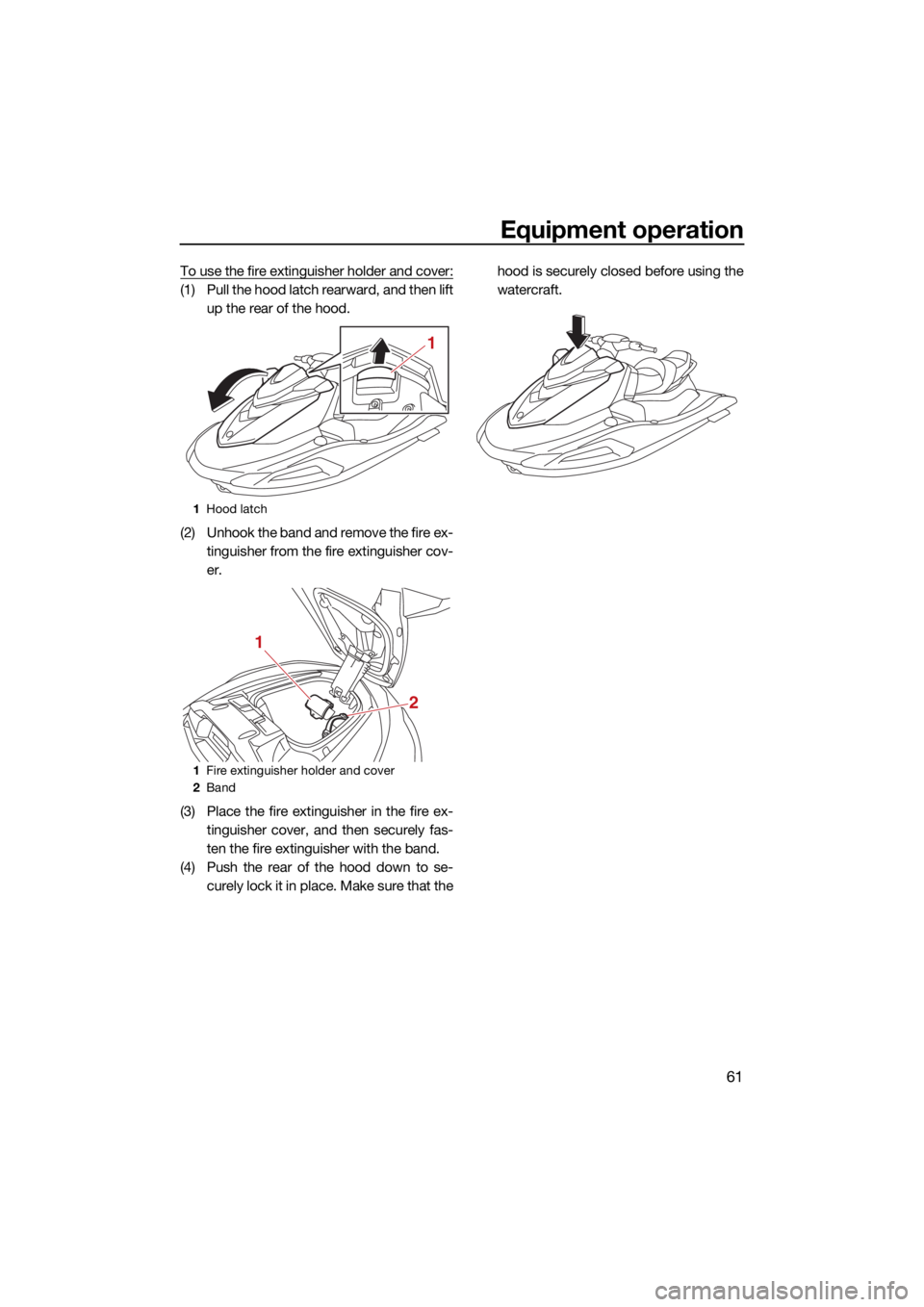
To use the fire extinguisher holder and cover:
(1) Pull the hood latch rearward, and then liftup the rear of the hood.
(2) Unhook the band and remove the fire ex- tinguisher from the fire extinguisher cov-
er.
(3) Place the fire extinguisher in the fire ex- tinguisher cover, and then securely fas-
ten the fire extinguisher with the band.
(4) Push the rear of the hood down to se- curely lock it in place. Make sure that the hood is securely closed before using the
watercraft.
1
Hood latch
1 Fire extinguisher holder and cover
2 Band
1
2
1
UF4N70E0.book Page 61 Tuesday, October 6, 2020 5:13 PM
Page 72 of 123
Operation and handling requirements
63
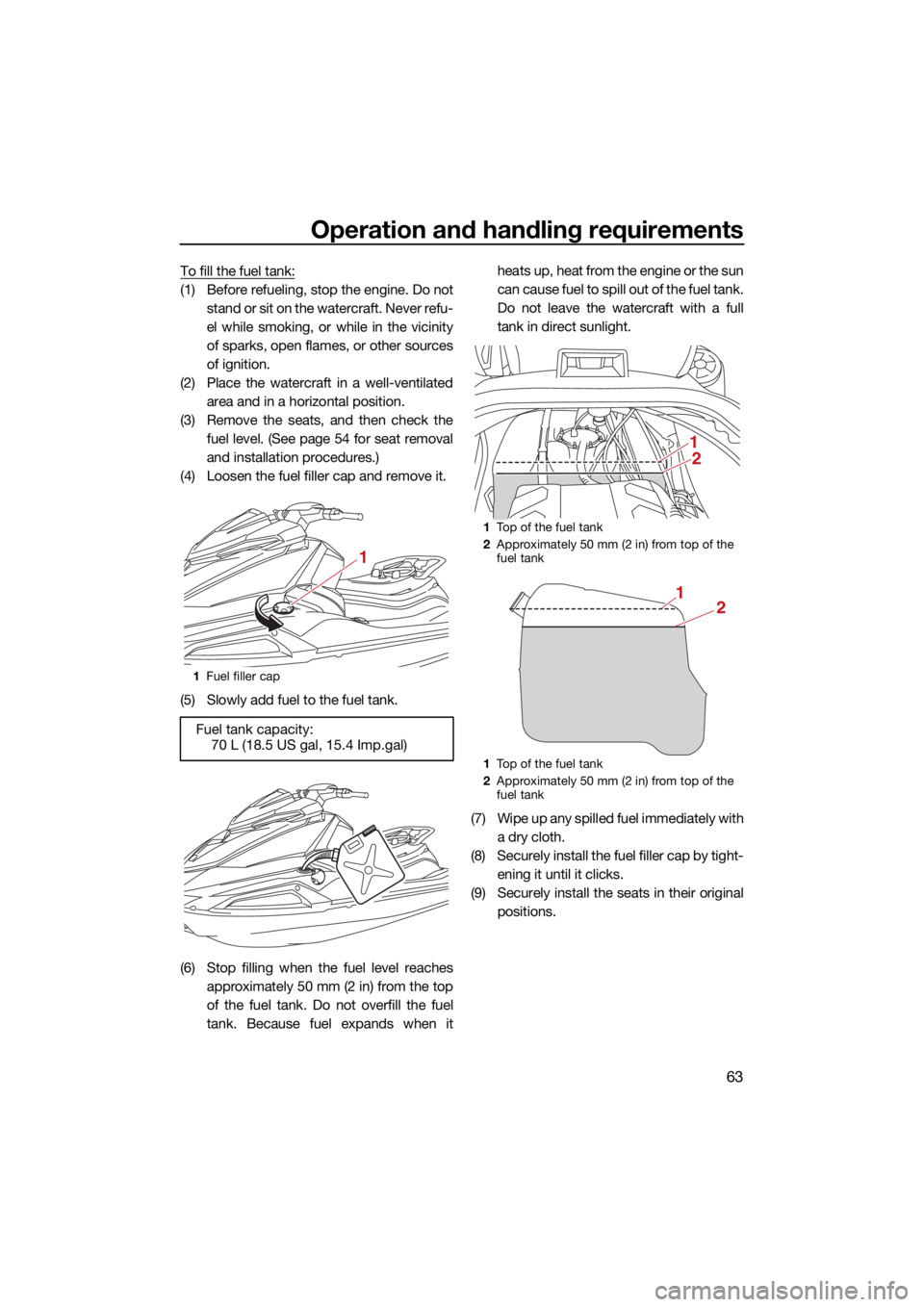
To fill the fuel tank:
(1) Before refueling, stop the engine. Do notstand or sit on the watercraft. Never refu-
el while smoking, or while in the vicinity
of sparks, open flames, or other sources
of ignition.
(2) Place the watercraft in a well-ventilated area and in a horizontal position.
(3) Remove the seats, and then check the fuel level. (See page 54 for seat removal
and installation procedures.)
(4) Loosen the fuel filler cap and remove it.
(5) Slowly add fuel to the fuel tank.
(6) Stop filling when the fuel level reaches approximately 50 mm (2 in) from the top
of the fuel tank. Do not overfill the fuel
tank. Because fuel expands when it heats up, heat from the engine or the sun
can cause fuel to spill out of the fuel tank.
Do not leave the watercraft with a full
tank in direct sunlight.
(7) Wipe up any spilled fuel immediately with a dry cloth.
(8) Securely install the fuel filler cap by tight- ening it until it clicks.
(9) Securely install the seats in their original positions.
1Fuel filler cap
Fuel tank capacity:
70 L (18.5 US gal, 15.4 Imp.gal)
1
1Top of the fuel tank
2 Approximately 50 mm (2 in) from top of the
fuel tank
1 Top of the fuel tank
2 Approximately 50 mm (2 in) from top of the
fuel tank
1
2
21
UF4N70E0.book Page 63 Tuesday, October 6, 2020 5:13 PM
Page 74 of 123
Operation and handling requirements
65
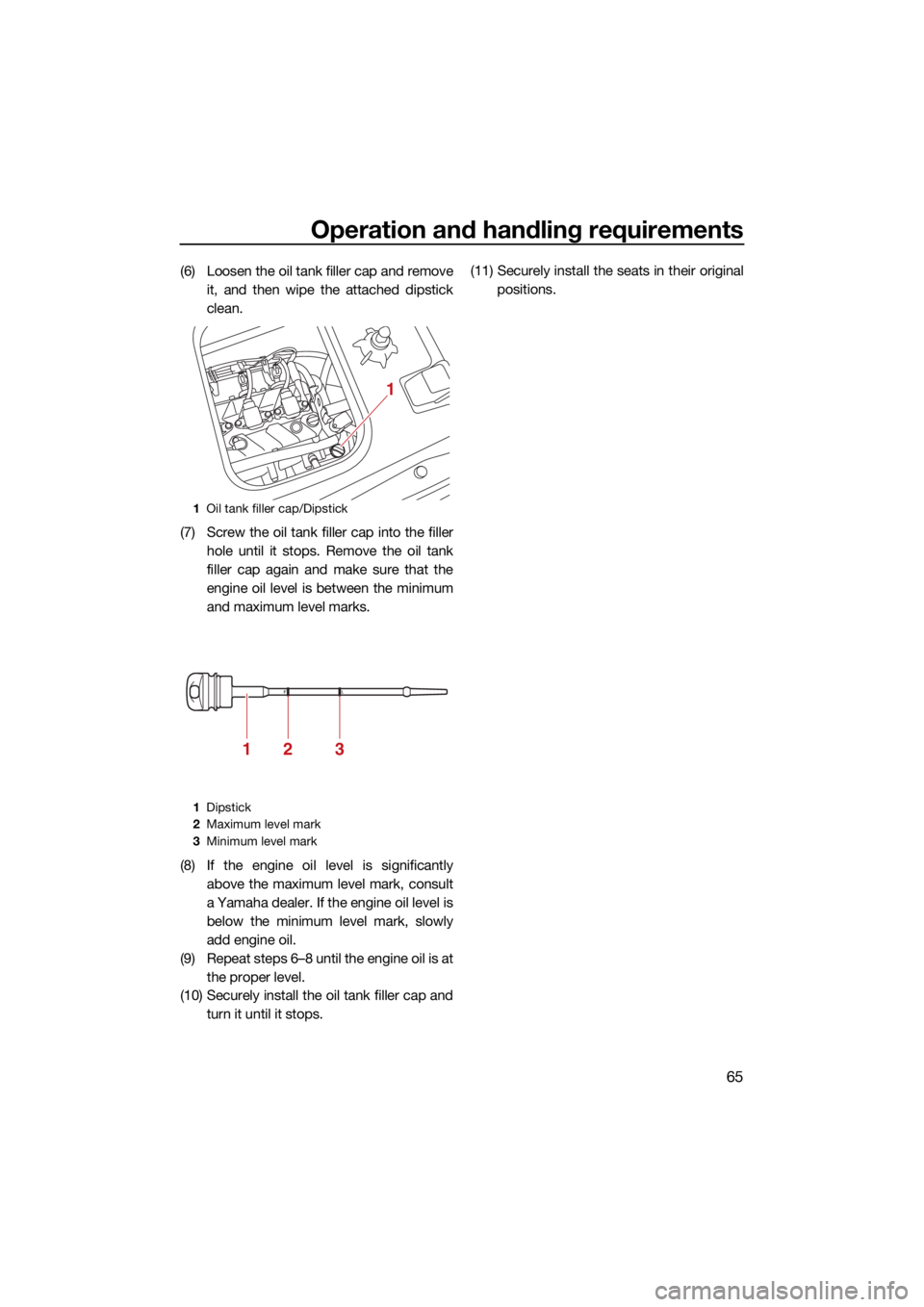
(6) Loosen the oil tank filler cap and removeit, and then wipe the attached dipstick
clean.
(7) Screw the oil tank filler cap into the filler hole until it stops. Remove the oil tank
filler cap again and make sure that the
engine oil level is between the minimum
and maximum level marks.
(8) If the engine oil level is significantly above the maximum level mark, consult
a Yamaha dealer. If the engine oil level is
below the minimum level mark, slowly
add engine oil.
(9) Repeat steps 6–8 until the engine oil is at the proper level.
(10) Securely install the oil tank filler cap and turn it until it stops. (11) Securely install the seats in their original
positions.
1Oil tank filler cap/Dipstick
1 Dipstick
2 Maximum level mark
3 Minimum level mark
1
213
UF4N70E0.book Page 65 Tuesday, October 6, 2020 5:13 PM
Page 75 of 123
Operation and handling requirements
66
EJU40022
Draining the bilge waterECJ01302
Do not run the engine at full throttle when
bilge water remains in the engine com-
partment. The bilge water can splash into
the engine, which can result in severe
damage.
EJU44260Draining the bilge water on land
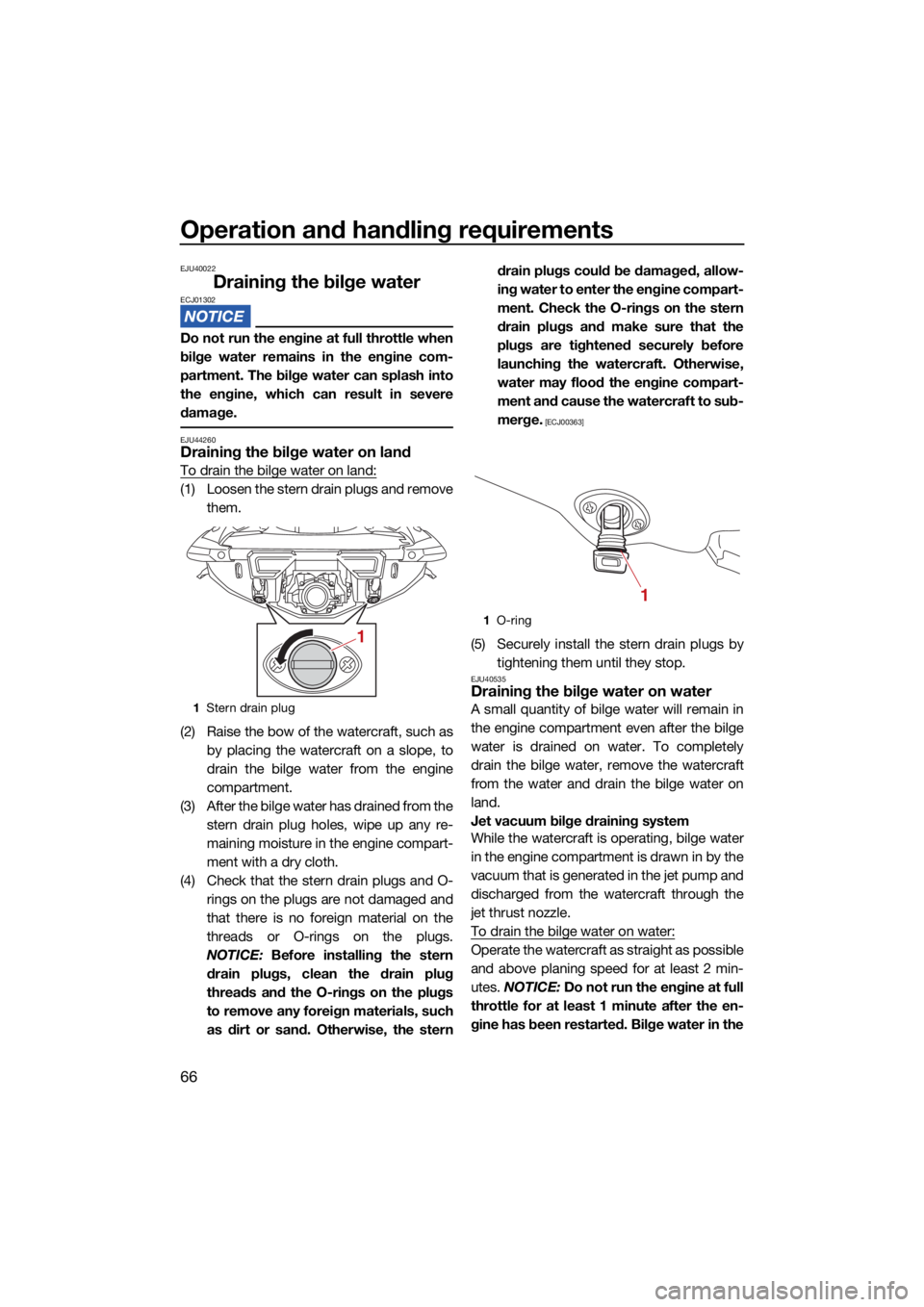
To drain the bilge water on land:
(1) Loosen the stern drain plugs and removethem.
(2) Raise the bow of the watercraft, such as by placing the watercraft on a slope, to
drain the bilge water from the engine
compartment.
(3) After the bilge water has drained from the stern drain plug holes, wipe up any re-
maining moisture in the engine compart-
ment with a dry cloth.
(4) Check that the stern drain plugs and O- rings on the plugs are not damaged and
that there is no foreign material on the
threads or O-rings on the plugs.
NOTICE: Before installing the stern
drain plugs, clean the drain plug
threads and the O-rings on the plugs
to remove any foreign materials, such
as dirt or sand. Otherwise, the stern drain plugs could be damaged, allow-
ing water to enter the engine compart-
ment. Check the O-rings on the stern
drain plugs and make sure that the
plugs are tightened securely before
launching the watercraft. Otherwise,
water may flood the engine compart-
ment and cause the watercraft to sub-
merge.
[ECJ00363]
(5) Securely install the stern drain plugs by
tightening them until they stop.
EJU40535Draining the bilge water on water
A small quantity of bilge water will remain in
the engine compartment even after the bilge
water is drained on water. To completely
drain the bilge water, remove the watercraft
from the water and drain the bilge water on
land.
Jet vacuum bilge draining system
While the watercraft is operating, bilge water
in the engine compartment is drawn in by the
vacuum that is generated in the jet pump and
discharged from the watercraft through the
jet thrust nozzle.
To drain the bilge water on water:
Operate the watercraft as straight as possible
and above planing speed for at least 2 min-
utes. NOTICE: Do not run the engine at full
throttle for at least 1 minute after the en-
gine has been restarted. Bilge water in the
1 Stern drain plug
1
1O-ring
1
UF4N70E0.book Page 66 Tuesday, October 6, 2020 5:13 PM
Page 76 of 123
![YAMAHA VX 2021 User Guide Operation and handling requirements
67
engine compartment can splash into the
engine, which can result in severe dam-
age.
[ECJ00554]EJU42432
Transporting on a trailer
When transporting the watercraf](/img/51/52046/w960_52046-75.png "YAMAHA VX 2021 User Guide Operation and handling requirements
67
engine compartment can splash into the
engine, which can result in severe dam-
age.
[ECJ00554]EJU42432
Transporting on a trailer
When transporting the watercraf")
Operation and handling requirements
67
engine compartment can splash into the
engine, which can result in severe dam-
age.
[ECJ00554]EJU42432
Transporting on a trailer
When transporting the watercraft on a trailer,
secure the tie downs to the trailer through the
bow eye and stern eyes.
NOTICE: Do not at-
tach ropes or tie downs to any part of the
watercraft other than the bow eye and
stern eyes to secure the watercraft to the
trailer. Otherwise, the watercraft may be
damaged. Wrap the ropes or tie downs
with towels or rags where they touch the
body of the watercraft to avoid scratches
or damage.
[ECJ02150]
UF4N70E0.book Page 67 Tuesday, October 6, 2020 5:13 PM
Page 78 of 123

Pre-operation checks
69
EJU31982
EWJ00412
Failure to inspect or maintain the watercraft properly increases the possibility of an ac-
cident or damage to the watercraft. Do not operate the watercraft if you find any prob-
lem. If a problem cannot be corrected by the procedures provided in this manual, have
the watercraft inspected by a Yamaha dealer.
EJU41235Pre-operation checklist
Before using this watercraft, be sure to perform the checks in the following checklist.
ITEMROUTINEPAGE
PRE-LAUNCH CHECKS
Engine compartment Ventilate the engine compartment.
Check inside the engine compartment for damage.
71
Fuel system Check the fuel system for leakage.
Check the fuel level in the fuel tank.
71
Water separator Check the water separator for water. 71
Engine unit Check the exterior of the engine unit for damage. 72
Engine oil level Check the engine oil level. 72
Bilge water Check the engine compartment for bilge water. 72
Battery Check the battery connections. 72
Steering system Check the steering system for proper operation. 72
RiDE lever (VX /
VX DELUXE /
VX CRUISER / VX LIMITED) Check the RiDE lever for proper operation.
73
Throttle lever Check the throttle lever for proper operation. 73
Yamaha Security System
(VX DELUXE /
VX CRUISER / VX LIMITED) Check the Yamaha Security System for proper op-
eration.
73
Engine shut-off cord (lan-
yard) Check the engine shut-off cord (lanyard) for dam-
age.
73
Switches VX-C:
Check the start switch, engine stop switch, and en-
gine shut-off switch for proper operation.
VX / VX DELUXE / VX CRUISER / VX LIMITED:
Check the engine start/stop switch and engine
shut-off switch for proper operation.
74
Storage compartments Check the storage compartments for damage and
water.
75
Fire extinguisher holder,
cover, and band Check the fire extinguisher holder, cover, and band
for damage.
75
Fire extinguisher Check the condition of the fire extinguisher. 75
Safety equipment Check that safety equipment meeting the applica-
ble regulations is on board.
75
UF4N70E0.book Page 69 Tuesday, October 6, 2020 5:13 PM
Page 79 of 123

Pre-operation checks
70
TIP:
To ensure safety and reliability, pre-operation checks should be made each time the water-
craft is used.
Hull and deck Check the hull and deck for damage. 75
Jet intake Check the jet intake for damage and clogging. 75
Jet thrust nozzle and re-
verse gate (VX /
VX DELUXE /
VX CRUISER / VX LIMITED) Check the jet thrust nozzle and reverse gate for
damage.
76
Stern drain plugs Check the stern drain plugs for damage and foreign
material and check that they are securely installed.
76
Hood Check that the hood is securely closed. 76
Front and rear seats Check that the seats are securely installed. 54
POST-LAUNCH CHECKS
Cooling water pilot outlet Check that water is discharged from the cooling
water pilot outlet while the engine is running.
77
Multifunction information
center Check the multifunction information center for prop-
er operation.
77
Shift system (VX /
VX DELUXE /
VX CRUISER / VX LIMITED) Check the shift system for proper operation.
77
Engine idling speed Check the engine idling speed. 77
ITEM
ROUTINEPAGE
UF4N70E0.book Page 70 Tuesday, October 6, 2020 5:13 PM
Page 80 of 123
Pre-operation checks
71
EJU32282
Pre-operation check pointsEJU40099Pre-launch checks
Perform the pre-launch checks in the pre-op-
eration checklist while the watercraft is on
land.
To perform the pre-launch checks:
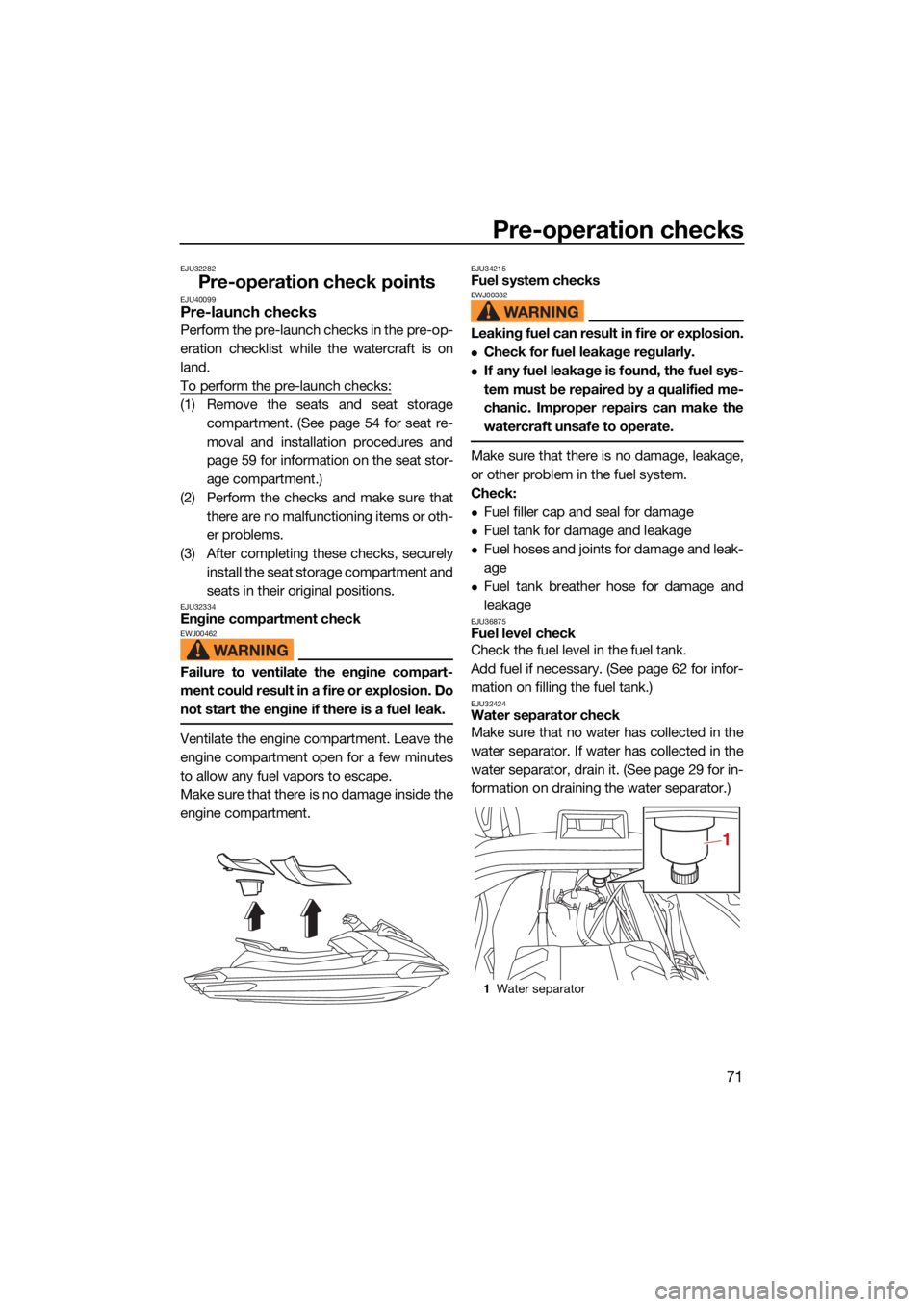
(1) Remove the seats and seat storagecompartment. (See page 54 for seat re-
moval and installation procedures and
page 59 for information on the seat stor-
age compartment.)
(2) Perform the checks and make sure that there are no malfunctioning items or oth-
er problems.
(3) After completing these checks, securely install the seat storage compartment and
seats in their original positions.
EJU32334Engine compartment checkEWJ00462
Failure to ventilate the engine compart-
ment could result in a fire or explosion. Do
not start the engine if there is a fuel leak.
Ventilate the engine compartment. Leave the
engine compartment open for a few minutes
to allow any fuel vapors to escape.
Make sure that there is no damage inside the
engine compartment.
EJU34215Fuel system checksEWJ00382
Leaking fuel can result in fire or explosion.
Check for fuel leakage regularly.
If any fuel leakage is found, the fuel sys-
tem must be repaired by a qualified me-
chanic. Improper repairs can make the
watercraft unsafe to operate.
Make sure that there is no damage, leakage,
or other problem in the fuel system.
Check:
Fuel filler cap and seal for damage
Fuel tank for damage and leakage
Fuel hoses and joints for damage and leak-
age
Fuel tank breather hose for damage and
leakage
EJU36875Fuel level check
Check the fuel level in the fuel tank.
Add fuel if necessary. (See page 62 for infor-
mation on filling the fuel tank.)
EJU32424Water separator check
Make sure that no water has collected in the
water separator. If water has collected in the
water separator, drain it. (See page 29 for in-
formation on draining the water separator.)
1Water separator
1
UF4N70E0.book Page 71 Tuesday, October 6, 2020 5:13 PM
Page 81 of 123
Pre-operation checks
72
EJU40182Engine unit check
Check the exterior of the engine unit for dam-
age or other problem.
EJU41561Engine oil level check
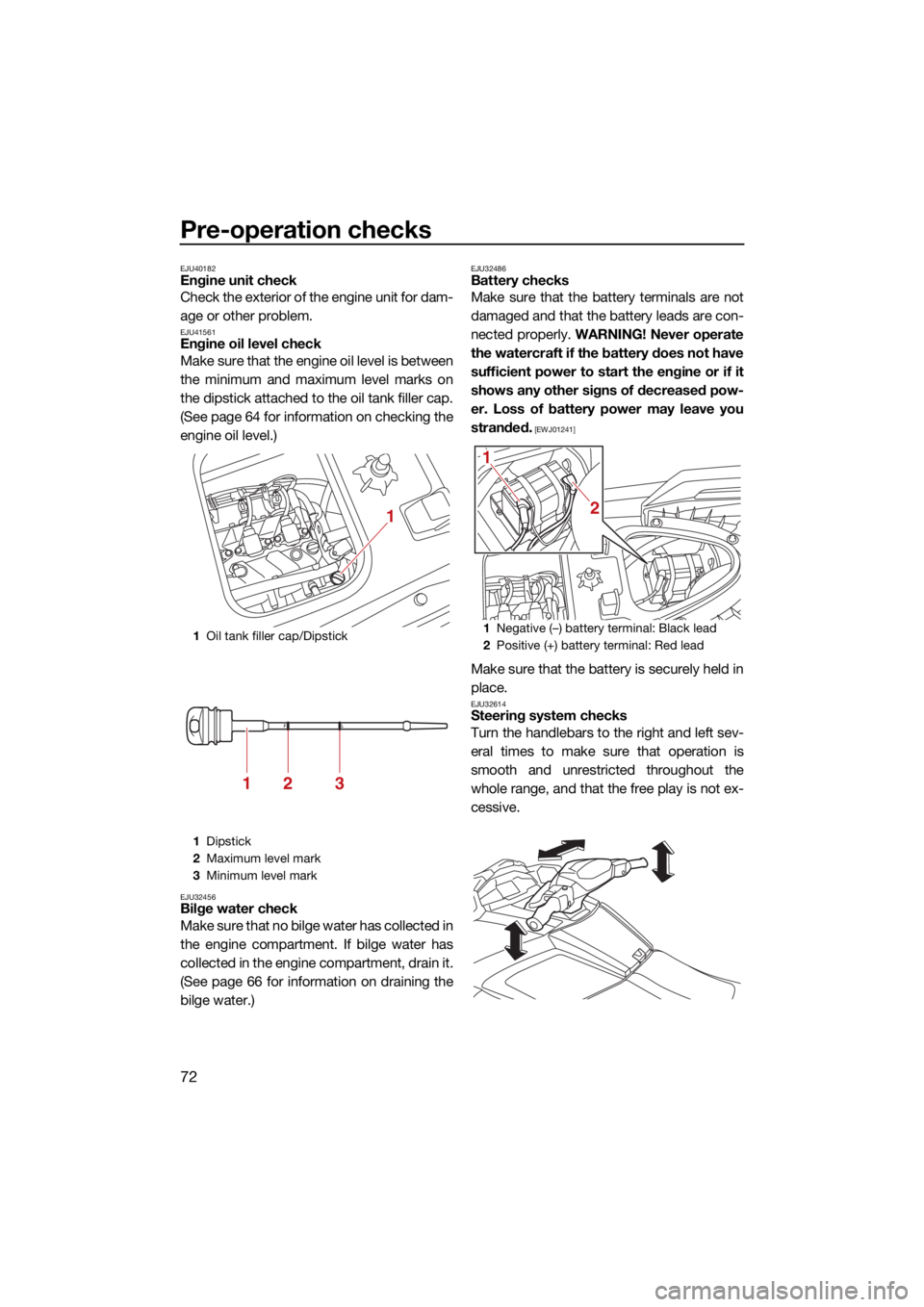
Make sure that the engine oil level is between
the minimum and maximum level marks on
the dipstick attached to the oil tank filler cap.
(See page 64 for information on checking the
engine oil level.)
EJU32456Bilge water check
Make sure that no bilge water has collected in
the engine compartment. If bilge water has
collected in the engine compartment, drain it.
(See page 66 for information on draining the
bilge water.)
EJU32486Battery checks
Make sure that the battery terminals are not
damaged and that the battery leads are con-
nected properly. WARNING! Never operate
the watercraft if the battery does not have
sufficient power to start the engine or if it
shows any other signs of decreased pow-
er. Loss of battery power may leave you
stranded.
[EWJ01241]
Make sure that the battery is securely held in
place.
EJU32614Steering system checks
Turn the handlebars to the right and left sev-
eral times to make sure that operation is
smooth and unrestricted throughout the
whole range, and that the free play is not ex-
cessive.
1 Oil tank filler cap/Dipstick
1 Dipstick
2 Maximum level mark
3 Minimum level mark
1
213
1Negative (–) battery terminal: Black lead
2 Positive (+) battery terminal: Red lead
2
1
UF4N70E0.book Page 72 Tuesday, October 6, 2020 5:13 PM