battery YAMAHA VX 2021 User Guide
[x] Cancel search | Manufacturer: YAMAHA, Model Year: 2021, Model line: VX, Model: YAMAHA VX 2021Pages: 123, PDF Size: 5.72 MB
Page 102 of 123
Care and storage
93
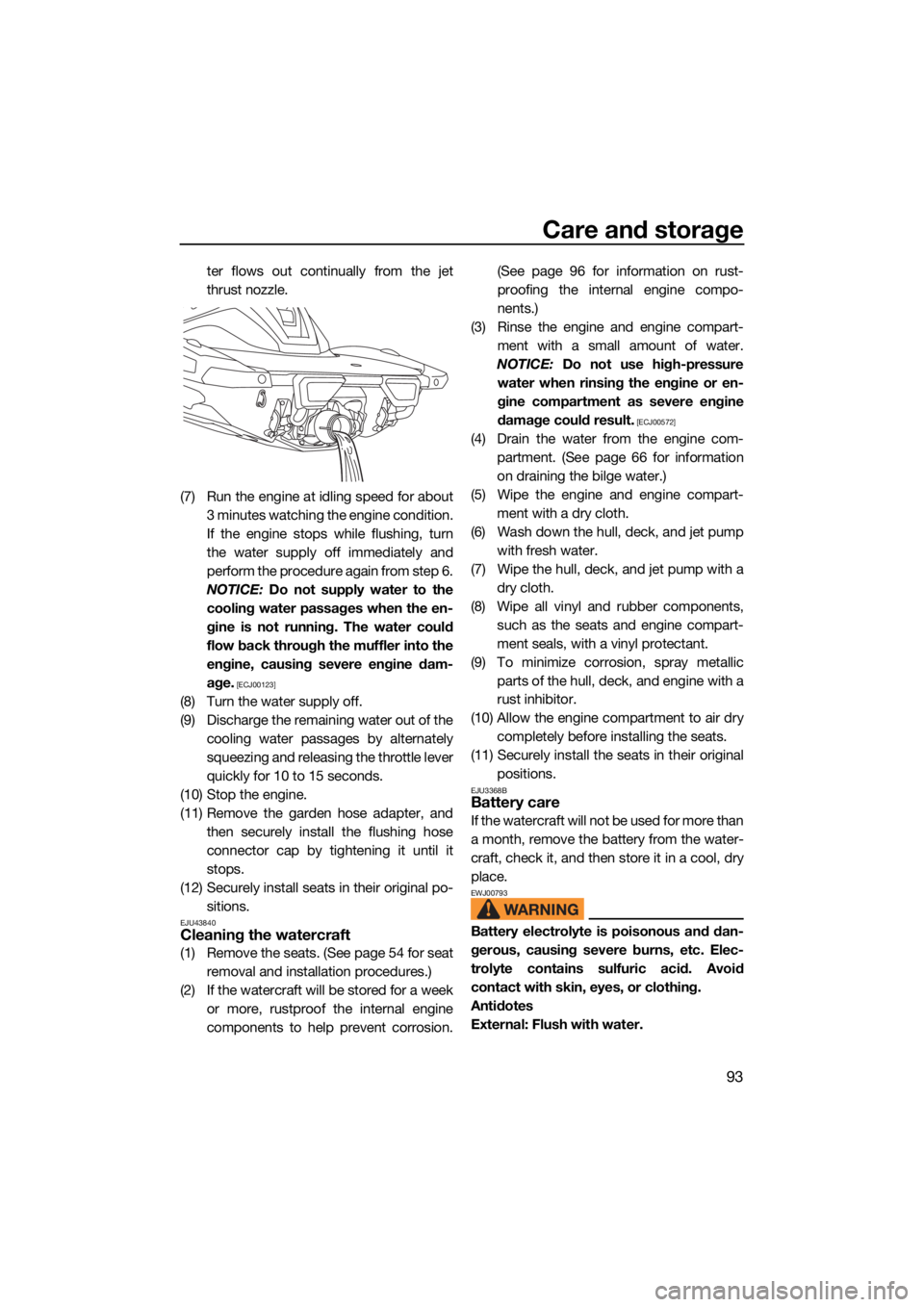
ter flows out continually from the jet
thrust nozzle.
(7) Run the engine at idling speed for about 3 minutes watching the engine condition.
If the engine stops while flushing, turn
the water supply off immediately and
perform the procedure again from step 6.
NOTICE: Do not supply water to the
cooling water passages when the en-
gine is not running. The water could
flow back through the muffler into the
engine, causing severe engine dam-
age.
[ECJ00123]
(8) Turn the water supply off.
(9) Discharge the remaining water out of the cooling water passages by alternately
squeezing and releasing the throttle lever
quickly for 10 to 15 seconds.
(10) Stop the engine.
(11) Remove the garden hose adapter, and then securely install the flushing hose
connector cap by tightening it until it
stops.
(12) Securely install seats in their original po- sitions.
EJU43840Cleaning the watercraft
(1) Remove the seats. (See page 54 for seatremoval and installation procedures.)
(2) If the watercraft will be stored for a week or more, rustproof the internal engine
components to help prevent corrosion. (See page 96 for information on rust-
proofing the internal engine compo-
nents.)
(3) Rinse the engine and engine compart- ment with a small amount of water.
NOTICE: Do not use high-pressure
water when rinsing the engine or en-
gine compartment as severe engine
damage could result.
[ECJ00572]
(4) Drain the water from the engine com- partment. (See page 66 for information
on draining the bilge water.)
(5) Wipe the engine and engine compart- ment with a dry cloth.
(6) Wash down the hull, deck, and jet pump with fresh water.
(7) Wipe the hull, deck, and jet pump with a dry cloth.
(8) Wipe all vinyl and rubber components, such as the seats and engine compart-
ment seals, with a vinyl protectant.
(9) To minimize corrosion, spray metallic parts of the hull, deck, and engine with a
rust inhibitor.
(10) Allow the engine compartment to air dry completely before installing the seats.
(11) Securely install the seats in their original positions.
EJU3368BBattery care
If the watercraft will not be used for more than
a month, remove the battery from the water-
craft, check it, and then store it in a cool, dry
place.
EWJ00793
Battery electrolyte is poisonous and dan-
gerous, causing severe burns, etc. Elec-
trolyte contains sulfuric acid. Avoid
contact with skin, eyes, or clothing.
Antidotes
External: Flush with water.
UF4N70E0.book Page 93 Tuesday, October 6, 2020 5:13 PM
Page 103 of 123
Care and storage
94
Internal: Drink large quantities of water or
milk. Follow with milk of magnesia, beaten
egg, or vegetable oil. Call a physician im-
mediately.
Eyes: Flush with water for 15 minutes and
get prompt medical attention.
Batteries produce explosive gases. Keep
sparks, flames, cigarettes, etc., well away.
If using or charging the battery in an en-
closed space, make sure that it is well
ventilated. Always shield your eyes when
working near batteries.
Keep out of the reach of children.
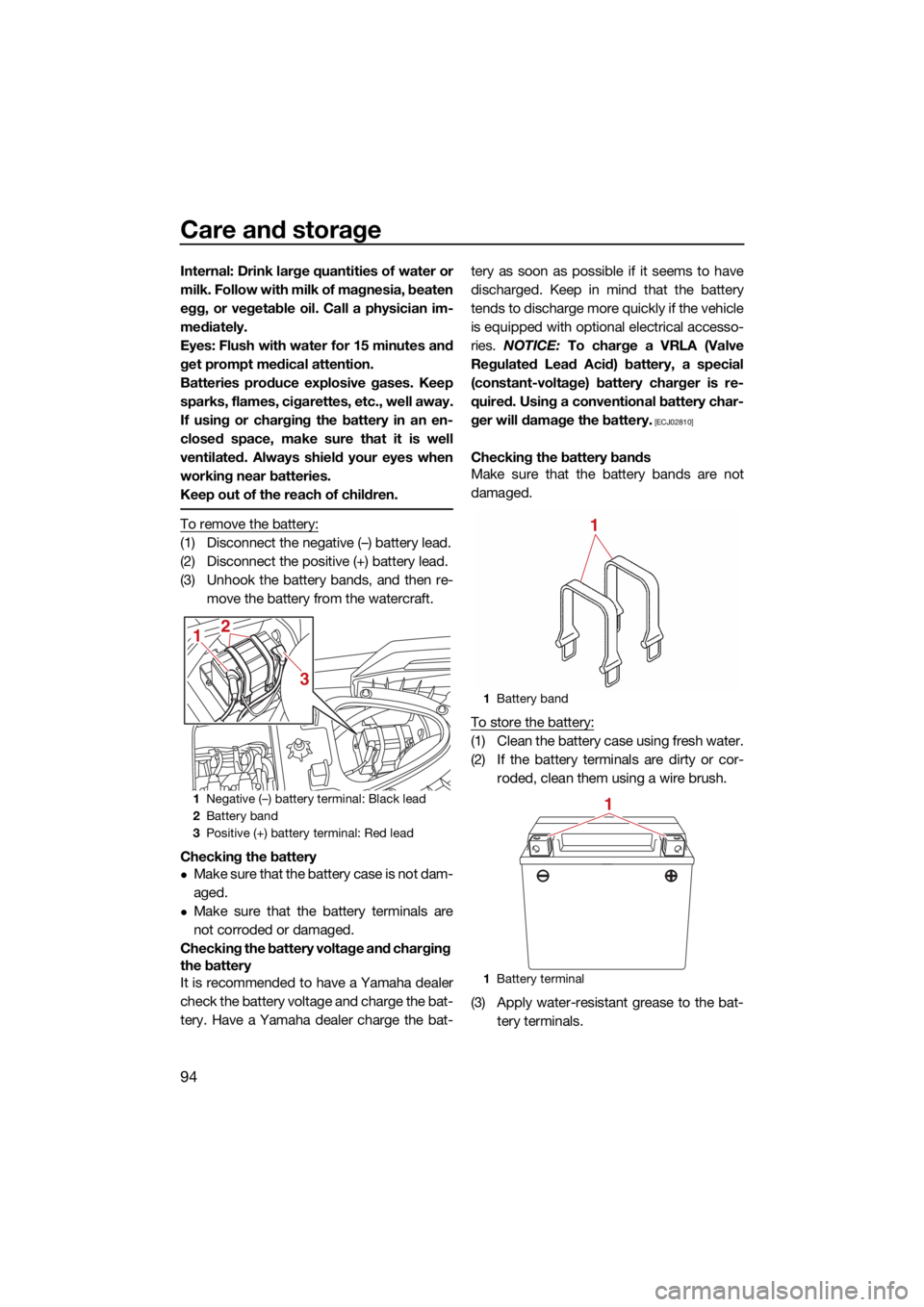
To remove the battery:
(1) Disconnect the negative (–) battery lead.
(2) Disconnect the positive (+) battery lead.
(3) Unhook the battery bands, and then re-move the battery from the watercraft.
Checking the battery
Make sure that the battery case is not dam-
aged.
Make sure that the battery terminals are
not corroded or damaged.
Checking the battery voltage and charging
the battery
It is recommended to have a Yamaha dealer
check the battery voltage and charge the bat-
tery. Have a Yamaha dealer charge the bat- tery as soon as possible if it seems to have
discharged. Keep in mind that the battery
tends to discharge more quickly if the vehicle
is equipped with optional electrical accesso-
ries.
NOTICE: To charge a VRLA (Valve
Regulated Lead Acid) battery, a special
(constant-voltage) battery charger is re-
quired. Using a conventional battery char-
ger will damage the battery.
[ECJ02810]
Checking the battery bands
Make sure that the battery bands are not
damaged.
To store the battery:
(1) Clean the battery case using fresh water.
(2) If the battery terminals are dirty or cor- roded, clean them using a wire brush.
(3) Apply water-resistant grease to the bat- tery terminals.
1Negative (–) battery terminal: Black lead
2 Battery band
3 Positive (+) battery terminal: Red lead
3
1
2
1
Battery band
1 Battery terminal
1
1
UF4N70E0.book Page 94 Tuesday, October 6, 2020 5:13 PM
Page 104 of 123

Care and storage
95
(4) Store the battery in a cool, dry place.NOTICE: Storing the battery in an un-
charged condition can cause perma-
nent battery damage. Check the
battery periodically.
[ECJ00103]
To install the battery:
(1) Place the battery in the battery compart- ment and hook the battery bands onto
the holders.
(2) Connect the positive (+) battery lead (red) to the positive (+) battery terminal.
NOTICE: Reversal of the battery leads
will damage the electrical parts.
[ECJ00262]
(3) Connect the negative (–) battery lead (black) to the negative (–) battery termi-
nal.
(4) Make sure that the battery is securely held in place.
EJU33493
Long-term storageEWJ00331
Always place the watercraft upright in a
horizontal position when storing it, other-
wise fuel could leak out into the engine or
engine compartment, which could create
a fire hazard.
Storage for long periods of time, such as win-
ter storage, requires preventive maintenance
to ensure against deterioration. It is advisable
to have the watercraft serviced by a Yamaha
dealer prior to storage.
However, the following procedures can be
performed easily by the owner.
EJU40763Cleaning
(1) Flush the cooling water passages. (See
page 92 for information on flushing the
cooling water passages.)
TIP:
If you will be storing the watercraft for a pro-
longed period, such as winter storage, top off
the fuel tank with fresh gasoline and add fuel
stabilizer and conditioner to the fuel tank ac-
cording to the manufacturer’s instruction be-
fore starting the engine.
(2) Clean the watercraft. (See page 93 for in-formation on cleaning the watercraft.)
Wax the hull with a non-abrasive wax.
EJU43663Lubrication
To keep moving parts sliding or rotating
smoothly, lubricate them with water-resistant
grease.
Recommended water-resistant grease:
YAMALUBE MARINE
GREASE/Yamaha Grease A
Recommended water-resistant grease:YAMALUBE MARINE GREASE /
Ya m a h a G r e a s e A
UF4N70E0.book Page 95 Tuesday, October 6, 2020 5:13 PM
Page 108 of 123

Maintenance
99
EJU43102Periodic maintenance chart
The periodic maintenance chart gives general guidelines for periodic maintenance. Have a
Yamaha dealer perform the checks in the following chart. However, maintenance may need to be performed more frequently depending on your operating conditions. If you have any
questions, consult a Yamaha dealer.
This “ √” mark indicates items to be checked and serviced by a Yamaha dealer.
Item OperationInitial Thereafter every
Page
10 hours 50 hours
or 12
months *1 100
hours or 12
months *1 200
hours or 24
months *1
Fuel line Check fuel hoses and
clamps
√
—
Fuel filler cap/Wa-
ter separator Check O-rings for cracks
and deformation
√
—
Fuel tank Check installation and
straps
√
—
Water inlet strainer Check for clogs and dam-
age
√
—
Cooling water hos-
es Check for damage and
leakage, and check
clamps
√
—
Engine oil Replace √√ 101
Oil filter Replace √101
Intermediate hous-
ing Lubricate
√—
Spark plugs Check √√ —
Battery Check state of charge,
terminals and bands
√
—
Battery leads Check terminals √—
Steering master Check operation and for
looseness
√√
—
Steering cable Check exterior and con-
nections, and lubricate
√
—
Shift rod and re-
verse gate (VX /
VX DELUXE /
VX CRUISER / VX
LIMITED) Check exterior and con-
nections, and lubricate
√
—
Air filter element Check for damage and
dirt
√
—
Air intake hoses Check for damage, and
check clamps
√
—
Throttle body Lubricate throttle valve √—
UF4N70E0.book Page 99 Tuesday, October 6, 2020 5:13 PM
Page 111 of 123
Specifications
102
EJU46450
Specifications
Watercraft capacity:
Maximum people on board:3 person
Maximum load capacity: 240 kg (530 lb)
Dimensions and weight:
Length:
3.33 m (131.1 in) (VX-C)
3.37 m (132.7 in) (VX LIMITED, VX CRUISER,
VX DELUXE, VX)
Width: 1.24 m (48.8 in)
Height: 1.20 m (47.2 in)
Dry weight:
306 kg (675 lb) (VX DELUXE)
308 kg (679 lb) (VX CRUISER)
314 kg (692 lb) (VX DELUXE with audio)
316 kg (697 lb) (VX LIMITED, VX CRUISER
with audio)
318 kg (701 lb) (VX-C)
326 kg (719 lb) (VX)
Performance:
Maximum output (according to ISO 8665/SAE
J1228):74.6 kW at 7300 r/min (VX-C)
85.0 kW at 8000 r/min (VX LIMITED,
VX CRUISER, VX DELUXE, VX)
Maximum fuel consumption:
29.1 L/h (7.7 US gal/h, 6.4 Imp.gal/h) (VX-C)
33.0 L/h (8.7 US gal/h, 7.3 Imp.gal/h) (VX
LIMITED, VX CRUISER, VX DELUXE, VX)
Cruising range at full throttle: 2.12 hour (VX LIMITED, VX CRUISER,
VX DELUXE, VX)
2.41 hour (VX-C)
Trolling speed: 1500 ±100 r/min
Engine:
Engine type:
Liquid cooled 4-stroke, DOHC
Number of cylinders: 3
Engine displacement: 1049 cm³
Bore × stroke:
82.0 × 66.2 mm (3.23 × 2.61 in) Compression ratio:
11.0 : 1
Valve clearance-intake (cold): 0.15–0.22 mm (0.0059–0.0087 in)
Valve clearance-exhaust (cold):
0.26–0.32 mm (0.0102–0.0126 in)
Lubrication system: Dry sump
Cooling system: Water
Starting system:
Electric
Ignition system: T.C.I.
Spark plug (NGK): CR9EB
Spark plug gap: 0.7–0.8 mm (0.028–0.031 in)
Battery capacity:
12 V, 18 Ah
Battery type: YTX20L-BS
Charging system: Flywheel magneto
Drive unit:
Propulsion system:Jet pump
Jet pump type: Axial flow, single stage
Impeller rotation:
Counterclockwise
Jet thrust nozzle angle: 24+24 °
Fuel and oil:
Recommended fuel:
Regular unleaded gasoline
Minimum octane rating (PON): 86
Minimum octane rating (RON): 90
Recommended engine oil:
YAMALUBE 4W or 4-stroke motor oil
Recommended engine oil type SAE: SAE 10W-30, 10W-40, 20W-40, 20W-50
UF4N70E0.book Page 102 Tuesday, October 6, 2020 5:13 PM
Page 113 of 123

Trouble recovery
104
EJU34562
Troubleshooting
If you have any trouble with your watercraft, use the troubleshooting chart to check for the
possible cause.
If you cannot find the cause, consult a Yamaha dealer.
EJU46272Troubleshooting chart
Confirm the possible cause and remedy, and then refer to the applicable page.
TROUBLEPOSSIBLE CAUSE REMEDYPAGE
Engine does not
start (Starter motor
does not turn over)
Yamaha Secu- rity System
(VX DELUXE /
VX CRUISER /
VX LIMITED)Lock mode selected Select unlock mode
25
Engine shut-
off switch Clip not in place Install clip
26
Fuse Burned out Have serviced by Yamaha dealer—
Battery Run down Recharge93
Poor terminal con-
nections Tighten as required
93
Terminal corroded Clean or replace 93
Starter motor Faulty Have serviced by
Yamaha dealer —
Engine does not
start (Starter motor
turns over) Throttle lever Squeezed
Release27
RiDE lever
(VX /
VX DELUXE /
VX CRUISER /
VX LIMITED)SqueezedRelease
27
Fuel Fuel tank empty Refill as soon as pos-
sible 62
Stale or contaminat-
ed Have serviced by
Yamaha dealer
—
Fuel tank Water or dirt present Have serviced by Yamaha dealer—
Spark plug Fouled or defective Have serviced by Yamaha dealer—
Fuel injec-
tion system Fuel pump faulty Have serviced by
Yamaha dealer —
UF4N70E0.book Page 104 Tuesday, October 6, 2020 5:13 PM
Page 117 of 123

Trouble recovery
108
ler, jet pump housing, and jet thrust noz-
zle.
If debris is difficult to remove, consult a
Yamaha dealer.
EJU43472Raising the reverse gate (VX /
VX DELUXE / VX CRUISER / VX
LIMITED)
If the RiDE system malfunctions and the re-
verse gate remains in the lowered position,
the watercraft will not be able to move for-
ward.
After raising the reverse gate so that the wa-
tercraft can move forward, immediately re-
turn to shore and have a Yamaha dealer
service the watercraft.
To raise the reverse gate:
(1) Stop the engine and remove the clip from
the engine shut-off switch.
(2) Enter the water and move to the rear of the watercraft.
(3) Slide the shift rod joint toward the bow, and then disconnect the shift rod joint
from the ball joint. (4) Raise the reverse gate to the forward po-
sition.
TIP:
While the shift rod is disconnected, the re-
verse gate will not move to the neutral po-
sition or reverse position even if the RiDE
lever is squeezed.
If the RiDE lever is squeezed while the shift
rod is disconnected, the watercraft will
move forward.
EJU34642Jumping the battery
If the watercraft battery has run down, the en-
gine can be started using a 12-volt booster
battery and jumper cables.
EJU34664Connecting the jumper cablesEWJ01251
To avoid battery explosion and serious
damage to the electrical system:
Do not reverse the polarity of the jumper
cables when connecting to the batter-
ies.
Do not connect the negative (–) jumper
cable to the negative (–) terminal of the
watercraft battery.
Do not touch the positive (+) jumper ca-
ble to the negative (–) jumper cable.
1Shift rod joint
2 Ball joint
1 2
1
Reverse gate
2 Forward position
1
2
UF4N70E0.book Page 108 Tuesday, October 6, 2020 5:13 PM
Page 118 of 123

Trouble recovery
109
(1) Connect the positive (+) jumper cable tothe positive (+) battery terminals of both
batteries.
(2) Connect one end of the negative (–) jumper cable to the negative (–) battery
terminal of the booster battery.
(3) Connect the other end of the negative (–) jumper cable to an engine hanger.
(4) Start the engine, and then disconnect the jumper cables by reversing the steps
above. (See page 27 for information on
starting the engine.)
EJU34716Towing the watercraftEWJ00812
The operator of the towing boat must
keep speed to a minimum and avoid
traffic or obstacles which could be a
hazard to the operator on the water-
craft.
The towline should be long enough so
that the watercraft will not collide with
the towing boat when slowing down.
If the watercraft becomes inoperative in the
water, it can be towed to shore. To tow the watercraft:
Use a towline that is three times the com-
bined length of the towing boat and the wa-
tercraft.
(1) Securely attach the towline to the bow
eye of the watercraft being towed.
(2) Sit astride the seat and hold on to the handlebars in order to balance the water-
craft. NOTICE: The bow must be kept
up out of the water during towing, oth-
erwise water could flood the engine
compartment or water could flow
back into the engine, causing severe
engine damage.
[ECJ01331]
Tow the watercraft at 8 km/h (5 mph) or less.
NOTICE: Tow the watercraft at 8 km/h (5
mph) or less, otherwise water could flood
the engine compartment or water could
flow back into the engine, causing severe
engine damage.
[ECJ01322]
EJU36156
Submerged watercraft
If the watercraft is submerged or flooded with
water, drain the bilge water from the engine
compartment. Then, have a Yamaha dealer
service the watercraft as soon as possible.
If the watercraft was submerged:
(1) Remove the watercraft from the water and drain the water from the storage
compartments. (See page 57 for infor-
1Booster battery
2 Positive (+) jumper cable
3 Negative (–) jumper cable
4 Engine hanger
3
12
41Bow eye
1
UF4N70E0.book Page 109 Tuesday, October 6, 2020 5:13 PM
Page 120 of 123

111
Index
A
Accessory outlet ...................................... 52
After removing the watercraft from the water ..................................................... 91
Audio control............................................ 52
Audio system (equipped models) ............ 52
B
Battery care.............................................. 93
Battery checks ......................................... 72
Battery, jumping..................................... 108
Beaching and docking the watercraft ...... 90
Bilge water check..................................... 72
Bilge water, draining ................................ 66
Bilge water, draining on land ................... 66
Bilge water, draining on water ................. 66
Boarding alone ......................................... 86
Boarding and starting off from a dock ..... 89
Boarding the watercraft ........................... 86
Boarding with passenger(s) ..................... 87
Bow eye ................................................... 56
Bow storage compartment ...................... 57
Builder’s plate ............................................ 3
C
Capsized watercraft ................................. 89
Check engine warning ............................. 43
Cleaning ................................................... 95
Cleaning the watercraft ............................ 93
Cleat ......................................................... 57
Cooling water pilot outlet ......................... 28
Cooling water pilot outlet check .............. 77
Craft Identification Number (CIN)............... 1
Cruise assist............................................. 37
Cruising limitations................................... 11
D
Display ..................................................... 45
Drive control mode................................... 36
Drive control mode screen ....................... 47
E
Emergency procedures .......................... 107
Engine break-in ........................................ 68
Engine compartment check ..................... 71
Engine idling speed check ....................... 77
Engine lock screen ................................... 49
Engine oil ................................................. 64
Engine oil and oil filter ............................ 101 Engine oil level check ............................... 72
Engine oil requirements ........................... 64
Engine overheat warning.......................... 43
Engine serial number ................................. 2
Engine shut-off cord (lanyard) check ....... 73
Engine shut-off switch ............................. 26
Engine start/stop switch (VX /
VX DELUXE / VX CRUISER /
VX LIMITED) .......................................... 26
Engine stop switch (VX-C)........................ 26
Engine unit check ..................................... 72
Enjoy your watercraft responsibly ............ 19
Equipment ................................................ 54
F
Fire extinguisher check ............................ 75
Fire extinguisher holder and cover........... 60
Fire extinguisher holder, cover, and band checks ......................................... 75
Flushing the cooling water passages....... 92
Fuel .......................................................... 62
Fuel level check........................................ 71
Fuel level meter ........................................ 42
Fuel level warning..................................... 42
Fuel requirements .................................... 62
Fuel system checks ................................. 71
G
Getting to know your watercraft .............. 78
Glossary, watercraft ................................. 20
Glove compartment ................................. 58
H
Handgrip .................................................. 55
Hazard information................................... 15
Home screen ............................................ 46
Hood check .............................................. 76
Hour meter and voltmeter ........................ 41
Hull and deck check ................................ 75
I
Identification numbers ............................... 1
Information display................................... 39
Information screen ................................... 47
J
Jet intake and impeller, cleaning............ 107
Jet intake checks ..................................... 75
UF4N70E0.book Page 111 Tuesday, October 6, 2020 5:13 PM