sensor ACURA NSX 1991 Service Owner's Manual
[x] Cancel search | Manufacturer: ACURA, Model Year: 1991, Model line: NSX, Model: ACURA NSX 1991Pages: 1640, PDF Size: 60.48 MB
Page 304 of 1640
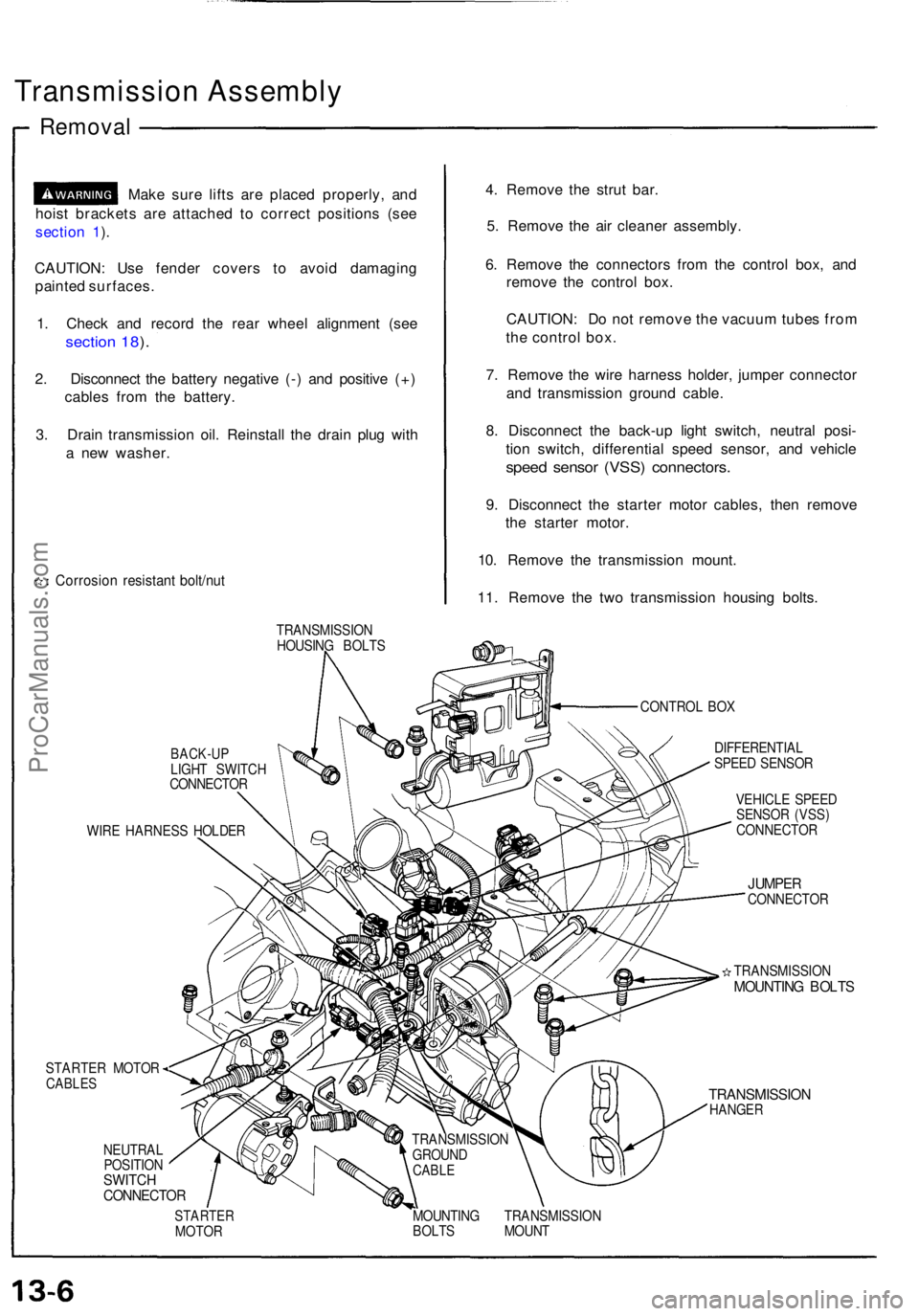
Transmission Assembl y
Removal
Make sur e lift s ar e place d properly , an d
hois t bracket s ar e attache d t o correc t position s (se e
sectio n 1 ).
CAUTION : Us e fende r cover s t o avoi d damagin g
painte d surfaces .
1 . Chec k an d recor d th e rea r whee l alignmen t (se e
sectio n 18 ).
2 . Disconnec t th e batter y negativ e (- ) an d positiv e (+ )
cable s fro m th e battery .
3 . Drai n transmissio n oil . Reinstal l th e drai n plu g wit h
a ne w washer .
Corrosio n resistan t bolt/nu t
4. Remov e th e stru t bar .
5 . Remov e th e ai r cleane r assembly .
6 . Remov e th e connector s fro m th e contro l box , an d
remov e th e contro l box .
CAUTION : D o no t remov e th e vacuu m tube s fro m
th e contro l box .
7 . Remov e th e wir e harnes s holder , jumpe r connecto r
an d transmissio n ground cable.
8 . Disconnec t th e back-u p ligh t switch , neutra l posi -
tio n switch , differentia l spee d sensor , an d vehicl e
speed senso r (VSS ) connectors .
9. Disconnec t th e starte r moto r cables , the n remov e
th e starte r motor .
10 . Remov e th e transmissio n mount .
11 . Remov e th e tw o transmissio n housin g bolts .
TRANSMISSIO N
HOUSIN G BOLT S
CONTROL BO X
BACK-U PLIGHT SWITC H
CONNECTO R
WIR E HARNES S HOLDE R
STARTER MOTOR
CABLES
NEUTRA L
POSITIO N
SWITCHCONNECTO R
DIFFERENTIA L
SPEE D SENSO R
VEHICL E SPEE D
SENSO R (VSS )
CONNECTO R
JUMPERCONNECTO R
TRANSMISSIO N
MOUNTING BOLT S
TRANSMISSIO NHANGER
STARTE RMOTOR MOUNTIN
G TRANSMISSIO N
BOLT S MOUN T
TRANSMISSIO
N
GROUN D
CABLE
ProCarManuals.com
Page 306 of 1640
Transmission Assembly
Removal
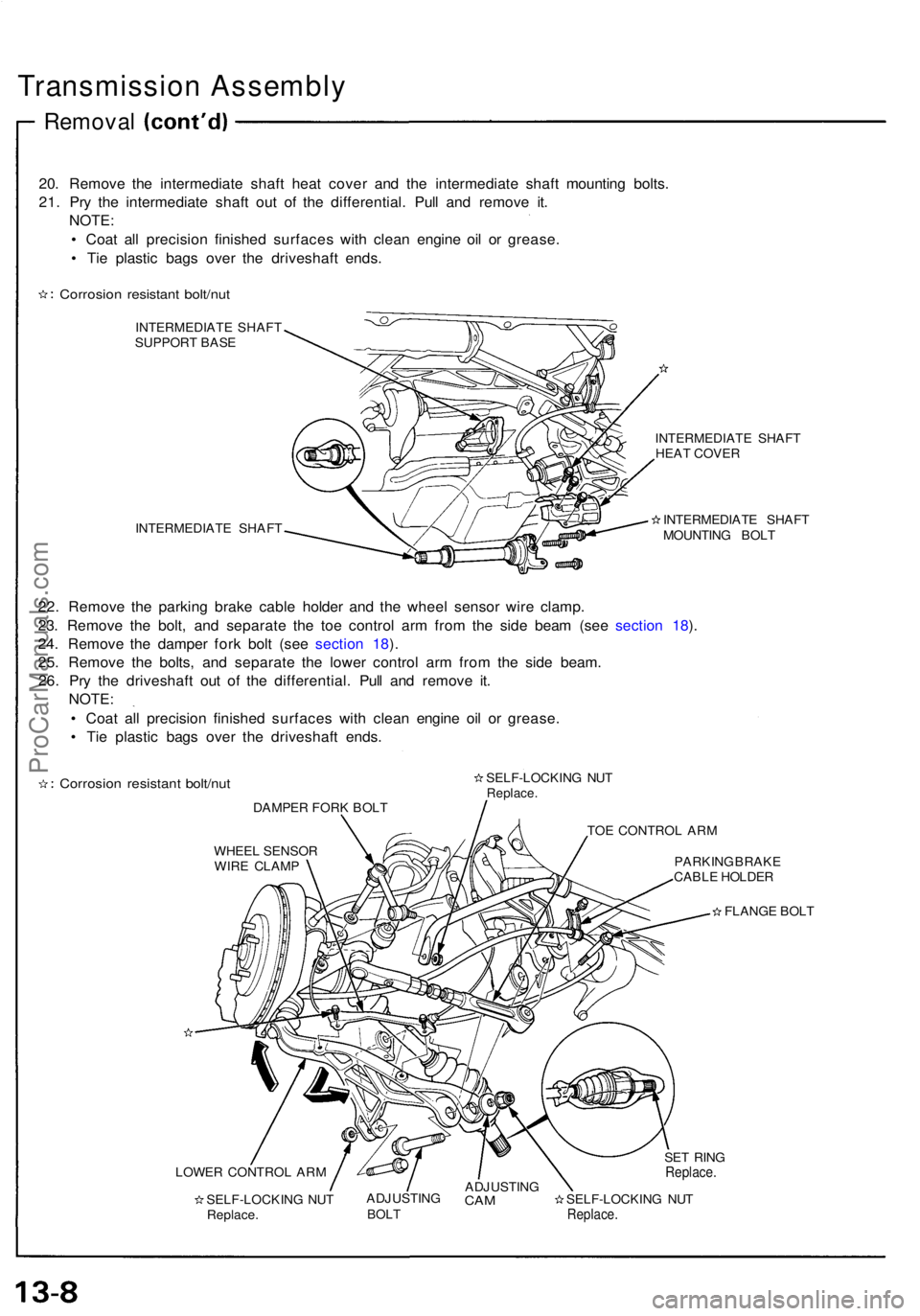
20. Remove the intermediate shaft heat cover and the intermediate shaft mounting bolts.
21. Pry the intermediate shaft out of the differential. Pull and remove it. NOTE:
• Coat all precision finished surfaces with clean engine oil or grease.
• Tie plastic bags over the driveshaft ends.
Corrosion resistant bolt/nut
INTERMEDIATE SHAFT
SUPPORT BASE
INTERMEDIATE SHAFT INTERMEDIATE SHAFT
HEAT COVER
INTERMEDIATE SHAFT
MOUNTING BOLT
22. Remove the parking brake cable holder and the wheel sensor wire clamp.
23. Remove the bolt, and separate the toe control arm from the side beam (see section 18).
24. Remove the damper fork bolt (see section 18).
25. Remove the bolts, and separate the lower control arm from the side beam. 26. Pry the driveshaft out of the differential. Pull and remove it. NOTE:
• Coat all precision finished surfaces with clean engine oil or grease.
• Tie plastic bags over the driveshaft ends.
Corrosion resistant bolt/nut
DAMPER FORK BOLT SELF-LOCKING NUT
Replace.
TOE CONTROL ARM
WHEEL SENSOR WIRE CLAMP PARKING BRAKE
CABLE HOLDER
FLANGE BOLT
LOWER CONTROL ARM SELF-LOCKING NUTReplace. ADJUSTING
BOLT
ADJUSTING
CAM
SELF-LOCKING NUT
Replace.
SET RING
Replace.ProCarManuals.com
Page 310 of 1640
Transmission Housing
Removal
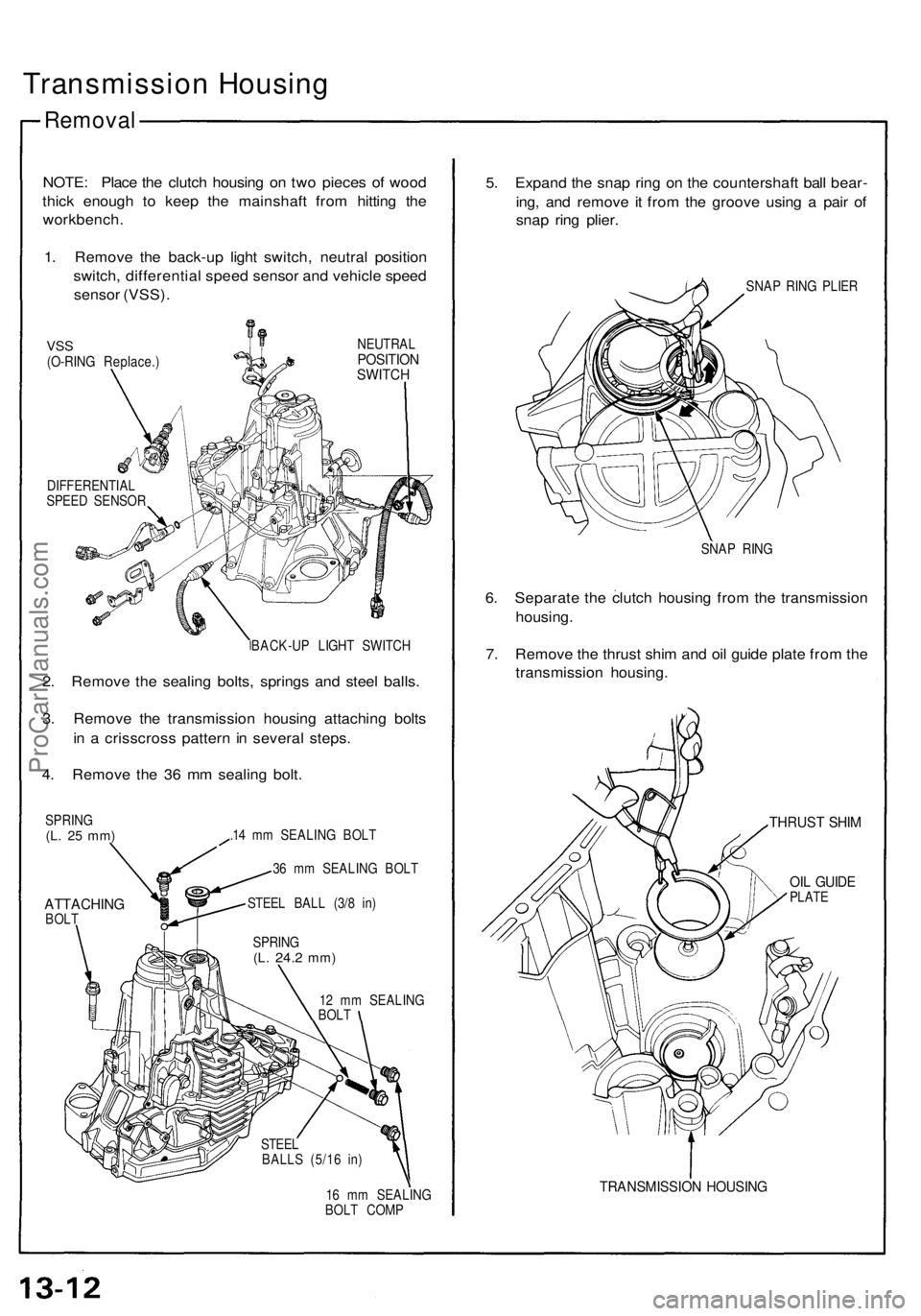
NOTE: Place the clutch housing on two pieces of wood
thick enough to keep the mainshaft from hitting the
workbench.
1. Remove the back-up light switch, neutral position
switch, differential speed sensor and vehicle speed
sensor (VSS).
VSS
(O-RING Replace.)
NEUTRAL
POSITION
SWITCH
DIFFERENTIAL
SPEED SENSOR
BACK-UP LIGHT SWITCH
2. Remove the sealing bolts, springs and steel balls.
3. Remove the transmission housing attaching bolts
in a crisscross pattern in several steps.
4. Remove the 36 mm sealing bolt.
SPRING
(L. 25 mm)
ATTACHING
BOLT
.14 mm SEALING BOLT
36 mm SEALING BOLT
STEEL BALL (3/8 in)
12 mm SEALING
BOLT
16 mm SEALING
BOLT COMP
5. Expand the snap ring on the countershaft ball bear-
ing, and remove it from the groove using a pair of
snap ring plier.
SNAP RING PLIER
SNAP RING
6. Separate the clutch housing from the transmission
housing.
7. Remove the thrust shim and oil guide plate from the
transmission housing.
THRUST SHIM
OIL GUIDE
PLATE
TRANSMISSION HOUSING
SPRING
(L.
24.2
mm)
STEEL
BALLS (5/16 in)ProCarManuals.com
Page 355 of 1640
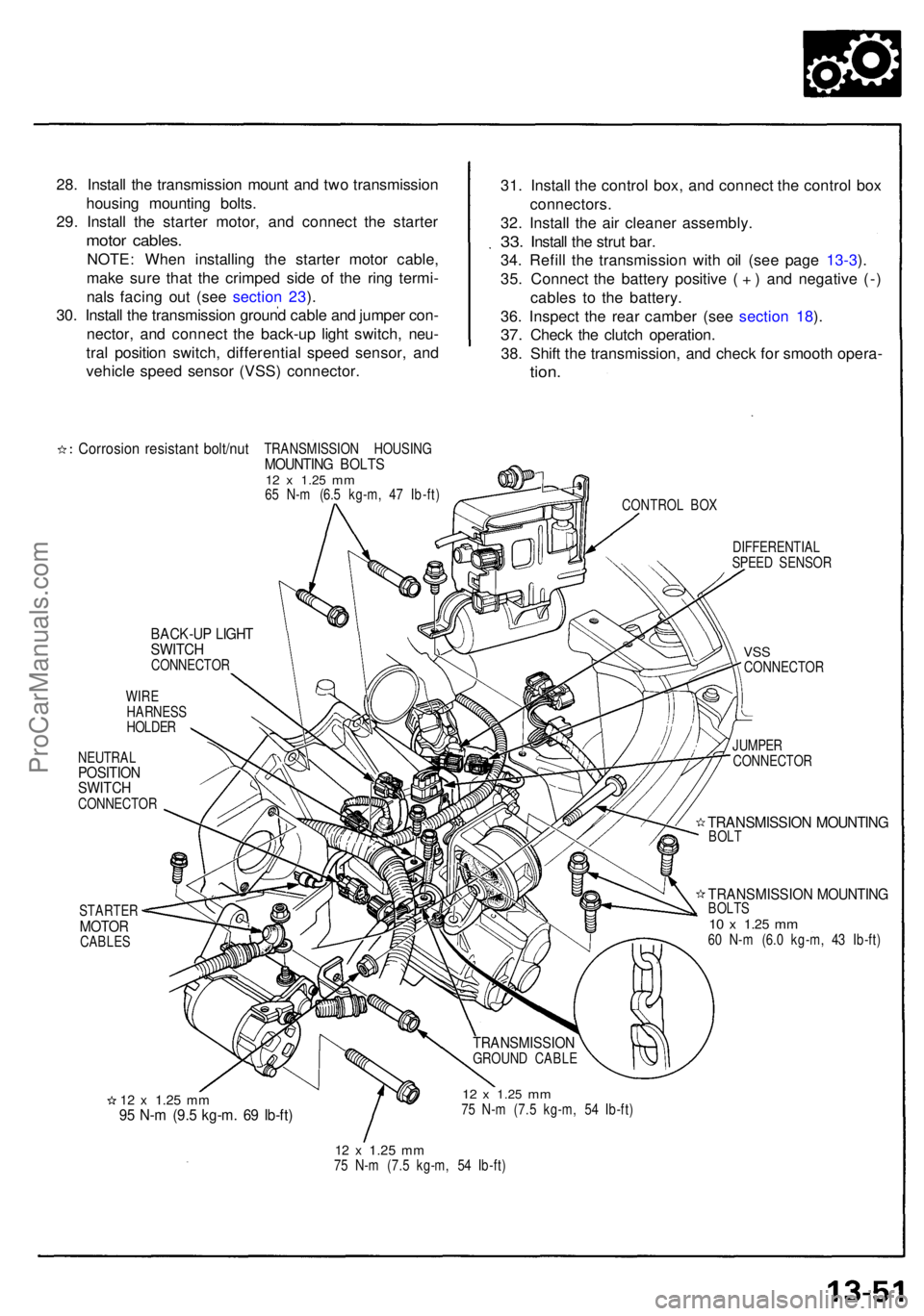
28. Instal l th e transmissio n moun t an d tw o transmissio n
housin g mountin g bolts .
29 . Instal l th e starte r motor , an d connec t th e starte r
motor cables .
NOTE: Whe n installin g th e starte r moto r cable ,
mak e sur e tha t th e crimpe d sid e o f th e rin g termi -
nal s facin g ou t (se e sectio n 23 ).
30 . Instal l th e transmissio n groun d cabl e an d jumpe r con -
nector , an d connec t th e back-u p ligh t switch , neu -
tra l positio n switch , differentia l spee d sensor , an d
vehicl e spee d senso r (VSS ) connector . 31
. Instal l th e contro l box , an d connec t th e contro l bo x
connectors .
32. Instal l th e ai r cleane r assembly .
33. Instal l th e stru t bar .
34 . Refil l th e transmissio n wit h oi l (se e pag e 13-3 ).
35 . Connec t th e batter y positiv e ( + ) an d negativ e (- )
cable s t o th e battery .
36 . Inspec t th e rea r cambe r (se e sectio n 18 ).
37 . Chec k th e clutc h operation .
38 . Shif t th e transmission , an d chec k fo r smoot h opera -
tion.
Corrosio n resistan t bolt/nu tTRANSMISSIO N HOUSIN GMOUNTING BOLT S12 x 1.2 5 mm65 N- m (6. 5 kg-m , 4 7 Ib-ft )
CONTROL BO X
BACK-U P LIGH TSWITC HCONNECTO R
WIR E
HARNES S
HOLDE R
NEUTRA L
POSITIONSWITCHCONNECTO R
STARTE R
MOTORCABLE S DIFFERENTIA
L
SPEE D SENSO R
VSSCONNECTO R
JUMPE R
CONNECTO R
TRANSMISSIO N MOUNTIN GBOLT
TRANSMISSIO N MOUNTIN GBOLTS10 x 1.2 5 mm60 N- m (6. 0 kg-m , 4 3 Ib-ft )
12 x 1.2 5 mm95 N- m (9. 5 kg-m . 6 9 Ib-ft )
12 x 1.2 5 mm75 N- m (7. 5 kg-m , 5 4 Ib-ft )
12 x 1.2 5 mm75 N- m (7. 5 kg-m , 5 4 Ib-ft )
TRANSMISSIO NGROUND CABL E
ProCarManuals.com
Page 388 of 1640
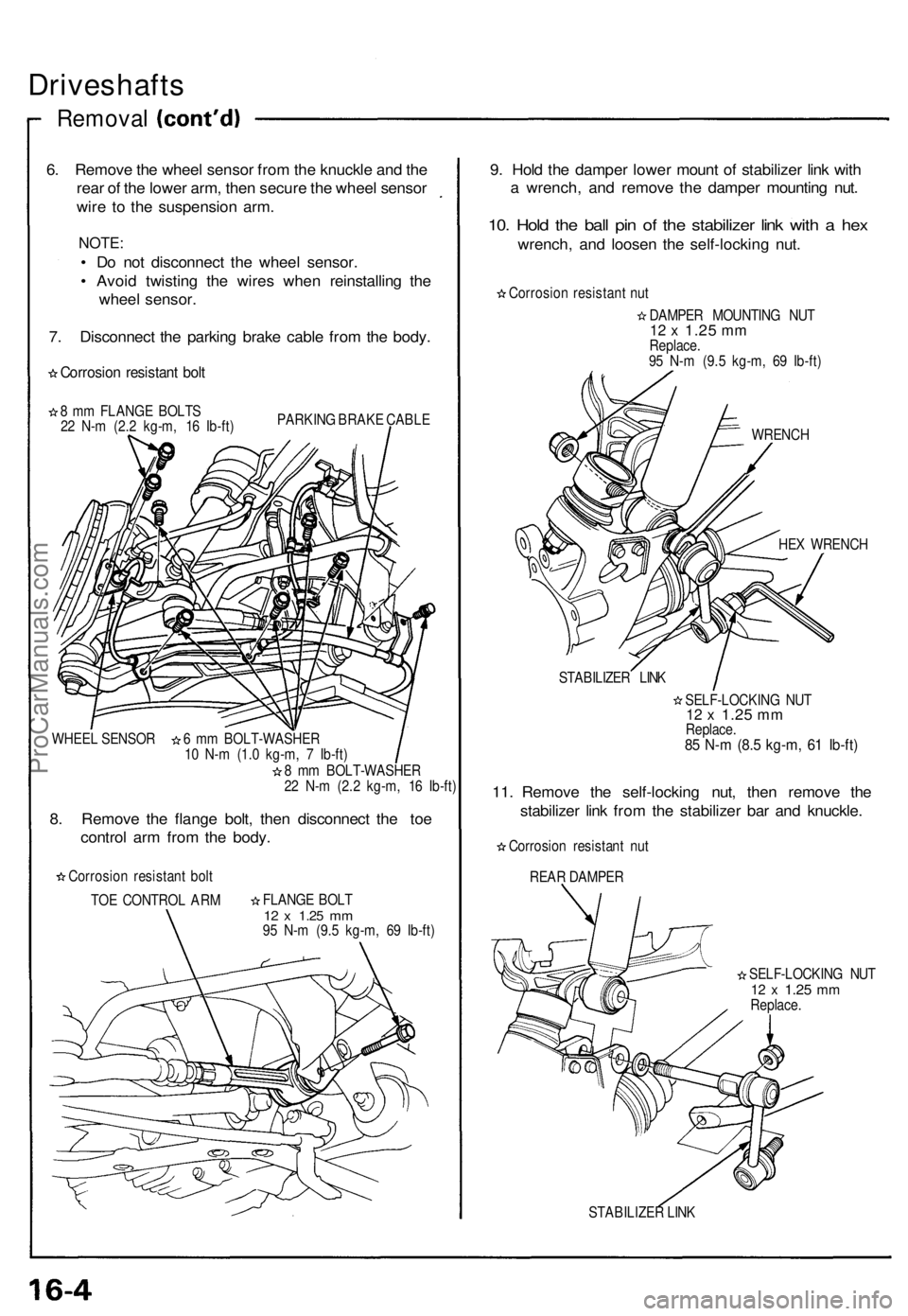
Driveshafts
Removal
6. Remov e th e whee l senso r fro m th e knuckl e an d th e
rea r o f th e lowe r arm , the n secur e th e whee l senso r
wir e t o th e suspensio n arm .
NOTE :
• D o no t disconnec t th e whee l sensor .
• Avoi d twistin g th e wire s whe n reinstallin g th e
whee l sensor .
7 . Disconnec t th e parkin g brak e cabl e fro m th e body .
Corrosio n resistan t bol t
8 m m FLANG E BOLT S
2 2 N- m (2. 2 kg-m , 1 6 Ib-ft ) PARKIN
G BRAK E CABL E
WHEE L SENSO R 6 mm BOLT-WASHE R
1 0 N- m (1. 0 kg-m , 7 Ib-ft )
8 m m BOLT-WASHE R
2 2 N- m (2. 2 kg-m , 1 6 Ib-ft )
Corrosio n resistan t bol t
TO E CONTRO L AR M FLANG
E BOL T
12 x 1.2 5 mm95 N- m (9. 5 kg-m , 6 9 Ib-ft )
9. Hol d th e dampe r lowe r moun t o f stabilize r lin k wit h
a wrench , an d remov e th e dampe r mountin g nut .
10. Hol d th e bal l pi n o f th e stabilize r lin k wit h a he x
wrench , an d loose n th e self-lockin g nut .
Corrosio n resistan t nu t
DAMPE R MOUNTIN G NU T
12 x 1.2 5 mmReplace .
9 5 N- m (9. 5 kg-m , 6 9 Ib-ft )
WRENC H
HE X WRENC H
STABILIZE R LIN K
SELF-LOCKIN G NU T
12 x 1.2 5 mmReplace .85 N- m (8. 5 kg-m , 6 1 Ib-ft )
11. Remov e th e self-lockin g nut , the n remov e th e
stabilize r lin k fro m th e stabilize r ba r an d knuckle .
Corrosio n resistan t nu t
REA R DAMPE R
SELF-LOCKING NU T
12 x 1.2 5 mmReplace .
STABILIZE R LIN K
8. Remov e th e flang e bolt , the n disconnec t th e to e
contro l ar m fro m th e body .
ProCarManuals.com
Page 407 of 1640
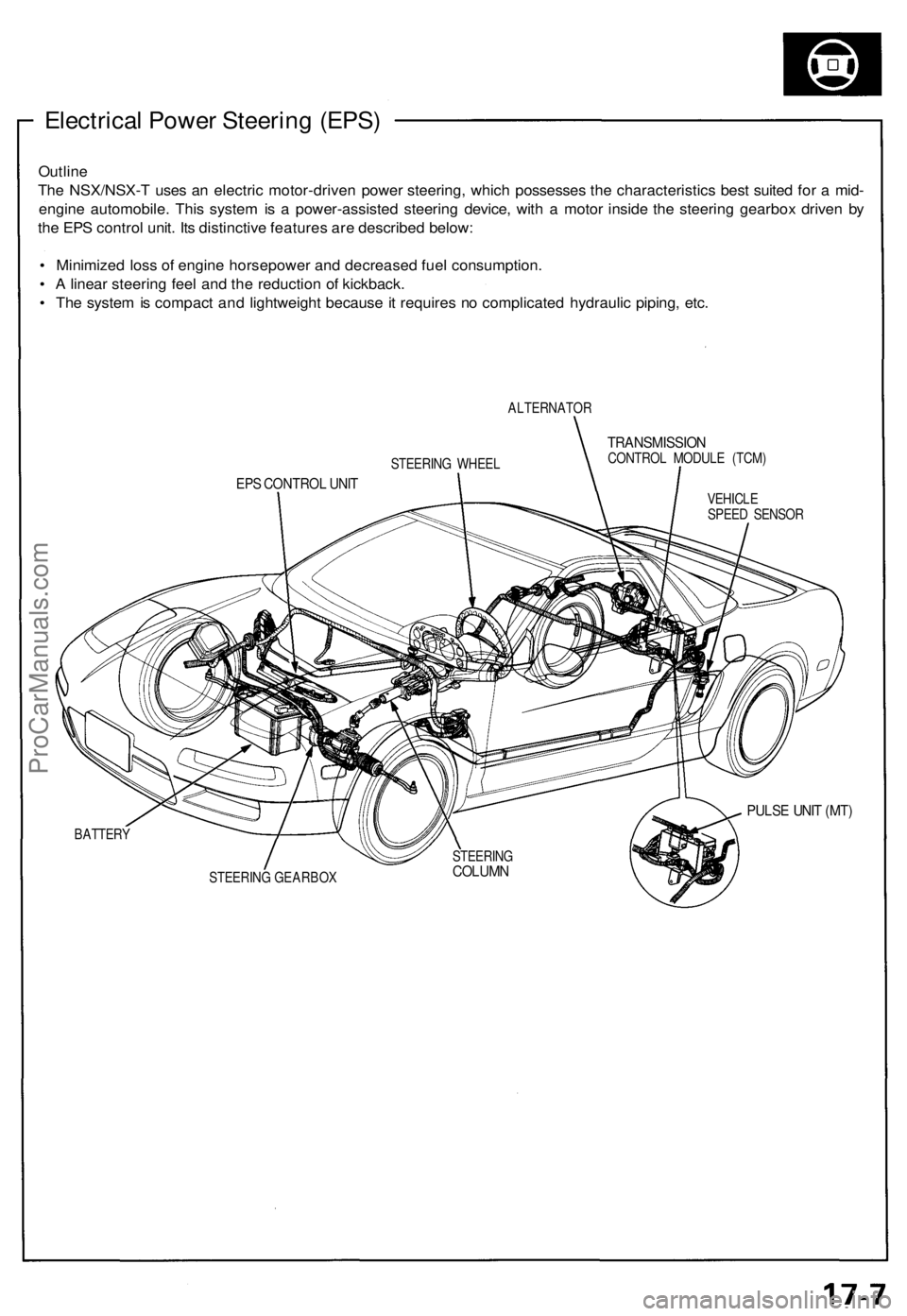
Electrical Power Steering (EPS)
Outline
The NSX/NSX-T uses an electric motor-driven power steering, which possesses the characteristics best suited for a mid-
engine automobile. This system is a power-assisted steering device, with a motor inside the steering gearbox driven by
the EPS control unit. Its distinctive features are described below:
• Minimized loss of engine horsepower and decreased fuel consumption.
• A linear steering feel and the reduction of kickback.
• The system is compact and lightweight because it requires no complicated hydraulic piping, etc.
ALTERNATOR
TRANSMISSION
CONTROL MODULE (TCM)
EPS CONTROL UNIT
VEHICLE
SPEED SENSOR
PULSE UNIT (MT)
BATTERY
STEERING GEARBOX
STEERING WHEEL
STEERING
COLUMNProCarManuals.com
Page 408 of 1640
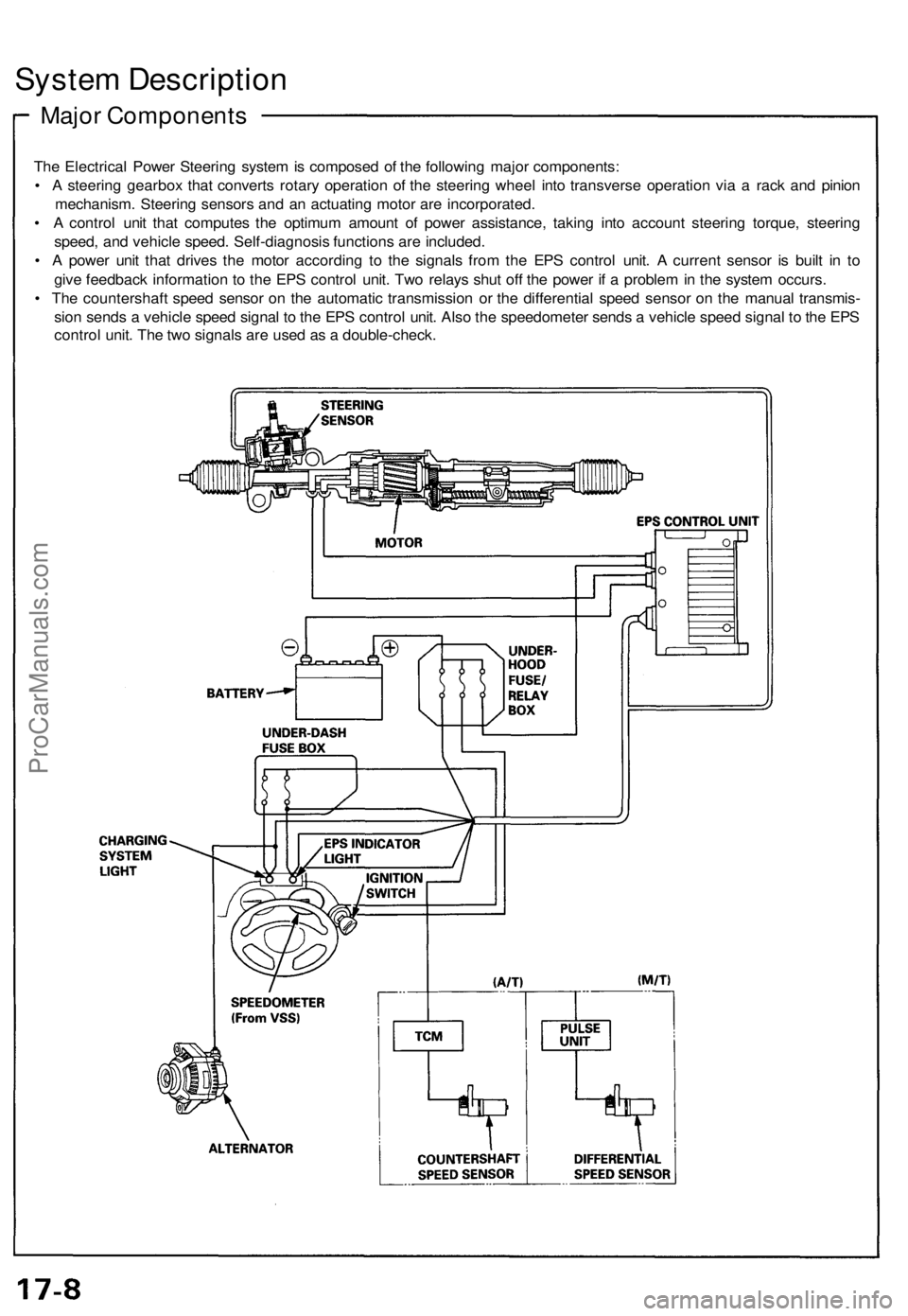
System Description
Major Components
The Electrical Power Steering system is composed of the following major components:
• A steering gearbox that converts rotary operation of the steering wheel into transverse operation via a rack and pinion
mechanism. Steering sensors and an actuating motor are incorporated.
• A control unit that computes the optimum amount of power assistance, taking into account steering torque, steering
speed, and vehicle speed. Self-diagnosis functions are included.
• A power unit that drives the motor according to the signals from the EPS control unit. A current sensor is built in to
give feedback information to the EPS control unit. Two relays shut off the power if a problem in the system occurs.
• The countershaft speed sensor on the automatic transmission or the differential speed sensor on the manual transmis-
sion sends a vehicle speed signal to the EPS control unit. Also the speedometer sends a vehicle speed signal to the EPS
control unit. The two signals are used as a double-check.ProCarManuals.com
Page 409 of 1640
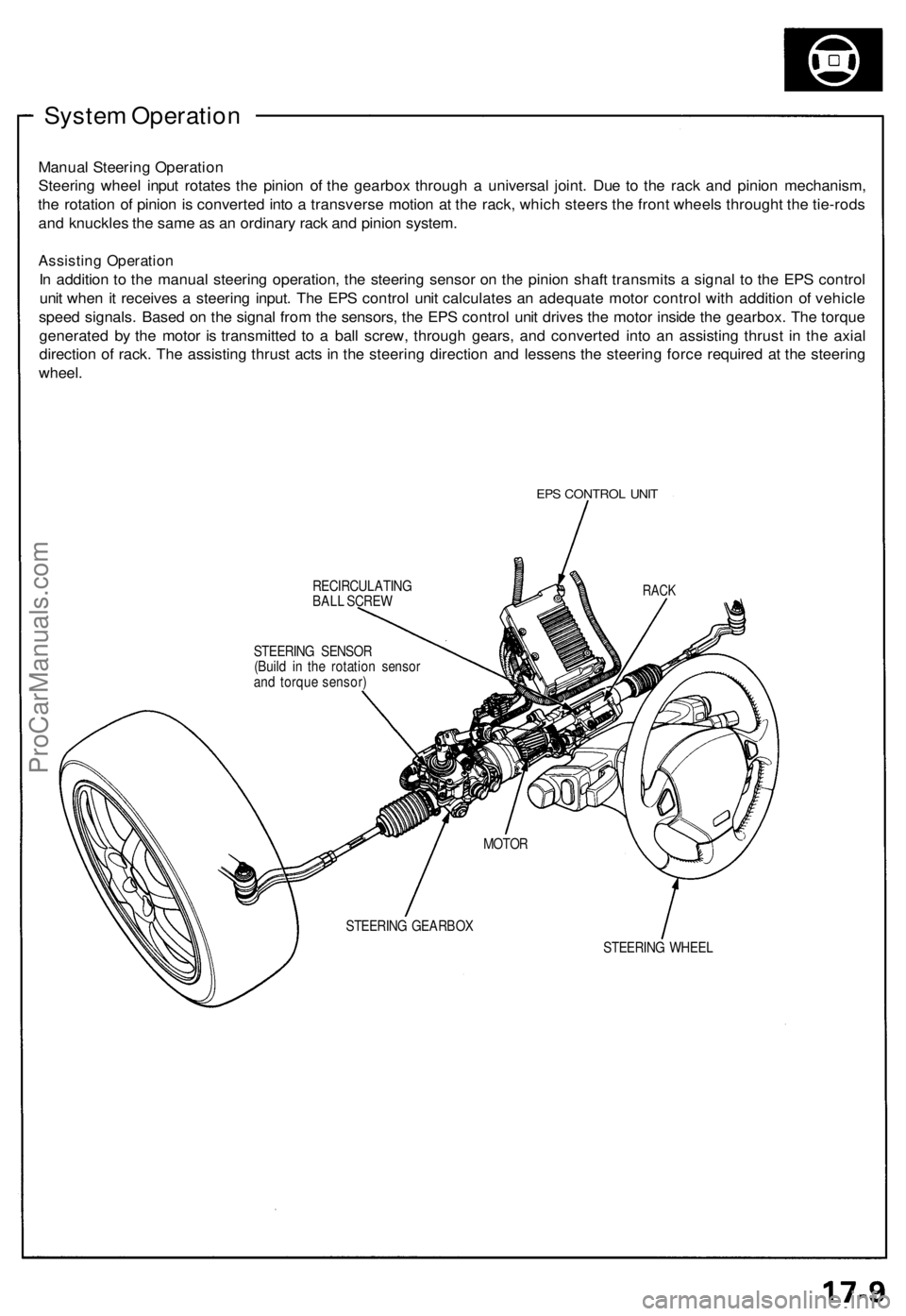
System Operation
Manual Steering Operation
Steering wheel input rotates the pinion of the gearbox through a universal joint. Due to the rack and pinion mechanism,
the rotation of pinion is converted into a transverse motion at the rack, which steers the front wheels throught the tie-rods
and knuckles the same as an ordinary rack and pinion system.
Assisting Operation
In addition to the manual steering operation, the steering sensor on the pinion shaft transmits a signal to the EPS control
unit when it receives a steering input. The EPS control unit calculates an adequate motor control with addition of vehicle
speed signals. Based on the signal from the sensors, the EPS control unit drives the motor inside the gearbox. The torque
generated by the motor is transmitted to a ball screw, through gears, and converted into an assisting thrust in the axial
direction of rack. The assisting thrust acts in the steering direction and lessens the steering force required at the steering
wheel.
EPS CONTROL UNIT
RECIRCULATING
BALL SCREW
STEERING WHEEL
RACK
STEERING SENSOR
(Build in the rotation sensor
and torque sensor)
MOTOR
STEERING GEARBOXProCarManuals.com
Page 410 of 1640
System Description
Function and Operation
Steering Sensor
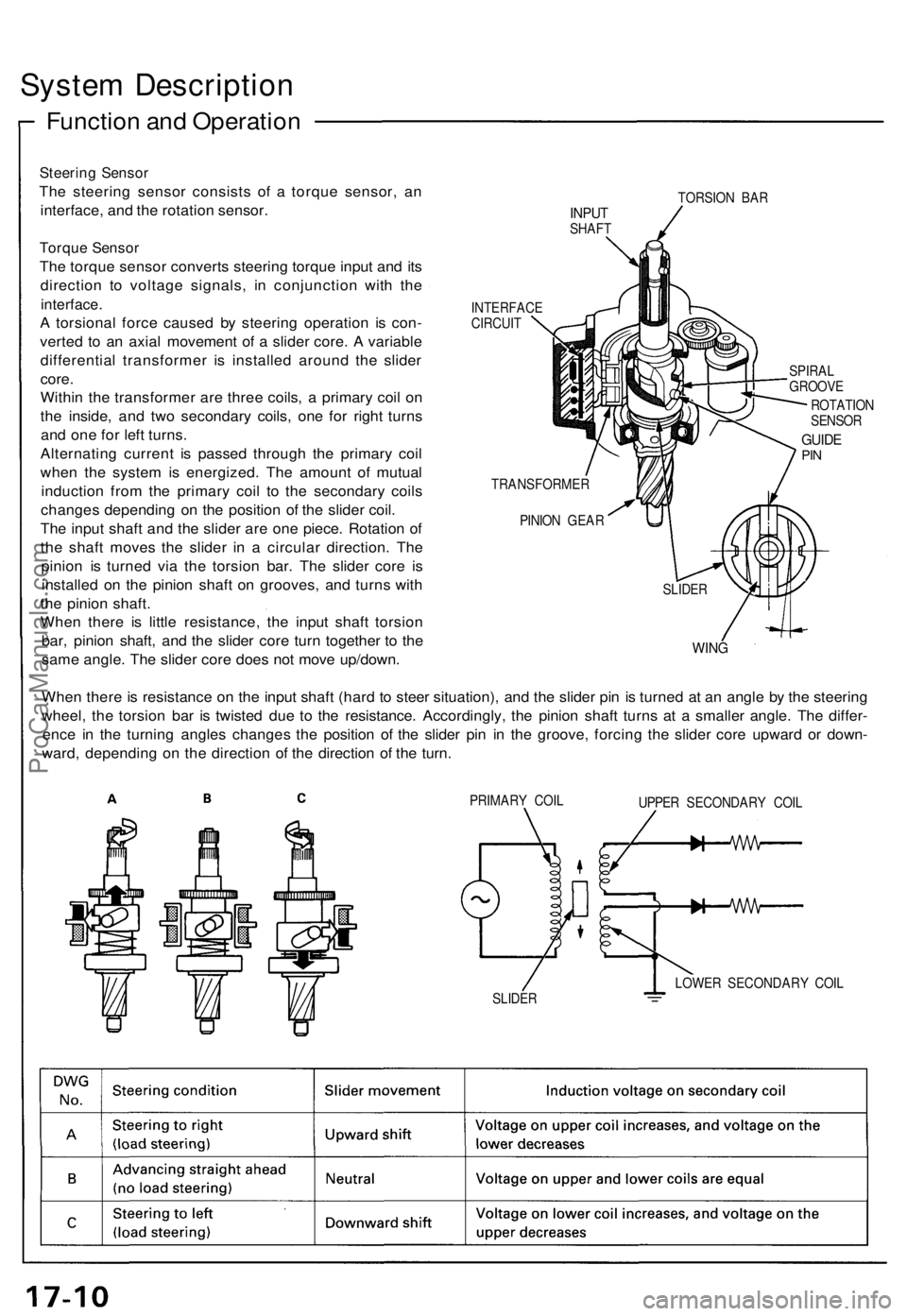
The steering sensor consists of a torque sensor, an
interface, and the rotation sensor.
Torque Sensor
The torque sensor converts steering torque input and its
direction to voltage signals, in conjunction with the
interface.
A torsional force caused by steering operation is con-
verted to an axial movement of a slider core. A variable
differential transformer is installed around the slider
core.
Within the transformer are three coils, a primary coil on
the inside, and two secondary coils, one for right turns
and one for left turns.
Alternating current is passed through the primary coil
when the system is energized. The amount of mutual
induction from the primary coil to the secondary coils
changes depending on the position of the slider coil.
The input shaft and the slider are one piece. Rotation of
the shaft moves the slider in a circular direction. The
pinion is turned via the torsion bar. The slider core is
installed on the pinion shaft on grooves, and turns with
the pinion shaft.
When there is little resistance, the input shaft torsion
bar, pinion shaft, and the slider core turn together to the
same angle. The slider core does not move up/down.
TORSION BAR
INPUT
SHAFT
INTERFACE
CIRCUIT
SPIRAL
GROOVE
ROTATION
SENSOR
GUIDE
PIN
TRANSFORMER
PINION GEAR
WING
When there is resistance on the input shaft (hard to steer situation), and the slider pin is turned at an angle by the steering
wheel, the torsion bar is twisted due to the resistance. Accordingly, the pinion shaft turns at a smaller angle. The differ-
ence in the turning angles changes the position of the slider pin in the groove, forcing the slider core upward or down-
ward, depending on the direction of the direction of the turn.
PRIMARY COIL
UPPER SECONDARY COIL
LOWER SECONDARY COIL
SLIDER
SLIDERProCarManuals.com
Page 411 of 1640
Rotation Sensor
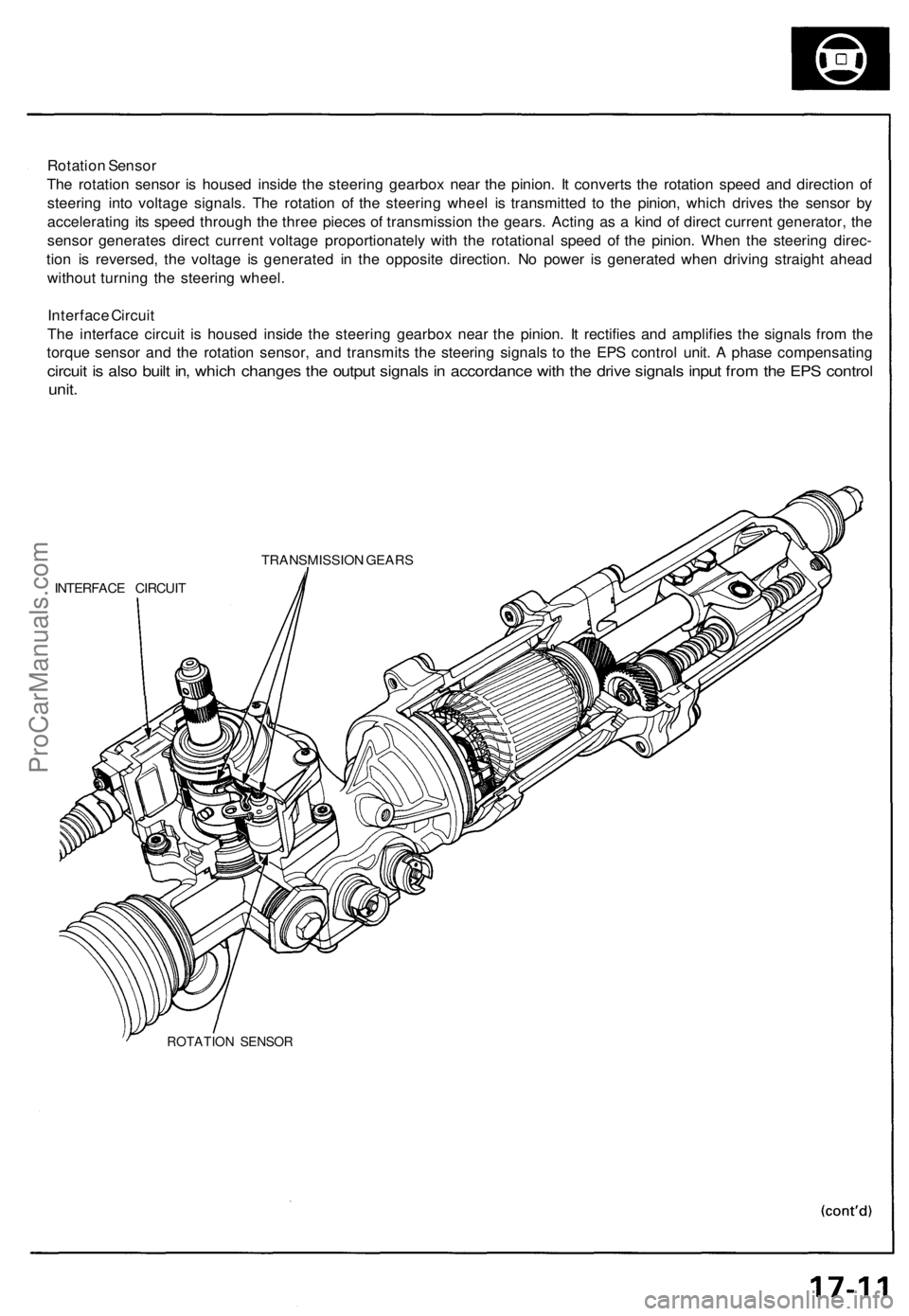
The rotation sensor is housed inside the steering gearbox near the pinion. It converts the rotation speed and direction of
steering into voltage signals. The rotation of the steering wheel is transmitted to the pinion, which drives the sensor by
accelerating its speed through the three pieces of transmission the gears. Acting as a kind of direct current generator, the
sensor generates direct current voltage proportionately with the rotational speed of the pinion. When the steering direc-
tion is reversed, the voltage is generated in the opposite direction. No power is generated when driving straight ahead
without turning the steering wheel.
Interface Circuit
The interface circuit is housed inside the steering gearbox near the pinion. It rectifies and amplifies the signals from the
torque sensor and the rotation sensor, and transmits the steering signals to the EPS control unit. A phase compensating
circuit is also built in, which changes the output signals in accordance with the drive signals input from the EPS control
unit.
TRANSMISSION GEARS
INTERFACE CIRCUIT
ROTATION SENSORProCarManuals.com