sensor ACURA NSX 1991 Service Owner's Guide
[x] Cancel search | Manufacturer: ACURA, Model Year: 1991, Model line: NSX, Model: ACURA NSX 1991Pages: 1640, PDF Size: 60.48 MB
Page 412 of 1640
System Description
Function and Operation
EPS Control Unit
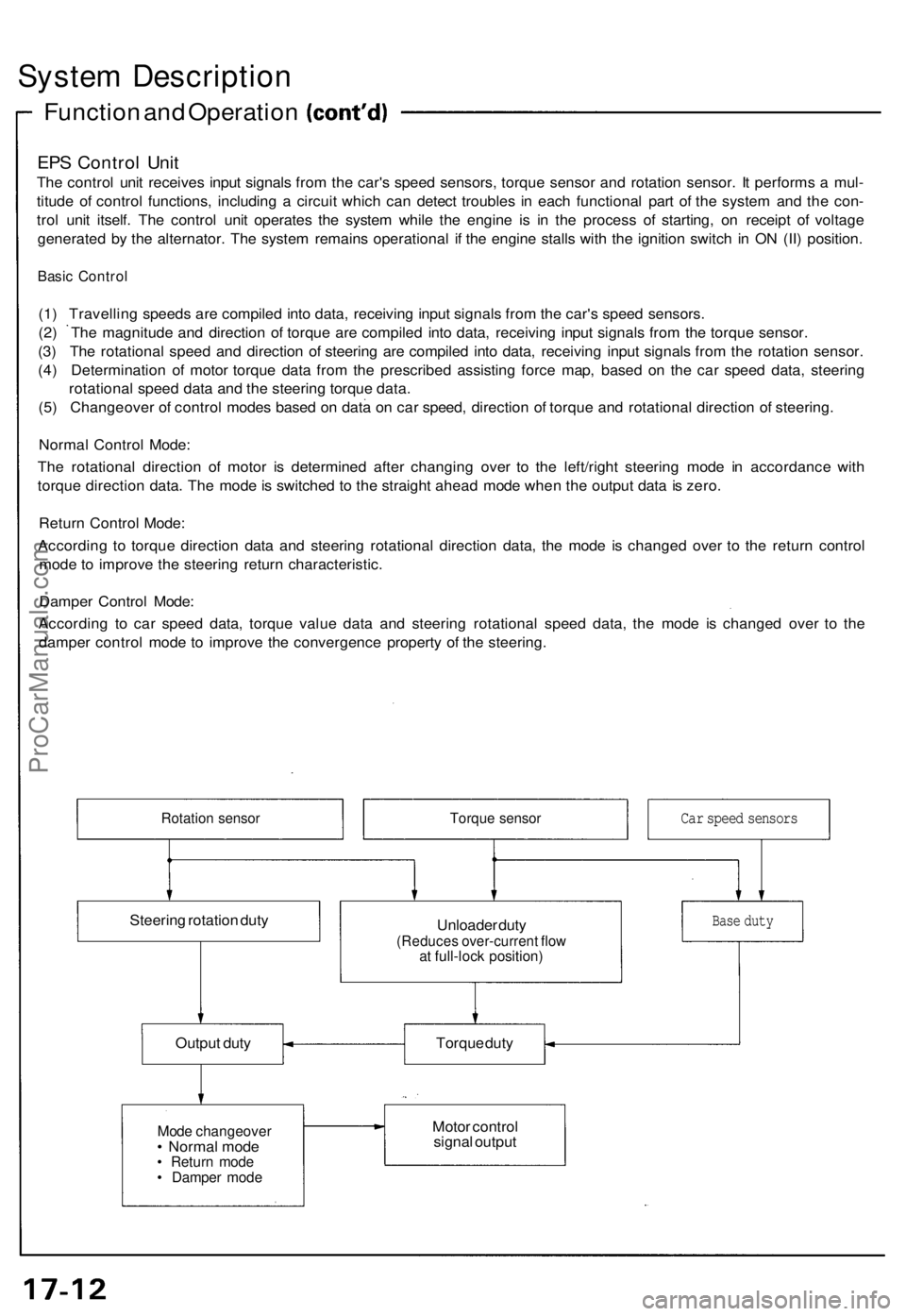
The control unit receives input signals from the car's speed sensors, torque sensor and rotation sensor. It performs a mul-
titude of control functions, including a circuit which can detect troubles in each functional part of the system and the con-
trol unit itself. The control unit operates the system while the engine is in the process of starting, on receipt of voltage
generated by the alternator. The system remains operational if the engine stalls with the ignition switch in ON (II) position.
Basic Control
(1) Travelling speeds are compiled into data, receiving input signals from the car's speed sensors.
(2) The magnitude and direction of torque are compiled into data, receiving input signals from the torque sensor.
(3) The rotational speed and direction of steering are compiled into data, receiving input signals from the rotation sensor.
(4) Determination of motor torque data from the prescribed assisting force map, based on the car speed data, steering
rotational speed data and the steering torque data.
(5) Changeover of control modes based on data on car speed, direction of torque and rotational direction of steering.
Normal Control Mode:
The rotational direction of motor is determined after changing over to the left/right steering mode in accordance with
torque direction data. The mode is switched to the straight ahead mode when the output data is zero.
Return Control Mode:
According to torque direction data and steering rotational direction data, the mode is changed over to the return control
mode to improve the steering return characteristic.
Damper Control Mode:
According to car speed data, torque value data and steering rotational speed data, the mode is changed over to the
damper control mode to improve the convergence property of the steering.
Rotation sensor
Torque sensor
Steering rotation duty
Unloader duty
(Reduces over-current flow
at full-lock position)
Output duty
Torque duty
Mode changeover
• Normal mode
• Return mode
• Damper mode
Motor control
signal output
Base duty
Car speed sensorsProCarManuals.com
Page 413 of 1640
Self-Diagnosis Functio n
Th e EP S contro l uni t monitor s th e syste m input s an d outputs , an d th e drivin g curren t o f th e motor . I f ther e i s a proble m in
th e system , th e contro l uni t turn s th e syste m of f b y actuatin g th e relay . Powe r assis t stop s an d norma l manua l steerin g
operatio n resumes . Th e contro l uni t als o turn s th e EP S indicato r ligh t o n t o aler t th e driver , an d memorize s th e proble m in
th e for m o f a code . Connectin g th e terminal s o f th e servic e chec k connecto r wit h th e SC S servic e connecto r (specia l tool )
enable s th e EP S indicato r ligh t t o blin k th e proble m cod e whe n th e ignitio n switc h i s turne d o n (II) .
Unloade r Contro l
I f th e steerin g whee l i s turne d full y an d hel d in th e full-loc k position , th e steerin g torqu e reache s th e maximu m point , an d
a n over-curren t flow s t o th e motor . Th e contro l uni t detect s thi s an d reduce s th e curren t flo w to th e motor .
Averag e Movin g Curren t Contro l
Th e electri c curren t flo w to th e moto r i s estimate d fro m th e curren t value s detecte d b y th e curren t sensor , an d th e averag e
curren t i s obtaine d a t tw o secon d intervals . Th e moto r drivin g curren t i s suppresse d whe n th e averag e curren t valu e
exceed s a predetermine d margina l value . Th e contro l uni t regulate s th e moto r curren t durin g continuou s loadin g t o sup -
press any excessiv e temperatur e ris e in th e motor .
Over-Voltag e Contro l
I f ther e i s a n excessiv e increas e i n powe r sourc e voltag e du e t o a poo r batter y condition , a n alternato r voltag e regulato r
problem , etc. , th e moto r assistin g forc e increases , resultin g i n excessiv e control . T o preven t this , th e contro l signal s ar e
correcte d to ensur e tha t adequat e assistin g forc e is generated .
ProCarManuals.com
Page 414 of 1640
System Description
Function and Operation
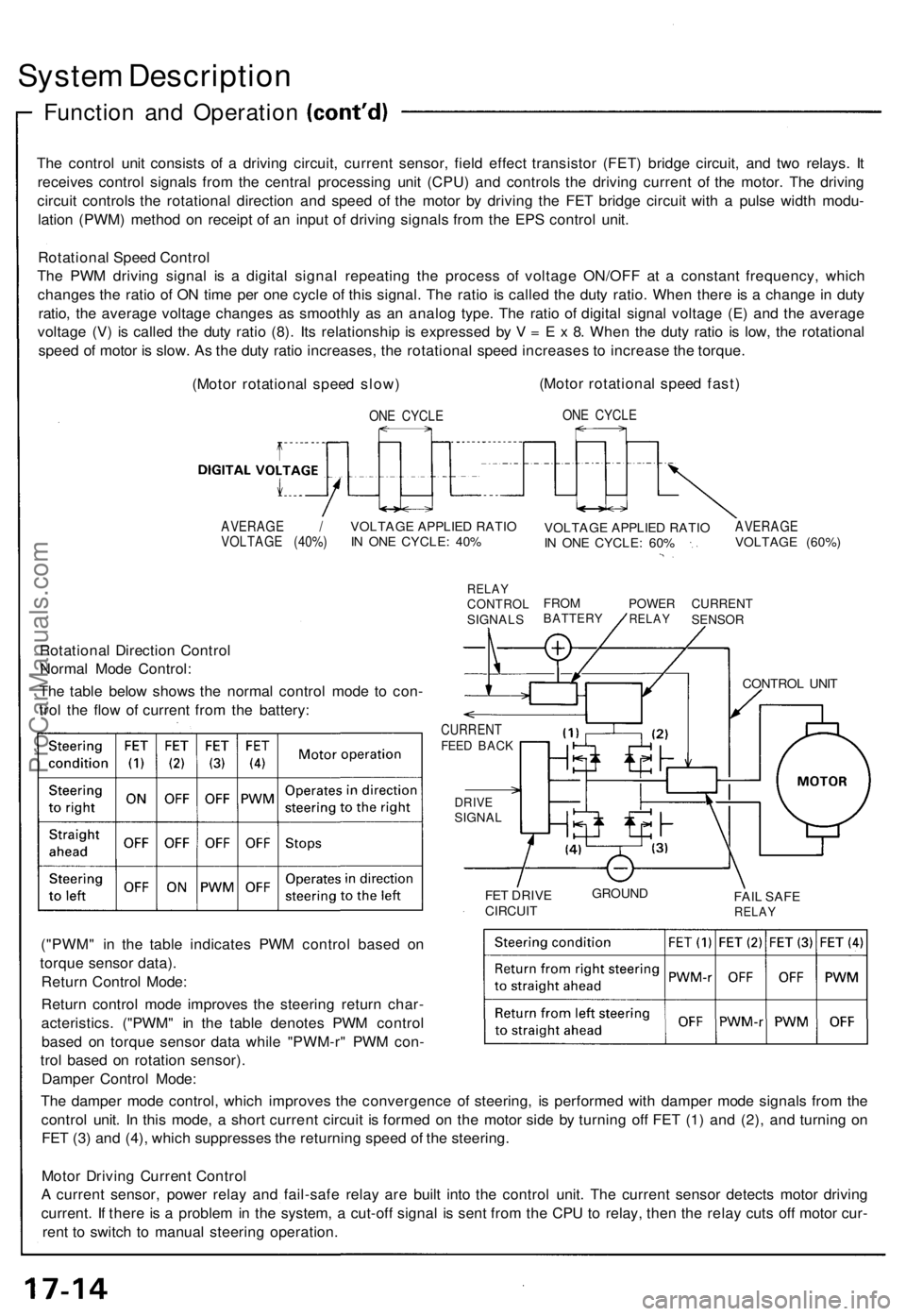
The control unit consists of a driving circuit, current sensor, field effect transistor (FET) bridge circuit, and two relays. It
receives control signals from the central processing unit (CPU) and controls the driving current of the motor. The driving
circuit controls the rotational direction and speed of the motor by driving the FET bridge circuit with a pulse width modu-
lation (PWM) method on receipt of an input of driving signals from the EPS control unit.
Rotational Speed Control
The PWM driving signal is a digital signal repeating the process of voltage ON/OFF at a constant frequency, which
changes the ratio of ON time per one cycle of this signal. The ratio is called the duty ratio. When there is a change in duty
ratio, the average voltage changes as smoothly as an analog type. The ratio of digital signal voltage (E) and the average
voltage (V) is called the duty ratio (8). Its relationship is expressed by V = E x 8. When the duty ratio is low, the rotational
speed of motor is slow. As the duty ratio increases, the rotational speed increases to increase the torque.
(Motor rotational speed slow)
ONE CYCLE
(Motor rotational speed fast)
ONE CYCLE
AVERAGE /
VOLTAGE (40%)
VOLTAGE APPLIED RATIO
IN ONE CYCLE: 40%
RELAY
CONTROL
SIGNALS
VOLTAGE APPLIED RATIO
IN ONE CYCLE: 60%
AVERAGE
VOLTAGE (60%)
FROM
BATTERY
POWER
RELAY
CURRENT
SENSOR
Rotational Direction Control
Normal Mode Control:
The table below shows the normal control mode to con-
trol the flow of current from the battery:
CURRENT
FEED BACK
DRIVE
SIGNAL
FET DRIVE
CIRCUIT
GROUND
FAIL SAFE
RELAY
("PWM" in the table indicates PWM control based on
torque sensor data).
Return Control Mode:
Return control mode improves the steering return char-
acteristics. ("PWM" in the table denotes PWM control
based on torque sensor data while "PWM-r" PWM con-
trol based on rotation sensor).
Damper Control Mode:
The damper mode control, which improves the convergence of steering, is performed with damper mode signals from the
control unit. In this mode, a short current circuit is formed on the motor side by turning off FET (1) and (2), and turning on
FET (3) and (4), which suppresses the returning speed of the steering.
Motor Driving Current Control
A current sensor, power relay and fail-safe relay are built into the control unit. The current sensor detects motor driving
current. If there is a problem in the system, a cut-off signal is sent from the CPU to relay, then the relay cuts off motor cur-
rent to switch to manual steering operation.
CONTROL UNITProCarManuals.com
Page 416 of 1640
Component Location s
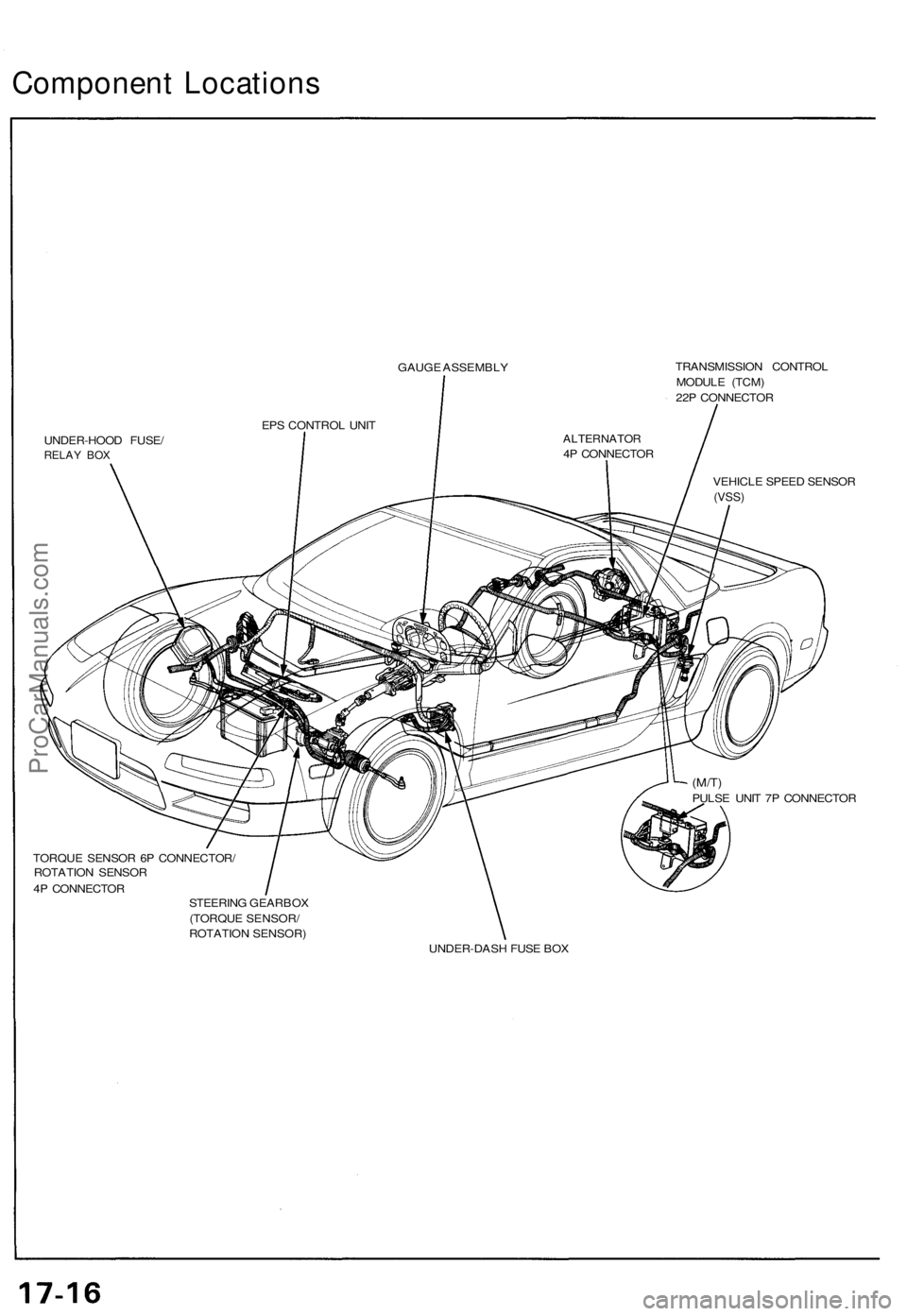
GAUGE ASSEMBL Y
UNDER-HOO D FUSE /
RELAY BO X
TRANSMISSIO N CONTRO L
MODUL E (TCM )
22 P CONNECTO R
VEHICL E SPEE D SENSO R
(VSS)
(M/T)PULS E UNI T 7 P CONNECTO R
TORQU E SENSO R 6 P CONNECTOR /
ROTATIO N SENSO R
4 P CONNECTO R
STEERING GEARBO X
(TORQU E SENSOR /
ROTATIO N SENSOR )
UNDER-DASH FUS E BO X
EP
S CONTRO L UNI T
ALTERNATO R4P CONNECTO R
ProCarManuals.com
Page 433 of 1640
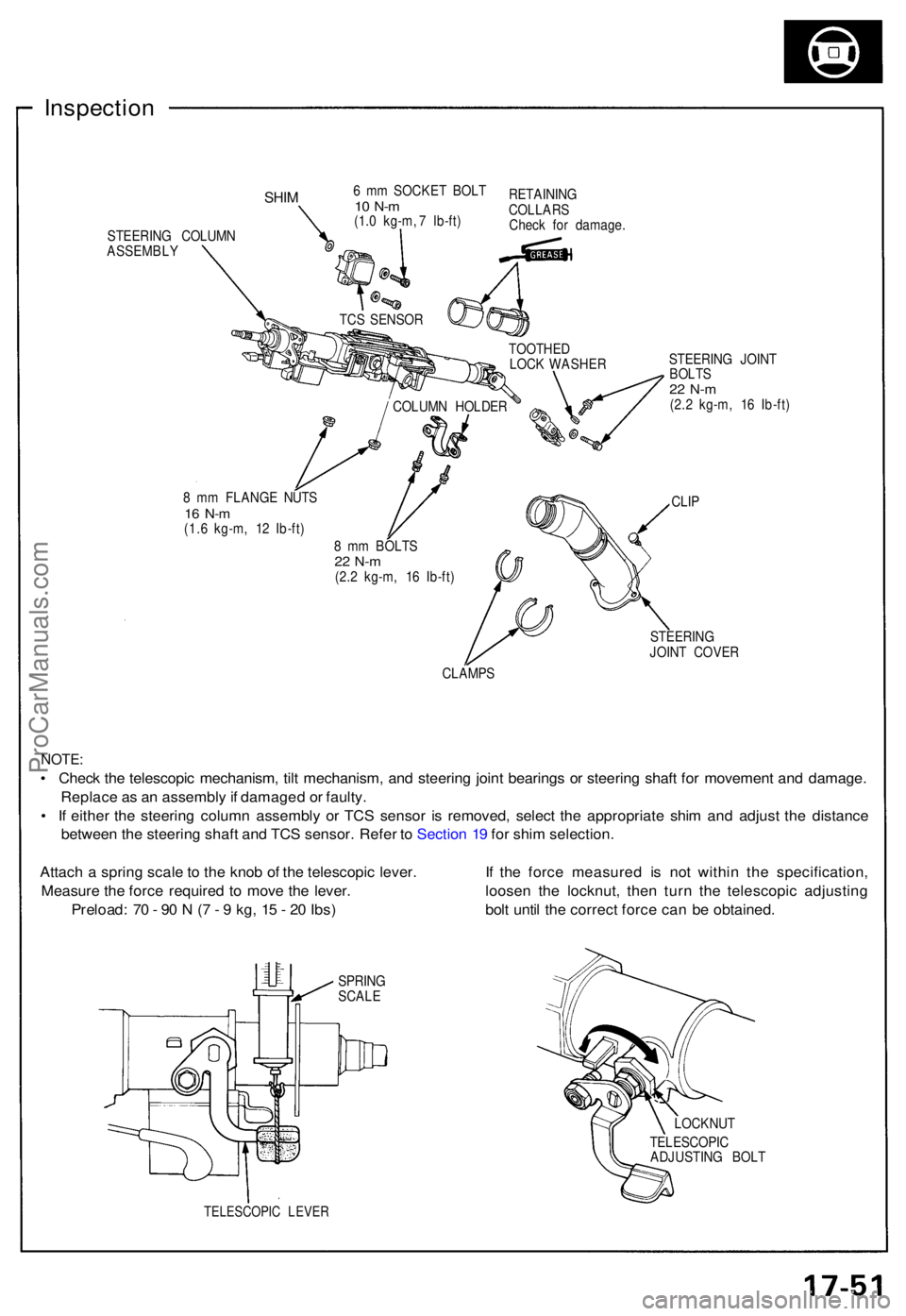
Inspection
SHIM
STEERIN G COLUM N
ASSEMBL Y 6
m m SOCKE T BOL T
10 N- m(1.0 kg-m , 7 lb-ft ) RETAININ
GCOLLARSCheck fo r damage .
8 m m FLANG E NUT S
16 N- m(1.6 kg-m , 1 2 Ib-ft ) STEERIN
G JOIN T
BOLT S
22 N- m(2.2 kg-m , 1 6 Ib-ft )
CLI P
8 m m BOLT S
22 N- m(2.2 kg-m , 1 6 Ib-ft )
STEERIN GJOINT COVE R
CLAMP S
NOTE:
• Chec k th e telescopi c mechanism , til t mechanism , an d steerin g join t bearing s o r steerin g shaf t fo r movemen t an d damage .
Replac e a s a n assembl y if damage d o r faulty .
• I f eithe r th e steerin g colum n assembl y o r TC S senso r i s removed , selec t th e appropriat e shi m an d adjus t th e distanc e
betwee n th e steerin g shaf t an d TC S sensor . Refe r t o Sectio n 1 9 fo r shi m selection .
Attac h a sprin g scal e to th e kno b o f th e telescopi c lever .
Measur e th e forc e require d t o mov e th e lever .
Preload : 7 0 - 9 0 N (7 - 9 kg , 1 5 - 2 0 Ibs )
SPRIN GSCALE
If th e forc e measure d i s no t withi n th e specification ,
loose n th e locknut , the n tur n th e telescopi c adjustin g
bol t unti l th e correc t forc e ca n b e obtained .
LOCKNUT
TELESCOPI C
ADJUSTIN G BOL T
TELESCOPI C LEVE R
COLUM N HOLDE RTOOTHE
D
LOC K WASHE R
TC
S SENSO R
ProCarManuals.com
Page 435 of 1640
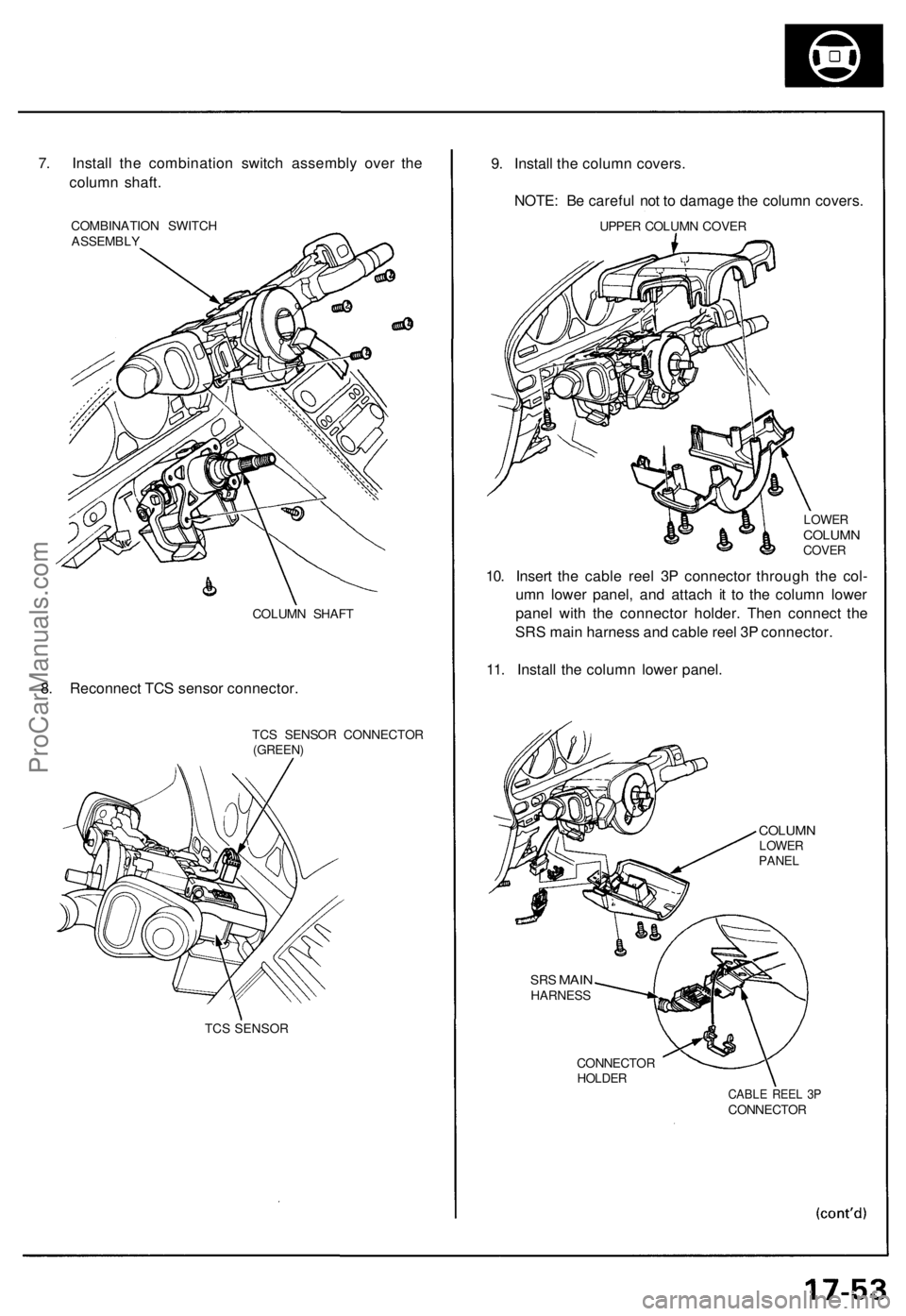
7. Install the combination switch assembly over the
column shaft.
COMBINATION SWITCH
ASSEMBLY
COLUMN SHAFT
8. Reconnect TCS sensor connector.
TCS SENSOR CONNECTOR
(GREEN)
TCS SENSOR
9. Install the column covers.
NOTE: Be careful not to damage the column covers.
UPPER COLUMN COVER
LOWER
COLUMN
COVER
10. Insert the cable reel 3P connector through the col-
umn lower panel, and attach it to the column lower
panel with the connector holder. Then connect the
SRS main harness and cable reel 3P connector.
11. Install the column lower panel.
COLUMN
LOWER
PANEL
SRS
MAIN
HARNESS
CONNECTOR
HOLDER
CABLE REEL 3P
CONNECTORProCarManuals.com
Page 461 of 1640
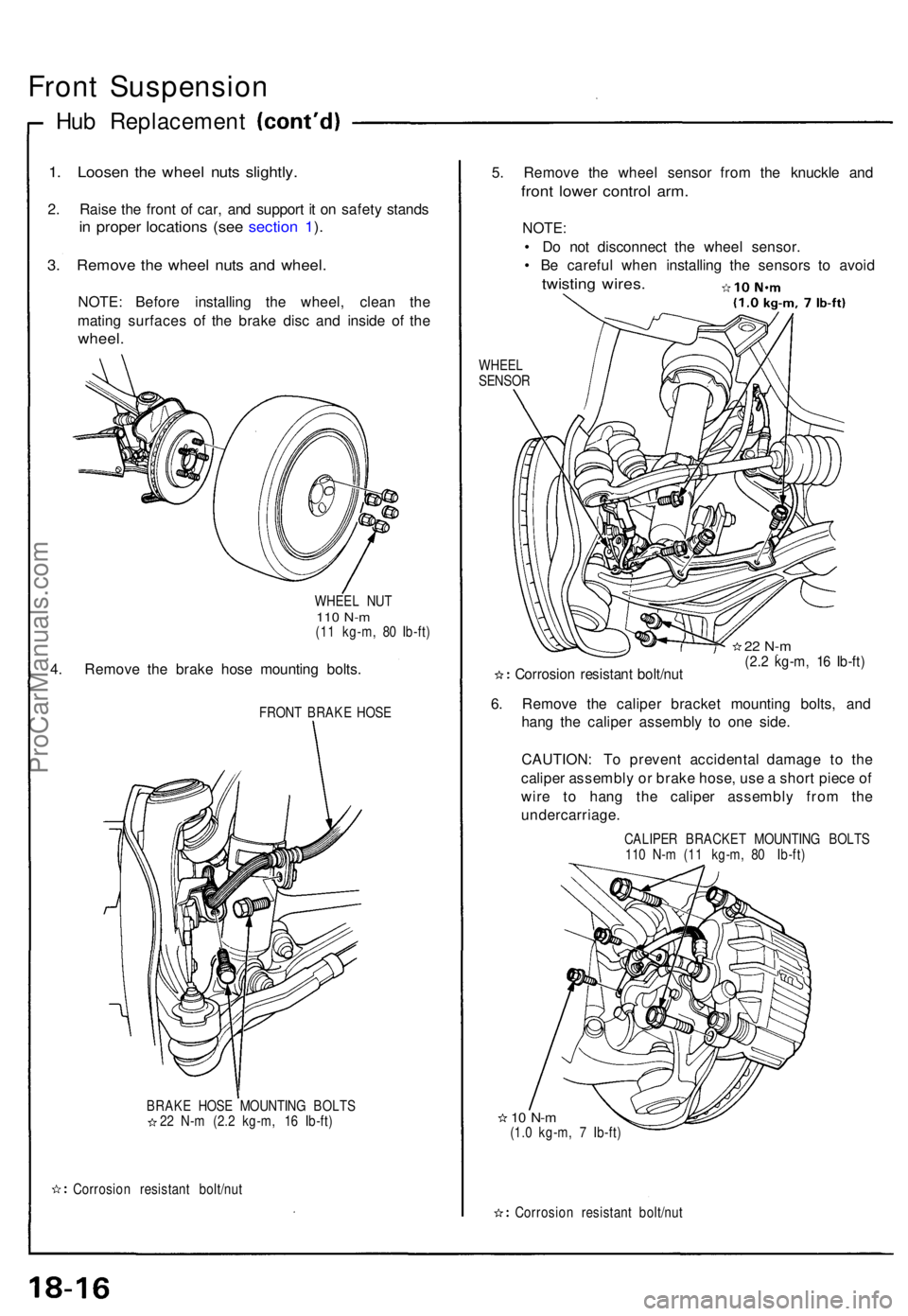
Front Suspensio n
Hub Replacemen t
1. Loose n th e whee l nut s slightly .
2. Rais e th e fron t o f car , an d suppor t i t o n safet y stand s
in prope r location s (se e sectio n 1 ).
3 . Remov e th e whee l nut s an d wheel .
NOTE: Befor e installin g th e wheel , clea n th e
matin g surface s o f th e brak e dis c an d insid e o f th e
wheel .
WHEE L NU T110 N- m(11 kg-m , 8 0 Ib-ft )
4. Remov e th e brak e hos e mountin g bolts .
FRON T BRAK E HOS E
BRAK E HOS E MOUNTIN G BOLT S
2 2 N- m (2. 2 kg-m , 1 6 Ib-ft )
Corrosio n resistan t bolt/nu t
5. Remov e th e whee l senso r fro m th e knuckl e an d
fron t lowe r contro l arm .
NOTE :
• D o no t disconnec t th e whee l sensor .
• B e carefu l whe n installin g th e sensor s t o avoi d
twistin g wires .
WHEE L
SENSO R
Corrosio n resistan t bolt/nu t
22 N- m(2.2 kg-m , 1 6 Ib-ft )
6. Remov e th e calipe r bracke t mountin g bolts , an d
han g th e calipe r assembl y t o on e side .
CAUTION : T o preven t accidenta l damag e t o th e
calipe r assembl y o r brak e hose , us e a shor t piec e o f
wir e t o han g th e calipe r assembl y fro m th e
undercarriage .
CALIPER BRACKE T MOUNTIN G BOLT S
11 0 N- m (1 1 kg-m , 8 0 Ib-ft )
10 N- m(1.0 kg-m , 7 Ib-ft )
Corrosio n resistan t bolt/nu t
ProCarManuals.com
Page 477 of 1640
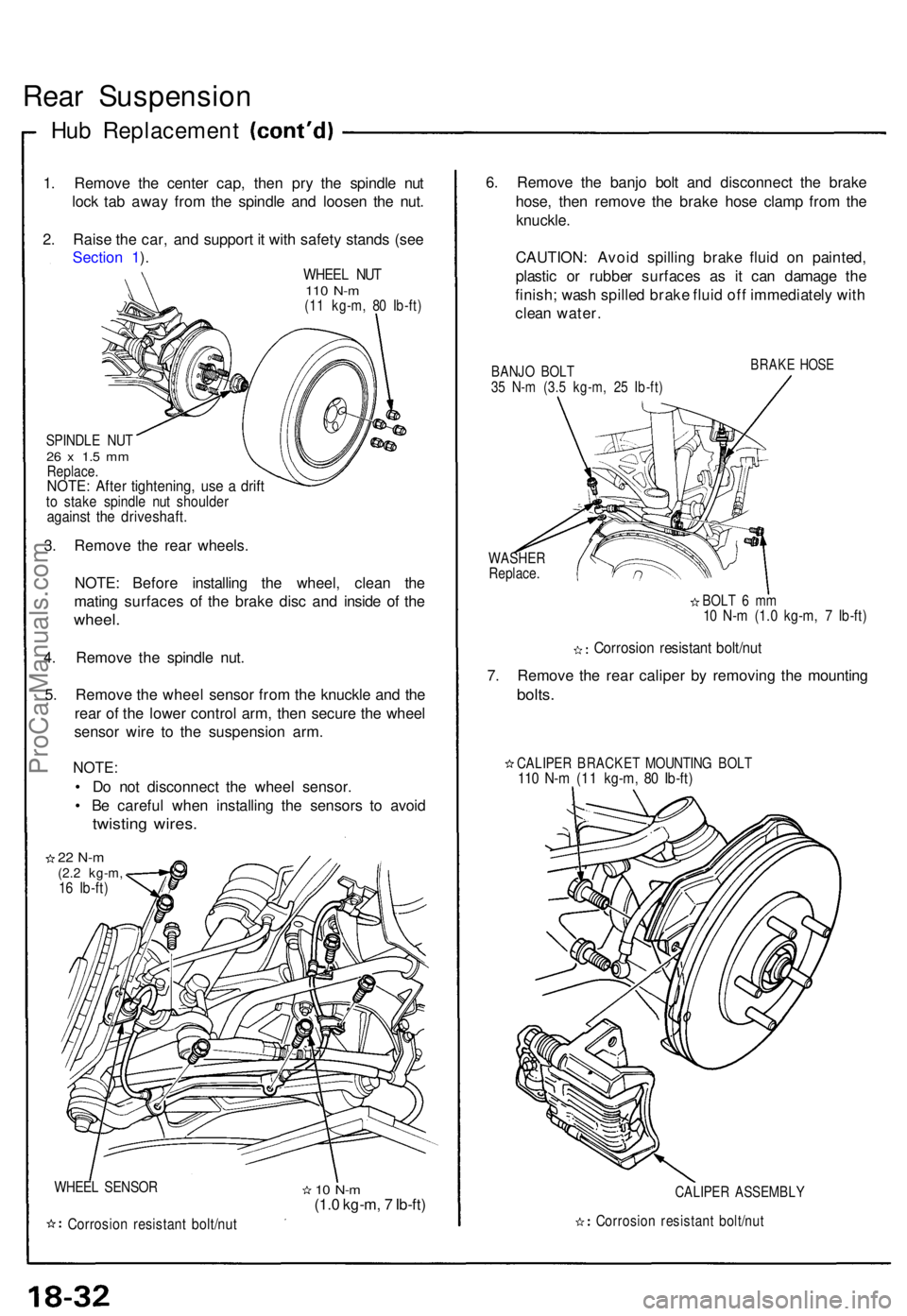
Rear Suspensio n
Hub Replacemen t
1. Remov e th e cente r cap , the n pr y th e spindl e nu t
loc k ta b awa y fro m th e spindl e an d loose n th e nut .
2 . Rais e th e car , an d suppor t i t wit h safet y stand s (se e
Sectio n 1 ).
WHEE L NU T110 N- m(11 kg-m , 8 0 Ib-ft )
SPINDL E NU T26 x 1. 5 m mReplace .NOTE: Afte r tightening , us e a drif tto stak e spindl e nu t shoulde ragainst th e driveshaft .
3. Remov e th e rea r wheels .
NOTE : Befor e installin g th e wheel, clean th e
matin g surface s o f th e brak e dis c an d insid e o f th e
wheel .
4. Remov e th e spindl e nut .
5 . Remov e th e whee l senso r fro m th e knuckl e an d th e
rea r o f th e lowe r contro l arm , the n secur e th e whee l
senso r wir e t o th e suspensio n arm .
NOTE :
• D o no t disconnec t th e whee l sensor .
• B e carefu l whe n installin g th e sensor s t o avoi d
twistin g wires .
22 N- m(2.2 kg-m ,16 Ib-ft )
WHEE L SENSO R
Corrosio n resistan t bolt/nu t
10 N- m(1.0 kg-m , 7 Ib-ft ) 6
. Remov e th e banj o bol t an d disconnec t th e brak e
hose , the n remov e th e brak e hos e clam p fro m th e
knuckle .
CAUTION : Avoi d spillin g brak e flui d o n painted ,
plasti c o r rubbe r surface s a s i t ca n damag e th e
finish ; was h spille d brak e flui d of f immediatel y wit h
clea n water .
BANJO BOL T35 N- m (3. 5 kg-m , 2 5 Ib-ft )
BRAK E HOS E
WASHE RReplace.
BOLT 6 m m10 N- m (1. 0 kg-m , 7 Ib-ft )
Corrosio n resistan t bolt/nu t
7. Remov e th e rea r calipe r b y removin g th e mountin g
bolts.
CALIPE R BRACKE T MOUNTIN G BOL T110 N- m (1 1 kg-m , 8 0 Ib-ft )
CALIPE R ASSEMBL Y
Corrosion resistan t bolt/nu t
ProCarManuals.com
Page 492 of 1640
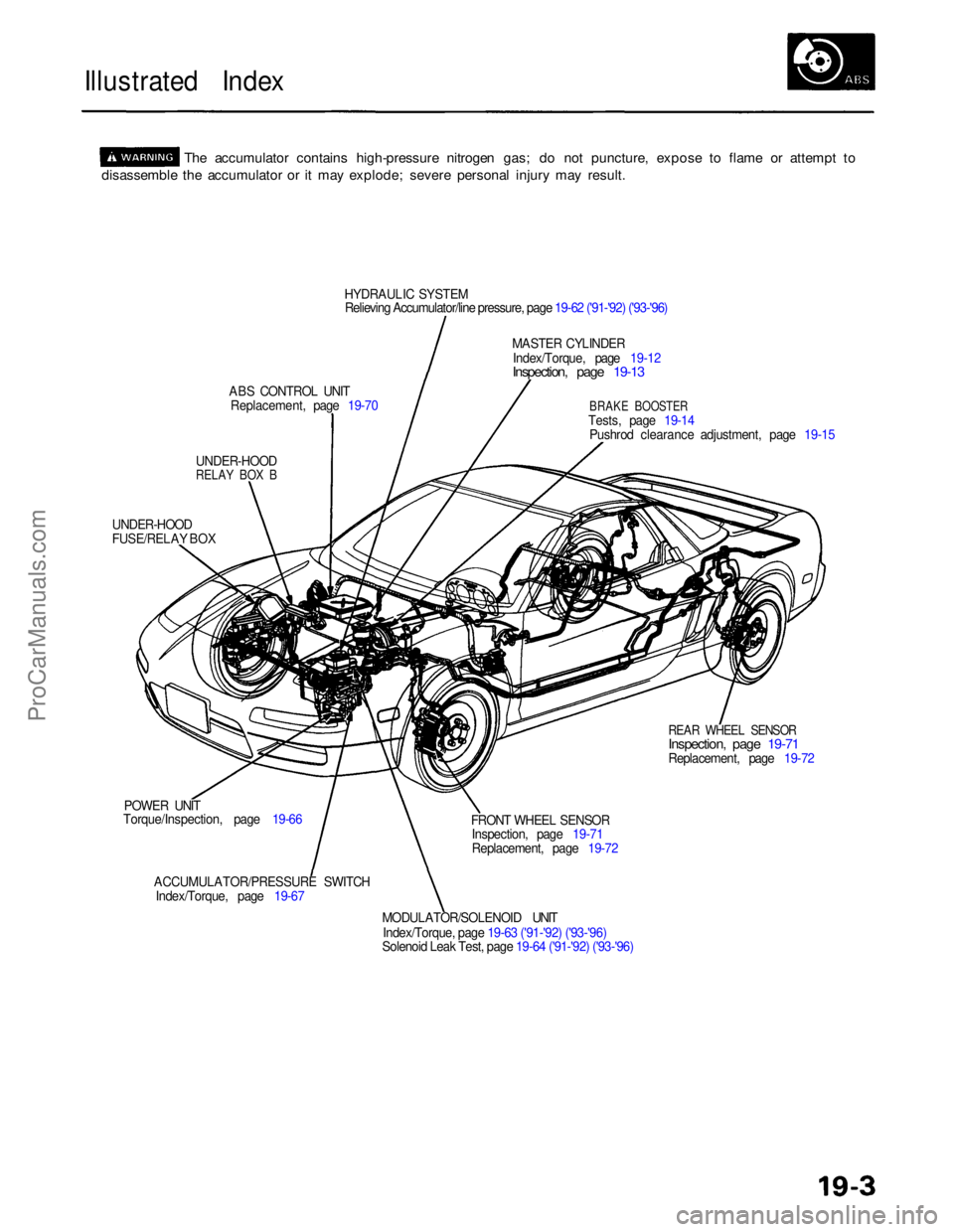
Illustrated Index
The accumulator contains high-pressure nitrogen gas; do not puncture, expose to flame or attempt to
disassemble the accumulator or it may explode; severe personal injury may result.
HYDRAULIC SYSTEM
Relieving Accumulator/line pressure, page 19-62 ('91-'92) ('93-'96)
MASTER CYLINDER
Index/Torque, page 19-12
Inspection, page 19-13
ABS CONTROL UNIT Replacement, page 19-70
BRAKE BOOSTER
Tests, page 19-14 Pushrod clearance adjustment, page 19-15
UNDER-HOOD
RELAY BOX B
UNDER-HOOD
FUSE/RELAY BOX
REAR WHEEL SENSOR
Inspection, page 19-71
Replacement, page 19-72
POWER UNIT
Torque/Inspection, page 19-66
ACCUMULATOR/PRESSURE SWITCHIndex/Torque, page 19-67 FRONT WHEEL SENSOR
Inspection, page 19-71
Replacement, page 19-72
MODULATOR/SOLENOID UNIT
Index/Torque, page 19-63 ('91-'92) ('93-'96)
Solenoid Leak Test, page 19-64 ('91-'92) ('93-'96)
ProCarManuals.com
Page 517 of 1640
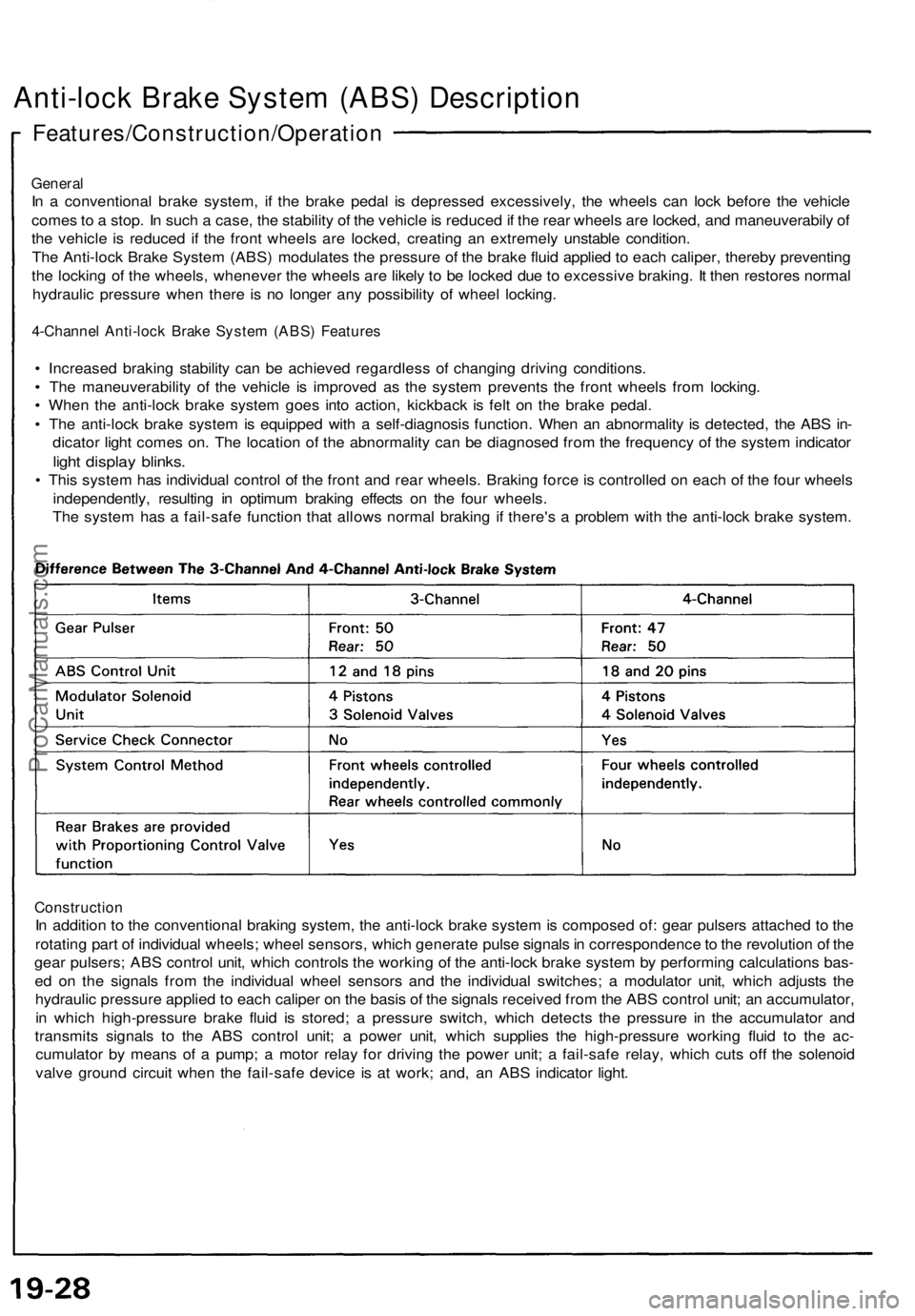
Anti-lock Brake System (ABS) Description
Features/Construction/Operation
General
In a conventional brake system, if the brake pedal is depressed excessively, the wheels can lock before the vehicle
comes to a stop. In such a case, the stability of the vehicle is reduced if the rear wheels are locked, and maneuverabily of
the vehicle is reduced if the front wheels are locked, creating an extremely unstable condition.
The Anti-lock Brake System (ABS) modulates the pressure of the brake fluid applied to each caliper, thereby preventing
the locking of the wheels, whenever the wheels are likely to be locked due to excessive braking. It then restores normal
hydraulic pressure when there is no longer any possibility of wheel locking.
4-Channel Anti-lock Brake System (ABS) Features
• Increased braking stability can be achieved regardless of changing driving conditions.
• The maneuverability of the vehicle is improved as the system prevents the front wheels from locking.
• When the anti-lock brake system goes into action, kickback is felt on the brake pedal.
• The anti-lock brake system is equipped with a self-diagnosis function. When an abnormality is detected, the ABS in-
dicator light comes on. The location of the abnormality can be diagnosed from the frequency of the system indicator
light display blinks.
• This system has individual control of the front and rear wheels. Braking force is controlled on each of the four wheels
independently, resulting in optimum braking effects on the four wheels.
The system has a fail-safe function that allows normal braking if there's a problem with the anti-lock brake system.
Construction
In addition to the conventional braking system, the anti-lock brake system is composed of: gear pulsers attached to the
rotating part of individual wheels; wheel sensors, which generate pulse signals in correspondence to the revolution of the
gear pulsers; ABS control unit, which controls the working of the anti-lock brake system by performing calculations bas-
ed on the signals from the individual wheel sensors and the individual switches; a modulator unit, which adjusts the
hydraulic pressure applied to each caliper on the basis of the signals received from the ABS control unit; an accumulator,
in which high-pressure brake fluid is stored; a pressure switch, which detects the pressure in the accumulator and
transmits signals to the ABS control unit; a power unit, which supplies the high-pressure working fluid to the ac-
cumulator by means of a pump; a motor relay for driving the power unit; a fail-safe relay, which cuts off the solenoid
valve ground circuit when the fail-safe device is at work; and, an ABS indicator light.ProCarManuals.com