engine ACURA NSX 1997 Service Repair Manual
[x] Cancel search | Manufacturer: ACURA, Model Year: 1997, Model line: NSX, Model: ACURA NSX 1997Pages: 1503, PDF Size: 57.08 MB
Page 625 of 1503
Throttle Bod y
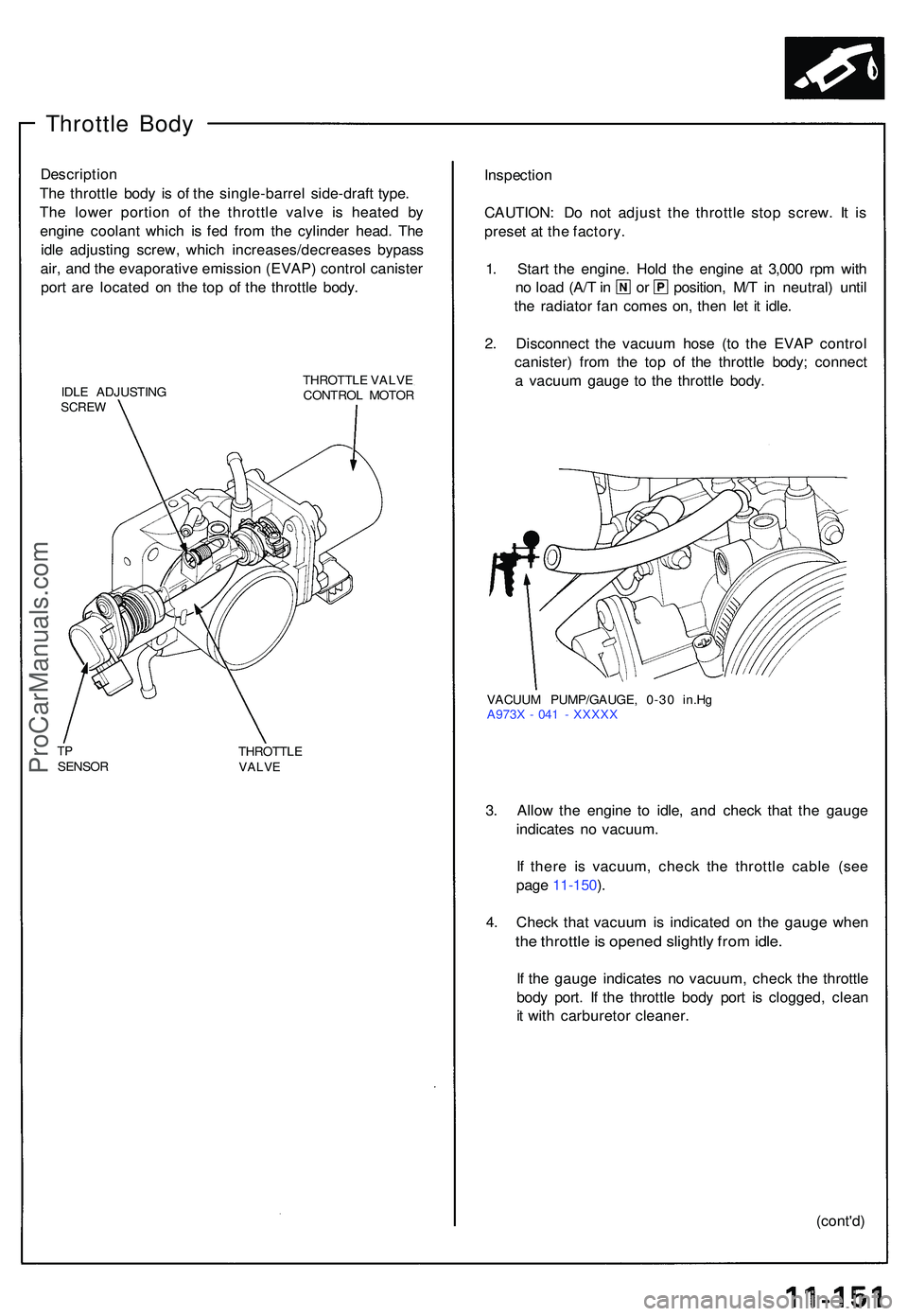
Descriptio n
Th e throttl e bod y i s o f th e single-barre l side-draf t type .
Th e lowe r portio n o f th e throttl e valv e i s heate d b y
engine coolan t whic h i s fe d fro m th e cylinde r head . Th e
idl e adjustin g screw , whic h increases/decrease s bypas s
air , an d th e evaporativ e emissio n (EVAP ) contro l caniste r
por t ar e locate d o n th e to p o f th e throttl e body .
IDLE ADJUSTIN GSCREW
THROTTL E VALV E
CONTRO L MOTO R
TPSENSO R THROTTL
EVALVE
Inspectio n
CAUTION : D o no t adjus t th e throttl e sto p screw . I t i s
prese t a t th e factory .
1 . Star t th e engine . Hol d th e engine at 3,00 0 rp m wit h
no loa d (A/ T in o r position , M/ T i n neutral ) unti l
th e radiato r fa n come s on , the n le t i t idle .
2 . Disconnec t th e vacuu m hos e (t o th e EVA P contro l
canister ) fro m th e to p o f th e throttl e body ; connec t
a vacuu m gaug e t o th e throttl e body .
VACUU M PUMP/GAUGE , 0-3 0 in.H g
A973 X - 04 1 - XXXX X
3. Allo w th e engine to idle , an d chec k tha t th e gaug e
indicate s n o vacuum .
I f ther e i s vacuum , chec k th e throttl e cabl e (se e
pag e 11-150 ).
4 . Chec k tha t vacuu m is indicate d o n th e gaug e whe n
the throttl e is opene d slightl y fro m idle .
If th e gaug e indicate s n o vacuum , chec k th e throttl e
bod y port . I f th e throttl e bod y por t i s clogged , clea n
i t wit h carbureto r cleaner .
(cont'd)
ProCarManuals.com
Page 628 of 1503
Intake Air System
Intake Air Bypass (IAB) Control System
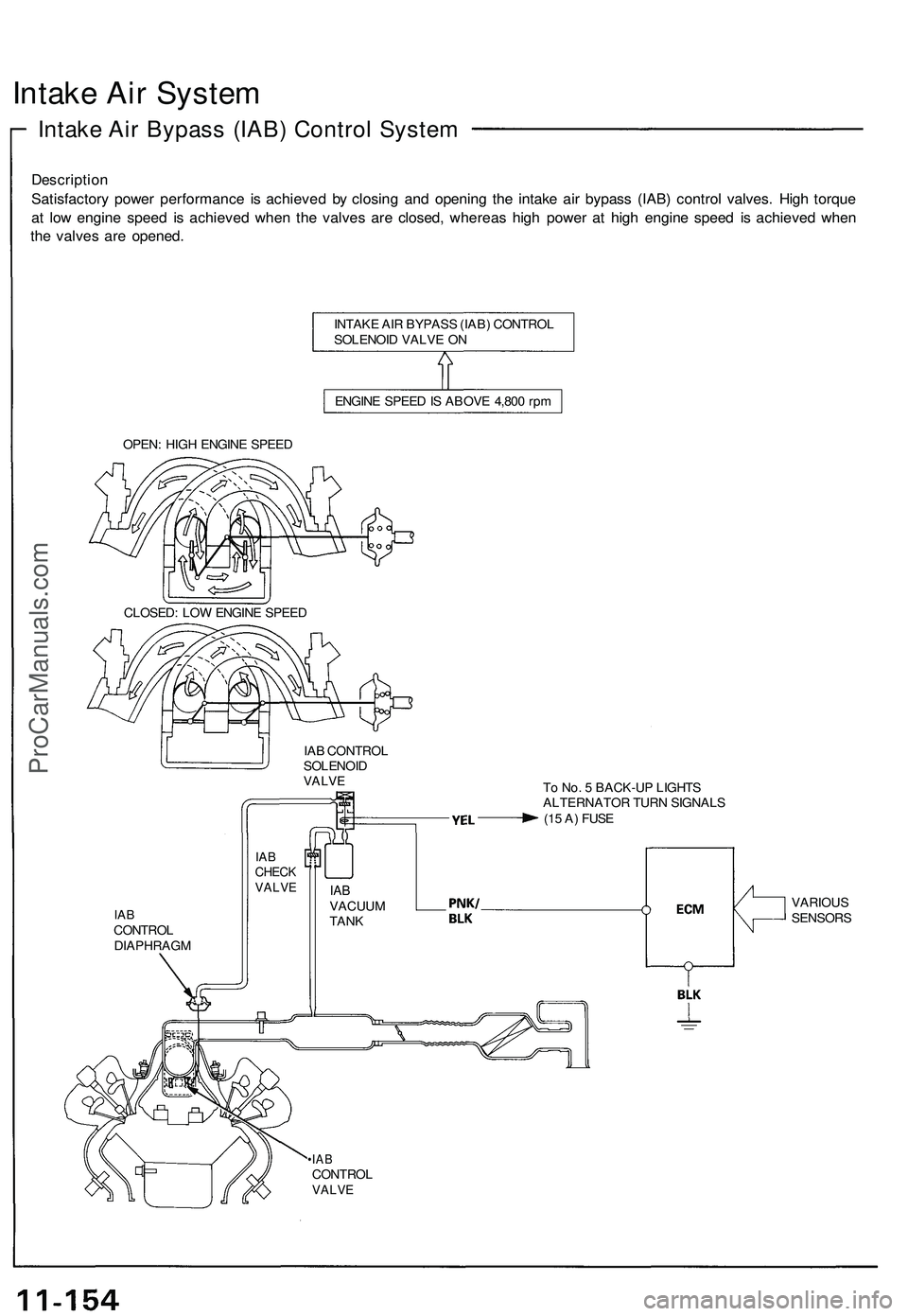
Description
Satisfactory power performance is achieved by closing and opening the intake air bypass (IAB) control valves. High torque
at low engine speed is achieved when the valves are closed, whereas high power at high engine speed is achieved when
the valves are opened.
INTAKE AIR BYPASS (IAB) CONTROL
SOLENOID VALVE ON
ENGINE SPEED IS ABOVE 4,800 rpm
OPEN: HIGH ENGINE SPEED
CLOSED: LOW ENGINE SPEED
IAB CONTROL
SOLENOID
VALVE
To No. 5 BACK-UP LIGHTS
ALTERNATOR TURN SIGNALS
(15 A) FUSE
IAB
CONTROL
DIAPHRAGM
•IAB
CONTROL
VALVE
IAB
CHECK
VALVE
IAB
VACUUM
TANK
VARIOUS
SENSORSProCarManuals.com
Page 632 of 1503
Emission Contro l Syste m
System Descriptio n
The emissio n contro l syste m include s tw o Thre e Wa y
Catalyti c Converter s (TWCs) , Exhaus t Ga s Recirculatio n
(EGR ) system , Positiv e Crankcas e Ventilatio n (PCV ) sys -
te m an d Evaporativ e Emissio n (EVAP ) Contro l system .
Th e emissio n contro l syste m is designe d t o mee t federa l
an d stat e emissio n standards .
Tailpipe Emissio n
1. Star t th e engine . Hol d th e engine at 3,00 0 rp m wit h
no loa d (A/ T in o r position , M/ T in neutral ) unti l
th e radiato r fa n come s on , the n le t i t idle .
2 . Connec t a tachometer .
3 . Chec k an d adjus t th e idl e speed , i f necessar y (se e
pag e 11-129 ).
4 . War m u p an d calibrat e th e C O mete r accordin g t o
th e mete r manufacturer' s instructions .
5 . Chec k idl e C O wit h th e headlights , heate r blower ,
rea r windo w defogger , coolin g fan , an d ai r condi -
tione r off .
NOTE : (Canada ) Pul l th e parkin g brak e leve r up .
Star t th e engine , the n chec k tha t th e headlight s ar e
off.
CO mete r shoul d indicat e 0.1 % maximum .
Inspection
any ope n flam e awa y fro m you r wor k area .
D
o no t smok e durin g thi s procedure . Kee p
ProCarManuals.com
Page 635 of 1503
Emission Control System
Positive Crankcase Ventilation (PCV) System
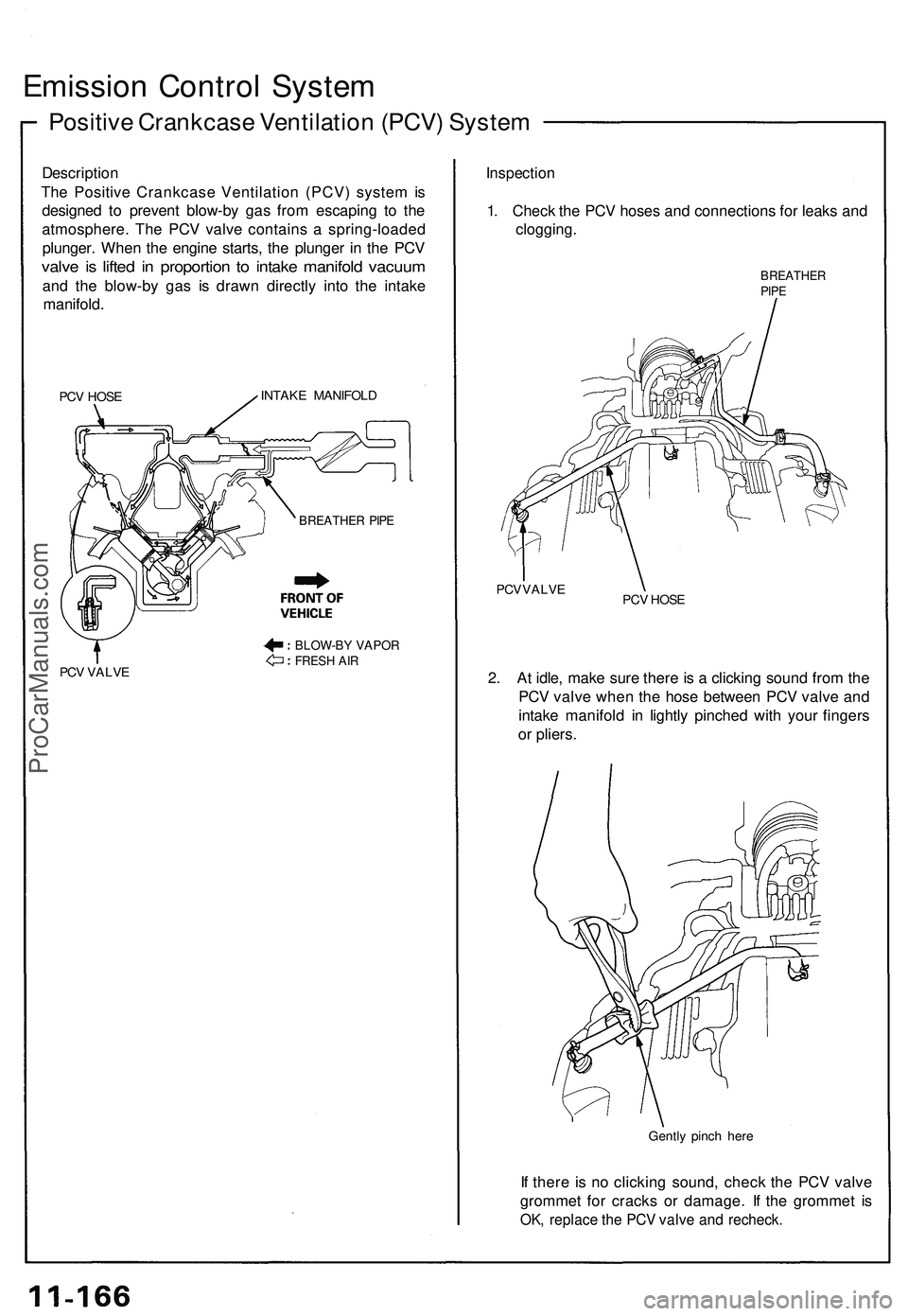
Description
The Positive Crankcase Ventilation (PCV) system is
designed to prevent blow-by gas from escaping to the
atmosphere. The PCV valve contains a spring-loaded
plunger. When the engine starts, the plunger in the PCV
valve is lifted in proportion to intake manifold vacuum
and the blow-by gas is drawn directly into the intake
manifold.
PCV HOSE
INTAKE MANIFOLD
PCV VALVE
Inspection
1. Check the PCV hoses and connections for leaks and
clogging.
BREATHER
PIPE
PCV VALVE
PCV HOSE
2. At idle, make sure there is a clicking sound from the
PCV valve when the hose between PCV valve and
intake manifold in lightly pinched with your fingers
or pliers.
Gently pinch here
If there is no clicking sound, check the PCV valve
grommet for cracks or damage. If the grommet is
OK, replace the PCV valve and recheck.
BLOW-BY VAPOR
FRESH AIR
BREATHER PIPEProCarManuals.com
Page 636 of 1503
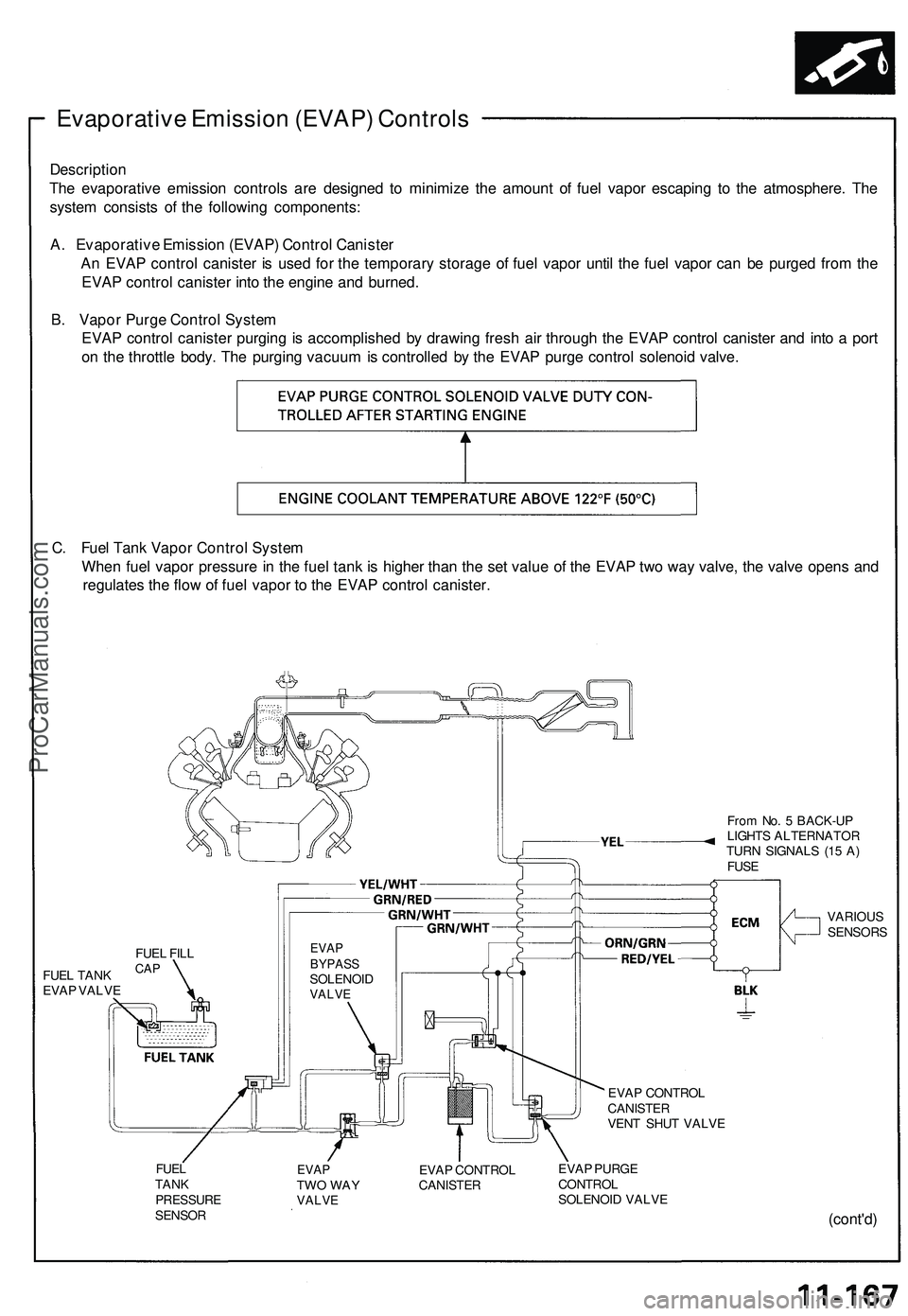
Evaporative Emission (EVAP) Controls
Description
The evaporative emission controls are designed to minimize the amount of fuel vapor escaping to the atmosphere. The
system consists of the following components:
A. Evaporative Emission (EVAP) Control Canister
An EVAP control canister is used for the temporary storage of fuel vapor until the fuel vapor can be purged from the
EVAP control canister into the engine and burned.
B. Vapor Purge Control System
EVAP control canister purging is accomplished by drawing fresh air through the EVAP control canister and into a port
on the throttle body. The purging vacuum is controlled by the EVAP purge control solenoid valve.
C. Fuel Tank Vapor Control System
When fuel vapor pressure in the fuel tank is higher than the set value of the EVAP two way valve, the valve opens and
regulates the flow of fuel vapor to the EVAP control canister.
From No. 5 BACK-UP
LIGHTS ALTERNATOR
TURN SIGNALS (15 A)
FUSE
FUEL TANK
EVAP VALVE
EVAP
BYPASS
SOLENOID
VALVE
VARIOUS
SENSORS
EVAP CONTROL
CANISTER
VENT SHUT VALVE
FUEL
TANK
PRESSURE
SENSOR
EVAP
TWO WAY
VALVE
EVAP CONTROL
CANISTER
EVAP PURGE
CONTROL
SOLENOID VALVE
(cont'd)
FUEL FILL
CAPProCarManuals.com
Page 637 of 1503
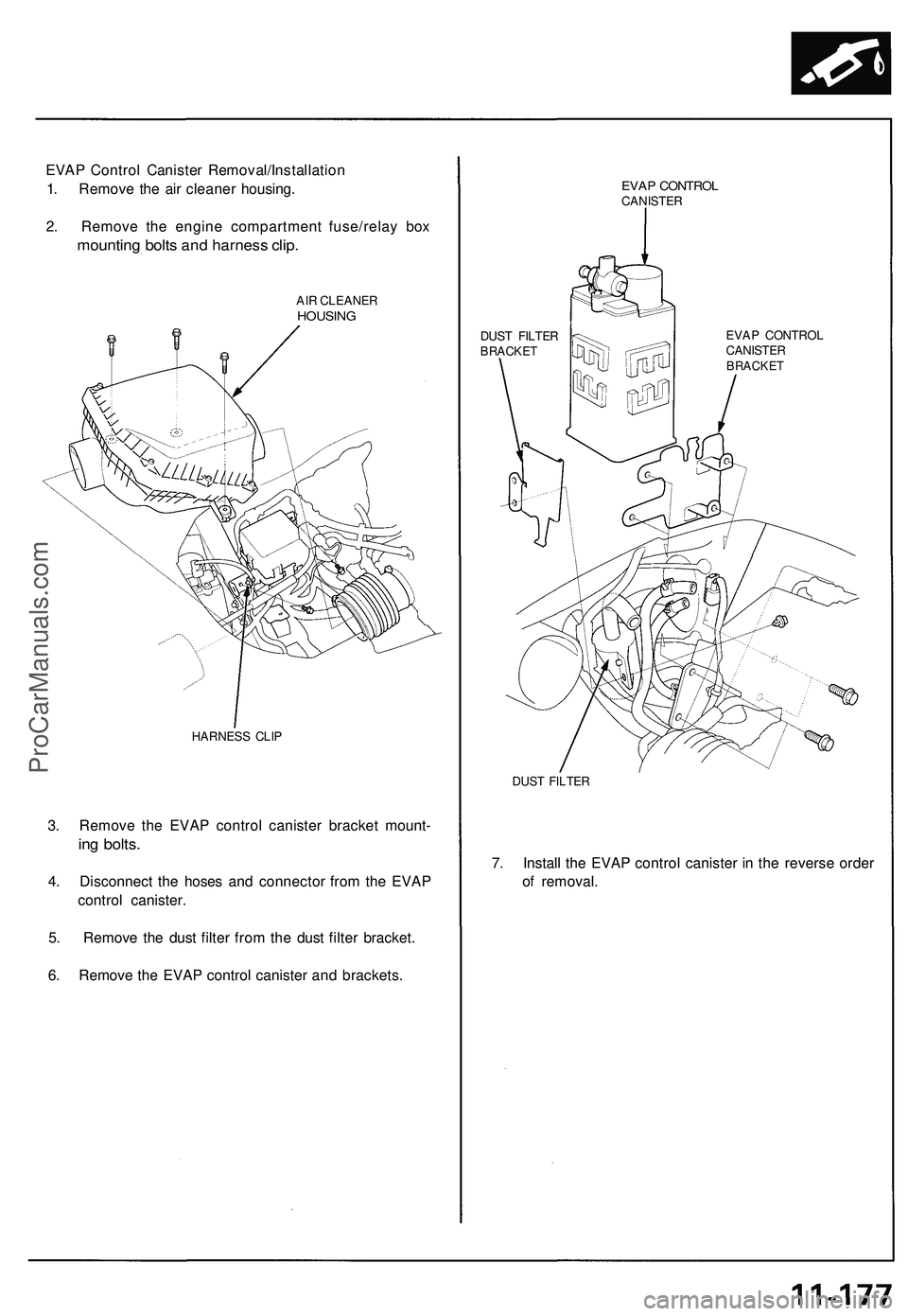
EVAP Control Canister Removal/Installation
1. Remove the air cleaner housing.
2. Remove the engine compartment fuse/relay box
mounting bolts and harness clip.
AIR CLEANER
HOUSING
HARNESS CLIP
3. Remove the EVAP control canister bracket mount-
ing bolts.
4. Disconnect the hoses and connector from the EVAP
control canister.
5. Remove the dust filter from the dust filter bracket.
6. Remove the EVAP control canister and brackets.
EVAP CONTROL
CANISTER
DUST FILTER
BRACKET
EVAP CONTROL
CANISTER
BRACKET
DUST FILTER
7. Install the EVAP control canister in the reverse order
of removal.ProCarManuals.com
Page 640 of 1503
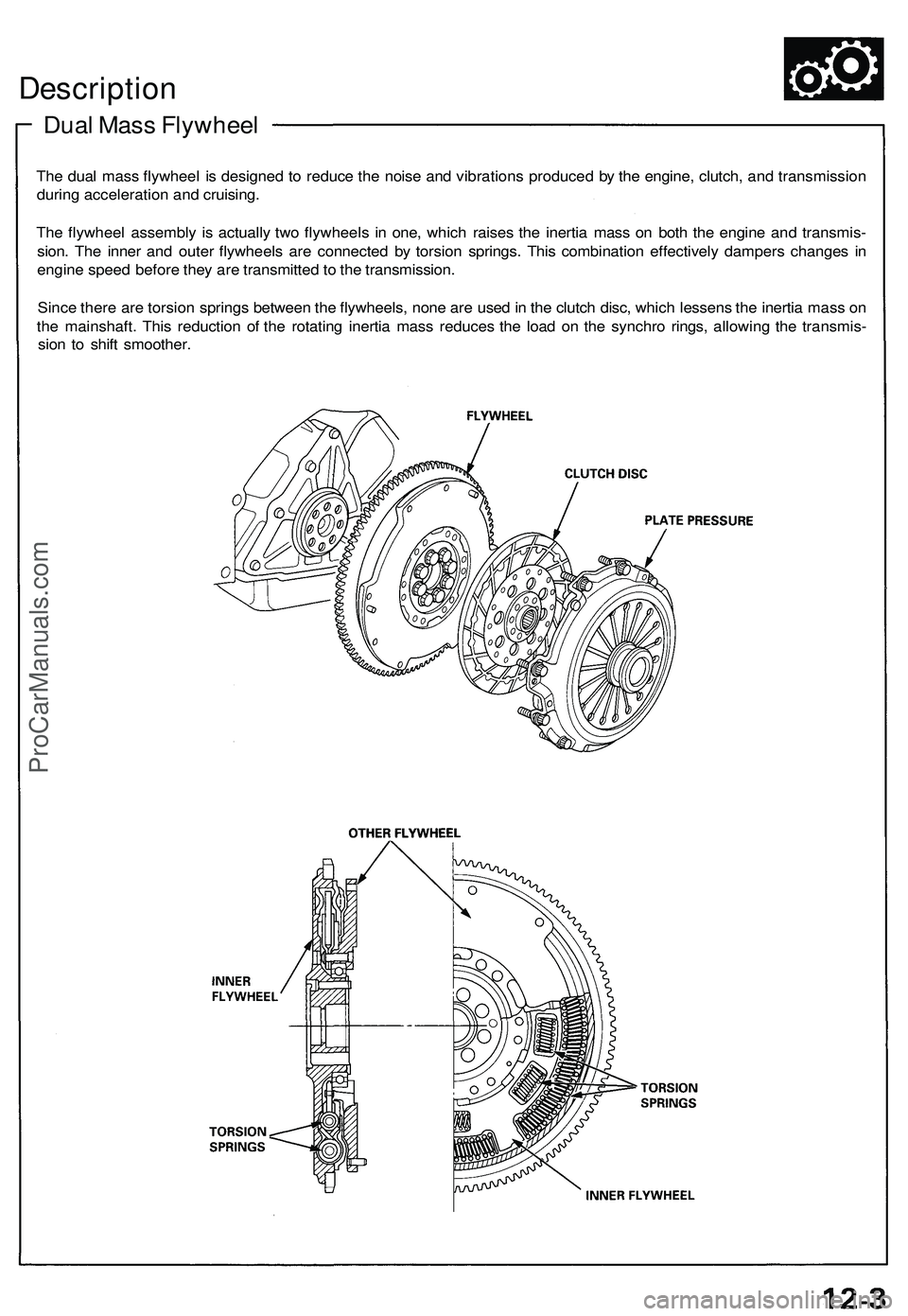
Description
Dual Mas s Flywhee l
The dua l mas s flywhee l i s designe d t o reduc e th e nois e an d vibration s produce d b y th e engine , clutch , an d transmissio n
durin g acceleratio n an d cruising .
Th e flywhee l assembl y i s actuall y tw o flywheel s i n one , whic h raise s th e inerti a mas s o n bot h th e engin e an d transmis -
sion . Th e inne r an d oute r flywheel s ar e connecte d b y torsio n springs . Thi s combinatio n effectivel y damper s change s i n
engin e spee d befor e the y ar e transmitte d to th e transmission .
Sinc e ther e ar e torsio n spring s betwee n th e flywheels , non e ar e use d in th e clutc h disc , whic h lessen s th e inerti a mas s o n
th e mainshaft . Thi s reductio n o f th e rotatin g inerti a mas s reduce s th e loa d o n th e synchr o rings , allowin g th e transmis -
sio n t o shif t smoother .
ProCarManuals.com
Page 663 of 1503
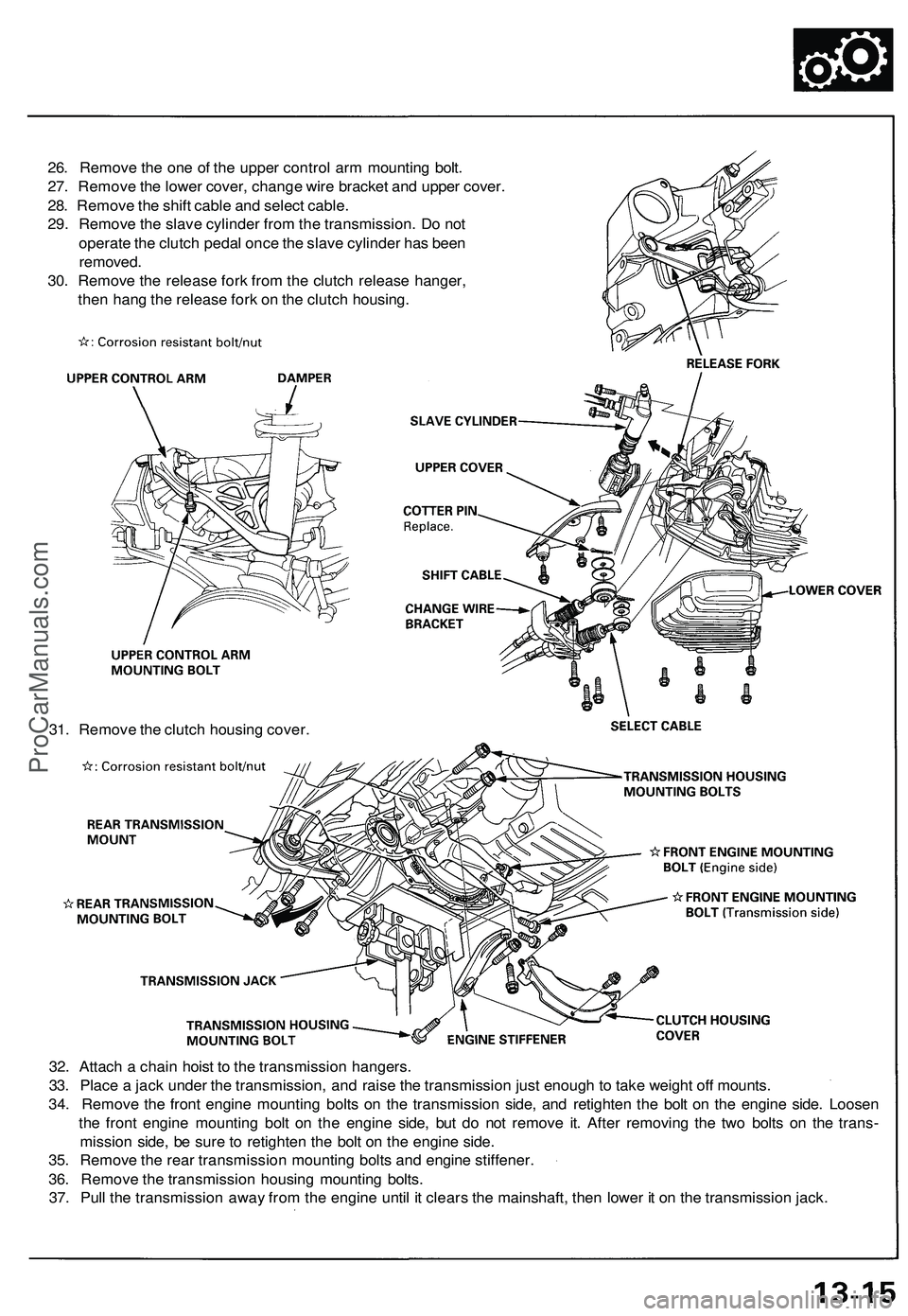
32. Attach a chain hoist to the transmission hangers.
33. Place a jack under the transmission, and raise the transmission just enough to take weight off mounts.
34. Remove the front engine mounting bolts on the transmission side, and retighten the bolt on the engine side. Loosen
the front engine mounting bolt on the engine side, but do not remove it. After removing the two bolts on the trans-
mission side, be sure to retighten the bolt on the engine side.
35. Remove the rear transmission mounting bolts and engine stiffener.
36. Remove the transmission housing mounting bolts.
37. Pull the transmission away from the engine until it clears the mainshaft, then lower it on the transmission jack.
26. Remove the one of the upper control arm mounting bolt.
27. Remove the lower cover, change wire bracket and upper cover.
28. Remove the shift cable and select cable.
29. Remove the slave cylinder from the transmission. Do not
operate the clutch pedal once the slave cylinder has been
removed.
30. Remove the release fork from the clutch release hanger,
then hang the release fork on the clutch housing.
31. Remove the clutch housing cover.ProCarManuals.com
Page 707 of 1503
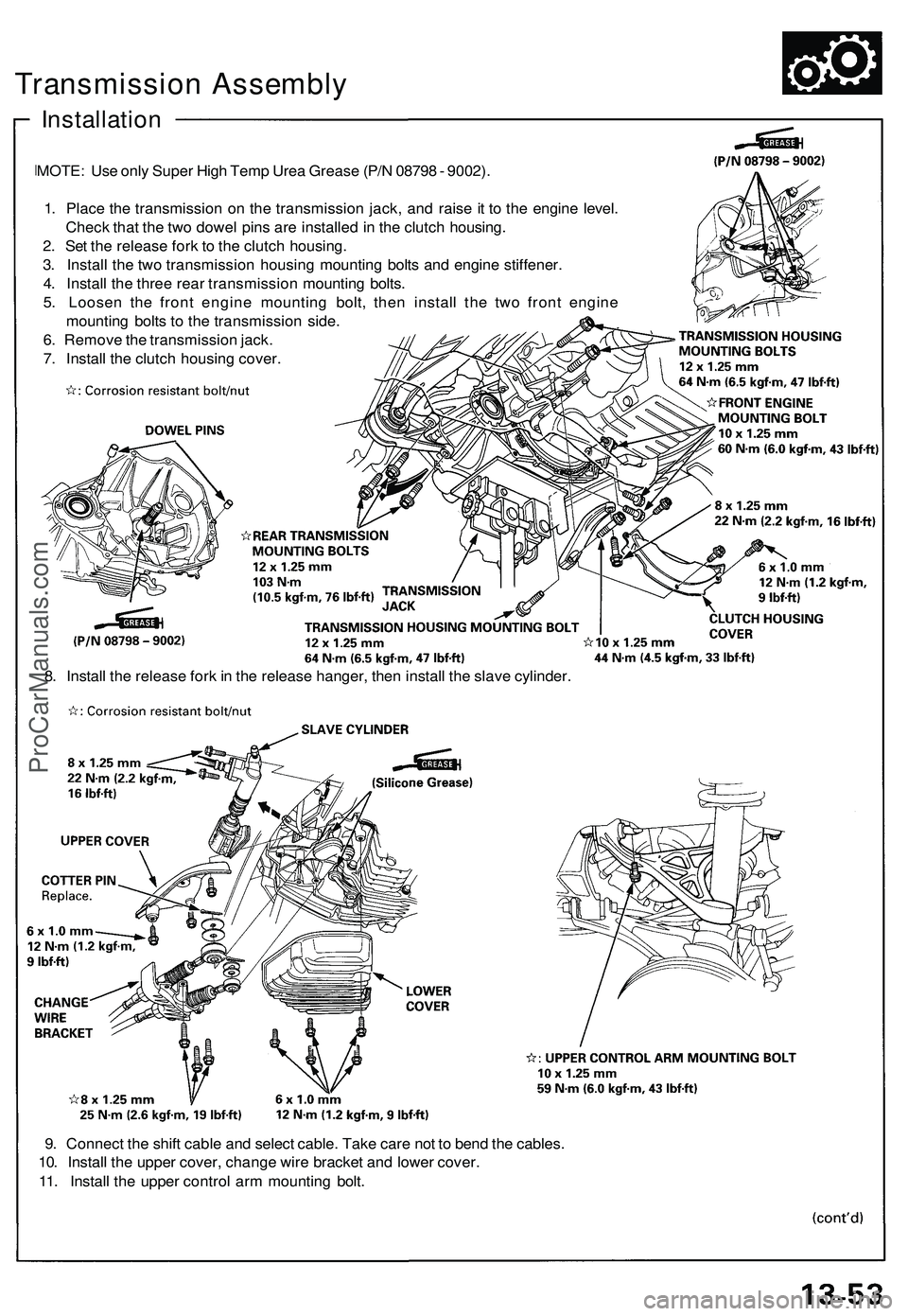
Transmission Assembly
Installation
MOTE: Use only Super High Temp Urea Grease (P/N 08798 - 9002).
1. Place the transmission on the transmission jack, and raise it to the engine level.
Check that the two dowel pins are installed in the clutch housing.
2. Set the release fork to the clutch housing.
3. Install the two transmission housing mounting bolts and engine stiffener.
4. Install the three rear transmission mounting bolts.
5. Loosen the front engine mounting bolt, then install the two front engine
mounting bolts to the transmission side.
6. Remove the transmission jack.
7. Install the clutch housing cover.
8. Install the release fork in the release hanger, then install the slave cylinder.
9. Connect the shift cable and select cable. Take care not to bend the cables.
10. Install the upper cover, change wire bracket and lower cover.
11. Install the upper control arm mounting bolt.ProCarManuals.com
Page 713 of 1503
Description
The automatic transmission is a combination of a 3-element torque converter and a triple-shaft electronically controlled
automatic transmission which provides 4 speeds forward and 1 speed reverse. The entire unit is positioned in line with the
engine.
Torque Converter, Gears, and Clutches
The torque converter consists of a pump, turbine, and stator, assembled in a single unit.
They are connected to the engine crankshaft so they turn together as a unit as the engine turns.
Around the outside of the torque converter is a ring gear which meshes with the starter pinion when the engine is being
started. The entire torque converter assembly serves as a flywheel while transmitting power to the transmission main-
shaft. The transmission has three parallel shafts: the mainshaft, the countershaft, and the secondary shaft. The mainshaft
is in line with the engine crankshaft.
The mainshaft includes the 1st and 4th clutches, and gears for 3rd, 4th, reverse, and 1st (3rd gear is integral with the main-
shaft, while reverse gear is integral with 4th gear).
The countershaft includes the 1st-hold and 3rd clutches, and gears for 2nd, 3rd, 4th, reverse, 1st, and parking.
The secondary shaft includes the 2nd clutch and gears for 2nd and 3rd.
The 4th and reverse gears can be locked to the countershaft at its center, providing 4th gear or reverse, depending on
which way the selector is moved.
The gears on the mainshaft and secondary shaft are in constant mesh with those on the countershaft.
When certain combinations of gears in the transmission are engaged by clutches, power is transmitted from the mainshaft
to the countershaft to provide positions.
Electronic Control
The electronic control system consists of the Transmission Control Module (TCM), sensors, a linear solenoid, a shift switch,
and 4 solenoid valves. Shifting and lock-up are electronically controlled for comfortable driving under all conditions.
The TCM is located on the insulator center bulkhead, behind the driver's seat.
Hydraulic Control
The valve bodies include the main valve body, secondary valve body, servo body, regulator valve body, throttle valve
body, lock-up valve body, and the 2nd accumulator body.
They are bolted to the torque converter housing as an assembly.
The main valve body contains the manual valve, 1-2 shift valve, 2-3 shift valve, 3-4 shift valve, relief valve, one-way relief
valve, and oil pump gears.
The secondary valve body contains the 3-2 kick-down valve, clutch pressure control (CPC) valve, 2nd orifice control valve, 3rd
orifice control valve, modulator valve, 4th exhaust valve, servo control valve, 2nd exhaust valve, and 4-3 kick-down valve.
The servo body contains the accumulator pistons and servo valve. The throttle valve body includes the throttle valve B
which is bolted to the servo body.
The regulator valve body contains the pressure regulator valve, lock-up control valve, and cooler relief valve. Fluid from
the regulator passes through the manual valve to the various control valves.
The lock-up valve body contains the lock-up timing B valve and lock-up shift valve. The 2nd accumulator body contains
the accumulator pistons and limited slip differential relief valve.
The torque converter check valve is located in the torque converter housing, under the main valve body.
The 1st, 1st-hold, 3rd, and 4th clutches receive fluid from their respective feed pipes and the 2nd clutch receives fluid from
the internal hydraulic circuit.
Shift Control Mechanism
Input from various sensors located throughout the vehicle determines which shift control solenoid valve the TCM will acti-
vate. Activating a shift control solenoid valve changes modulator pressure, causing a shift valve to move. This pressurizes
a line to one of the clutches, engaging that clutch and its corresponding gear.
Lock-up Mechanism
In position and position in 2nd, 3rd, and 4th, pressurized fluid is drained from the back of the torque converter
through a fluid passage, causing the lock-up piston to be held against the torque converter cover. As this takes place, the
mainshaft rotates at the same speed as the engine crankshaft. Together with hydraulic control, the TCM optimizes the tim-
ing of the lock-up mechanism.
The lock-up valves control the range of lock-up according to lock-up control solenoid valves A and B, and throttle valve B.
When lock-up control solenoid valves A and B activate, modulator pressure changes. The lock-up control solenoid valves
A and B are mounted on the torque converter housing, and are controlled by the TCM.
(cont'd)ProCarManuals.com