window ASTON MARTIN DB7 1997 Owner's Manual
[x] Cancel search | Manufacturer: ASTON MARTIN, Model Year: 1997, Model line: DB7, Model: ASTON MARTIN DB7 1997Pages: 421, PDF Size: 9.31 MB
Page 193 of 421
^7
Electrics
Airbag System
6.4.21.2
Airbag 'Safing' Sensor Renew
Read and adhere to all warnings and safety
procedures quoted at the start of this section when
working on the airbag system.
1.
Disconnect the battery and wait for at least one
minute before working on the airbag system.
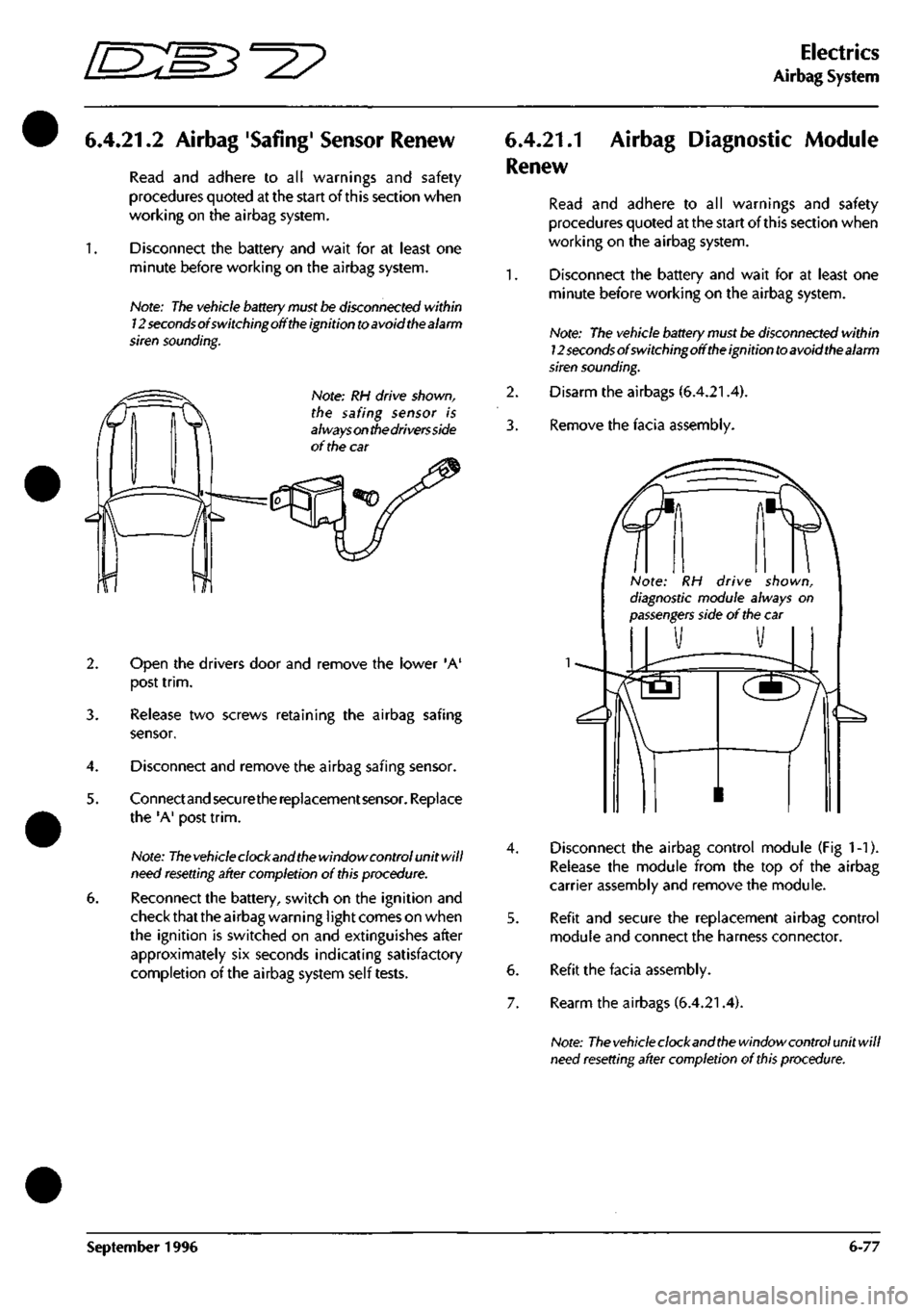
Note:
The
vehicle battery must be disconnected within
12 secondsofswitchingoffthe ignition to avoid the alarm
siren sounding.
^h
Note: RH drive shown,
the safing sensor is
always
on
the drivers side
of the car
2. Open the drivers door and remove the lower 'A'
post
trim.
3. Release two screws retaining the airbag safing
sensor.
4.
Disconnect and remove the airbag safing sensor.
5. Connectand securethe replacement sensor. Replace
the 'A' post
trim.
Note:
The
vehicle clock and
the
window control unit will
need
resetting
after completion of
this
procedure.
6. Reconnect the battery, switch on the ignition and
check that the airbag warning
I
ight comes on when
the ignition is switched on and extinguishes after
approximately six seconds indicating satisfactory
completion of the airbag system self tests.
6.4.21.1
Renew
Airbag Diagnostic Module
1.
2.
3.
4.
6.
7.
Read and adhere to all warnings and safety
procedures quoted at the start of this section when
working on the airbag system.
Disconnect the battery and wait for at least one
minute before working on the airbag system.
Note: The vehicle battery must
be
disconnected within
l2secondsofswitchingofftheignitiontoavoidthealarm
siren
sounding.
Disarm the airbags (6.4.21.4).
Remove the facia assembly.
Note: RH drive shown,
diagnostic module always on
passengers
side of
the
car
Disconnect the airbag control module (Fig 1-1).
Release the module from the top of the airbag
carrier assembly and remove the module.
Refit and secure the replacement airbag control
module and connect the harness connector.
Refit the facia assembly.
Rearm the airbags (6.4.21.4).
Note:
The
vehicle clock and
the
window control unit will
need
resetting
after completion of this procedure.
September 1996 6-77
Page 196 of 421
Electrics
Airbag System ^2?
6.4.21.4
Airbag Disarming/Arming
Procedures
WARNINGS AND CAUTIONS:
WARNINGS:
Disarm the airbags by disconnecting the battery
ground (black)
lead,
waiting one minute and then
removing the airbag modules before servicing of
any airbag or steering column component.
After disconnecting the battery ground
lead,
allow
a minimum of one minute delay for the back-up
power supply to discharge before servicing the
airbag system.
The system components are non-serviceable, if
faults are
suspected,
change components for new
items
only.
Failure to observe the above procedures may
result in accidental deployment of the airbags.
Always wear safety
glasses
when working on airbag
equipped vehicles.
Personnel carrying an airbag module must ensure
that the module and trim cover are pointing away
from the
body.
When positioning on a bench or
work surface, ensure that the airbag module and
trim cover face upwards to limit motion on
accidental deployment.
Always wear
gloves
when handling deployed airbag
modules. Deposits of sodium hydroxide may be
presenton the module surface. If sodium hydroxide
contacts any area of the skin, wash the affected
area immediately with mild soap and
water.
Dispose of the deployed airbag using the correct
procedures referred to in this section.
Cautions:
When scrapping vehicles,
ensure
that the
airbags
have
been deployed (see
Scrapping Vehicles
with Live
Airbags).
If a component
has been
renewed and the fault
does
not
clear,
refit the original item and repeat the diagnostic
procedure.
After
servicing,
repeatthe diagnostic
procedures
to ensure
correct
system
operation.
Renew
the airbag module if the surrounding trim
panels
are
damaged.
Do not attempt to repaint trim covers as
paint may
damage
cover material.
Disarming the Airbags
3.
4.
WARNING: Carry out the following disarming
procedure before attempting any work on the
vehicles electrical
systems.
Note: The battery ground (black) lead must be
disconnected within 12 seconds of switching off the
ignition to avoid the alarm siren sounding.
Disconnect the battery ground
lead.
Allow a
minimum of one minute delay for the back-up
power supply to discharge.
Remove the drivers side airbag module and replace
it with an airbag simulatorfrom the simulator kit (Pt
No.
43.27028).
Remove the passengers airbag module and replace
it with an airbag simulator from the simulator kit.
Reconnect the battery ground.
Rearming the Airbags
WARNING: Carry out the following procedure to
rearm and check the airbags after completing all
work on the vehicles electrical
systems.
Note: The vehicle battery
must be
disconnected within
12
seconds
of switching off
the
ignition
to
avoid the alarm
siren sounding.
^. Disconnect the battery ground
lead.
Allow a
minimum of one minute delay for the back-up
power supply to discharge.
2.
Removethedriverssideairbagsimulatorand replace
it with the drivers airbag module. Secure the airbag
module with the two captive torx screws.
3. Remove the passengers side airbag simulator and
replace it with the passenger side airbag module.
Secure the module with four nuts and washers.
Close the passenger side airbag door.
4.
Reconnect the battery ground.
5. Switch on the ignition and check for correct
indications from the SRS/AIRBAG warning light.
TheSRS/AIRBAC lamp should come on after
a
brief
delay and remain on for approximately six seconds
during the airbag system self check. The lamp will
extinguish upon satisfactory completion of the self
check, or will flash a diagnostic code if an airbag
system fault is detected. Continuous illumination of
the warning lamp may indicate a seatbelt
pretensioner fault
Note:
Reset the
clock and window
ECUs
on completion.
6-80 September 1996
Page 219 of 421
'^^
Electrics
Seat Belt Pretensioner
6.6.26.1
Pretensioner Control Module -
Renew
Read the warnings given in system fault strategy
and service instructions on the previous page before
starting the following procedure.
Procedure
1.
Disconnect the battery ground (black) lead and
wait at least 10 minutes for the pretensioner power
supply to fully discharge before working on the
pretensioner system.
Note:
The
vehicle battery must
be
disconnected within
12
seconds
of switching off
the
ignition to avoid the alarm
siren sounding.
2. Motor the right front seat to its rearmost position.
3. Remove the floor carpet and the ECU cover.
4.
Disconnect the pretensioner control module
connector (orange connector with black safety
clip).
5. Remove 3 flange screws securing the module,
noting the position of the earth strap.
6. Fit the new pretensioner control module with the
connector facing to the rear and secure with 3
flange screwsensuringthatthe earth strap is secured
with the outboard rear screw.
7. Connect the orange connector to the control
module.
8. RefitandsecuretheECU cover and the floor carpet.
9. Reconnect the battery ground (black)
lead.
Note:
The
vehicle clock and the window control unit will
need
resetting
after completion of this procedure.
10.
Switch on the ignition and check that the airbag
warni ng I ight comes on when the ign ition
is
switched
on and extinguishesafterapproximately sixseconds
indicating satisfactory completion of the
pretensioner and airbag system self tests.
6.6.24.1
Pretensioner Assembly Renew
Read the warnings given in system fault strategy
and service i nstruaions on the previous page before
starting the following procedure.
1.
2.
4.
Procedure
Motor the drivers seat to its rearmost position.
Disconnect the battery ground (black) lead and
wait at least 10 minutes for the pretensioner power
supply to fully discharge before working on the
pretensioner system.
Note: Disconnect the battery within 12 seconds of
switchingoffthe ignition to avoid the alarm siren sounding.
Remove the pretensioner trim cover. Unbolt the
drivers seat. Tip the seat rearwards and disconnect
the seat and pretensioner squib connectors.
Release one bolt at the
base
of the seat belt
stal k
and
remove the pretensioner assembly.
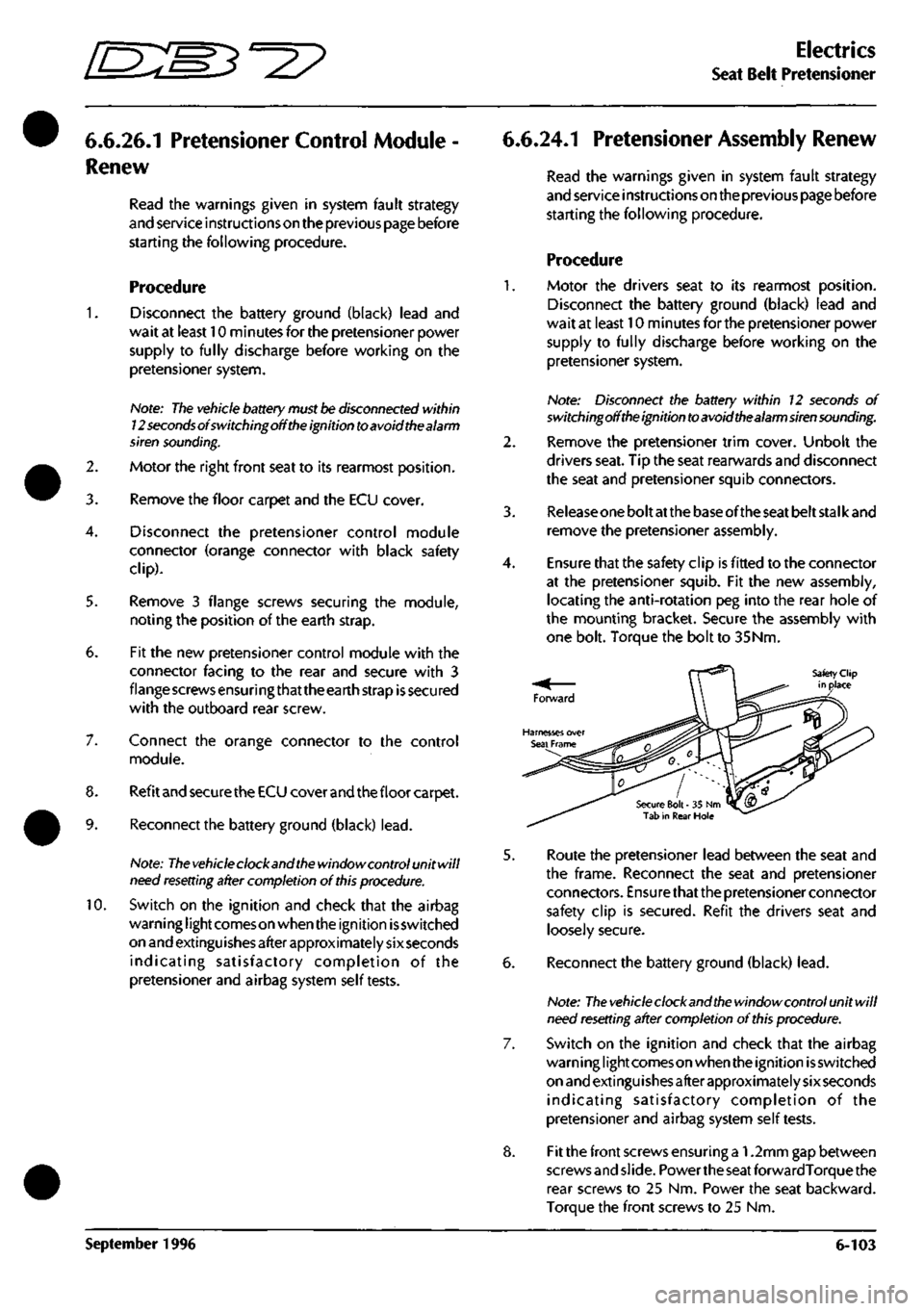
Ensure that the safety clip is fitted to the connector
at the pretensioner squib. Fit the new assembly,
locating the anti-rotation peg into the rear hole of
the mounting bracket. Secure the assembly with
one bolt. Torque the bolt to 35Nm.
Safety Clip in place
5. Route the pretensioner lead between the seat and
the frame. Reconnect the seat and pretensioner
connectors. Ensure that the pretensioner connector
safety clip is secured. Refit the drivers seat and
loosely secure.
6. Reconnect the battery ground (black)
lead.
Note:
The
vehicle clock and
the
window control unit will
need
resetting
after completion of this procedure.
7. Switch on the ignition and check that the airbag
warn i ng I ight comes on when the ignition
is
switched
on and extingu
ishes
after approximately six seconds
indicating satisfactory completion of the
pretensioner and airbag system self tests.
8. Fit the front screws ensuring a 1.2mm gap between
screws and slide. Power the seat forwardTorque the
rear screws to 25 Nm. Power the seat backward.
Torque the front screws to 25 Nm.
September 1996 6-103
Page 227 of 421
3-^?
Electrics
Seat Removal/Replacement 97.5 MY
6.6.03
Seat Removal 97.5 MY
Description
The 97.5 MY front seats are common to the DB7
Coupe
and
Volante
models.
Seat
switch
assembi ies
are located on the outboard side of both driver and
passenger
seats.
The front switch controls fore and
aft movement and the seat height adjustment. The
centre switch controls the recline adjustment. The
rear switch
controls
the
lumbar support adjustment.
The seat
heater switches are mounted on the centre
console, forward of the gear selector
lever.
Only one of
the
slide,
recline or height motors can
be driven under manual control at any one time.
Each seat switch pack is hard wired to the relevant
Seat Control
Module
beneath each
seat.
The
module
outputs are hard wired to the seat motors.
Removal
WARNING -
Seat
belt
Pretensioners
(if fitted):
To avoid the possibility
of
personal
injury
caused
by accidental deployment of the seat belt
pretensioner,
disconnect
the
vehicle battery and
wait at
least
10
minutes
for all
voltages
to fully
discharge
before working on the
pretensioner
system.
This covers the possibility
of
the normal
capacitor
discharge
circuits being inoperative and
failing to discharge the detonator capacitor when
instructed
to
do
so.
Procedure
1.
Motortheseatto
its
maximum forward position and
remove the fixings at the rear of the slides.
2.
Motor the seat to its maximum rearward position
and remove the front seat slide fixings.
3. Disconnect the battery
ground
(black)
lead.
Wait at
least 10 minutes for the pretensioner power supply
to fully discharge before working on the seat if a
pretensioner is fitted.
Note: Disconnect the battery within 12 seconds of
switching off the ignition to avoid the alarm siren sounding.
4.
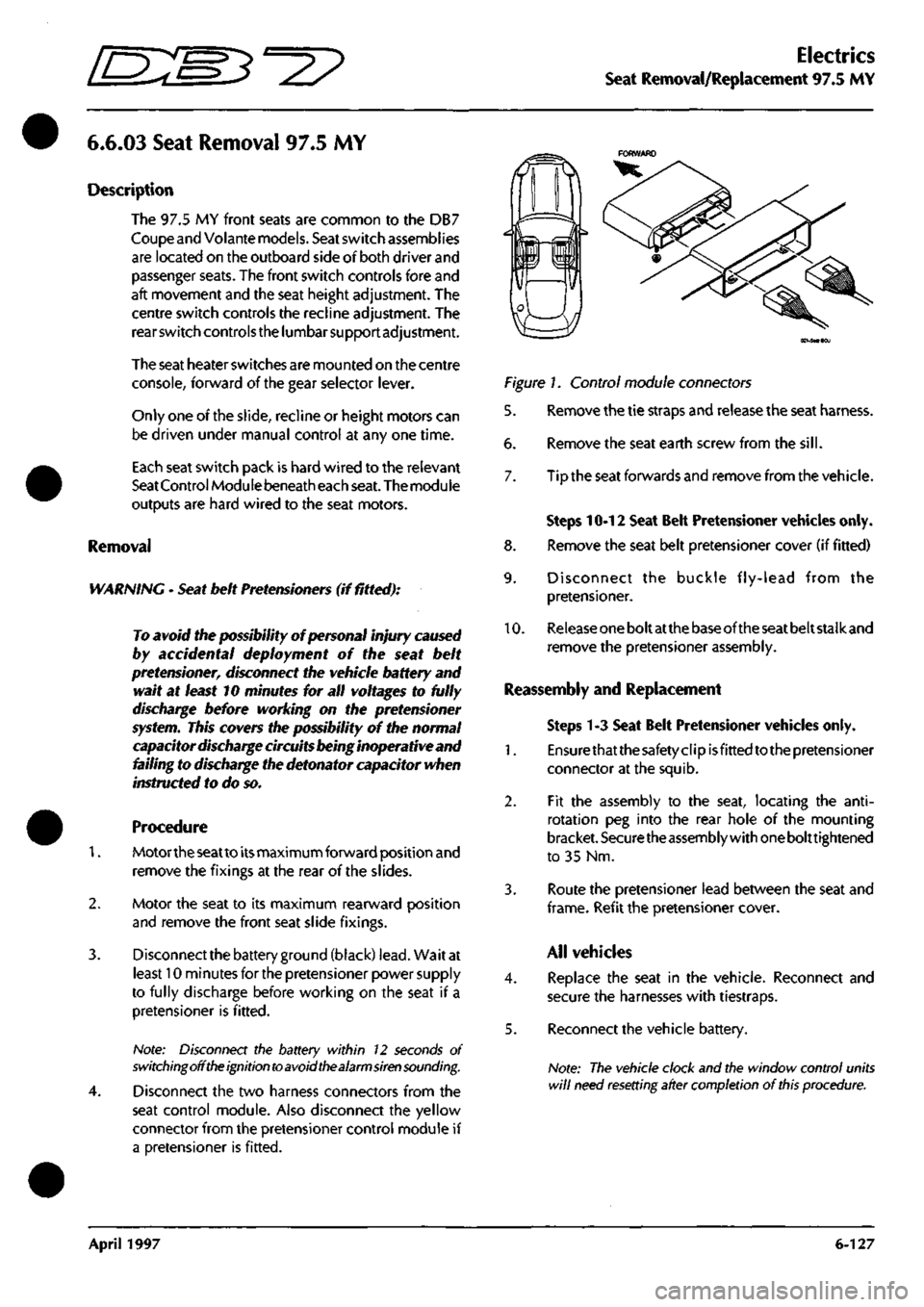
Disconnect the two harness connectors from the
seat control module. Also disconnect the yellow
connector from the pretensioner control module if
a pretensioner is fitted.
Figure 1. Control module connectors
5. Remove the tie straps and release the seat harness.
6. Remove the seat earth screw from the
sill.
7. Tip the seat forwards and remove from the vehicle.
Steps 10-12 Seat Belt Pretensioner vehicles only.
8. Remove the seat belt pretensioner cover (if fitted)
9. Disconnect the buckle fly-lead from the
pretensioner.
10.
Release
one
bolt at
the
base of the
seat
belt stalk and
remove the pretensioner assembly.
Reassembly and Replacement
Steps 1-3 Seat Belt Pretensioner vehicles only.
1.
Ensurethatthesafetyclipisfittedtothepretensioner
connector at the squib.
2.
Fit the assembly to the seat, locating the
anti-
rotation peg into the rear hole of the mounting
bracket.
Securethe
assembly with
one
bolttightened
to 35 Nm.
3. Route the pretensioner lead between the seat and
frame.
Refit the pretensioner
cover.
All vehicles
4.
Replace the seat in the vehicle. Reconnect and
secure the harnesses with tiestraps.
5. Reconnect the vehicle battery.
Note:
The vehicle clock and the window control units
will
need resetting after completion
of
this
procedure.
April 1997 6-127
Page 228 of 421
Electrics
Seat Control Module Removal/Replacement 97.5 MY 'O "3^2?
Switch on the ignition and checi< that the airbag
warning lamp comes on when the ignition is
switched on and extinguishes after approximately
six seconds indicating satisfactory completion of
the pretensioner and airbag system self
tests.
Fit
the front
seat
retaining screws ensuring
a
1.2mm
gap between the screw heads
and
the
slides.
Power
the seat forward and refit the rear screws.
Caution:
Centralise the
rear
fixing holes
with the
body weld
nuts
prior to
inserting the
bolts.
Torque the rear screws to 25 Nm. Power the seat
backwards. Torque the front screws to 25 Nm.
Motor the seat through its full range of movement
to ensure correct
operation.
6.6.08
Seat Control Module 97.5 MY
Removal
WARNING -
Seat
belt
Pretensioners
(if
fitted):
To avoid the possibility
of
personal injury caused
by accidental deployment of the seat belt
pretensioner,
disconnect
the
vehicle battery and
wait at
least
10
minutes
for all
voltages
to fully
discharge
before
working
near the
pretensioner
system.
This covers
the
possibility
of
the
normal
capacitor
discharge circuits
being
inoperative and
failing to discharge the detonator capacitor when
instructed
to
do
so.
1.
Lower the door window and open the relevant
door. Disconnect
the
battery ground cableand wait
for 10 minutes if
a
pretensioner
is
fitted.
Otherwise,
proceed immediately to step 2.
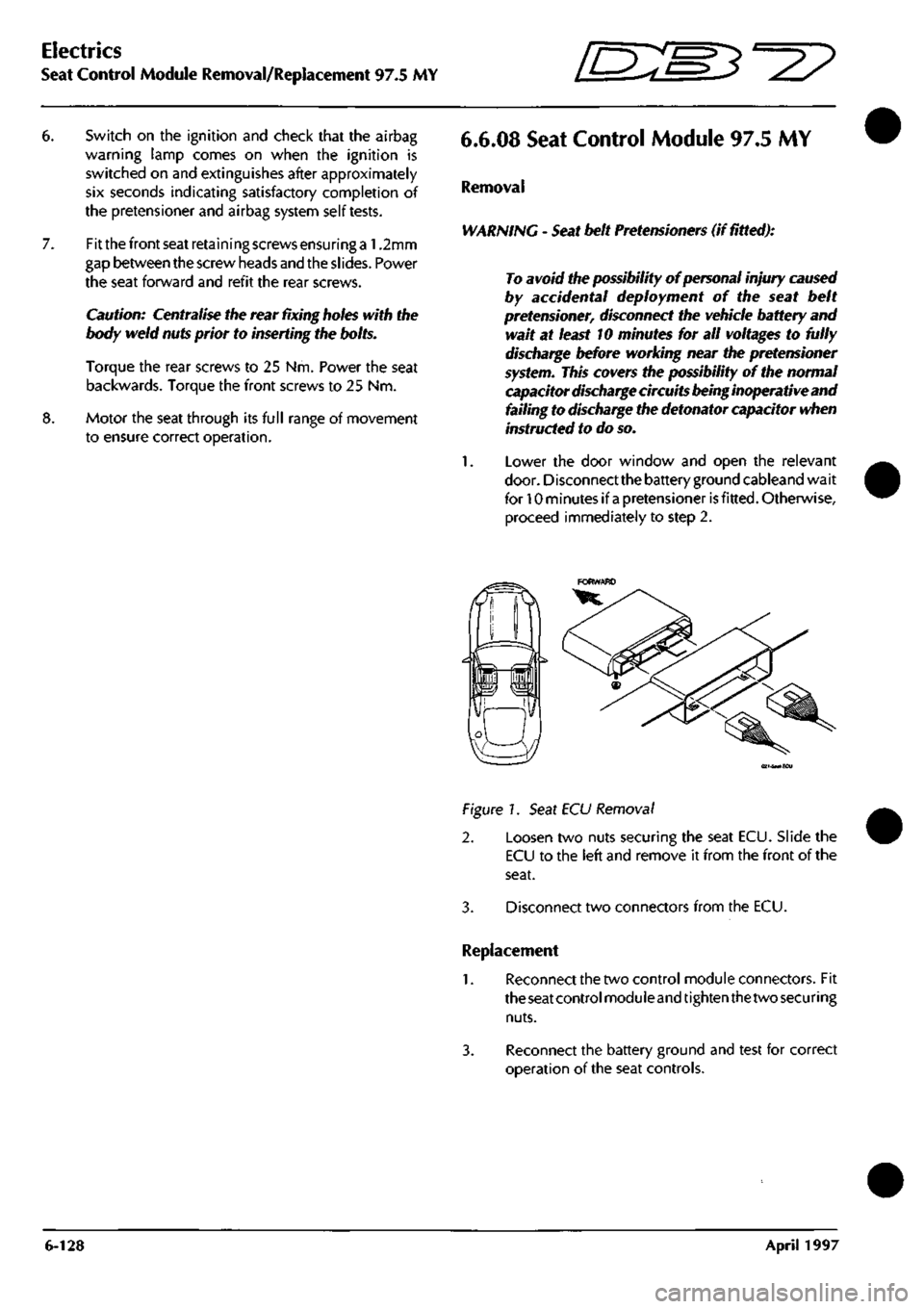
(ei-SMiECu
Figure!.
Seat ECU Removal
2. Loosen two nuts securing the seat ECU. Slide the
ECU to the left and remove it from the front of the
seat.
3. Disconnect two connectors from the ECU.
Replacement
1.
Reconnect the two control module connectors. Fit
the seat control
moduleand
tighten
thetwo securing
nuts.
3. Reconnect the battery ground and test for correct
operation of the seat controls.
6-128 April 1997
Page 229 of 421
O" D^?
Body and Trim
Contents
Contents
Body and Trim
Body Repair
Potential Risks
Precautions
General Repair Notes
Steel Body Parts - Repair, Remove and Replace
RTM Body Parts
Body Panel and Trim Removal
Front Apron
Front Undertray
Wheel Arch Liners
Side Sills (top fixings)
Side Sills (bottom fixings)
Rear Bumper
Doors
Door Liners
Door Liner (components)
Steering Wheel
Column Switches
Instrument Panel (surround)
Instrument Panel
Facia Underscuttles
Glove Box
Facia Mountings (1)
Facia Mountings (2)
Console Instruments
Radio
Front Seats
Ashtray
Centre Console
Seat ECU Covers
Rear Console
Rear Seats and C Post Trim
Quarter Panels, B Post Panels, Parcel Shelf
Headlining
Roof System Description and Repair Procedures
Vol ante Roof
Roof and Rear Quarter Light Control
Roof Component Location
Roof Control System
9.0.02.1
Roof Removal/Replacement
9.0.02.3
Roof Hydrailic Control System
9.0.02.5
Bleeding the Roof Hydraulic System
9.1.01.1
Rear Quarter Window Renewal
9.1.01.2
Rear Quarter Glass Adjustment
9.1.01.4
Rear Quarter Window Lift Motor - LH
9.1.01.5
Rear Quarter Window Lift Motor - RH
Roof Sealing and Wind Noise
9.2.01.5
'A' Post/Header Sealing and Lock Adj
9.2.01.6
Roof Seals - Adjustment
9.2.01.7
Cheater Plate Seals - Adjust/Renew
9.2.01.8
Door Glass Adjustment
Alcantara Cleaning
7-1
7-2
7-2
7-3
7-3
7-4
7-5
7-6
Sheet 1
Sheet 2
Sheet 3
Sheet 4
Sheet 5
Sheet 6
Sheet 7
Sheet 8
Sheet 9
Sheet 10
Sheet 11
Sheet 12
Sheet 13
Sheet 14
Sheet 15
Sheet 16
Sheet 17
Sheet 18
Sheet 19
Sheet 20
Sheet 21
Sheet 22
Sheet 23
Sheet 24
Sheet 25
Sheet 26
Sheet 27
7-7
7-7
7-8
7-9
7-10
7-11
7-12
7-13
7-14
7-15
7-16
7-17
7-17
7-18
7-19
7-20
7-21
May 1996 7-1
Page 262 of 421
y/--^^^^3^
'—-p "^ Body and Trim
Roof Description
Volante Roof
Description
The system comprises an electrically driven hydraulic pump and two hydraulic rams for raising and lowering the
roof.
The pump is powered via two heavy duty changeover relays. Two further pairs of changeover relays power
the rear quarter windows (one pair for each window). The roof hydraulic pump is protected by a 30A fuse, the
windows by circuit breakers.
An electronic control module (ECM) is actuated by the roof switch on the centre console. The ECM controls the
operation of
both
the roof
and
rear quarter window circuits
so
that they can only be operated in
a
pre-programmed
manned.
When in operation, the ECM provides signals to the roof and to the rear quarter windows.
When the roof
switch
is moved into the open (Roof Down) position, the roof
and
rear windows move together until
approximately four seconds has elapsed. At this time, the ECM will remove power from the rear window circuits,
leaving the roof motor running. The roof motor will stop after 12 seconds (i.e. a further 8 seconds after the rear
window motors stop).
The signals will be removed from the rear window relay after 4 seconds and from the roof relay after 12 seconds
if the roof switch is held in either position for longer than 12 seconds.
In order to comply with legislation, the following features are built into the system:
If the roof switch is operated in either direction and then released before that operation is complete, the roof and
rear quarter windows will stop immediately. If, whilst the system is in operation, the ignition switch
is
turned to the
off position, the system will immediately stop.
If the roof switch is pressed again after pausing during a roof movement, the timing sequence will be as follows:
1.
If the previous direction is selected, the timing recommences from where it left off and will continue to
completion. If the ignition has been turned off, the timing will start from the beginning of its cycle.
2.
If theoppositedirection
is
selected,
the timing sequence will commence
from the beginning
of the newly selected
direction and continue to completion.
Roof and Rear Quarter Light Control
The following diagrams show the component location and the electrical control for the roof and rear quarter light
systems.
May 1996 7-7
Page 263 of 421

Body and Trim >/—^
^^^^5^
' ^ ^
Roof Components I -^' ^—^ -^-^
Roof Component Location
Roof Switch
Hydraulic Pump
ECM
Roof Up Relay
Roof Down Relay
LH Q Light Up Relay
LH Q Light Down Relay
RH Q Light Up Relay
RH Q Light Down Relay
Fuse and Circuit Breakers
Hydraulic Rams
Heated Rear Window Overide Switch
Figure 7. Roof
System
Component Location
7-8 May 1996
Page 264 of 421
5^^
Body and Trim
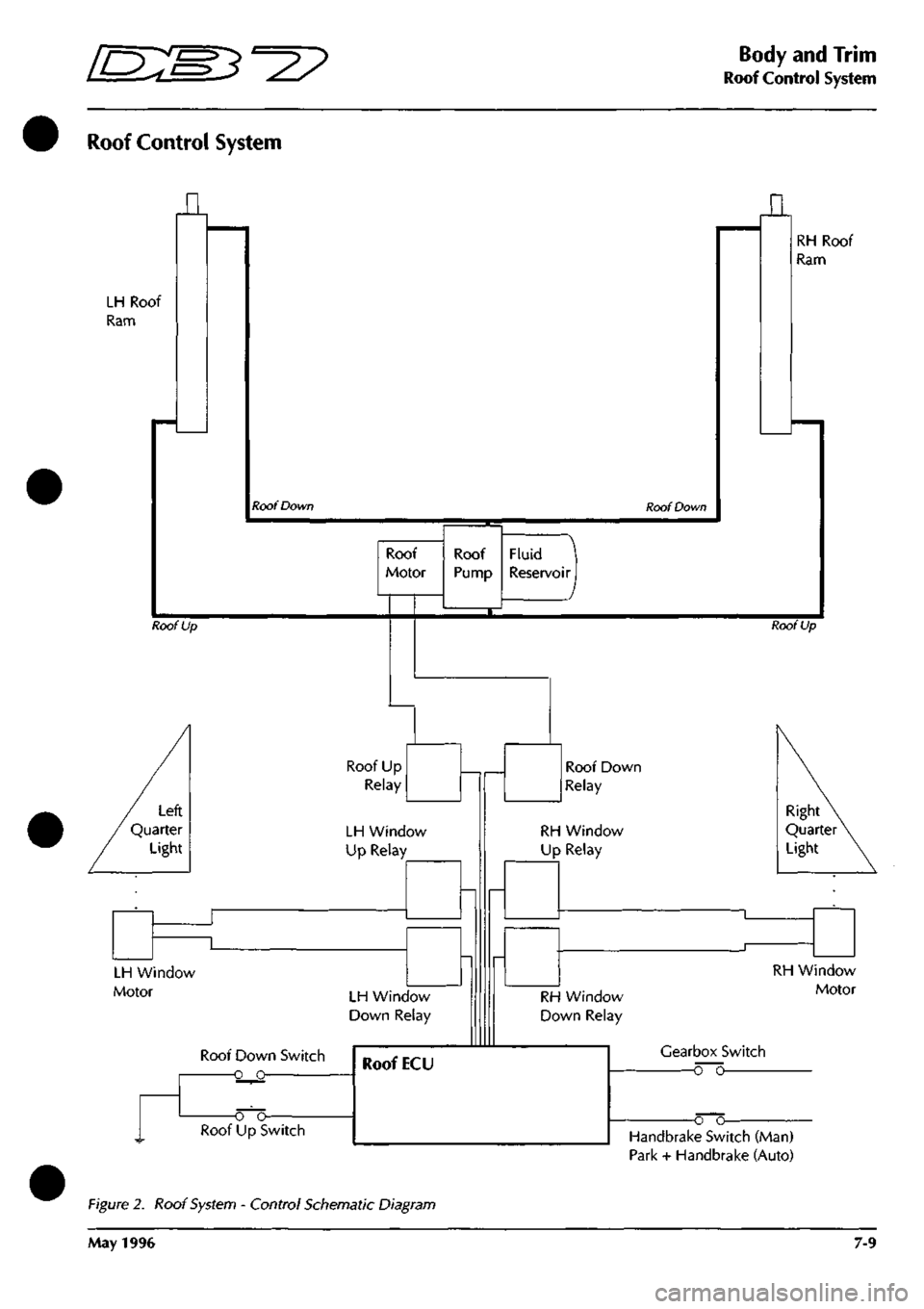
Roof Control System
Roof Control System
LH Roof
Ram
n
Roof Down Roof Down
n
RH Roof
Ram
Roof
Motor
Roof Up
Fluid
Reservoir I
Roof Up
Roof Up
Relay
LH Window
Up Relay
LH Window
Motor LH Window
Down Relay
Roof Down Switch
-o o-
Roof Down
Relay
RH Window
Up Relay
Right
Quarter
Light
RH Window
Down Relay
RH Window
Motor
Gearbox Switch
o~o
o o-Handbrake Switch (Man)
Park + Handbrake (Auto)
Figure 2. Roof System - Control Schematic Diagram
May 1996 7-9
Page 265 of 421
Body and Trim
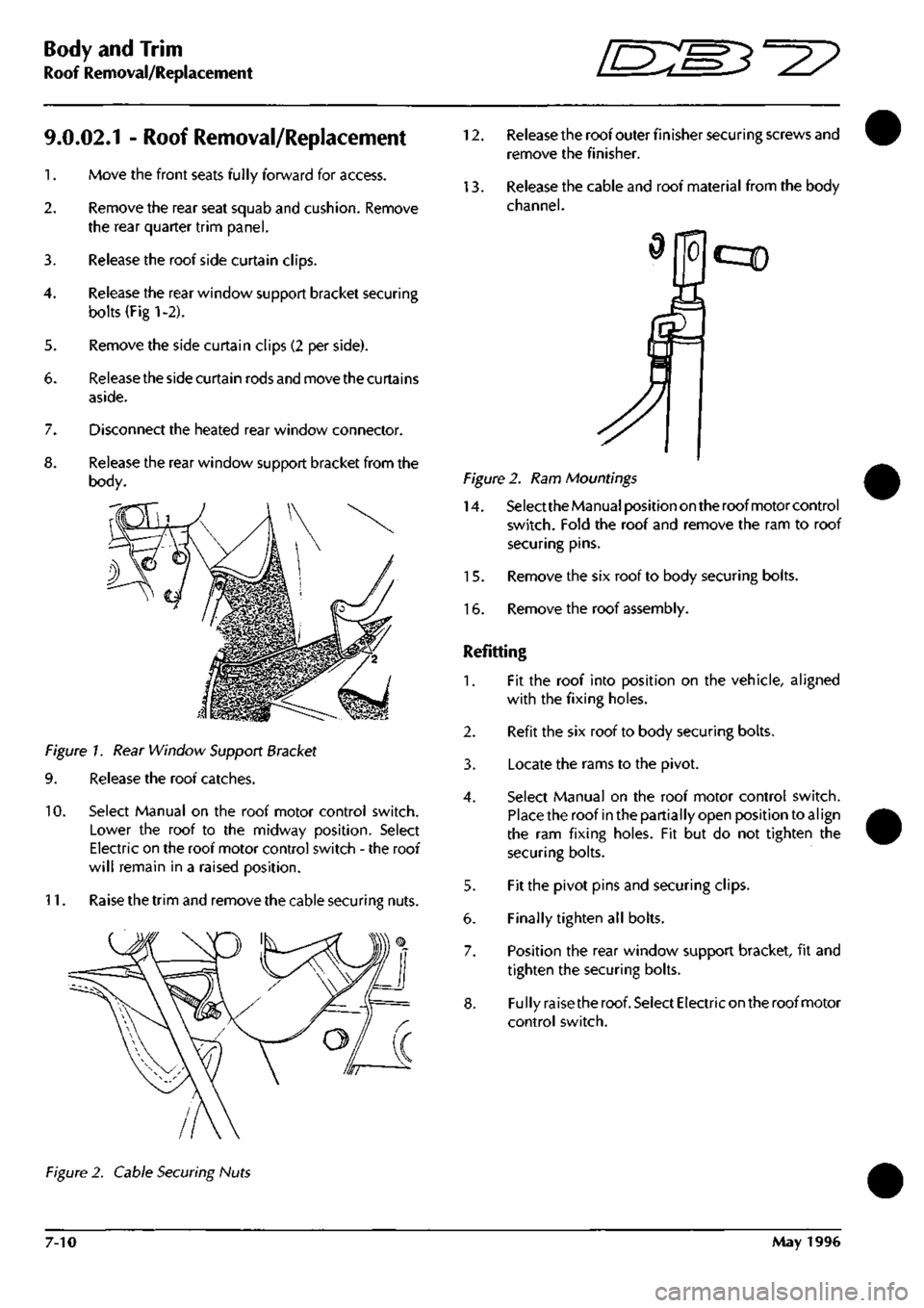
Roof Removal/Replacement [D::M^=2?
9.0.02.1 - Roof Removal/Replacement
1.
2.
3.
4.
5.
6.
7.
8.
Move the front seats fully forward for access.
Remove the rear seat squab and cushion. Remove
the rear quarter trim panel.
Release the roof side curtain clips.
Release the rear window support bracket securing
bolts (Fig 1-2).
Remove the side curtain clips (2 per side).
Release the side curtain rods and move the curtains
aside.
Disconnect the heated rear window connector.
Release the rear window support bracket from the
body.
Figure 1. Rear Window Support Bracket
9. Release the roof catches.
10.
Select Manual on the roof motor control switch.
Lower the roof to the midway position. Select
Electric on the roof motor control switch - the roof
will remain in a raised position.
11.
Raise the trim and remove the cable securing nuts.
12.
Release the roof outer finisher securing screws and
remove the finisher.
13.
Release the cable and roof material from the body
channel.
cqD
Figure 2. Ram Mountings
14.
Select the Manual position on the roof motor control
switch.
Fold the roof and remove the ram to roof
securing pins.
15.
Remove the six roof to body securing bolts.
16.
Remove the roof assembly.
Refitting
1.
Fit the roof into position on the vehicle, aligned
with the fixing holes.
2.
Refit the six roof to body securing bolts.
3. Locate the rams to the pivot.
4.
Select Manual on the roof motor control switch.
Place the roof in the partially open position to
al
ign
the ram fixing holes. Fit but do not tighten the
securing bolts.
5. Fit the pivot pins and securing clips.
6. Finally tighten all bolts.
7. Position the rear window support bracket, fit and
tighten the securing bolts.
8. Fully raise the roof. Select Electric on the roof motor
control switch.
Figure 2. Cable Securing Nuts
7-10 May 1996