ignition AUDI A5 2015 Owner´s Manual
[x] Cancel search | Manufacturer: AUDI, Model Year: 2015, Model line: A5, Model: AUDI A5 2015Pages: 264, PDF Size: 66.83 MB
Page 156 of 264
Child safety
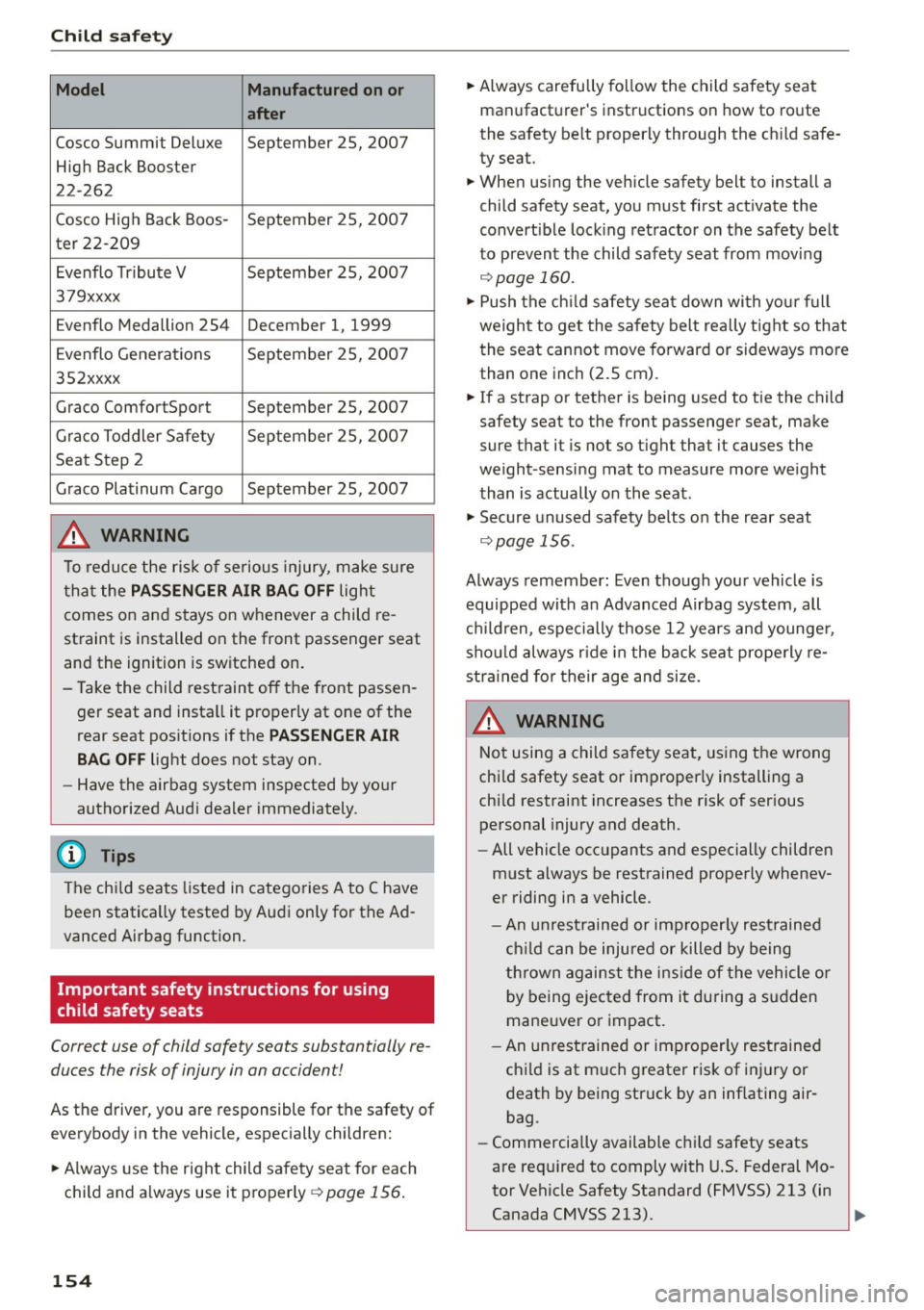
Model Manufactured on or
after
Cosco Summit Deluxe September 25, 2007
High Back Booster
22-262
Cosco High Back Boos -September 25, 200 7
ter 22-209
Evenflo Tr ibute V September 25, 2007
379xxxx
Evenflo Medallion 254 December 1, 1999
E venflo Generations September 25, 2007
352xxxx
Grace ComfortSport September 25, 2007
Grace To ddler Sa fe ty Sep
tember 25, 200 7
Seat Step 2
G race Platinum Cargo September 25, 2007
.&_ WARNING
To reduce the ris k of serious injury, make sure
t ha t the
PASSENGER AIR BAG OFF light
comes on and stays on whenever a child re
st raint is installed on the front passenger seat
and the ignition is switched on.
- Take the child rest raint off the front passen
ger seat and insta ll it properly at one of the
rear seat pos itions if the
PASSENGER AIR
BAG OFF
light does not stay on.
- Have the airbag system inspected by yo ur
autho rized Audi dealer immediately.
(D Tips
The ch ild sea ts listed in catego ries A to C have
been statica lly tested by Audi only for the Ad
vanced Airbag function.
Important safety instructions for using
child safety seats
Correct use of child safety seats substantially re
duces the risk of injury in on occident!
As the driver, you are responsible for the safety of
everybody in the vehicle, espec ially children:
... Always use the right child sa fety seat for each
c h ild and a lways use it properly
¢ page 156.
154 ...
Always carefully fo llow the child safety seat
manufact urer's instructions on how to ro ute
the sa fety belt proper ly through the c hild safe
ty seat.
... When using the vehicle safety belt to install a
child safety seat, you must first act ivate the
convert ible lock ing ret ractor on the safety belt
to prevent the child safety seat from moving
¢ page 160.
... Push the ch ild safety sea t down wi th yo ur fu ll
weigh t to get the safety belt really tight so that
the seat cannot move forward or sideways more
than one inch (2.5 cm).
... If a strap or tether is be ing used to tie the child
safety seat to the front passenger seat, make
sure that it is not so tight that it causes the
weight-sensi ng mat to measure more we ight
than is actually o n the seat .
... Secu re unused safety belts on the r ear seat
¢ page 156.
Always remember : Even tho ugh you r vehicle is
equipped with an Advanced Airbag system, all
c hi ld ren, espe cially those 12 years and younge r,
shou ld always r ide in the back seat prope rly re
stra ine d f or t heir age an d size.
.&_ WARNING
-
N ot using a child safe ty seat, using t he wrong
chi ld safety seat or improper ly installing a
chi ld restraint increases the risk of ser ious
personal injury and death.
- All vehicle occ upants and especially children
m ust always be restrained properly whenev
er riding in a vehicle.
- An un rest rained or imp rope rly res trained
chi ld ca n be inju red or killed by being
t h rown ag ains t the i nsid e of the vehicle or
b y being ejected from it du ring a s udden
mane uver o r impact.
- An unrestrained or im properly res trained
ch ild is at much greater risk of i nju ry or
death by being struck by an inflating air
bag.
- Commercially available ch ild safety seats
are req uired to comply with U.S. Federal Mo
tor Vehicle Safety Standard (FMVSS) 213 (in
Canada CMVSS 213). .,_
Page 157 of 264
M N
i? co ,...., \!) 1.1'1
N 1.1'1 ,....,
-When buying a child restraint, select one
that fits your child and the vehicle.
- Only use child restraint systems that fully
contact the flat portion of the seat cush
ion. The child restraint must not tip or
lean to either side. Audi does not recom
mend using child safety seats that rest on
legs or tube-like frames. They do not pro
vide adequate contact with the seat.
- Always heed all legal requirements per
taining to the installation and use of child
safety seats and carefully follow the in
structions provided by the manufacturer
of the seat you are using.
- Never allow children under 57 inches
(1.45 meters) to wear a normal safety belt.
They must always be restrained by a proper
child restraint system. Otherwise, they
could sustain injuries to the abdomen and
neck areas during sudden braking maneu
vers or accidents.
- Never let more than one child occupy a child
safety seat.
- Never let babies or older children ride in a
vehicle while sitting on the lap of another
passenger.
- Holding a child in your arms is never a sub
stitute for a child restraint system.
- The strongest person could not hold the
child with the forces that exist in an acci
dent. The child will strike the interior of
the vehicle and can also be struck by the
passenger.
- The child and the passenger can also in
jure each other in an accident.
- Never install rearward-facing child safety
seats or infant carriers on the front passen
ger seat. A child will be seriously injured and
can be killed when the passenger airbag in
flates -even with an Advanced Airbag Sys
tem.
- The inflating airbag will hit the child safe
ty seat or infant carrier with great force
and will smash the child safety seat and
child against the backrest, center arm
rest, door or roof.
-Always install rearward-facing child safety
seats or infant carriers on the rear seat.
Child safety
-Forward-facing child safety seats installed
on the front passenger's seat can interfere
with the airbag when it inflates and cause serious injury to the child . Always install for
ward-facing child safety seats on the rear seat .
- If exceptional circumstances require the use of a forward-facing child restraint on the
front passenger's seat, the child's safety
and well-being require that the following
special precautions be taken :
- Make sure the forward-facing seat has
been designed and certified by its manu
facturer for use on a front seat with a pas
senger front and side airbag .
- Always carefully follow the manufacturer's
instructions provided with the child safety
seat or carrier .
- Always move the front passenger seat into
the rearmost position of the passenger
seat's fore and aft adjustment range, and
as far away from the airbag as possible be
fore installing the child restraint.
-Always make sure that nothing prevents
the front passenger's seat from being
moved to the rearmost position in its fore
and aft adjustment range.
- Always make sure that the backrest is in
the upright position.
- Always buckle the child safety seat firmly in
place even if a child is not sitting in it. A
loose child safety seat can fly around during
a sudden stop or in a collision.
- Always read and heed all WARNINGS when
ever using a child restrained in a vehicle is
being used
¢page 121, Safety belts,
¢ page 129, Airbag system and
¢ page 151, Child safety.
A WARNING
-To reduce the risk of serious injury, make sure
that the
PASSENGER AIR BAG OFF light
comes on and stays on whenever a child re
straint is installed on the front passenger seat
and the ignition is switched on.
liJ,,
155
Page 160 of 264
Child safety
Toddlers and children who are older than one
year up to about 4 years old and weigh more than
20 lbs. (9 kg) up to 40 lbs. (18 kg) must always
be properly restrained in a child safety seat certi
fied for their size and weight¢
fig. 144 and
¢ fig. 145.
The airbag on the passenger side makes the front
seat a potentially dangerous place for a child to
ride. The front seat is not the safest place for a
child in a forward -facing child safety seat .
It is a
very dangerous place for an infant or a larger
child in a rearward-facing seat .
A WARNING
Not using a child safety seat, using the wrong
child safety seat or improperly installing a
child restraint increases the risk of serious
personal injury and death in a collision or oth
er emergency situation.
- Children on the front seat of any car, even with Advanced Airbags, can be seriously in
jured or even killed when an airbag inflates. A child in a rearward-facing child safety seat
installed on the front passenger seat will be
seriously injured and can be killed if the
front airbag inflates -even with an Ad
vanced Airbag System .
- The inflating airbag will hit the child safety seat or infant carrier with great force and
will smash the child safety seat and child against the backrest, center armrest, door
or roof.
- Always install rearward-facing child safety
seats on the rear seat.
- If you must install a rearward facing child
safety seat on the front passenger seat be
cause of exceptional circumstances and the
PASSENGER AIR BAG OFF light does not
come on and stay on, immediately install
the rearward-facing child safety seat in a rear seating position and have the airbag
system inspected by your authorized Audi
dealer.
- The rear side of the child safety seat should be positioned as close as possible to the
backrest on the vehicle seat . Adjust or re
move the rear seat head restraint if it is dif-
158
ficult to install the child seat with the head
restraint in place¢
page 58. Install the
head restraint again immediately once the
child seat is removed . Driving without head
restraints or with head restraints that are
not properly adjusted increases the risk of
serious or fatal neck injury dramatically.
- Always read and heed all WARNINGS when
ever using a child restrained in a vehicle is
being used
¢page 121, Safety belts,
¢page 129, Airbag system
and
¢ page 151, Important information.
A WARNING
If exceptional circumstances require the use
of a forward-facing child restraint on the front
passenger's seat, the child's safety and well
being require that the following special pre
cautions be taken :
- Make sure the forward-facing seat has been
designed and certified by its manufacturer
for use on a front seat with a passenger
front and side airbag .
-Always follow the manufacturer's instruc
tions provided with the child safety seat or
infant carrier.
- Always move the front passenger seat into
the rearmost position of the passenger
seat's fore and aft adjustment range, and as
far away from the airbag as possible before
installing the child restraint.
- Always make sure that nothing prevents the
front passenger's seat from being moved to
the rearmost position in its fore and aft ad
justment range.
- Always make sure the backrest is in an up
right position .
- Make sure that the
PASSENGER AIR BAG
OFF
light comes on and stays on all the time
whenever the ignition is switched on.
- If the light does not stay on, perform the
checks ¢
page 139, Monitoring the Ad
vanced Airbag System.
- Take the child restraint off the front passen
ger seat and install it properly at one of the
rear seat positions if the
PASSENGER AIR ~
Page 161 of 264
M N
0 loo
rl I.O
"' N
"' rl
BAG OFF light does not stay on whenever
the ignition is switched on.
Booster seats and safety belts
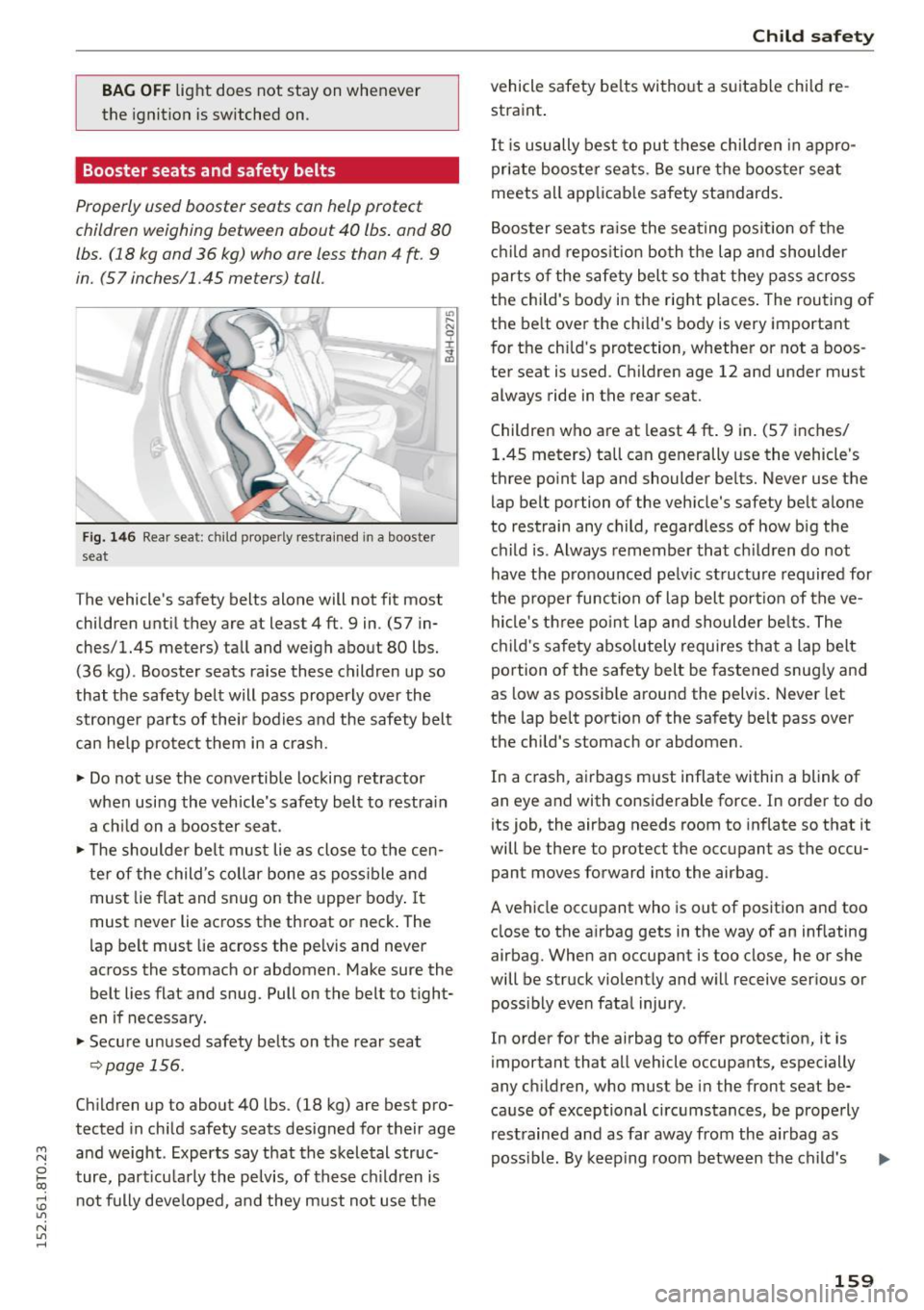
Properly used booster seats can help protect
children weighing between about 40 lbs . and 80
lbs. (18 kg and 36 kg) who are less than 4 ft .
9
in. (57 inches/1.45 meters) tall.
Fig. 1 46 Rea r seat : child p roper ly rest ra ined in a booster
seat
The vehicle's safety belts alone will not fit most
children until they are at least4
ft. 9 in . (57 in
ches/1.45 meters) tall and weigh about 80 lbs.
(36 kg). Booster seats raise these children up so
that the safety belt will pass properly over the
stronger parts of their bodies and the safety belt
can he lp protect them in a crash.
.,.. Do not use the convertible locking retractor
when using the vehicle's safety belt to restra in
a ch ild on a booster seat .
.,.. The shoulder be lt must lie as close to the cen
ter of the child's collar bone as poss ible and
must lie flat and snug on the upper body .
It
must never lie across the throat or neck. The
l ap belt must lie across the pe lvis and never
across the stomach or abdomen . Make sure the
belt lies flat and snug. Pull on the belt to tight
en if necessary.
.,.. Secure unused safety belts on the rear seat
<=> page 156.
Children up to about 40 lbs. (18 kg) are best pro
tected in ch ild safety seats des igned for their age
and weight . Experts say that the skeletal struc
ture, part icu larly the pe lvis, of these ch ildren is
n ot fully deve loped, and they m ust not use t he
Chil d sa fe ty
vehicle safety be lts without a suitable chi ld re
straint .
It is usually best to put these chi ldren in appro
priate booster seats. Be sure the booster sea t
meets a ll applicab le safety standards.
Booster seats ra ise the seating posit ion of the
c h ild and re pos it ion bo th the lap and shoulder
parts of the safety belt so that they pass across
the child's body in the right places . The routing of
the be lt over the child 's body is very important
for the ch ild's protection, whether or not a boos
ter seat is used. Children age 12 and under must
always ride in the rear seat.
Children who are at least 4
ft . 9 in. (57 inches/
1.45 meters) tall can generally use the vehicle's
three po int lap and shoulder be lts. Never use the
lap belt portion of the vehicle's safety belt a lone
to restrain any child, regardless of how big the
c hi ld is. Always remember that ch ildren do not
have the pronounced pe lv ic st ructu re required for
the proper func tion of lap belt port io n of the ve
hicle 's th ree po int l ap and shoulder be lts. The
ch ild 's sa fety abso lutely requires that a lap belt
portion of the safety belt be fastened snug ly and
as low as possib le around the pelvis . Never let
the lap belt portion of the safety belt pass over
the child's stomach or abdomen.
In a crash, airbags must inflate within a blink of
an eye and with considerable force. In order to do
its job, the airbag needs room to inflate so that it
will be there to protect the occupant as the occu
pant moves forward into the airbag .
A vehicle occ upant who is out of position and too
close to the a irbag gets in the way of an inflating
airbag. When an occupant is too close, he or she
will be struck violently and w ill receive serious or
poss ibly even fata l injury .
In order for the airbag to offer protection, it is
important that all vehicle occupants, especially
any children, who must be in the front seat be
cause of exceptional circumstances, be properly
rest rained and as far away from the airbag as
poss ible. By keep ing room between th e ch ild's
II>-
159
Page 162 of 264
Child safety
body and the front of the passenger compart
ment, the airbag can inflate completely and pro
vide supplemental protection in certain frontal
collisions .
.,&. WARNING
Not using a booster seat, using the booster
seat improperly, incorrectly installing a boos
ter seat or using the vehicle safety belt im
properly increases the risk of serious personal
injury and death in a collision or other emer
gency situation. To help reduce the risk of se
rious personal injury and/or death:
- The shoulder belt must lie as close to the
center of the child's collar bone as possible
and must lie flat and snug on the upper
body. It must never lie across the throat or
neck. The lap belt must lie across the pelvis
and never across the stomach or abdomen.
Make sure the belt lies flat and snug. Pull on
the belt to tighten if necessary.
- Failure to properly route safety belts over a
child's body will cause severe injuries in an
accident or other emergency situation
c::> page 121 .
-The rear side of the child safety seat should
be positioned as close as possible to the
backrest on the vehicle seat . Adjust or re
move the rear seat head restraint if it is dif
ficult to install the child seat with the head
restraint in place
c::>page 58. Install the
head restraint again immediately once the
child seat is removed. Driving without head
restraints or with head restraints that are
not properly adjusted increases the risk of
serious or fatal neck injury dramatically .
- Children on the front seat of any car, even
with Advanced Airbags, can be seriously in
jured or even killed when an airbag inflates.
- Never let a child stand or kneel on any seat.
- Never let a child ride in the cargo area of
your vehicle.
- Always remember that a child leaning for
ward, sitting sideways or out of position in
any way during an accident can be struck by
a deploying airbag. This will result in serious
personal injury or death .
160
-If you must install a booster seat on the
front passenger seat because of exceptional
circumstances the
PASSENGER AIR BAG
OFF
light must come on and stay on, when
ever the ignition is switched on .
- If the
PASSENGER AIR BAG OFF light does
not come on and stay on, perform the
checks described
c::, page 139, Monitoring
the Advanced Airbag System.
- Take the child restraint off the front passen
ger seat and install it properly at one of the rear seat positions if the
PASSENGER AIR
BAG OFF
light does not stay on whenever
the ignition is switched on.
- Always read and heed all WARNINGS when
ever using a child restrained in a vehicle is
being used
<=> page 121, Safety belts,
<=>page 129, Airbag system
and
c::> page 151, Important information.
Securing child seats
' Securing a child safety seat using a safety
I _!>elt
Safety belts for the rear seats and the front pas
senger's seat con be locked with the convertible
locking retractor to properly secure child safety
seats.
The safety belts emergency locking retractors for
the rear seats safety belts and for the front pas
senger's seat safety belt have a convertible lock
ing retractor for child restraints. The safety belt
must be locked so that belt webbing cannot un
reel. The retractor can be activated to lock the
safety belt and prevent the safety belt webbing
from loosening up during normal driving. A child
safety seat can only be properly installed when
the safety belt is locked so that the child and child safety seat will stay in place.
Always remember: Even though your vehicle is equipped with an Advanced Airbag system, all
children, especially those 12 years and younger,
should always ride in the back seat properly re-
strained for their age and weight . ..,_
Page 163 of 264
M N
i? co ,...., \!) 1.1'1
N 1.1'1 ,....,
A WARNING ,~ -
Improperly installed child safety seats in
crease the risk of serious personal injury and
death in a collision.
- Always make sure that the safety belt re
tractor is locked when installing a child safe
ty seat . An unlocked safety belt retractor
cannot hold the child safety seat in place
during normal driving or in a crash.
- Always buckle the child safety seat firmly in
place even if a child is not sitting in it. A
loose child safety seat can fly around during
a sudden stop or in a collision.
- If the backrest is not securely latched, the
child and the child restraint will be thrown
forward together with the backrest and will
strike parts of the vehicle interior. The child
can be seriously injured or killed.
- Never install rearward-facing child safety seats or infant carriers on the front passen
ger seat . A child will be seriously injured and
can be killed when the passenger airbag in
flates.
- The inflating airbag will hit the child safety seat or infant carrier with great force and
will smash the child safety seat and child
against the backrest, center armrest, door
or roof.
- Always install rearward-facing child safety
seats or infant carriers on the rear seat.
- Forward-facing child safety seats or infant
carriers installed on the front passenger's
seat may interfere with the deployment of
the airbag and cause serious injury to the
child.
- It is safer to install a forward-facing child
safety seat on the rear seat.
- Always read and heed all WARNINGS when
ever using a child restrained in a vehicle is
being used
r=;, page 151 . Special precautions
apply when installing a child safety seat on
the front passenger seat
¢ page 130, Child
restraints on the front seat -some impor
tant things to know.
Child safety
A WARNING
Always take special precautions if you must
install a forward or rearward-facing child re
straint on the front passenger's seat in excep
tional situations:
- Whenever a forward or rearward -facing
child restraint is installed on the front pas
senger seat, the
PASSENGER AIR BAG OFF
light must come on and stay on whenever
the ignition is switched on.
- If the PASSENGER AIR BAG OFF light does
not come on and stay on, perform the
checks described
r=;, page 139, Monitoring
the Advanced Airbag System.
- Take the child restraint off the front passen
ger seat and install it properly at one of the
rear seat positions if the
PASSENGER AIR
BAG OFF
light does not stay on whenever
the ignition is switched on.
- Improper installation of child restraints can
reduce their effectiveness or even prevent
them from providing any protection.
- An improperly installed child restraint can
interfere with the airbag as it deploys and
seriously injure or even kill the child .
- Always carefully follow the manufacturer's
instructions provided with the child safety
seat or carrier.
- Never place additional items on the seat
that can increase the total weight registered
by the weight-sensing mat and can cause in
jury in a crash .
A WARNING
-Forward-facing child restraints:
- Always make sure the forward-facing seat
has been designed and certified by its man
ufacturer for use on a front seat with a pas
senger front and side airbag.
- Never put the forward-facing child restraint up, against or very near the instrument pan
el.
-Always move the passenger seat into its
rearmost position in the seat's fore and aft
-
161
Page 164 of 264
Child safet y
adjustment range, as far away from the air
bag as possib le before installing the for
ward-fac ing ch ild restraint. The backrest
must be adjusted to an upright posit ion.
- Make sure that the
PASSENGER AIR BAG
OFF
light comes on and stays on all the t ime
whenever the ignition is switched on.
A WARNING
Rearward-fac ing ch ild restra ints:
- A ch ild in a rearward-facing child safety seat
installed on the front passenger seat will be
seriously injured and can be k illed if the
front a irbag inflates - even with an Ad
vanced Airbag System.
- The inflating a irbag w ill hit the child safety
seat or infant car rier with great force and
will smash the chi ld safety seat and child
against the bac krest, center armrest, door
or roof .
- Always be espe cially caref ul if you must in
sta ll a rearward facing chi ld safety seat on
the front passenger seat in exceptiona l cir
cumstances .
- A tight tether strap on a rearward-facing
child restraint attached to the front passen
ger seat can put too much pressure on the
weight-mat in the seat and register a heavi er we ight in the Advanced Airbag System.
The heav ier weight reg istered can make the
system work as though an adult were on the
seat and deploy the Advanced Airbag when it m ust be s uppressed causing ser ious o r
even fatal injury to the child.
- Make sure that the
PASSENGER AIR BAG
OFF
light comes on and s tays on all the t ime
whenever the ignition is switched on.
- If the PASSENGER AIR BAG OFF light does
not come on and stay on, immed iate ly in
sta ll the rearward-fac ing ch ild safety sea t in
a rear seating posit ion and have the airbag
system inspected by your authorized Audi
dealer .
162
· Activating the convertible locking retractor
Use the convertible locking retractor to secure a
child restraint.
Always heed the child safety seat manufacturer's
i nstruct ions when installing a child restraint in
your vehicle . T o activate the convert ible locking
retractor:
.. Place the child restraint on a seat, preferably on
the rear seat .
.. Slowly pull the belt
all th e wa y out .
.. Route it around or through the child restraint
belt pat h
c::> _&..
.. Push the ch ild safety seat down with your full
weigh t to get the sa fety belt really tight.
.. Insert the belt tongue into the b uckle for that
seating position .
.. Guide the safety be lt back into the retractor un
til the belt lies flat and snug on the ch ild safety
seat.
.. You should hear a "clicking" noise as the belt
w inds back into the inertia reel. Test the con
vert ible lock ing retractor by pu lling on the belt .
You should no longer be able to pull the belt
out of the ret ractor. The conve rtible locking re
tractor is now ac tivated .
.. Make s ure that the red release button is fac ing
away from the child restraint so that it can be
unbuckled quickly .
.. Pull on the belt to make sure the safety be lt is
properly tight and fastened so that the seat
cannot move forward or s ideways more than
one inch (2 .5 cm).
A WARNING
Using the wrong child restraint or an improp
e rly installed child restraint can cause serious
personal injury or death in a crash.
- Always ma ke sure that the safe ty be lt re
tracto r is loc ked when insta lling a child sa fe
ty seat. An unlocked sa fety belt retractor
cannot ho ld the child safety seat in place
during normal driving or in a crash.
- Always buckle the child safety seat firmly in place even if a chi ld is not sitting in it. A
loose child safety seat can fly around d uring
a sudden stop or in a crash.
.
Page 177 of 264
M N
i? co ,...., \!) ..,.,
N ..,., ,....,
The all-wheel drive concept is designed for high
engine power . Your vehicle is exceptionally pow
erful and has excellent driving character istics
both under normal driving conditions and on
snow and ice. Always read and follow safety pre
cautions <=>
,&.
Winter tire s
When driving in the winter, your vehicle with all
wheel drive has an advantage, even with regular
tires. In winter road conditions it may be advisa
ble to mount w inter tires (or all-season tires) for
improved driveability and braking: these tires
must be mounted on
all four wheels. See also
<=> page 220, Winter tires.
Tire chains
Where tire chains are mandatory on certain
roads, this normally also applies to vehicles with
all-wheel drive <=>
page 220, Snow chains.
Replacing wheels/tires
Vehicles with all-wheel drive must a lways have
tires of the same size. Also avoid tires with differ
ent tread depths. For details see page
<=>
page 212, New tires or wheels.
Off-Road driving?
Your Audi does not have enough ground clear
ance to be used as an off-road vehicle. It is there
fore best to avoid rough tracks and uneven ter
rain as much as possible. Also refer to
<=>page 177.
A WARNING
Always adjust your driving to road and traffic
conditions. Do not let the extra safety afford
ed by all-wheel drive tempt you into taking
extra risks.
- Although the all-wheel dr ive is very effec
t ive, always remember that braking capacity
is limited by tire traction. You should there
fore not drive at excessive speeds on icy or
slippery road surfaces.
- On wet road surfaces, be careful not to dr ive
too fast because the front wheels could be
gin to slide on top of the water (aquap lan
ing). If this shou ld occur, you will have no
Smart Technology
warning from a sudden increase in engine
speed as with a front-wheel drive vehicle.
Always drive at speeds which are suited to the road conditions -risk of crash.
Energy management
Starting ability is optimized
Energy management controls the distribution of
electrical energy and thus optimizes the availa
bility of electrical energy for starting the engine.
If a vehicle with a conventional energy system is
not driven for a long pe riod of time, the battery
is discharged by idling current consumers (e.g.
i mmobil izer). In certain circumstances it can re
su lt in there being insufficient energy available to
start the engine.
Intelligent energy management in your vehicle
hand les the distribution of electrical energy.
Starting ability is markedly improved and the life
of the battery is extended.
Basically, energy management consists of
bat
tery diagnosis , idling current management
and
dynamic energy management.
Battery diagnosis
Battery diagnosis continuously determines the
state of the battery . Sensors determine battery
vo lta ge, battery current and battery tempera
tu re. This determines the current state of charge
and the power of the battery.
Idling current management
Idling current management reduces energy con
sumption whi le the vehicle is standing. With the
ignition switched off, it contro ls the energy sup
ply to the various electrical components. Data
from battery diagnosis is considered.
Depending on the battery's state of charge, indi
vidual consumers are gradually turned off to pre
vent excessive discharge of the battery and thus
maintain starting capability .
Dynamic energy management
While the vehicle is being driven, dynamic energy
management distr ibutes the energy generated ..,.
175
Page 178 of 264
Smart Technology
according to the needs of the individual compo
nents. It regulates consumption, so that more
electrical energy is not being used than is being
generated and ensures an opt imal state of
charge for the battery.
(D Tips
- But even energy management cannot neg
ate the limits of physics. Consider that the
power and life of a battery are limited.
- If starting ability is threatened, the indica tor light (•) appears ¢
page 16.
What you should know
The highest priority is given to maintaining start
ing capability.
The battery is severely taxed in short-distance
driving, in city traffic and during the cold time of
year. Abundant electrica l energy is requ ired, but
only a little is generated. It is also critical if the
engine is not running and electrical components
are turned on. In th is instance energy is being
consumed but none is being generated.
It is in precisely these situations that you will no
tice energy management actively regulating the
d istr ibut ion of energy.
Vehicle stands for an extended period
If you do not drive your vehicle over a period of
several days or weeks, e lectrical components are
gradually cut back or switched
off. This reduces
energy consumption and maintains starting ca pability over a longer period . Some of the con
ven ience funct ions may not operate, such as the
interior lights or the powe r seat adjustment. The
conven ience functions w ill be available again
when yo u sw itch on the ignition and start the en
gine.
With the engine turned off
I f you listen to the radio, for example, with the
engine turned
off or use other MMI functions,
the battery is being discha rged .
If starting capability is jeopardized due to energy
consumption, a message appears in the MMI dis
p la y. The message indicates that the system will
176
be switched off automatically in a moment . If
you wish to continue using the functions, you have to start the eng ine.
With the engine running
Althoug h elec trical energy is generated when the
vehicle is being driven, the battery can become
discharged . This happens mostly when litt le en
ergy is being generated and a great dea l con
sumed and the battery's state of charge is not
optimal.
To bring the energy ba lance back into equilibri
u m, consumers which require especially large
amounts of energy are temporar ily cut back or
switched
off. Heating systems in part icular re
quire a great deal of energy. If you notice, for ex
ample, that the heated seats* or the heated rear
window a re not heating, they have been tempo
rarily cut back or switched
off. These systems w ill
be ava ilable again as soon as the energy ba lance
has been restored.
You will also notice that engine idle speed has
been increased slightly . Thi s is normal and not a
cause for concern. By incr easing eng ine idle
speed the additional energy required is generated
and the battery is cha rged.
Page 180 of 264
Driving and th e environment
(D Tips
- Check the depth of the water before driving
through it.
- Do not stop the veh icle, drive in reverse or
switch the engine
off when driving through
water.
- Keep in mind that oncoming vehicles may
create waves that raise the water level and
make it too deep for your vehicle to dr ive
through safely.
- Avoid driving through sa lt water because it
can cause corrosion.
Catalytic converter
It is very important that your emission control
system (catalytic converter) is functioning prop erly to ensure that your vehicle is running in an
environmentally sound manner .
~ Always use lead-free gasoline¢ page 186,
Fuel supply .
~ Never run the tank down a ll the way to empty .
~ Never put too much motor oil in your engine
¢ page 195, 9::?1 Adding engine oil .
~ Never try to push- or tow -start your veh icle.
The cata lytic conve rter is an eff icient "clean-up"
dev ice bu ilt into the exhaust system of the vehi
cle. The cataly tic converter burns many of the
pollutants in the exhaust gas before they are re
leased into the atmosphere.
The ex clusive use of u nleaded fuel is critically im
por tant for the life of the catalyt ic converte r and
p roper functioning o f the engine.
A WARNING ,..___ -
- The temperature of the exhaust system is
high, both when driving and after stopping
the engine.
- Never touch the exha ust tail pipes once they
have become hot. This could result in burns.
- Do not park o r operate the vehicle in areas
whe re the hot exhaust system may come in
contact with dry grass, brush, fue l spill or
other mater ial which can cause a fire.
- Do not apply additional undercoating or
rustproofing on or near the exha ust man i-
178
fold, exha ust pipes, catalytic converter or
heat shields. During driv ing, the substance
used for undercoat ing could overheat and
cause a f ire.
Cl) Note
- Be aware that just one tank fill ing with
le ad·
ed
fue l w ill already ser iously degrade the
performance of the catalytic converter.
- Do not exceed the correct engine oil level
¢page 195.
-Do not drive until the fue l tank becomes
completely empty. The engine co uld m isfire.
Unburned fuel could also get into the ex
haust system and this could cause the cata
lyt ic converter to overheat.
- Do not turn
off the ignition while the vehicle
is moving .
- Do not continue to operate your veh icle un
der these conditions, as otherwise fuel can
reach the catalytic converter . This could re
sult in overheating of the conve rter, requ ir
ing its replacement.
- T o assure efficient operation of the Emission
Cont ro l System:
- Have your vehicle maintained properly and
in accordance with the se rvice recommen
dations in yo ur Warranty
& Maintenance
booklet.
- Lack of proper maintenance as we ll as im
proper use of the vehicle will impair the
function of the emission control system
and could lead to damage.
(® For the sake of the environment
Even when the Emiss ion C ontrol System is op
e rat ing proper ly, the exhaust gas can have a
sulfur-like exhaust gas sme ll under some op
erat ing states. This depends on the sulfur
content of the fuel being used. Us ing a d iffe r
ent brand of fue l may he lp, or fi llin g the tank
wi th lead-free s uper grade gaso line.
Shutting down vehicle
If you would like you r vehicle to remai n inope ra
tive for a longer period of time, con tact an Audi
o r other spec ia liz ed dealer. They can adv ise you .,.