tyre pressure BMW MOTORRAD G 650 XCHALLENGE 2007 Rider's Manual (in English)
[x] Cancel search | Manufacturer: BMW MOTORRAD, Model Year: 2007, Model line: G 650 XCHALLENGE, Model: BMW MOTORRAD G 650 XCHALLENGE 2007Pages: 138, PDF Size: 2.23 MB
Page 4 of 138

Table of ContentsYou can also consult the index at
the end of this Rider's Manual if
you want to find a particular topic
or item of information.
1 General instructions . . . . . 5
Overview ...................... 6
Abbreviations and symbols . . . . 6
Air Damping System.......... 6
Equipment . . . . . ............... 7
Technical data . ............... 7
Currency ...................... 7
2 General views . . . . . . . . . . . . . 9
General view, left side . . . . . . . . 11
General view, right side . . . . . . 13
Underneath the seat......... 14
Handlebar fitting, left......... 15
Handlebar fitting, right . . . . . . . . 16
Instrument cluster . . .......... 17
Headlight ..................... 18
3 Status indicators . . . . . . . 19
Status indicators............. 20
Standard warnings . .......... 20
ABS warnings
OE
............. 234 Operation . . . . . . . . . . . . . . . . 27
Ignition switch and steering
lock . . . . . ..................... 28
Multifunction display......... 28
Lights . . . ..................... 31
Turn indicators . .............. 32
Emergency off switch (kill
switch) . . ..................... 32
BMW Motorrad ABS
OE
...... 33
Mirrors . . ..................... 33
Pneumatic pump............. 34
Air pressure in the Air Damp-
ing System . . . . . .............. 34
Damping ..................... 38
Tyres . . . . ..................... 40
Headlight ..................... 41
Seat . . . . . ..................... 41
5 Riding . . . . . . . . . . . . . . . . . . . . 43
Safety instructions . .......... 44
Checklist ..................... 46
Starting . . ..................... 46
Running in . . . . . .............. 48
Riding off-road . .............. 49
Brakes . . ..................... 50Parking your motorcycle . . . . . 51
Refuelling.................... 52
6 Engineering details . . . . . 55
Brake system with BMW Mo-
torrad ABS
OE
................ 56
7 Accessories . . . . . . . . . . . . . 59
General instructions .......... 60
Power socketOE.............. 60
Luggage ..................... 61
8 Maintenance . . . . . . . . . . . . 63
Notes........................ 64
Toolkit........................ 64
Engine oil.................... 65
Brake system . . .............. 67
Brake pads . . . . . .............. 68
Brake fluid.................... 69
Coolant . . ..................... 71
Clutch . . . ..................... 72
Tyres . . . . ..................... 73
Rims ......................... 73
Chain . . . . ..................... 73
Wheels . . ..................... 75
Page 29 of 138

Operation
Operation
Ignition switch and steering lock..... 28
Multifunction display................. 28
Lights................................ 31
Turn indicators....................... 32
Emergency off switch (kill switch) . . . . 32
BMW Motorrad ABS
OE
.............. 33
Mirrors . . ............................. 33
Pneumatic pump . . .................. 34
Air pressure in the Air Damping Sys-
tem .................................. 34
Damping ............................. 38
Tyres................................ 40
Headlight............................ 41
Seat................................. 41
427zOperation
Page 36 of 138
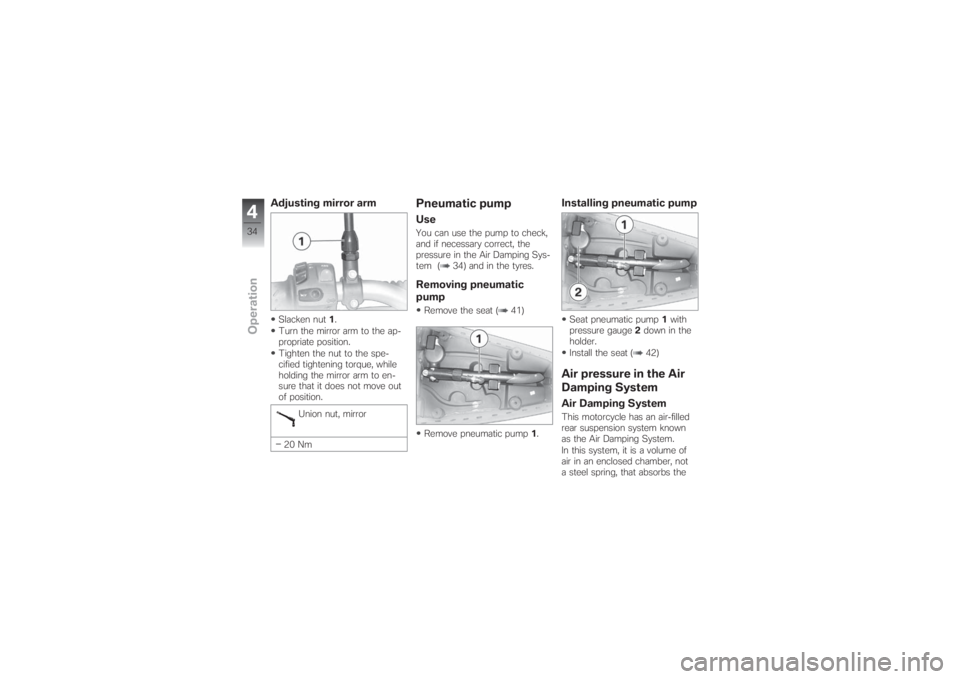
Adjusting mirror armSlacken nut1.
Turn the mirror arm to the ap-
propriate position.
Tighten the nut to the spe-
cified tightening torque, while
holding the mirror arm to en-
sure that it does not move out
of position.
Union nut, mirror
20 Nm
Pneumatic pumpUseYou can use the pump to check,
and if necessary correct, the
pressure in the Air Damping Sys-
tem ( 34) and in the tyres.Removing pneumatic
pumpRemove the seat ( 41)
Remove pneumatic pump1.
Installing pneumatic pumpSeat pneumatic pump1with
pressure gauge2down in the
holder.
Install the seat ( 42)Air pressure in the Air
Damping SystemAir Damping SystemThis motorcycle has an air-filled
rear suspension system known
as the Air Damping System.
In this system, it is a volume of
air in an enclosed chamber, not
a steel spring, that absorbs the
434zOperation
Page 42 of 138
adjusting screw in the+direc-
tion.
If you want softer damping, use
a screwdriver to turn the ad-
justing screw in the - direction.
Compression stage, basic
setting, front
Turn adjusting screw as far
as it will go in the "+" dir-
ection, then back it off 11
clicks in the "-" direction.Adjustment for rear
suspensionThe Air Damping System has
two settings so that it can be ad-
justed to suit the type of surface
on which you intend riding.
You can turn the adjusting screw
any distance in either direction.
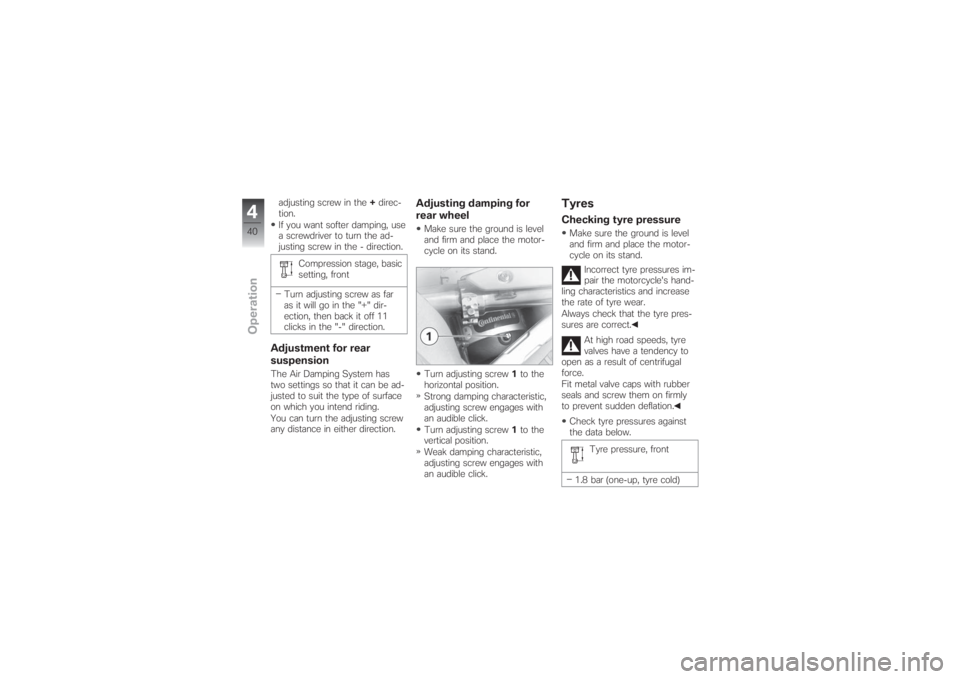
Adjusting damping for
rear wheelMake sure the ground is level
and firm and place the motor-
cycle on its stand.
Turn adjusting screw1to the
horizontal position.
Strong damping characteristic,
adjusting screw engages with
an audible click.
Turn adjusting screw1to the
vertical position.
Weak damping characteristic,
adjusting screw engages with
an audible click.
TyresChecking tyre pressureMake sure the ground is level
and firm and place the motor-
cycle on its stand.
Incorrect tyre pressures im-
pair the motorcycle's hand-
ling characteristics and increase
the rate of tyre wear.
Always check that the tyre pres-
sures are correct.
At high road speeds, tyre
valves have a tendency to
open as a result of centrifugal
force.
Fit metal valve caps with rubber
seals and screw them on firmly
to prevent sudden deflation.
Check tyre pressures against
the data below.
Tyre pressure, front
1.8 bar (one-up, tyre cold)
440zOperation
Page 43 of 138
Tyre pressure, front
1.9 bar (two-up and/or with
luggage, tyre cold)
Tyre pressure, rear
2 bar (one-up, tyre cold)
2.2 bar (two-up and/or with
luggage, tyre cold)
If tyre pressure is too low:
Correct tyre pressure.
HeadlightAdjusting headlight for
driving on right/driving on
leftThe motorcycle's headlight beam
is symmetric, so there is no need
for modification if you intend rid-
ing in a country where the op-
posite rule of the road applies.
Beam throw and air
pressure in the Air
Damping SystemHeadlight beam throw is kept
constant when the air pressure
in the Air Damping System is
adjusted to suit load.
Air-pressure adjustment might
not suffice only if the motorcycle
is very heavily loaded. Under
these circumstances, headlight
beam throw has to be adjusted
to suit the weight carried by the
motorcycle.
Consult a specialist work-
shop, preferably an au-
thorised BMW Motorrad deal-
er, if you are unsure whether
the headlight basic setting is
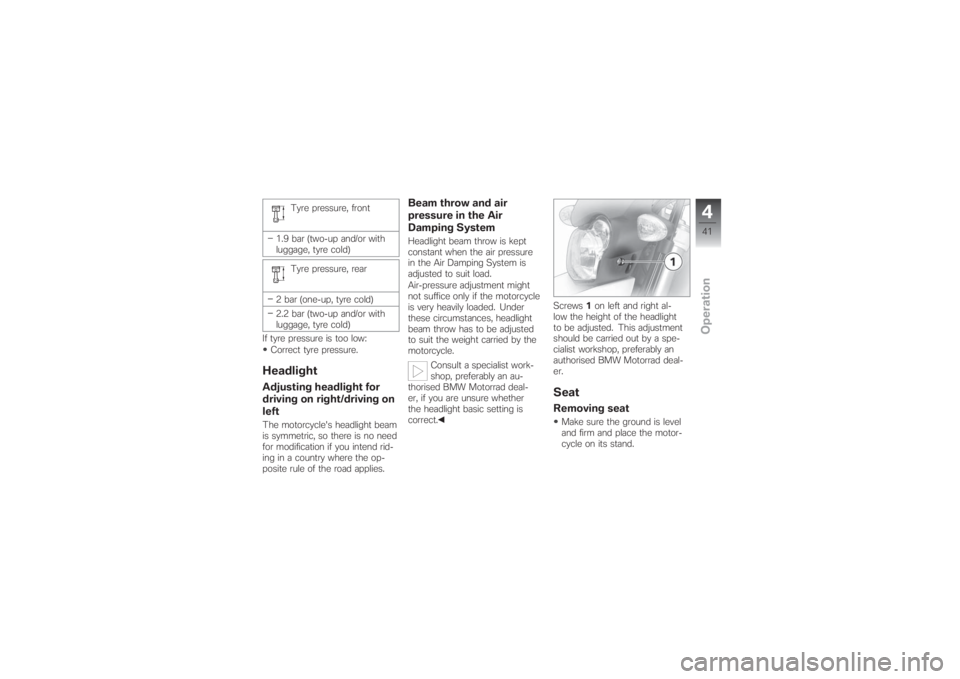
correct.Screws1on left and right al-
low the height of the headlight
to be adjusted. This adjustment
should be carried out by a spe-
cialist workshop, preferably an
authorised BMW Motorrad deal-
er.
SeatRemoving seatMake sure the ground is level
and firm and place the motor-
cycle on its stand.
441zOperation
Page 46 of 138
Safety instructionsRider's equipmentDo not ride without the correct
clothing. Always wear:
Helmet
Motorcycling jacket and
trousers
Gloves
Boots
This applies even to short jour-
neys, and to every season of the
year. Your authorised BMW Mo-
torrad dealer will be glad to ad-
vise you on the correct clothing
for every purpose.SpeedIf you ride at high speed, always
bear in mind that various bound-
ary conditions can adversely af-
fect the handling of your motor-
cycle:Settings of the spring-strut and
shock-absorber system
Imbalanced load
Loose clothing
Insufficient tyre pressure
Poor tyre tread
Etc.
Correct loading
Overloading and imbal-
anced loads can adversely
affect the motorcycle's handling.
Do not exceed the permissible
gross weight and be sure to
comply with the instructions on
loading.
Alcohol and drugs
Even small amounts of
alcohol or drugs will ad-
versely affect your perception
and your ability to assess situ-
ations and make decisions, and
slow down your reflexes. Med-
ication can exacerbate these ef-
fects.Do not ride your motorcycle after
consuming alcohol, drugs and/or
medication.
Risk of poisoningExhaust fumes contain carbon
monoxide, which is colourless
and odourless but highly toxic.
Inhaling the exhaust fumes
therefore represents a
health hazard and can even
cause loss of consciousness with
fatal consequences.
Do not inhale exhaust fumes.
Do not run the engine in an en-
closed space.High voltage
Touching live parts of the
ignition system with the
engine running can cause electric
shock.
Do not touch parts of the igni-
tion system when the engine is
running.
544zRiding
Page 48 of 138
ChecklistUse the following checklist to
check important functions, set-
tings and wear limits before you
ride off.
Brakes
Brake-fluid levels, front and rear
Clutch
Clutch fluid level
Damping-characteristic adjust-
ment and air pressure in the Air
Damping System
Tyre-tread depth and tyre
pressures
Cases correctly installed and
luggage secured
At regular intervals:
Engine oil level (every refuelling
stop)
Brake-pad wear (every third
refuelling stop)
Tension and lubrication of the
drive chain
StartingSide standYou cannot start the motorcycle
with the side stand extended and
a gear engaged. The engine will
switch itself off if you start it with
the gearbox in neutral and then
engage a gear before retracting
the side stand.GearboxYou can start the engine when
the gearbox is in neutral or if you
pull the clutch with a gear en-
gaged.
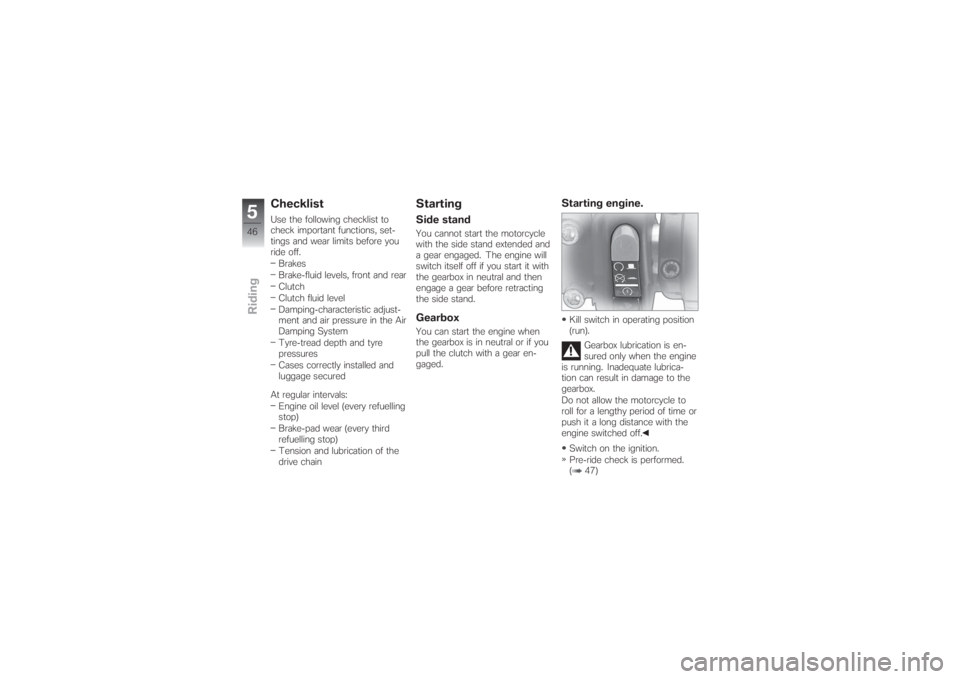
Starting engine.Kill switch in operating position
(run).
Gearbox lubrication is en-
sured only when the engine
is running. Inadequate lubrica-
tion can result in damage to the
gearbox.
Do not allow the motorcycle to
roll for a lengthy period of time or
push it a long distance with the
engine switched off.
Switch on the ignition.
Pre-ride check is performed.
( 47)
546zRiding
Page 51 of 138
Keep to the specified engine
speeds for running in.
During the running-in phase,
do not exceed the speed limits
specified for the various gears.
Maximum speeds during
running-in period
max 35 km/h (1st gear)
max 55 km/h (2nd gear)
max 75 km/h (3rd gear)
max 95 km/h (4th gear)
max 110 km/h (5th gear)
No full-load acceleration.
Avoid low engine speeds at full
load.
Do not omit the first inspection
after 500 - 1200 km.Brake padsNew brake pads must "bed
down" and therefore do not
achieve their optimum friction
levels during the first 500km. You can compensate for
this initial reduction in braking
efficiency by exerting greater
pressure on the levers.
New brake pads can ex-
tend stopping distance by a
significant margin.
Apply the brakes in good time.
TyresNew tyres have a smooth sur-
face. This must be roughened by
riding in a restrained manner at
various heel angles until the tyres
are run in. This running in pro-
cedure is essential if the tyres are
to achieve maximum grip.
Tyres do not have their full
grip when new and there
is a risk of accidents at extreme
angles of heel.
Avoid extreme angles of heel.
Riding off-roadTyre pressures
Tyre pressures reduced for
off-road riding impair the
motorcycle's handling character-
istics on surfaced roads and can
lead to accidents.
Always check that the tyre pres-
sures are correct.
Dirt or mud on brakes
When riding on loose sur-
faces or muddy roads, the
brakes may fail to take effect
immediately because of dirt or
moisture on the discs or brake
pads.
Apply the brakes in good time
until the brakes have been
cleaned.
The brake pads will wear
more rapidly if you ride fre-
quently on unsurfaced tracks or
poor roads.
Check the thickness of the brake
549zRiding
Page 52 of 138
pads more frequently and replace
the brake pads in good time.Air pressure and damping
characteristics
The off-road settings for air
pressure in the Air Damping
System and the front and rear
shock-absorber damping char-
acteristics will impair the motor-
cycle's handling characteristics
on surfaced roads.
If you have been off-roading, re-
member to correct the air pres-
sure in the Air Damping System
and the shock-absorber damping
characteristics before you return
to surfaced roads.
Deactivatable ABS
OE
You can deactivate the BMW
Motorrad Integral ABS for off-
roading ( 33).
BrakesHow can stopping
distance be minimised?Each time the brakes are applied,
a load distribution shift takes
place with the load shifting for-
ward from the rear to the front
wheel. The sharper the motor-
cycle decelerates, the more load
is shifted to the front wheel. The
higher the wheel load, the more
braking force can be transmitted
without the wheel locking.
To optimise stopping distance,
apply the front brakes rapidly and
keep on increasing the force you
apply to the brake lever. This
makes the best possible use
of the dynamic increase in load
at the front wheel. Remember
to pull the clutch at the same
time. In the "panic braking situ-
ations" that are trained so fre-
quently braking force is applied
as rapidly as possible and withthe rider's full force applied to
the brake levers; under these cir-
cumstances the dynamic shift
in load distribution cannot keep
pace with the increase in de-
celeration and the tyres cannot
transmit the full braking force to
the surface of the road. ABS has
to intervene to keep the front
wheel from locking; this increases
stopping distance.
Descending mountain
passes
There is a danger of the
brakes fading if you use
only the rear brakes when des-
cending mountain passes. Under
extreme conditions, the brakes
could overheat and suffer severe
damage.
Use both front and rear brakes,
and make use of the engine's
braking effect as well.
550zRiding
Page 58 of 138
Brake system with
BMW Motorrad ABS
OE
How does ABS work?The amount of braking force that
can be transferred to the road
depends on factors hat include
the coefficient of friction of the
road surface. Loose stones, ice
and snow or a wet road all have
much lower coefficients of fric-
tion than a clean, dry asphalt sur-
face. The lower the coefficient
of friction, the longer the braking
distance.
If the rider increases braking
pressure to the extent that brak-
ing force exceeds the maxim-
um transferrable limit, the wheels
start to lock and the motorcycle
loses its directional stability; a fall
is imminent. Before this situation
can occur, ABS intervenes and
adapts braking pressure to the
maximum transferrable braking
force, so the wheels continueto turn and directional stability
is maintained irrespective of the
condition of the road surface.
What are the effects of
surface irregularities?Humps and surface irregularit-
ies can cause the wheels to lose
contact temporarily with the road
surface; if this happens the brak-
ing force that can be transmit-
ted to the road can drop to zero.
If the brakes are applied under
these circumstances the ABS
has to reduce braking force to
ensure that directional stability
is maintained when the wheels
regain contact with the road sur-
face. At this instant the BMW
Motorrad ABS must assume an
extremely low coefficient of fric-
tion, so that the wheels will con-
tinue to rotate under all imagin-
able circumstances, because this
is the precondition for ensuring
directional stability. As soon asis registers the actual circum-
stances, the system reacts in-
stantly and adjusts braking force
accordingly to achieve optimum
braking.
Rear wheel liftEven under severe braking, a
high level of tyre grip can mean
that the front wheel does not
lock up until very late, if at all.
Consequently, ABS does not in-
tervene until very late, if at all.
Under these circumstances the
rear wheel can lift off the ground,
and the outcome can be a high-
siding situation in which the mo-
torcycle can flip over.
Severe braking can cause
the rear wheel to lift off the
ground.
When you brake, bear in mind
that ABS control cannot be relied
on in all circumstances to prevent
the rear wheel from lifting clear of
the ground.
656zEngineering details