light CHRYSLER VOYAGER 2001 Service Manual
[x] Cancel search | Manufacturer: CHRYSLER, Model Year: 2001, Model line: VOYAGER, Model: CHRYSLER VOYAGER 2001Pages: 4284, PDF Size: 83.53 MB
Page 776 of 4284
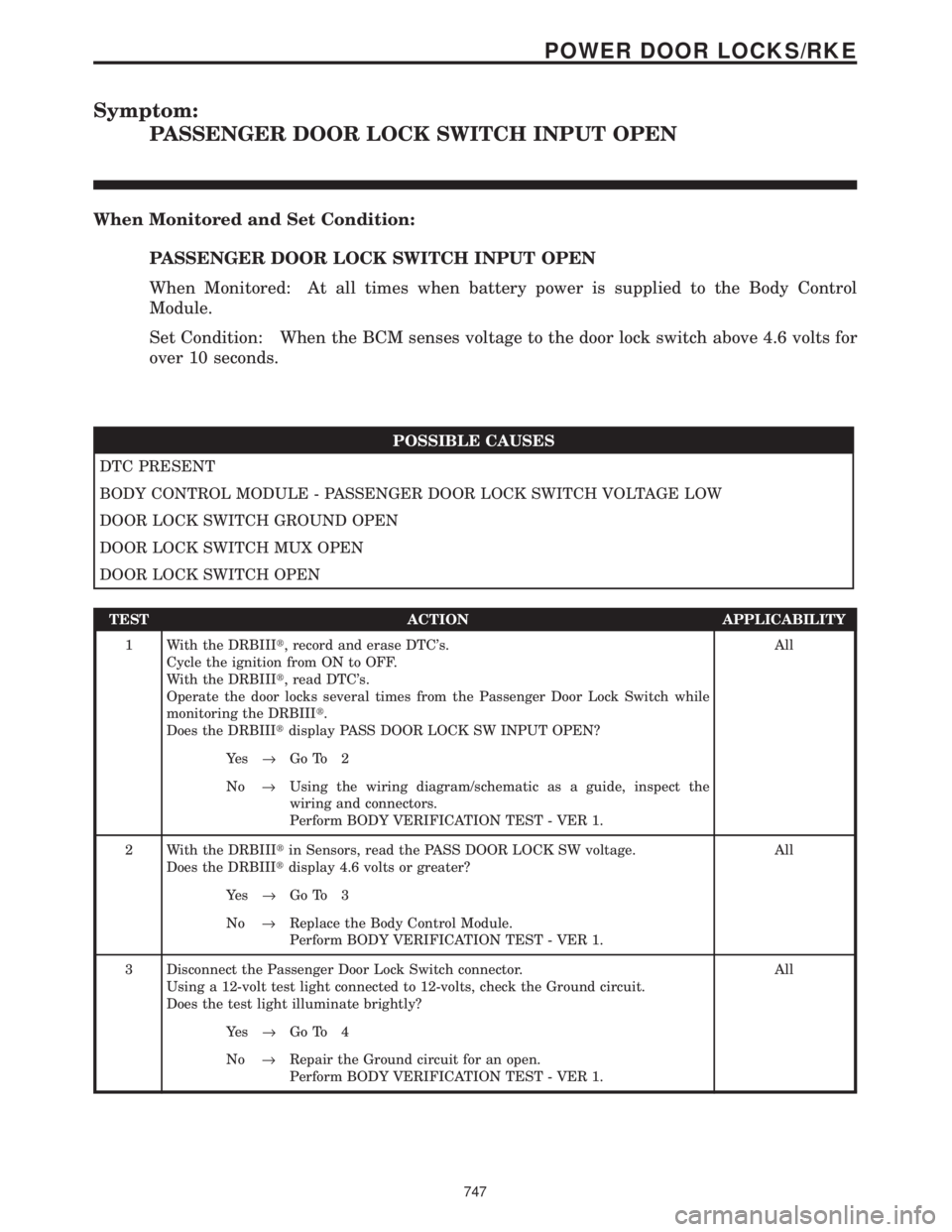
Symptom:
PASSENGER DOOR LOCK SWITCH INPUT OPEN
When Monitored and Set Condition:
PASSENGER DOOR LOCK SWITCH INPUT OPEN
When Monitored: At all times when battery power is supplied to the Body Control
Module.
Set Condition: When the BCM senses voltage to the door lock switch above 4.6 volts for
over 10 seconds.
POSSIBLE CAUSES
DTC PRESENT
BODY CONTROL MODULE - PASSENGER DOOR LOCK SWITCH VOLTAGE LOW
DOOR LOCK SWITCH GROUND OPEN
DOOR LOCK SWITCH MUX OPEN
DOOR LOCK SWITCH OPEN
TEST ACTION APPLICABILITY
1 With the DRBIIIt, record and erase DTC's.
Cycle the ignition from ON to OFF.
With the DRBIIIt, read DTC's.
Operate the door locks several times from the Passenger Door Lock Switch while
monitoring the DRBIIIt.
Does the DRBIIItdisplay PASS DOOR LOCK SW INPUT OPEN?All
Ye s®Go To 2
No®Using the wiring diagram/schematic as a guide, inspect the
wiring and connectors.
Perform BODY VERIFICATION TEST - VER 1.
2 With the DRBIIItin Sensors, read the PASS DOOR LOCK SW voltage.
Does the DRBIIItdisplay 4.6 volts or greater?All
Ye s®Go To 3
No®Replace the Body Control Module.
Perform BODY VERIFICATION TEST - VER 1.
3 Disconnect the Passenger Door Lock Switch connector.
Using a 12-volt test light connected to 12-volts, check the Ground circuit.
Does the test light illuminate brightly?All
Ye s®Go To 4
No®Repair the Ground circuit for an open.
Perform BODY VERIFICATION TEST - VER 1.
747
POWER DOOR LOCKS/RKE
Page 780 of 4284
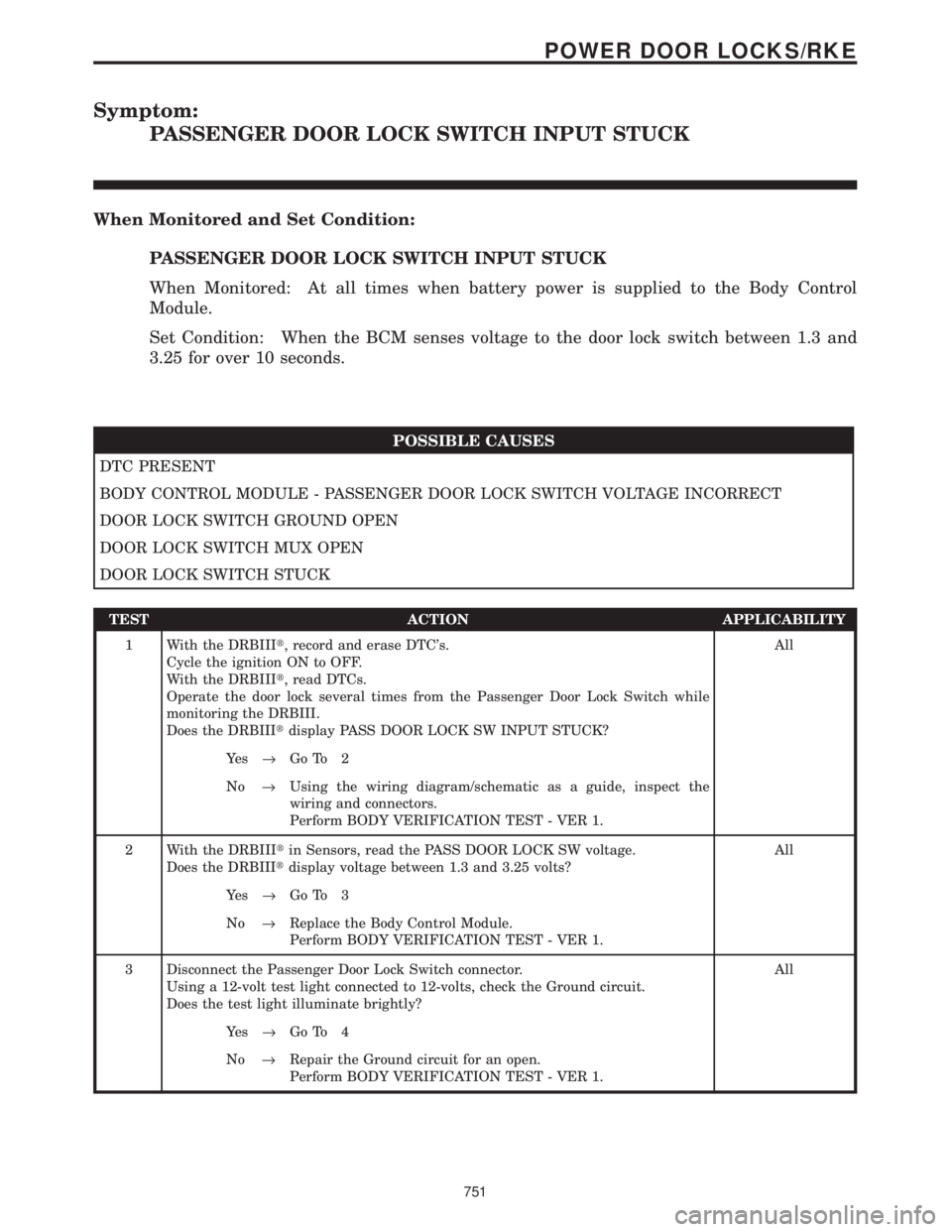
Symptom:
PASSENGER DOOR LOCK SWITCH INPUT STUCK
When Monitored and Set Condition:
PASSENGER DOOR LOCK SWITCH INPUT STUCK
When Monitored: At all times when battery power is supplied to the Body Control
Module.
Set Condition: When the BCM senses voltage to the door lock switch between 1.3 and
3.25 for over 10 seconds.
POSSIBLE CAUSES
DTC PRESENT
BODY CONTROL MODULE - PASSENGER DOOR LOCK SWITCH VOLTAGE INCORRECT
DOOR LOCK SWITCH GROUND OPEN
DOOR LOCK SWITCH MUX OPEN
DOOR LOCK SWITCH STUCK
TEST ACTION APPLICABILITY
1 With the DRBIIIt, record and erase DTC's.
Cycle the ignition ON to OFF.
With the DRBIIIt, read DTCs.
Operate the door lock several times from the Passenger Door Lock Switch while
monitoring the DRBIII.
Does the DRBIIItdisplay PASS DOOR LOCK SW INPUT STUCK?All
Ye s®Go To 2
No®Using the wiring diagram/schematic as a guide, inspect the
wiring and connectors.
Perform BODY VERIFICATION TEST - VER 1.
2 With the DRBIIItin Sensors, read the PASS DOOR LOCK SW voltage.
Does the DRBIIItdisplay voltage between 1.3 and 3.25 volts?All
Ye s®Go To 3
No®Replace the Body Control Module.
Perform BODY VERIFICATION TEST - VER 1.
3 Disconnect the Passenger Door Lock Switch connector.
Using a 12-volt test light connected to 12-volts, check the Ground circuit.
Does the test light illuminate brightly?All
Ye s®Go To 4
No®Repair the Ground circuit for an open.
Perform BODY VERIFICATION TEST - VER 1.
751
POWER DOOR LOCKS/RKE
Page 782 of 4284
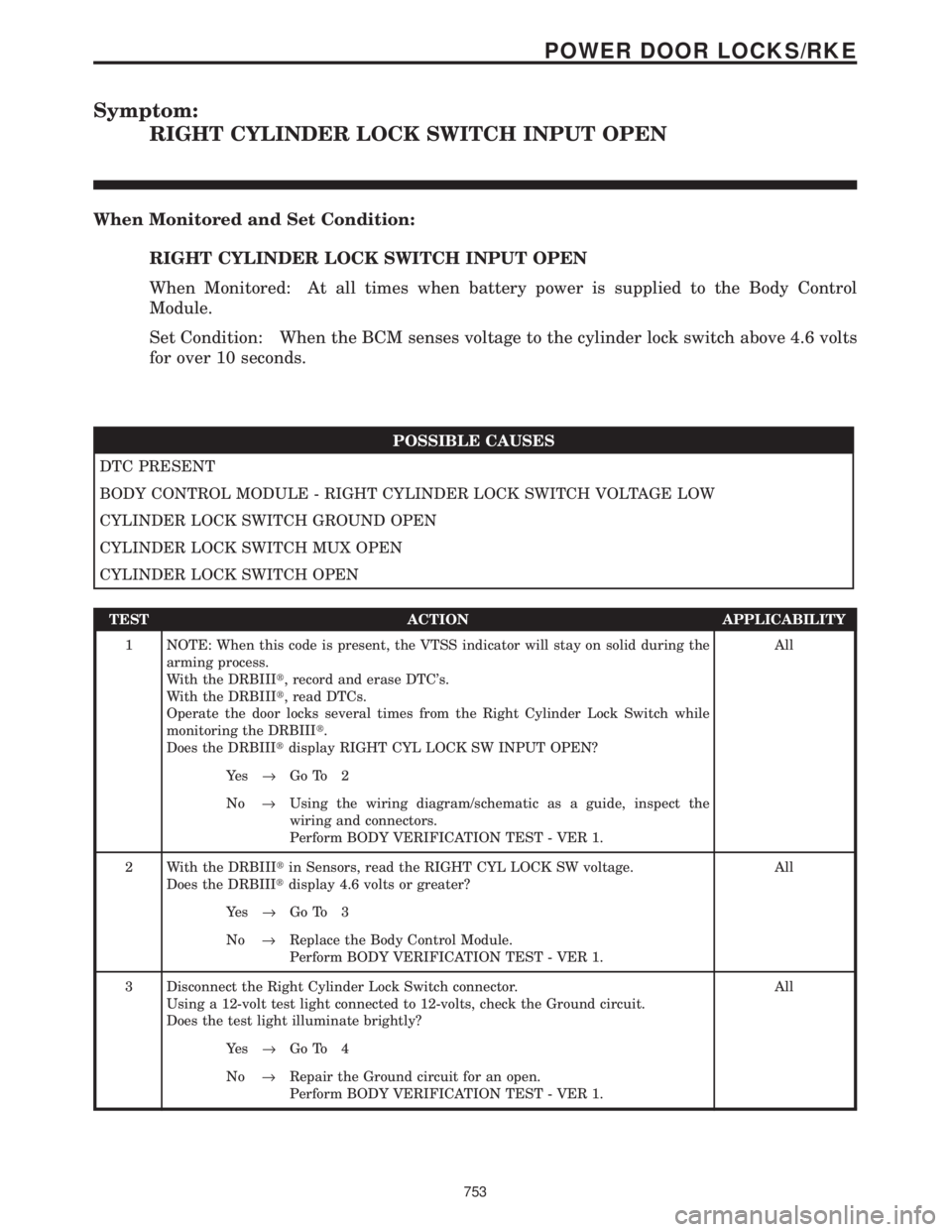
Symptom:
RIGHT CYLINDER LOCK SWITCH INPUT OPEN
When Monitored and Set Condition:
RIGHT CYLINDER LOCK SWITCH INPUT OPEN
When Monitored: At all times when battery power is supplied to the Body Control
Module.
Set Condition: When the BCM senses voltage to the cylinder lock switch above 4.6 volts
for over 10 seconds.
POSSIBLE CAUSES
DTC PRESENT
BODY CONTROL MODULE - RIGHT CYLINDER LOCK SWITCH VOLTAGE LOW
CYLINDER LOCK SWITCH GROUND OPEN
CYLINDER LOCK SWITCH MUX OPEN
CYLINDER LOCK SWITCH OPEN
TEST ACTION APPLICABILITY
1 NOTE: When this code is present, the VTSS indicator will stay on solid during the
arming process.
With the DRBIIIt, record and erase DTC's.
With the DRBIIIt, read DTCs.
Operate the door locks several times from the Right Cylinder Lock Switch while
monitoring the DRBIIIt.
Does the DRBIIItdisplay RIGHT CYL LOCK SW INPUT OPEN?All
Ye s®Go To 2
No®Using the wiring diagram/schematic as a guide, inspect the
wiring and connectors.
Perform BODY VERIFICATION TEST - VER 1.
2 With the DRBIIItin Sensors, read the RIGHT CYL LOCK SW voltage.
Does the DRBIIItdisplay 4.6 volts or greater?All
Ye s®Go To 3
No®Replace the Body Control Module.
Perform BODY VERIFICATION TEST - VER 1.
3 Disconnect the Right Cylinder Lock Switch connector.
Using a 12-volt test light connected to 12-volts, check the Ground circuit.
Does the test light illuminate brightly?All
Ye s®Go To 4
No®Repair the Ground circuit for an open.
Perform BODY VERIFICATION TEST - VER 1.
753
POWER DOOR LOCKS/RKE
Page 786 of 4284
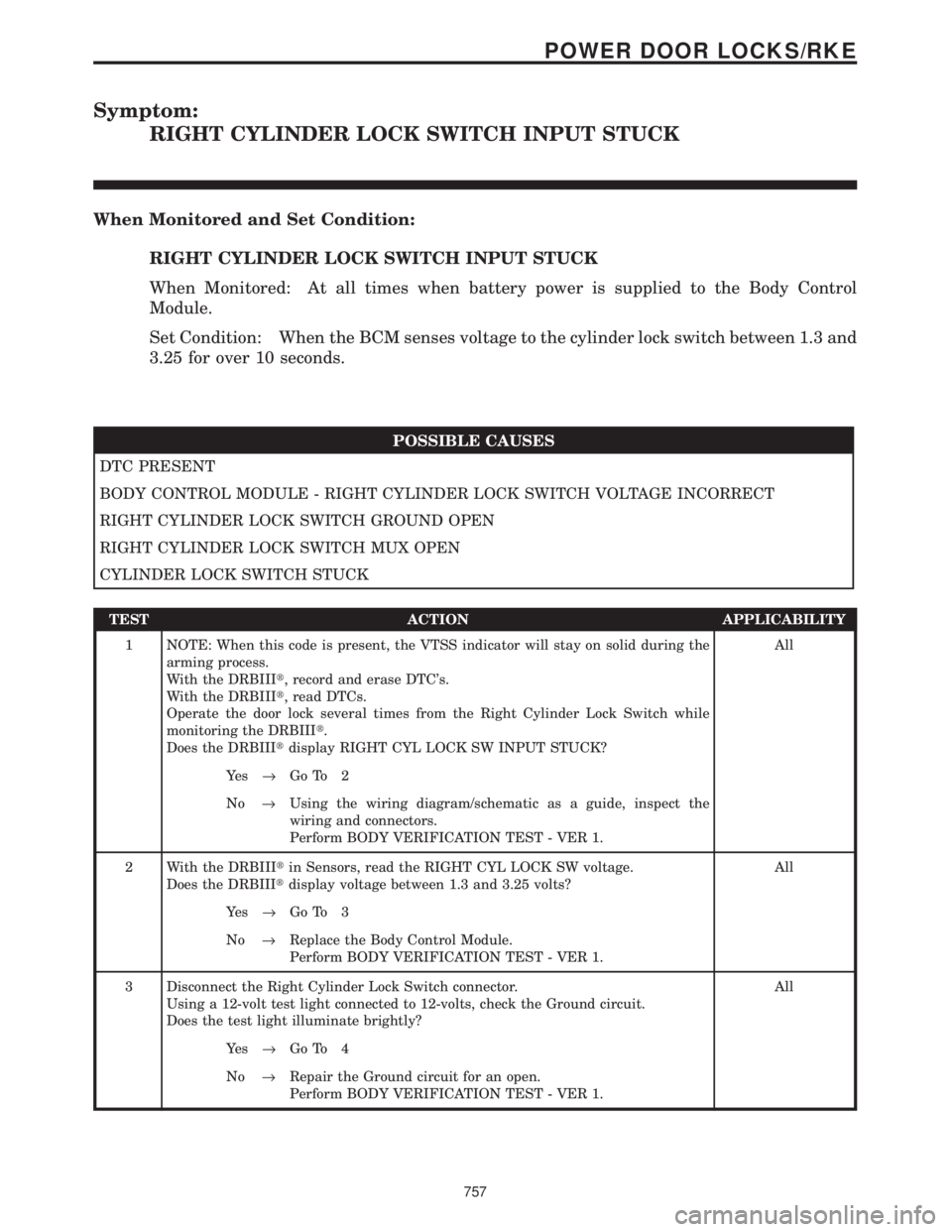
Symptom:
RIGHT CYLINDER LOCK SWITCH INPUT STUCK
When Monitored and Set Condition:
RIGHT CYLINDER LOCK SWITCH INPUT STUCK
When Monitored: At all times when battery power is supplied to the Body Control
Module.
Set Condition: When the BCM senses voltage to the cylinder lock switch between 1.3 and
3.25 for over 10 seconds.
POSSIBLE CAUSES
DTC PRESENT
BODY CONTROL MODULE - RIGHT CYLINDER LOCK SWITCH VOLTAGE INCORRECT
RIGHT CYLINDER LOCK SWITCH GROUND OPEN
RIGHT CYLINDER LOCK SWITCH MUX OPEN
CYLINDER LOCK SWITCH STUCK
TEST ACTION APPLICABILITY
1 NOTE: When this code is present, the VTSS indicator will stay on solid during the
arming process.
With the DRBIIIt, record and erase DTC's.
With the DRBIIIt, read DTCs.
Operate the door lock several times from the Right Cylinder Lock Switch while
monitoring the DRBIIIt.
Does the DRBIIItdisplay RIGHT CYL LOCK SW INPUT STUCK?All
Ye s®Go To 2
No®Using the wiring diagram/schematic as a guide, inspect the
wiring and connectors.
Perform BODY VERIFICATION TEST - VER 1.
2 With the DRBIIItin Sensors, read the RIGHT CYL LOCK SW voltage.
Does the DRBIIItdisplay voltage between 1.3 and 3.25 volts?All
Ye s®Go To 3
No®Replace the Body Control Module.
Perform BODY VERIFICATION TEST - VER 1.
3 Disconnect the Right Cylinder Lock Switch connector.
Using a 12-volt test light connected to 12-volts, check the Ground circuit.
Does the test light illuminate brightly?All
Ye s®Go To 4
No®Repair the Ground circuit for an open.
Perform BODY VERIFICATION TEST - VER 1.
757
POWER DOOR LOCKS/RKE
Page 794 of 4284
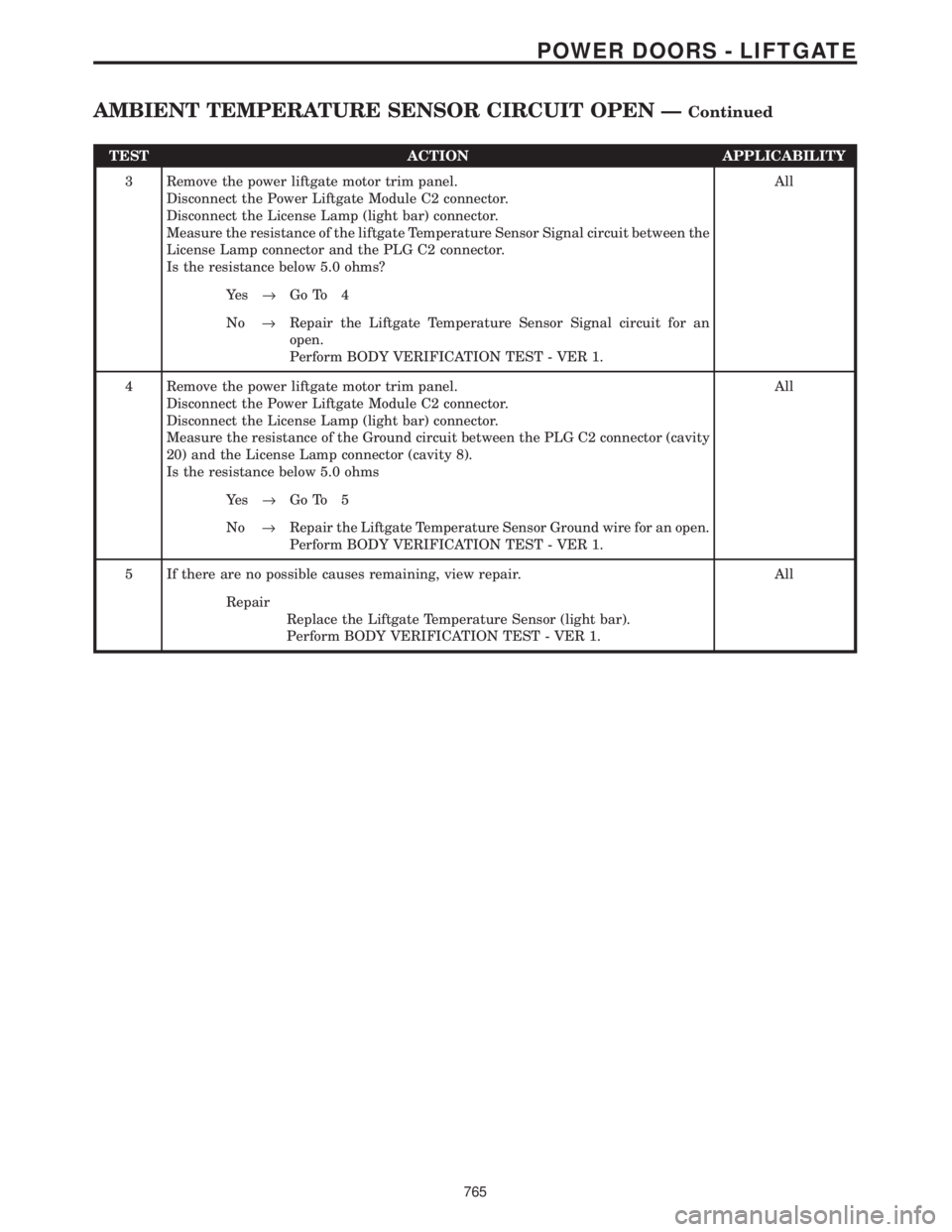
TEST ACTION APPLICABILITY
3 Remove the power liftgate motor trim panel.
Disconnect the Power Liftgate Module C2 connector.
Disconnect the License Lamp (light bar) connector.
Measure the resistance of the liftgate Temperature Sensor Signal circuit between the
License Lamp connector and the PLG C2 connector.
Is the resistance below 5.0 ohms?All
Ye s®Go To 4
No®Repair the Liftgate Temperature Sensor Signal circuit for an
open.
Perform BODY VERIFICATION TEST - VER 1.
4 Remove the power liftgate motor trim panel.
Disconnect the Power Liftgate Module C2 connector.
Disconnect the License Lamp (light bar) connector.
Measure the resistance of the Ground circuit between the PLG C2 connector (cavity
20) and the License Lamp connector (cavity 8).
Is the resistance below 5.0 ohmsAll
Ye s®Go To 5
No®Repair the Liftgate Temperature Sensor Ground wire for an open.
Perform BODY VERIFICATION TEST - VER 1.
5 If there are no possible causes remaining, view repair. All
Repair
Replace the Liftgate Temperature Sensor (light bar).
Perform BODY VERIFICATION TEST - VER 1.
765
POWER DOORS - LIFTGATE
AMBIENT TEMPERATURE SENSOR CIRCUIT OPEN ÐContinued
Page 796 of 4284
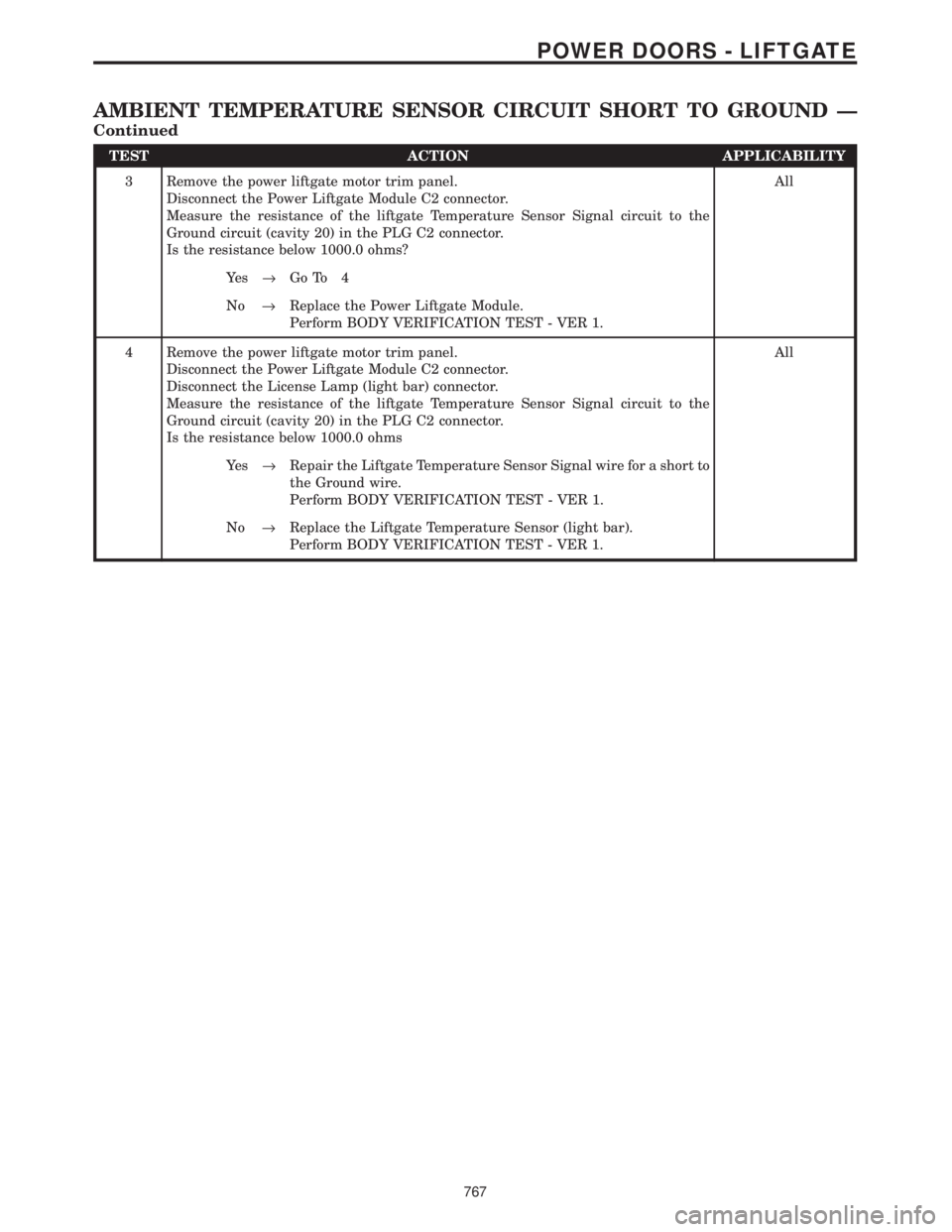
TEST ACTION APPLICABILITY
3 Remove the power liftgate motor trim panel.
Disconnect the Power Liftgate Module C2 connector.
Measure the resistance of the liftgate Temperature Sensor Signal circuit to the
Ground circuit (cavity 20) in the PLG C2 connector.
Is the resistance below 1000.0 ohms?All
Ye s®Go To 4
No®Replace the Power Liftgate Module.
Perform BODY VERIFICATION TEST - VER 1.
4 Remove the power liftgate motor trim panel.
Disconnect the Power Liftgate Module C2 connector.
Disconnect the License Lamp (light bar) connector.
Measure the resistance of the liftgate Temperature Sensor Signal circuit to the
Ground circuit (cavity 20) in the PLG C2 connector.
Is the resistance below 1000.0 ohmsAll
Ye s®Repair the Liftgate Temperature Sensor Signal wire for a short to
the Ground wire.
Perform BODY VERIFICATION TEST - VER 1.
No®Replace the Liftgate Temperature Sensor (light bar).
Perform BODY VERIFICATION TEST - VER 1.
767
POWER DOORS - LIFTGATE
AMBIENT TEMPERATURE SENSOR CIRCUIT SHORT TO GROUND Ð
Continued
Page 799 of 4284
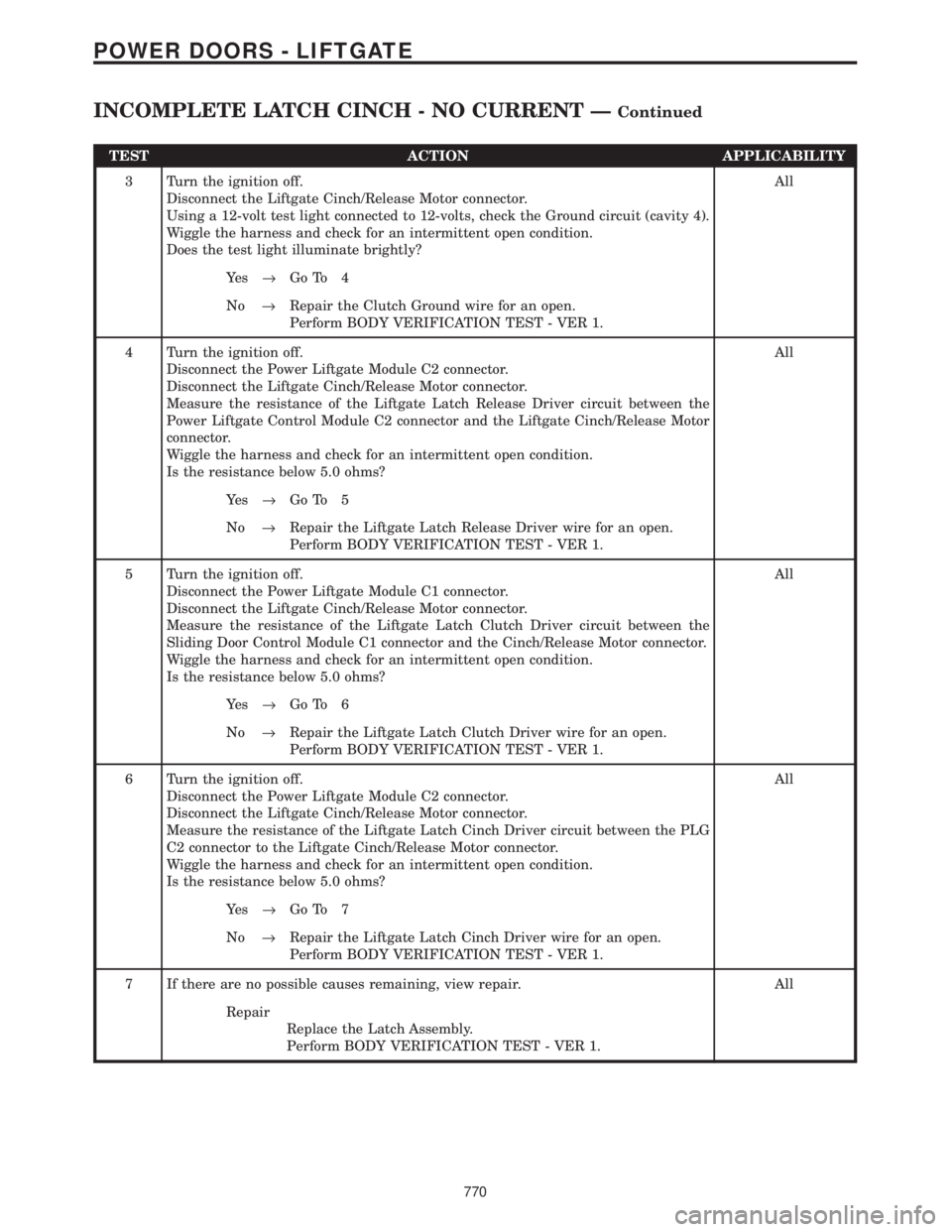
TEST ACTION APPLICABILITY
3 Turn the ignition off.
Disconnect the Liftgate Cinch/Release Motor connector.
Using a 12-volt test light connected to 12-volts, check the Ground circuit (cavity 4).
Wiggle the harness and check for an intermittent open condition.
Does the test light illuminate brightly?All
Ye s®Go To 4
No®Repair the Clutch Ground wire for an open.
Perform BODY VERIFICATION TEST - VER 1.
4 Turn the ignition off.
Disconnect the Power Liftgate Module C2 connector.
Disconnect the Liftgate Cinch/Release Motor connector.
Measure the resistance of the Liftgate Latch Release Driver circuit between the
Power Liftgate Control Module C2 connector and the Liftgate Cinch/Release Motor
connector.
Wiggle the harness and check for an intermittent open condition.
Is the resistance below 5.0 ohms?All
Ye s®Go To 5
No®Repair the Liftgate Latch Release Driver wire for an open.
Perform BODY VERIFICATION TEST - VER 1.
5 Turn the ignition off.
Disconnect the Power Liftgate Module C1 connector.
Disconnect the Liftgate Cinch/Release Motor connector.
Measure the resistance of the Liftgate Latch Clutch Driver circuit between the
Sliding Door Control Module C1 connector and the Cinch/Release Motor connector.
Wiggle the harness and check for an intermittent open condition.
Is the resistance below 5.0 ohms?All
Ye s®Go To 6
No®Repair the Liftgate Latch Clutch Driver wire for an open.
Perform BODY VERIFICATION TEST - VER 1.
6 Turn the ignition off.
Disconnect the Power Liftgate Module C2 connector.
Disconnect the Liftgate Cinch/Release Motor connector.
Measure the resistance of the Liftgate Latch Cinch Driver circuit between the PLG
C2 connector to the Liftgate Cinch/Release Motor connector.
Wiggle the harness and check for an intermittent open condition.
Is the resistance below 5.0 ohms?All
Ye s®Go To 7
No®Repair the Liftgate Latch Cinch Driver wire for an open.
Perform BODY VERIFICATION TEST - VER 1.
7 If there are no possible causes remaining, view repair. All
Repair
Replace the Latch Assembly.
Perform BODY VERIFICATION TEST - VER 1.
770
POWER DOORS - LIFTGATE
INCOMPLETE LATCH CINCH - NO CURRENT ÐContinued
Page 806 of 4284
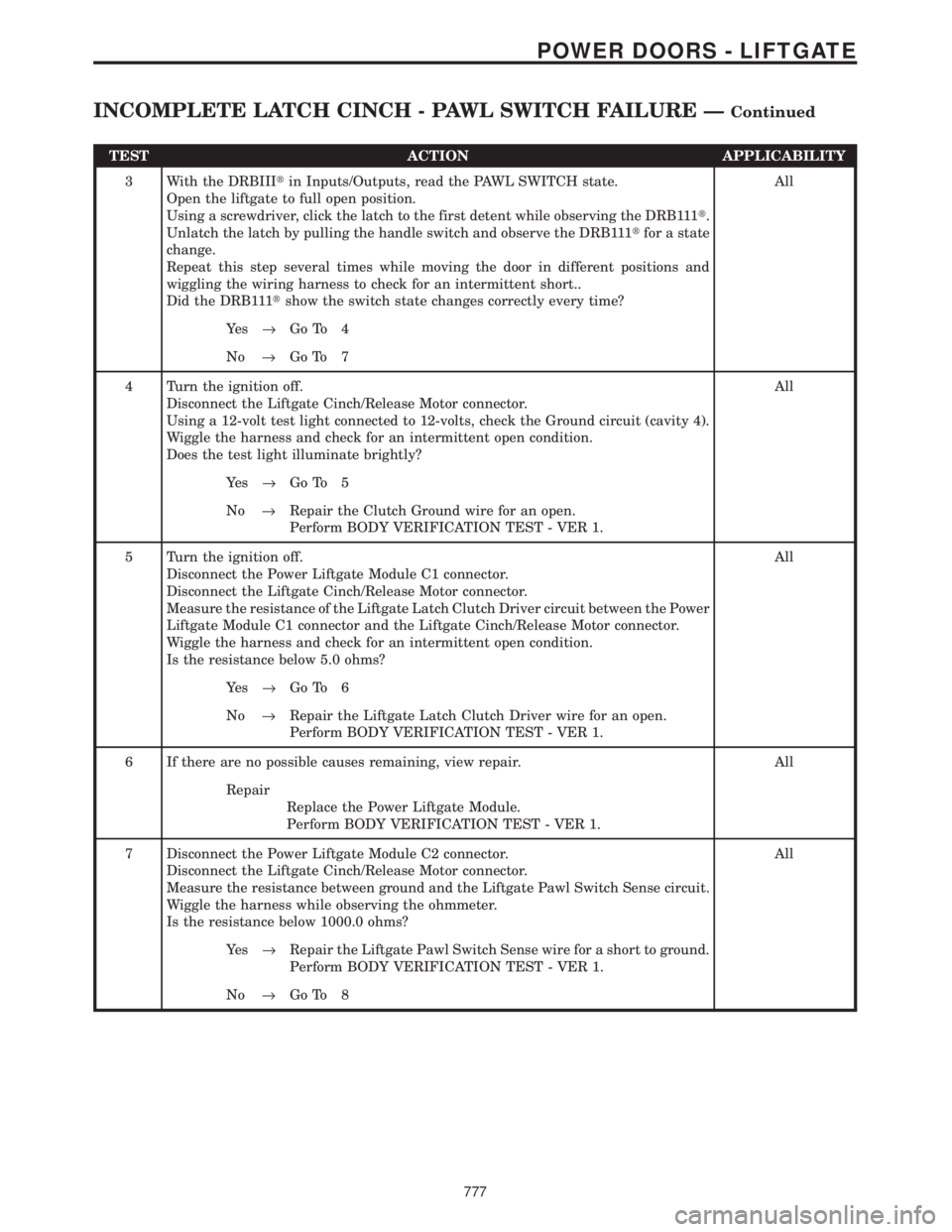
TEST ACTION APPLICABILITY
3 With the DRBIIItin Inputs/Outputs, read the PAWL SWITCH state.
Open the liftgate to full open position.
Using a screwdriver, click the latch to the first detent while observing the DRB111t.
Unlatch the latch by pulling the handle switch and observe the DRB111tfor a state
change.
Repeat this step several times while moving the door in different positions and
wiggling the wiring harness to check for an intermittent short..
Did the DRB111tshow the switch state changes correctly every time?All
Ye s®Go To 4
No®Go To 7
4 Turn the ignition off.
Disconnect the Liftgate Cinch/Release Motor connector.
Using a 12-volt test light connected to 12-volts, check the Ground circuit (cavity 4).
Wiggle the harness and check for an intermittent open condition.
Does the test light illuminate brightly?All
Ye s®Go To 5
No®Repair the Clutch Ground wire for an open.
Perform BODY VERIFICATION TEST - VER 1.
5 Turn the ignition off.
Disconnect the Power Liftgate Module C1 connector.
Disconnect the Liftgate Cinch/Release Motor connector.
Measure the resistance of the Liftgate Latch Clutch Driver circuit between the Power
Liftgate Module C1 connector and the Liftgate Cinch/Release Motor connector.
Wiggle the harness and check for an intermittent open condition.
Is the resistance below 5.0 ohms?All
Ye s®Go To 6
No®Repair the Liftgate Latch Clutch Driver wire for an open.
Perform BODY VERIFICATION TEST - VER 1.
6 If there are no possible causes remaining, view repair. All
Repair
Replace the Power Liftgate Module.
Perform BODY VERIFICATION TEST - VER 1.
7 Disconnect the Power Liftgate Module C2 connector.
Disconnect the Liftgate Cinch/Release Motor connector.
Measure the resistance between ground and the Liftgate Pawl Switch Sense circuit.
Wiggle the harness while observing the ohmmeter.
Is the resistance below 1000.0 ohms?All
Ye s®Repair the Liftgate Pawl Switch Sense wire for a short to ground.
Perform BODY VERIFICATION TEST - VER 1.
No®Go To 8
777
POWER DOORS - LIFTGATE
INCOMPLETE LATCH CINCH - PAWL SWITCH FAILURE ÐContinued
Page 809 of 4284
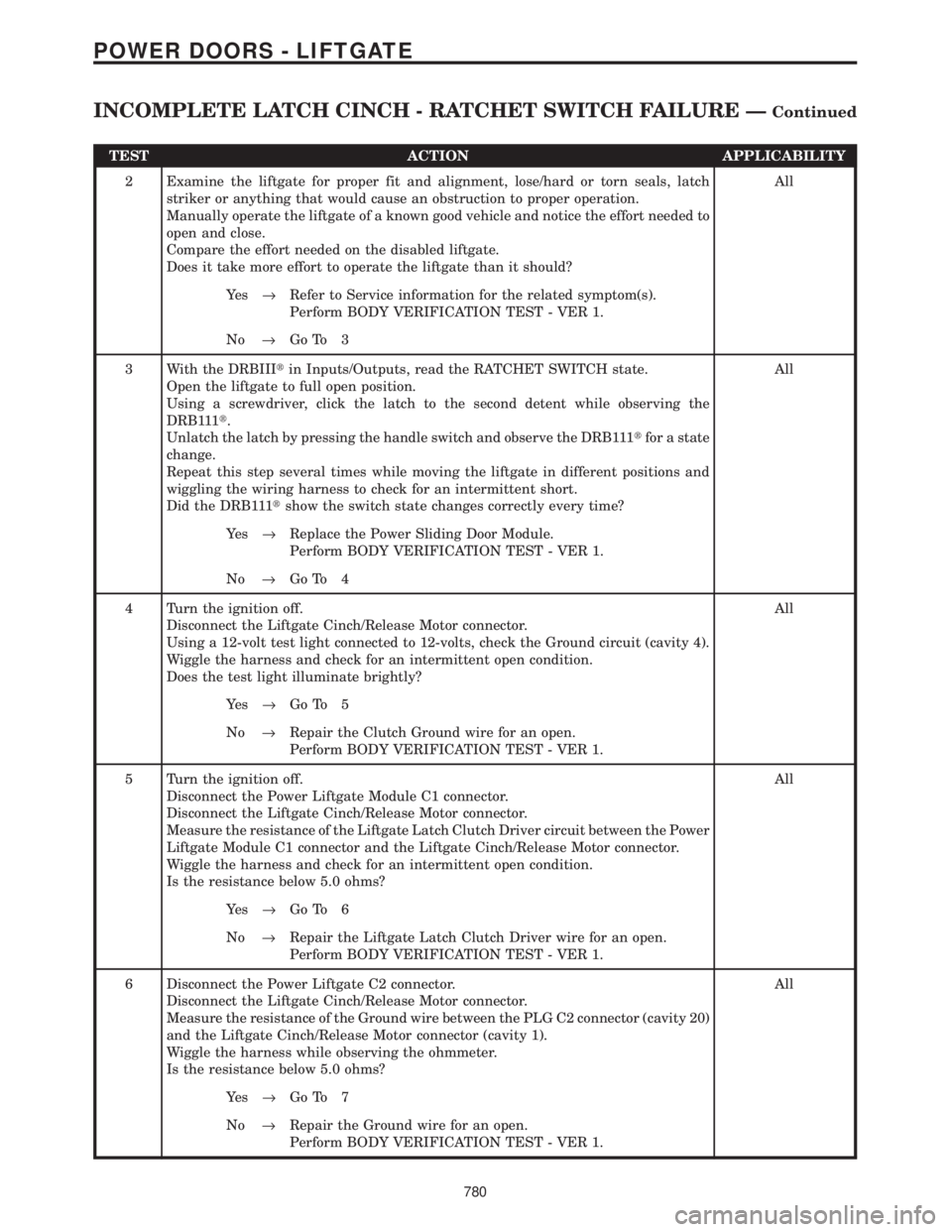
TEST ACTION APPLICABILITY
2 Examine the liftgate for proper fit and alignment, lose/hard or torn seals, latch
striker or anything that would cause an obstruction to proper operation.
Manually operate the liftgate of a known good vehicle and notice the effort needed to
open and close.
Compare the effort needed on the disabled liftgate.
Does it take more effort to operate the liftgate than it should?All
Ye s®Refer to Service information for the related symptom(s).
Perform BODY VERIFICATION TEST - VER 1.
No®Go To 3
3 With the DRBIIItin Inputs/Outputs, read the RATCHET SWITCH state.
Open the liftgate to full open position.
Using a screwdriver, click the latch to the second detent while observing the
DRB111t.
Unlatch the latch by pressing the handle switch and observe the DRB111tfor a state
change.
Repeat this step several times while moving the liftgate in different positions and
wiggling the wiring harness to check for an intermittent short.
Did the DRB111tshow the switch state changes correctly every time?All
Ye s®Replace the Power Sliding Door Module.
Perform BODY VERIFICATION TEST - VER 1.
No®Go To 4
4 Turn the ignition off.
Disconnect the Liftgate Cinch/Release Motor connector.
Using a 12-volt test light connected to 12-volts, check the Ground circuit (cavity 4).
Wiggle the harness and check for an intermittent open condition.
Does the test light illuminate brightly?All
Ye s®Go To 5
No®Repair the Clutch Ground wire for an open.
Perform BODY VERIFICATION TEST - VER 1.
5 Turn the ignition off.
Disconnect the Power Liftgate Module C1 connector.
Disconnect the Liftgate Cinch/Release Motor connector.
Measure the resistance of the Liftgate Latch Clutch Driver circuit between the Power
Liftgate Module C1 connector and the Liftgate Cinch/Release Motor connector.
Wiggle the harness and check for an intermittent open condition.
Is the resistance below 5.0 ohms?All
Ye s®Go To 6
No®Repair the Liftgate Latch Clutch Driver wire for an open.
Perform BODY VERIFICATION TEST - VER 1.
6 Disconnect the Power Liftgate C2 connector.
Disconnect the Liftgate Cinch/Release Motor connector.
Measure the resistance of the Ground wire between the PLG C2 connector (cavity 20)
and the Liftgate Cinch/Release Motor connector (cavity 1).
Wiggle the harness while observing the ohmmeter.
Is the resistance below 5.0 ohms?All
Ye s®Go To 7
No®Repair the Ground wire for an open.
Perform BODY VERIFICATION TEST - VER 1.
780
POWER DOORS - LIFTGATE
INCOMPLETE LATCH CINCH - RATCHET SWITCH FAILURE ÐContinued
Page 823 of 4284
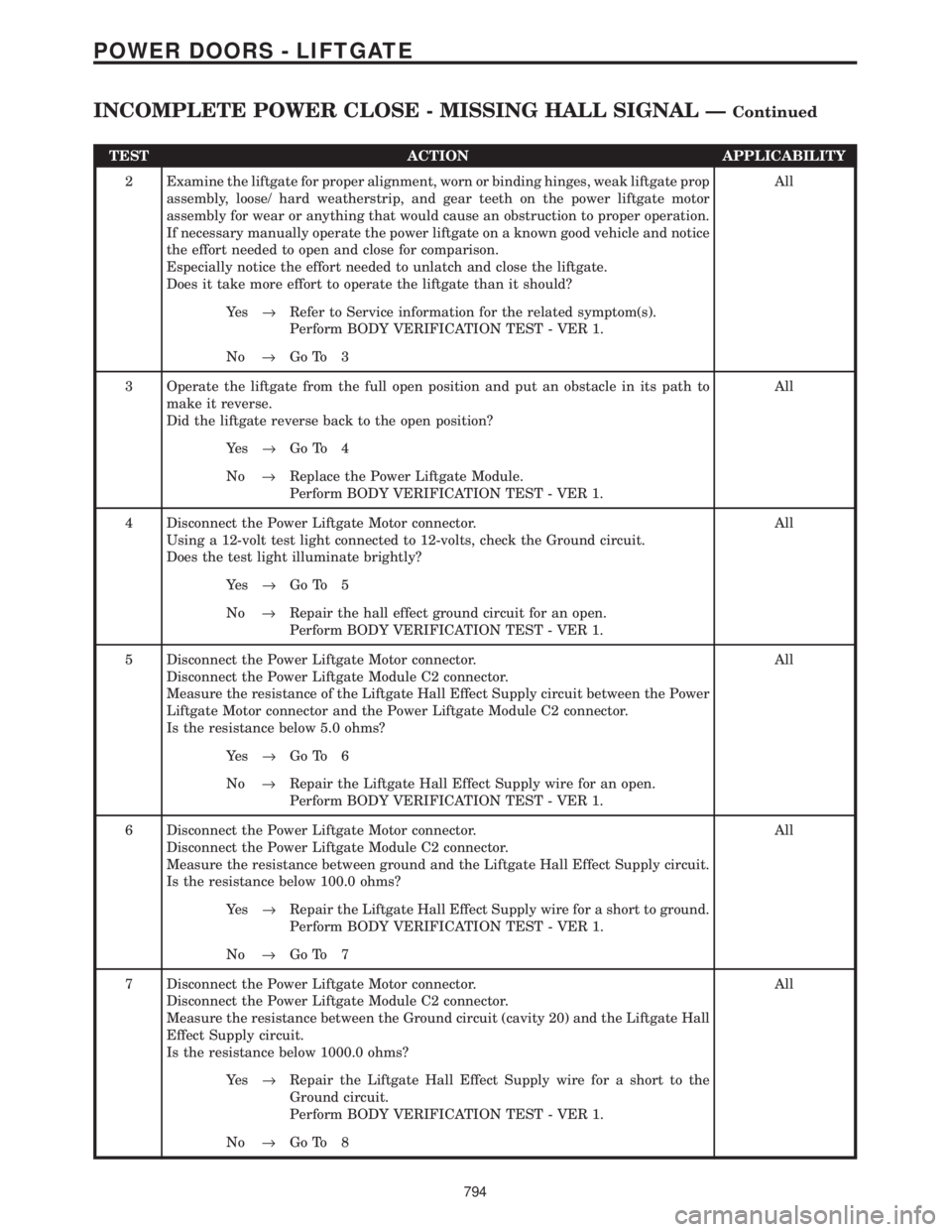
TEST ACTION APPLICABILITY
2 Examine the liftgate for proper alignment, worn or binding hinges, weak liftgate prop
assembly, loose/ hard weatherstrip, and gear teeth on the power liftgate motor
assembly for wear or anything that would cause an obstruction to proper operation.
If necessary manually operate the power liftgate on a known good vehicle and notice
the effort needed to open and close for comparison.
Especially notice the effort needed to unlatch and close the liftgate.
Does it take more effort to operate the liftgate than it should?All
Ye s®Refer to Service information for the related symptom(s).
Perform BODY VERIFICATION TEST - VER 1.
No®Go To 3
3 Operate the liftgate from the full open position and put an obstacle in its path to
make it reverse.
Did the liftgate reverse back to the open position?All
Ye s®Go To 4
No®Replace the Power Liftgate Module.
Perform BODY VERIFICATION TEST - VER 1.
4 Disconnect the Power Liftgate Motor connector.
Using a 12-volt test light connected to 12-volts, check the Ground circuit.
Does the test light illuminate brightly?All
Ye s®Go To 5
No®Repair the hall effect ground circuit for an open.
Perform BODY VERIFICATION TEST - VER 1.
5 Disconnect the Power Liftgate Motor connector.
Disconnect the Power Liftgate Module C2 connector.
Measure the resistance of the Liftgate Hall Effect Supply circuit between the Power
Liftgate Motor connector and the Power Liftgate Module C2 connector.
Is the resistance below 5.0 ohms?All
Ye s®Go To 6
No®Repair the Liftgate Hall Effect Supply wire for an open.
Perform BODY VERIFICATION TEST - VER 1.
6 Disconnect the Power Liftgate Motor connector.
Disconnect the Power Liftgate Module C2 connector.
Measure the resistance between ground and the Liftgate Hall Effect Supply circuit.
Is the resistance below 100.0 ohms?All
Ye s®Repair the Liftgate Hall Effect Supply wire for a short to ground.
Perform BODY VERIFICATION TEST - VER 1.
No®Go To 7
7 Disconnect the Power Liftgate Motor connector.
Disconnect the Power Liftgate Module C2 connector.
Measure the resistance between the Ground circuit (cavity 20) and the Liftgate Hall
Effect Supply circuit.
Is the resistance below 1000.0 ohms?All
Ye s®Repair the Liftgate Hall Effect Supply wire for a short to the
Ground circuit.
Perform BODY VERIFICATION TEST - VER 1.
No®Go To 8
794
POWER DOORS - LIFTGATE
INCOMPLETE POWER CLOSE - MISSING HALL SIGNAL ÐContinued