light CHRYSLER VOYAGER 2001 Service Manual
[x] Cancel search | Manufacturer: CHRYSLER, Model Year: 2001, Model line: VOYAGER, Model: CHRYSLER VOYAGER 2001Pages: 4284, PDF Size: 83.53 MB
Page 911 of 4284
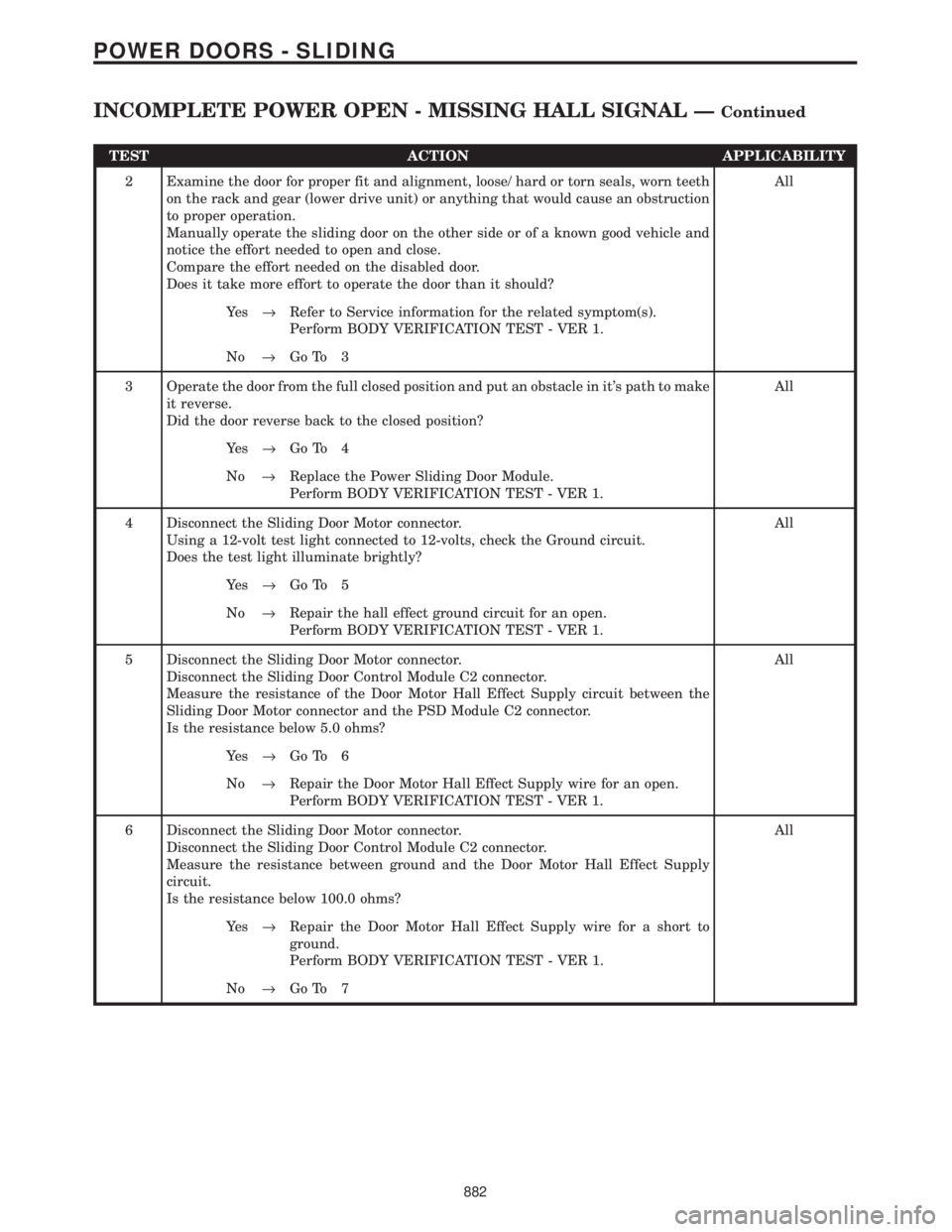
TEST ACTION APPLICABILITY
2 Examine the door for proper fit and alignment, loose/ hard or torn seals, worn teeth
on the rack and gear (lower drive unit) or anything that would cause an obstruction
to proper operation.
Manually operate the sliding door on the other side or of a known good vehicle and
notice the effort needed to open and close.
Compare the effort needed on the disabled door.
Does it take more effort to operate the door than it should?All
Ye s®Refer to Service information for the related symptom(s).
Perform BODY VERIFICATION TEST - VER 1.
No®Go To 3
3 Operate the door from the full closed position and put an obstacle in it's path to make
it reverse.
Did the door reverse back to the closed position?All
Ye s®Go To 4
No®Replace the Power Sliding Door Module.
Perform BODY VERIFICATION TEST - VER 1.
4 Disconnect the Sliding Door Motor connector.
Using a 12-volt test light connected to 12-volts, check the Ground circuit.
Does the test light illuminate brightly?All
Ye s®Go To 5
No®Repair the hall effect ground circuit for an open.
Perform BODY VERIFICATION TEST - VER 1.
5 Disconnect the Sliding Door Motor connector.
Disconnect the Sliding Door Control Module C2 connector.
Measure the resistance of the Door Motor Hall Effect Supply circuit between the
Sliding Door Motor connector and the PSD Module C2 connector.
Is the resistance below 5.0 ohms?All
Ye s®Go To 6
No®Repair the Door Motor Hall Effect Supply wire for an open.
Perform BODY VERIFICATION TEST - VER 1.
6 Disconnect the Sliding Door Motor connector.
Disconnect the Sliding Door Control Module C2 connector.
Measure the resistance between ground and the Door Motor Hall Effect Supply
circuit.
Is the resistance below 100.0 ohms?All
Ye s®Repair the Door Motor Hall Effect Supply wire for a short to
ground.
Perform BODY VERIFICATION TEST - VER 1.
No®Go To 7
882
POWER DOORS - SLIDING
INCOMPLETE POWER OPEN - MISSING HALL SIGNAL ÐContinued
Page 914 of 4284
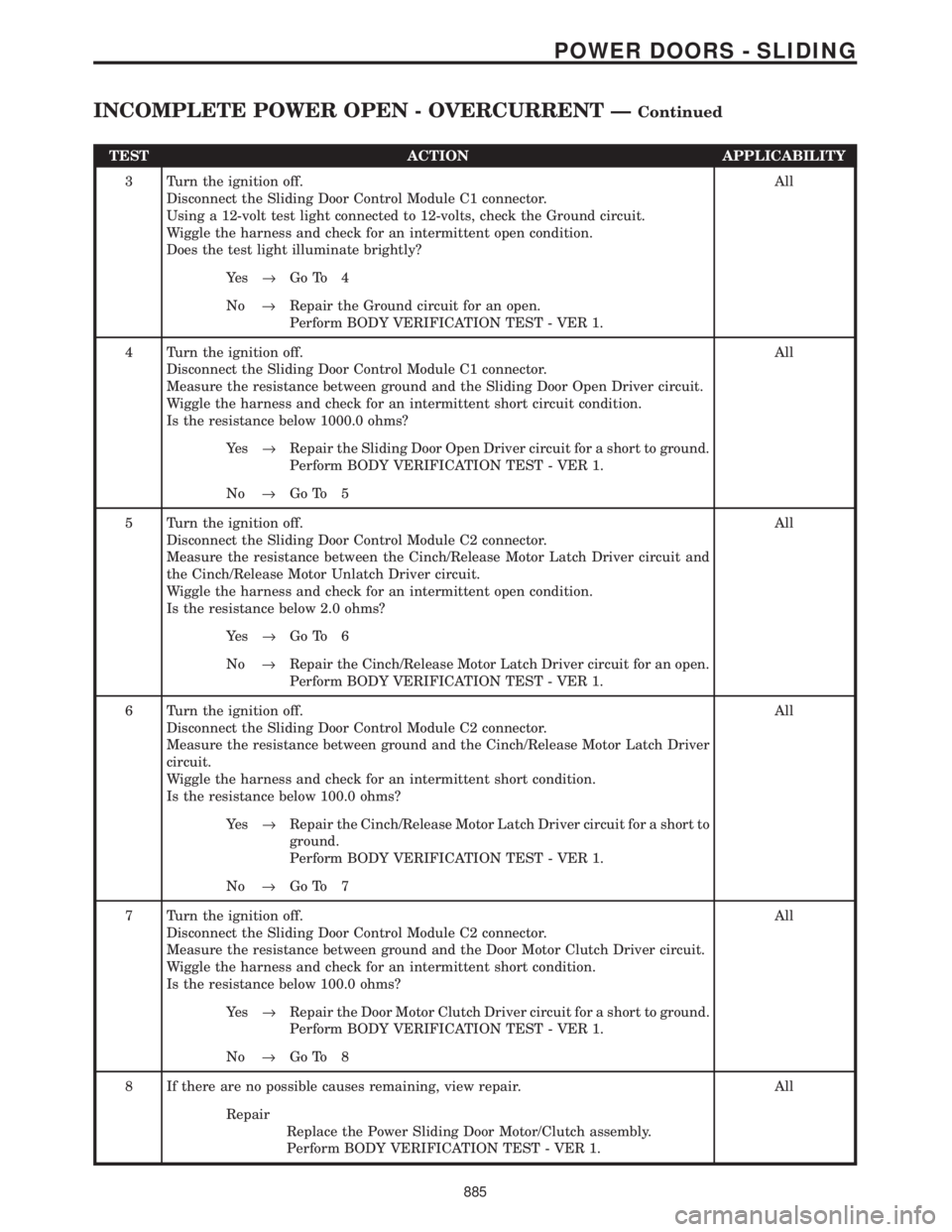
TEST ACTION APPLICABILITY
3 Turn the ignition off.
Disconnect the Sliding Door Control Module C1 connector.
Using a 12-volt test light connected to 12-volts, check the Ground circuit.
Wiggle the harness and check for an intermittent open condition.
Does the test light illuminate brightly?All
Ye s®Go To 4
No®Repair the Ground circuit for an open.
Perform BODY VERIFICATION TEST - VER 1.
4 Turn the ignition off.
Disconnect the Sliding Door Control Module C1 connector.
Measure the resistance between ground and the Sliding Door Open Driver circuit.
Wiggle the harness and check for an intermittent short circuit condition.
Is the resistance below 1000.0 ohms?All
Ye s®Repair the Sliding Door Open Driver circuit for a short to ground.
Perform BODY VERIFICATION TEST - VER 1.
No®Go To 5
5 Turn the ignition off.
Disconnect the Sliding Door Control Module C2 connector.
Measure the resistance between the Cinch/Release Motor Latch Driver circuit and
the Cinch/Release Motor Unlatch Driver circuit.
Wiggle the harness and check for an intermittent open condition.
Is the resistance below 2.0 ohms?All
Ye s®Go To 6
No®Repair the Cinch/Release Motor Latch Driver circuit for an open.
Perform BODY VERIFICATION TEST - VER 1.
6 Turn the ignition off.
Disconnect the Sliding Door Control Module C2 connector.
Measure the resistance between ground and the Cinch/Release Motor Latch Driver
circuit.
Wiggle the harness and check for an intermittent short condition.
Is the resistance below 100.0 ohms?All
Ye s®Repair the Cinch/Release Motor Latch Driver circuit for a short to
ground.
Perform BODY VERIFICATION TEST - VER 1.
No®Go To 7
7 Turn the ignition off.
Disconnect the Sliding Door Control Module C2 connector.
Measure the resistance between ground and the Door Motor Clutch Driver circuit.
Wiggle the harness and check for an intermittent short condition.
Is the resistance below 100.0 ohms?All
Ye s®Repair the Door Motor Clutch Driver circuit for a short to ground.
Perform BODY VERIFICATION TEST - VER 1.
No®Go To 8
8 If there are no possible causes remaining, view repair. All
Repair
Replace the Power Sliding Door Motor/Clutch assembly.
Perform BODY VERIFICATION TEST - VER 1.
885
POWER DOORS - SLIDING
INCOMPLETE POWER OPEN - OVERCURRENT ÐContinued
Page 918 of 4284
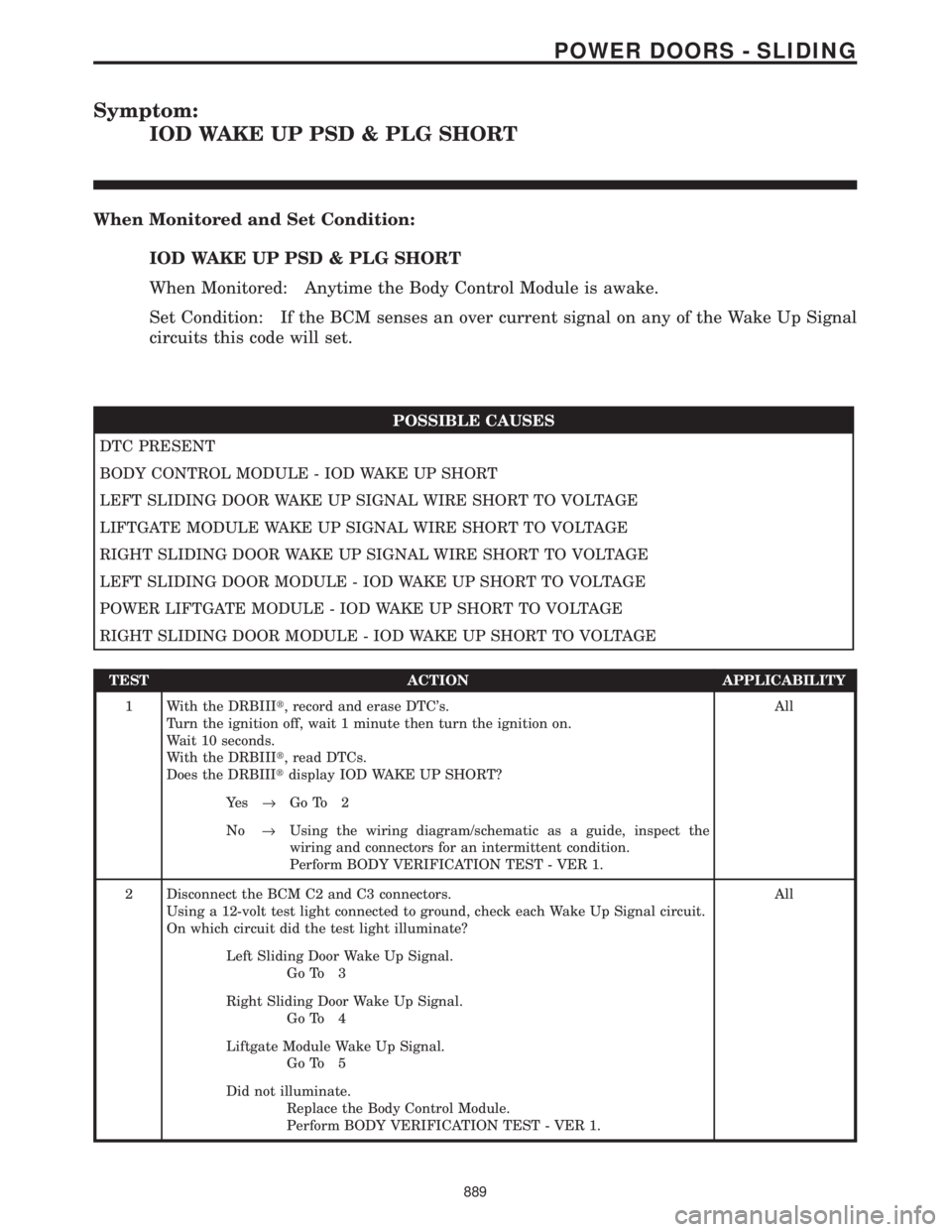
Symptom:
IOD WAKE UP PSD & PLG SHORT
When Monitored and Set Condition:
IOD WAKE UP PSD & PLG SHORT
When Monitored: Anytime the Body Control Module is awake.
Set Condition: If the BCM senses an over current signal on any of the Wake Up Signal
circuits this code will set.
POSSIBLE CAUSES
DTC PRESENT
BODY CONTROL MODULE - IOD WAKE UP SHORT
LEFT SLIDING DOOR WAKE UP SIGNAL WIRE SHORT TO VOLTAGE
LIFTGATE MODULE WAKE UP SIGNAL WIRE SHORT TO VOLTAGE
RIGHT SLIDING DOOR WAKE UP SIGNAL WIRE SHORT TO VOLTAGE
LEFT SLIDING DOOR MODULE - IOD WAKE UP SHORT TO VOLTAGE
POWER LIFTGATE MODULE - IOD WAKE UP SHORT TO VOLTAGE
RIGHT SLIDING DOOR MODULE - IOD WAKE UP SHORT TO VOLTAGE
TEST ACTION APPLICABILITY
1 With the DRBIIIt, record and erase DTC's.
Turn the ignition off, wait 1 minute then turn the ignition on.
Wait 10 seconds.
With the DRBIIIt, read DTCs.
Does the DRBIIItdisplay IOD WAKE UP SHORT?All
Ye s®Go To 2
No®Using the wiring diagram/schematic as a guide, inspect the
wiring and connectors for an intermittent condition.
Perform BODY VERIFICATION TEST - VER 1.
2 Disconnect the BCM C2 and C3 connectors.
Using a 12-volt test light connected to ground, check each Wake Up Signal circuit.
On which circuit did the test light illuminate?All
Left Sliding Door Wake Up Signal.
Go To 3
Right Sliding Door Wake Up Signal.
Go To 4
Liftgate Module Wake Up Signal.
Go To 5
Did not illuminate.
Replace the Body Control Module.
Perform BODY VERIFICATION TEST - VER 1.
889
POWER DOORS - SLIDING
Page 921 of 4284
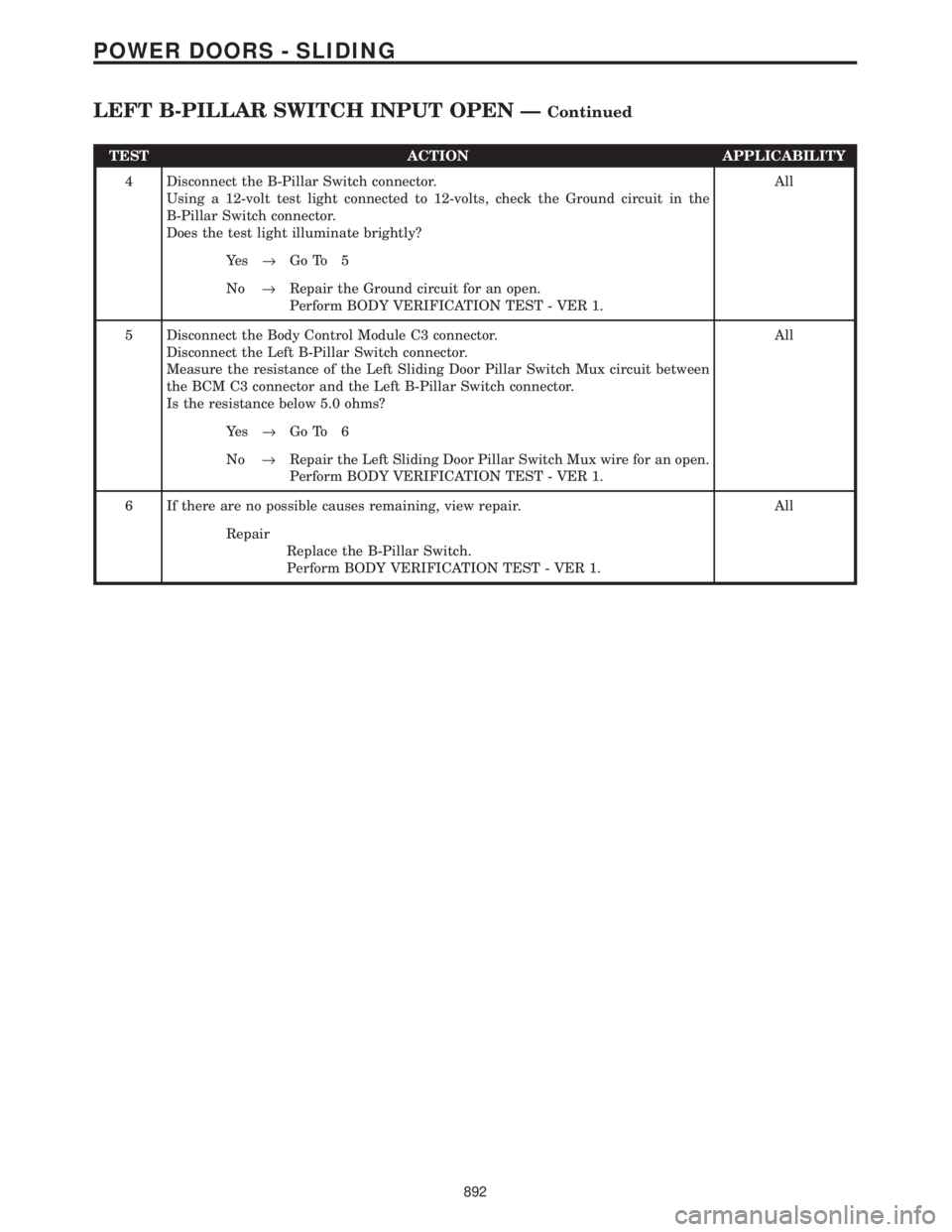
TEST ACTION APPLICABILITY
4 Disconnect the B-Pillar Switch connector.
Using a 12-volt test light connected to 12-volts, check the Ground circuit in the
B-Pillar Switch connector.
Does the test light illuminate brightly?All
Ye s®Go To 5
No®Repair the Ground circuit for an open.
Perform BODY VERIFICATION TEST - VER 1.
5 Disconnect the Body Control Module C3 connector.
Disconnect the Left B-Pillar Switch connector.
Measure the resistance of the Left Sliding Door Pillar Switch Mux circuit between
the BCM C3 connector and the Left B-Pillar Switch connector.
Is the resistance below 5.0 ohms?All
Ye s®Go To 6
No®Repair the Left Sliding Door Pillar Switch Mux wire for an open.
Perform BODY VERIFICATION TEST - VER 1.
6 If there are no possible causes remaining, view repair. All
Repair
Replace the B-Pillar Switch.
Perform BODY VERIFICATION TEST - VER 1.
892
POWER DOORS - SLIDING
LEFT B-PILLAR SWITCH INPUT OPEN ÐContinued
Page 932 of 4284
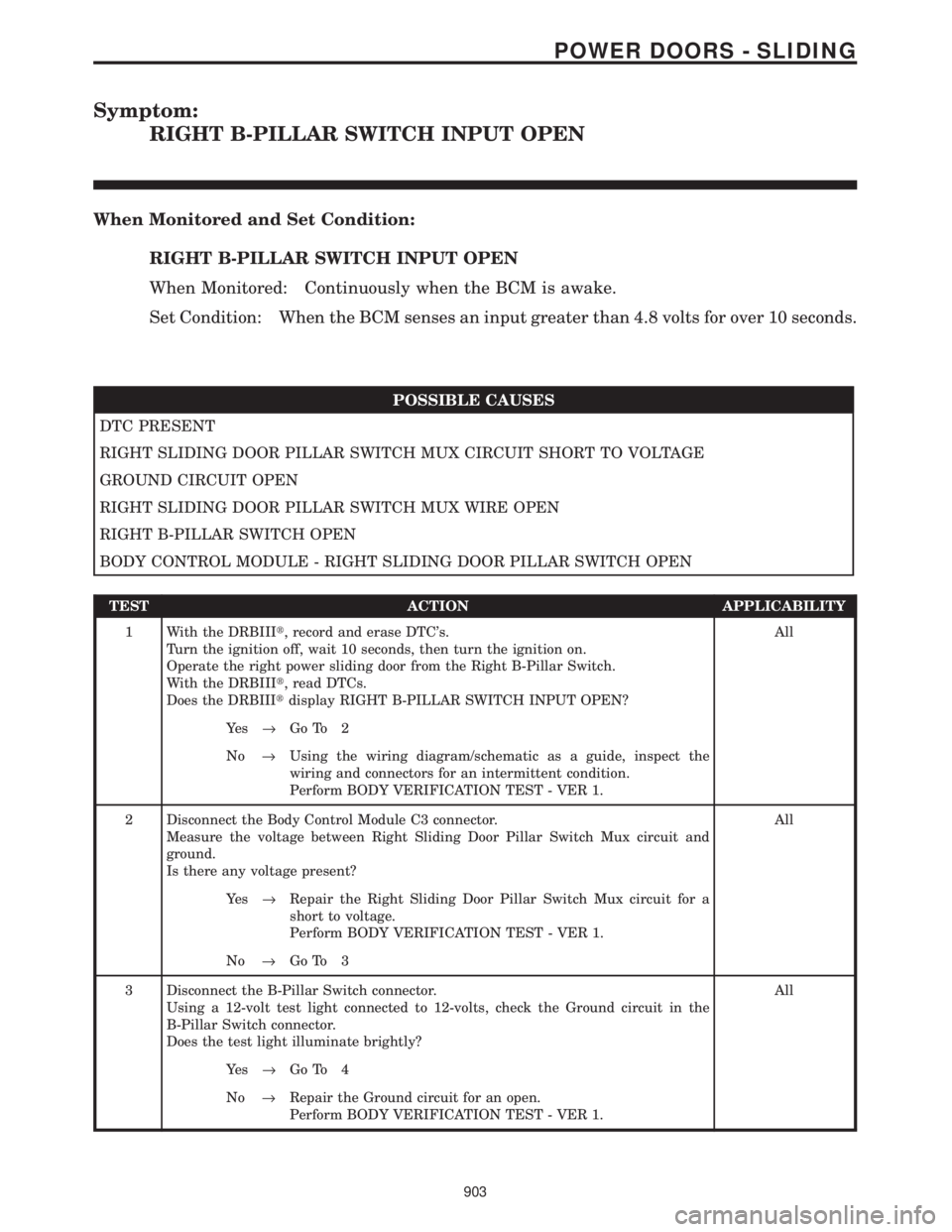
Symptom:
RIGHT B-PILLAR SWITCH INPUT OPEN
When Monitored and Set Condition:
RIGHT B-PILLAR SWITCH INPUT OPEN
When Monitored: Continuously when the BCM is awake.
Set Condition: When the BCM senses an input greater than 4.8 volts for over 10 seconds.
POSSIBLE CAUSES
DTC PRESENT
RIGHT SLIDING DOOR PILLAR SWITCH MUX CIRCUIT SHORT TO VOLTAGE
GROUND CIRCUIT OPEN
RIGHT SLIDING DOOR PILLAR SWITCH MUX WIRE OPEN
RIGHT B-PILLAR SWITCH OPEN
BODY CONTROL MODULE - RIGHT SLIDING DOOR PILLAR SWITCH OPEN
TEST ACTION APPLICABILITY
1 With the DRBIIIt, record and erase DTC's.
Turn the ignition off, wait 10 seconds, then turn the ignition on.
Operate the right power sliding door from the Right B-Pillar Switch.
With the DRBIIIt, read DTCs.
Does the DRBIIItdisplay RIGHT B-PILLAR SWITCH INPUT OPEN?All
Ye s®Go To 2
No®Using the wiring diagram/schematic as a guide, inspect the
wiring and connectors for an intermittent condition.
Perform BODY VERIFICATION TEST - VER 1.
2 Disconnect the Body Control Module C3 connector.
Measure the voltage between Right Sliding Door Pillar Switch Mux circuit and
ground.
Is there any voltage present?All
Ye s®Repair the Right Sliding Door Pillar Switch Mux circuit for a
short to voltage.
Perform BODY VERIFICATION TEST - VER 1.
No®Go To 3
3 Disconnect the B-Pillar Switch connector.
Using a 12-volt test light connected to 12-volts, check the Ground circuit in the
B-Pillar Switch connector.
Does the test light illuminate brightly?All
Ye s®Go To 4
No®Repair the Ground circuit for an open.
Perform BODY VERIFICATION TEST - VER 1.
903
POWER DOORS - SLIDING
Page 939 of 4284
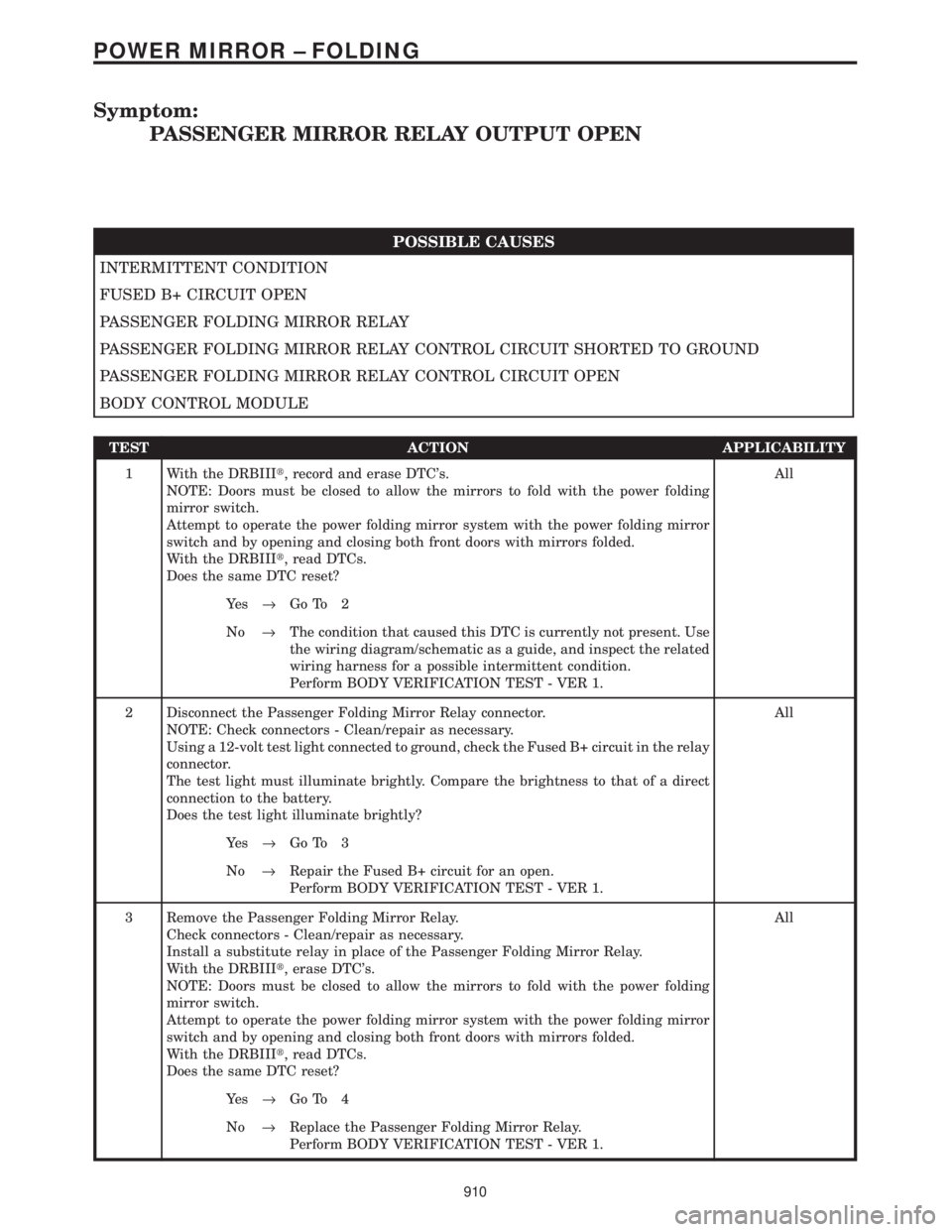
Symptom:
PASSENGER MIRROR RELAY OUTPUT OPEN
POSSIBLE CAUSES
INTERMITTENT CONDITION
FUSED B+ CIRCUIT OPEN
PASSENGER FOLDING MIRROR RELAY
PASSENGER FOLDING MIRROR RELAY CONTROL CIRCUIT SHORTED TO GROUND
PASSENGER FOLDING MIRROR RELAY CONTROL CIRCUIT OPEN
BODY CONTROL MODULE
TEST ACTION APPLICABILITY
1 With the DRBIIIt, record and erase DTC's.
NOTE: Doors must be closed to allow the mirrors to fold with the power folding
mirror switch.
Attempt to operate the power folding mirror system with the power folding mirror
switch and by opening and closing both front doors with mirrors folded.
With the DRBIIIt, read DTCs.
Does the same DTC reset?All
Ye s®Go To 2
No®The condition that caused this DTC is currently not present. Use
the wiring diagram/schematic as a guide, and inspect the related
wiring harness for a possible intermittent condition.
Perform BODY VERIFICATION TEST - VER 1.
2 Disconnect the Passenger Folding Mirror Relay connector.
NOTE: Check connectors - Clean/repair as necessary.
Using a 12-volt test light connected to ground, check the Fused B+ circuit in the relay
connector.
The test light must illuminate brightly. Compare the brightness to that of a direct
connection to the battery.
Does the test light illuminate brightly?All
Ye s®Go To 3
No®Repair the Fused B+ circuit for an open.
Perform BODY VERIFICATION TEST - VER 1.
3 Remove the Passenger Folding Mirror Relay.
Check connectors - Clean/repair as necessary.
Install a substitute relay in place of the Passenger Folding Mirror Relay.
With the DRBIIIt, erase DTC's.
NOTE: Doors must be closed to allow the mirrors to fold with the power folding
mirror switch.
Attempt to operate the power folding mirror system with the power folding mirror
switch and by opening and closing both front doors with mirrors folded.
With the DRBIIIt, read DTCs.
Does the same DTC reset?All
Ye s®Go To 4
No®Replace the Passenger Folding Mirror Relay.
Perform BODY VERIFICATION TEST - VER 1.
910
POWER MIRROR ± FOLDING
Page 947 of 4284
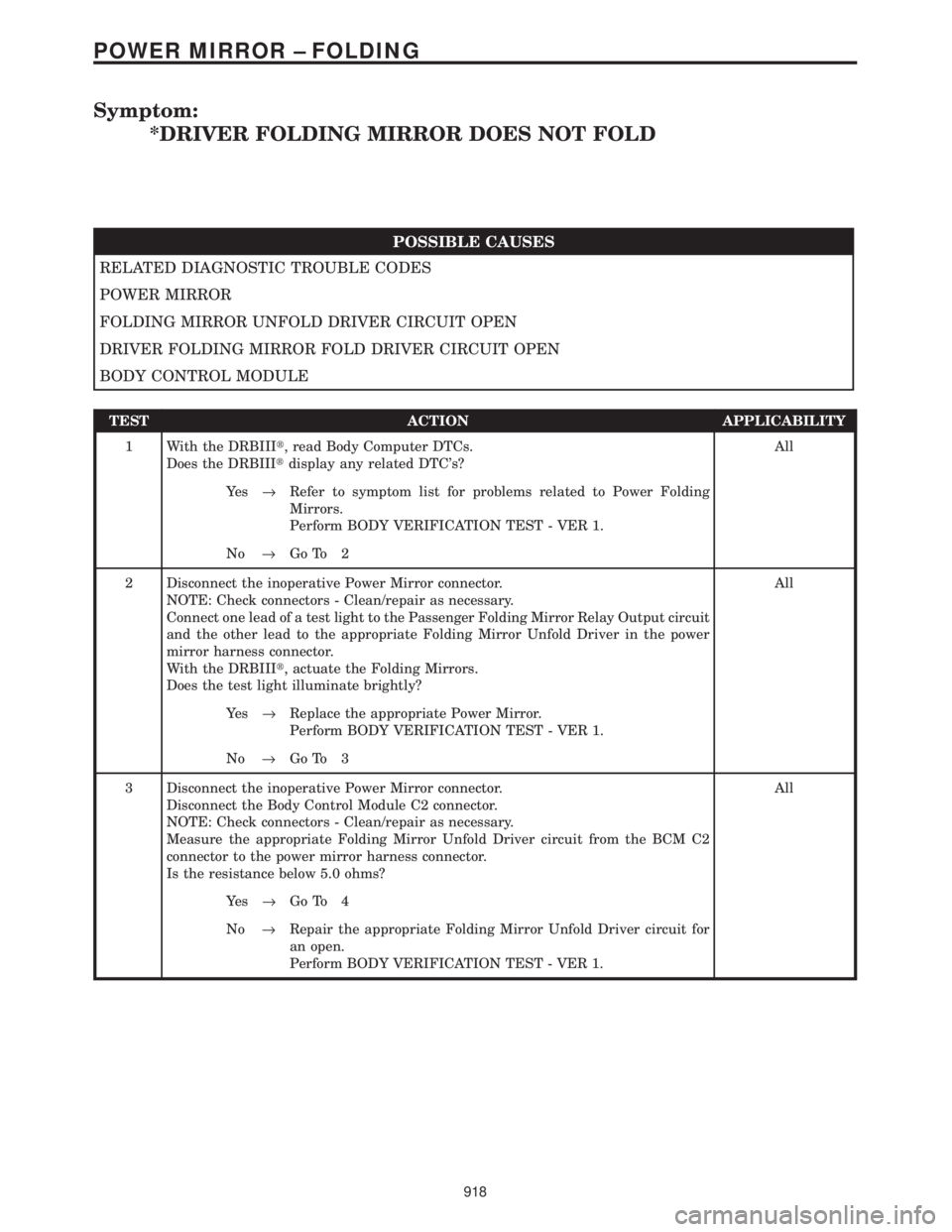
Symptom:
*DRIVER FOLDING MIRROR DOES NOT FOLD
POSSIBLE CAUSES
RELATED DIAGNOSTIC TROUBLE CODES
POWER MIRROR
FOLDING MIRROR UNFOLD DRIVER CIRCUIT OPEN
DRIVER FOLDING MIRROR FOLD DRIVER CIRCUIT OPEN
BODY CONTROL MODULE
TEST ACTION APPLICABILITY
1 With the DRBIIIt, read Body Computer DTCs.
Does the DRBIIItdisplay any related DTC's?All
Ye s®Refer to symptom list for problems related to Power Folding
Mirrors.
Perform BODY VERIFICATION TEST - VER 1.
No®Go To 2
2 Disconnect the inoperative Power Mirror connector.
NOTE: Check connectors - Clean/repair as necessary.
Connect one lead of a test light to the Passenger Folding Mirror Relay Output circuit
and the other lead to the appropriate Folding Mirror Unfold Driver in the power
mirror harness connector.
With the DRBIIIt, actuate the Folding Mirrors.
Does the test light illuminate brightly?All
Ye s®Replace the appropriate Power Mirror.
Perform BODY VERIFICATION TEST - VER 1.
No®Go To 3
3 Disconnect the inoperative Power Mirror connector.
Disconnect the Body Control Module C2 connector.
NOTE: Check connectors - Clean/repair as necessary.
Measure the appropriate Folding Mirror Unfold Driver circuit from the BCM C2
connector to the power mirror harness connector.
Is the resistance below 5.0 ohms?All
Ye s®Go To 4
No®Repair the appropriate Folding Mirror Unfold Driver circuit for
an open.
Perform BODY VERIFICATION TEST - VER 1.
918
POWER MIRROR ± FOLDING
Page 949 of 4284
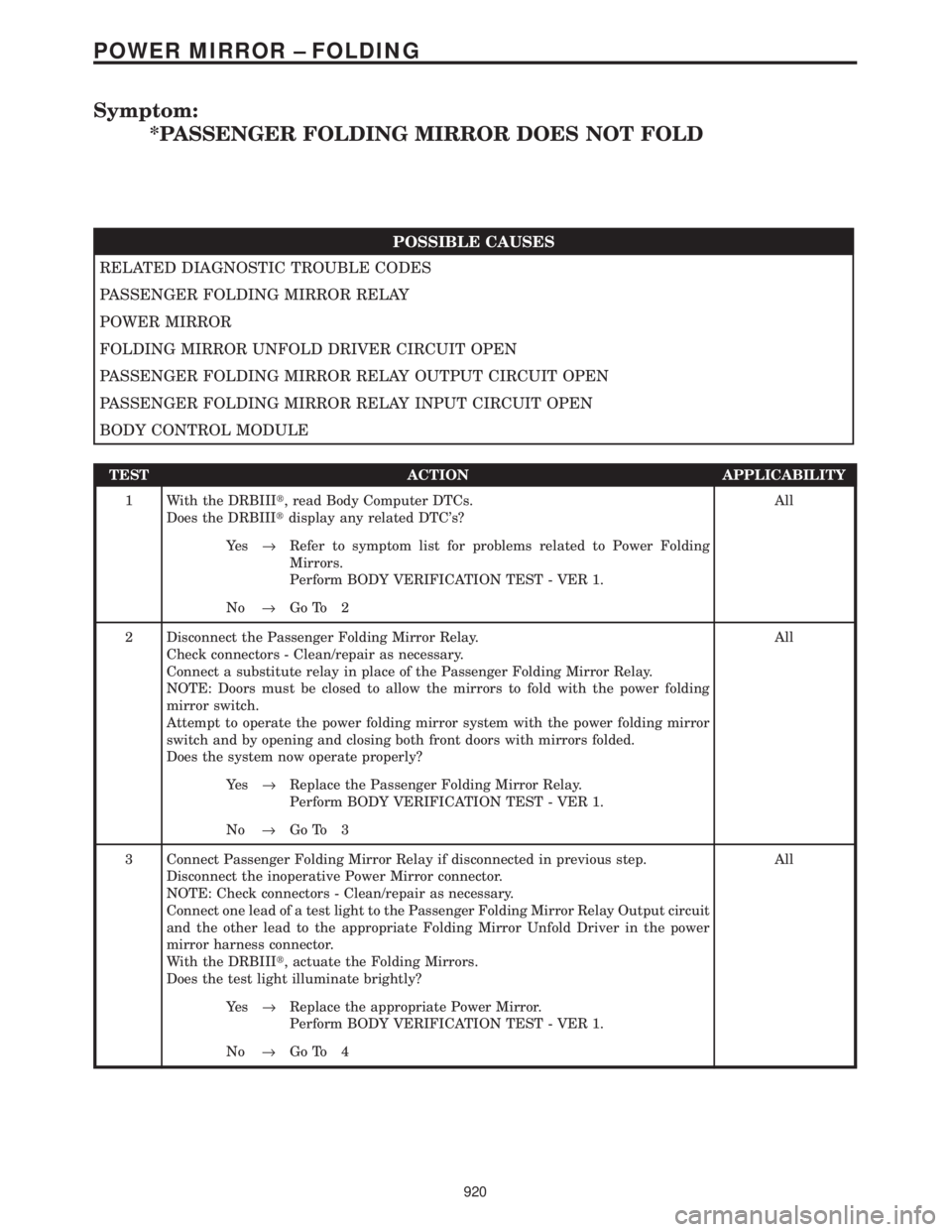
Symptom:
*PASSENGER FOLDING MIRROR DOES NOT FOLD
POSSIBLE CAUSES
RELATED DIAGNOSTIC TROUBLE CODES
PASSENGER FOLDING MIRROR RELAY
POWER MIRROR
FOLDING MIRROR UNFOLD DRIVER CIRCUIT OPEN
PASSENGER FOLDING MIRROR RELAY OUTPUT CIRCUIT OPEN
PASSENGER FOLDING MIRROR RELAY INPUT CIRCUIT OPEN
BODY CONTROL MODULE
TEST ACTION APPLICABILITY
1 With the DRBIIIt, read Body Computer DTCs.
Does the DRBIIItdisplay any related DTC's?All
Ye s®Refer to symptom list for problems related to Power Folding
Mirrors.
Perform BODY VERIFICATION TEST - VER 1.
No®Go To 2
2 Disconnect the Passenger Folding Mirror Relay.
Check connectors - Clean/repair as necessary.
Connect a substitute relay in place of the Passenger Folding Mirror Relay.
NOTE: Doors must be closed to allow the mirrors to fold with the power folding
mirror switch.
Attempt to operate the power folding mirror system with the power folding mirror
switch and by opening and closing both front doors with mirrors folded.
Does the system now operate properly?All
Ye s®Replace the Passenger Folding Mirror Relay.
Perform BODY VERIFICATION TEST - VER 1.
No®Go To 3
3 Connect Passenger Folding Mirror Relay if disconnected in previous step.
Disconnect the inoperative Power Mirror connector.
NOTE: Check connectors - Clean/repair as necessary.
Connect one lead of a test light to the Passenger Folding Mirror Relay Output circuit
and the other lead to the appropriate Folding Mirror Unfold Driver in the power
mirror harness connector.
With the DRBIIIt, actuate the Folding Mirrors.
Does the test light illuminate brightly?All
Ye s®Replace the appropriate Power Mirror.
Perform BODY VERIFICATION TEST - VER 1.
No®Go To 4
920
POWER MIRROR ± FOLDING
Page 976 of 4284
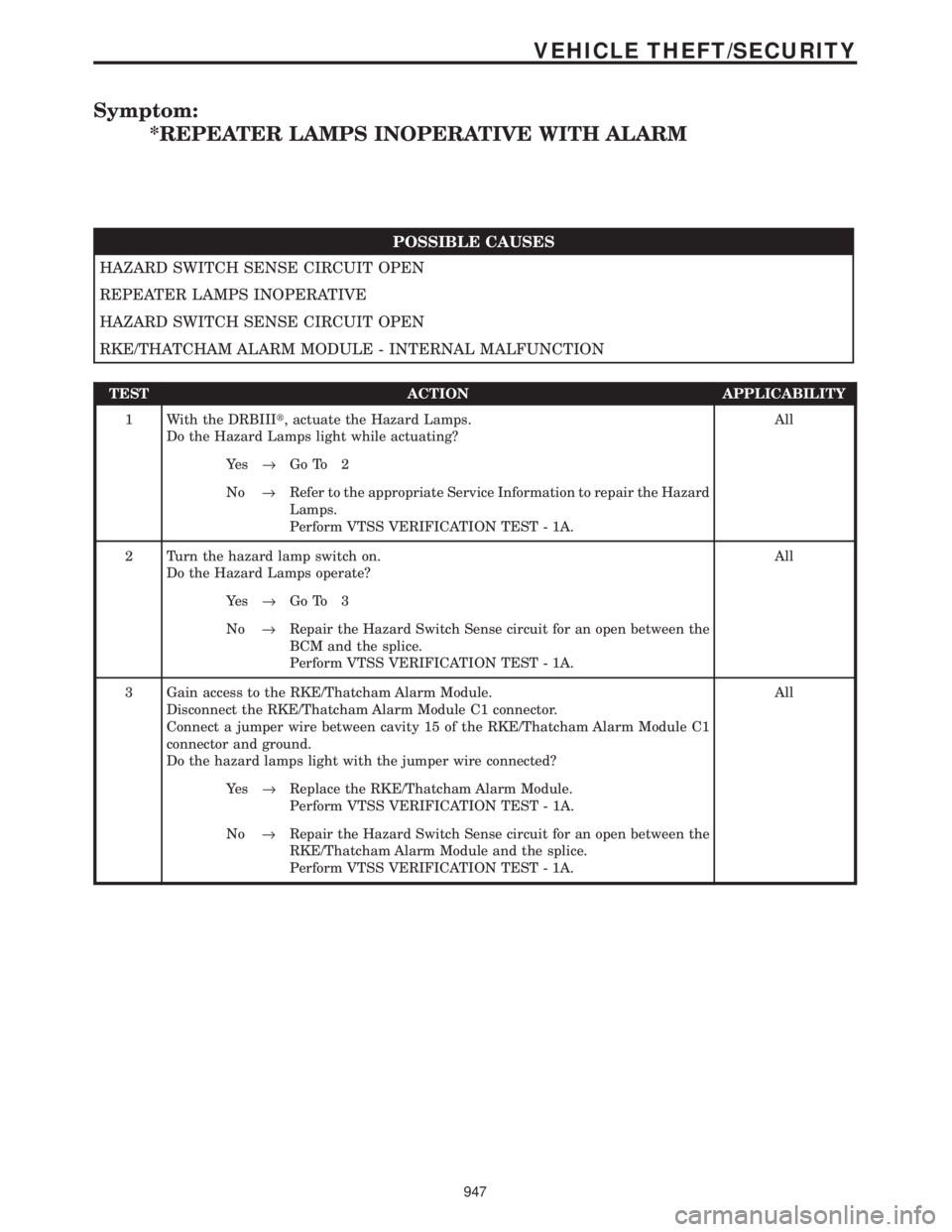
Symptom:
*REPEATER LAMPS INOPERATIVE WITH ALARM
POSSIBLE CAUSES
HAZARD SWITCH SENSE CIRCUIT OPEN
REPEATER LAMPS INOPERATIVE
HAZARD SWITCH SENSE CIRCUIT OPEN
RKE/THATCHAM ALARM MODULE - INTERNAL MALFUNCTION
TEST ACTION APPLICABILITY
1 With the DRBIIIt, actuate the Hazard Lamps.
Do the Hazard Lamps light while actuating?All
Ye s®Go To 2
No®Refer to the appropriate Service Information to repair the Hazard
Lamps.
Perform VTSS VERIFICATION TEST - 1A.
2 Turn the hazard lamp switch on.
Do the Hazard Lamps operate?All
Ye s®Go To 3
No®Repair the Hazard Switch Sense circuit for an open between the
BCM and the splice.
Perform VTSS VERIFICATION TEST - 1A.
3 Gain access to the RKE/Thatcham Alarm Module.
Disconnect the RKE/Thatcham Alarm Module C1 connector.
Connect a jumper wire between cavity 15 of the RKE/Thatcham Alarm Module C1
connector and ground.
Do the hazard lamps light with the jumper wire connected?All
Ye s®Replace the RKE/Thatcham Alarm Module.
Perform VTSS VERIFICATION TEST - 1A.
No®Repair the Hazard Switch Sense circuit for an open between the
RKE/Thatcham Alarm Module and the splice.
Perform VTSS VERIFICATION TEST - 1A.
947
VEHICLE THEFT/SECURITY
Page 979 of 4284
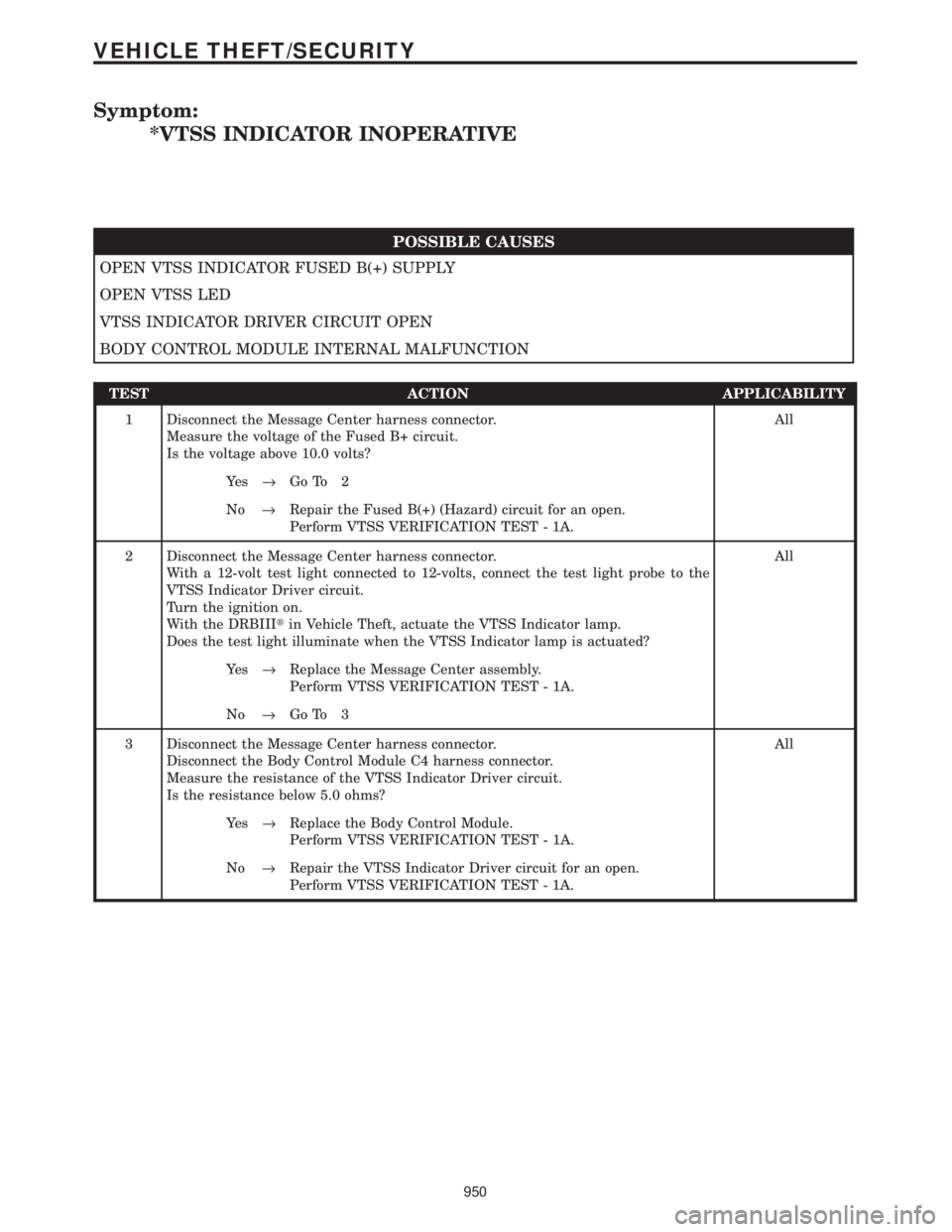
Symptom:
*VTSS INDICATOR INOPERATIVE
POSSIBLE CAUSES
OPEN VTSS INDICATOR FUSED B(+) SUPPLY
OPEN VTSS LED
VTSS INDICATOR DRIVER CIRCUIT OPEN
BODY CONTROL MODULE INTERNAL MALFUNCTION
TEST ACTION APPLICABILITY
1 Disconnect the Message Center harness connector.
Measure the voltage of the Fused B+ circuit.
Is the voltage above 10.0 volts?All
Ye s®Go To 2
No®Repair the Fused B(+) (Hazard) circuit for an open.
Perform VTSS VERIFICATION TEST - 1A.
2 Disconnect the Message Center harness connector.
With a 12-volt test light connected to 12-volts, connect the test light probe to the
VTSS Indicator Driver circuit.
Turn the ignition on.
With the DRBIIItin Vehicle Theft, actuate the VTSS Indicator lamp.
Does the test light illuminate when the VTSS Indicator lamp is actuated?All
Ye s®Replace the Message Center assembly.
Perform VTSS VERIFICATION TEST - 1A.
No®Go To 3
3 Disconnect the Message Center harness connector.
Disconnect the Body Control Module C4 harness connector.
Measure the resistance of the VTSS Indicator Driver circuit.
Is the resistance below 5.0 ohms?All
Ye s®Replace the Body Control Module.
Perform VTSS VERIFICATION TEST - 1A.
No®Repair the VTSS Indicator Driver circuit for an open.
Perform VTSS VERIFICATION TEST - 1A.
950
VEHICLE THEFT/SECURITY