ignition CITROEN C4 2019 Owner's Manual
[x] Cancel search | Manufacturer: CITROEN, Model Year: 2019, Model line: C4, Model: CITROEN C4 2019Pages: 317, PDF Size: 9.31 MB
Page 83 of 317
81
C4-cactus_en_Chap04_Eclairage-et-visibilite_ed01-2016
In good or rainy weather, both day and night, the front foglamps and the
r
ear foglamp are prohibited. In these
s
ituations, the power of their beams
m
ay dazzle other drivers. They should
o
nly be used in fog or snow.
In these weather conditions, it is your
responsibility
to switch on the foglamps
a
nd dipped beam headlamps manually
a
s the sunshine sensor may detect
s
ufficient light.
Do
not forget to switch off the front
f
oglamps and the rear foglamp when
t
hey are no longer necessary.Switching off the lamps when
the ignition is switched off
On switching off the ignition, all of the lamps turn off immediately, except for
d
ipped beam if guide-me-home lighting
i
s activated.
Switching on the lamps
after the ignition is
switched off
To reactivate the lighting control, rotate the ring to the "0" position - lamps off,
t
hen to the desired position.
On
opening the driver's door a
t
emporary audible signal warns the
d
river that the lighting is on.
The
lamps, with the exception of the
s
idelamps, switch off automatically after
a
maximum duration of thirty minutes to
p
revent discharging of the battery.
Direction indicators
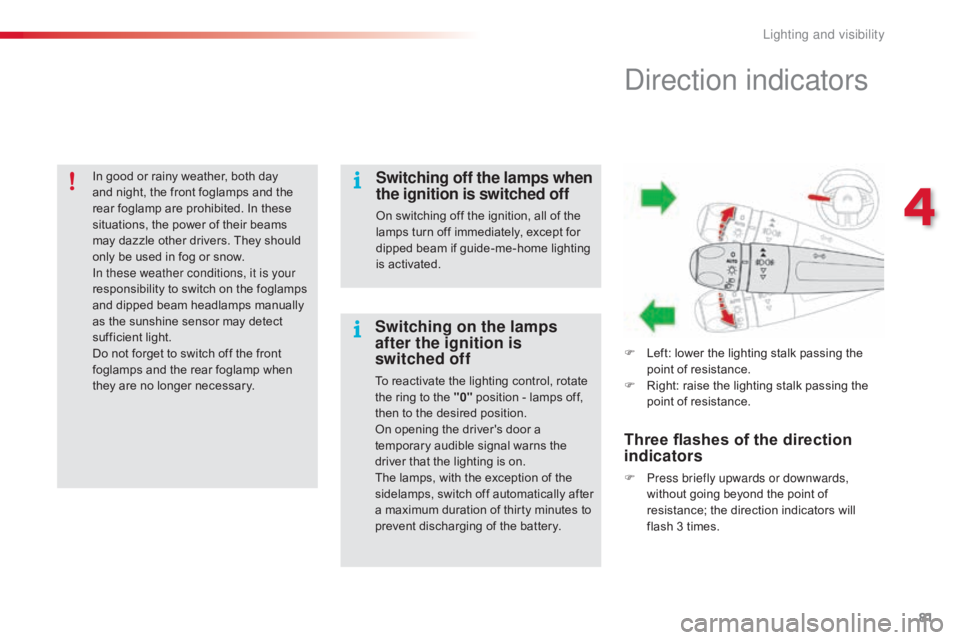
F Left: lower the lighting stalk passing the p
oint of resistance.
F
R
ight: raise the lighting stalk passing the
p
oint of resistance.
Three flashes of the direction
indicators
F Press briefly upwards or downwards, without going beyond the point of
r
esistance; the direction indicators will
f
lash 3 times.
4
Lighting and visibility
Page 85 of 317
83
C4-cactus_en_Chap04_Eclairage-et-visibilite_ed01-2016
Parking lamps
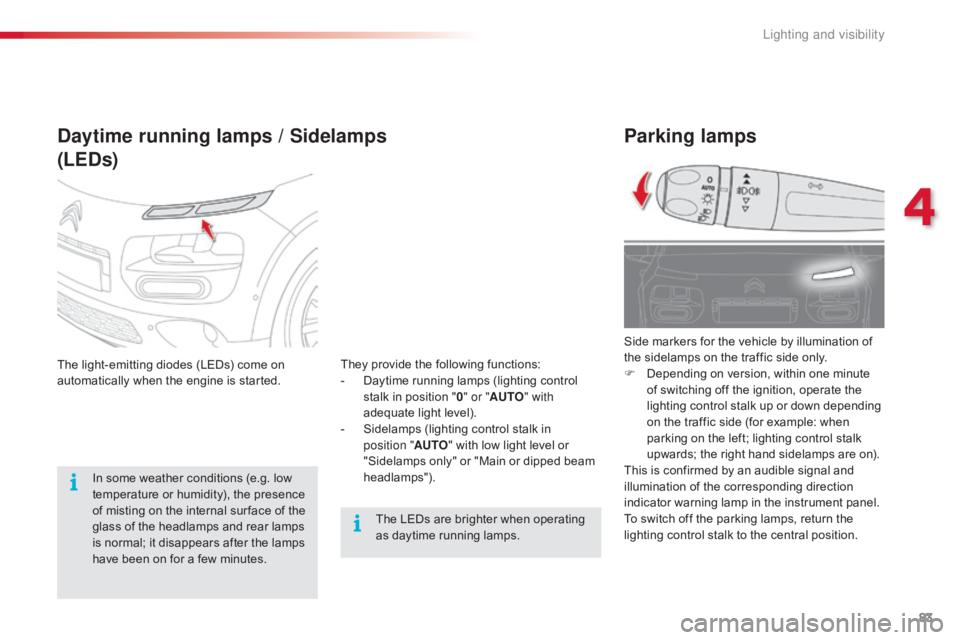
Side markers for the vehicle by illumination of the sidelamps on the traffic side only.
F
D
epending on version, within one minute
o
f switching off the ignition, operate the
l
ighting control stalk up or down depending
o
n the traffic side (for example: when
p
arking on the left; lighting control stalk
u
pwards; the right hand sidelamps are on).
This
is confirmed by an audible signal and
i
llumination of the corresponding direction
i
ndicator warning lamp in the instrument panel.
To
switch off the parking lamps, return the
l
ighting control stalk to the central position.
Daytime running lamps / Sidelamps
(LEDs)
The light-emitting diodes (LEDs) come on automatically when the engine is started.
In
some weather conditions (e.g. low
t
emperature or humidity), the presence
o
f misting on the internal sur face of the
g
lass of the headlamps and rear lamps
i
s normal; it disappears after the lamps
h
ave been on for a few minutes.They
provide the following functions:
- D aytime running lamps (lighting control
s
talk in position "0 " or " AUTO " with
adequate
light level).
-
S
idelamps (lighting control stalk in
p
osition "AUTO"
with low light level or
"
Sidelamps only" or "Main or dipped beam
h
eadlamps").The
LEDs are brighter when operating
a
s daytime running lamps.
4
Lighting and visibility
Page 86 of 317
84
C4-cactus_en_Chap04_Eclairage-et-visibilite_ed01-2016
Switching on
F W ith the ignition off, "flash" the headlamps
u
sing the lighting stalk.
F
A
further "headlamp flash" switches the
f
unction off.
Switching off
The
manual guide-me-home lighting switches
o
ff automatically after a set time.
The
temporary illumination of the dipped beam
h
eadlamps after the vehicle's ignition has been
s
witched off makes the driver's exit easier
w
hen the light is poor.
Guide-me-home
lighting
Automatic
When the automatic illumination of headlamps i
s activated, if the ambient light level is
l
ow, the dipped beam headlamps come on
a
utomatically when switching off the ignition.
Activation
or deactivation of the system, as well
a
s the period for the guide-me-home lighting is
s
et in the touch screen tablet.
F
Sel
ect the "Driving assistance "
menu,
then "Vehicle settings ".
Manual
Headlamp beam
h
eight
ad
justment
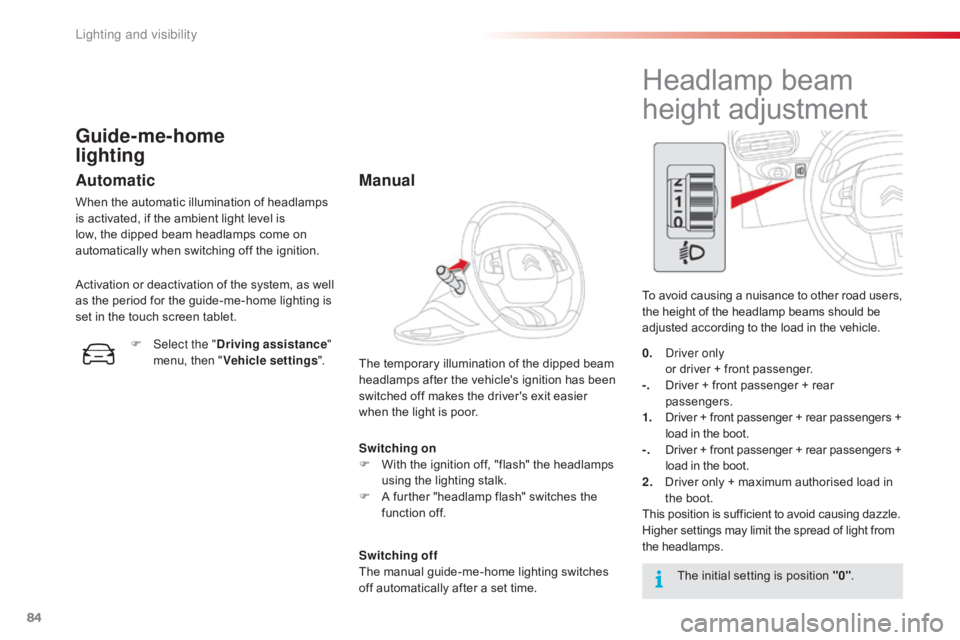
To avoid causing a nuisance to other road users, t
he height of the headlamp beams should be a
djusted according to the load in the vehicle.
The
initial setting is position "0".
0.
D
river only
o
r driver + front passenger.
-.
D
river + front passenger + rear
p
assengers.
1.
D
river + front passenger + rear passengers +
l
oad in the boot.
-.
D
river + front passenger + rear passengers +
l
oad in the boot.
2.
D
river only + maximum authorised load in
t
he boot.
This
position is sufficient to avoid causing dazzle.
Higher
settings may limit the spread of light from
t
he
hea
dlamps.
Lighting and visibility
Page 91 of 317
89
C4-cactus_en_Chap04_Eclairage-et-visibilite_ed01-2016
Special position of the
windscreen wipers
To maintain the effectiveness of the flat wiper blades, it is advisable to:
-
h
andle them with care,
-
c
lean them regularly using soapy
w
ater,
-
a
void using them to retain
c
ardboard on the windscreen,
-
r
eplace them at the first signs of
w
e a r.
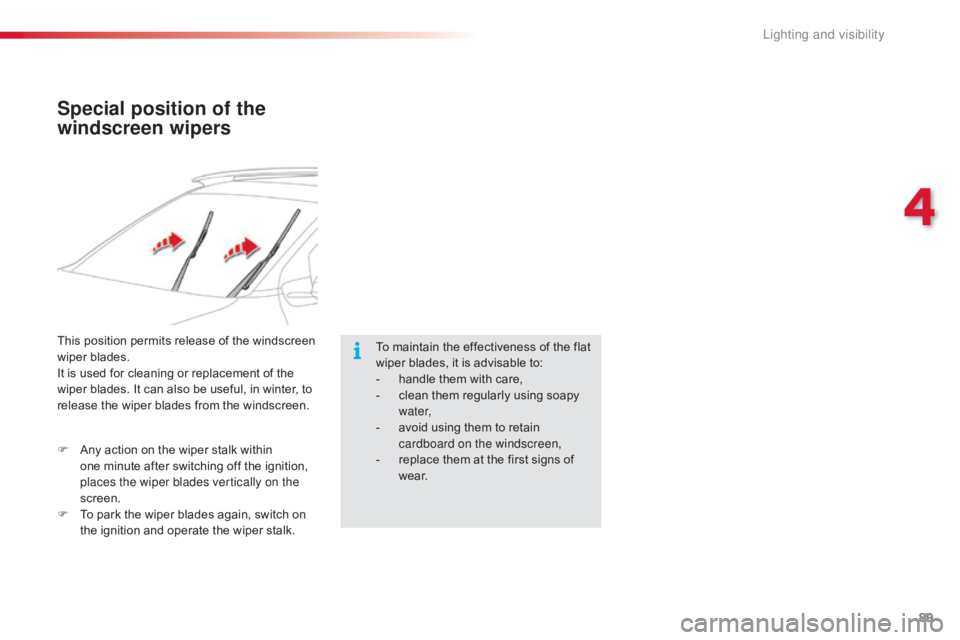
This
position
permits
release
of
the
windscreen
w
iper
blades.
It
is
used
for
cleaning
or
replacement
of
the
w
iper
blades.
It
can
also
be
useful,
in
winter,
to
r
elease
the
wiper
blades
from
the
windscreen.
F
A
ny
action
on
the
wiper
stalk
within
o
ne minute
after
switching
off
the
ignition,
p
laces the wiper blades vertically on the
screen.
F
T
o
park
the
wiper
blades
again,
switch
on
t
he
ignition
and
operate
the
wiper
stalk.
4
Lighting and visibility
Page 92 of 317
90
C4-cactus_en_Chap05_securite_ed01-2016
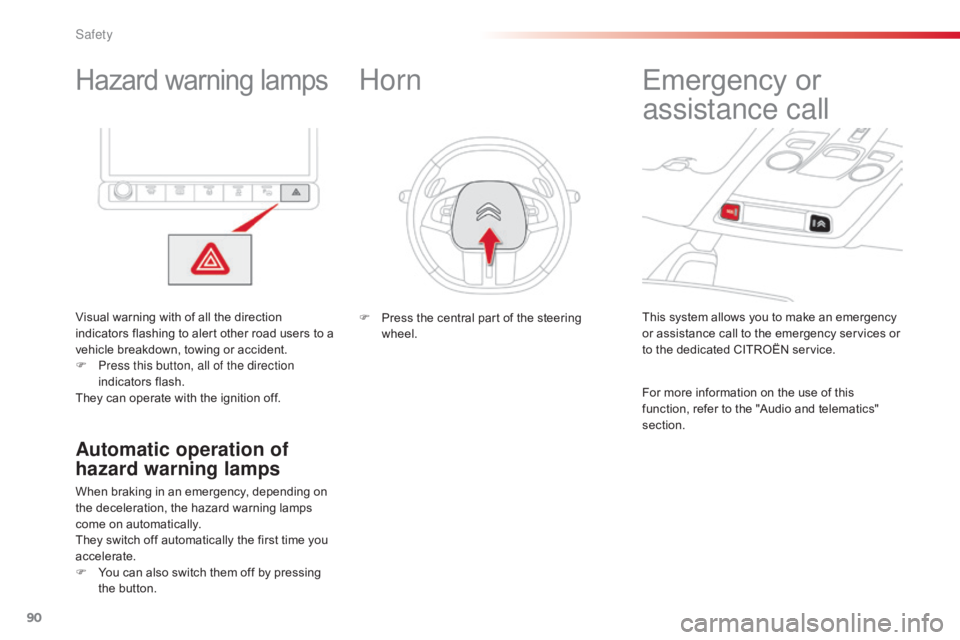
Hazard warning lamps
Visual warning with of all the direction i
ndicators flashing to alert other road users to a
v
ehicle breakdown, towing or accident.
F
P
ress this button, all of the direction
indicators
f
lash.
They
can operate with the ignition off.
Automatic operation of
hazard warning lamps
When braking in an emergency, depending on the deceleration, the hazard warning lamps
c
ome on automatically.
They
switch off automatically the first time you
a
ccelerate.
F
Y
ou can also switch them off by pressing
t
he button. This
system allows you to make an emergency
o
r assistance call to the emergency services or
t
o the dedicated CITROËN service.
Emergency o
r
a
ssistance call
For more information on the use of this f
unction, refer to the "Audio and telematics"
s
ection.
Horn
F Press the central part of the steering w
heel.
Safety
Page 95 of 317
93
C4-cactus_en_Chap05_securite_ed01-2016
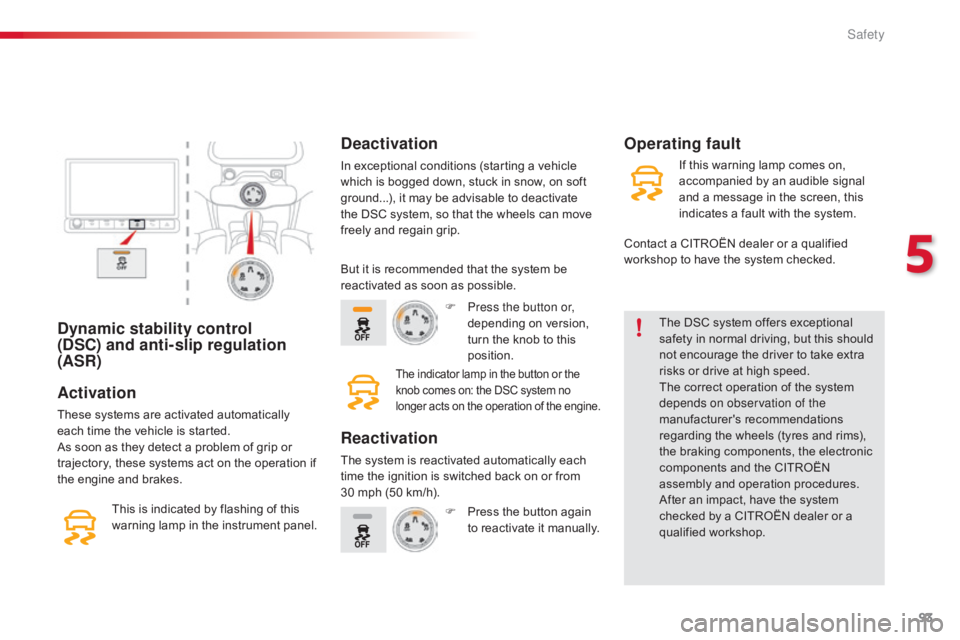
Dynamic stability control
(DSC) and anti-slip regulation
(ASR)The DSC system offers exceptional safety in normal driving, but this should
n
ot encourage the driver to take extra
r
isks or drive at high speed.
The
correct operation of the system
d
epends on observation of the
manufacturer's
r
ecommendations
r
egarding the wheels (tyres and rims),
t
he braking components, the electronic
c
omponents and the CITROËN
a
ssembly and operation procedures.
After
an impact, have the system
c
hecked by a CITROËN dealer or a
q
ualified
w
orkshop.
Activation
These systems are activated automatically each time the vehicle is started.
As
soon as they detect a problem of grip or
t
rajectory, these systems act on the operation if
t
he engine and brakes.
Deactivation
In exceptional conditions (starting a vehicle which is bogged down, stuck in snow, on soft
g
round...), it may be advisable to deactivate
t
he DSC system, so that the wheels can move
f
reely and regain grip.
This
is
indicated
by
flashing
of
this
w
arning
lamp
in
the
instrument
panel.
Operating fault
But it is recommended that the system be r eactivated as soon as possible.
F
P
ress the button or,
depending
on version,
t
urn the knob to this
p
osition.
The indicator lamp in the button or the knob comes on: the DSC system no l
onger acts on the operation of the engine.
Reactivation
The system is reactivated automatically each time the ignition is switched back on or from
3
0 mph (50 km/h).F
P
ress the button again
t
o reactivate it manually.If
this warning lamp comes on,
a
ccompanied by an audible signal
a
nd a message in the screen, this
i
ndicates a fault with the system.
Contact a CITROËN dealer or a qualified
w
orkshop to have the system checked.
5
Safety
Page 96 of 317
94
C4-cactus_en_Chap05_securite_ed01-2016
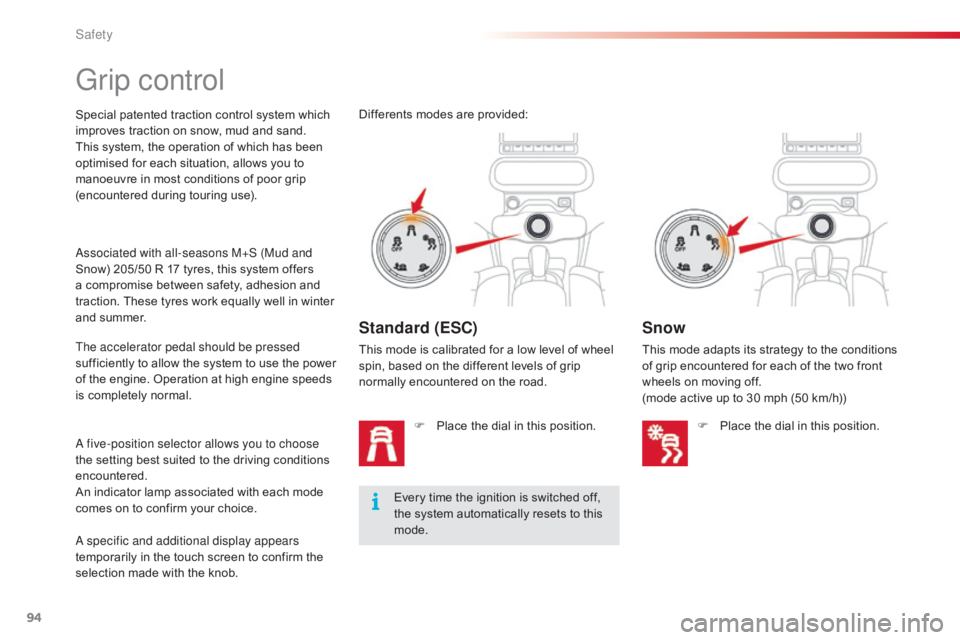
Grip control
Special patented traction control system which improves traction on snow, mud and sand.
This
system, the operation of which has been
o
ptimised for each situation, allows you to
m
anoeuvre in most conditions of poor grip
(
encountered
d
uring
t
ouring
u
se).
The accelerator pedal should be pressed
sufficiently
t
o
a
llow
t
he
s
ystem
t
o
u
se
t
he
p
ower
o
f the engine. Operation at high engine speeds
i
s completely normal.
Associated with all-seasons M+S (Mud and
Snow)
205/50 R 17 tyres, this system offers
a
compromise between safety, adhesion and
t
raction. These tyres work equally well in winter
a
nd summer.
A five-position selector allows you to choose
the
setting best suited to the driving conditions
en
countered.
An
indicator lamp associated with each mode
c
omes on to confirm your choice.
A specific and additional display appears
temporarily
in the touch screen to confirm the
s
election made with the knob. Every
time the ignition is switched off,
t
he system automatically resets to this
m
ode.
Differents
modes are provided:
Standard (ESC)
This mode is calibrated for a low level of wheel s
pin, based on the different levels of grip
n
ormally encountered on the road.
F
P
lace the dial in this position.
Snow
This mode adapts its strategy to the conditions of grip encountered for each of the two front
w
heels on moving off.
(mode
active up to 30 mph (50 km/h))
F
P
lace the dial in this position.
Safety
Page 98 of 317
96
C4-cactus_en_Chap05_securite_ed01-2016
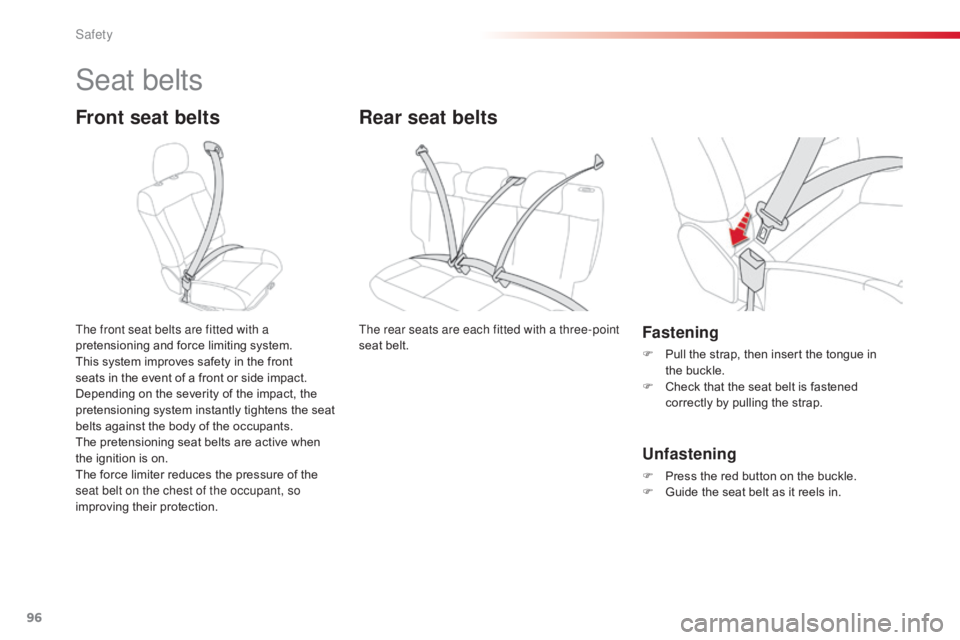
Seat belts
Front seat belts
The front seat belts are fitted with a
pretensioning and force limiting system.
This
system improves safety in the front
s
eats in the event of a front or side impact.
D
epending on the severity of the impact, the
p
retensioning system instantly tightens the seat
b
elts against the body of the occupants.
The
pretensioning seat belts are active when
t
he ignition is on.
The
force limiter reduces the pressure of the
s
eat belt on the chest of the occupant, so
improving
their protection.Fastening
F Pull the strap, then insert the tongue in t
he buckle.
F
C
heck that the seat belt is fastened
c
orrectly by pulling the strap.
Unfastening
F Press the red button on the buckle.
F G uide the seat belt as it reels in.
Rear seat belts
The rear seats are each fitted with a three-point
seat belt.
Safety
Page 99 of 317
97
C4-cactus_en_Chap05_securite_ed01-2016
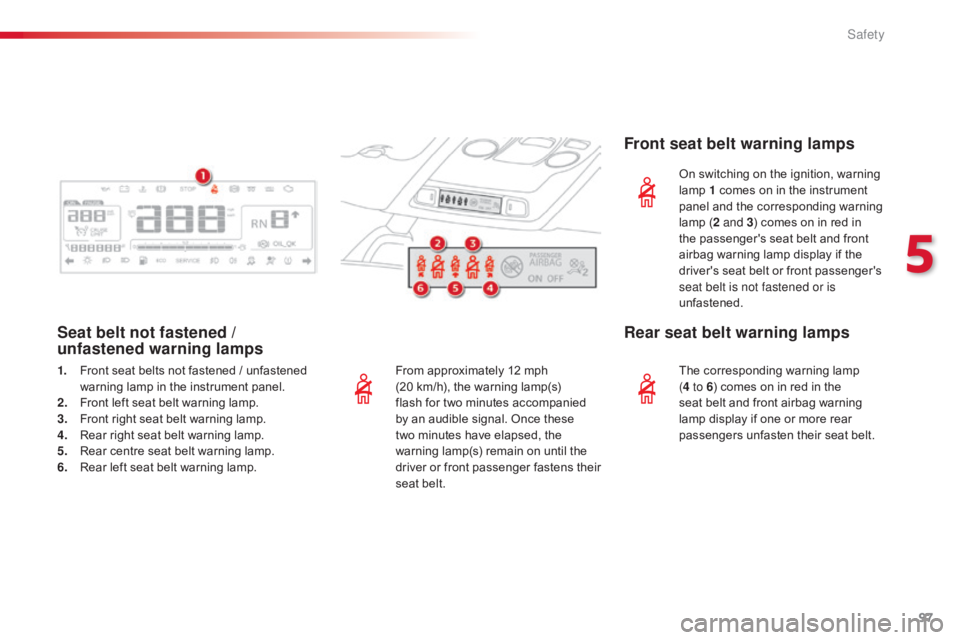
From approximately 12 mph (20 km/h), the warning lamp(s)
f
lash for two minutes accompanied
b
y an audible signal. Once these
t
wo minutes have elapsed, the
w
arning lamp(s) remain on until the
d
river or front passenger fastens their
s
eat belt.
Seat belt not fastened /
unfastened warning lamps Front seat belt warning lamps
On switching on the ignition, warning lam
p 1 comes on in the instrument
p
anel and the corresponding warning
l
amp (2 and 3 )
comes on in red in
t
he passenger's seat belt and front
a
irbag warning lamp display if the
d
river's seat belt or front passenger's
s
eat belt is not fastened or is
unfastened.
1.
F
ront
seat
belts
not
fastened
/
unfastened
w
arning
lamp
in
the
instrument
panel.
2.
F
ront
left
seat
belt
warning
lamp.
3.
F
ront
right
seat
belt
warning
lamp.
4.
R
ear
right
seat
belt
warning
lamp.
5.
R
ear
centre
seat
belt
warning
lamp.
6.
R
ear
left
seat
belt
warning
lamp.
Rear seat belt warning lamps
The corresponding warning lamp ( 4
to 6 )
comes on in red in the
s
eat belt and front airbag warning
l
amp display if one or more rear
p
assengers
u
nfasten
t
heir
sea
t
b
elt.
5
Safety
Page 101 of 317
99
C4-cactus_en_Chap05_securite_ed01-2016
Airbags
General information
System designed to contribute towards improving the safety of the occupants (with
t
he exception of the rear centre passenger)
i
n the event of violent collisions. The airbags
s
upplement the action of the seat belts fitted
w
ith force limiters (all except the centre rear
p
assenger
b
elt).
If a collision occurs, the electronic detectors
record
and analyse the front and side impacts
s
ustained in the impact detection zones:
-
i
n the case of a serious impact, the airbags
a
re deployed instantly and contribute
towards better protection of the occupants
of
the vehicle (with the exception of the
r
ear centre passenger); immediately after
t
he impact, the airbags deflate rapidly so
t
hat they do not hinder visibility or the exit
o
f the occupants,
-
i
n the case of a minor or rear impact or in
c
ertain roll-over conditions, the airbags
m
ay not be deployed; the seat belt
a
lone contributes towards ensuring your
p
rotection in these situations. The airbags do not operate when the
ignition is switched off.
This
equipment will only deploy once.
I
f a second impact occurs (during the
s
ame or a subsequent accident), the
a
irbag will not be deployed again.Deployment
of one or more of the
a
irbags is accompanied by a slight
e
mission of smoke and a noise, due
t
o the activation of the pyrotechnic
cartridge
incorporated in the system.
This
smoke is not harmful, but sensitive
i
ndividuals may experience slight
ir
ritation.
The noise of detonation related to the
deployment
of one or more airbags may
r
esult in a slight loss of hearing for a
s
hort time.
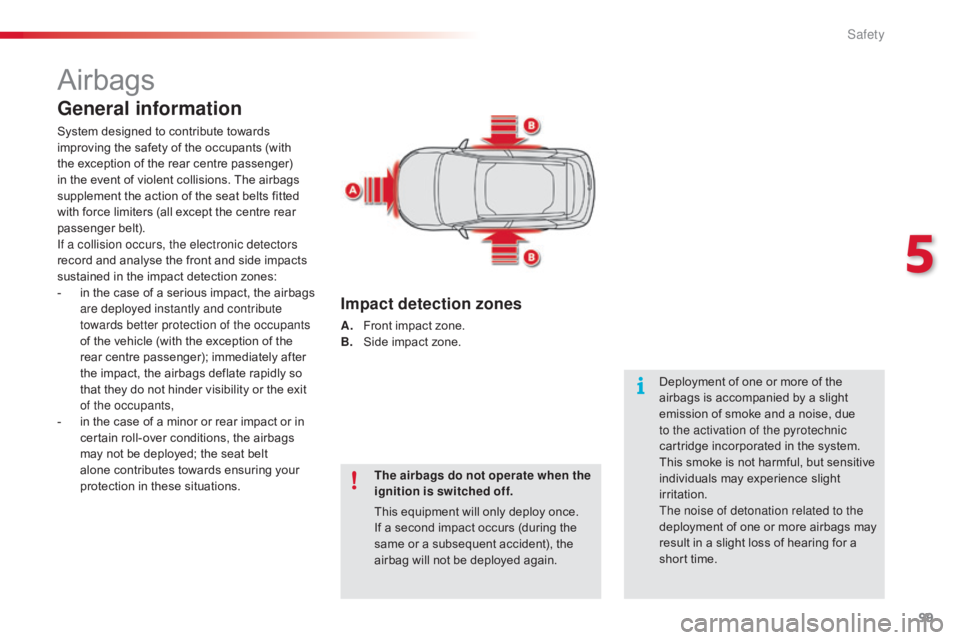
Impact detection zones
A. Front impact zone.
B. S ide impact zone.
5
Safety