air condition DATSUN 210 1979 Owner's Guide
[x] Cancel search | Manufacturer: DATSUN, Model Year: 1979, Model line: 210, Model: DATSUN 210 1979Pages: 548, PDF Size: 28.66 MB
Page 125 of 548
Emission
Control
System
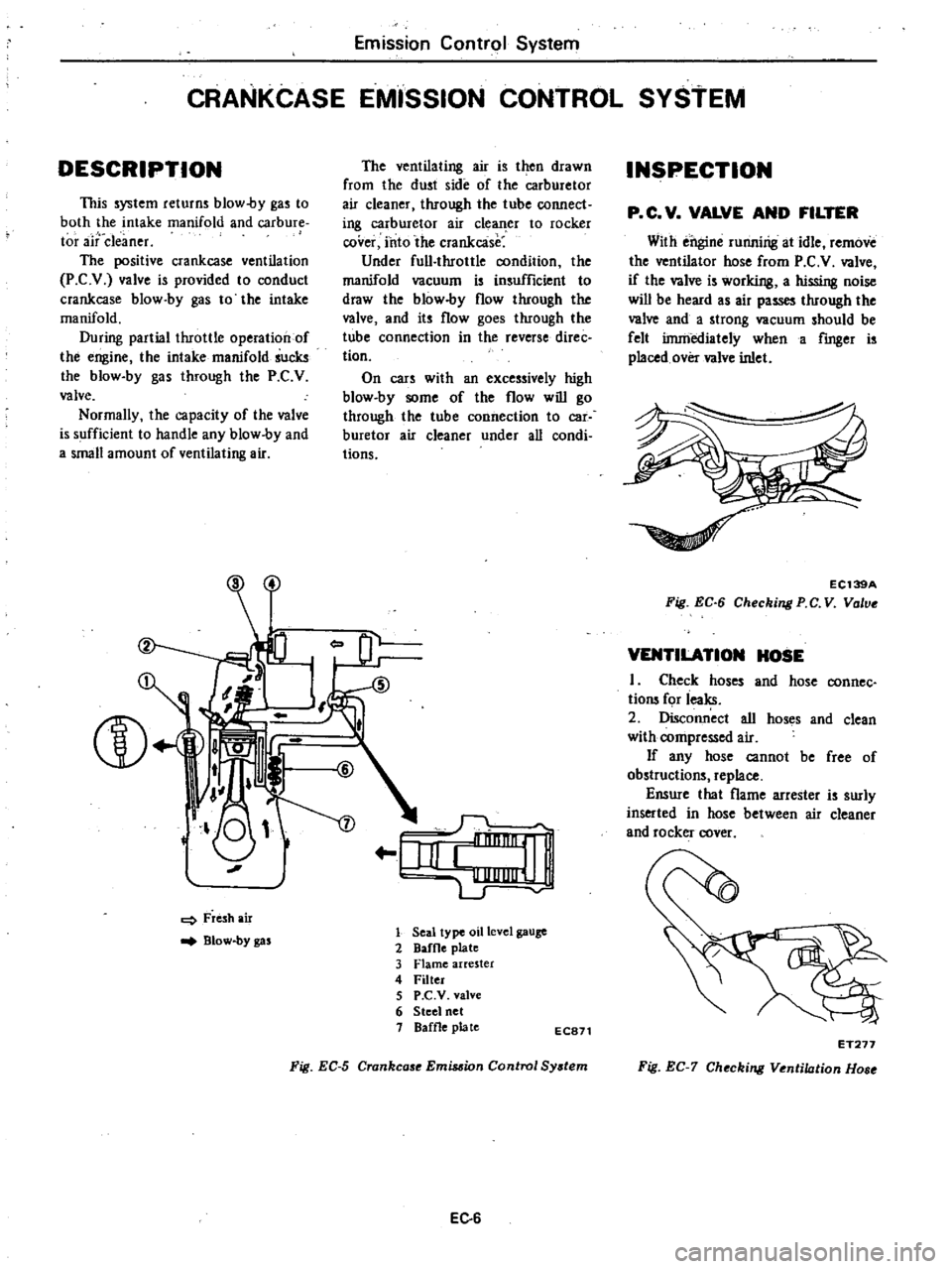
CRANKCASE
EMISSION
CONTROL
SYSTEM
DESCRIPTION
This
system
returns
blow
by
gas
to
both
the
intake
manifold
and
carbure
tor
aitdeaner
The
positive
crankcase
ventilation
P
C
v
valve
is
provided
to
conduct
crankcase
blow
by
gas
to
the
intake
manifold
During
partial
throttle
operation
of
the
engine
the
intake
manifold
sucks
the
blow
by
gas
through
the
P
C
V
valve
Normally
the
capacity
of
the
valve
is
sufficient
to
handle
any
blow
by
and
a
small
amount
of
ventilating
air
L
J
J
o
I
Fresh
air
Blow
by
gas
The
ventilating
air
is
then
drawn
from
the
dust
side
of
the
carburetor
air
cleaner
through
the
tube
connect
ing
carburetor
air
cle
er
to
rocker
cover
into
the
crankcase
Under
full
throttle
condition
the
manifold
vacuum
is
insufficient
to
draw
the
blow
by
flow
through
the
valve
and
its
flow
goes
through
the
tube
connection
in
the
reverse
direc
tion
On
cars
with
an
excessively
high
blow
by
some
of
the
flow
will
go
through
the
tube
connection
to
car
buretor
air
cleaner
under
all
condi
tions
r
IiI
e
1
LJ
1
Seal
type
oil
level
gauge
2
DafOe
plate
3
Flame
arrester
4
Filter
5
P
C
V
valve
6
Steel
net
1
Baffle
plate
EC871
Fig
EC
5
Crankcase
Emis
ion
Control
Sy
tem
EC
6
INSPECTION
p
C
V
VALVE
AND
FILTER
With
ei
gine
runnirig
at
idle
remove
the
ventilator
hose
from
P
C
V
valve
if
the
valve
is
working
a
hissing
noise
wiD
be
heard
as
air
passes
through
the
valve
and
a
strong
vacuum
should
be
felt
irnniediately
when
a
fmger
is
placed
over
valve
inlet
EC139A
Fig
EC
6
Checking
PC
V
Vo
ve
VENTILATION
HOSE
I
Check
hoses
and
hose
connec
tions
for
ieaks
2
oisconn
ct
all
hoses
and
clean
with
compressed
air
If
any
hose
cannot
be
free
of
obstructions
replace
Ensure
that
flame
arrester
is
surly
inserted
in
hose
between
air
cleaner
and
rocker
rover
ET277
Fig
EC
7
Checking
Ventilation
Hose
Page 127 of 548
Emission
Control
System
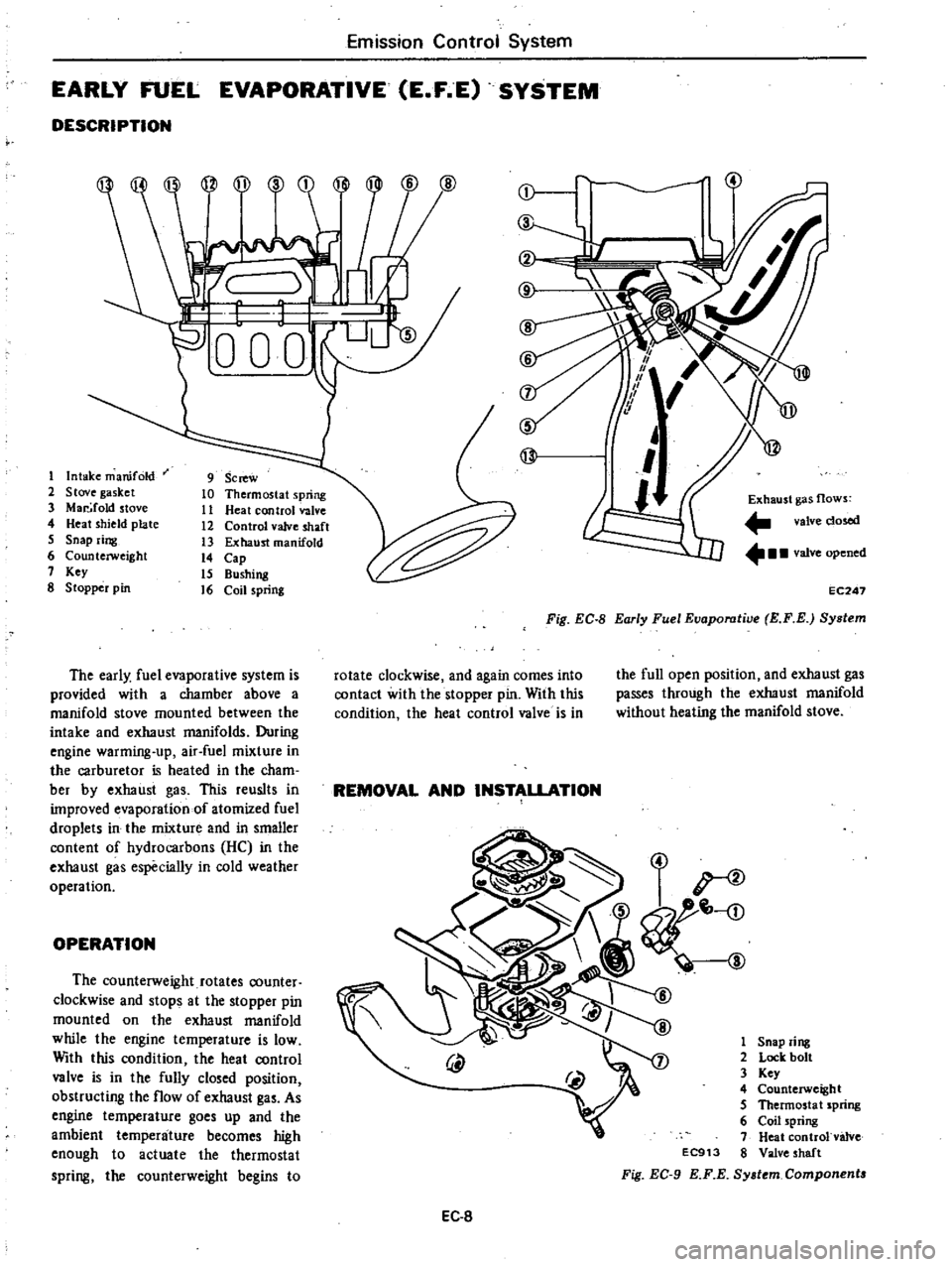
EARLY
FUEL
EVAPORATIVE
E
FE
SYSTEM
DESCRIPTION
@
jl
D
W
o
0
0
UL
@
1
Intake
manifold
9
Screw
2
Stove
gasket
10
Thermostat
spring
3
Mar
fold
stove
11
Heat
control
valve
4
Heat
shield
plate
12
Control
valve
shaft
5
Snap
ring
13
Exhaust
manifold
6
Countczwcight
14
Cap
7
Key
15
Bushing
8
Stopper
pin
16
Coil
spring
The
early
fuel
evaporative
system
is
provided
with
a
chamber
above
a
manifold
stove
mounted
between
the
intake
and
exhaust
manifolds
During
engine
warming
up
air
fuel
mixture
in
the
carburetor
is
heated
in
the
cham
ber
by
exhaust
gas
This
reuslts
in
improved
evaporation
of
atomized
fuel
droplets
in
the
mixture
and
in
smaller
content
of
hydrocarbons
HC
in
the
exhaust
gas
especially
in
cold
weather
operation
OPERATION
The
counterweight
rotates
counter
clockwise
and
stops
at
the
stopper
pin
mounted
on
the
exhaust
manifold
while
the
engine
temperature
is
low
With
this
condition
the
heat
control
valve
is
in
the
fully
closed
position
obstructing
the
flow
of
exhaust
gas
As
engine
temperature
goes
up
and
the
ambient
temperature
becomes
high
enough
to
actuate
the
thermostat
spring
the
counterweight
begins
to
j
@
l
7
1
1
5
If
@
I
Exhaust
gas
flows
valve
dosed
valve
opened
EC247
Fig
EC
8
Early
Fuel
Eaaporatiae
E
F
E
System
rotate
clockwise
and
again
comes
into
contact
with
the
stopper
pin
With
this
condition
the
heat
control
valve
is
in
the
full
open
position
and
exhaust
gas
passes
through
the
exhaust
manifold
without
heating
the
manifold
stove
REMOVAL
AND
INSTALLATION
1
Snap
ring
2
Lock
bolt
3
Key
4
Counterweight
5
Thermosta
t
spring
6
Coil
spring
7
Heat
controlvalve
EC913
8
Valve
shaft
Fig
EC
9
KF
E
Sy
tem
Component
EC
8
Page 128 of 548
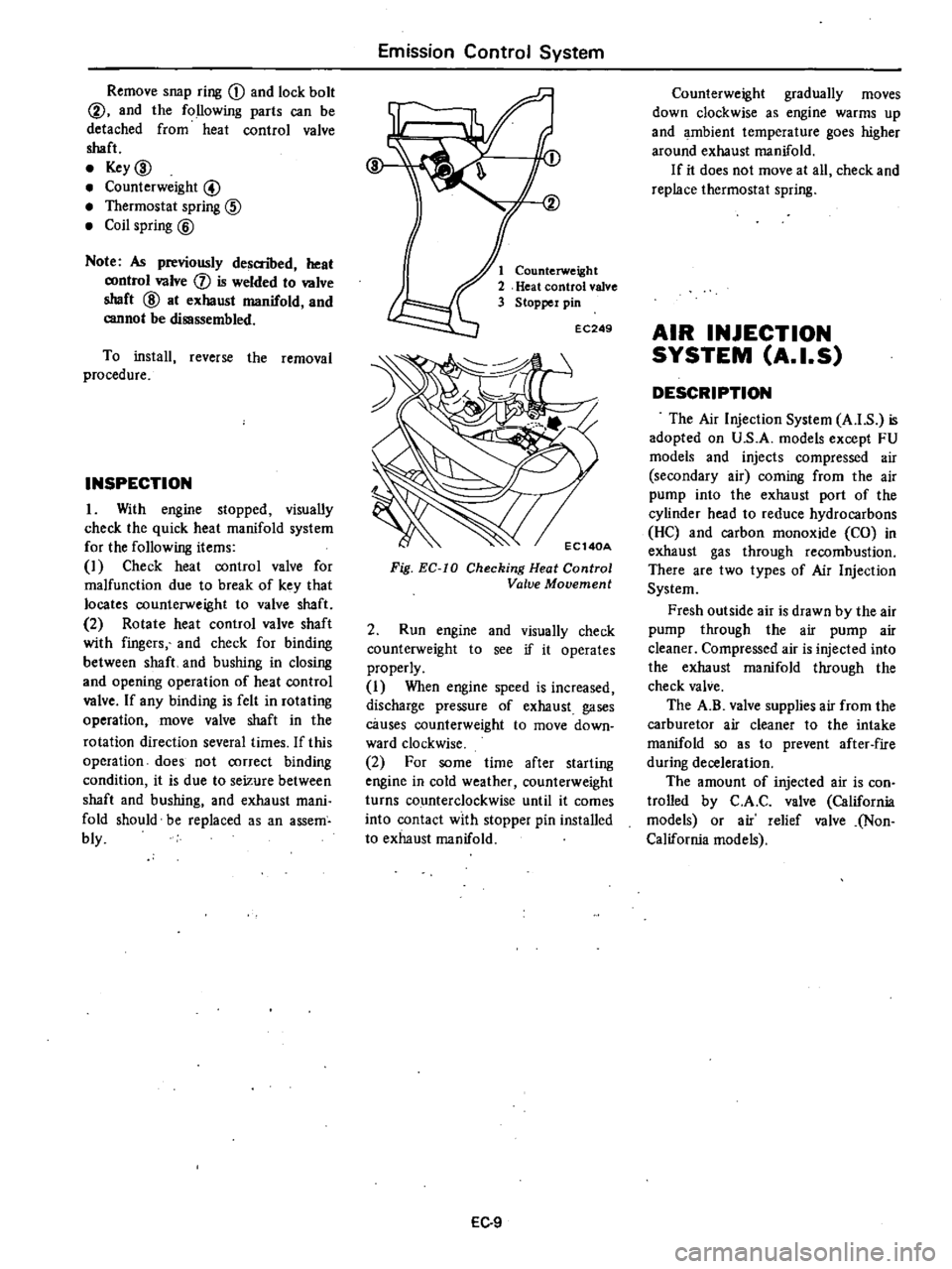
Remove
snap
ring
CD
and
lock
bolt
@
and
the
following
parts
can
be
detached
from
heat
control
valve
shaft
Key
ID
Counterweight
@
Thermostat
spring
@
Coil
spring
@
Note
As
previously
descnbed
heat
control
valve
j
is
welded
to
valve
shaft
@
at
exhaust
manifold
and
cannot
be
disassembled
To
install
reverse
the
removal
procedure
INSPECTION
1
With
engine
stopped
visually
check
the
quick
heat
manifold
system
for
the
following
items
I
Check
heat
control
valve
for
malfunction
due
to
break
of
key
that
locates
counterweight
to
valve
shaft
2
Rotate
heat
control
valve
shaft
with
fingers
and
check
for
binding
between
shaft
and
bushing
in
closing
and
opening
operation
of
heat
control
valve
If
any
binding
is
felt
in
rotating
operation
move
valve
shaft
in
the
rotation
direction
several
times
If
this
operation
does
not
correct
binding
condition
it
is
due
to
seizure
between
shaft
and
bushing
and
exhaust
mani
fold
should
be
replaced
as
an
assem
bly
Emission
Control
System
Counterweight
Heat
control
valve
Stopper
pin
EC249
Fig
EC
IO
Checking
Heat
Control
Valve
Movement
2
Run
engine
and
visually
check
counterweight
to
see
if
it
operates
properly
I
When
engine
speed
is
increased
discharge
pressure
of
exhaust
gases
causes
counterweight
to
move
down
ward
clockwise
2
For
some
time
after
starting
engine
in
cold
weather
counterweight
turns
counterclockwise
until
it
comes
into
contact
with
stopper
pin
installed
to
exhaust
manifold
EC
9
Counterweight
gradually
moves
down
clockwise
as
engine
warms
up
and
ambient
temperature
goes
higher
around
exhaust
manifold
If
it
does
not
move
at
all
check
and
replace
thermostat
spring
AIR
INJECTION
SYSTEM
A
I
S
DESCRIPTION
The
Air
Injection
System
A
I
S
is
adopted
on
U
S
A
models
except
FU
models
and
injects
compressed
air
secondary
air
coming
from
the
air
pump
into
the
exhaust
port
of
the
cylinder
head
to
reduce
hydrocarbons
He
and
carbon
monoxide
CO
in
exhaust
gas
through
recombustion
There
are
two
types
of
Air
Injection
System
Fresh
outside
air
is
drawn
by
the
air
pump
through
the
air
pump
air
cleaner
Compressed
air
is
injected
into
the
exhaust
manifold
through
the
check
valve
The
A
B
valve
supplies
air
from
the
carburetor
air
cleaner
to
the
intake
manifold
so
as
to
prevent
after
fire
during
deceleration
The
amount
of
injected
air
is
con
trolled
by
C
A
C
valve
California
models
or
air
relief
valve
Non
California
models
Page 130 of 548
Emission
Control
System
r
@
@
CD
L
I
1
Air
pump
drive
hub
5
V
ne
2
Housing
6
Carbon
shoe
3
Rotor
rins
7
Shoe
spri
ng
4
End
cover
8
Stripper
with
needle
bearing
9
Rotor
shaft
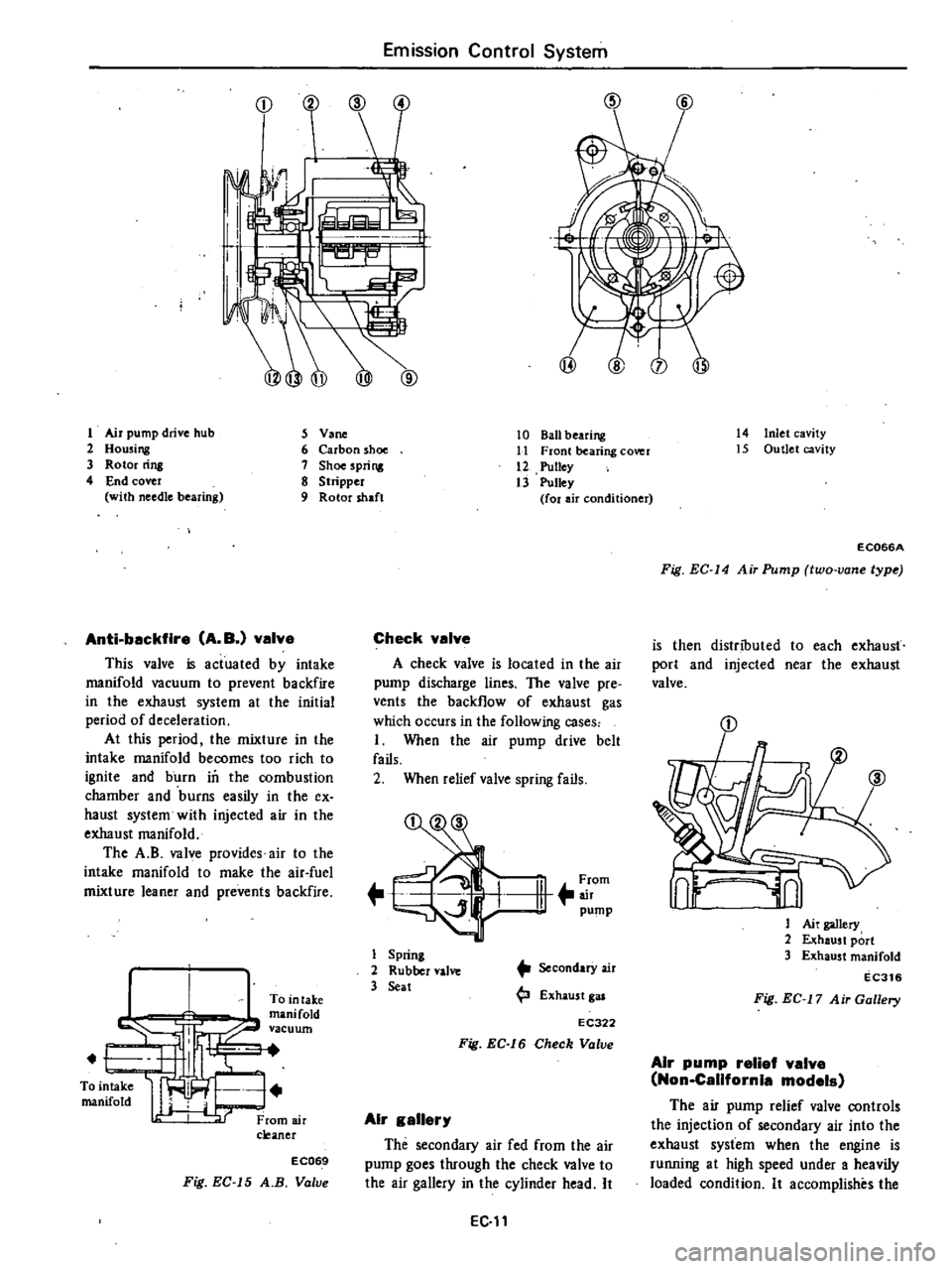
Anti
backfire
A
B
valve
This
valve
is
actuated
by
intake
manifold
vacuum
to
prevent
backfire
in
the
exhaust
system
at
the
initial
period
of
deceleration
At
this
period
the
mixture
in
the
intake
manifold
becomes
too
rich
to
ignite
and
burn
in
the
combustion
chamber
and
burns
easily
in
the
ex
haust
system
with
injected
air
in
the
exhaust
manifold
The
A
B
valve
provides
air
to
the
intake
manifold
to
make
the
air
fuel
mixture
leaner
and
prevents
backfire
To
in
take
manifold
vacuum
EC069
Fig
EC
15
A
B
Valve
10
Ball
bearing
11
Front
bearing
cOYer
12
Pulley
13
Pulley
for
air
conditioner
Check
valve
A
check
valve
is
located
in
the
air
pump
discharge
lines
The
valve
pre
vents
the
backflow
of
exhaust
gas
which
occurs
in
the
following
cases
I
When
the
air
pump
drive
belt
fails
2
When
relief
valve
spring
fails
1
11
rom
pump
1
Spring
2
Rubber
valve
3
Seat
SecondarY
air
4
J
Exhaust
gas
EC322
Fig
EC
16
Check
Valve
Air
gallery
The
secondary
air
fed
from
the
air
pump
goes
through
the
check
valve
to
the
air
gallery
in
the
cylinder
head
It
EC
lt
14
Inlet
cavity
15
Outlet
cavity
EC066A
Fig
EC
14
Air
Pump
two
vane
lype
is
then
distributed
to
each
exhaust
port
and
injected
near
the
exhaust
valve
0
iJl
Ai
gallery
2
Exhaust
port
3
Exhaust
manifold
EC316
Fig
EC
17
Air
Gallery
Air
pump
relief
valve
Non
California
models
The
air
pump
relief
valve
controls
the
injection
of
secondary
air
into
the
exhaust
system
when
the
engine
is
running
at
high
speed
under
a
heavily
loaded
condition
It
accomplishes
the
Page 131 of 548

following
functions
without
affecting
the
effectiveness
of
the
exhaust
emis
sion
control
system
Minimizes
exhaust
gas
tempera
ture
rise
2
Minimizes
horsepower
losses
reo
sulting
from
air
injection
into
the
exhaust
system
3
Protects
pump
from
excessive
back
pressure
To
carburetor
air
cleaner
Secondary
ir
Not
actuated
To
carburetor
air
cleaner
J
l
Secondary
sir
Actuated
EC294
Fig
EC
18
Air
Pump
Relief
Valve
c
A
C
valve
Californiamodels
The
C
A
C
valve
controls
the
quantity
of
secondary
air
fed
from
the
air
pump
according
to
the
load
condi
tion
and
it
discharges
the
secondary
air
into
the
atmosphere
to
prevent
overheating
of
the
catalytic
converter
This
valve
is
operated
by
intake
manifold
vacuum
and
air
pump
dis
charge
pressure
When
intake
manifold
vacuum
is
small
or
in
the
high
load
range
the
No
2
valve
opens
when
it
is
great
or
in
the
low
load
range
the
No
I
valve
opens
If
air
pump
discharge
pressure
is
large
or
the
engine
is
running
at
a
high
speed
the
No
3
valve
opens
admitting
the
air
pump
discharge
pressure
to
the
No
2
dia
phragm
chamber
of
the
C
A
C
valve
mission
Control
System
and
opening
ihe
No
i
valve
At
this
point
the
No
2
valve
serves
as
a
relief
valve
F
111
air
pump
No
3
valve
EC787
Fig
EC
19
C
A
C
Valve
I
Engine
in
low
speed
and
light
load
When
the
engine
is
operating
under
these
conditions
intake
vacuum
is
high
The
No
2
valve
unitized
with
the
No
I
diaphragm
is
lifted
by
the
intake
manifold
vacuum
pushing
up
the
No
I
valve
These
valves
will
then
stop
at
a
position
where
a
balanced
condition
exists
between
air
pump
discharge
pressure
an
d
spring
tension
acting
on
the
No
I
and
No
2
valves
The
No
2
jiaphragm
however
does
not
move
due
to
low
engine
speed
low
air
pump
discharge
pressure
and
spring
tension
acting
on
the
No
3
valve
For
this
reason
these
valves
are
brought
to
a
balanced
condition
To
intake
manifold
t
i
l
3
Spring
4
ValveNo
3
5
Di
phragm
No
I
I
@
6
Spring
7
Valve
No
1
8
Valve
No
2
EC683
Fig
EC
20
Operation
of
C
A
C
Valve
1
2
Engine
in
low
speed
and
heavy
load
EC12
Wheo
the
engine
is
operating
under
these
cooditions
intake
manifold
vacuum
is
low
and
all
valves
are
balanced
t
To
intake
manUol
U
E
ii
ji
j
Ii
5
LL
jj
Ii
JI
l
Jij
ulJC
1t
To
atmosphere
EC685
Fig
EC
21
Operation
of
C
A
C
Valve
2
3
Engine
in
high
speed
and
middle
load
When
the
engine
is
operating
under
these
conditions
intake
manifold
vacuum
lies
midway
between
1
and
2
above
The
No
3
valve
moves
to
the
left
because
of
high
air
pump
discharge
pressure
To
intake
manifold
t
L
J
f
E
bt
I
5
tfi
11
I
LJr
To
tmg
J
j
1
EC
4
Fig
EC
22
Operation
of
C
A
C
Volve
3
REMOVAL
AND
INSTALLATION
Air
pump
air
cleaner
Loosen
nuts
securing
air
pump
air
cleaner
to
bracket
then
detach
air
cleaner
from
bracket
Air
cleaner
filter
and
air
cleaner
lower
body
are
built
into
a
unit
construction
Replace
air
cleaner
filter
and
lower
body
as
an
assembly
Page 137 of 548
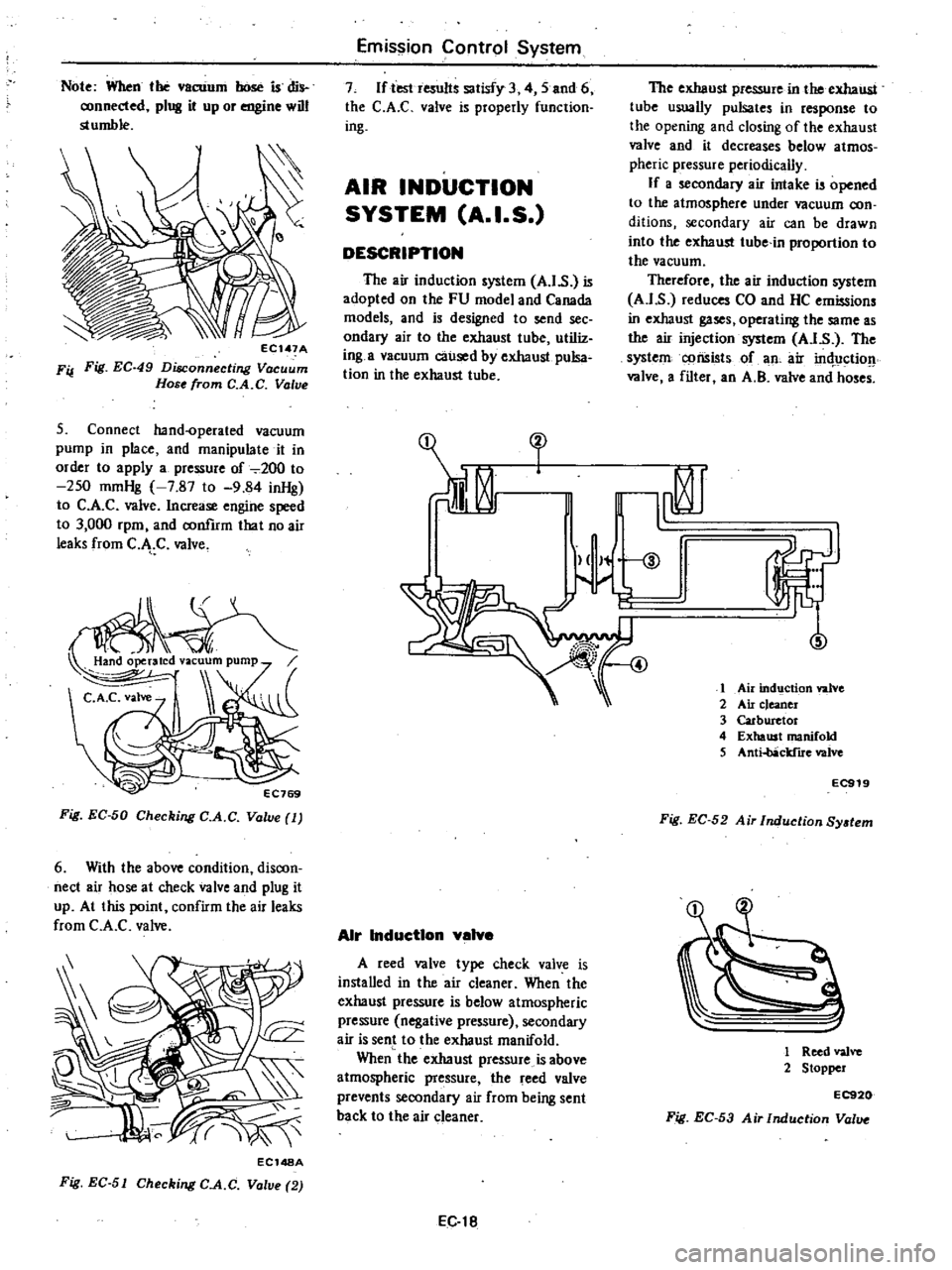
Note
When
tho
vaCUUm
hose
is
dis
connected
plug
it
up
or
engine
will
stumble
EC
47A
FiJ
Fig
EC
49
Disconnecting
Vacuum
Hose
from
C
A
C
Valve
5
Connect
hand
operated
vacuum
pump
in
place
and
manipulate
it
in
order
to
apply
a
pressure
of
2oo
to
250
mmHg
7
87
to
9
84
inHg
to
C
A
C
valve
Increase
engine
speed
to
3
000
rpm
and
confIrm
that
no
air
leaks
from
C
J
C
valve
Fig
EC
50
Checking
C
A
C
Valve
1
6
With
the
above
condition
discon
nect
air
hose
at
check
valve
and
plug
it
up
At
this
point
confirm
the
air
leaks
from
C
A
C
valve
ECl48A
Fig
EC
51
Checking
C
A
C
Volve
2
Emission
Control
System
7
If
teshesults
satisfy
3
4
5
and
6
the
C
A
C
valve
is
properly
function
ing
AIR
INDUCTION
SYSTEM
A
I
S
DESCRIPTION
The
air
induction
system
A
1
s
is
adopted
on
the
FU
model
and
Canada
models
and
is
designed
to
send
see
ondary
air
to
the
exhaust
tube
utiliz
ing
a
vacuum
caused
by
exhaust
pulsa
tion
in
the
exhaust
tube
Air
inductIon
valve
A
reed
valve
type
check
valve
is
installed
in
the
air
cleaner
When
the
exhaust
pressure
is
below
atmospheric
pressure
negative
pressure
secondary
air
is
sent
to
the
exhaust
manifold
When
the
exhaust
pressure
is
above
atmospheric
pressure
the
reed
valve
prevents
secondary
air
from
being
sent
back
to
the
air
cleaner
EC
t8
The
exhaust
pressure
in
the
exhaust
tube
usually
pulsates
in
response
to
the
opening
and
closing
of
the
exhaust
valve
and
it
decreases
below
atmos
pheric
pressure
periodically
If
a
secondary
air
intake
is
opened
to
the
atmosphere
under
vacuum
con
ditions
secondary
air
can
be
drawn
into
the
exhaust
tube
in
proportion
to
the
vacuum
Therefore
the
air
induction
system
A
I
s
reduces
CO
and
HC
emissions
in
exhaust
gases
operatiug
the
same
as
the
air
injection
system
A
I
s
The
system
cpnsistsof
an
air
in
tJctio
valve
a
filter
an
A
B
valve
and
hoses
fl
V
t
5
1
Air
ind9ction
valve
2
Air
c
eancr
3
Carburetor
4
Exhaust
manifold
5
Anti
obRcldlre
valve
EC919
Fig
EC
52
Ai
Induction
SYltem
1
Reed
valvo
2
Stopper
EC920
Fig
EC
53
Air
Induction
Val
Page 142 of 548
1l
I
I
1J
1
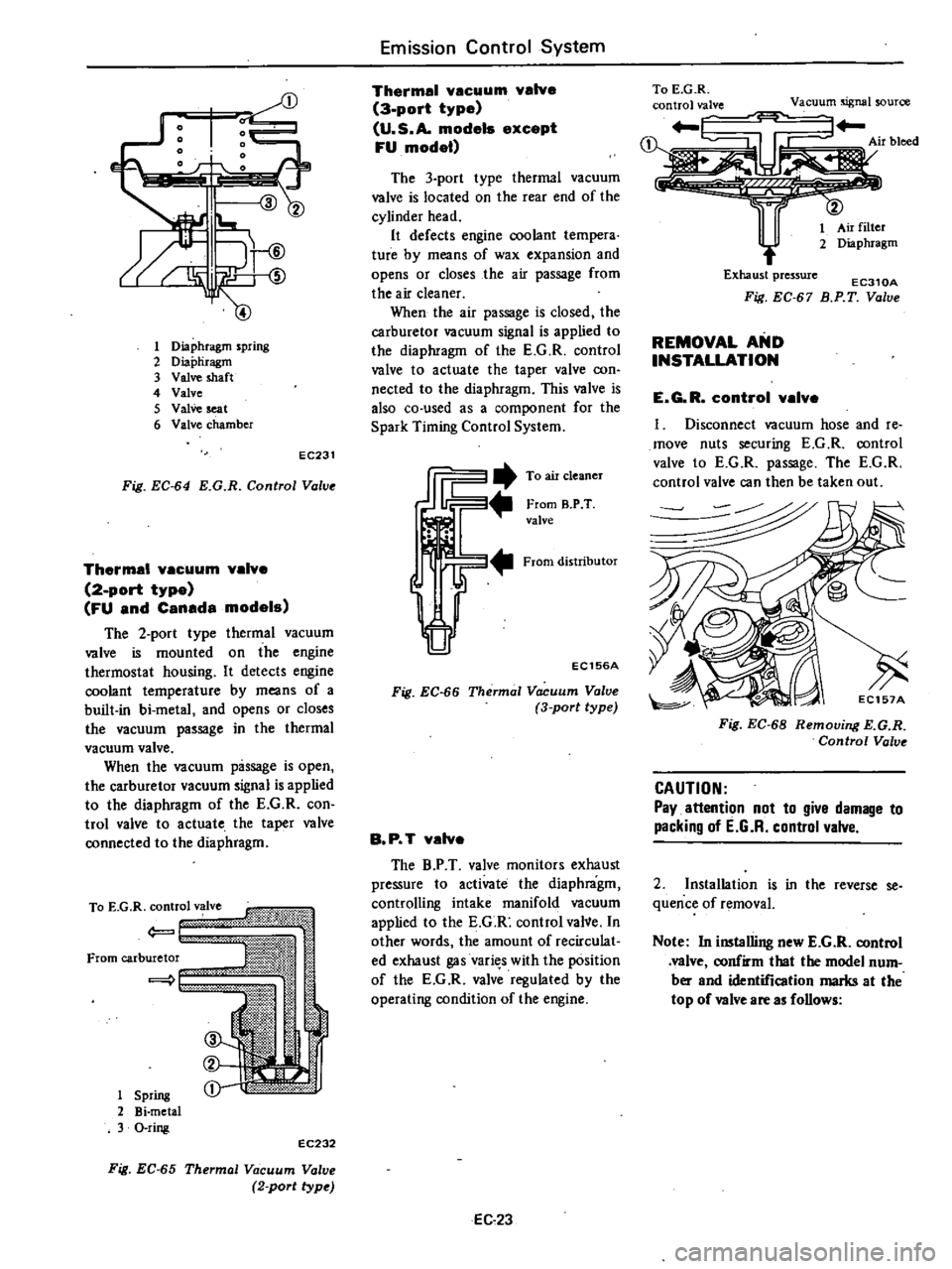
Diaphragm
spring
2
Diapliragm
3
Valve
shaft
4
Valve
5
ValVe
seat
6
Valve
chamber
EC231
Fig
EC
64
E
G
R
Control
Value
Thermal
vacuum
valve
2
port
type
FU
and
Canada
models
The
2
port
type
thermal
vacuum
valve
is
mounted
on
the
engine
thermostat
housing
It
detects
engine
coolant
temperature
by
means
of
a
built
in
bi
metal
and
opens
or
closes
the
vacuum
passage
in
the
thermal
vacuum
valve
When
the
vacuum
passage
is
open
the
carburetor
vacuum
signal
is
applied
to
the
diaphragm
of
the
E
G
R
con
trol
valve
to
actuate
the
taper
valve
connected
to
the
diaphragm
1
Spring
2
Bi
metal
3
O
ring
EC232
Fig
EC
65
Thermal
Vacuum
Valve
2
port
type
Emission
Control
System
Thermal
vacuum
valve
3
port
type
U
S
A
models
except
FU
model
The
3
port
type
thermal
vacuum
valve
is
located
on
the
rear
end
of
the
cylinder
head
It
defects
engine
coolant
tempera
ture
by
means
of
wax
expansion
and
opens
or
closes
the
air
passage
from
the
air
cleaner
When
the
air
passage
is
closed
the
carburetor
vacuum
signal
is
applied
to
the
diaphragm
of
the
E
G
R
control
valve
to
actuate
the
taper
valve
con
nected
to
the
diaphragm
This
valve
is
also
co
used
as
a
component
for
the
Spark
Timing
Control
System
JiI2
To
air
cleaner
From
B
P
T
valve
From
distributor
EC156A
Fig
EC
66
Thermal
Vacuum
Valve
3
port
type
B
P
T
valve
The
B
P
T
valve
monitors
exhaust
pressure
to
activate
the
diaphragm
controlling
intake
manifold
vacuum
applied
to
the
E
G
R
control
vaNe
In
other
words
the
amount
of
recirculat
ed
exhaust
gas
vari
s
with
the
position
of
the
E
G
R
valve
regulated
by
the
operating
condition
of
the
engine
EC
23
To
E
G
R
control
valve
Vacuum
nal
Curce
Air
bleed
1
Exhaust
pressure
EC310A
Fig
EC
67
B
P
T
Value
REMOVAL
AND
INSTALLATION
E
G
R
control
valve
I
Disconnect
vacuum
hose
and
re
move
nuts
securing
E
G
R
control
valve
to
E
G
R
passage
The
E
G
R
control
valve
can
then
be
taken
out
Fig
EC
68
Remouing
E
G
R
Control
Valve
CAUTION
Pay
attention
not
to
give
damage
to
packing
of
E
G
R
control
valve
2
Installation
is
in
the
reverse
se
quence
of
removal
Note
In
installing
new
E
G
R
control
valve
confirm
that
the
model
num
ber
and
identification
marks
at
the
top
of
valve
are
as
follows
Page 144 of 548
INSPECTION
Entire
system
I
Make
a
thorough
vjsual
check
of
E
G
R
control
system
If
necessary
wipe
away
oil
to
facilitate
inspection
If
any
hoses
are
cracked
or
broken
replace
2
With
engine
stopped
inspect
E
G
R
control
valve
for
any
indication
of
binding
or
sticking
by
moving
dia
phragm
of
control
valve
upwards
with
a
finger
3
With
engine
running
inspect
E
G
R
control
valve
and
thermal
vacu
um
valve
for
normal
operation
1
When
engine
coolant
tempera
tun
is
low
Make
sure
that
E
G
R
control
valve
does
not
operate
when
engine
speed
is
increased
from
idling
to
3
000
to
3
500
rpm
Place
a
finger
on
the
diaphragm
of
E
G
R
control
valve
to
check
for
valve
operation
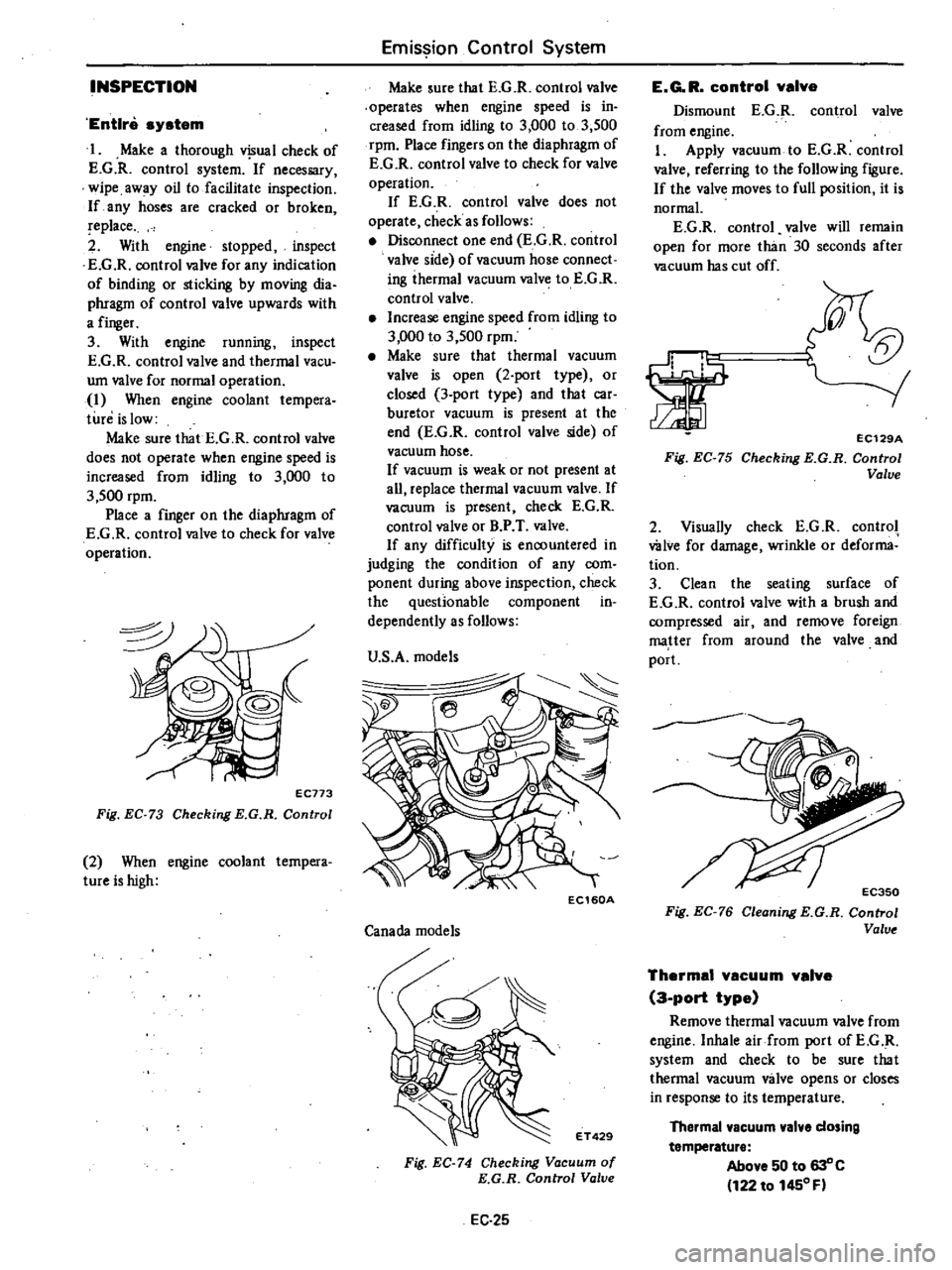
EC773
Fig
EC
73
Checking
E
G
R
Control
2
When
engine
coolant
tempera
tureishigh
Emission
Control
System
Make
sure
that
E
G
R
control
valve
operates
when
engine
speed
is
in
creased
from
idling
to
3
000
to
3
500
rpm
Place
fingers
on
the
diaphragm
of
E
G
R
control
valve
to
check
for
valve
operation
If
E
G
R
control
valve
does
not
operate
check
as
follows
Disconnect
one
end
E
G
R
control
valve
side
of
vacuum
hose
connect
ing
ihermal
vacuum
valve
to
E
G
R
control
valve
Increase
engine
speed
from
idling
to
3
000
to
3
500
rpm
Make
sure
that
thermal
vacuum
valve
is
open
2
port
type
or
closed
3
port
type
and
that
car
buretor
vacuum
is
present
at
the
end
E
G
R
control
valve
side
of
vacuum
hose
If
vacuum
is
weak
or
not
present
at
all
replace
thermal
vacuum
valve
If
vacuum
is
present
check
E
G
R
control
valve
or
B
P
T
valve
If
any
difficulty
is
encountered
in
judging
the
condition
of
any
com
ponent
during
above
inspection
check
the
questionable
component
in
dependently
as
follows
U
S
A
models
Ie
EC160A
Canada
models
ET429
Fig
EC
74
Checking
Vacuum
of
E
G
R
Control
Valve
EC
25
E
G
R
control
valve
Dismount
E
G
R
control
valve
from
engine
I
Apply
vacuum
to
E
G
R
control
valve
referring
to
the
following
figure
If
the
valve
moves
to
full
position
it
is
normal
E
G
R
control
valve
will
remain
open
for
more
than
30
seconds
after
vacuum
has
cut
off
5t
orr
rl
1
1
Fig
EC
75
EC129A
Checking
E
G
R
Control
Valve
2
Visually
check
E
G
R
control
wive
for
damage
wrinkle
or
deforma
tion
3
Clean
the
seating
surface
of
E
G
R
control
valve
with
a
brush
and
compressed
air
and
remove
foreign
matter
from
around
the
valve
and
port
Fig
EC
76
Cleoning
E
G
R
Control
Valve
Thermal
vacuum
valve
3
port
type
Remove
thermal
vacuum
valve
from
engine
Inhale
air
from
port
ofE
G
R
system
and
check
to
be
sure
that
thermal
vacuum
valve
opens
or
closes
in
response
to
its
temperature
Thermal
vacuum
valve
dosing
temperature
Above
50
to
630
C
122
to
1450
F
Page 152 of 548

e
In
o
L
1
Ignition
switch
2
Vacuum
switching
v3
lve
3
Top
detecting
switch
4
Function
check
connector
EC330A
i
Fig
EC
99
Checking
Top
Detecting
l
Switch
Vacuum
dela
valve
Remove
vacUum
delay
valve
2
Blow
air
from
th
port
of
the
distributor
side
The
vacuum
delay
valve
is
in
go
ij
condition
if
the
air
flows
through
the
valve
3
Try
again
from
the
opposit
side
of
the
valve
Th
valve
is
in
goo
condition
if
th
a
flow
resistance
is
greater
than
the
step
2
abov
Distributor
side
Carburetor
side
Distribu
tor
side
Carburetor
side
EC346
Fig
EC
100
Checking
Vocuum
Dewy
Valve
Emission
Control
Syst
m
4
If
the
condition
of
spark
delay
valve
is
questionable
dip
port
into
a
cup
filled
with
water
Blow
air
from
brown
face
side
Small
air
bubbles
should
appear
CAUTION
Be
c
areful
to
avoid
entry
of
oil
or
dirt
into
valve
7
E
C279
Fig
EC
101
Checking
Vacuum
D
lDy
Valve
CATALYTIC
CONVERTER
California
dels
DESCRIPTION
1
The
catalytic
converter
accelerates
the
chemical
reaction
of
hydrocarbons
CD
0
He
and
carbon
monoxide
O
in
the
exhaust
gas
and
changes
them
into
non
harmful
carbon
dioxide
C02
and
water
H20
This
chemical
reac
tiOD
process
requires
the
proper
a
mount
of
air
which
is
supplied
by
the
air
pump
Refer
to
the
item
AJ
S
This
air
is
called
secondary
air
The
Catalytic
converter
is
mounted
0
the
models
destinbd
for
California
OPERATION
Exhaust
gas
emitted
from
the
en
gine
contains
some
harmful
substances
due
to
incomplete
combustion
in
the
combustion
chamber
The
air
injection
stem
i
designed
to
reduce
the
con
tent
of
such
substances
in
the
exhaust
gas
In
this
system
the
secondary
air
is
led
from
the
ch
ck
valve
and
injected
in
o
the
exhaust
manifold
With
this
injection
of
the
secondary
air
hydro
carbons
He
and
carbon
monoxide
CO
in
the
exhaust
gas
are
gradually
oxidized
with
oxygen
02
in
the
secondary
air
and
converted
into
nOD
harmful
carbon
dioxide
C02
and
water
HP
The
catalytic
converter
further
cleans
engine
exhaust
gas
Through
catalytic
action
it
changes
residual
hydrocarbons
and
carbon
monoxide
contained
in
exhaust
gas
into
carbon
dioxide
and
water
before
exhaust
gas
is
discharged
to
the
atmosphere
0
Secondary
air
Carbon
monoxide
hydrocarbon
Carbon
dioxide
gas
Nater
EC
i
A
I
Front
tube
2
Catalytic
converter
3
Center
tube
4
Main
murner
EC
33
EC215
Fig
EC
I02
Function
of
Catalytic
Converter
Page 153 of 548

REMOVAL
AND
INSTALLATION
I
Jack
up
the
car
Note
Apply
parking
brake
and
place
wheel
chocks
2
Remove
screws
securing
lower
shelter
of
catalytic
converter
Loosen
flange
bolt
connecting
catalytic
converter
to
front
and
rear
exhaust
tube
Catalytic
converter
assembly
can
then
be
taken
out
3
Installation
i
in
the
reverse
se
quence
of
removal
CAUTION
a
Be
careful
not
to
damage
catalytic
co
when
handliilg
b
Never
wet
catalyzer
with
water
oil
etc
t
J
Tightening
torque
Catalyti
converter
bolts
2
6
to
3
4
kg
m
19
to
25
ft
lb
Emission
Control
System
EC075A
EC076A
Fig
EC
103
Removing
Catalytic
Converter
INSPECTION
PrelimInary
In
pectlon
Vi
ually
check
condition
of
all
component
parts
including
hose
tubes
and
wires
replace
if
necessary
Refer
to
Air
Injection
System
for
inspection
EC
34
Catalytic
converter
Whether
catalytic
converter
is
nor
mal
or
not
can
e
checked
by
ob
serving
variation
in
CO
percentage
The
checking
procedure
is
as
follows
Apply
parking
brake
Shift
gears
into
Neutral
for
manual
transmis
sion
and
N
or
P
for
automatic
transmission
position
I
Adjust
engine
idling
speed
and
CO
percentage
Refer
to
Adjusting
Carburetor
Idle
RPM
and
Mixture
Ratio
for
adjustment
2
Race
engine
1
500
to
2
000
rpm
two
or
three
times
under
no
load
and
make
sure
that
specified
CO
percent
age
obtained
3
Remove
cap
and
connect
air
hose
to
air
check
valve
If
idling
speed
increases
readjust
it
to
specified
speed
with
throttle
adjusting
screw
4
Warm
up
engine
for
about
four
minutes
at
2
000
pm
under
no
load
S
Measure
Ci
percentage
at
idling
speed
After
stepAhas
been
complet
ed
wait
for
one
minute
before
making
CO
percentage
measurement
6
If
CO
percentage
measured
in
step
5
is
less
than
0
3
the
catalytic
converter
is
normaL
7
If
CO
percentage
measured
in
step
5
is
over
0
3
recheck
AJ
S
and
1
replace
air
check
valVe
The
perform
inspection
steps
4
and
S
8
If
CO
percentage
is
still
over
0
3
in
step
7
catalyt
iC
converter
i
mal
functioning
Replace
catalytic
con
verter