air condition DATSUN 210 1979 User Guide
[x] Cancel search | Manufacturer: DATSUN, Model Year: 1979, Model line: 210, Model: DATSUN 210 1979Pages: 548, PDF Size: 28.66 MB
Page 34 of 548
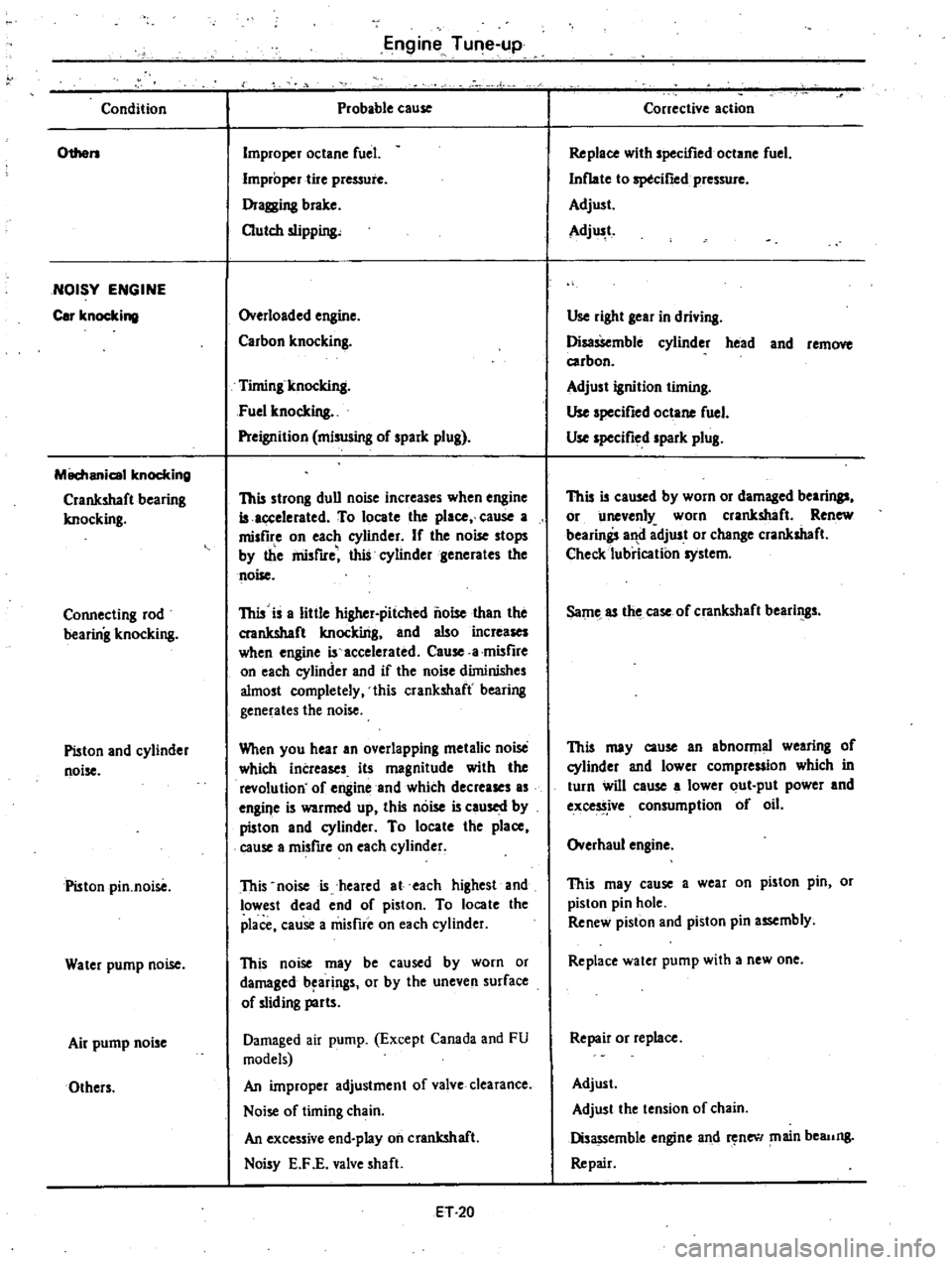
Condition
Othen
NOISY
ENGINE
Cor
knockillll
M8chanicol
knocking
Crankshaft
bearing
knocking
Connecting
rod
bearing
knocking
Piston
and
cylinder
noise
Piston
pin
noise
Water
pump
noise
Air
pump
noise
Others
Engine
Tune
up
Probable
cause
Improper
octane
fuel
Improper
tire
pressure
Dragging
brake
Dutch
slipping
Overloaded
engine
Carbon
knocking
Timing
knocking
Fuel
knocking
Preignition
miswing
of
spark
plug
This
strong
dull
noise
increases
when
engine
is
occelerated
To
locate
the
place
cause
a
misfire
on
each
cylinder
If
the
noise
stops
by
the
misfire
this
cylinder
generates
the
noise
This
is
a
little
higher
pitched
noise
than
the
crankshaft
knocking
and
also
increases
when
engine
is
accelerated
Cause
a
misfire
on
each
cylinder
and
if
the
noise
diminishes
almost
completely
this
crankshaft
bearing
generates
the
noise
When
you
hear
an
overlapping
metalic
noise
which
increases
its
magnitude
with
the
revolution
of
engine
and
which
decreases
as
engil
e
is
warmed
up
this
noise
is
caused
by
piston
and
cylinder
To
locate
the
place
cause
a
misfire
on
each
cylinder
This
noise
is
heared
at
each
highest
and
lowest
dead
end
of
piston
To
locate
the
place
cause
a
misfire
on
each
cylinder
This
noise
may
be
caused
by
worn
or
damaged
b
arings
or
by
the
uneven
surface
of
sliding
parts
Damaged
air
pump
Except
Canada
and
FU
models
An
improper
adjustment
of
valve
clearance
Noise
of
timing
chain
An
excessive
end
play
on
crankshaft
Noisy
E
F
E
valve
shaft
H20
Corrective
action
Replace
with
specified
octane
fuel
Inflate
to
sptcifled
pressure
Adjust
Adjwt
Use
right
gear
in
driving
Disassemble
cylinder
head
and
remove
carbon
Adjust
ignition
timing
Use
specified
octane
fuel
Use
specified
spark
plug
This
is
caused
by
worn
or
damaged
bearings
or
unevenly
worn
crankshaft
Renew
bearings
and
adjust
or
change
crankshaft
Check
lubrication
system
Same
as
the
case
of
crankshaft
bearings
This
may
cause
an
abnormal
wearing
of
cylinder
and
lower
compression
which
in
turn
will
cause
a
lower
out
put
power
and
excess
ive
consumption
of
oil
Overhaul
engine
This
may
cause
a
wear
on
piston
pin
or
piston
pin
hole
Renew
piston
and
piston
pin
assembly
Replace
water
pump
with
a
new
one
Repair
or
replace
Adjust
Adjust
the
tension
of
chain
Disassemble
engine
and
new
main
beaung
Repair
Page 35 of 548
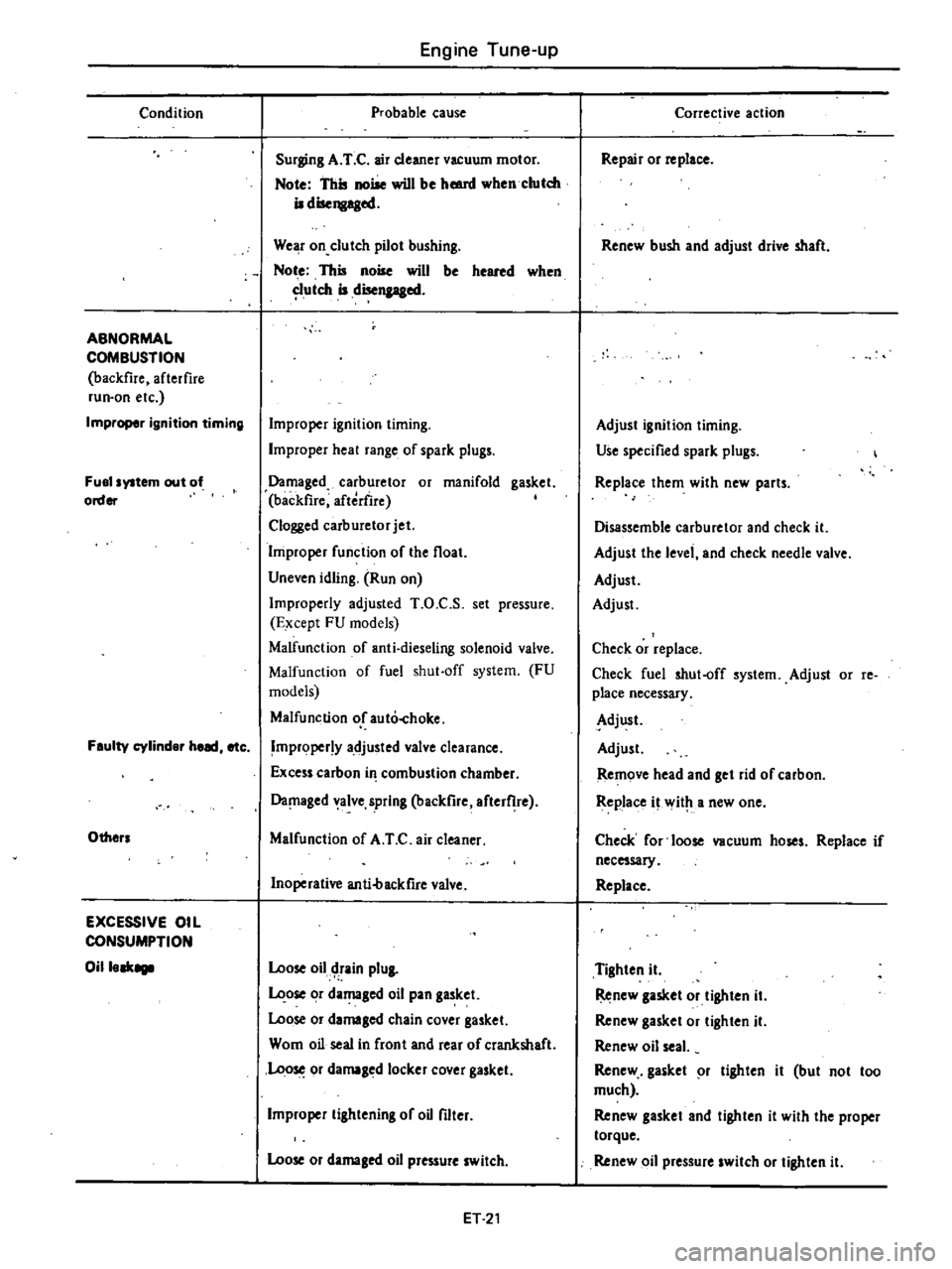
Condition
ABNORMAL
COMBUSTION
backfire
afterfire
run
on
etc
Improper
ignition
timing
Fuel
system
out
of
order
Feulty
cylinder
heed
etc
Others
EXCESSIVE
OIL
CONSUMPTION
Oilleek8111
Engine
Tune
up
Probable
cause
Surging
A
T
C
air
cleaner
vacuum
motor
Note
This
noise
will
be
hmnl
when
clutch
iI
disengaged
We
r
on
clutch
pilot
bushing
Not
e
This
noise
will
be
heared
when
utch
iI
disengaged
Improper
ignition
timing
Improper
heal
range
of
spark
plugs
Damaged
carburetor
or
manifold
gasket
backfire
aftedire
Clogged
carburetor
jet
Improper
function
of
the
float
Uneven
idling
Run
on
Improperly
adjusted
T
O
C
S
set
pressure
Except
FU
models
Malfunction
of
anti
dieseling
solenoid
valve
Malfunction
of
fuel
shut
off
system
FU
models
Malfunction
or
auto
hoke
Improper
y
adjusted
valve
clearance
Excess
carbon
in
combustion
chamber
Da
laged
alve
spring
backfire
after
he
Malfunction
of
A
T
C
air
cleaner
Inoperative
anti4lackfire
valve
Loose
oil
tain
plUI
ose
or
damaged
oil
pan
gasket
Loose
or
damaled
chain
cover
gasket
Wom
oil
seal
in
front
and
rear
of
crankshaft
Loo
or
damaged
locker
cover
gasket
Improper
lilhtening
of
oU
filter
Loose
or
damaled
oil
pressure
switch
ET
21
Corrective
action
Repair
or
replace
Renew
bush
and
adjust
drive
shaft
Adjust
ignition
liming
Use
specified
spark
plugs
Replace
them
with
new
parts
Disassemble
carburetor
and
check
it
Adjust
the
level
and
check
needle
valve
Adjust
Adjust
Check
or
replace
Check
fuel
shut
off
system
Adjust
or
re
place
necessary
Adjust
Adjust
Remove
head
and
get
rid
of
carbon
Replace
it
wit
a
new
one
Check
for
loose
vacuum
hoses
Replace
if
necessary
Replace
Tighten
it
Renew
lasket
or
tighten
iI
Renew
gasket
or
lighten
it
Renew
oil
seal
Renew
gasket
r
lighten
it
but
not
too
much
Renew
gasket
and
tighten
it
with
the
proper
torque
Renew
oil
pressure
switch
or
tighten
it
Page 36 of 548
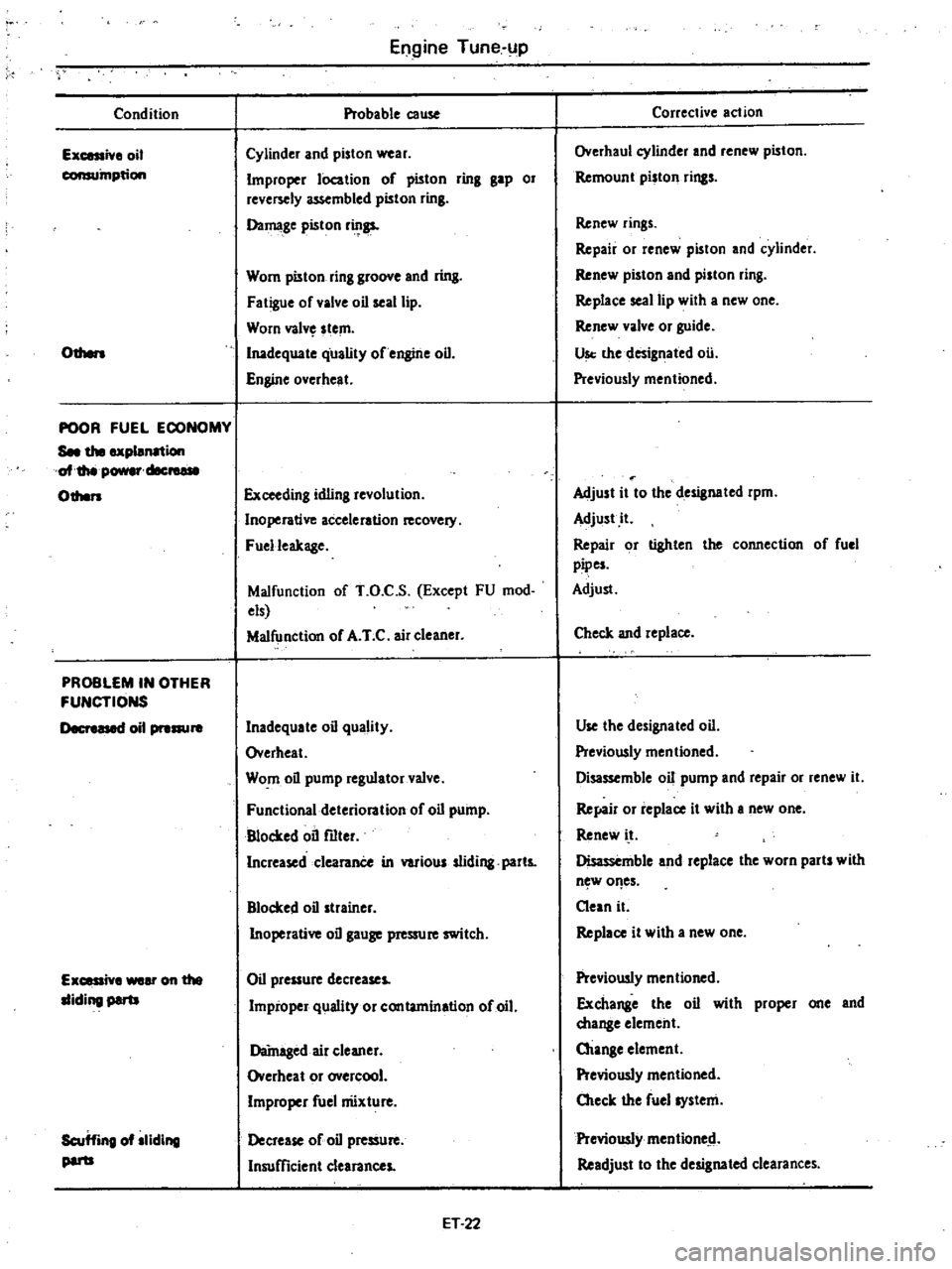
Condition
Ex
iv
oil
consumption
Odlen
POOR
FUEL
ECONOMY
See
the
explanation
oI
thtI
power
cIec
01hen
PROBLEM
IN
OTHER
FUNCTIONS
t
1
oil
pre
E
eronthe
lIiding
par1J
Scuffing
oIlliding
par1J
Engine
Tune
up
Probable
cause
Cylinder
and
piston
wear
Improper
lOcation
of
pi5ton
ring
gap
or
reversely
assembled
piston
ring
Damage
pi5ton
r
gs
Wom
pilton
ring
groove
and
ring
Fatigue
of
valve
oil
seal
lip
Worn
valv
stem
Inadequate
qUality
of
engine
oil
Engine
overheat
Exceeding
idling
revolution
Inoperative
acceleration
covel
Fuelleakage
Malfunction
of
T
O
C
S
Except
FU
mod
els
Malfunction
of
A
T
C
air
cleaner
Inadequate
oil
quality
Overheat
Worn
oil
pump
regulator
valve
Functional
deterioration
of
oil
pump
Blocked
oil
filter
Increased
clearanCe
in
various
sliding
parts
Blocked
oil
strainer
Inoperative
oil
gauge
pressure
switch
Oil
pressure
decreases
Improper
quality
or
contamination
of
oil
Damaged
air
cleaner
Overheat
or
overcool
Improper
fuel
nUxture
Decrease
of
oil
presSure
Insufficient
clearances
ET
22
Corrective
action
Overhaul
cylinder
and
renew
piston
Remount
piston
rings
Renew
rings
Repair
or
renew
piston
and
cylinder
Renew
piston
and
piston
ring
Replace
seal
lip
with
a
new
one
Renew
valve
or
guide
Us
the
designated
ou
Previously
mentioned
Adjust
it
to
the
designated
rpm
Adjust
it
Repair
or
lighten
the
connection
of
fuel
pipes
Adjust
Check
and
replace
Use
the
designated
oil
Previously
mentioned
Disassemble
oil
pump
and
repair
or
renew
it
Ref4ir
or
replace
it
with
I
new
one
Renew
i
t
Disassemble
and
replace
the
worn
parts
with
n
w
of
es
Clean
it
Replace
it
with
a
new
one
Previously
mentioned
Exchange
the
oil
with
proper
one
and
change
element
Otange
element
Previously
mentioned
Oteck
the
fuel
system
Previously
mentione
d
Readjust
to
the
designated
clearances
Page 37 of 548
Engine
Tune
up
Condition
Probable
cause
Overheat
Improper
fuel
mixture
Floor
temp
ture
too
high
California
and
FU
model
Problem
in
fuel
system
Refer
to
Inspec
tion
of
Fuel
System
Problem
in
ignition
system
Refer
to
In
spection
oflgnition
System
Corrective
action
Previously
mentioned
Check
the
fuel
system
Check
and
repair
Check
and
repair
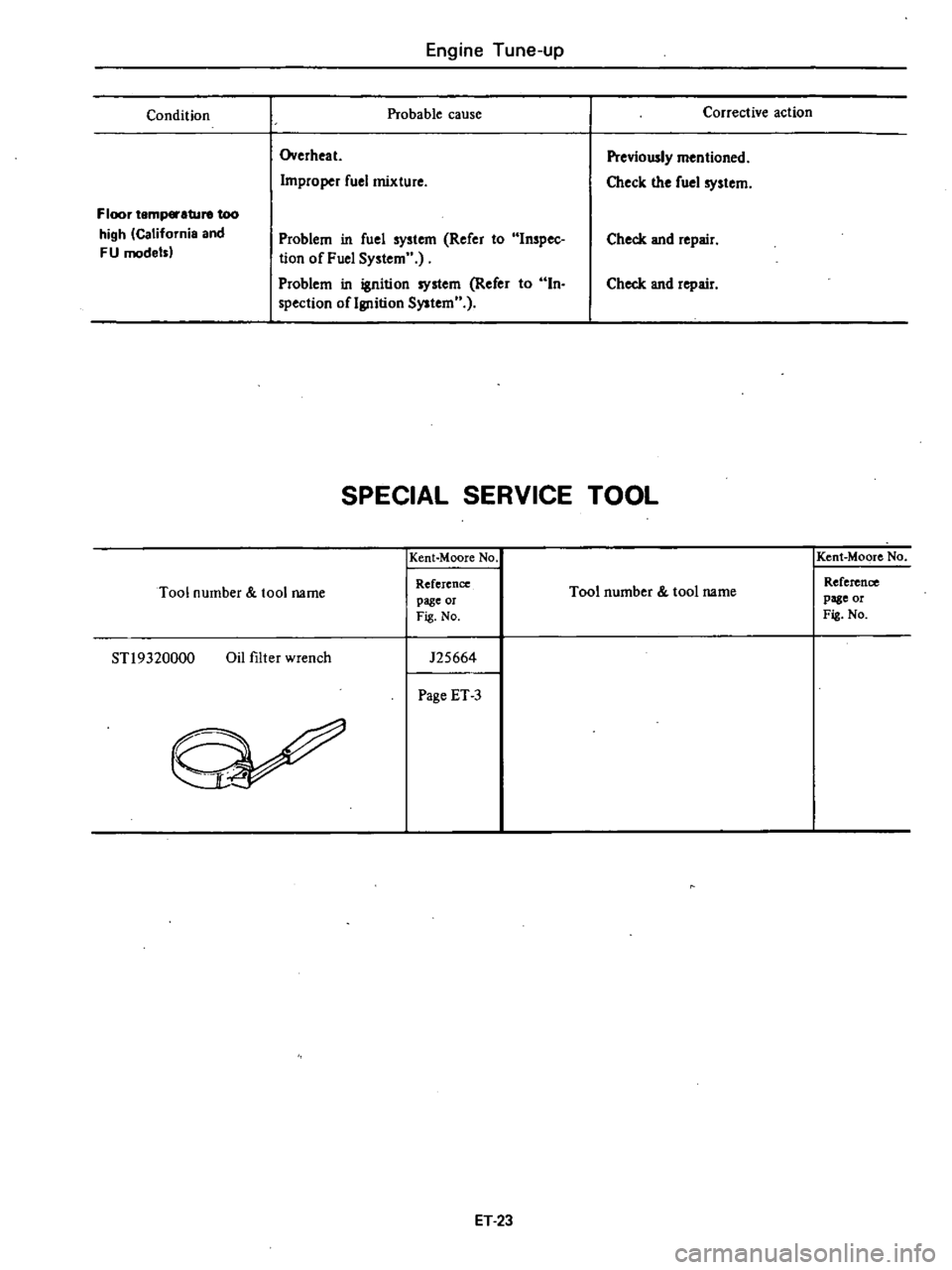
SPECIAL
SERVICE
TOOL
Kent
Moore
No
Tool
number
tool
name
Reference
page
or
Fig
No
STl9320000
Oil
filter
wrench
125664
Page
ET
3
ET
23
Kent
Moore
No
Tool
number
tool
name
Reference
page
or
Fig
No
Page 40 of 548
PRELIMINARY
CLEANING
AND
INSPECTION
Before
disassembling
engine
ob
serve
the
following
items
I
Prior
to
disassembling
check
outer
parts
for
sign
of
leak
past
their
gasketed
surfaces
2
Check
carburetor
and
fuel
pump
for
condition
fuel
hoses
for
deteriora
t
ion
cracks
or
otherwise
leakage
of
fuel
past
their
jointed
or
connected
surfaces
3
Wipe
dust
and
mud
off
engine
4
Inspect
outer
parts
for
visual
faults
and
broken
or
missing
parts
such
as
bolts
and
nuts
5
Check
piping
and
electrical
cir
cuits
for
deterioration
breakage
fittings
discontinuity
or
insulation
DISASSEMBLY
To
remove
engine
from
car
refer
to
Section
ER
for
Removal
1
Remove
starting
motor
then
re
move
transmission
from
engine
2
Remove
clutch
assembly
3
Remove
alternator
fan
belt
alter
nator
bracket
and
alternator
adjusting
bar
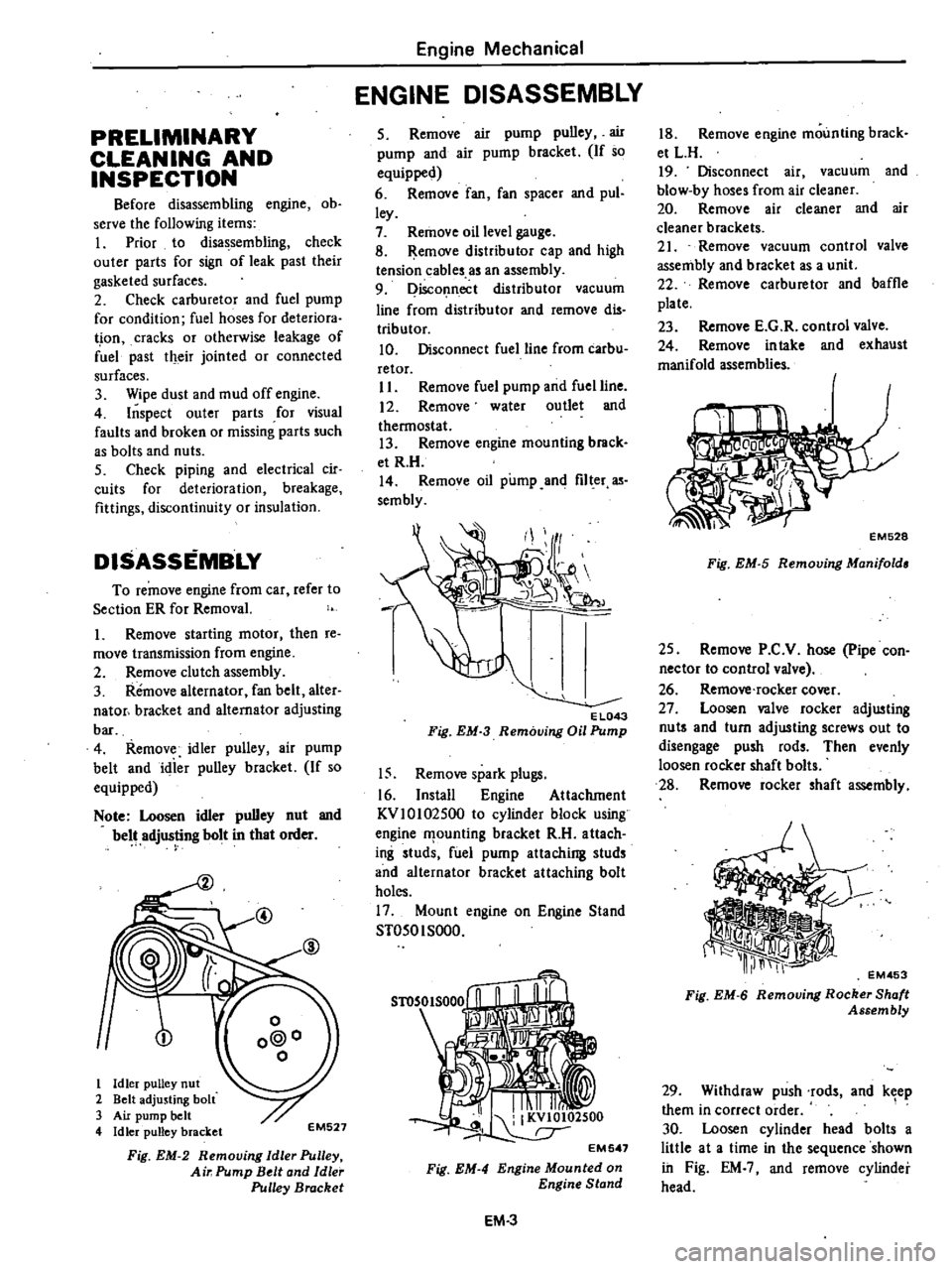
4
Remove
idler
pulley
air
pump
belt
and
idier
pulley
bracket
If
so
equipped
Note
Loosen
idler
pulley
nut
and
belt
adjusting
bolt
in
that
order
@
1
Idler
pulley
nut
2
Belt
adjusting
bolt
3
Air
pump
belt
4
Idler
pulley
bracket
EM527
Fig
EM
2
Removing
Idle
Pulley
Air
Pump
Belt
and
Idle
Pulley
Bracket
Engine
Mechanical
ENGINE
DISASSEMBLY
5
Remove
air
pump
pulley
air
pump
and
air
pump
bracket
If
so
equipped
6
Remove
fan
fan
spacer
and
pul
ley
7
Remove
oil
level
gauge
8
Remove
distributor
cap
and
high
tension
cables
as
an
assembly
9
Disconnect
distributor
vacuum
line
from
distributor
and
remove
dis
tributor
10
Disconnect
fuel
line
from
carbu
retor
II
Remove
fuel
pump
and
fuel
line
12
Remove
water
outlet
and
thermostat
13
Remove
engine
mounting
brack
et
R
H
14
Remove
oil
pump
and
filter
as
sembly
EL043
Fig
EM
3
Removing
Oil
Pump
15
Remove
spark
plugs
16
Install
Engine
Attachment
KVlOI02500
to
cylinder
block
using
engine
f1
ounling
bracket
R
H
attach
ing
studs
fuel
pump
attaching
studs
and
alternator
bracket
attaching
bolt
holes
17
Mount
engine
on
Engine
Stand
ST050I
SOOO
Fig
EM
4
EM
3
18
Remove
engine
mounting
brack
et
L
H
19
Disconnect
air
vacuum
and
blow
by
hoses
from
air
cleaner
20
Remove
air
cleaner
and
air
cleaner
brackets
21
Remove
vacuum
control
valve
assembly
and
bracket
as
a
unit
22
Remove
carburetor
and
baffle
plate
23
Remove
E
G
R
control
valve
24
Remove
intake
and
exhaust
manifold
assemblies
EM528
Fig
EM
5
Removing
Manifold
25
Remove
P
C
V
hose
pipe
con
nector
to
control
valve
26
Remove
rocker
cover
27
Loosen
valve
rocker
adjusting
nut
and
turn
adjusting
screws
out
to
disengage
push
rods
Then
evenly
loosen
rocker
shaft
bolts
28
Remove
rocker
shaft
assembly
EM453
Fig
EM
6
Removing
Rocker
Shaft
Assembly
29
Withdraw
push
rods
and
keep
them
in
correct
order
1
30
Loosen
cylinder
head
bolts
a
little
at
a
time
in
the
sequence
shown
in
Fig
EM
and
remove
cylinder
head
Page 68 of 548

Engine
Mechanical
TROUBLE
DIAGNOSES
AND
CORRECTIONS
Condition
I
Noill
f
onglno
Knocking
of
crank
shaft
and
bearing
Piston
and
connecting
rod
knocking
Camshaft
knocking
Timilli
chain
noise
Camshaft
and
valve
mechanism
knock
ing
Probable
cause
Loose
main
bearing
Seized
bearing
Ben
crankshaft
Excessive
crankshaft
end
play
Loose
bearing
Seized
bearing
Loose
piston
pin
Loose
piston
in
cylinder
Broken
piston
ring
Improper
connecting
rod
alignment
Loose
bearing
Exc
essive
axial
play
Rough
ge
r
teeth
8roken
cam
gear
Improper
chain
tension
Worn
and
or
damaged
chain
I
Wom
sprocket
Worn
and
or
broken
tension
adjusting
mecha
nism
Excessive
camshaft
and
bearing
clearance
Improper
valve
clearance
Worn
adjusting
screw
Worn
rocker
face
Loose
valve
stem
in
guide
Weakened
valve
pring
Seized
valve
EM
31
Corrective
action
Replace
Replac
Repair
or
replace
Peplace
center
thrust
bearing
l
Replace
Replace
Replace
pin
or
bushing
Recondition
cylinder
Replace
Realign
Replace
Replace
bearing
thrust
plate
Repair
Replace
Adjust
Replace
Replace
Replace
Replace
AdjUst
Replace
Replace
Replace
guide
Replace
Repair
or
replace
Page 69 of 548

Condition
Waterpurnp
knocking
II
Othw
mllChani
troubl
Stuck
valve
Seized
valve
seat
Excessively
wom
cylinder
and
piston
Engine
Mechanical
Probab
Ie
cause
Improper
shaft
end
play
Broken
impeller
Improper
valve
clearance
Insufficient
clearance
between
valve
stem
and
guide
Weakened
or
broken
valve
pring
Biting
or
damage
of
valve
stem
Poor
fuel
quality
Il1
prop
r
valve
clearance
Weakened
valve
pring
Thin
valve
head
edge
Narrow
valve
seat
Overheating
Over
speeding
Sticked
valve
guide
Shortage
ofengine
oil
Dirty
engine
oil
Poor
oil
quality
Overheat
Wrong
assembly
of
piston
with
connecting
rod
Improper
piston
ring
clearance
Dirty
air
cleaner
Too
rich
mixture
Engine
over
run
Stuck
choke
valve
Over
choking
EM
32
Corrective
action
Replace
Replace
Adjust
Clean
stem
or
ream
the
guide
Replace
Repil
ce
or
clean
Use
good
fuel
Adjust
Replace
Replace
valve
Reface
Repair
or
replace
Drive
at
proper
speed
Repair
Add
or
replace
oil
Check
oil
level
on
daily
basis
Clean
crankcase
replace
oil
and
re
place
oil
ftIter
element
Use
proper
oil
Repair
or
replace
Repair
or
replace
Adjust
Clean
periodically
Adju
t
Drive
correctly
Clean
and
adjust
Start
in
correct
way
Page 70 of 548

Condition
Faulty
connecting
rod
Faulty
crankshaft
bearing
Engine
Mechanical
Probable
cause
Shortage
of
engine
oil
Low
oil
pressure
Poor
engine
oil
quality
Rough
crankshaft
surface
Clogged
oil
passage
Bearing
worn
or
eccentric
Bearing
improperly
assembled
Loose
bearing
Incorrect
connecting
rod
alignment
Shortage
of
engine
oil
Low
oil
pressure
Poor
quality
engine
oil
Worn
or
out
of
round
crankshaft
journal
Clogged
oil
passage
in
crankshaft
Bearing
worn
or
eccentric
Bearing
inproperly
assembled
Non
co
centric
crankshaft
or
bearing
EM
33
Corrective
action
Add
or
replace
oil
Check
oil
level
on
daily
basis
Correct
Use
proper
oil
Grind
and
replace
bearing
Clean
Replace
Repair
Replace
Repair
or
replace
Add
or
replace
Check
oil
level
on
daily
basis
Adjust
Use
proper
oil
Repair
Clean
Replace
Repair
Replace
Page 81 of 548
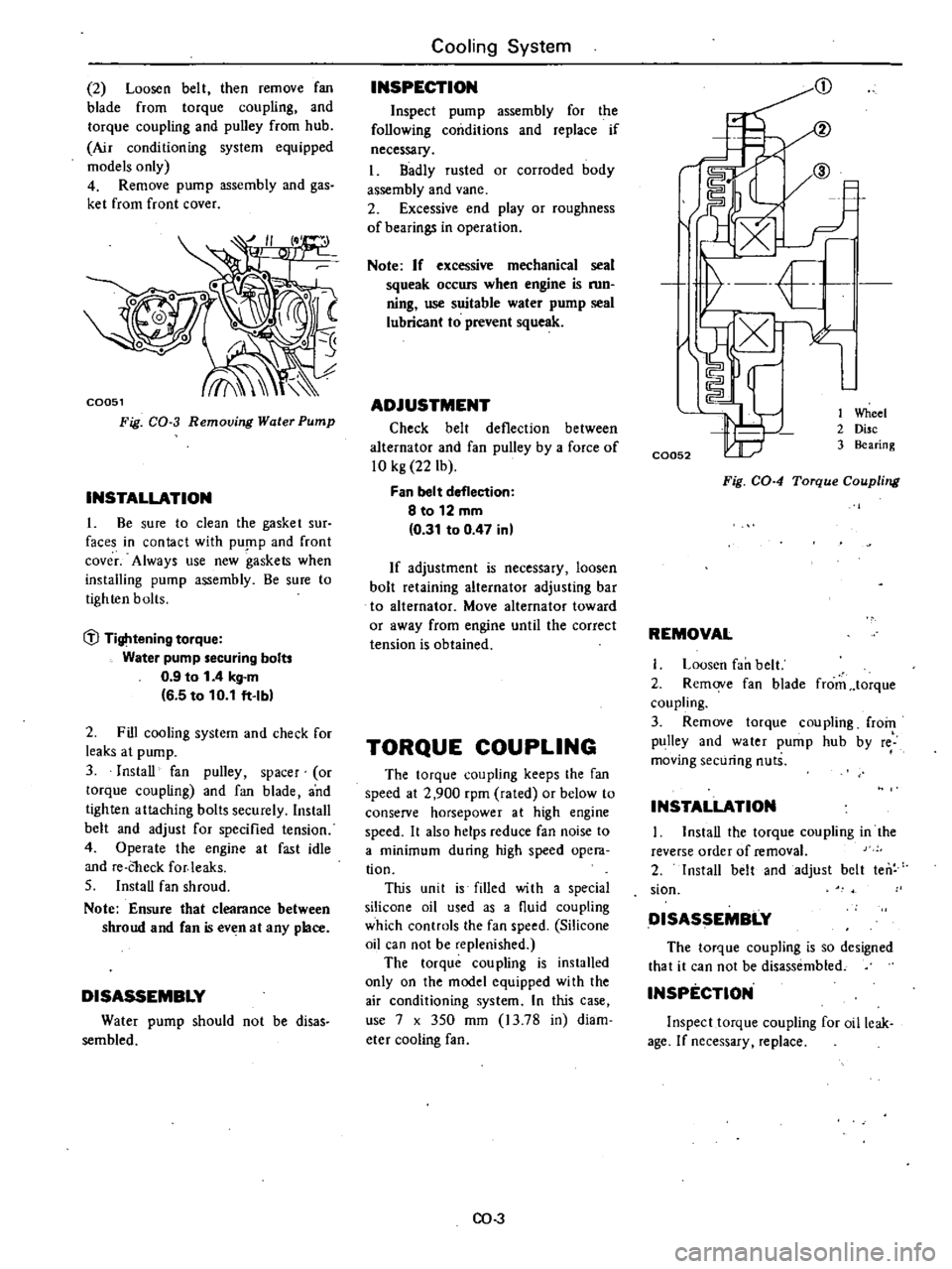
2
Loosen
belt
then
remove
fan
blade
from
torque
coupling
and
torque
coupling
and
pulley
from
hub
Air
conditioning
system
equipped
models
only
4
Remove
pump
assembly
and
gas
ket
from
front
cover
C0051
Fig
CO
3
Removing
Water
Pump
INSTALLATION
1
Be
sure
to
clean
the
gasket
sur
faces
in
contact
with
pU
flP
and
front
cover
Always
use
new
gaskets
when
installing
pump
assembly
Be
sure
to
tighten
bolts
i
l
Tightening
torque
Water
pump
securing
bolts
0
9
to
1
4
kg
m
6
5
to
10
1
ft
Ib
2
Fill
cooling
system
and
check
for
leaks
at
pump
3
InstaD
fan
pulley
spacer
or
torque
coupling
and
fan
blade
and
tighten
attaching
bolts
securely
Install
belt
and
adjust
for
specified
tension
4
Operate
the
engine
at
fast
idle
and
re
Check
for
leaks
S
Install
fan
shroud
Note
Ensure
that
clearance
between
shroud
and
fan
even
at
any
place
DISASSEMBLY
Water
pump
should
not
be
disas
sembled
Cooling
System
INSPECTION
Inspect
pump
assembly
for
the
following
conditions
and
replace
if
necessary
I
Badly
rusted
or
corroded
body
assembly
and
vane
2
Excessive
end
play
or
roughness
of
bearings
in
operation
Note
If
excessive
mechanical
seal
squeak
occurs
when
engine
is
mn
ning
use
suitable
water
pump
seal
lubricant
to
prevent
squeak
ADJUSTMENT
Check
belt
deflection
between
alternator
and
fan
pulley
by
a
force
of
10
kg
22
Ib
Fan
belt
deflection
8
to
12
mm
0
31
to
0
47
in
If
adjustment
is
necessary
loosen
bolt
retaining
alternator
adjusting
bar
to
alternator
Move
alternator
toward
or
away
from
engine
until
the
correct
tension
is
obtained
TORQUE
COUPLING
The
torque
coupling
keeps
the
fan
speed
at
2
900
rpm
rated
or
below
to
conserve
horsepower
at
high
engine
speed
It
also
helps
reduce
fan
noise
to
a
minimum
during
high
speed
opera
tion
This
unit
is
filled
with
a
special
silicone
oil
used
as
a
fluid
coupling
which
controls
the
fan
speed
Silicone
oil
can
not
be
replenished
The
torque
coupling
is
installed
only
on
the
model
equipped
with
the
air
conditioning
system
In
this
case
use
7
x
350
mm
13
78
in
diam
eter
cooling
fan
CO
3
C0052
t
Wheel
2
Disc
3
Bearing
Fig
CO
4
Torque
Coupling
REMOVAL
Lousen
fan
belt
2
Remove
fan
blade
from
torque
coupling
3
Remove
torque
coupling
from
pulley
and
water
pump
hub
by
re
moving
securing
nuts
INSTALLATION
I
InstaD
the
torque
coupling
in
the
reverse
order
of
removal
2
Install
belt
and
adjust
belt
ten
sian
DISASSEMBLY
The
torque
coupling
is
so
designed
that
it
can
not
be
disassembled
INSPECTION
Inspect
torque
coupling
for
oil
leak
age
If
necessary
replace
Page 82 of 548
Cooling
System
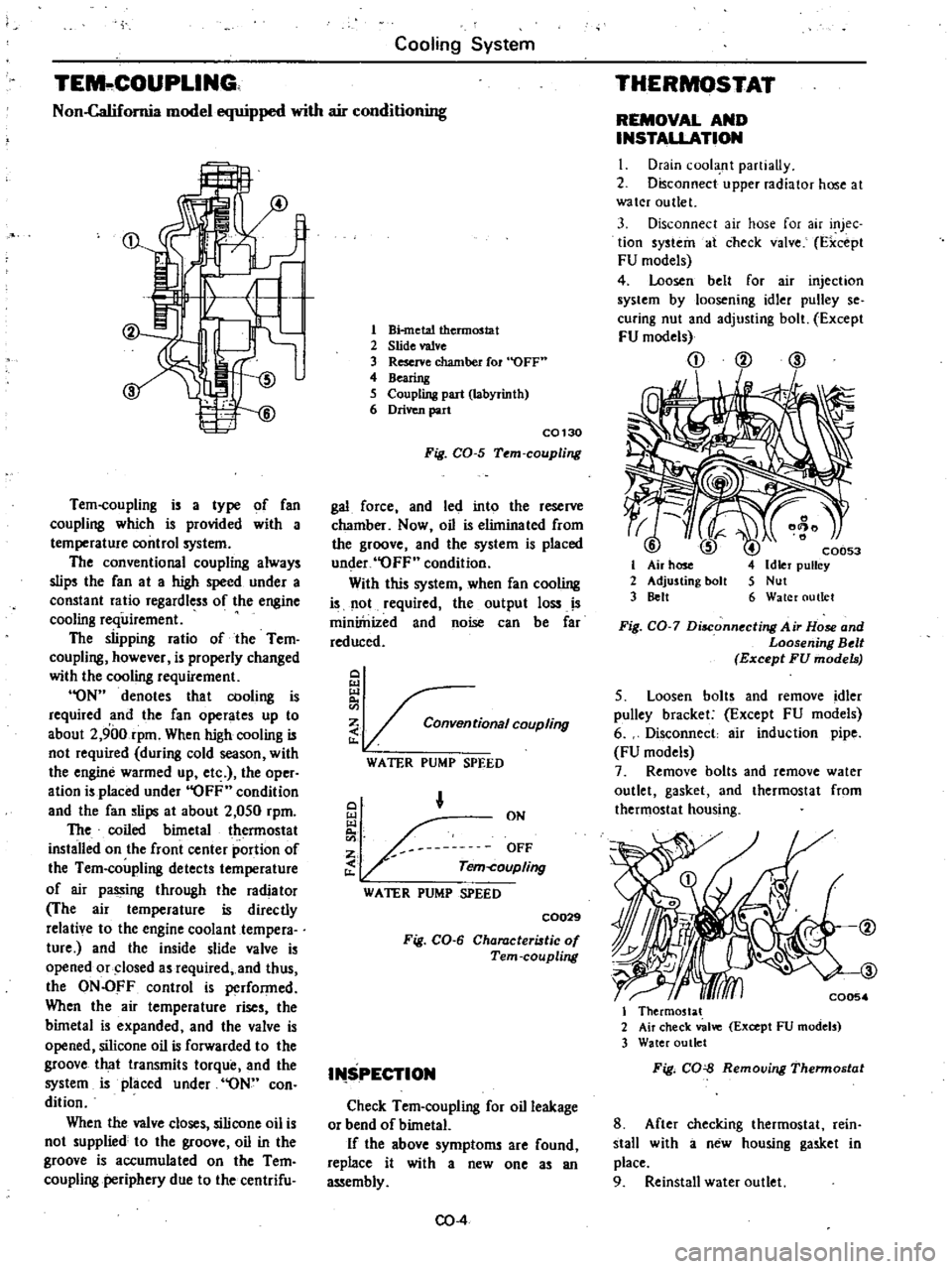
TEM
COUPLlNG
Non
Califomia
model
equipped
with
air
conditioning
Tem
coupling
is
a
type
of
fan
coupling
which
is
provided
with
a
temperature
control
system
The
conventional
coupling
always
slips
the
fan
at
a
high
speed
under
a
constant
ratio
regardless
of
the
engine
cooling
requirement
The
slipping
ratio
of
the
Tem
coupling
however
is
properly
changed
with
the
cooling
requirement
ON
denotes
that
cooling
is
required
and
the
fan
operates
up
to
about
2
900rpm
When
high
cooling
is
not
required
during
cold
season
with
the
engine
warmed
up
etc
the
oper
ation
is
placed
under
OFF
condition
and
the
fan
slips
at
about
2
050
rpm
The
coiled
bimetal
thermostat
installed
on
the
front
center
portion
of
the
Tem
coupling
detects
temperature
of
air
passing
through
the
radiator
The
air
temperature
is
directly
relative
to
the
engine
coolant
tempera
ture
and
the
inside
slide
valve
is
opened
or
closed
as
required
and
thus
the
ON
OFF
control
is
performed
When
the
air
temperature
rises
the
bimetal
is
expanded
and
the
valve
is
opened
silicone
oil
is
forwarded
to
the
groove
that
transmits
torque
and
the
system
is
placed
under
ON
con
dition
When
the
valve
closes
silicone
oil
is
not
supplied
to
the
groove
oil
in
the
groove
is
accumulated
on
the
Tem
coupling
periphery
due
to
the
centrifu
1
Bi
metal
thermostat
2
Slide
valve
3
Reserve
chamber
fOl
OFF
4
Bearing
5
Coupling
part
labyrinth
6
Driven
part
C0130
Fig
CO
5
Tem
coupling
gal
force
and
led
into
the
reserve
chamber
Now
oil
is
eliminated
from
the
groove
and
the
system
is
placed
under
OFF
condition
With
this
system
when
fan
cooling
is
not
required
the
output
loss
IS
miniinized
and
noise
can
be
far
reduced
Q
i
tionalCOUPling
WATER
PUMP
SPEED
Q
ON
OFF
Tem
coupling
WATER
PUMP
SPEED
C0029
Fig
CO
6
Characteristic
of
Tern
coupling
I
SPECTION
Check
Tem
coupling
for
oil
leakage
or
bend
of
bimetaL
If
the
above
symptoms
are
found
replace
it
with
a
new
one
as
an
assembly
CO
4
THERMOSTAT
REMOVAL
AND
INSTALLATION
I
Drain
cool
nt
partiaUy
2
Disconnect
upper
radiator
hose
at
water
outlet
3
Disconnect
air
hose
for
air
injec
tion
systein
at
check
valve
Fxcept
FU
models
4
Loosen
belt
for
air
injechon
system
by
loosening
idler
pulley
se
curing
nut
and
adjusting
bolt
Except
FU
models
CD
@
ID
I
2
3
C0053
Idler
pulley
Nut
Water
outlet
Fig
CO
7
Disconnecting
Air
Hose
and
Loosening
Belt
Except
FU
models
5
Loosen
bolts
and
remove
idler
pulley
bracket
Except
FU
models
6
Disconnect
air
induction
pipe
FU
models
7
Remove
bolts
and
remove
water
outlet
gasket
and
thermostat
from
thermostat
housing
I
Thermostat
2
Air
check
valve
Except
FU
models
3
Water
outlet
Fig
CO
Removing
Thennostat
8
After
checking
thermostat
rein
stall
with
a
new
housing
gasket
in
place
9
Reinstall
water
outlet