air condition DATSUN 210 1979 Owner's Manual
[x] Cancel search | Manufacturer: DATSUN, Model Year: 1979, Model line: 210, Model: DATSUN 210 1979Pages: 548, PDF Size: 28.66 MB
Page 85 of 548
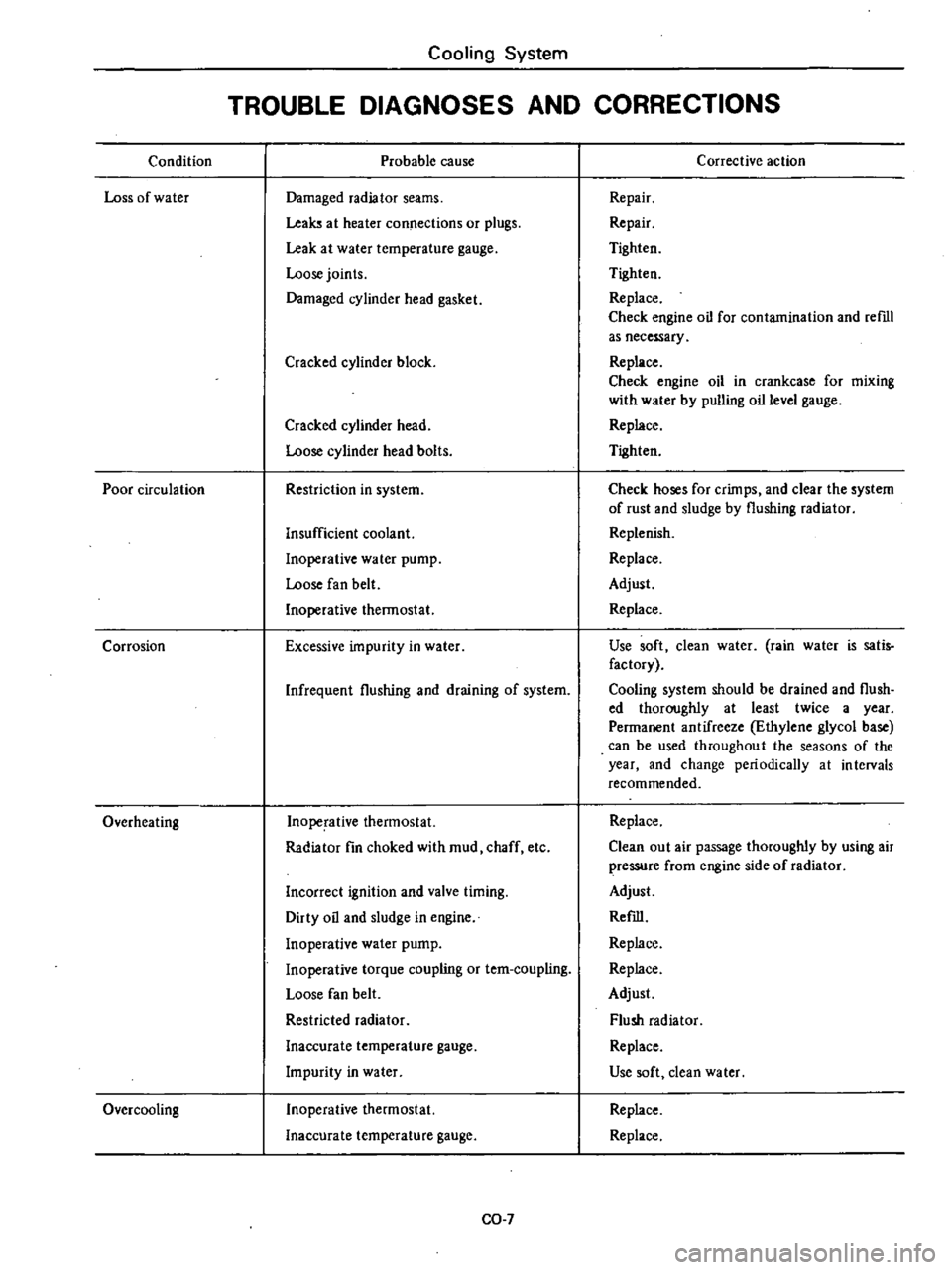
Condition
Loss
of
water
Poor
circulation
Corrosion
Overheating
Over
cooling
Cooling
System
TROUBLE
DIAGNOSES
AND
CORRECTIONS
Probable
cause
Damaged
radiator
seams
Leaks
at
heater
connections
or
plugs
Leak
at
water
temperature
gauge
Loose
joints
Damaged
cylinder
head
gasket
Cracked
cylinder
block
Cracked
cylinder
head
Loose
cylinder
head
bolts
Restriction
in
system
Insufficient
coolant
Inoperative
water
pump
Loose
fan
belt
Inoperative
thermostat
Excessive
impurity
in
water
Infrequent
flushing
and
draining
of
system
Inoperative
thermostat
Radiator
fin
choked
with
mud
chaff
etc
Incorrect
ignition
and
valve
timing
Dirty
oil
and
sludge
in
engine
Inoperative
water
pump
Inoperative
torque
coupling
or
tem
coupling
Loose
fan
belt
Restricted
radiator
Inaccurate
temperature
gauge
Impurity
in
water
Inoperative
thermostat
Inaccurate
temperature
gauge
CO
7
Corrective
action
Repair
Repair
Tighten
Tighten
Replace
Check
engine
oil
for
contamination
and
reml
as
necessary
Replace
Check
engine
oil
in
crankcase
for
mixing
with
water
by
pulling
oil
level
gauge
Replace
Tighten
Check
hoses
for
crimps
and
clear
the
system
of
rust
and
sludge
by
flushing
radiator
Replenish
Replace
Adjust
Replace
Use
soft
clean
water
rain
water
is
satis
factory
Cooling
system
should
be
drained
and
flush
ed
thoroughly
at
least
twice
a
year
Permanent
antifreeze
Ethylene
glycol
base
can
be
used
throughout
the
seasons
of
the
year
and
change
periodically
at
intervals
recommended
Replace
Clean
out
air
passage
thoroughly
by
using
air
pressure
from
engine
side
of
radiator
Adjust
Refill
Replace
Replace
Adjust
Flush
radiator
Replace
Use
soft
dean
water
Replace
Replace
Page 87 of 548
Engine
Fuel
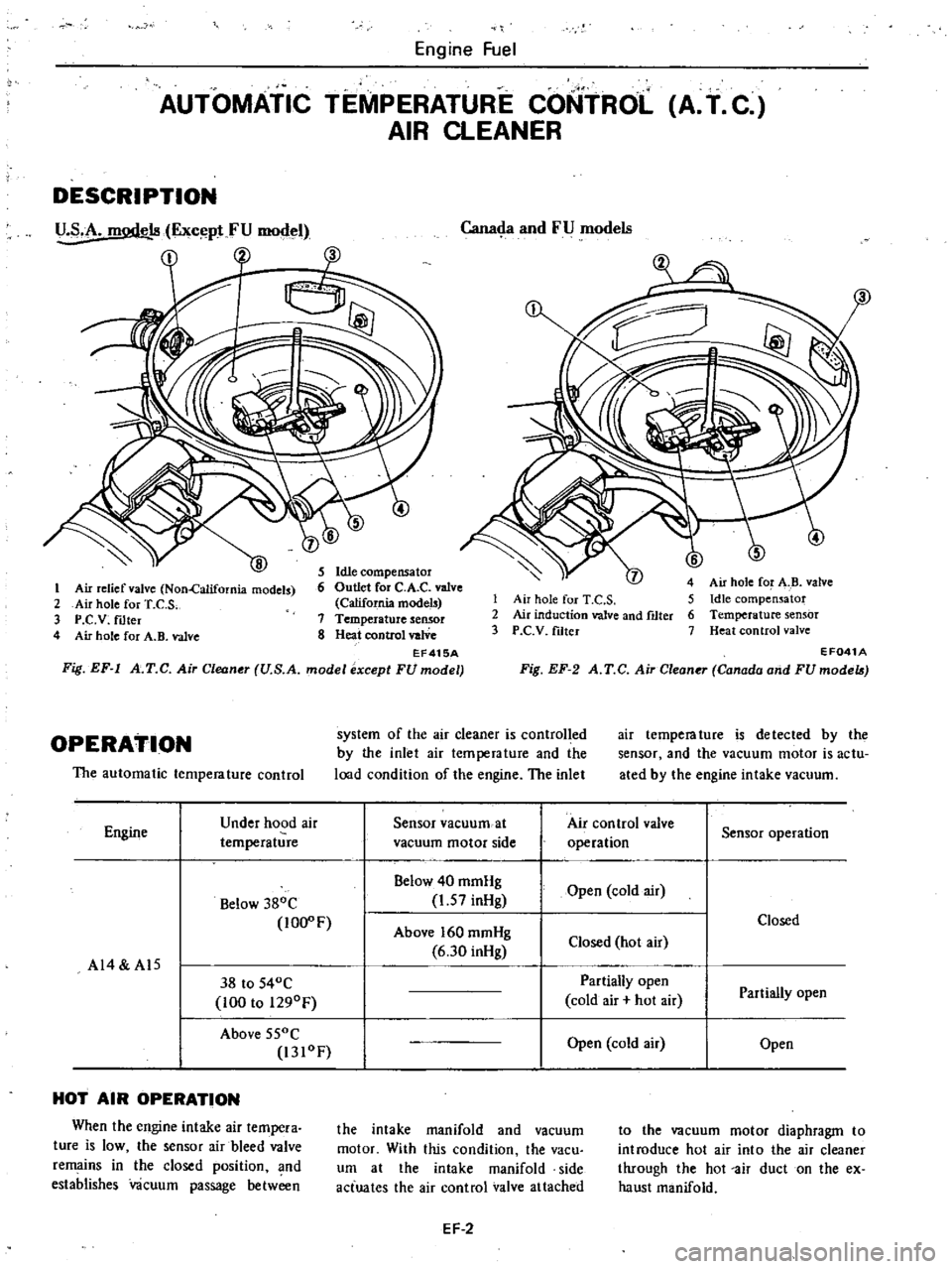
AUTOMATIC
TEMPERATURE
COtirROL
A
T
C
AIR
CLEANER
DESCRIPTION
U
S
A
mode
18
ExC
FU
model
I
C1J
Cana
ia
and
FU
models
I
Air
relief
valve
Non
alifornia
models
2
Air
hole
for
T
C
S
3
P
C
V
mter
4
Air
hole
for
A
B
valve
5
Idle
compensator
6
Outlet
for
C
A
C
valve
California
model
7
Temperature
seIl50r
8
Heat
control
valVe
EF415A
Fig
EF
l
A
T
C
Air
Cleaner
U
S
A
model
except
FU
model
8
3
1
Air
hole
for
T
C
S
2
Air
induction
valve
and
ftIter
3
P
C
V
mtet
Air
hole
for
A
B
valve
Idle
compen
ator
Temperature
sensor
Heat
control
valve
EF041A
Fig
EF
2
A
T
C
Air
Cleaner
Canado
ond
FUmodel
The
automatic
temperature
control
system
of
the
air
cleaner
is
control
ed
by
the
inlet
air
temperature
and
the
load
condition
of
the
engine
The
inlet
air
temperature
is
detected
by
th
sensor
and
the
vacuum
motor
is
actu
ated
by
the
engine
intake
vacuum
OPERATION
Engine
Under
hood
air
temperature
Sensor
vacuum
at
vacuum
motor
side
Air
con
trol
valve
operation
Sensor
operation
Below
380e
IOO
F
Below
40
mmHg
1
57
inHg
Open
cold
air
AI4
A15
Above
160
mmHg
6
30
inHg
Closed
Closed
hot
air
38
to
S40C
100
to
l290F
Partially
open
cold
air
hot
air
Partially
open
Above
550e
1310F
Open
cold
air
Open
HOT
AIR
OPERATION
When
the
engine
intake
air
tempera
ture
is
low
the
sensor
air
bleed
valve
remains
in
the
closed
position
and
establishes
vacuum
passage
betw
n
the
intake
manifold
and
vacuum
motor
With
this
condition
the
vacu
um
at
the
intake
manifold
side
actuates
the
air
control
valve
attached
to
the
vacuum
motor
diaphragm
to
introduce
hot
air
into
the
air
cleaner
through
the
hot
air
duct
on
the
ex
haust
manifold
EF
2
Page 89 of 548
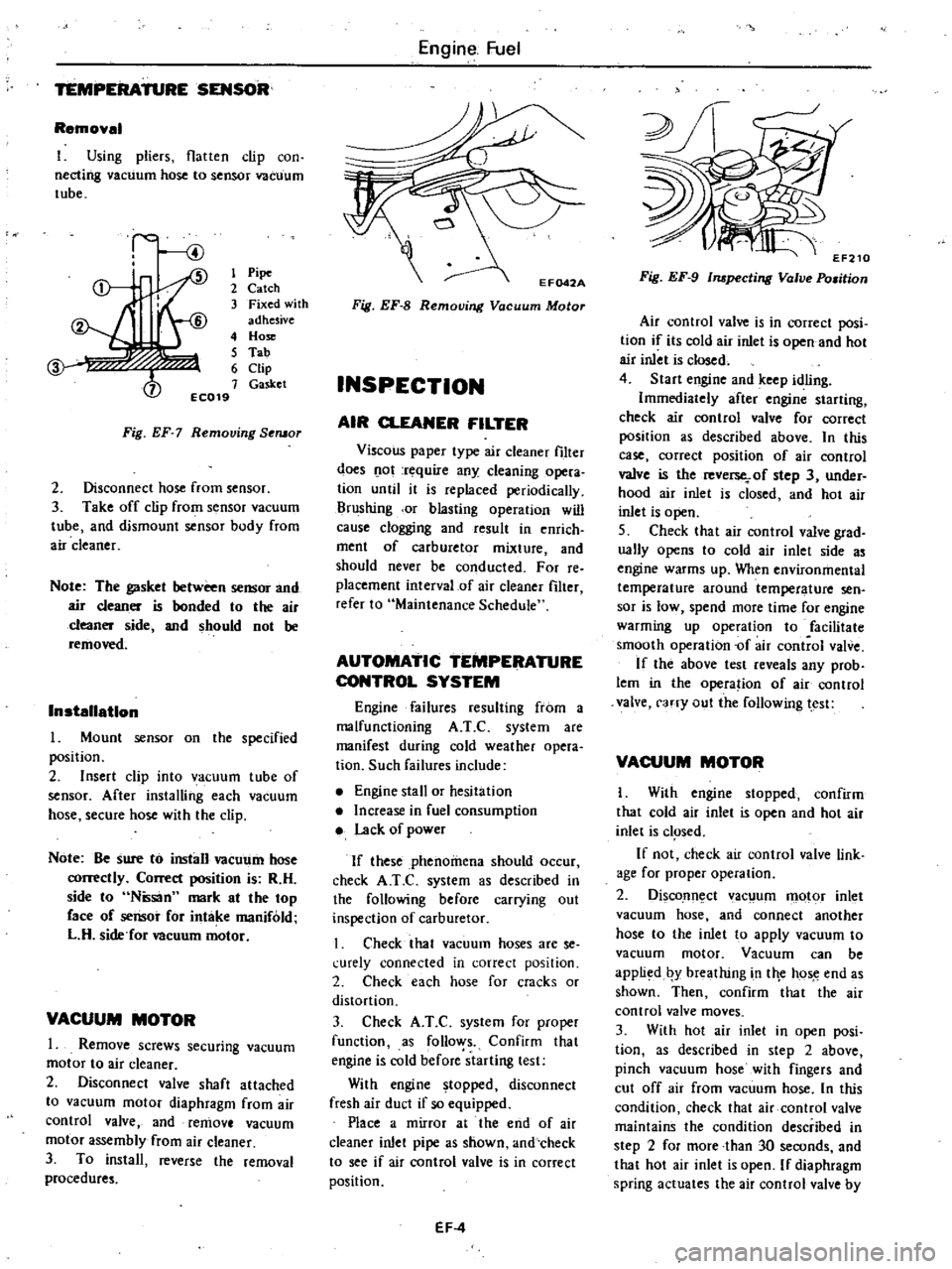
TEMPERATURE
SENSOR
Removal
I
Using
pliers
flatten
clip
con
necting
vacuum
hose
to
sensor
vacuum
tube
1
Pipe
2
Catch
3
Fixed
with
adhesive
4
Hose
5
Tab
6
Clip
7
Gasket
EC019
Fig
EF
7
Removing
Seruor
2
Disconnect
hose
from
sensor
3
Take
off
clip
from
sensor
vacuum
tube
and
dismount
sensor
body
from
air
cleaner
Note
The
gasket
between
sensor
and
air
cleaner
is
bonded
to
the
air
cleaner
side
and
should
not
be
removed
Installation
Mount
sensor
on
the
specified
position
2
Insert
clip
into
vacuum
tube
of
sensor
After
installing
each
vacuum
hose
secure
hose
with
the
clip
Note
Be
sure
to
install
vacUl
11n
hose
correctly
Correct
position
is
R
H
side
to
Ntisan
mark
at
the
top
face
of
sensor
for
intake
manifold
L
H
side
for
Deuum
motor
VACUUM
MOTOR
1
Remove
screws
securing
vacuum
motor
to
air
cleaner
2
Disconnect
valve
shaft
attached
to
vacuum
motor
diaphragm
from
air
control
valve
and
remove
vacuum
motor
assembly
from
air
cleaner
3
To
install
reverse
the
removal
procedures
Engine
Fuel
Fig
EF
8
Removing
Vacuum
Motor
INSPECTION
AIR
CLEANER
FILTER
Viscous
paper
type
air
cleaner
filter
does
o
ot
rt
quire
any
cleaning
opera
tion
until
it
is
replaced
periodically
Brushing
or
blasting
operation
will
cause
clogging
and
result
in
enrich
ment
of
carburetor
mixture
and
should
never
be
conducted
For
reo
placement
interval
of
air
cleaner
filter
refer
to
Maintenance
Schedule
AUTOMATIC
TEMPERATURE
CONTROL
SYSTEM
Engine
failures
resulting
from
a
malfunctioning
A
T
C
system
are
manifest
during
cold
weather
opera
tion
Such
failures
include
Engine
stall
or
hesitation
Increase
in
fuel
consumption
Lack
of
power
If
these
phenomena
should
occur
check
A
T
e
system
as
described
in
the
following
before
carrying
out
inspection
of
carburetor
I
Check
that
vacuum
hoses
are
se
l
urely
connected
in
correct
position
2
Check
each
hose
for
cracks
or
distortion
3
Check
A
T
C
system
for
proper
function
as
follo
ys
Confirm
that
engine
is
cold
before
starting
test
With
engine
topped
disconnect
fresh
air
duct
if
so
equipped
Place
a
mirror
at
the
end
of
air
cleaner
inlet
pipe
as
shown
and
check
to
see
if
air
control
valve
is
in
correct
position
EF
4
Fig
EF
9
Inspecting
Valve
Po
man
Air
control
valve
is
in
correct
posi
tion
if
its
cold
air
inlet
is
open
and
hot
air
inlet
is
closed
4
Start
engine
and
keep
idling
Immediately
after
engine
starting
check
air
control
valve
for
correct
position
as
described
above
In
this
case
correct
position
of
air
control
valve
is
the
reverse
of
step
3
under
hood
air
inlet
is
closed
and
hot
air
inlet
is
open
S
Check
that
air
control
valve
grad
ually
opens
to
cold
air
inlet
side
as
engine
warms
up
When
environmental
temperature
around
temperature
sen
sor
is
low
spend
more
time
for
engine
warming
up
operation
to
facilitate
smooth
operation
of
air
control
valve
If
the
above
test
reveals
any
prob
lem
in
the
opera
ion
of
air
control
valve
carry
out
the
following
test
VACUUM
MOTOR
I
With
engine
stopped
confirm
that
cold
air
inlet
is
open
and
hot
air
inlet
is
c1
Sed
If
not
check
air
control
valve
link
age
for
proper
operation
2
DiscoJln
ct
ac
um
motor
inlet
vacuum
hose
and
connect
another
hose
to
the
inlet
to
apply
vacuum
to
vacuum
motor
Vacuum
can
be
appli
d
by
breathing
in
tile
hos
e
end
as
shown
Then
confirm
that
the
air
control
valve
moves
3
With
hot
air
inlet
in
open
posi
tion
as
described
in
step
2
above
pinch
vacuum
hose
with
fingers
and
cut
off
air
from
vacuum
hose
In
this
condition
check
that
air
control
valve
maintains
the
condition
described
in
step
2
for
more
than
30
seconds
and
that
hot
air
inlet
is
open
If
diaphragm
spring
actuates
the
air
control
valve
by
Page 93 of 548
DESCRIPTION
The
carburetors
are
of
downdraft
two
barrel
type
designed
to
increase
ppwe
r
a
fu
l
eC
l
Il
Y
t
3
ell
a
to
reduce
exhaust
gas
emissions
These
carburetors
present
several
distinct
features
of
importance
to
car
owner
A
summary
of
features
is
as
fol
lows
1
Secondary
throttle
valve
is
oper
ated
by
throttle
lever
High
power
and
good
acceleration
are
gained
with
com
bination
of
the
auxiliary
valve
2
Accelerating
pump
provide
ex
cellent
acceleration
3
Power
valve
mechanism
is
a
vacuo
urn
actuated
boost
type
and
improves
high
speed
driving
4
The
throttle
opener
control
sys
tem
Except
FU
model
incorporates
a
servo
diaphragm
which
helps
open
the
throttle
valve
at
a
decreasing
speed
so
as
to
reduce
hydrocarbon
emissions
to
a
minimum
5
An
anti
d
eseling
solenoid
valve
is
installed
to
prevent
dieseling
When
ignition
key
is
turned
off
the
fuel
passage
involved
in
the
ow
system
is
closed
and
the
fuel
supply
is
shut
down
completely
The
solenoid
valve
also
serves
as
an
actuator
of
the
fuel
shut
off
system
on
the
FU
model
6
In
the
choke
mechanism
an
elec
trie
automatic
choke
is
used
to
auto
maticaDy
control
chok
valve
opera
tion
during
engin
war
up
7
The
carburetor
comes
equipped
with
dash
pot
which
ensures
smooth
deceleration
without
engine
stall
under
aU
operating
conditions
STRUCTURE
AND
OPERATION
These
carburetors
consist
of
a
main
system
for
normal
running
a
slow
system
for
idling
and
an
accelerating
and
power
mechanisIll
Some
emission
control
devices
are
added
E
ngine
Fuel
CARBURETOR
I
J
1
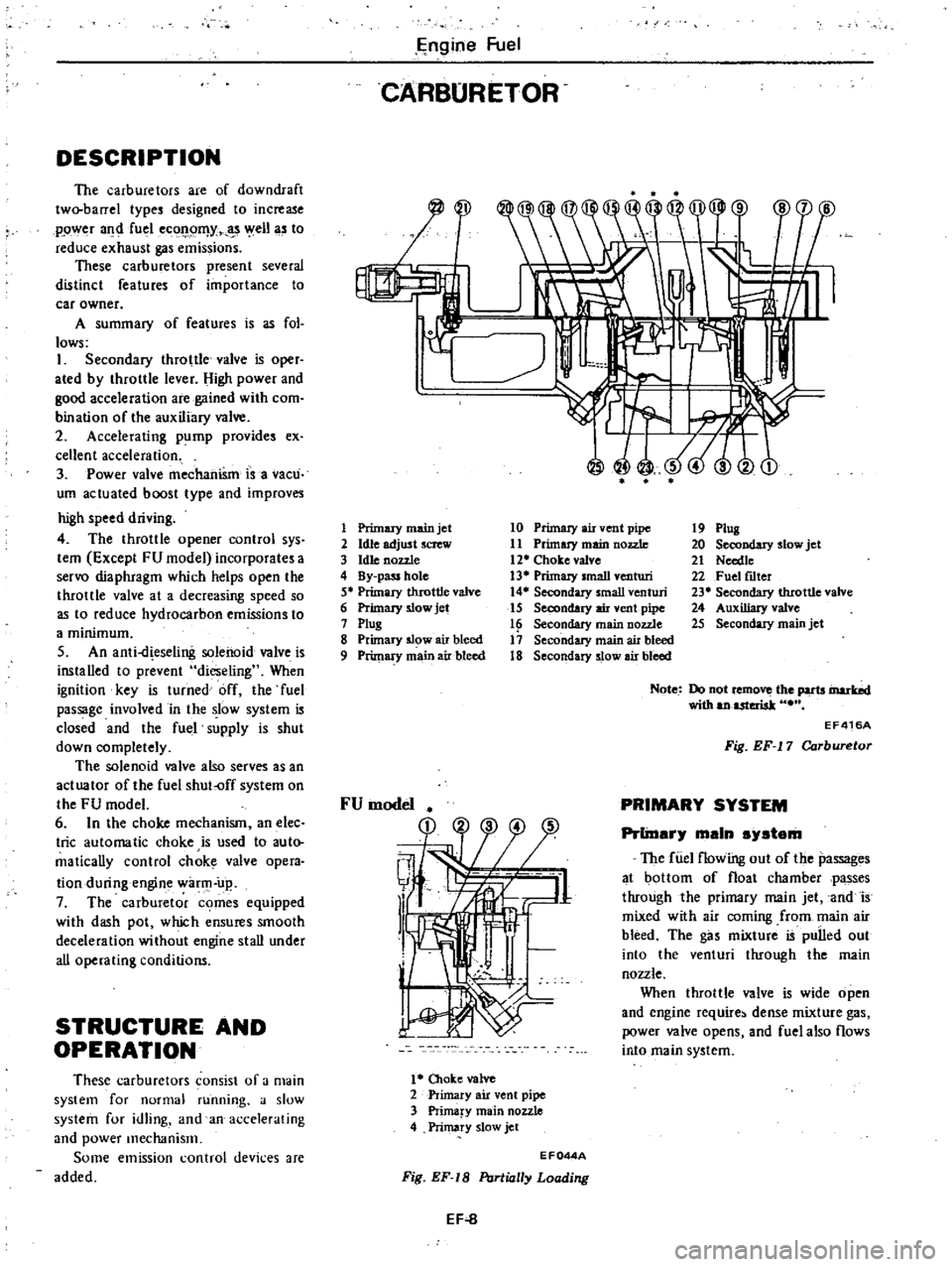
Primary
main
jet
2
Idle
adjust
screw
3
hUe
nozzle
4
By
pass
hole
5
Primary
throttle
valve
6
Primary
slow
jet
7
ptug
8
Primary
5l
w
air
bleed
9
Primary
main
air
bleed
10
Primary
air
vent
pipe
11
Primuy
main
nozzle
12
Choke
valve
13
Primary
small
venturi
14
Secondary
small
venturi
15
Secondary
air
vent
pipe
16
Secondary
main
nozzle
17
Secondary
main
air
bleed
18
Secondary
slow
air
bleed
1
Oloke
valve
2
Primary
air
vent
pipe
3
Prima
y
main
nozzle
4
Primary
slow
jet
19
Plug
20
Secondary
slow
jet
21
Needte
22
Fuel
fLlter
23
Secondary
tIuottle
valve
24
Auxiliary
valve
25
Secondary
main
jet
Note
Do
not
remo
the
parts
inarbd
with
anuteriak
EF416A
Fig
EF
17
Carburetor
PRIMARY
SYSTEM
PrlinarJ
main
sJstam
The
fUel
flowing
out
of
the
passages
at
bottom
of
float
chamber
passes
through
the
primary
main
jet
and
is
mixed
with
air
coming
from
main
air
bleed
The
gas
mixture
is
pulled
out
into
the
venturi
through
the
main
nozzle
When
throttle
valve
is
wide
open
and
engine
require
dense
mixture
gas
power
valve
opens
and
fuel
also
flows
into
main
system
EF044A
Fig
EF
18
PtJrlially
Loading
EF
8
Page 95 of 548
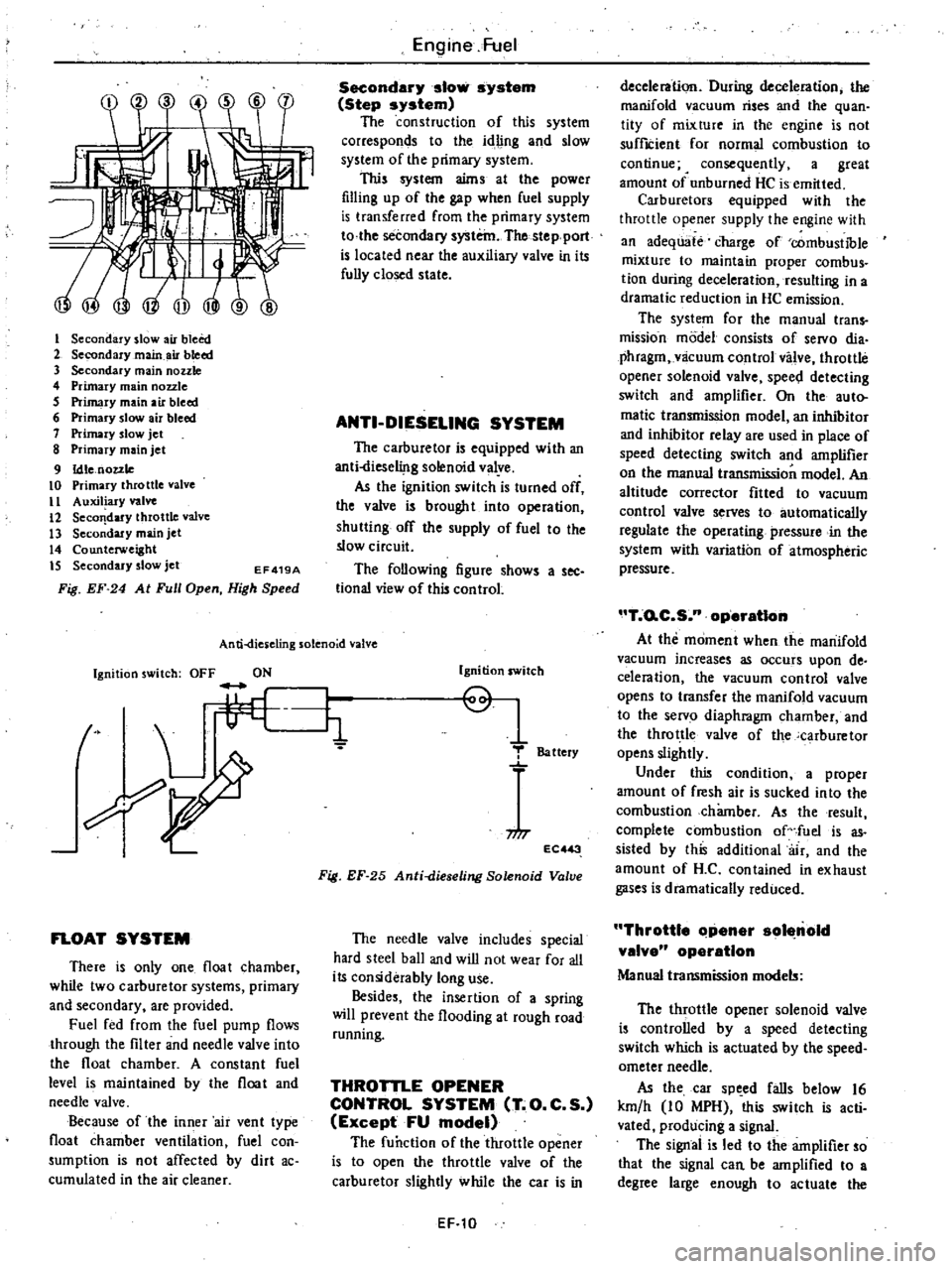
I
Secondary
slow
air
bleed
2
Secondary
main
air
bleed
3
Secondary
main
nozzle
4
Primary
main
nozzle
5
Primary
main
air
bleed
6
Primary
slow
air
bleed
7
Primary
slow
jet
8
Primary
main
jet
9
Idle
nozzle
10
Primary
throttle
valve
II
Auxiliary
valve
12
Seco
dary
throttle
valve
13
Secondary
main
jet
14
Counterweight
IS
Secondary
slow
jet
EF419A
Fig
EF
24
At
Full
Open
High
Speed
Engine
Fuel
Secondary
slow
system
Step
system
The
construction
of
this
system
corresponds
to
the
idling
and
slow
system
of
the
primary
system
This
system
aims
at
the
power
filling
up
of
the
gap
when
fuel
supply
is
transferred
from
the
primary
system
to
the
secondary
system
The
stepport
is
located
near
the
auxiliary
valve
in
its
fully
closed
state
ANTI
DIESELING
SYSTEM
The
carburetor
is
equipped
with
an
anti
liese1i
lg
solenoid
valye
As
the
ignition
switch
is
turned
off
the
valve
is
brought
into
operation
shutting
off
the
supply
of
fuel
to
the
slow
circuit
The
following
figure
shows
a
see
tional
view
of
this
control
An
ti
dies
eling
solenoid
valve
Ignition
switch
OFF
ON
t
L
li
FLOAT
SYSTEM
There
is
only
one
float
chamber
while
two
carburetor
systems
primary
and
secondary
are
provided
Fuel
fed
from
the
fuel
pump
flows
through
the
filter
and
needle
valve
into
the
float
chamber
A
constant
fuel
level
is
maintained
by
the
float
and
needle
valve
Because
of
the
inner
air
vent
type
float
chamber
ventilation
fuel
con
sumption
is
not
affected
by
dirt
ac
cumulated
in
the
air
cleaner
Ignition
switch
Q
1
T
Battery
niT
EC
3
Fig
EF
25
Anti
dieseling
Solenoid
Valve
The
needle
valve
includes
special
hard
steel
ball
and
wiD
not
wear
for
all
its
considerably
long
use
Besides
the
insertion
of
a
spring
will
prevent
the
flooding
at
rough
road
running
THROTTLE
OPENER
CONTROL
SYSTEM
T
O
C
S
Except
FU
model
The
function
of
the
throttle
opener
is
to
open
the
throttle
valve
of
the
carburetor
slightly
while
the
car
is
in
EF
10
deceleration
During
deceleration
the
manifold
vacuum
rises
and
the
quan
tity
of
mixture
in
the
engine
is
not
suffICient
for
normal
combustion
to
continue
4
consequently
a
great
amount
of
unburned
HC
is
emitted
Carburetors
equipped
with
the
throttle
opener
supply
the
engine
with
an
adequate
charge
of
combustible
mixture
to
maintain
proper
combus
tion
during
deceleration
resulting
in
a
dramatic
reduction
in
HC
emission
The
system
for
the
manual
trans
mission
model
consists
of
servo
dia
phragm
vlicuum
control
valve
throttle
opener
solenoid
valve
spee
l
detecting
switch
and
amplifier
On
the
auto
matic
transmission
model
an
inhibitor
and
inhibitor
relay
are
used
in
place
of
speed
detecting
switch
and
amplifier
on
the
manual
transmission
model
An
altitude
corrector
fitted
to
vacuum
control
valve
serves
to
automatically
regulate
the
operating
pressure
in
the
system
with
variation
of
atmospheric
pressure
T
o
C
S
n
operatIon
At
the
moment
when
the
manifold
vacuum
increases
as
occurs
upon
de
celeration
the
vacuum
control
valve
opens
to
transfer
the
manifold
vacuum
to
the
servo
diaphragm
chamber
and
the
throttle
valve
of
the
carburetor
opens
slightly
Under
this
condition
a
proper
amount
of
fresh
air
is
sucked
into
the
combustion
chamber
As
the
result
complete
combustion
of
fuel
is
as
sisted
by
this
additional
air
and
the
amount
of
H
C
contained
in
exhaust
gases
is
dramatically
reduced
Throttle
Clpener
sol
nold
valve
operation
Manual
transmission
models
The
throttle
opener
solenoid
valve
is
controlled
by
a
speed
detecting
switch
which
is
actuated
by
the
speed
ometer
needle
As
the
car
sp
ed
falls
below
16
km
h
10
MPH
this
switch
is
acti
vated
producing
a
signal
The
signal
is
led
to
the
amplifier
so
that
the
signal
can
be
amplified
to
a
degree
large
enough
to
actuate
the
Page 98 of 548
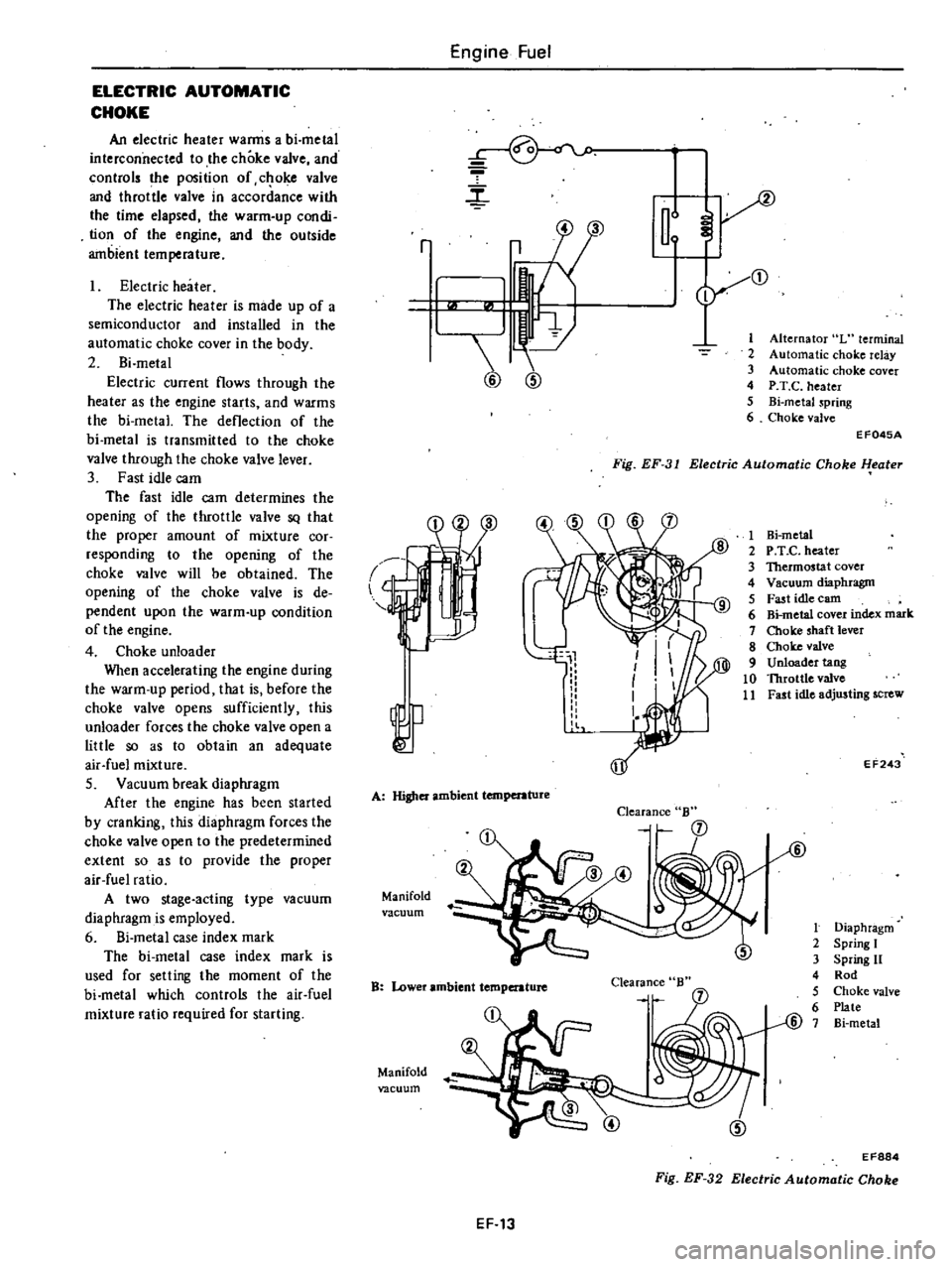
ELECTRIC
AUTOMATIC
CHOKE
An
electric
heater
warms
a
bi
metal
interconnected
to
the
choke
valve
and
controls
the
position
of
c
oke
valve
and
throttle
valve
in
accordance
with
the
time
elapsed
the
warm
up
condi
tion
of
the
engine
and
the
outside
ambient
temperature
Electric
heater
The
electric
heater
is
made
up
of
a
semiconductor
and
installed
in
the
automatic
choke
cover
in
the
body
2
Bi
metal
Electric
current
flows
through
the
heater
as
the
engine
starts
and
warms
the
bi
metal
The
deflection
of
the
bi
metal
is
transmitted
to
the
choke
valve
through
the
choke
valve
lever
3
Fast
idle
cam
The
fast
idle
cam
determines
the
opening
of
the
throttle
valve
SQ
that
the
proper
amount
of
mixture
cor
responding
to
the
opening
of
the
choke
valve
will
be
obtained
The
opening
of
the
choke
valve
is
de
pendent
upon
the
warm
up
condition
of
the
engine
4
Choke
unloader
When
accelerating
the
engine
during
the
warm
up
period
that
is
before
the
choke
valve
opens
sufficiently
this
unloader
forces
the
choke
valve
open
a
little
so
as
to
obtain
an
adequate
air
fuel
mixture
S
Vacuum
break
diaphragm
After
the
engine
has
been
started
by
cranking
this
diaphragm
forces
the
choke
valve
open
to
the
predetermined
extent
so
as
to
provide
the
proper
air
fuel
ratio
A
two
stage
acting
type
vacuum
diaphragm
is
employed
6
Si
metal
case
index
mark
The
bi
metal
case
index
mark
is
used
for
selling
the
moment
of
the
bi
metal
which
controls
the
air
fuel
mixture
ratio
required
for
starting
Engine
Fuel
r
m
2
3
4
5
6
r
3
1
@
@
Alternator
L
terminal
Automatic
choke
relay
Automatic
choke
cover
P
T
C
heater
Bi
metaJ
spring
Choke
valve
Fig
EF
31
Electric
Automatic
Choke
l
eater
EF045A
l
A
Higher
ambient
temperature
Manifold
vacuum
Clearance
B
B
Lower
ambient
temperature
Clearance
Manifold
vacuum
1
Hi
metal
2
P
T
e
heater
3
Thermostat
cover
4
Vacuum
diaphragm
5
Fast
idle
earn
6
Bi
metal
cover
index
mark
7
Choke
shaft
lever
8
Choke
valve
9
Unloader
tang
10
Throttle
valve
11
Fast
idle
adjusting
screw
EF243
t
Diaphragm
2
Spring
I
3
Spring
11
4
Rod
5
Choke
valve
6
Plate
@
7
Bi
metal
EF884
Fig
EF
32
Electric
Automatic
Choke
EF
13
Page 107 of 548
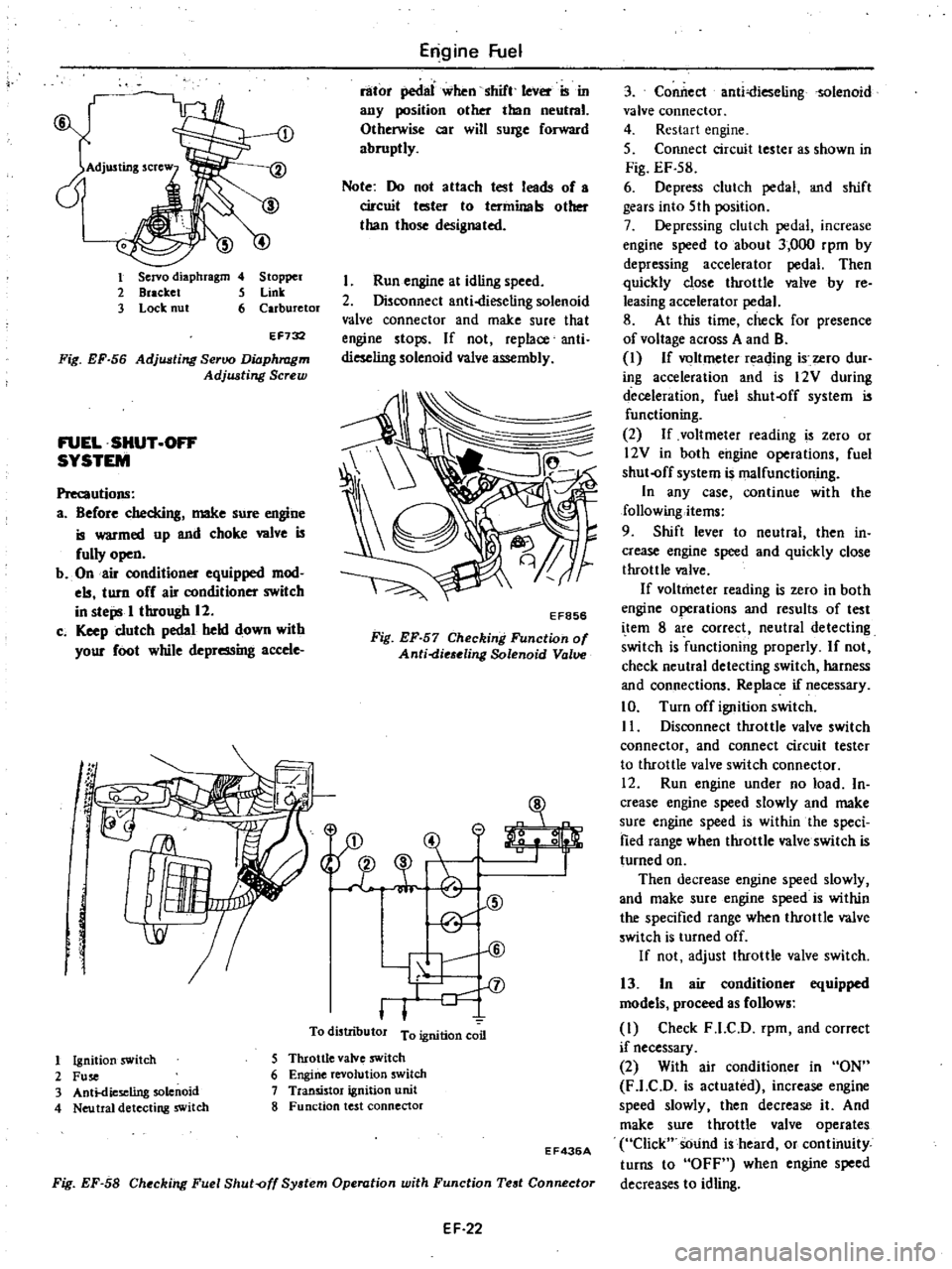
1
Servo
diaphragm
4
Stopper
2
Bracket
5
Link
3
Lock
nut
6
Carburetor
EF732
Fig
EF
56
Adjusting
Seroo
Diaphragm
Adjwting
Screw
FUEL
SHUT
OFF
SYSTEM
Precautions
a
Before
checking
make
sure
engine
is
warmed
up
and
choke
wive
is
fully
open
b
On
air
conditioner
equipped
mod
els
turn
off
air
conditioner
switch
in
steps
I
through
12
c
Keep
clutch
pedal
held
down
with
your
foot
while
depressing
accele
g
f
J
1
Engine
Fuel
rator
pedllI
when
shift
leVer
ISm
any
position
other
than
neutral
Otherwise
car
will
surge
forward
abruptly
Note
Do
not
attach
test
leads
of
a
circuit
tester
to
terminals
other
than
those
designated
Run
engine
at
idling
speed
2
Disconnect
anti
dieseling
solenoid
valve
connector
and
make
sure
that
engine
stops
If
not
replace
anti
dieseling
solenoid
valve
assembly
EF856
Fig
EF
57
Checking
Function
of
Anti
die
eling
Solenoid
Valve
31
A
t
CID
@
V
II
l
To
distributor
T
n
l1on
coon
o
1
Ignition
switch
2
Fuse
3
Anti
dieseling
solenoid
4
Neu
tral
detecting
switch
5
Throttle
valve
swltch
6
Engine
revolution
switch
7
Transistor
ignition
unit
8
Function
test
connector
Fig
EF
58
Checking
Fuel
Shut
off
System
Operation
with
Function
Test
Connector
EF436A
EF
22
3
Conilect
anti
ieselingsolenoid
valve
connector
4
Restart
engine
5
Connect
circuit
tester
as
shown
in
Fig
EF
S8
6
Depress
clutch
pedal
and
shift
gears
into
5th
position
7
Depressing
clutch
pedal
increase
engine
speed
to
about
3
000
rpm
by
depressing
accelerator
pedal
Then
quickly
close
throttle
wIve
by
re
leasing
accelerator
pedal
8
At
this
time
check
for
presence
of
voltage
across
A
and
B
I
If
voltmeter
reading
i
ero
dur
ing
acceleration
and
is
12V
during
deceleration
fuel
shut
off
system
is
functioning
2
If
voltmeter
reading
is
zero
or
l2V
in
both
engine
operations
fuel
shut
off
system
is
malfunctioning
In
any
case
continue
with
the
following
items
9
Shift
lever
to
neutral
then
in
crease
engine
speed
and
quickly
close
throttle
valve
If
voltmeter
reading
is
zero
in
both
engine
operations
and
results
of
test
i
tern
8
are
correct
neutral
detecting
switch
is
functioning
properly
If
not
check
neutral
detecting
switch
harness
and
connections
Replace
if
necessary
10
Turn
off
ignition
switch
II
Disconnect
throttle
valve
switch
connector
and
connect
circuit
tester
to
throttle
valve
switch
connector
12
Run
engine
under
no
load
In
crease
engine
speed
slowly
and
make
sure
engine
speed
is
within
the
speci
fied
range
when
throttle
valve
switch
is
turned
on
Then
decrease
engine
speed
slowly
and
make
sure
engine
speed
is
within
the
specified
range
when
throttle
valve
switch
is
turned
off
If
not
adjust
throttle
valve
switch
13
In
air
conditioner
equipped
models
proceed
as
follows
I
Check
F
l
C
D
rpm
and
correct
if
necessary
2
With
air
conditioner
in
ON
F
l
C
D
is
actuated
increase
engine
speed
slowly
then
decrease
it
And
make
sure
throttle
valve
operates
Click
sOund
is
heard
or
continuity
turns
to
OFF
when
engine
speed
decreases
to
idling
Page 108 of 548

If
not
adjust
throttle
valve
switch
Fig
EF
59
Adjusting
Throttle
Valve
Switch
Eng
ine
Fuel
If
throttle
valve
switch
cannot
be
adjusted
to
specification
replace
Engine
operation
Throttle
valve
switch
continuity
Engine
speed
rpm
When
engine
speed
increases
OFF
ON
1
150
t200
When
engine
speed
decreases
ON
OFF
I
000
t
200
Inspecting
engine
revolution
switch
Note
Before
checking
the
engine
revolution
switch
make
sure
the
functions
of
other
components
are
correct
in
accordance
with
the
items
described
above
Disconnect
throttle
valve
switch
connector
2
Connect
circuit
tester
3
Run
engine
at
idling
speed
4
Depress
clutch
pedal
and
shift
gear
into
5th
position
5
Depressing
clutch
pedal
increase
engine
speed
slowly
Make
sure
engine
speed
is
within
the
specified
range
when
voltmeter
goes
from
OV
to
l2V
Then
decrease
engine
speed
slowly
and
make
sure
engine
speed
is
within
the
specified
range
when
voltmeter
goes
from
12V
to
OV
EF
23
MAJOR
SERVICE
OPERATION
The
perfectly
adjusted
carburetor
deliver
the
proper
fuel
and
air
ratios
at
aD
speeds
for
the
particular
engine
for
which
it
was
designed
By
com
pletely
disassembling
at
re
ular
inter
vals
which
will
allow
cleaning
of
all
parts
and
passages
the
carburetor
can
be
maintained
in
its
original
condition
and
will
continue
to
deliver
the
proper
ratios
To
maintain
accurate
carburetion
of
passages
and
discharge
holes
ex
treme
care
must
be
taken
in
cleaning
Use
only
carburetor
solvent
and
compressed
air
to
clean
all
passages
and
discharge
holes
Never
use
wire
or
other
pointed
instrument
to
clean
or
carburetor
calibration
will
be
affected
REMOVAL
Remove
carburetor
from
engine
taking
sufficient
care
to
the
following
Precautions
a
When
disconnecting
fuel
lines
do
not
spill
fuel
from
fuel
pipe
b
When
removing
carburetor
do
not
drop
any
nut
or
bolt
into
intake
manifold
c
Be
careful
not
to
bend
or
scr
tch
any
part
d
Link
system
of
carburetor
differ
between
models
for
U
S
A
and
Canada
For
details
see
Figure
EF
60
which
is
based
on
Canadian
models
Page 114 of 548
CLEANING
AND
INSPECTION
Dirt
gum
water
or
carbon
con
tamination
in
or
on
exterior
moving
parts
of
a
carburetor
are
often
respon
sible
for
unsatisfactory
performance
For
this
reason
efficient
carhuretion
depends
upon
careful
cleaning
and
inspection
while
servicing
Blow
all
passages
and
castings
with
compressed
air
and
blow
off
all
parts
until
dry
Note
Do
not
pass
drills
or
wires
through
calibrated
jets
or
passages
as
this
may
enlarge
orifice
and
seriously
affect
carburetor
calibra
tion
2
Check
all
parts
for
wear
If
wear
is
noted
damaged
parts
must
be
re
placed
Note
especially
the
following
I
Check
float
needle
and
seat
for
wear
If
wear
is
noted
assembly
must
be
replaced
2
Check
throttle
and
choke
shaft
bores
in
throttle
chamber
and
choke
chamber
for
wear
or
out
of
roundness
3
Inspect
idle
adjusting
needle
for
hurrs
or
ridges
Such
a
condition
re
quires
replacement
Engine
Fuel
3
Inspect
gaskets
to
see
if
they
appear
hard
or
brittle
or
if
edges
are
torn
or
distorted
If
any
such
condi
tion
is
noted
they
must
be
replaced
4
Check
filter
screen
for
dirt
or
lint
Clean
and
if
screen
is
distorted
or
remains
plugged
replace
5
Check
linkage
for
operating
condition
6
Inspect
operation
of
accelerating
pump
Pour
fuel
into
float
chamber
and
make
throttle
lever
operate
Check
condition
of
fuel
injection
from
the
accelerating
nome
7
Push
connecting
rod
of
dia
phragm
chamber
and
block
passage
of
vacuum
with
finger
When
connecting
rod
becomes
free
check
for
leakage
of
air
or
damage
to
diaphragm
Jets
Carburetor
performance
depend
on
jets
and
air
bleeds
That
is
why
these
components
must
be
fabricated
with
utmost
care
To
clean
them
use
cleaning
solvent
and
blow
air
on
them
Larger
inner
nwnbers
stamped
on
the
EF
29
jets
indicate
larger
diameters
Ac
cordingIy
main
and
slow
jets
with
larger
numbers
provide
richer
mixture
the
smaller
numbers
the
leaner
mix
ture
Conversely
the
main
and
slow
air
bleeds
through
which
air
to
passes
make
the
fuel
leaner
if
they
bear
larger
numbers
the
smaller
numbers
the
richer
fuel
Assembly
To
assemble
reverse
the
disassem
bly
procedure
taking
care
to
the
following
I
Thoroughly
wash
all
the
parts
before
assembling
2
Inspect
gaskets
to
see
if
they
appear
hard
or
brittle
or
if
edges
are
torn
or
distorted
If
any
of
such
undesirable
condi
tions
is
noted
they
must
be
replaced
3
Install
jet
and
air
bleed
having
the
Same
size
number
as
that
of
original
one
4
After
reassembling
carburetor
check
each
rotating
portion
or
sliding
portion
for
smooth
operation
Page 115 of 548

Engine
fuel
TROUBLE
DIAGNOSES
AND
CORRECTIONS
In
the
following
table
the
symp
toms
and
causes
of
carburetor
troubles
and
remedies
for
them
are
listed
to
facilitate
quick
repairs
There
are
various
causes
of
engine
malfunctions
It
sometimes
happens
that
a
carburetor
which
has
no
fault
appears
to
have
some
problems
when
Condition
Probable
cause
Overflow
Dirt
accumulated
on
needle
valve
Fuel
pump
pressure
too
high
Needle
valve
improperly
seated
Excessive
fuel
consumption
Fuel
overflow
Slow
jet
too
large
on
each
main
jet
Main
air
bleed
clogged
Choke
valve
does
not
open
fully
Outlet
valve
seat
of
accelerator
pump
improper
Unked
opening
of
secondary
throttle
valve
opens
ioo
early
Power
shortage
Mainjels
clogged
Every
throttle
valve
Joes
not
open
fully
Idling
adjustment
incorrect
Fuel
filter
clo
ll
ed
Vacuum
jet
clogged
Air
cleaner
clogged
Diaphragm
damaged
Power
valve
operating
improperly
Improper
idling
Slow
jet
clogged
Every
throttle
valve
does
not
close
Secondary
throttle
valve
operating
im
properly
Throttle
valve
shafts
wom
Packing
between
manifold
carburetor
faulty
Manifold
carburetor
tightening
improper
Fuel
overflow
T
O
C
S
adjustment
incorrect
Vacuum
control
solenoid
damaged
Stuck
dash
pot
EF
30
acfuaJIy
theelectric
syslem
i
at
fatilt
Therefore
whenever
the
engine
is
mal
functioning
the
electrical
system
should
be
checked
fust
before
adjust
ing
carburetor
Corrective
action
Clean
needle
valve
Repair
pump
Replace
See
above
item
Replace
Clean
Adjust
Lap
Adjust
Clean
Adjust
Repair
Repair
Clean
Clean
Replace
Adjust
Clean
Adjust
Overhaul
and
clean
Replace
Replace
packing
Correct
tightening
See
the
first
item
Adjust
Replace
Replace