check oil DATSUN 210 1979 Manual Online
[x] Cancel search | Manufacturer: DATSUN, Model Year: 1979, Model line: 210, Model: DATSUN 210 1979Pages: 548, PDF Size: 28.66 MB
Page 292 of 548
Place
the
vehicle
in
a
pit
and
by
sampling
the
lealeed
oil
deiermine
if
it
is
the
torque
converter
oil
The
torque
converter
oil
has
a
color
like
red
wine
so
it
is
easily
distinguished
from
engine
oil
or
gear
oil
Wipe
off
the
lealeing
oil
and
dust
and
detect
the
spot
of
ill
lell8e
nonflammable
organic
solvent
such
as
carbon
tetrachloride
for
wiping
Raise
the
oil
tcmperature
by
op
erating
the
engine
and
shift
the
lever
to
D
to
increase
the
oil
pressure
The
sp
Q
of
o
1
1I8
u
J1en
be
found
more
easily
Note
As
oil
leakage
from
the
breath
er
does
not
talee
place
except
when
running
at
high
peed
it
iSimpos
sible
to
ate
this
lealcage
with
vehicle
stationary
CHECKING
ENGINE
IDLING
REVOLunON
The
engine
idling
revolution
should
be
properly
adjusted
If
the
engine
revolution
is
too
low
the
e
gine
does
not
operate
smoothly
and
if
too
high
a
strong
shocle
or
creep
develops
when
changing
over
from
ON
to
Dn
or
R
CHECKING
AND
ADJUSTING
KICK
WN
SWITCH
AND
DOWNSH
FT
SOLENOID
When
the
Ieickdown
operation
is
not
made
properly
or
the
speed
chang
ingpoint
is
too
high
check
the
kick
down
switch
downshift
solenoid
and
wiring
between
them
When
the
igni
tion
Ieey
is
po
iti
ned
at
the
1st
stage
and
the
accelerator
pedal
is
depressed
deeply
the
switch
contact
hould
be
closed
and
the
solenoid
should
clicle
If
it
does
not
click
it
indicates
a
defect
Then
check
each
part
with
the
testing
inatrumen15
Auto
lT1atic
Transmissiqn
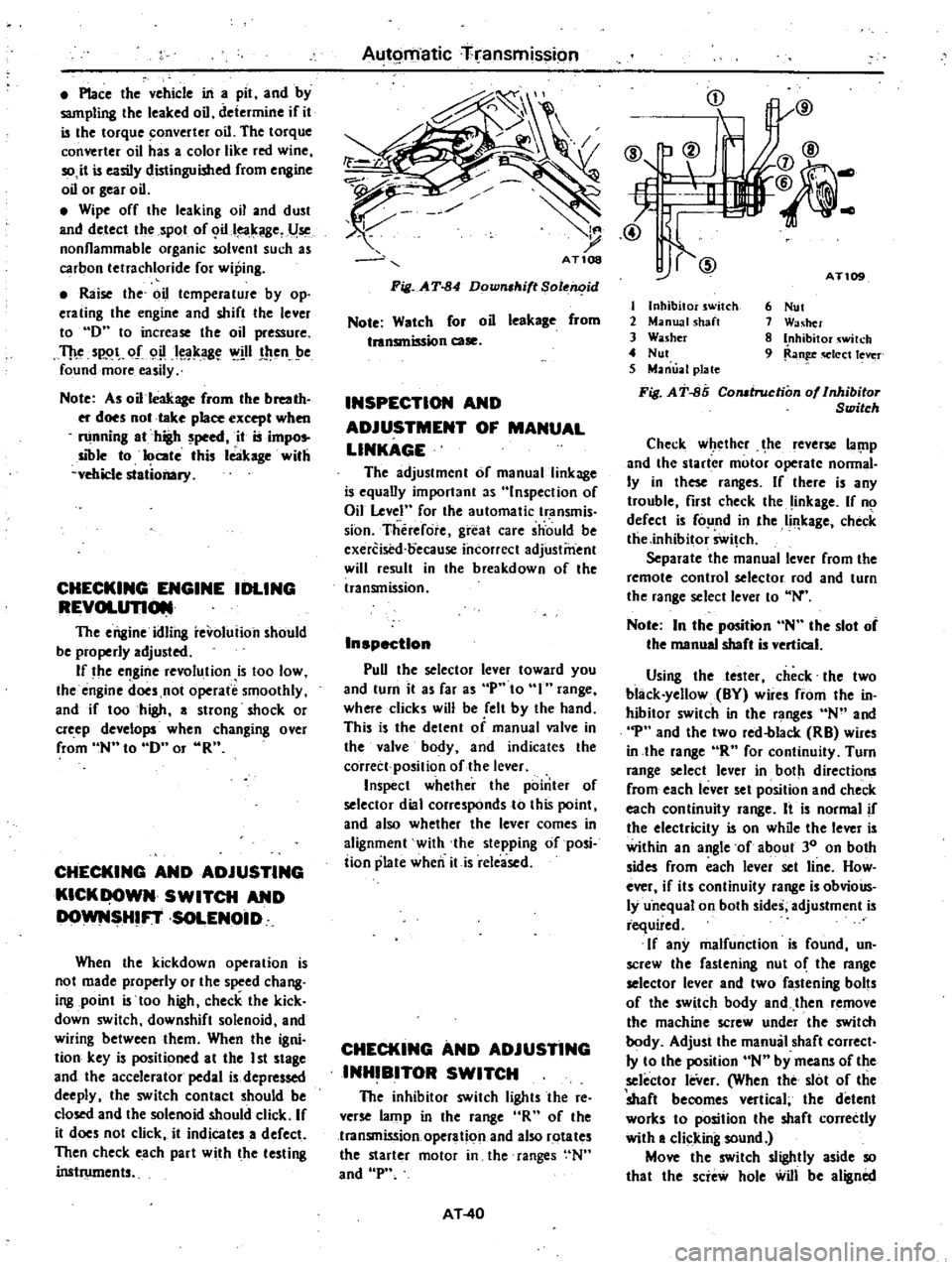
Fi
J
A
T
84
Down
ltift
Sole
id
Note
Watch
for
oil
leekage
from
tnnsmission
case
INSPECTION
AND
ADJUSTMENT
OF
MANUAL
LINKAGE
The
adjustmcnt
of
manual
linkage
i
equany
important
as
Inspection
of
Oil
Level
for
the
automatic
transmis
sion
Therefore
great
care
should
be
cxercised
oecause
incorrect
adjustment
will
result
in
the
breakdown
of
the
transmission
Inspection
pun
the
selector
lever
toward
you
and
turn
it
as
far
as
p
to
range
where
clicks
will
be
ell
by
the
hand
This
is
the
detent
of
manual
valve
in
the
valve
body
and
indicates
the
corrett
position
of
the
lever
Inspect
whether
the
pointer
of
selector
dial
corresponds
to
this
point
and
also
whether
the
lever
comes
in
alignment
with
the
stepping
of
posi
iion
plate
when
itis
released
CHECKING
AND
ADJUSTING
INHIBITOR
SWITCH
The
inhibitor
switch
lights
the
re
verse
lamp
in
the
range
R
of
the
transmission
operation
and
also
rotates
the
starter
motor
in
the
ranges
N
and
P
AT
40
i
j
tI
IlV
@
@
AT
I
Inhibitor
switch
2
Manual
shaft
3
Washer
4
Nut
5
Manual
plate
Fi
J
AT
85
Comtruction
of
Inhibitor
Switch
6
Nut
1
Washer
8
Inhibitor
wilch
9
Ran
q
Iect
lever
Check
w
ethcr
he
leverse
lal
1p
and
the
starter
motor
operate
nonnal
Iy
in
these
ranges
If
there
is
any
trouble
first
check
the
inkage
If
no
defect
is
fo
nd
in
the
Ii
leage
check
tlie
inhibitor
Swi
ch
Separate
the
manual
lever
from
the
remote
control
selector
rod
and
turn
the
range
select
lever
to
N
Note
In
the
position
N
the
slot
of
the
manual
shaft
is
vertical
Using
the
tester
check
the
two
black
yellow
BY
wire
from
the
in
hibitor
switch
in
the
ranges
N
and
p
and
the
two
red
blacle
RB
wires
in
the
lange
R
for
continuity
Turn
range
select
lever
in
both
directions
from
each
lever
set
position
and
check
each
continuity
range
It
is
normal
if
the
electricity
is
on
while
the
lever
is
within
an
angle
of
about
30
on
both
sides
from
each
lever
set
line
How
ever
if
its
continuity
range
is
obvioUs
ly
u
nequal
on
both
sides
adjustment
is
required
If
any
malfunction
is
found
un
screw
the
fastening
nut
o
the
range
selector
lever
and
two
fastening
bolts
of
the
switch
body
and
then
remove
the
machine
screw
under
the
switch
body
Adjust
the
manual
shaft
correct
Iy
to
the
position
N
by
means
of
the
selector
leVer
When
the
slot
of
the
shaft
becomes
vertical
the
detent
worles
to
position
the
shaft
correctly
with
a
clicking
sound
Move
the
switch
slightly
aside
so
that
the
scie
hole
will
be
aligned
Page 293 of 548
with
the
pin
hole
of
the
internal
rotor
combined
with
the
manual
shaft
and
check
their
alignment
by
inserting
a
1
5
mm
0
059
in
diameter
pin
into
the
holes
If
the
alignment
is
correct
fasten
the
switch
body
with
the
bolts
pull
out
the
pin
tighten
up
the
screw
in
the
hole
and
fasten
the
selector
lever
as
before
Check
the
continuity
pin
with
the
lesler
If
Ihe
malfunc
tion
still
remains
replace
the
inhibitor
switch
STALL
TEST
The
purpose
of
this
test
is
to
check
the
transmission
and
engine
for
trou
ble
by
measuring
the
maximum
num
bers
of
revoiutions
o
the
cngine
while
vehicle
is
held
in
a
stalled
condition
The
carburetor
is
in
fullthrollle
opera
tion
with
the
selector
lever
in
ranges
1
2
and
I
respectively
Com
pale
the
measured
results
with
the
standard
values
Components
to
be
tested
and
test
itelJUl
I
Clutches
brake
and
band
in
trans
mission
for
slipping
2
Torque
converter
for
proper
func
tioning
3
Engine
for
overall
properly
STAU
TEST
PROCEDURES
Before
testing
check
the
engine
oil
and
torque
converter
oil
warm
up
the
engine
cooling
w
ter
to
suitable
tem
perature
by
running
at
1
200
rpm
with
the
selector
lever
in
the
range
P
for
sevcral
minutes
Warm
up
the
torque
converter
oil
to
suitable
temperature
60
to
lOOoC
140
to
2120F
I
Mount
the
engine
tachometer
at
a
location
that
allows
good
visibility
from
the
driver
s
seat
and
put
a
mark
on
specified
revolutions
on
the
meter
2
Secure
the
front
and
rear
wheels
with
chocks
and
apply
the
hand
brake
Be
SIIre
to
depress
the
brake
pedal
firmly
with
the
left
foot
before
de
pressing
the
accelerator
pedal
3
Throw
the
selector
lever
into
the
range
11
4
Slowly
depress
the
accelerator
pedal
until
the
throttle
valvc
is
fully
Automatic
Transmission
opened
Quickly
read
and
record
the
engine
revolution
when
the
engine
begins
to
rotate
steadily
and
then
release
the
accelerator
pedal
5
Shift
the
selector
lever
to
N
and
operate
the
engine
at
approxi
mately
1
200
rpm
for
more
than
one
minute
to
cool
down
the
torque
con
verter
oil
and
coolant
6
Make
similar
staU
tests
in
ranges
2
I
and
R
CAUTION
The
dill
test
operstion
81
specified
in
i18m
4
should
be
I118de
within
fiv
lIeonds
If
it
tBkes
too
long
the
oil
If
and
the
cluti
hn
blllke
and
b
nd
elll
ly
I
Suf
ficient
cooling
time
should
be
given
r
eech
test
for
the
four
IlInges
0
Z
1
end
R
JUDGEMENT
High
stall
revolution
more
than
staitdard
revolution
If
the
engine
levolulion
in
stall
condi
ion
is
higher
than
the
standard
values
it
indicates
that
onc
or
more
clutches
in
the
transmission
are
slipping
and
therefore
no
further
test
is
required
For
the
following
abnormalities
the
respective
causes
are
presumed
High
rpm
in
all
ranges
low
line
pr
ssure
High
rpm
in
0
2
and
I
and
normal
rpm
in
6R
Rear
clutch
slipping
High
rpm
in
D
and
2
and
normal
rpm
in
One
way
clutch
slipping
High
Ipm
in
R
only
Front
clutch
or
low
and
reverse
brake
slipping
To
determine
which
is
slipping
front
clutch
or
low
and
reverse
brake
a
road
test
is
needed
If
while
coasting
after
starting
with
the
levcr
in
I
range
engine
braking
does
not
work
properly
the
low
and
reverse
brake
is
slipping
Otherwise
the
front
clutch
is
slipping
Slipping
of
the
band
brake
is
diffi
cuJt
to
ascertain
However
jf
it
occurs
with
the
lever
in
1
range
engine
AT
41
revolution
increases
up
to
the
same
level
as
in
1st
range
It
is
impossible
to
check
it
in
the
stall
test
2
Standard
stall
rnoluiion
If
the
engine
revoluiion
in
stall
ondition
is
within
he
standard
values
the
control
elements
are
nOf
mally
operating
in
the
ranges
D
2n
I
and
R
Also
the
engine
and
one
way
clutch
of
the
torque
converter
are
norinal
in
performance
and
operation
The
one
way
clutch
of
the
torque
converter
however
sometimes
sticks
This
is
determined
in
the
road
test
3
Lower
stall
revolution
than
lIand
ard
revolution
If
the
engine
revolution
in
stall
condition
is
lower
than
the
standard
values
it
indicates
that
the
engine
is
in
abnormal
condition
or
the
torque
con
verter
s
one
way
clutch
is
slipping
4
O
hers
I
If
the
accelerating
performance
is
poor
until
vehicle
speed
of
approxi
mately
SO
kmfh
30
MPH
is
attained
and
then
normal
beyond
that
speed
it
can
be
judged
that
the
torque
con
verte
c
s
one
way
clutch
is
slipping
2
If
the
torque
converter
sane
way
dutch
sticks
vehicle
speed
can
not
exceed
approximately
80
kmfh
SO
MPH
in
the
road
tesl
In
such
a
case
the
torque
converter
oil
tem
perature
rises
abnormally
and
so
special
care
is
required
3
If
the
transmission
does
not
op
erate
properly
at
all
vehicle
speeds
it
indicates
poor
engine
performance
ROAD
TEST
An
accurate
knowledge
of
the
au
to
matic
transmission
is
required
for
an
exact
diagnosis
II
is
recommended
that
a
diagnosis
guide
chart
with
the
standard
vehicle
speeds
for
each
stage
of
the
up
and
down
shiftings
be
prepared
Measured
vehicle
speeds
are
to
be
filled
in
the
adjoining
column
after
each
testing
Also
it
is
advisable
to
mount
a
stopper
for
positioning
the
throttle
opening
Page 295 of 548

CHECKING
SPEED
CHANGING
CONDITION
The
driver
s
feeling
during
gear
changes
should
also
be
checked
atten
lively
J
A
sharp
shock
or
unsrnoothness
is
felt
duting
a
gear
change
Tlus
indicates
that
the
throttle
pres
sure
is
too
high
or
some
valve
con
nected
to
the
throttle
is
faulty
2
A
gear
change
is
made
with
a
long
and
dragging
feeling
This
indicates
that
the
throttle
pres
sure
is
too
low
or
some
valve
con
nected
to
the
throttle
is
faulty
Automatic
Transmission
CHECKING
ITEMS
DURING
SPEED
CHANGE
I
In
D
range
gear
changes
DJ
D
D3
are
effected
In
R
range
the
speed
does
not
increase
2
The
kickdown
operates
properly
3
By
moving
the
lever
from
D
to
I
gearchangesD3
2
1
1
are
effected
In
the
ranges
j
and
I
the
engine
braking
works
prop
erly
4
In
I
the
speed
does
not
in
crease
S
Should
be
quickly
fixed
at
2
SHI
SCHEDULE
Non
Cellfornla
models
Sedan
end
Hetchbeck
1
2
1
l
2
I
I
2
L
3
1
1
1
0
E
I
Kickdown
range
I
T
7
87f
1
500
2
000
2
500
Output
shaft
speed
rpm
km
h
9
1P
29
30
4
0
50
6
0
70
80
MPH
6
1
0
io
30
40
5
0
California
models
All
models
and
Non
Callfornie
models
Wegon
0
E
c
E
3
00
11
81f
5
400
u
a
15
75
0
u
If
z
5
0
0
19
69
0
500
I
c
I
100
3
94
E
I
1
000
I
Kickdown
range
1
2
1
2
1
2
2
3
2
0
0
7
87
E
c
E
300
11
81
5
400
15
75
a
500
0
19
0
0
i
z
km
h
9
MPH
6
3
1
1
1
1
11
12
1
1
1
range
6
In
P
vehicle
can
be
parked
properly
If
any
malfunction
occurs
in
second
gear
during
the
road
test
thai
is
if
vehicle
shakes
drags
or
slings
while
shifting
up
from
D
directly
to
D3
or
in
shifting
up
from
D
to
D
the
braKe
band
should
be
ad
justed
If
these
troubles
remain
after
the
brake
band
is
adjusted
check
the
servo
piston
seal
for
oil
leakage
2
32
3
3
0
00
4
000
3
50
0
9
0
60
100
AT434
2
321
3
500
1
000
1
500
2
600
2
50
0
3
600
3
500
4
000
Output
shaft
speed
rpm
10
20
30
40
50
6
0
70
80
90
100
1
0
io
3
0
4
0
50
60
AT435
Fig
A
T
86
Shift
Schedule
AT
43
Page 296 of 548

LlNE
PRESSURE
TEST
When
any
slipping
occurs
in
clutch
or
brake
or
the
feeling
during
a
speed
change
is
not
correct
the
line
pressure
must
be
checked
Measuring
line
pressure
is
done
by
a
pressure
gatqle
attached
to
pressure
measuring
holea
after
removing
blind
pluga
locate
d
at
transmission
case
The
line
pressure
measurement
is
begun
at
idling
and
taken
step
by
step
by
enlarging
the
throttle
opening
Automatic
Transmission
For
line
pressure
data
when
shift
ing
gem
refer
to
Road
Test
1
A
sharp
shock
in
up
shifting
or
too
high
changing
speeds
are
caused
mostly
by
too
high
throttle
pressure
2
Slipping
or
incaPability
of
opera
tion
is
mostly
due
to
oil
pressure
leakage
within
the
gear
trains
or
spool
valve
LINE
PRESSURE
GOVERNOR
FEED
PRESSURE
Non
Cellfornill
models
Seden
and
Halchbeck
At
idling
Range
At
stall
test
R
Une
pressure
kg
em
psi
Range
3
0
to
5
5
43
to
7S
3
0
to
4
0
43
to
57
6
0
to
12
0
S5to
171
o
2
R
D
3
0
to
4
0
43
to
57
2
snSOSSOOI
CD
AT454
1
Line
pressure
2
Governorpressure
3
Servo
release
prenure
Fig
AT
87
Mecuuring
Line
Pre
Line
pressure
kg
cm2
psi
14
0
to
16
0
199
to
22S
94
to
11
0
134
to
156
10
0
to
12
0
142
to
171
94
to
11
0
134
to
156
At
idling
California
models
All
models
end
Non
Callfornill
modela
Wa
on
At
stall
test
R
Line
pressure
kg
cm
psi
Range
Range
R
o
4
2
to
5
6
60
to
SO
3
2
to
3
S
46
to
54
D
2
6
0
to
II
7
S5
to
166
2
3
2
to
3
S
46
to
54
AT44
Une
pressure
kg
cm2
psi
143
to
16
2
203
to
230
9
9
to
11
1
141
to
15S
10
2
to
II
7
145
to
166
9
9
to
11
1
14110
15S
Page 297 of 548

JUDGEMENT
IN
MEASURING
LINE
PRESSURE
Low
idling
line
pressure
in
the
ranges
D
2
R
and
P
This
can
be
attributed
to
trouble
in
the
pressure
supply
system
or
too
low
output
of
power
caused
by
I
A
worn
oil
pump
2
An
oil
pressure
leak
in
the
oil
pump
valve
body
or
case
3
A
sticking
regulator
valve
2
Low
idling
line
pressure
i
n
cer
tain
ranges
only
This
is
presumably
caused
by
an
oil
leak
in
the
devices
or
circuits
con
nected
to
the
relevant
ranges
I
When
there
is
an
oil
leaJi
in
the
rear
clutch
and
governor
the
line
pressure
in
on
2
and
I
are
low
but
the
pressure
i
nonnal
in
R
2
When
an
oil
leak
occurs
in
the
low
and
reverse
brake
circuit
the
line
pressure
in
oR
and
P
are
low
b
t
the
pressure
is
normal
in
0
2
and
I
3
High
idling
line
pressure
Thi
is
presumably
caused
by
an
increased
aC
1ulT
t
rott
e
pr
ssure
owing
to
a
leak
in
the
vacuum
tube
or
diaphragin
or
by
an
increased
line
Automatic
Transmission
pressure
due
to
a
sticking
regulator
valve
Vacuum
leakage
is
checked
by
directly
measuring
the
negative
pres
sure
after
removing
the
vacuum
pipe
A
puncture
of
the
vacuum
dia
phragm
can
be
easily
ascertained
because
the
torque
converter
oil
is
absorbed
into
the
engine
and
the
exhaust
pipe
emits
white
smoke
4
Item
to
be
checked
when
the
Ii
e
pressure
is
increasing
In
this
c
1eck
the
line
pressure
should
be
measured
with
vacuums
of
300
mmHg
Il
SI
inHg
and
0
mmHg
0
inHg
in
accordance
with
the
staIl
test
procedure
i
If
the
line
pressure
does
not
in
crease
despite
the
vacuum
decrease
check
whether
the
vacuum
rod
is
i
corporated
2
If
the
line
pressure
does
not
meet
tile
standard
iUs
caused
mostly
by
a
sticking
pressure
regulating
valve
pres
sure
regulating
valve
plug
or
amplifier
TROUBLE
SHOOTING
CHART
INSPECTING
ITEMS
I
Inspection
with
automatic
trans
mission
on
vehicle
AT
45
A
Oil
level
B
Range
select
linkage
C
Inhibitor
switch
and
wiring
D
Vacuum
diaphragm
and
piping
E
Downshift
solenoid
kickdown
switch
and
wiring
F
Engine
idling
rpm
G
Oil
pressure
throttle
H
Engine
stall
rpm
I
Rear
lubrication
J
Control
valve
manual
K
Governor
valve
L
Band
servo
M
Transmission
air
check
N
Oil
quality
o
Ignition
switch
and
starter
motor
P
Engine
adjustment
and
brake
in
spection
2
Inspection
after
inspecting
auto
matic
transmission
on
vehicle
m
Rear
clutch
n
Front
clutch
q
Band
brake
r
Low
and
reverse
brake
s
Oil
pump
t
Leakage
of
oil
passage
u
One
way
clutch
of
troque
converter
v
One
way
clutch
of
transmission
w
Front
clutch
check
ball
x
Parking
linkage
y
Planetary
gear
Page 301 of 548

Automatic
Transmission
TROUBLE
SHOOTING
GUIDE
FOR
3N71B
AUTOMATIC
TRANSMISSION
Ordel
Test
item
Checking
Oil
level
gauge
j
Downshift
solenoid
3
Manual
linkage
4
Inhibitor
switch
5
Engine
idling
rpm
6
Vacuum
pressure
of
vacuum
pipe
7
Operation
in
each
range
g
Creep
of
vehicle
Stall
test
1
Oil
pressure
before
t
sting
2
Stall
test
3
Oil
pressure
after
teSling
Road
test
L
Slow
acceleration
Ist
2nd
2nd
3rd
2
Quick
acceleration
Ist
2nd
2nd
3rd
3
Kick
down
operation
3rd
2nd
or
2nd
1st
Procedure
Check
gauge
for
oil
level
and
leakage
before
and
after
each
test
Check
for
sound
of
operating
solenoid
when
depressing
accelerator
pedal
fully
with
ignition
key
ON
Check
by
shifting
into
P
R
N
0
2
and
ranges
with
selector
lever
Check
whether
starter
operates
in
N
and
p
ranges
only
and
whether
reverse
lamp
operates
in
R
range
only
Check
whether
idling
rpm
meet
slandard
Check
whether
vacuum
pressure
is
more
than
450
mmHg
17
72
inHg
in
idling
and
whether
it
decreases
with
increasing
rpm
Check
whether
transmission
engages
positively
by
shifting
N
0
N
2
N
to
I
and
N
R
range
while
idling
with
brake
applied
Check
whether
there
is
any
creep
in
0
2
and
R
ranges
Measure
line
pressures
in
D
2
I
and
R
range
while
idling
Measure
engine
rpm
and
line
pressure
in
0
2
t
and
R
ranges
during
full
throttle
operation
Note
Temperature
of
torque
con
erter
oil
used
in
test
should
be
from
6
to
lOO
C
140
to
2120F
i
e
suf
ficiently
1
up
but
not
o
heeted
CAUTION
To
cool
oil
between
IIch
mil
test
for
OH
ZH
1
H
Ind
RH
nnges
idle
engine
i
e
rpm
It
Ibout
1
200
rpm
for
more
thin
1
minutll
in
P
nnge
MeeRlr
ment
time
mUlt
not
be
more
then
5
seconds
Same
as
item
1
Check
vehicle
speeds
and
engine
rpm
in
shifting
up
1
st
2nd
range
and
2nd
3rd
range
while
running
with
lever
in
D
range
and
engine
vacuum
pressure
of
about
200
mmHg
7
87
inHg
Same
as
item
1
above
except
with
engine
vacuum
pressure
of
o
mrnHg
0
inHg
i
e
in
position
just
before
kickdown
Check
whether
the
kickdown
operates
and
measure
the
time
delays
while
running
at
30
40
50
60
70
km
h
19
25
31
37
43
MPH
in
OJ
range
AT
49
Page 302 of 548

Oldel
Others
Automatic
Transmission
Test
item
4
Shift
down
Or
O
O
5
Shift
down
Or
I
1
6
Shift
down
0
2
7
Shift
up
1
1
8
Shift
up
or
down
when
start
ing
in
2
ranae
9
Parking
Abnormal
shock
oil
leakage
Procedure
Check
vehicle
speeds
and
engine
rpm
in
shifting
down
from
3rd
2nd
1st
sequentiaUy
while
coasting
with
accelerater
pedal
released
in
0
range
and
engine
vacuum
pressure
of
about
450
mmHg
17
72
inHg
Check
for
shifti
ng
do
n
I
I
nd
engine
blaking
and
further
for
shifting
down
I
I
and
engine
braking
tel
shifting
the
leyer
into
I
range
with
the
accelerator
pedal
released
and
the
engine
vacuum
pressure
of
0
mmHg
0
inHg
while
driving
at
about
50
km
h
30
MPH
in
0
range
Check
for
quick
shifting
down
OJ
2
and
engine
braking
after
shifting
the
lever
into
2
range
while
driving
at
about
50
km
h
30
MPH
in
0
range
Further
chec
for
locking
of
the
transmission
i
2nd
gear
ratio
regardless
of
vehicle
sPeed
Check
for
failure
of
the
transmission
to
shift
up
during
acceleration
when
starting
in
range
Check
the
transmission
for
not
shifting
up
or
down
during
acceleration
or
deceleration
when
starting
in
2
range
Confirm
that
yehicle
will
notmoye
on
grade
when
shifting
to
pn
range
Enter
into
record
conditions
observed
durq
these
lests
such
as
gear
noise
abnormal
clutch
noise
and
acceleration
performance
AT
50
Page 308 of 548

Rropeller
Shaft
Differential
Carrier
PROPELLER
SHAFT
INSPECTION
GENERAL
INSPECTION
I
Check
propeller
shaft
tube
sur
Cace
for
dents
or
cracks
If
damaged
replace
with
an
assembly
2
Check
journal
for
axial
play
If
there
is
play
replace
propeller
shaft
mbly
Note
JournaI
cannot
be
disassem
bled
PROPELLER
SHAFT
VIBRATION
To
check
and
correct
an
unbal
anced
propeller
shaCt
proceed
as
Col
lows
L
Remove
undercoating
and
other
foreign
material
which
could
upset
shaft
balance
and
check
shaft
vibra
tion
by
road
test
2
If
shaft
vibration
is
noted
during
road
test
disconnect
propeller
shaft
et
differential
carrier
companion
flange
rotate
companion
flange
180
degrees
and
reinstall
propeller
shaft
ff
3
Again
check
shaft
vibration
If
vibration
still
persists
replace
propel
ler
shaft
assembly
REMOVAL
AND
INSTALLATION
REMOVAL
I
Raise
car
on
hoist
Put
match
malks
both
on
propeller
shaft
and
companion
flange
so
that
shaft
can
be
reinstalled
in
its
original
position
2
Remove
bolts
connecting
pro
peller
shaft
to
companion
flange
PD459
Fig
PD
2
Removing
Propeller
Shaft
PD
2
Tightening
torque
kg
m
ft
b
@
2
410
3
3
1710
24
PD468
Fig
PD
l
PropellerSha
t
3
Draw
out
propeller
shall
sleeve
yoke
from
transmission
by
moving
shaft
realWard
passing
it
under
rear
axle
Plug
up
rear
end
of
rear
extension
housing
to
prevent
oil
leakage
Note
Remove
propeller
aheCt
care
Cully
so
as
not
to
demege
spline
sleeve
yoke
and
rear
oil
seal
INSTALLAnON
To
inS
aJI
reverse
the
foregoing
removal
prOCedure
CAUTION
Align
propeller
shift
with
com
penion
fllnge
of
differentiel
Clrrier
ulling
reference
marks
prl
1Cribed
in
Remova
procedure
and
tightsn
them
with
bolts
Failure
to
do
so
could
resuh
in
driving
vibration
fJ
Tightening
tOlquo
Propellol
sheft
to
companion
f1enge
bolts
2
4
to
3
3
kg
m
117
to
24
ft
b
Page 309 of 548
Propeller
Shaft
Differential
Carrier
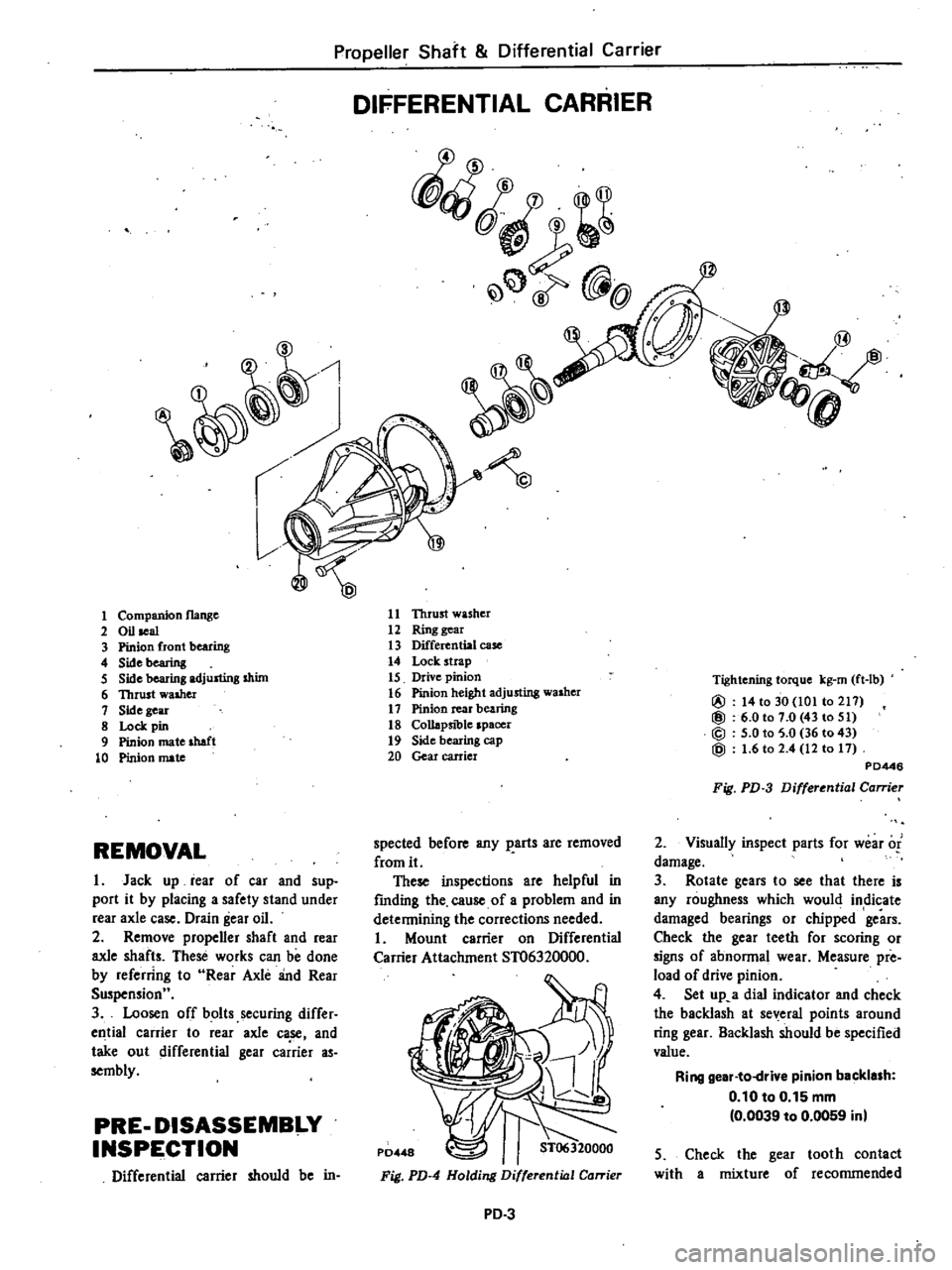
DIFFERENTIAL
CARRIER
fQ
@
1
11
Thrust
washer
12
Ring
gear
13
Differential
case
14
Lock
strap
15
Drive
pinion
16
Pinion
height
adjusting
washer
17
Pinion
rear
bearing
18
Collapsible
spacer
19
Side
bearing
cap
20
Gear
carrier
1
Companion
flange
2
Oil
seal
3
Pinion
front
bearing
4
Sidebearing
5
Side
bearing
adjusting
shim
6
Thrust
walher
1
Side
gear
8
Lock
pin
9
Pinion
mate
shaft
10
Pinion
mate
Tightening
torque
kg
rn
ft
lb
@
14
to
30
101
to
211
@
6
0101
0
43
to
51
@
5
0
to
5
0
36
to
43
@
1
6
to
2
4
12
to
11
PD446
Fig
PD
3
Differential
Carrier
2
Visuany
inspect
parts
for
wear
of
damage
3
Rotate
gears
to
see
that
there
is
any
roughness
which
would
indicate
damaged
bearings
or
chipped
gears
Check
the
gear
teeth
for
scoring
or
signs
of
abnonnal
wear
Measure
pre
load
of
drive
pinion
4
Set
up
a
dial
indicator
and
check
the
backlash
at
several
points
around
ring
gear
Backlash
should
be
specified
value
Ring
gear
to
drive
pinion
backlash
0
10
to
0
15
mm
0
0039
to
0
0059
inl
spected
before
any
parts
are
removed
from
it
These
inspections
are
helpful
in
fmding
the
cause
of
a
problem
and
in
detennining
the
corrections
needed
Mount
carrier
on
Differential
Carrier
Attachment
ST06320000
REMOVAL
I
Jack
up
rear
of
car
and
sup
port
it
by
placing
a
safety
stand
under
rear
axle
case
Drain
gear
oil
2
Remove
propener
shaft
and
rear
axle
shafts
These
works
can
be
done
by
referring
to
Rear
Axle
and
Rear
Suspensionu
3
Loosen
off
bolts
securing
differ
ell
tial
carrier
to
rear
axle
ca
se
and
take
out
differential
gear
carrier
as
sembly
PRE
DISASSEMBI
Y
INSPE
CTION
Differential
carrier
should
be
in
5
Check
the
gear
tooth
contact
with
a
mixture
of
recommended
Fig
PD
4
Holding
Differential
Carrier
PD
3
Page 310 of 548
I
powder
and
oil
applied
sp
hingly
to
all
ring
gear
teeth
For
the
tooth
contact
pattern
see
paragraph
dealing
with
tooth
contact
pattern
adjustl1ll
nt
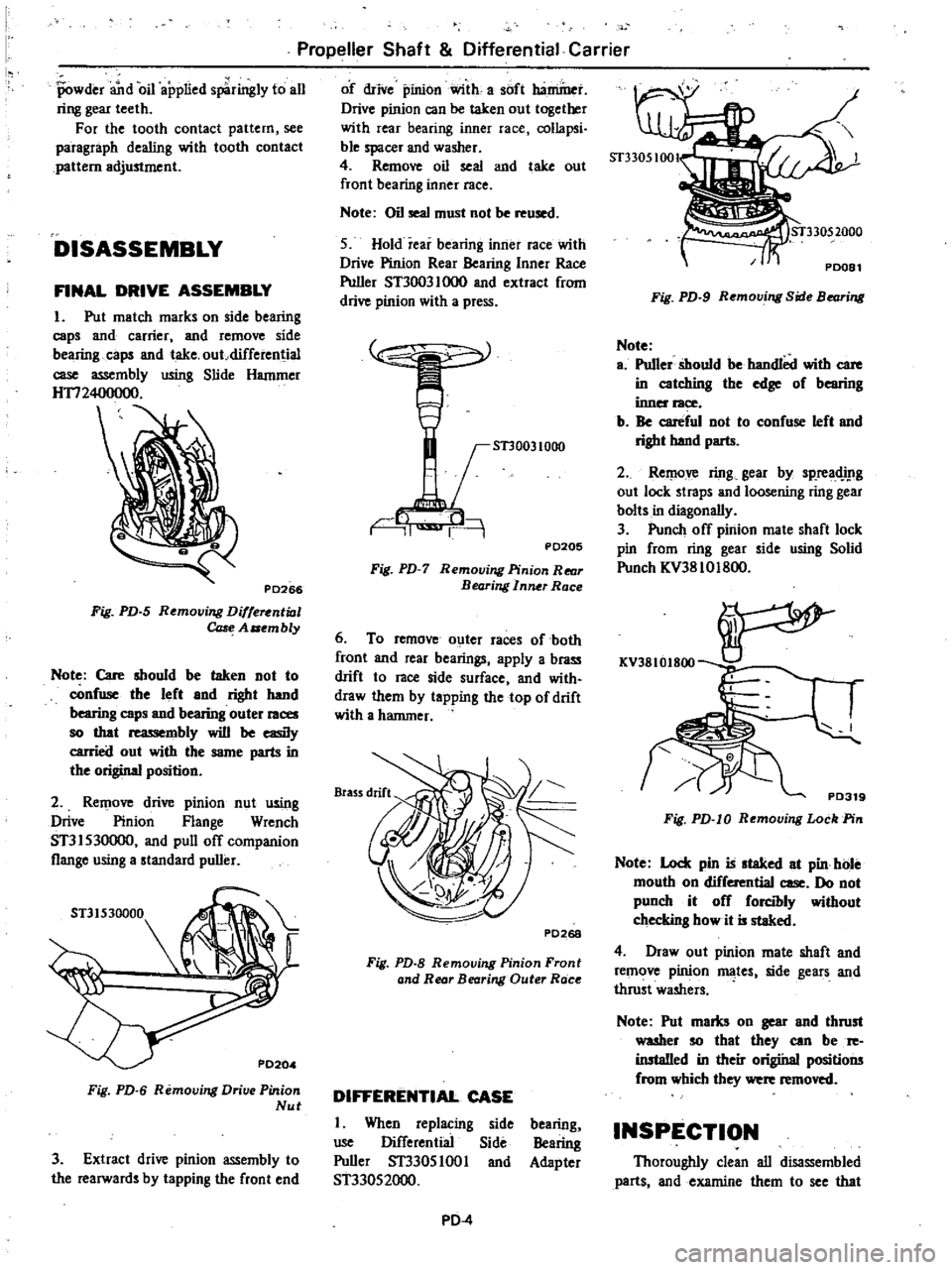
DISASSEMBLY
FINAL
DRIVE
ASSEMBLY
I
Put
match
marks
on
side
bearing
caps
and
carrier
and
remove
side
bearing
caps
and
take
out
differential
case
assembly
using
Slide
Hammer
HTI2400000
PD266
Fig
PD
5
Removing
Diffe
ntial
Ca
e
A
embly
Note
Care
should
be
taken
not
to
confWle
the
left
end
right
hand
bearing
caps
and
bearing
outer
races
so
that
reassembly
will
be
easily
carried
out
with
the
same
parts
in
the
original
position
2
Rel
love
drive
pinion
nut
using
Drive
Pinion
Flange
Wrench
ST31530000
and
pull
off
companion
flange
using
a
standard
puller
Fig
PD
6
Removing
Drive
Pinion
Nut
3
Extract
drive
pinion
assembly
to
the
rearwards
by
tapping
the
front
end
Propeller
Shaft
Differential
Carrier
of
drive
pinion
with
a
soft
baminet
Drive
pinion
can
be
taken
out
together
with
rear
bearing
inner
race
collapsi
ble
spacer
and
washer
4
Remove
oil
seal
and
take
out
front
bearing
inner
race
Note
Oil
seal
must
not
be
reused
5
Hold
rear
bearing
inner
race
with
Drive
Pinion
Rear
Bearing
Inner
Race
Puller
ST30031000
and
extract
from
drive
pinion
with
a
press
STJ0031000
r
1
i
9
PD205
Fig
PD
7
Removing
Pinion
Rear
Bearing
I
nfUr
Race
6
To
remove
outer
races
of
both
front
and
rear
bearings
apply
a
brass
drift
to
race
side
surface
and
with
draw
them
by
tapping
the
top
of
drift
with
a
hammer
PD268
Fig
PD
B
Removing
Pinion
Front
and
Rear
Bearing
Outer
Race
DIFFERENTIAL
CASE
I
When
replacing
side
Wle
Differenliai
Side
Puller
ST3305
1001
and
ST33052000
bearing
Bearing
Adapter
PD
4
Fig
PD
9
Removing
Side
Bearing
Note
a
Puller
should
be
bandlOd
with
care
in
catching
the
edge
of
bearing
inner
race
b
Be
careful
not
to
confuse
left
and
right
band
parts
2
Rel
love
ring
gear
by
sp
readJ
lg
out
lock
straps
and
loosening
ring
gear
bolts
in
diagonally
3
Punch
off
pinion
mate
shaft
lock
pin
from
ring
gear
side
using
Solid
Punch
KV3810Ig00
KV3810I800
PD319
Fig
PD
I0
Removing
Lock
Pin
Note
Lock
pin
is
slaked
et
pin
hole
mouth
on
differential
case
Do
not
punch
it
off
forcibly
without
checking
how
it
is
staked
4
Draw
out
pinion
mate
shaft
and
remove
pinion
ID3
tes
side
gears
and
thrust
washers
Note
Put
mams
on
gear
end
thrust
waaher
so
that
they
can
be
re
installed
in
their
origiital
positions
from
which
they
were
removed
INSPECTION
Thoroughly
clean
all
disassembled
parts
and
examine
them
to
see
that